Imagine a child or two or three in the back seat during a family trip:
Mom, did you pack my toothbrush?
Dad, are you sure you know the way?
Will we be able to find somewhere to eat at dinner time?
Will Grandma have room for us?
Weren’t we supposed to turn there?
What if the road is out?
Or a tornado comes?
Or a robber comes to our house while we’re away?
Is the GPS working right?
After a while, a weary parent would be tempted to respond, “Just trust me. I’ve traveled before. I know what to do. Even if we have problems along the way, we’ll take care of them. Just relax and enjoy the trip.”
Yet, earthly parents can fail. I did, in fact, forget one child’s underwear one trip, necessitating a stop at Wal-Mart when we arrived at our destination. Once, my husband took us to the airport the wrong day. Drivers can take wrong turns and get lost.
Sometimes we seem like anxious children with God, our perfect Parent. We wonder if He’s really guiding us the right way, if He can truly meet our needs. We wouldn’t put it quite this way, but we act as if we don’t trust that He knows what He’s doing.
God not only knows the way, He is the way.
“Jesus said to him, “I am the way, and the truth, and the life. No one comes to the Father except through me‘” (John 14:6).
Trust in the Lord with all your heart, and do not lean on your own understanding. In all your ways acknowledge him, and he will make straight your paths” (Proverbs 3:5-6).
He will take care of all our needs.
But seek first the kingdom of God and his righteousness, and all these things will be added to you (Matthew 6:33).
And my God will supply every need of yours according to his riches in glory in Christ Jesus (Philippians 4:19).
He promises to be with us and help us every step of the way, “From life’s first cry to final breath.”*
Fear not, for I am with you; be not dismayed, for I am your God; I will strengthen you, I will help you, I will uphold you with my righteous right hand (Isaiah 41:10).
Even to your old age I am he, and to gray hairs I will carry you. I have made, and I will bear;I will carry and will save (Isaiah 46:4).
Whatever need we have, God is more than able to meet. We may not like some sections of the path of life. There will be bumps in the road, dark valleys, and occasional detours from the way we thought we should go. But He has good purposes in all He brings us through.
As we face a new year, He bids us cast every anxious care on Him, because He cares for us.
*From “In Christ Alone” by Stuart Townend and Keith Getty.
Boomerangs, according to G. K. Chesterton, are “things that return.” He names sleep and a new day as boomerang blessings–something we experience which comes back to us to experience again. No matter how many times we go to sleep and wake up again, we continue to enjoy those recurring cycles.
In Winter Fire: Christmas with G. K. Chesterton, Ryan Whitaker Smith comments that feasts in the Jewish calendar were like boomerangs, recurring reminders of God’s grace in delivering and providing for His people. He quotes Chesterton again:
It is the very essence of a festival that it breaks upon one brilliantly and abruptly, that at one moment the great day is not and the next moment the great day is . . . The thing is done at a particular time so that people may be conscious of a particular truth; as is the case with all ceremonial observances, such as the Silence of Armistice Day or the signal of a salute with the guns or the sudden noise of bells for the New Year. They are all meant to fix the mind upon the fact of the feast or memorial, and suggest that a passing moment has a meaning when it would otherwise be meaningless (pp. 68-69).
Whitaker goes on to say, “As the Israelites’ festivals were a perpetual retelling of the same story, so are our Christian traditions a form of continually re-grounding ourselves in the narrative of redemption. The consistent ‘return of old things in new times,’ Chesterton tells us, . . . . the regularity of our holiday rituals is a way of maintaining godly sanity in an unstable and unpredictable world” (p. 56).
Our modern church and personal calendars may not follow the feasts given Israel in the Old Testament. But regular observances with their symbols and rituals remind us of great truths.
Christmas reminds us:
We need a Savior. “She will bear a son, and you shall call his name Jesus, for he will save his people from their sins” Matthew 1:21).
God loves us enough to rescue us at great cost to Himself. “For God so loved the world, that he gave his only Son, that whoever believes in him should not perish but have eternal life.” (John 3:16).
God’s timing is perfect. “But when the fullness of time had come, God sent forth his Son, born of woman, born under the law, to redeem those who were under the law, so that we might receive adoption as sons” (Galatians 4:4-5).
And so much more.
May the “boomerang blessing” of Christmas never be stale or empty, but rather a regular reminder that God loved us enough to send His Son to be our Savior, to die for our sins so we could become His.
What Would Happen if You Became a Christian? A Thought Experiment, HT to Challies. “Let me invite you into a thought experiment. What if you became a Christian? What would change? I’m talking about an actual disciple of Jesus, not a Christian in name only. What would be different if you became a Christian?”
He No Longer Sleeps. “Do you remember that Jesus is in your boat? He’s with you. He sees you. And He’s not asleep or unaware or busy with someone else.” (This post has Mendelssohn’s “He, Watching Over Israel” from Elijah in my thoughts this week.)
When Offenses Come: How to Forgive and Move On, HT to Challies. “The air of our Father’s home is grace — grace from basement to attic and floor to ceiling, grace in every room. He crowns us with grace, clothes us with grace, sings over us with grace (Romans 5:2). Far be it from us, then, as the children of this God, to replace his grace with malice, gossip, passive-aggressive paybacks, or bitter distancing from a brother or sister whom God has forgiven.”
Do Children Need to Consent to Puberty? HT to Challies. I am continually amazed at the world’s warped thought processes. This article explains why the answer to the title question is “No.”
On Winning the War: The World. This is the second in a series of fighting against a Christian’s enemies: the world, the flesh, and the devil.
The Messages We Receive, HT to Challies. “Messages about who we are—our identity—are powerful. They can shape how we see ourselves, how we see the world, and how we see God. It is a matter that regularly comes up in counseling conversations. When people have hard experiences in their lives or have been mistreated by others, it always proves valuable to explore what messages those experiences have communicated about who they are.” I especially like her examples of reframing messages with God’s truth about us.
What Is My Spiritual Gift? Maybe You’re Asking the Wrong Question, HT to Challies. “In view of the ink spilt and bytes downloaded on the matter of discovering one’s spiritual gift, you might be surprised to learn that such introspection is completely absent in all these passages. Either Paul and Peter failed to answer such a vital question . . . or we are asking the wrong question. I think the latter is the case.”
The Plimsoll Line, HT to Challies. “’The Plimsoll line is a reference mark located on a ship’s hull that indicates the maximum depth to which the vessel may be safely immersed when loaded with cargo.’ . . . . Years ago I decided to include the Plimsoll line in my marriage.” In this case, the Plimsoll line has to do with one being an extrovert and one being an introvert.
“Better to be disappointed a thousand times—yes, and be deceived—than once miss a chance to help a soul. The love of God suffices for any disappointment, for any defeat. And in that love is the energy of faith and the very sap of hope.” Amy Carmichael
Many of you know that writer Elisabeth Elliot has been my “mentor from afar” for over forty years.
One of my favorites quotes comes from her book Love Has a Price Tag:
My second husband once said that a wife, if she is very generous, may allow that her husband lives up to eighty percent of her expectations. There is always the other twenty percent that she would like to change, and she may chip away at it for the whole of their married life without reducing it very much. She may, on the other hand, simply decide to enjoy the eighty percent, and both of them will be happy
That’s so true, isn’t it? We tend to fixate on the small things that bug us rather than the great majority of things we love.
I was thinking recently that this principle applies to more than marriage.
Take friendship, for instance. My best friend in high school had a lot of good qualities, but she was slow-moving, especially when we were to go somewhere together. Any attempts to hurry her led to even more slowness. Constant harping on this one issue would only have driven a wedge between us.
Or neighbors. A good neighbor is a treasure. A bad neighbor is a pain. We don’t want to offend the person who is going to live right next door to us for years, maybe decades. So we pick our battles. We can live with some irritants to keep peace.
We might love our work, but it’s not all sunshine. Even with the best job, there are always a couple of unpleasant aspects.
And what about churches? None is perfect. You’ve probably heard the old cliche: “If you find a perfect church, don’t join it, because then it won’t be perfect any more.” No one church will be and do everything we might like.
When I hear of people leaving church because of some disappointment, I often think of the Corinthians, the epitome of dysfunctional churches. If we had visited such a church in our searches, we would not have gone to this one twice.
Yet every time I read 1 and 2 Corinthians, I am amazed at how patient the apostle Paul is in dealing with them. They had much more than 20 percent that needed to be dealt with, but he never gave up on them.
Enjoying the 80 percent of any relationship doesn’t mean we can never address the aspects we don’t enjoy. But sometimes, as the KJV puts it, we need to forbear with one another. Other translations say bear with, make allowance for, tolerate, or even put up with each other.
And the Bible goes beyond just bearing with each other. Ephesians 4:1-3 says: “I therefore, a prisoner for the Lord, urge you to walk in a manner worthy of the calling to which you have been called, with all humility and gentleness, with patience, bearing with one another in love, eager to maintain the unity of the Spirit in the bond of peace.”
Humility, gentleness, patience, love, unity, and peace: these are all more important than whatever irritates us about each other.
A couple of other thoughts that help me with this: there’s probably more than 20 percent about me that others have to “put up with,” yet they graciously do. My husband and friends don’t constantly find fault and criticize or insist I do things their way. I can extend that grace to them.
Also, even though God is in the business of correcting and sanctifying us, He does it with patience and grace. He doesn’t pile up everything we need to deal with all at once. We’d be crushed under the load.
One caveat to this 80 percent principle: it depends on what’s in the 20 percent. If a wife likes everything about her husband except the fact that he beats her, that behavior is not something that should be overlooked or ignored. If one friend learned that the other was embezzling his company, or cheating on his wife, he would be wise to step in. If we love the music, fellowship, people, and preaching of a church, yet the leadership denies that Jesus is God, or tells us we get to heaven by doing good works, then we need to find another church.
But in most cases, the 20 percent we don’t like is comprised of smaller issues. Can we not overlook them, for God’s glory and for the love and fellowship of His people?
I hope you’ll find something of interest in this collection of good reads.
Love the Church Like Jesus, HT to Challies. “Imagine you see a bride early on the morning of her wedding day — and she is a mess.” But she’ll look very different at the wedding, and it would be wrong and foolish to tell others how awful she looked that morning. The author provides an interesting comparison to the imperfections of the church and what it will be someday, and how we look at it as Jesus does.
Why Am I So Spiritually Dry? HT to Challies. “As I crunched my way through my neighborhood and watched the clouds for rain, I realized that dry seasons can be for our good. Sometimes spiritual dry spells come with a diagnosis and sometimes they don’t, but the only way through them is through them.”
Responding When Those We Respect Disappoint Us, HT to Challies. “While we understand intellectually that every person we meet is fallen and desperately needs God’s grace, that knowledge gets tested when someone we deeply respect disappoints us.”
The Spiritual Gift Inventory I Believe In. “In many churches, it is standard practice to have Christians take some kind of a spiritual gift inventory. Through a series of questions that probe an individual’s interests, passions, and successes, these tests claim to help people discover the ways the Holy Spirit has gifted them to better love and serve his people. Much has been written about such inventories and many people have expressed a degree of skepticism about their usefulness or accuracy.”
Marriage Happy, Marriage Holy. I really don’t like the saying that marriage is to make us holy, not happy. Scripture depicts marriage as happy. Yet when two sinners live together, they are bound to have differences and irritations. Tim Challies shares some of the surprising ways marriage can help sanctify us.
He makes us wait. He keeps us on purpose in the dark. He makes us walk when we want to run, sit still when we want to walk, for He has things to do in our souls that we are not interested in. –Elisabeth Elliot, Secure in the Everlasting Arms
Many of us cringe at the popular saying that “God doesn’t give us more than we can handle.” I wonder if people who say that have not experienced many trials in life. God often puts people in situations that bring them to the end of their own strength in order that they might rely on His.
But there are clues in the Bible that God knows how much we can take and adjusts our experiences accordingly.
For instance, there is an often overlooked passage right after the ten plagues in Egypt and the institution of the Passover.
When Pharaoh let the people go, God did not lead them by way of the land of the Philistines, although that was near. For God said, “Lest the people change their minds when they see war and return to Egypt.”But God led the people around by the way of the wilderness toward the Red Sea (Exodus 13:17-18).
Did you catch that? God didn’t lead the people out of the promised land by the shortest route because they might “change their minds if they see war.” From what I have read, this means that the Philistines would have seen the coming Israelites as an invasion, and Israel, just coming out of 400 years of slavery, would have been frightened out of their wits and tempted to turn back.
But when God takes them through a longer route, they end up caught between the Red Sea and the Egyptians, who had decided to come after then.
Didn’t God know they would still be scared out of their wits? (I’m not judging them: I would have been, too!) Of course He did. But the fact that He led them this way on purpose seems to me to indicate this is a situation they could have have trusted Him for. They had just seen Him challenge and defeat all the Egyptian deities by the plagues He sent. He miraculously delivered them from captivity. He led them with a pillar of fire by night and a pillar of cloud to this very place.
Another example even before the exodus was when God called Moses to be Israel’s leader and bring His people out of Egypt. Moses gave every excuse in the book as to why he couldn’t (and I am sure I would have done the same). But God had all the details worked out and would equip Moses for what He called Him to.
One more: when God called Gideon to deliver Israel from the Midianites, Gideon obeyed, but with some trepidation. In Judges 7, right before a major battle, God whittled his army down to 300 men to face “the Midianites and the Amalekites and all the people of the East . . . like locusts in abundance, and their camels were without number, as the sand that is on the seashore in abundance.” God told Gideon He had given the Midianite camp into Gideon’s hands. But, God said, “If you are afraid to go down, go down to the camp with Purah your servant. And you shall hear what they say, and afterward your hands shall be strengthened to go down against the camp.“
So they went down to the enemy camp and overheard one of the soldiers telling about a dream in which a barley cake rolled into the camp and hit a tent so hard that the tent fell, turned upside down, and then lay flat. “His comrade answered, ‘This is no other than the sword of Gideon the son of Joash, a man of Israel; God has given into his hand Midian and all the camp.’”
Gideon responded by worshiping God and then arousing the Israelite camp with confidence. The confidence wasn’t in himself. The main reason God had reduced the army to 300 was so that Israel couldn’t boast in saving themselves. It was still a task they couldn’t do on their own. But God “knows our frame; he remembers that we are dust“ (Psalm 10:14), and He stoops to our weakness, as one old hymn says.
For a New Testament example, 1 Corinthians 10 tells of several in the Old Testament who failed in some way. Then Paul writes, “Therefore let anyone who thinks that he stands take heed lest he fall.No temptation has overtaken you that is not common to man. God is faithful, and he will not let you be tempted beyond your ability, but with the temptation he will also provide the way of escape, that you may be able to endure it.” There’s the warning: take heed. Don’t trust in yourself. But there’s also reassurance: God is faithful and will provide a way of escape.
In John 15, Jesus tells us to abide in Him, for without Him we can do nothing. And Philippians 4:13 says we “can do all thingsthrough him who strengthens me.”
God does bring us to more than we can handle in ourselves. Paul says in 1 Corinthians he had been at a point where he was “so utterly burdened beyond our strength that we despaired of life itself”. But, he said, “that was to make us rely not on ourselves but on God who raises the dead” (verses 8-9).
When God brings us to a situation that seems too much to handle, we can ask Him for deliverance. I’ve always been heartened by the fact that Jesus prayed in Gethsemane, “Father, if you are willing, remove this cup from me. Nevertheless, not my will, but yours, be done” (Luke 22:42).
But if God doesn’t remove the situation, we can trust Him for the grace to go through it. He knows our limits and weaknesses. He wants to grow our faith, character, and reliance on Him, and that will take us out of our comfort zone many times. Warren Wiersbe says, “When God puts us in the furnace, His hand is on the thermostat and His eye is on the clock.” He won’t keep us there longer than necessary. He promises His strength for our weakness, His presence, and His care for every step of the way.
Christianity Is not Colonial: An Autobiographical Account, HT to Challies. “According to this ‘Christianity is colonial’ narrative, Christianity is the ‘white,’ ‘western’ religion which permitted all the above. Therefore, the Christian God is himself a racist colonialist who deserves, not to be worshiped, but to be denounced. This association of Christianity with colonialism is so out of step with reality as to be literally ridiculous.”
COVID’s Gift: The Gem We Should Now See We Were Missing. “If I asked you to make a list of the ten two-word phrases most common in the New Testament, the phrase ‘in Christ’ wouldn’t make it on most of our lists. Yet that phrase and its variants occur more times in the New Testament than the phrases ‘the cross,’ ‘eternal life,’ or even ‘Jesus Christ.'” The author posits that understanding our unity in Christ would reignite our love and understanding of the church. The best part of the article is under the heading “How are believers unified with Jesus?”
I’m Fine! “How are you today? No, I mean really, how are you today? I know you know the socially, western culturally correct response is that you are fine, however, that’s not what we’re about here, in this space.”
Purposes of Predictive Prophecy. “Certainly prophecy is intended to have a present impact on the believer’s faith and practice. No one should dispute that. But some posit that viewing eschatological prophecy as a detailed prediction of specific events short-circuits the ethical intention of such prophecy. I am positing that God tells us about the future because He actually wants us to know what is going to happen and expects us to believe that it is going to happen just as He says.”
Sanctification and Sexual Purity: God’s Will for Your Life, HT to Challies. “There is a direct link between our holiness and our sexual purity. There’s a direct link between your body which is united to Christ and what you do with your body. And that my friends is not popular.”
Finally, I don’t know David and Ciara Dierking, but evidently many of my friends do, because I started seeing requests for prayer all over Facebook back in December when Ciara and her young son Colton became ill. Colton had COVID and strep, I believe, and two abscesses of infection in his neck. Once he had surgery to drain those, he was well on the road to recovery. Ciara had influenza B, group A strep, severe pneumonia, which sent her into toxic shock (sepsis). She nearly died. The medicine to treat the sepsis narrowed her blood vessels to the point that her extremities couldn’t get enough oxygen. She ended up having both arms and both legs amputated.
You can imagine how devastating that would be, especially for a young wife and mother. As I have prayed over and ached with this sweet family these last several months, there have been so many signs of God’s hand on them.
Ciara was rereading Nancy DeMoss Wolgemuth’s book, Choosing Gratitude, when all of this happened. As her family put excerpts from the book that Ciara had underlined on their Facebook page, somehow Nancy learned of it and asked if she could interview Ciara and David. That episode will air November 11 and 12 on the Revive Our Hearts app or website or podcast. But as part of that interview, ROH made this video. I encourage you to watch, be encouraged, and pray for this family. They’ve all overcome many challenges, but still have many more ahead. I’m going to leave this here in place of my usual Saturday morning graphic.
Almost every day, I pray for rulers and authorities according to 1 Timothy 2:1-2. Recently I had occasion to look up that passage, and was stunned to find I had forgotten a key point.
First of all, then, I urge that supplications, prayers, intercessions, and thanksgivings be made for all people,for kings and all who are in high positions, that we may lead a peaceful and quiet life, godly and dignified in every way.
The word I had overlooked?
Thanksgiving.
Thanksgiving?
How can we be thankful for rulers who don’t rule well (speaking generally across a lifetime of elected officials), who oppose God’s moral law, who stand for things we’re against?
Well, at the time Paul wrote this letter to Timothy, they were under the reign of Nero—not the most moral of leaders, and certainly not friendly to Christians.
Even the worst rulers keep some sort of order. Without them, we’d have total anarchy or mob rule, neither of which is good.
For rulers are not a terror to good conduct, but to bad. Would you have no fear of the one who is in authority? Then do what is good, and you will receive his approval,for he is God’s servant for your good. But if you do wrong, be afraid, for he does not bear the sword in vain. For he is the servant of God, an avenger who carries out God’s wrath on the wrongdoer.Therefore one must be in subjection, not only to avoid God’s wrath but also for the sake of conscience (Romans 13:3).
But besides that, the Bible says that rulers are appointed by God.
Let every person be subject to the governing authorities. For there is no authority except from God, and those that exist have been instituted by God (Romans 13:1).
For not from the east or from the west and not from the wilderness comes lifting up,but it is God who executes judgment, putting down one and lifting up another (Psalm 75:6-7).
He changes times and seasons; he removes kings and sets up kings; he gives wisdom to the wise and knowledge to those who have understanding (Daniel 2:21).
The Most High rules the kingdom of men and gives it to whom he will and sets over it the lowliest of men (Daniel 4:17b).
How can God set up ungodly rulers?
Habakkuk wondered that in the book that bears his name. He complained to God about the sin, violence, strife, and destruction all around him. “The law is paralyzed, and justice never goes forth.For the wicked surround the righteous; so justice goes forth perverted” (1:4).
How did God answer? He was sending the “dreaded and fearsome” Chaldeans, known for their violence, “whose own might is their god.“
If Habakkuk lived in our day, he might have said, “Wait—what?” He protests, and then God elaborates. Their conversation is too long to share here, but I encourage you to read it. God was judging Israel, but He would judge the Chaldeans, too. Habakkuk asks God to “in wrath remember mercy,” and though he trembles, he trusts and will rejoice in God.
God doesn’t always share His reasons for what He does. Sometimes He appoints wicked rulers as a judgment. Sometimes we’re more prayerful when a candidate we’re opposed to wins an election. When “our guy” is in office, we tend to trust him rather than God. Sometimes He has other purposes in mind. But rulers don’t have a free pass just because God appointed them. They are accountable to Him as well.
And even when wicked rulers are in power, God is still on the throne. Statements and evidences of this are all over Scripture, but one clear example is in the book of Esther. God’s name is not mentioned in Esther, but His fingerprints are everywhere. Despite a heathen king and a wicked enemy, God spared His people.
The United States will hold elections in a couple of weeks. Whether our preferred candidates win or not, we should:
Remember God is still on the throne.
Obey authorities unless they ask us to disobey God. “We must obey God rather than men” (Acts 5:29); “Remind them to be submissive to rulers and authorities, to be obedient, to be ready for every good work, to speak evil of no one, to avoid quarreling, to be gentle, and to show perfect courtesy toward all people” (Titus 3:1-2).
Pray for them. “First of all, then, I urge that supplications, prayers, intercessions, and thanksgivings be made for all people, for kings and all who are in high positions, that we may lead a peaceful and quiet life, godly and dignified in every way (1 Timothy 2:1-2).
Thank God for them (1 Timothy 2:1).
Respect them. Honor everyone. Love the brotherhood. Fear God. Honor the emperor (1 Peter 2:17).
Serve God. Be subject for the Lord’s sake to every human institution, whether it be to the emperor as supreme, or to governors as sent by him to punish those who do evil and to praise those who do good. For this is the will of God, that by doing good you should put to silence the ignorance of foolish people. Live as people who are free, not using your freedom as a cover-up for evil, but living as servants of God (1 Peter 2:13-16).
Human government is, in one sense, God’s gift to help maintain order in the world, so that the church may minister the Word and win the lost to Christ (1 Tim. 2: 1–8). We should pray daily for those in authority so that they might exercise that authority in the will of God. It is a serious thing for a Christian to oppose the law, and he must be sure he is in the will of God when he does it. He should also do it in a manner that glorifies Christ, so that innocent people (including unsaved government employees) might not be made to suffer (p. 64).
Speaking evil of others is a great sin, and the people of God must avoid it. We may not respect the people in office, but we must respect the office, for all authority is God-given. Those who revile government officials in the name of Christ ought to read and ponder Titus 3: 1–2: “Remind them to be subject to rulers, to authorities, to be obedient, to be ready for every good deed, to malign no one, to be peaceable, gentle, showing every consideration for all men” (NASB). When Daniel refused the king’s food, he did it in a gracious way that did not get his guard into trouble (Dan. 1). Even when the apostles refused to obey the Sanhedrin’s order that they stop preaching in the name of Jesus, they acted like gentlemen. They respected the authority, even though they disobeyed the order (p. 65, emphasis mine).
What can we pray for elected officials?
Wisdom. “Give your servant therefore an understanding mind to govern your people, that I may discern between good and evil, for who is able to govern this your great people?” (1 Kings 3:9).
Justice. “May he judge your people with righteousness, and your poor with justice! May he defend the cause of the poor of the people,give deliverance to the children of the needy,and crush the oppressor!” (Psalm 72:2, 4).
Peace; opportunity to live a godly life. “That we may lead a peaceful and quiet life, godly and dignified in every way” (1 Timothy 2:2)
Right counsel, that wrong counsel will be unheeded. “And it was told David, ‘Ahithophel is among the conspirators with Absalom.’ And David said, ‘O Lord, please turn the counsel of Ahithophel into foolishness” (2 Samuel 15:31).
Truth; salvation. Joseph, Daniel, Peter, Paul, and others had opportunities to share God’s truth with the leaders of their day.
No earthly ruler or authority will be perfect, yet God uses them for His own purposes. It matters that we use the voice God has given us through voting as wisely as possible. But then we trust Him for and through the results. And because we trust Him, we can thank Him.
Updated to add: I will not approve any comments pro or against any candidate. My point is that ALL Christians are under obligation to respect, obey, pray for, and thank God for whichever candidates are elected.
Perhaps you know someone who can’t seem to come to assurance that they are Christians.They’ve asked Him to save them several times, and feel content each time, but sooner or later, they question whether they really believed or repented, or did so the right way or “enough.”
Satan can trip people up over assurance because if we’re insecure about our salvation, we come to a standstill in our Christian growth. We don’t have the confidence to serve the Lord in any way. Instead of going forward in our Christian lives, we’re spinning our wheels over the same issues.
On the other hand, there is such a thing as false assurance. Jesus said there would be people who stand before Him some day, fully assured that they are all right spiritually. They’ll be shocked to hear Him say, “I never knew you; depart from me, you workers of lawlessness.”
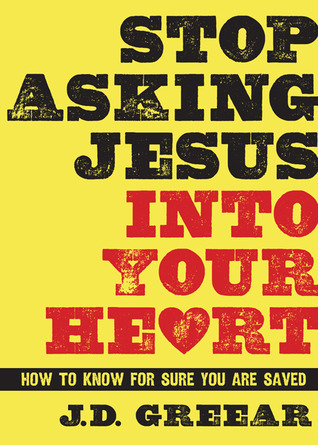
Then he explains that God truly wants us to have assurance. He shares what it means that Jesus died in our place and why we can trust Him, along with separate chapters on the nature of true faith and repentance. Another chapter discusses the seeming contradiction between Bible verses that say we will never lose our salvation with other verses that appear to indicate we can. The last two chapters cover evidences of salvation in 1 John and what to do with continued doubts. One appendix deals with whether one needs to be baptized again if they’ve made subsequent professions of faith after baptism. The second deals with the “indispensable link between assurance and the doctrine of justification by faith alone.”
At first glance, I thought this book was about reasons not to use the terminology of “asking Jesus into your heart” as a way of telling people how to be saved. Greear discusses this briefly, saying he thinks it can be used as long as the gospel has been fully understood.
Some of the quotes that stood out to me:
Salvation comes not because you prayed a prayer correctly, but because you have leaned the hopes of your soul on the finished work of Christ (Location 269, Kindle).
I can say with certainty that God wants you to have certainty about your salvation. He changes, encourages, and motivates us not by the uncertainty of fear, but by the security of love. That is one of the things that makes the gospel absolutely distinct from all other religious messages in the world (Location 295).
We don’t hope we are forgiven, we know it, because our standing before God has nothing to do with our worthiness, but the worthiness of the Advocate who now stands in our place (Location 551).
If you base your assurance on what you do or how well you do it, you’ll never find assurance. You’ll always be wondering if you are doing enough. If your assurance is based on what Christ has done, however, you can rest in His performance. Your salvation is as secure as His finished work (Location 654).
When we come to Jesus nothing can be off-limits. We cannot come with preconditions or limitations. To possess eternal life, we must be willing to let everything else go. We don’t approach Jesus to negotiate eternal life; we approach Him in total surrender. As C. S. Lewis famously said, “We don’t come to Him as bad people trying to become good people; we come as rebels to lay down our arms” (Location 887).
You don’t follow Jesus like you follow someone on Twitter, where you are free to take or leave their thoughts at your leisure. Following Jesus is not letting Him come into your life to be an influence, even if it’s a significant influence. Following Jesus means submitting to Him in all areas at all times regardless of whether you agree with what He says or not (Location 979).
If repentance were perfection, none of these people repented. Repentance, however, means recognizing Jesus’ authority and submitting to it, even though you know your heart is weak, divided, and pulled in conflicting directions. Repentance includes a plea for God to change your inconsistent, divided heart (Ps. 86: 11; Mark 9: 24) (Location 1019).
Greear writes pastorally, basing his answers firmly in Scripture but with everyday rather than academic language. I’ve not read him before, and I might disagree with a couple of his minor points. But overall I think this book was tremendously helpful both for those who have made a false profession and those who fear they might have.
Some believe that Jesus is a good example, but they don’t believe He is God in the flesh.
C. S. Lewis famously said that if Jesus is not God, He is not good. Since He claimed to the God, if He isn’t, then He is either delusional or deceptive.
We know by faith, by the Word of God, by His claims, by the testimony of others that Jesus is God.
So we know that Jesus is more than just a good example. Yet the Scriptures tell His children specifically to look to Him as an example in various aspects of life.
We don’t follow His example to try to be enough like Him to earn salvation. That would never work. We could never be “good enough.” Plus, He’s told us that salvation is by grace through faith, not ourselves (Ephesians 2:8-9).
So first, we look to Him for salvation (John 3:16-18). Then we look to Him as our perfect example for leading a godly life.
Love. “Therefore be imitators of God, as beloved children. And walk in love, as Christ loved us and gave himself up for us, a fragrant offering and sacrifice to God” (Ephesians 5:1-2).
Endurance. “Therefore, since we are surrounded by so great a cloud of witnesses, let us also lay aside every weight, and sin which clings so closely, and let us run with endurance the race that is set before us, looking to Jesus, the founder and perfecter of our faith, who for the joy that was set before him endured the cross, despising the shame, and is seated at the right hand of the throne of God. Consider him who endured from sinners such hostility against himself, so that you may not grow weary or fainthearted.” (Hebrews 12:1-3).
Service. “When he had washed their feet and put on his outer garments and resumed his place, he said to them, “Do you understand what I have done to you? You call me Teacher and Lord, and you are right, for so I am. If I then, your Lord and Teacher, have washed your feet, you also ought to wash one another’s feet. For I have given you an example, that you also should do just as I have done to you. Truly, truly, I say to you, a servant is not greater than his master, nor is a messenger greater than the one who sent him. If you know these things, blessed are you if you do them” (John 13:12-27).
Putting othersfirst. “We who are strong have an obligation to bear with the failings of the weak, and not to please ourselves. Let each of us please his neighbor for his good, to build him up. For Christ did not please himself, but as it is written, ‘The reproaches of those who reproached you fell on me'” (Romans 15:1-3).
Humility and sacrifice. “Have this mind among yourselves, which is yours in Christ Jesus, who, though he was in the form of God, did not count equality with God a thing to be grasped, but emptied himself, by taking the form of a servant, being born in the likeness of men. And being found in human form, he humbled himself by becoming obedient to the point of death, even death on a cross. Therefore God has highly exalted him and bestowed on him the name that is above every name,so that at the name of Jesus every knee should bow, in heaven and on earth and under the earth, and every tongue confess that Jesus Christ is Lord, to the glory of God the Father” (Philippians 2:5-11).
Suffering. “For this is a gracious thing, when, mindful of God, one endures sorrows while suffering unjustly. For what credit is it if, when you sin and are beaten for it, you endure? But if when you do good and suffer for it you endure, this is a gracious thing in the sight of God. For to this you have been called, because Christ also suffered for you, leaving you an example, so that you might follow in his steps. He committed no sin, neither was deceit found in his mouth. When he was reviled, he did not revile in return; when he suffered, he did not threaten, but continued entrusting himself to him who judges justly. He himself bore our sins in his body on the tree, that we might die to sin and live to righteousness. By his wounds you have been healed” (1 Peter 2:19-24).
“Since therefore Christ suffered in the flesh, arm yourselves with the same way of thinking, for whoever has suffered in the flesh has ceased from sin, so as to live for the rest of the time in the flesh no longer for human passions but for the will of God” (1 Peter 4:1-2).
Taking up our cross. “Then Jesus told his disciples, ‘If anyone would come after me, let him deny himself and take up his cross and follow me. For whoever would save his life will lose it, but whoever loses his life for my sake will find it'” (Matthew 16:24).
There are also many ways He was an example to us where the Bible doesn’t use that word. For instance, as He resisted Satan with the Word of God, He showed us how to do the same. (Matthew 4). 1 John 2:6 says, “Whoever says he abides in him ought to walk in the same way in which he walked.”
However, looking to Jesus as an example naturally leads to this thought: He is God. Of course He could do all these things perfectly. I am not and cannot.
Of course, we’ll never do any of these things perfectly. But looking to Jesus does more than inspire us and give us an ideal.
When I look at how Jesus suffered unjustly without “reviling” or “threatening,” my tendency to chafe under my minor trials melts away.
When I see how He didn’t stand on His “rights” as the Son of God, my grasp on my own rights loosens.
When I see the love He expressed to me and to others, His love fills me and overflows.
Colossians 2:3 tells us that in Christ “are hidden all the treasures of wisdom and knowledge.” Similarly, 1 Corinthians 1:30 says, “And because of him you are in Christ Jesus, who became to us wisdom from God, righteousness and sanctification and redemption.”
So we not only learn wisdom as we observe in the Bible what He did when He was on earth, but our very righteousness and sanctification are in Him.
Furthermore, 2 Corinthians 3:18 tells us “And we all, with unveiled face, beholding the glory of the Lord, are being transformed into the same image from one degree of glory to another. For this comes from the Lord who is the Spirit.”
As we behold Him, we don’t just see an inspirational example to follow. In some way, we’re actually transformed to be more like Him.
May this be our prayer:
Oh! to be like Thee, oh! to be like Thee, Blessed Redeemer, pure as Thou art; Come in Thy sweetness, come in Thy fullness; Stamp Thine own image deep on my heart.














 Stray Thoughts