Review: Dreams of Savannah

In Dreams of Savannah by Roseanna M. White, Cordelia Owens is a pampered Southern belle who loves to dream and write stories. She also loves Phineas Dunn, a lifelong friend newly recruited to the Confederate Navy, and promises to wait for him forever.

When she learns Phineas has been lost at sea, she weaves heroic tales for his mother and sister to help them keep up hope.

When Phineas was shot and fell overboard, he thought he was done for. But somehow he washes up on an island near Cuba. He’s rescued by a person he never imagined existed: an educated free black man from England. He has no way to let his family or his commanding officer know what has happened to him. All he can do is try to get well as fast as possible and get home. But his injuries are severe.

As the weeks drag by, a distant cousin of Cordelia’s comes to Savannah, assigned to the Confederate regiment there. Her parents are impressed by his manners, standing, and wealth. They like Phineas well enough, but his family’s credentials just don’t compare. They put pressure on Cordelia to turn her attention to her cousin. But even if she had not promised Phin she would wait forever, she would not have her cousin. There’s a predatory gleam in his eyes when her parents aren’t around.

When Phineas finally returns, he is still suffering from his injury. Worse, he has fallen in his own estimation. He wanted to be the hero of Cordelia’s stories. He doesn’t feel worthy of her, but he still vies for her hand. Her parents keep pushing her toward her cousin.

Both Cordelia and Phineas are from good families who are known to be kind to their slaves. Phineas’ father was, in fact, planning to free his slaves until doing so became illegal in Georgia.

But different experiences and people begin to change their perspectives. The question now is what to do. Is it enough just to be good to one’s slaves? Could they be mocked, scorned, or even arrested if their views on slavery changed? And how could their views change without changing their actions as well?

At the beginning of this book, Cordelia came across to me as young and somewhat silly (one of her fears for Phineas was that he might be attacked by a giant squid. . . ). I’m not sure how old she was, something hard to go back and find in an audiobook. Also, the Southern belle vibe came across a little too thick, replete with “fiddale-faddle” and “fiddel-dee-dee” (making me wonder for the first time why “fiddle’ was in so many expressions then).

But after I settled into the story, I began to enjoy it more. Cordelia is immature at the beginning. But the circumstances of the story cause her to grow. Even her story-telling matures over time.

It would be hard to write a book of changing viewpoints towards slavery and black people set in the 1861 South without attributing to the characters twenty-first century sensibilities. But Roseanna avoided that and had beliefs change and grow in the context of what was going on at the time.

A couple of my favorite quotes:

She certainly shouldn’t be refused happiness because of your convoluted ideas about your precious blood making her better than her mother . . . Because let me just tell you . . . your blood doesn’t have that power. There’s only one Man’s blood in all of history that can make us better than we are—and your are not Him.

She didn’t need to be a heroine in some fantastic tale of derring-do. That wasn’t what the Lord had given her. No, He’d given her words. Words to live by. Words to create with. Words that maybe, just maybe, could change the world beyond her house as surely as they had changed the one within.

I listened to the audiobook nicely narrated by Sarah Zimmerman.

So far, I have loved every book of Roseanna’s that I have read, including this one.

Circle of Spies

Circle of Spies is the third of Roseanna M. White’s Culper Spy Ring, a real life spy ring active during the Revolutionary War (Ring of Secrets was the first and Whispers from the Shadows was second). Although we don’t know that the ring continued, Roseanna said in the last book that someone in the CIA said it was possible. So Roseanna imagined how the spy ring could have worked during the War of 1812 in the second book, and now in the Civil War.

Marietta Hughes is an unlikely heroine at first. She has lived mostly for her own will and pleasure, not walking with the God of her parents. She married Lucien Hughes, wealthy president of a railroad company. But Lucien had been killed. Marietta had an understanding with his brother, Devereaux, that they would marry as soon as was proper after her period of mourning.

But then Marietta’s grandfather, Thaddeus Lane, informs her that the Hughes family is not staunchly Unionist, as they proclaim. Not only are they Confederate, but Devereaux is the head of a secret fifth column bent on killing Lincoln and seizing power.

As if that wasn’t enough to turn Marietta’s world upside down, Lane tells her that their family has been involved as a ring of spies since the Revolutionary War. Then he tells her that a Pinkerton man, Slade Osborne, is on his way to infiltrate the secret society to try to find proof that will lead to their arrests. Marietta’s job is to distract Devereaux as much as possible to facilitate Osborne’s investigation.

Thus begins a game of cat-and-mouse. Osborne is not altogether certain he can trust Marietta at first. Marietta is revolted at what she has learned about the Hughes family, but must keep pretending she is in love with Devereaux.

I ached with Marietta as she came to face what she had become and wondered if God could forgive her. Sometimes the realization of the magnitude of one’s sin breaks open to them more fully after they believe. Osborne, too, has a broken background, as well as complications from a twin brother whose values were the opposite of his.

By the end of this book, I wanted to put everything else aside to keep reading what happened. There were some quite exciting twists and turns!

I did disagree with one point, though, when a character says that God doesn’t speak for or against slavery. He does: I wrote once about the Bible and Slavery. But I did like what the character had to say about trying to reconcile the views of different Christians on the issue: “At last we realized we didn’t have to, because God so very rarely tells us what society should do—rather, He tells us how we, as believers, should behave in whatever society to which we belong” (p. 226).

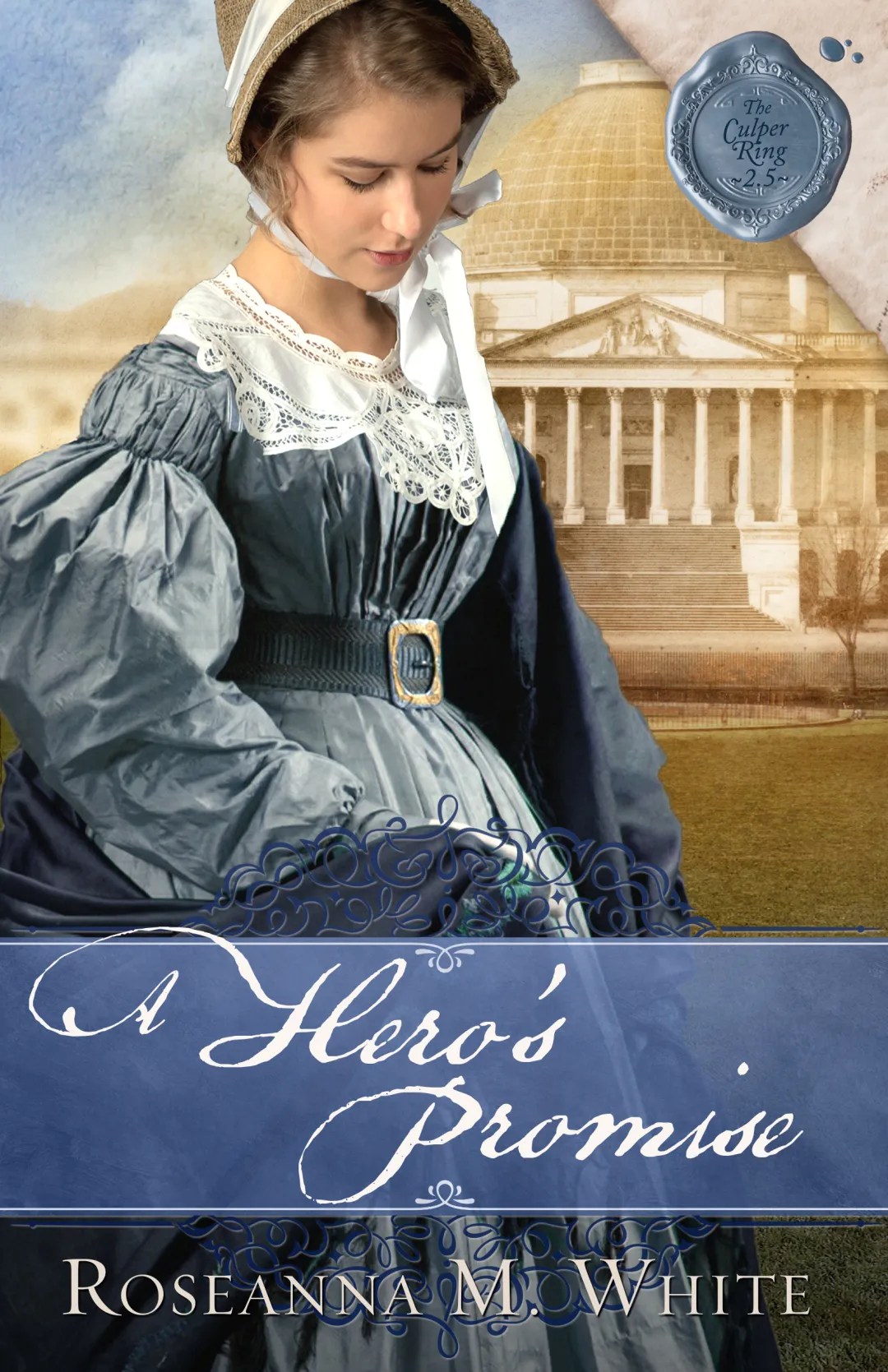
In-between this book and the previous one was a little novella titled A Hero’s Promise. Julienne Lane has been helping a friend, Freeda, hide runaway slaves and get them to safety. Julienne is unsure whether to let her fiance, Jack Arnaud, in on the situation.

Meanwhile, Jack has postponed their wedding twice already but might have to do so again. A mentally unbalanced man is being set up by enemies to assassinate President Jackson, and the Culpers must intervene.

The assassination attempt was based on a true event.

I enjoyed these forays in early American history and spycraft. But even more, I enjoyed the journeys of faith Roseanna takes her characters through.

Book Review: A Quilt for Christmas

Sandra Dallas’ novel, A Quilt for Christmas, takes place in Kansas in 1864. Eliza Spooner is trying to keep the farm together with her two children while her husband is away fighting for the Union. An expert quilter, Eliza decides to make a quilt for her husband’s Christmas present to keep him warm and remind him of her love.

When Eliza’s friend, Missouri Ann, learns that her own husband has died, Eliza invites Missouri Ann and her daughter to stay with her in order to rescue them from Missouri’s abusive in-laws.

Then the unthinkable happens. Eliza receives news that Will has also died. She hopes he was buried in her quilt. Her children and her quilting group help bear her through her grief.

Eliza’s beliefs are put to the test when she is asked to shelter an escaped slave. She has already given a husband to the war: isn’t that enough? And what about the danger to her children? Though Kansas is a Union state, slave catchers in pursuit of a reward could be dangerous to anyone in their way.

As the war ends, soldiers in various states of need show up at her door occasionally, asking for a meal or permission to sleep in the barn overnight. Then one day a soldier shows up with Will’s quilt with the surprising, and at first disconcerting, story of what happened to it after Will died.

I picked this up on my friend Susanne’s recommendation and listened to the audiobook version, nicely read by Pilar Witherspoon.

I thought this was a very well-written book. The story shows the hardships women went through alone on a farm in that time. Not only did they have to deal with their husbands’ absence while fighting or his death, they had all the responsibility of the farm on their shoulders. Even though the North won the war, and the widows and wives received some compensation, many lived in poverty. Yet they were generous, helping others in need as much as they could.

I really liked Eliza’s character and could empathize with her struggles..

I appreciated the emphasis in the last few chapters on forgiveness. Eliza’s son is full of hatred against “Johnnies” because they killed his father. But Eliza tries to teach him that the war is over and they are one nation now.

I also appreciated the talk that, even though only men could fight, there was much women could do to help after all.

Though there is talk of God in the book, I wouldn’t call this Christian fiction. One reason is that Eliza credits her dead husband with watching over her. Another is that, in the talk of forgiveness, nothing is brought up about God’s forgiveness or expectation that we forgive others.

All in all, it was a very good book.