Book Review: The Moonstone

MoonstoneThe Moonstone by Wilkie Collins opens with a copy of a family paper from an unnamed source. The writer and his cousin, John Herncastle, were soldiers in the English battle for Seringapatam, India, in 1799.  The night before, stories were told by the men in the camp about various treasures to be found there, especially one called the moonstone, a large yellow diamond in the forehead of a statue of a moon god. The narrative tells of the history and legend of the stone, including three Brahmins who were supposed to keep it under constant watch and “certain disaster to the presumptuous mortal who laid hands on the sacred gem, and to all of his house and name who received it after him.” After the battle, the narrator and his cousin were charged with keeping the men from looting, but the narrator came across his cousin in a room with the diamond in his hand and two dead and one dying Indian at his feet. Though the narrator knew his cousin had stolen the diamond and killed the men, he could not prove it since he had not actually seen it done, so he didn’t bring it to the authorities. He did, however, turn his back on his cousin and has written this narrative to explain to the family why he has done so. The family in turn turned their back on John. The narrator concludes, “Although I attach no sort of credit to the fantastic Indian legend of the gem, I must acknowledge, before I conclude, that I am influenced by a certain superstition of my own in this matter. It is my conviction, or my delusion, no matter which, that crime brings its own fatality with it. I am not only persuaded of Herncastle’s guilt; I am even fanciful enough to believe that he will live to regret it, if he keeps the Diamond; and that others will live to regret taking it from him, if he gives the Diamond away.  ”

Fast forward 50 years or so, and John Herncastle tries to visit his sister and her daughter. His sister refuses to see him. He retreats, but leaves the diamond to his sister’s daughter, Rachel, in his will. Rachel’s birthday is coming up, and her cousin Franklin Blake has been assigned to bring the diamond to her for the occasion. Knowing the diamond’s history, he is unsure whether giving it to Rachel is the best thing to do, but after consulting with longtime friend and family butler, Gabriel Betteredge, they conclude that giving it to her is the only thing that can be done.

So Franklin gives her the diamond and fastens a little setting so she can wear it on her blouse. And who should crash the party but three traveling Indian jugglers, who can’t escape seeing the diamond.

The next morning, it’s discovered that the diamond is missing, stolen out of Rachel’s room. The Indians are the first suspected, but they have an alibi. Rachel is strangely uncommunicative about the incident.

The story continues from there with various people being suspected and cleared, various family secrets coming forth, and finally the mystery revealed.

The Moonstone is considered by many to be the first detective novel written (Poe wrote mysteries, but they were short stories) and contains many elements that soon became standards of the genre: bumbling local police, a famous detective with eccentricities, false leads, , the “least likely” suspect being the perpetrator, a plot twist, and the detective summing everything up and filling in the missing pieces at the end. The detective is oddly missing in the middle of the novel, but Franklin Blake pursues the mystery, and even Gabriel Betteredge confesses to getting “detective fever.”

The story is written as a series of accounts requested by Blake from various people of what they saw and experienced, so in a sense the reader gets to consider the evidence and play detective along the way.

I thought the story dragged a bit in the middle, when the accounts there seemed to have little to do with the diamond theft: later, however, the reason for those seemingly unrelated details comes to the forefront. Like Dickens, with whom Collins was friends and for whose magazine he wrote, there are no extraneous details or characters: everything fits into the plot, though it doesn’t always make sense until the end. The latter third of the book really picked up the action and I found it hard to put down at that point. The story was originally published monthly in Dickens’ magazine, and at the end of many chapters I thought Collins showed great skill in ending the chapter on a note that would makes readers breathless until the next installment. I was glad I didn’t have to wait a month between chapters! I also thought Collins shone in having characters reveal details about themselves unawares and seemingly contradicting what they meant to reveal about themselves..

The Moonstone and The Woman in White are considered the best of Collins’ novels. I had read the latter a couple of years ago and consequently wanted to read more of Collins, but shied away from this one because I wasn’t sure how much superstition about the stone would play a part in it. But that turned out to be a very minor part of the story, mainly contained in the first section about its history. As the first narrator said, ” crime brings its own fatality,” and the book mainly deals with the crimes along the way of the moonstone’s history.

Though I normally enjoy reading analysis in Sparknotes, I thought they were a little off in a couple of places concerning this book. Here they say the story is “a novel in which women don’t speak often and therefore do not have a distinctive presence.” But the women spoke quite often – one of the major narrators is a woman. And they assert that the moonstone is symbolic of Rachel’s femininity and virginity and the theft of it from her room symbolic of her “deflowering.” But I saw no reason to associate it as such, especially as she is not “deflowered” in the incident.

I enjoyed listening to the audiobook narrated by several and the perusing parts of the text at Project Gutenberg.

(Sharing at Semicolon‘s Saturday Review of Books)

What’s On Your Nightstand: March 2016

What's On Your NightstandThe folks at 5 Minutes For Books host What’s On Your Nightstand? the last Tuesday of each month in which we can share about the books we have been reading and/or plan to read.

It’s been another busy month, but I’m thankful for the mini-breaks that reading provides.

Since last time I have completed:

Our Mutual Friend by Charles Dickens, audiobook, reviewed here.

Sweet Grace: How I Lost 250 Pounds And Stopped Trying To Earn God’s Favor by Teresa Shields Parker, recommended by Melanie, reviewed here.

Not In the Heart by Chris Fabry, reviewed here. Excellent!

Narrative of the Life of Frederick Douglass, reviewed here.

The Sword in the Stone by T. H. White, audiobook, reviewed here.

A Connecticut Yankee in King Arthur’s Court by Mark Twain, audiobook, reviewed here.

Around the World in 80 Days by Jules Verne, audiobook, reviewed here.

The Old Man and the Sea by Ernest Hemingway, audiobook, reviewed here.

What Are You Afraid Of: Facing Down Your Fears With Faith by David Jeremiah was finished and mentioned at the last Nightstand, but I had not reviewed it yet. That review is here. I think this will be a favorite of the year.

Every Waking Moment by Chris Fabry. Just finished it this weekend – review coming soon, hopefully.

Though that looks like a lot, a couple of them were mostly read in Feb. and just finished up this month, the last Nightstand was almost a week before Feb. ended  (giving us an extra week in this Nightstand’s reading), and five of these were fairly short audiobooks.

I’m currently reading:

True Woman 201: Interior Design by Mary Kassian and Nancy Leigh DeMoss.. Enjoying very much.

Beyond Stateliest Marble: The Passionate Femininity of Anne Bradstreet by Douglas Wilson

The Moonstone by Wilkie Collins, audiobook.

Pioneer Girl: The Annotated Autobiography by Laura Ingalls Wilder and Pamela Smith Hill. I probably should not include this because I don’t know if I have actually looked at it this month. :-/ As I’ve said before, it’s a big book that doesn’t really fit in the places where I keep books I am reading, so I keep forgetting to pick it up. I started it in Feb. and need to make a determined effort to finish it.

Up Next:

Pride, Prejudice, and Cheese Grits by Mary Jane Hathaway

The Renewing of the Mind Project by Barb Raveling, recommended by Kim.

After these, I still have some Christmas presents and my reading lists for the year to choose from.

What are you reading now?

Book Review: The Old Man and the Sea

Old Man and the SeaThe Old Man and the Sea is a short novel by Ernest Hemingway published in 1951. The last of his major works published during his lifetime, it earned him a Pulitzer Prize and contributed to his winning the Nobel Prize in Literature.

The old man is named Santiago but is usually just called the old man. He’s an aging fisherman in Cuba who, at the story’s beginning, has gone 84 days without catching a fish. A boy, Manolin (usually just called the boy), had been assisting him, but after forty days without a catch, his parents make him quit to work with another boat and tell him the old man is the worst form of unlucky. But the boy still cares for him and helps him out as he can.

As the old man wraps up his tasks for the day and prepares for the next, we see a little of his home and lifestyle. He lives alone with very little interaction with others except the boy. His wife has died and he has taken her picture down because it makes him too lonely. He lives in pretty abject poverty (offering the boy some of his dinner of fish and rice which the boy knows is nonexistent, tattered and patched sails, sleeping on newspapers). His one great interest besides fishing is American baseball with Joe DiMaggio being his favorite (partly because DiMaggio’s father was a fisherman). The old man and the boy discuss baseball while they eat a dinner donated by the local cafe owner. Santiago muses that he must do something nice for the cafe owner when he can.

The old man determines the next morning to go out further into the sea than fishermen usually do. He notices a bird circling the water and decides to follow it. He caches a tuna that he saves to use as bait. He’s precise in his actions and obviously skilled by many years at sea, knowledgeable about the characteristics and habits of many sea creatures.

Finally his deepest line tugs. The old man can tell it is a big fish and is confident that it is probably a marlin. He manages the line to keep it from breaking yet tries to hold it firmly enough that the fish is actually hooked. It’s too big to haul in, however, and he realizes that the fish is pulling him out to sea. At one point he sees enough of it to tell it is two feet longer than his skiff. He pulls the line over his shoulders to distribute the weight of it, but his hands still cramp and bleed from the line. He lets the fish pull his boat until it can get close enough for him to harpoon it. But he is pulled even further out to sea and can no longer see land.

Since this is such a short novel, telling more of the story would reveal the rest of the plot, so I’ll leave it there. But as you can imagine, the man has to deal not only with the fish but his own age, injuries, need for food and rest, and eventually sharks. The reader is given a window to his thoughts about life, baseball, nature, etc.

I chose this book for the Back to the Classics Challenge as a reread of a classic I had read in high school. I do remember the story from then, but I don’t think I had appreciated Hemingway’s sparse, clear writing at the time. I believe this is the only book of his that I have read, but rereading it has made me want to explore some of his other work.

I read some of the analysis of the story at Sparknotes and Shmoop, and both offer some interesting theories about symbolism in the book, but a quote I read from Hemingway (which didn’t name the source) said there is no symbolism in it (“There isn’t any symbolism. The sea is the sea. The old man is an old man. The boy is a boy and the fish is a fish.”) But I think the story does show the dignity, endurance, and triumph of the spirit  of the old man through the ordeal he faces.

Here are just a few quotes that stood out to me:

“Now is no time to think of what you do not have. Think of what you can do  with that there is.”

“I may not be as strong as I think, but I know many tricks and I have resolution.”

“You did not kill the fish only to keep alive and to sell for food, he thought. You killed him for pride and because you are a fisherman. You loved him when he was alive and you loved him after. If you love him, it is not a sin to kill him. Or is it more?”

“Only I have no luck any more. But who knows? Maybe today. Every day is a new day. It is better to be lucky. But I would rather be exact. Then when luck comes you are ready.”

“Fish,” the old man said. “Fish, you are going to have to die anyway. Do you have to kill me too?”

I listened to the audiobook read quite nicely by Donald Sutherland.

(Sharing at Semicolon‘s Saturday Review of Books)

Book Review: The Sword in the Stone

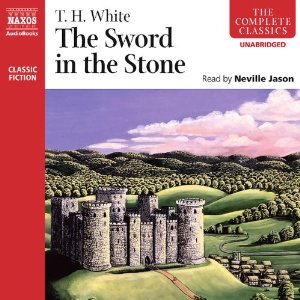
Sword in the StoneThe Sword in the Stone by T. H. White tells the story of the boyhood of King Arthur. He has no idea he is descended from royal blood. He’s growing up in the family of Sir Ector in his castle near the Sauvage Forest in England. Arthur is known then as “The Wart” and knows he is not a “proper son,” but we’re not told yet where he came from and how he got there. Sir Ector’s son, Kay, is about the Wart’s age, and they take lessons together in everything from History to jousting and hawking. Kay’s destiny is to become a knight: the best that The Wart can hope for is to become Kay’s squire.

When Sir Ector decides the boys need a tutor, the Wart happens upon Merlin. Merlin is a magician who is moving through time backwards, which often confuses him as to whether something is about to happen or has already happened. He is an able tutor, but he gives more time to the Wart, telling him it’s best to learn from experience and therefore turning him into various creatures, like a fish, a snake, an ant, a bird, and a badger, and sending him into each creatures environment to interact with others.

The Wart feels bad that Kay doesn’t get any adventures and wants Merlin to turn him into something, but Merlin insists he can’t use that magic for Kay. But he does send them off on a trail in the forest which leads them to Robin Hood’s camp and an expedition to save prisoners from the fairy queen, Morgan la Fey.

The word that seems to stand out to me to describe the Wart as a boy is decent. It’s not that he’s brave because bravery is a good trait in itself, but in doing the right thing he has to exercise bravery, such as when he and Kay take their father’s prize hawk into the woods to hunt rabbits, and Kay mishandles the hawk, resulting in its flying into a tree and not coming back to them. Kay goes home, but the Wart stays all night alone in the forest to keep an eye on the hawk so they don’t lose it. He’s also thoughtful, merciful, humble, and kind.

The musical Camelot is based on White’s version of Arthur’s story, and once I saw an interview with Richard Harris, who played Arthur in the film version, in which he said that he played him as someone who has greatness thrust upon him, but Richard Burton, who played Arthur on stage, played him as someone born to greatness. I can see both elements here. He is born to greatness, but he doesn’t know it yet. But events like the climatic removing the sword from the stone are done, not with the desire to overcome the challenge and prove himself king, but to help someone. He discovers only later that the sword would only come out for the person destined to be king (having missed the conversation in which everyone else talks about it) and at first feels quite uncomfortable with Sir Ector and Kay treating him like a king.

The Wart’s various experiences with animals were not just to teach him about nature. According to various sources, they also served to teach him about various governments. The pike, for instance, who was the king of that particular body of water in which the Wart was learning to be a fish, had absolute power but was deceptive and cruel. A colony of ants, on the other hand, acted like mindless automatons working for the greater good, which some suggest is meant to portray Communism (oddly, the ants aren’t included in the version I listened to, but I saw them mentioned in other sources). Perhaps what he learns about governing from each of them is brought out in the later books, but in this one, the various lessons he learns from them come back to him as he tries to pull the sword out of the stone. For instance, when he was trying to learn to swim as a fish with fins instead of arms and a tail instead of legs, Merlin kept telling him to “put his back into it.” That as well as bits from his other experiences came back to him in that moment.

The Sword in the Stone by T. H. White was originally published in 1938 but eventually it was combined with other books about the legend of King Arthur in The Once and Future King in 1958. It underwent quite a bit of revision by the time the 1958 version was published, incorporating some material that White had wanted to include in a fifth book in the series. According to Wikipedia, stand-alone publications of the novel tend to use the first version while publications of all four books into The Once and Future King used the revised. According to the PDF accompanying the audiobook I listened to, this version uses elements of both.

This book reads like a fairy tale or a boy’s adventure story, but it’s not technically aimed at children. There are comic moments along with the adventures and lessons as well. It was the basis for the Disney movie by the same name, but, as usually happens, much was changed in the cartoon version. I understand that the rest of the legend gets darker as it progresses in the other books. I haven’t decided yet whether to read them.

As far as potential objectionable elements go, there’s the whole issue of Merlin being a wizard, the Wart being turned into other creatures, and a fight with a witch. If you allow fairy tales, these shouldn’t be a problem: when my kids were young, I avoided stories with witches, but at some point when they were older decided that fairy tale witches were different from the real thing and operated more as the antagonist in stories. But if you have a problem with that or think your children shouldn’t be exposed to that yet, then you’d want to avoid this book. There is also a good deal about evolution and a good bit of violence, though it’s not gratuitous nor overly descriptive. The one brief part I didn’t like was the flippant portrayal of God in one legend.

But when it comes to the adventures themselves and Arthur’s growth into the man and king he eventually became, I enjoyed the story quite a lot.This book ends not long after Arthur’s coronation, and I assume the next one picks up some time after that.

(Sharing at Semicolon‘s Saturday Review of Books)

Book Review: Around the World in 80 Days

Around the WorldPhileas Fogg, the main character in Around the World in 80 Days by Jules Verne, is an English gentleman in the 1870s who runs his life by strict precision. He has the same habits and schedule every day and is extremely conscious of time. He’s so exacting that he fired his former valet for bringing his shaving water a few degrees off from the temperature he liked it. In one of the first chapters, he interviews Jean Passepartout, a Frenchman of about 30, who has lived in a variety of places with a variety of occupations and is looking to settle down working for a quiet English gentleman. Passepartout is hired, and Phileas leaves for the Reform Club, where he spends several hours a day, usually playing whist.

All the talk at the club concerns a seemingly polished robber of the Bank of England, who made away with 55,000 pounds. In speculating where he would likely go, someone remarks how small the world has gotten in that it could be traversed so much more easily, and someone like this robber with loads of money could easily get anywhere. Fogg answers that one could travel around the world in 80 days. The others challenge that theory, bringing up uncertainties in travel arrangements, delays, possible troubles encountered while traveling, etc. Fogg persists that even accounting for all those possibilities, the journey could still be accomplished in 80 days. The discussion eventually turns into a wager. They fix a date 80 days hence, and if Fogg can travel around the world, having his passport stamped in the various countries to prove he has been there, and be back at the Reform Club by 9 p.m. Dec. 21, they will pay him 20,000 pounds. If he is unsuccessful, he will pay them the same amount.

He sets off that very night, thus dismantling Passepartout’s plans for a tranquil life, at least for the next 80 days. They encounter a number of fortuitous legs of the trip that put them ahead of time, and several unfortuitous ones that put them behind. They pick up a couple of traveling companions along the way and engage various methods of travel (an elephant in India being the most exotic. Oddly, though the book is often associated with hot air balloons, the group never travels that way though they consider it once).

One of their first problems is that Fogg is mistaken for the recent gentleman bank robber: he matches the physical description and his sudden travel plans look suspicious to a Detective Fix. So Fix follows him, Javier-like, around the globe trying to get the arrest warrant to catch up to their location.

I won’t share any more of the adventure than that – I don’t want to give any of it away.

I’m thankful to the Back to the Classics challenge for expanding my horizons. This is not a book I would normally have been drawn to, but in looking for classics for the various categories for the challenge, I decided to try this one. I had never read Jules Verne before, and I was surprised by how much I enjoyed the book (I even enjoyed the chapter titles). I had originally chosen it for a classic that had been translated from its original language, but I might use it for the adventure classic instead. I listened to the audiobook narrated by Patrick Tull, who did a superb job with all the different accents and inflections. The text is available online at Project Gutenberg and there is a free Kindle edition.

(Sharing at Semicolon‘s Saturday Review of Books)

Book Review: A Connecticut Yankee in King Arthur’s Court

Connecticut YankeeA Connecticut Yankee in King Arthur’s Court by Mark Twain begins with a group of people touring a castle. The writer notices another man who is unusually knowledgeable about armor and seems from “some remote era and old forgotten country.” They begin talking and end up at the writer’s room, where the other man is persuaded to tell his story. He begins, but becoming sleepy, he shows the writer a manuscript he had compiled from his journals and invites him to read the rest there.

The manuscript tells of Hank Morgan, born of a blacksmith and raised in Hartford, Connecticut, who grew up to learn to make guns and “all sorts of labor-saving machinery” until he became head superintendent of an arms factory. In a fight with one of his men, he was hit on the head with a crowbar and passed out. When he woke up, he was in a meadow he didn’t remember and a man in armor on a horse was claiming him as a prisoner. At first he thought the man was from a circus, or perhaps an asylum, but deemed it safest to go with him for the moment.

He is taken to King Arthur’s court in Camelot where he is told the year is 513. A page tells him that his captor is Sir Kay, and that after dinner the knights will display their captures for the day, and afterward he, Hank, will be thrown in the dungeon until his friends could ransom him. Being newly arrived, of course Hank had no friends. In that case, he learned, he would be put to death along with the other prisoners.

Somehow he happened to remember that an eclipse was due the next day, so he told the king and his company that he was a magician, and if he was not released, he would blot out the sun. When the eclipse begins to happen, everyone is terrified, and Arthur begs him to restore the sun. Hank says he will if Arthur will “appoint me your perpetual minister and executive, and give me for my services one per cent of such actual increase of revenue over and above its present amount as I may succeed in creating for the state.” Arthur agrees and Hank becomes known by the title “The Boss.”

Hank reasons that, having been born 13 centuries later, he’s the most educated person in the kingdom. While he misses many conveniences (books, tobacco, candles, etc.) and it takes him a while to really settle into the fact of his circumstances, eventually he uses his position, the people’s superstitions, and “Yankee ingenuity” to create schools, factories, newspapers, and a whole host of other inventions and institutions. He wants to correct what he sees as social ills, but that must be done a little more carefully and stealthily. He doesn’t like the fact that someone of poor character who is a noble has advantages and rank and a person of good character but no nobility was basically a slave. He also doesn’t like knight errants and the control of the Catholic church and sets about to undercut their power..

The rest of the book tells of his experiences, discussions, adventures, inventions, battles, etc., until the ultimate end of it all.

I had gotten this book both because I am trying to familiarize myself with classic I’ve missed and also because I thought this would be humorous. It was, in some respects, but not as much as I would have thought. Maybe it was more so when it was published in 1889.

The ending was not at all what I was expecting: in fact, it was sad and discordant: one source said cynical. Perhaps Twain – and/or Hank – realized that technology wasn’t really the answer, or at least that it came with its own problems. I spent a lot of time looking at analyses in various places trying to determine whether this story was just meant as a humorous jab at idyllic medieval literature or whether it was trying to say something else, but the responses were mixed. The Wikipedia article says it is “a satire of romanticized ideas of chivalry, and of the idealization of the Middle Ages common in the novels of Sir Walter Scott and other 19th century literature. Twain had a particular dislike for Scott, blaming his kind of romanticism of battle for the southern states deciding to fight the American Civil War.”

Hank spends much of the book highly critical of the sixth century, particularly its customs and superstitions, yet at the end, he longs to be back in it (it’s no spoiler to say he does come back to his own time since the opening chapter has him talking to someone from his modern century). One source said this was inconsistent, but I think perhaps it shows he learned that the people he came to love were the most important part of his time there, not the inventions or improvements.

Some of my favorite humorous exchanges:

[A boy] arrived, looked me over with a smiling and impudent curiosity; said he had come for me, and informed me that he was a page.

“Go ‘long,” I said; “you ain’t more than a paragraph.”

“I was born modest. Not all over, but in spots.”

“His head was an hour-glass; it could stow an idea, but it had to do it a grain at a time, not the whole idea at once.”

“I allowed silence to accumulate while I got my impressiveness together.”

“We had a solemn stage-wait, now, for about twenty minutes—a thing I had counted on for effect; it is always good to let your audience have a chance to work up its expectancy.  At length, out of the silence a noble Latin chant—men’s voices—broke and swelled up and rolled away into the night, a majestic tide of melody.  I had put that up, too, and it was one of the best effects I ever invented. When it was finished I stood up on the platform and extended my hands abroad, for two minutes, with my face uplifted—that always produces a dead hush—”

But the parts I enjoyed most weren’t the humorous ones, maybe because the bravado is gone. They seemed the best written to me. My favorite section is when Hank and King Arthur go out disguised as commoners to see how the people really live. In one area they come upon a family dying of smallpox, and the humaneness of both of them is very touching.

Hank sounds quite arrogant in much of his narration, calling the people “ignorant” often (“The populace uncovered and fell back reverently to make a wide way for me, as if I had been some kind of a superior being—and I was”; “There was something very engaging about these great simple-hearted creatures, something attractive and lovable.  There did not seem to be brains enough in the entire nursery, so to speak, to bait a fish-hook with; but you didn’t seem to mind that, after a little, because you soon saw that brains were not needed in a society like that.”) But he owns up to the blunders he makes and learns from them, and, in the end, came to appreciate at least the people dearest to him. And though he thinks kings are “dangerous” and wants eventually to establish a republic, he saw value even in the king at times:

There was a slight noise from the direction of the dim corner where the ladder was.  It was the king descending.  I could see that he was bearing something in one arm, and assisting himself with the other.  He came forward into the light; upon his breast lay a slender girl of fifteen.  She was but half conscious; she was dying of smallpox.  Here was heroism at its last and loftiest possibility, its utmost summit; this was challenging death in the open field unarmed, with all the odds against the challenger, no reward set upon the contest, and no admiring world in silks and cloth of gold to gaze and applaud; and yet the king’s bearing was as serenely brave as it had always been in those cheaper contests where knight meets knight in equal fight and clothed in protecting steel.  He was great now; sublimely great.  The rude statues of his ancestors in his palace should have an addition—I would see to that; and it would not be a mailed king killing a giant or a dragon, like the rest, it would be a king in commoner’s garb bearing death in his arms that a peasant mother might look her last upon her child and be comforted.

Well, it was noble to see Launcelot and the boys swarm up onto that scaffold and heave sheriffs and such overboard.  And it was fine to see that astonished multitude go down on their knees and beg their lives of the king they had just been deriding and insulting. And as he stood apart there, receiving this homage in rags, I thought to myself, well, really there is something peculiarly grand about the gait and bearing of a king, after all.

(When Hank and the King were in disguise and taken as slaves): The king’s body was a sight to see—and to weep over; but his spirit?—why, it wasn’t even phased.  Even that dull clod of a slave-driver was able to see that there can be such a thing as a slave who will remain a man till he dies; whose bones you can break, but whose manhood you can’t.  This man found that from his first effort down to his latest, he couldn’t ever come within reach of the king, but the king was ready to plunge for him, and did it.  So he gave up at last, and left the king in possession of his style unimpaired. The fact is, the king was a good deal more than a king, he was a man; and when a man is a man, you can’t knock it out of him.

I’ve never been much of a Mark Twain fan, and this book didn’t really make me eager to pick up any of his others. And though this won’t go down as one of my favorite classics, there were parts among those I have quoted that I particularly enjoyed. I’m glad to have read it and to be familiar now with the story.

You can find this book online free at Project Gutenberg, and there is a free Kindle edition here. I went back and forth between the audiobook and Kindle versions.

(Sharing at Semicolon‘s Saturday Review of Books)

Book Review: Narrative of the Life of Frederick Douglass

F. DouglassFrederick Douglass was originally named Frederick Augustus Washington Bailey around 1817 or 1818–he was never sure of the exact date and year. He was born in Maryland to a black slave mother and an unknown white father, rumored to be his master but never confirmed. It was common practice in that time and place to remove slave children from their mothers at a young age, so his mother was sent away and he lived with his grandmother.

As he grew up, he witnessed the whole gamut of slavery, from kind masters to cruel ones, of savage beatings and even murders with no recourse or help for the slave against an unfair master. Any beatings were felt to be deserved because of something the slave had done or needed to keep him in his place. His master could pass him around to other relatives or even renters. When one master died, Frederick and all the other slaves owned by the master were reckoned up as property alongside the animals. One of his masters bought a slave woman specifically for breeding purposes. Under one of the worst masters, with inadequate clothing, food, and shelter, and being worked beyond endurance all hours of the day, he “was broken in body, soul, and spirit. My natural elasticity was crushed, my intellect languished, the disposition to read departed, the cheerful spark that lingered about my eye died; the dark night of slavery closed in upon me; and behold a man transformed into a brute!” During that time he spent Sundays, his only free time, “in a sort of beast-like stupor, between sleep and wake, under some large tree.”

At one time when he was a child, he was sent to a mistress who had never had slaves before, and she treated him more kindly that any white woman had ever treated him. He was to help take care of her son, and she started to teach him to read alongside her son. But her husband stopped her,

…telling her, among other things, that it was unlawful, as well as unsafe, to teach a slave to read. To use his own words, further, he said, “If you give a n—– an inch, he will take an ell. A n—– should know nothing but to obey his master—to do as he is told to do. Learning would spoil the best n—– in the world. Now,” said he, “if you teach that n—– (speaking of myself) how to read, there would be no keeping him. It would forever unfit him to be a slave. He would at once become unmanageable, and of no value to his master. As to himself, it could do him no good, but a great deal of harm. It would make him discontented and unhappy.” These words sank deep into my heart, stirred up sentiments within that lay slumbering, and called into existence an entirely new train of thought. It was a new and special revelation, explaining dark and mysterious things, with which my youthful understanding had struggled, but struggled in vain. I now understood what had been to me a most perplexing difficulty—to wit, the white man’s power to enslave the black man. It was a grand achievement, and I prized it highly. From that moment, I understood the pathway from slavery to freedom. It was just what I wanted, and I got it at a time when I the least expected it. Whilst I was saddened by the thought of losing the aid of my kind mistress, I was gladdened by the invaluable instruction which, by the merest accident, I had gained from my master. Though conscious of the difficulty of learning without a teacher, I set out with high hope, and a fixed purpose, at whatever cost of trouble, to learn how to read. The very decided manner with which he spoke, and strove to impress his wife with the evil consequences of giving me instruction, served to convince me that he was deeply sensible of the truths he was uttering. It gave me the best assurance that I might rely with the utmost confidence on the results which, he said, would flow from teaching me to read. What he most dreaded, that I most desired. What he most loved, that I most hated. That which to him was a great evil, to be carefully shunned, was to me a great good, to be diligently sought; and the argument which he so warmly urged, against my learning to read, only served to inspire me with a desire and determination to learn. In learning to read, I owe almost as much to the bitter opposition of my master, as to the kindly aid of my mistress. I acknowledge the benefit of both.

He used any means and methods he could to learn to read and write, including asking other white boys to help him:

The plan which I adopted, and the one by which I was most successful, was that of making friends of all the little white boys whom I met in the street. As many of these as I could, I converted into teachers. With their kindly aid, obtained at different times and in different places, I finally succeeded in learning to read. When I was sent of errands, I always took my book with me, and by going one part of my errand quickly, I found time to get a lesson before my return. I used also to carry bread with me, enough of which was always in the house, and to which I was always welcome; for I was much better off in this regard than many of the poor white children in our neighborhood. This bread I used to bestow upon the hungry little urchins, who, in return, would give me that more valuable bread of knowledge. I am strongly tempted to give the names of two or three of those little boys, as a testimonial of the gratitude and affection I bear them; but prudence forbids;—not that it would injure me, but it might embarrass them; for it is almost an unpardonable offence to teach slaves to read in this Christian country.

When he was older and working at a shipyard, he noted that the different boards were marked with the letter for the part of the ship they were meant for (“S” for starboard, etc.). He learned to make those letters, and “After that, when I met with any boy who I knew could write, I would tell him I could write as well as he. The next word would be, ‘I don’t believe you. Let me see you try it.’ I would then make the letters which I had been so fortunate as to learn, and ask him to beat that. In this way I got a good many lessons in writing, which it is quite possible I should never have gotten in any other way. During this time, my copy-book was the board fence, brick wall, and pavement; my pen and ink was a lump of chalk.”

His harshest words were for masters who professed to be Christians, because, sadly, they were often the worst, and because, if they were Christians, they should have known better than to treat people the way they did. In fact, he spoke so strongly against them that at the end of a book he felt he should put an appendix explaining

I have, in several instances, spoken in such a tone and manner, respecting religion, as may possibly lead those unacquainted with my religious views to suppose me an opponent of all religion. To remove the liability of such misapprehension, I deem it proper to append the following brief explanation. What I have said respecting and against religion, I mean strictly to apply to the slaveholding religion of this land, and with no possible reference to Christianity proper; for, between the Christianity of this land, and the Christianity of Christ, I recognize the widest possible difference—so wide, that to receive the one as good, pure, and holy, is of necessity to reject the other as bad, corrupt, and wicked. To be the friend of the one, is of necessity to be the enemy of the other. I love the pure, peaceable, and impartial Christianity of Christ: I therefore hate the corrupt, slaveholding, women-whipping, cradle-plundering, partial and hypocritical Christianity of this land.

Earlier in the book he says of his being sent to the mistress who began to teach him to read:

It is possible, and even quite probable, that but for the mere circumstance of being removed from that plantation to Baltimore, I should have to-day, instead of being here seated by my own table, in the enjoyment of freedom and the happiness of home, writing this Narrative, been confined in the galling chains of slavery. Going to live at Baltimore laid the foundation, and opened the gateway, to all my subsequent prosperity. I have ever regarded it as the first plain manifestation of that kind providence which has ever since attended me, and marked my life with so many favors. I regarded the selection of myself as being somewhat remarkable. There were a number of slave children that might have been sent from the plantation to Baltimore. There were those younger, those older, and those of the same age. I was chosen from among them all, and was the first, last, and only choice.

I may be deemed superstitious, and even egotistical, in regarding this event as a special interposition of divine Providence in my favor. But I should be false to the earliest sentiments of my soul, if I suppressed the opinion. I prefer to be true to myself, even at the hazard of incurring the ridicule of others, rather than to be false, and incur my own abhorrence. From my earliest recollection, I date the entertainment of a deep conviction that slavery would not always be able to hold me within its foul embrace; and in the darkest hours of my career in slavery, this living word of faith and spirit of hope departed not from me, but remained like ministering angels to cheer me through the gloom. This good spirit was from God, and to him I offer thanksgiving and praise.

This quote about singing especially touched me:

I have often been utterly astonished, since I came to the north, to find persons who could speak of the singing, among slaves, as evidence of their contentment and happiness. It is impossible to conceive of a greater mistake. Slaves sing most when they are most unhappy. The songs of the slave represent the sorrows of his heart; and he is relieved by them, only as an aching heart is relieved by its tears. At least, such is my experience. I have often sung to drown my sorrow, but seldom to express my happiness. Crying for joy, and singing for joy, were alike uncommon to me while in the jaws of slavery. The singing of a man cast away upon a desolate island might be as appropriately considered as evidence of contentment and happiness, as the singing of a slave; the songs of the one and of the other are prompted by the same emotion.

He tells of a failed attempt to escape, but shares little detail about the time he succeeded, both to protect those who helped him and to avoid letting masters in on ways that a slave could escape. In his early twenties at this time, he settled in New York, doing any kind of work he could find. Besides feeling”gladness and joy, like the rainbow, defy the skill of pen or pencil,” he noted when visiting a shipyard, “almost every body seemed to be at work, but noiselessly so, compared with what I had been accustomed to in Baltimore. There were no loud songs heard from those engaged in loading and unloading ships. I heard no deep oaths or horrid curses on the laborer. I saw no whipping of men; but all seemed to go smoothly on. Every man appeared to understand his work, and went at it with a sober, yet cheerful earnestness, which betokened the deep interest which he felt in what he was doing, as well as a sense of his own dignity as a man. To me this looked exceedingly strange.” All the wealthy, refined people in the places he had been all had had slaves, so he had thought the North, with no slaves, would be poor and rough. He was surprised to find that was not the case.

He married, changed his last name to Douglass, and got involved in the abolitionist movement. At one meeting he was asked to speak, and people were so taken by his oratory and articulation that some didn’t feel that he could have been a slave. That led to the writing of A Narrative of the Life of Frederick Douglass, an American Slave Written by Himself when he was 27 or 28. This narrative stops at about this time in his life. I wish, when I decided I wanted to read about him, that I had checked into his other writings, because he wrote two later autobiographies which included his life beyond this time. I did enjoy reading about it on the Wikipedia article about him. He spent the rest of his life fighting for freedom for slaves, and after the Civil War, fought for fairness for them as well as others who did not have equal rights.

Several things stood out to me in this book. In reading about slavery, treatment of POWs, and things like this, I am astonished at man’s inhumanity to man and the depths it will go. Just utterly astonished. And sadly it’s still not vanquished: there is still slavery in other parts of the world, and though we have come a long way since this era, there are still negative attitudes that cling to society that need to change.

Douglass’s passion for education and his value of being able to work for himself when he was free also spoke to me. We who have free education and opportunities for work take those gifts so for granted.

I agree with his assessment that “kind providence” led him in the way he should go and gave him opportunities to learn, and then he made the most of them. It was thought at that time by some that slaves couldn’t learn, and he disproved that abundantly. Then he used the rest of his life and his gifts to give a voice to those who were oppressed and to help them. I highly recommend the reading of this inspiring life. The text of this book is free online through Project Gutenberg and is also available as a free Kindle book. I listened to the audiobook but also reread many portion in the Kindle version.

(Sharing at Semicolon‘s Saturday Review of Books)

Book Review: Our Mutual Friend

Our Mutual FriendOur Mutual Friend is Charles Dickens’ last completed novel (he was working in The Mystery of Edwin Drood when he passed away, but it was not finished).

The story opens with a man in a boat, who apparently makes his living by fishing things out of the river, finding a man’s body. The deceased is identified as John Harmon, the son of a rich, peculiar miser who had stipulated in his will that John would only get his inheritance if he married a Bella Wilfur, whom John did not know. If he refused, the inheritance would go to Mr. Harmon’s faithful servants, the Boffins. Since he was found dead, the money goes to the Boffins anyway.

The Boffins are kindhearted, yet a bit naive. They do use some money to bring themselves “into fashion,” but they want to take Bella under their wing, since they feel she was “cheated” out of her part in the inheritance. They also want to take in an orphan boy and give him John’s name in his honor, feeling that it would be good “to think that a child will be made brighter, and better, and happier, because of that poor sad child…And isn’t it pleasant to know that the good will be done with the poor sad child’s own money?” But their sudden wealth also brings out people who want to take advantage of them. I love this description of the Boffins:

 These two ignorant and unpolished people had guided themselves so far on in their journey of life, by a religious sense of duty and desire to do right. Ten thousand weaknesses and absurdities might have been detected in the breasts of both; ten thousand vanities additional, possibly, in the breast of the woman. But the hard wrathful and sordid nature that had wrung as much work out of them as could be got in their best days, for as little money as could be paid to hurry on their worst, had never been so warped but that it knew their moral straightness and respected it. In its own despite, in a constant conflict with itself and them, it had done so. And this is the eternal law. For, Evil often stops short at itself and dies with the doer of it; but Good, never.

Through his most inveterate purposes, the dead Jailer of Harmony Jail [a nickname for their boss] had known these two faithful servants to be honest and true. While he raged at them and reviled them for opposing him with the speech of the honest and true, it had scratched his stony heart, and he had perceived the powerlessness of all his wealth to buy them if he had addressed himself to the attempt. So, even while he was their griping taskmaster and never gave them a good word, he had written their names down in his will. So, even while it was his daily declaration that he mistrusted all mankind–and sorely indeed he did mistrust all who bore any resemblance to himself–he was as certain that these two people, surviving him, would be trustworthy in all things from the greatest to the least, as he was that he must surely die.

Bella was disturbed and miffed by being named in someone’s will in that way, especially someone she doesn’t know. But she’s is discontent with her poor home and lack of money and nice things, and the invitation from the Boffins is a welcome one.

As usual with Dickens, there are a plethora of characters and subplots which intersect through the novel and come together in the end. Among them are:

Lizzie Hexam, whose father originally found the body in the river. She desires a better future for her brother, Charley. She has tried to teach him what little she knows, but her father is against education, feeling that a desire for it means they don’t think well of him in his uneducated state. Lizzie finds a way to save up enough money to send Charley off to a school. She’s being pursued by two unsuitable suitors: a lawyer named Eugene Wrayburn, who is above her in station, and Bradley Headstone, Charley’s schoolmaster, who comes across as stiff and strange and has a violent temper.

The Veneerings are among the upper crust of society and constantly host dinner parties for others in their echelon. They are aptly named, as they seem all surface and no depth. Some of Dickens’ most biting sarcasm is reserved for the members of “Society” and their judgments.

The Lammles are newlywed friends of the Veneerings. Alfred and Sophronia Lammle had each deceived the other about the amount of property and money they had, and after they are married they find the other has nothing. So they devise schemes to acquire money to support not only themselves but his gambling habit. I’m not a big fan of sarcasm, but I thought Dickens was pure genius with some of their dialogue when they pretended to be oh, so in love in front of other people. For instance, when Mr Lammle begins a question with, “Could you believe…,” Mrs. Lammle responds, “Of course I could believe, Alfred, anything that you told me.” He responds, “You dear one! And I anything that you told me.” And later:

“I give you my honor, my dear Sophronia—“

“And I know what that is, love.”

Fledgeby is a friend of the Lammles. He secretly runs a business that seems to be primarily involved with money-lending. He operates behind the scenes while his servant, the much-maligned Jew, Mr. Riah, does his dirty work and is sometimes portrayed as the head of the business. Fledgeby delights in getting people in tight places and then calling for their loans.

John Rokesmith comes from seemingly out of nowhere to offer his assistance to the Boffins as a secretary. Despite their lack of knowledge of him, they hire him on, and his expertise is just what they need. He’s attracted to Bella, but she is not at all interested in a mere secretary.

And those are just a handful of the many. I don’t know if Dickens had the specific verse in mind about the love of money being the root of all kinds of evil, but it is an apt theme for this book. A couple of characters have little and are content; a couple have much and aren’t corrupted. But most of the others are either coveting or scheming to increase their wealth, usually at someone else’s expense, or being corrupted by having it or desiring it.

There are also quite a lot of people pretending to be what they’re not. The Lammles and Mr. Fledgby I’ve already mentioned, but there is one character with  two other identities and personas besides his real one, another who disguises himself for a time, and several who misrepresent what they’re about.

There is a mystery involving the body found in the river (which I would dearly love to discuss but I don’t want to give it away.) There are detestable villains and truly kind, decent and good characters. And there are a few who start out one way and then go the other.

And Dickens, as a master weaver, brings the tapestry together as a whole. In an introduction by an Andrew Sanders to a 1994 Alfred A. Knopf edition, he deftly defends criticisms by Henry James towards this book, particularly that Dickens “was a tired old man playing tired old literary tricks” by recycling certain types of characters. Sanders points out definite differences in many of them: for instance, “Who, persuaded to believe in the virtues of poor-boys-made-good by Oliver Twist or in social liberation through education by David Copperfield, is ready for the distortions of Bradley Headstone and Charley Hexam?” He also discusses the different portrayals of London in Dickens’ different works and other things going on in his life at the time of his writing this book. It was very helpful that he explained how someone could become rich in that time by collecting and distributing people’s household waste, as Mr. Harmon had done. Evidently that was not at all uncommon then. I’m glad I happened upon this edition in the library: Mr. Sanders’ introduction greatly enhanced my enjoyment of the novel.

I had been told that the audio recording by Mil Nicholson was excellent, so I looked for it and could only find it at Librivox. Mil’s narration was indeed superb. I primarily listened to the recording but used the library paper copy to refer back to certain sections. I think this may have been my first Librivox recording, which specializes in books in the public domain and offers them for free, which I much appreciate. However, there were some annoyances with the recording. When I was out, either in the car or at the gym, two times I most listen to audiobooks, sometimes a new chapter would not download until I got back to my Wifi at home. And at the end of every chapter the narrator said something like, “End of Book 1, Chapter 1,” then there would be a long pause, and then the narrator would say, “Book 1, Chapter 2 of Our Mutual Friend. This Librivox recording is in the public domain. Recorded by Mil Nicholson. Our Mutual Friend by Charles Dickens. Book 1, The Cup and the Lip. Chapter 2: The Man From Somewhere.” Hearing all of the between every single chapter got on my nerves quite a lot at first, but after a while I got used to it. Plus I didn’t see any way to bookmark a favorite spot or quote one might want to note, as Audible recordings have. So Audible is still my first love as a source for audiobooks, but Librivox is good for free recordings, especially if the book or, in this case, the narrator, is one that can’t be found somewhere else.  I am not opposed to trying them again some time.

I very much enjoyed the story and loved many of the characters, particularly Lizzie, Bella, John Rokesmith, and Mrs. Boffin. I’ve been on a quest to read the Dickens books I am not familiar with, and am glad to now have this one completed. I don’t think it quite ranks up there with my favorites of his, David Copperfield and A Tale of Two Cities, but it is still a wonderful story well told.

(Sharing at Semicolon‘s Saturday Review of Books)

Book Review: The Bronte Plot

Bronte PlotIn The Bronte Plot by Katherine Reay, Lucy Alling loves working in an antique store, specializing in the books section. But in order to make her beloved books more special and valuable to customers, she incorporates several questionable practices. Her boss has no idea and would not approve if he did know.

When a handsome customer, James, comes in the store to find a gift for his grandmother, they hit it off and begin dating. But he soon finds that Lucy often embellishes the truth. She explains that her father was a con man, and she grew up with his stories. He loved classic stories, but he also made up many of his own. She hasn’t seen him in years. She “promised never to be like him and now…I suddenly hear myself and I am like him,” and her stories don’t sound quite so good when she recounts them to James, yet she feels compelled to make up stories even for things like getting seated at a restaurant without a reservation or getting a needed item for the store. Later when he finds out that she “embellished” the book he had bought for his grandmother, he breaks up with Lucy.

Oddly, however, James’s grandmother, Helen, who was quite taken with Lucy, has decided, against her family’s wishes, to take a trip to London and asks Lucy to go with her as a consultant. Lucy is not excited about the idea but eventually agrees, especially when she realizes there is a possibility they might be traveling near the place where she believes her father is.

As Helen and Lucy travel and each share their stories, Lucy realizes Helen has secrets of her own and a wrong in her past that she is trying to make right. Part of their travel takes them to antique stores, part to places of literary value, like the Bronte sisters’ home, and part to take care of the issue Helen needs to deal with.

As Lucy searches for her father, it almost seems that she feels doomed to follow in his steps since she shares his genes. But she learns that she can make her choices despite what he does, and determines to make things right with her boss and customers as much as she can, despite the risk to her reputation and job.

Reay’s specialty in all her books so far is weaving a plethora of literary references into her stories. I’m sadly not as familiar with the Bronte’s works except for Jane Eyre (one of my favorites), but I enjoyed getting to know more of their background and plan to read more of them in the future. Reay also quotes Dickens, Austen, Gaskell, and Lewis here (and possibly others I am not remembering), but she doesn’t just quote them – she incorporates something of their stories into her heroine’s story. One of my favorite quotes from this book, referencing Jane Eyre, is:

Lucy reached in her bag and pulled out the book, knowing exactly where to search. “I thank my Maker, that, in the midst of judgment, he has remembered mercy. I humbly entreat my Redeemer to give me strength to lead henceforth a purer life than I have done hitherto.” There it was. Mercy. Grace. And just as she’d told James, fiction conveyed change and truth and was loved and digested again and again because it reflected the worst, the best, and all the moments in between of the human experience (p. 267).

A couple of other favorite quotes:

All real lives hold controversy, trials, mistakes, and regrets. What matters is what you do next.

All the books have it . . . That time when you don’t know where you’ll be, but you can’t stay as you are. In life or in literature, that time rarely feels good (p. 31).

I thought all the characters were richly drawn, even the secondary characters like Dillon, their driver in England or Sid, Lucy’s boss. Looking through a few reviews here and there, I saw that many said they didn’t like Lucy. I think that’s because, though all characters should be flawed because no one is perfect, we’re hit with hers right off the bat. But I did like her as a person and sympathized with her in her journey.

It’s kind of ironic that reviews by non-Christians criticized the Christian element and reviews by Christians criticized that there was not much of a faith element. At first I felt the faith element was lacking because I didn’t recall Lucy making changes due to anything like repentance or a regard for having sinned against God, but I had forgotten the quote above referring to mercy and grace. As I went back and looked it up, in context she’s pondering her actions and thinks of Rochester in Jane Eyre: “Rochester couldn’t move–could never move–forward because he hadn’t gone back. He hadn’t laid down his sin and accepted that there was an absolute right” (p. 267). Then comes the quote from Jane about mercy and grace. So I did feel it was there, though perhaps a little more subtle than much Christian fiction. As I’ve mentioned in The Gospel and Christian Fiction and Why Read Christian Fiction?, it’s understandable that the nature of some stories would require more nuance (after all, the book of Esther does not mention God at all, but alert readers will see His hand there). But my only criticism of this book was that I did feel it was a little light in this department.

Nevertheless, all in all I enjoyed it very much. To me one sign of a great book is when you keep thinking of it and uncovering things about it long after turning the last page, and I definitely experienced that with this book.

If you’ve got half an hour, this interview with Katherine Reay was fun to listen to. I really enjoyed it, especially hearing the symbolism behind a scene that I hadn’t caught when I read it and some of the background information behind each of her books.

(Sharing at Semicolon‘s Saturday Review of Books)

A Few Grimm’s Fairy Tales

Rebekah at bekahcubed chose Grimm’s Fairy Tales for Carrie‘s Reading to Know Classics Book Club for November – as many of them as one wanted and had time to read. I knew I would not be able to read a whole volume, but I wanted to read some of the more well-known ones to see how they compared.

GrimmI knew I would get to more of them via audiobook than regular book, and the edition I had chosen, The Original Folk and Fairy Tales of the Brothers Grimm: The Complete First Edition, was translated and edited by Jack Zipes in 2014. His introduction, though a bit wordy and repetitive, was quite interesting. I had not known that German brothers Jacob and Wilhelm Grimm had not actually traveled around the country collecting tales, as is commonly thought. They originally studied law, but one professor, Friedrich Carl von Savigny, believed in an interdisciplinary approach in that history, language, literature, law, religion, etc., all influenced each other. Thus “the brothers eventually came to believe that language rather than law was the ultimate bond that united the German people.”

I also had not known that the brothers themselves revised the stories a great deal from their first edition (in 1812) to the seventh (in 1857). The original stories had details that were thought unsuitable for children (gruesomeness in some, “adult” details in others like Rapunzel getting pregnant by the visiting prince). Later editions also excluded some stories from other countries and added other stories that the Grimms had collected in the meantime. I can’t fault the Grimms for continually revising their work: I tend to tweak things I have written nearly every time I look at them. This and the fact that there were varying versions of the tales even in their day makes me a lot more forgiving of the modern twists on them. In his introduction, Zipes includes the first several paragraphs of a couple of stories from a few different editions to note the changes. I did like hearing how some of the stories originated even while feeling later versions were probably better.

“Florid descriptions, smooth transitions, and explanations are characteristic of most of the tales in the 1857 edition.” This version is a translation of the 1812 and 1815 editions. I only listened to a few stories from the first, and they are sparse, mostly unembellished, and simply told.

Zipes translated the originals into “succinct American English.” While this makes them easily understood, I do miss the “fairy tale style” of the wording (for instance, the prince gives Cinderella her missing slipper and says merely, “Try it on. If it fits, you’ll become my wife.”) I don’t know how much of the lack of that is due to his translation or to the simplicity of the originals: perhaps that’s a product of later editions. There are also a lot of exclamations taking God’s name in vain: again, I don’t know if this is Zipe’s doing or if there are equivalent expressions in the originals.

I did get to listen to quite a few more tales than I had thought I would. Here are a few thoughts on the ones I read:

“The Frog King”: A beautiful princess plays with her favorite thing, a golden ball, until it drops into some water. She’s distraught until a frog comes up out of the water and promises to fetch the ball for her if she’ll take him to be her companion, letting him eat from her plate, drink from her cup, and sleep in her bed. She agrees, but in her excitement over getting her ball back, runs off to the castle, forgetting about the frog. He comes to the castle to claim her promise, which she resists until her father makes her keep her word. When she has had enough and throws the frog against her bedroom wall in disgust, he turns into a prince, and they marry and live happily ever after. There’s no “you have to kiss a lot of frogs before you find a handsome prince” here, not even true love’s kiss transforming the frog. In fact, if I were the prince, I would have thanked the princess after the transformation and moved on. 🙂

“The Companionship of the Cat and Mouse.”: A cat and mouse lived together and stored some of their food under the altar in the church. Three times the cat leaves under false pretenses and eats some of the stored food until it’s gone. When the mouse discovers this, the cat eats the mouse. Zipes’ introductions says that many of the tales champion the underdog, but in this case the undermouse got the raw end of the deal.

“The Virgin Mary’s Child”: The Virgin Mary helps out a poor couple by taking their 3 year old daughter to care for her in heaven. Everything goes well until the girl grows, and Mary has to leave for a while. The girl is told not to go into a certain room, but she does. Mary knows she has disobeyed, but the girl won’t confess, so Mary makes her leave heaven and makes her mute. She’s discovered by a king, who marries her. When she has a child, Mary comes back and gives the girl – or young woman now – a chance to come clean. She doesn’t, so Mary takes her baby away. Some therefore think she’s an ogress who has eaten her own child – especially when this happens two more times. The third time, the woman is sentenced to die burned at the stake. She finally wants to confess to Mary that she lied and disobeyed, and then Mary restores her speech and her children.

“Rapunzel”: begins with a husband and wife wishing for years for a child. When the wife finally gets pregnant, she craves the rapunzel (a type of lettuce) in the neighboring garden. The husband gets some for her, but the wife’s craving increases. When he sneaks into the garden a second time, he finds the fairy (in later versions a sorceress) who owns the garden, and who is very angry over his theft. He explains why he is taking it, and the fairy says he can take all he wants as long as they give the baby to her when it is born. She takes the baby, and when the baby grown into a young woman, she locks her away in a tower with no doors. The fairy gets in and out by asking Rapunzel to let down her long hair, and then the fairy uses it to climb up. A prince happens by and hears Rapunzel singing, and is so taken with her voice that he wants to see her. He can’t find a way in, but he observes what the fairy says when she comes, and the next night when the fairy is gone, he calls up to Rapunzel to let down her hair. Rapunzel is frightened by him at first, but in a short time falls in love. They see each other every night. Finally Rapunzel asks the fairy why her clothes are getting so tight. The fairy perceives Rapunzel is pregnant (I don’t suppose you can fault Rapunzel if she has been locked away in a tower since she was 12. But the prince should’ve known better!) The fairy is so angry, she cuts off Rapunzel’s hair and banishes her. The fairy ties Rapunzel’s hair to a hook, and when the prince comes up, he finds the fairy instead. He is so distressed he throws himself out of the tower, and loses sight in both eyes. Eventually Rapunzel gives birth to twins in a desolate land. The prince, in his wanderings, hears her singing and finds her. Two of her tears fall on his eyes, and they are healed.

“Hansel and Gretal” are children of a poor woodcutter and his wife. There is not enough food, so the mother instructs her husband to take the children out into the woods and leave them. The children overhear, so Hansel takes some pebbles and drops them along the trail. When their parents leave them, the moon shines on the pebbles and they find their way back home. But the mother insists the father take them even deeper into the forest. Hansel is unable to get more pebbles, so this time he drops bread crumbs to mark the trail. But the birds eat the crumbs. Hansel and Gretel are distressed and try to get home for a couple of days, when they find a house made of bread “with cake for a roof and pure sugar for windows.” When the old woman inside discovers them, she feeds them well, but locks Hansel away to fatten him up to eat him. She was actually a witch who had built the house on purpose to lure children. She makes Gretel act as servant for several days, until she asks Gretel to check something in the oven, planning to shut her in. Gretel prays for help, feigns ignorance, and asks the witch to show her what she means, and when the witch is in the oven, Gretel shuts her in and locks the door. She rescues Hansel, they fill their pockets with the witch’s jewels, and go back home, where they are able to provide for their father. The evil mother had died.

“Herr Fix-It-Up” and and “The White Snake” have different settings but are similar in that the main characters help various animals who then help them on their quest to perform three tasks to win a princess.

“The Fisherman and His Wife”: The fisherman one day catches a talking flounder who claims to be an enchanted prince. The fish asks the man to spare him, which he does. When the fisherman tells his wife what happened, she says he should have wished for something in return. She sends him back to ask for a hut, which the flounder grants. The wife is content – for a week, when she sends her husband back to ask for a castle. He does, reluctantly, and the fish grants it. But the wife is still discontent. She sends him back to ask the fish to make her king, then emperor, and then pope. The fish grants each request until the wife admire a sunrise and decides she wants to be like God. When the fisherman reluctantly once again asks the fish, the fish sends them back to their original shack, where they are said to be living to this day.

“Cinderella” was pretty much as I had heard it, except the step-sisters were beautiful and were the main problem rather than the step-mother. There were three balls rather than one; no sewing mice but there were helpful pigeons; no fairy godmother, but a magic tree planted on Cinderella’s mother’s grave which she could wish on; no pumpkins turning into coaches; golden rather than glass slippers. Cinderella has to leave before midnight each night, and on the third night the prince pours pitch on the walkway so she can’t get away so fast (seems like that would be a problem for the other guests…). The step-mother did advise her daughters to cut off part of their feet to fit into the golden slipper, which they did, and almost fooled the prince, until the pigeons pointed out their bleeding feet. (This prince seems a little dim…) Finally he gets the shoe on the right foot and then finally recognizes Cinderella, the pigeons confirm she’s the one, and they live happily ever after.

“Little Red Cap” was exactly same as “Little Red Riding Hood.” The only thing different from the version I knew was that, after the fiasco with the wolf and being rescued by the huntsman, a second wolf attempts to distract Red, but she has learned her lesson and resists this time, and she and her grandmother trick the wolf into falling into a trough of water where it drowns.

“Death and the Goose Boy”: The goose boy is tired and wants to leave the world, and when he meets Death, he asks him to take him across the river out of the world. But Death can’t right them because he is on another mission. When he finishes that, he asks the goose boy if he still wants to go. He does. His geese turn into sheep, and he “heard that the shepherds of places like that become kings.” “The arch-shepherds, Abraham, Isaac, and Jacob,” give him a crown and take him to the castle of shepherds.

“Briar Rose” is the story of Sleeping Beauty and was pretty much as I remembered hearing it, though different than the Disney version.

“Little Snow White” was also close to the version I knew except it was her mother, not a step-mother, who was jealous of her beauty and had the magic mirror. She was changed to a step-mother in later versions. She also made three attempts on Snow’s life, the last one being the magic apple. In the end she was punished by being made to dance with burning shoes until she died.

“Rumpelstiltskin” was pretty much the story I knew. It’s never explained why the girl’s father tells the king his daughter can spin straw into gold: he is only mentioned in the beginning.

I hadn’t thought I would get to this many, but they are fairly short in this volume. I did enjoy both the familiar and unfamiliar ones. Now that I have started, I would love to hear or read the rest some time. But I don’t think that they are best enjoyed one right after another for several stories in a row, for me, anyway. I tended to lose details that way. Now that I have the audiobook, though, I can listen to 2 or 3 at a time in-between other books. I don’t know if I will ever listen to the whole thing, but there are several more stories I’d like to explore. I think they’d best be enjoyed either as individual children’s books with nice illustrations or as an illustrated collection of several of them. But I do think this original version is good for reference and for seeing how they started – at least the original written versions. Many of the stories themselves had been told orally for hundreds of years, so who knows what the actual originals were. But we’re indebted to the Grimms for writing them down for us.

(This review will also be linked to Semicolon‘s Saturday Review of Books.)