Book Review: War and Peace

I did not grow up reading many classics. Louisa May Alcott, Laura Ingalls Wilder, and Charles Dickens were my most-read classic authors. I don’t remember coming into contact with many classics even in school, though I must have and probably just can’t remember most of them. But because of this, over the last few years I’ve determined to read more classics.
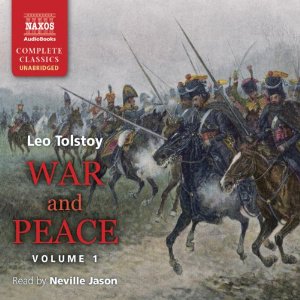
War and PeaceWhenever I’ve perused lists of classics or “books everyone should read,” War and Peace by Leo Tolstoy is almost always mentioned. Whenever I read a short description of it, I never could get a clear idea of what it was about. After reading my first Dostoyevsky last year and finding him not as difficult as I’d thought, I determined one day to read War and Peace. Over the last few months I’ve listened to the audiobook version with occasional forays into the library’s paper and ink version.

And now I know why the descriptions of the book didn’t really give much substance. It’s such a massive book with so many characters, it’s hard to sum up in a few sentences what it’s all about.

It covers the period from the time Napoleon is first seen as a threat in Russia in 1805 to his invasion of Russia in 1812 during the reign of Tsar Alexander and is basically about the lives and interactions of five aristocratic families and how the war affects them.

Pierre Bezukhov is one of many illegitimate sons of a crusty old count. He is kind-hearted and sincere but socially inept and awkward. He’s not afraid to speak his mind, even on controversial issues, but is too naive to realize when it is not socially appropriate to do so. Surprisingly, when his father comes to his death he has Pierre legitimized and leaves the bulk of his fortune to him. But Pierre is ill-prepared for the responsibility and doesn’t realize that everyone’s being nice to him now is because of his new wealth, not because they finally got to know him well enough to like him. He makes a disastrous marriage and spends much of the book searching for the meaning of life.

The Bolkonsky family consists of a cantankerous father and two adult children. Andrei is tolerant of his father, intelligent, ambitious, cynical, married and expecting a child but dissatisfied with his wife and indeed much of life. His sister, Marya, is very religious and tries to show her father love though he takes out the bulk of his eccentricities and bad moods on her.

The Rostov family, with children Nikolai, Natasha, and Petya, are a loving, fairly normal family whose finances are constantly a problem. An orphaned cousin, Sonya, lives with them. Sonya is quiet and dependable, but the three Rostov children are impetuous and immature at the beginning.

Prince Vasili Kuragin is crafty and wily, and his two adult children, Helene and Anatole, are good-looking but immoral.

Anna Drubetskaya has great ambitions for her son, Boris, and doesn’t mind asking for consideration and favors for him. Boris, in turn, has great ambitions for himself and learns quickly how to work the system to move ahead in life.

Tolstoy takes us from the ballroom to home scenes to the battlefield and back again. The lives of these characters intertwine and intersect with each other and historical figures. Some fall in love and marry; some don’t make it to the end of the book.

He also intersperses his story with essays about a number of things: his view of a particular historical event, his disagreement with the general consensus, his low opinion of Napoleon, the belief that great men and great events do not make history but rather there are innumerable small issues that work together to direct the course of history. The last is one of his major themes. In fact, the Encyclopaedia Britannica entry for War and Peace says:

As Tolstoy explains, to presume that grand events make history is like concluding from a view of a distant region where only treetops are visible that the region contains nothing but trees. Therefore Tolstoy’s novel gives its readers countless examples of small incidents that each exert a tiny influence—which is one reason that War and Peace is so long. Tolstoy’s belief in the efficacy of the ordinary and the futility of system-building set him in opposition to the thinkers of his day.

One of the main ways this is shown is on the battlefield. It’s hard to see how anything got done on the battlefield when the information relayed to the commander would have changed by the time he got it, when his orders were disobeyed or not received or when someone acted of their own accord without waiting for orders.

Tolstoy said of this book that it “is not a novel, even less is it an epic poem, and still less an historical chronicle.” He doesn’t say what he does call it, but it is kind of an amalgam of the three.

I had heard that Tolstoy was a Christian, so I was surprised that at first the religion in the book was mixed up with icons, superstition, and freemasonry. I read in various places that after his religious conversion, he renounced his earlier works. But reading about his conversion was confusing as well: it seemed to center primarily in non-resistance to evil (which led to pacifism) and in trying to divest himself of his property (which his family resisted and resented). There are nuggets of spiritual truth in this book, but it’s not where I’d send someone who was seeking to look for answers.

I wondered why so many Russians were speaking French at the beginning of the book. Wikipedia explains that it was the fashion of the day and for some years before in the upper class. But when Napoleon started attacking Russian territory, speaking French fell out of favor.

There is so much I feel I am leaving out, but with a book of 1,316 pages, it would be hard to include everything. I am indebted to SparkNotes, Wikipedia, the online Encyclopaedia Britannica, and the introduction and notes of the library copy I had for giving me more insight into the book that I would have gleaned on my own. I enjoyed the audiobook version narrated by Neville Jason in two parts over 60 hours. It did take a while to settle into it and get the characters straight. I do admit that my mind wandered a bit during the essays, especially the last appendix – I have a harder time listening to nonfiction and usually need to reread it parts of it a number of times to truly “get” it.

As with many older classics, there were parts that were a little dry, and due to the different time period and nationality there were ways people acted that didn’t always make sense to me. But I liked following the characters on their journey, especially Pierre, Natasha, and Marya and one minor character, a peasant named Karataev whom Pierre meets while in captivity. I liked where the ones mentioned at the end of the book ended up.  There were moments of great pathos in the book, moments of truly feeling a character’s pain and joy. Though not a “keep you on the edge of your seat” type of book, there were a few of those moments, such as when Andrei is waking up from surgery in a battlefield hospital and in his hazy state sees someone who looks familiar and is trying to figure out who it is. When I realized who it was, I think I gasped out loud. One of my favorite moments was during beloved oldest son Nikolai’s first battlefield experience when he is astonished that people are shooting at him, thinking, “Me, whom everyone loves!”

Years ago I read a couple of Richard Wurmbrand books about persecution behind the Iron Curtain, and he pleaded then that people not be prejudiced against the whole Soviet Union because of the Communists, remarking that the average Russians were big-hearted people. That came back to mind while reading this book, especially in the characters of Pierre and Count Rostov.

There is a 1970s BBC miniseries starring a young Anthony Hopkins as Pierre that I’d love to see sometime, but it would be quite an investment of time. I just learned that another BBC miniseries is in the works to be shown in six parts this year. Now I am even more glad I read this now!

I was dismayed when I saw a ballet segment from War and Peace in the opening ceremony at the Sochi Olympics that I didn’t know what was going on in it. I was delighted to find that segment on YouTube and watch it again after reading the book. This is Natasha’s first ball and the first time to dance with Andrei. The video quality isn’t great and there is an annoying sound like a rocking chair squeaking, but I was just glad to be able to see it again and understand it this time:

(This review will also be linked to Semicolon‘s Saturday Review of Books.)

Book Review: By the Shores of Silver Lake

Silver LakeBy the Shores of Silver Lake by Laura Ingalls Wilder opens on a sad time. Everyone in the family except Pa and Laura have had scarlet fever, and Mary has been left blind. Pa has no idea how he will pay the bill for the doctor, who has come every day. In the previous book, On the Banks of Plum Creek, the family had experienced a devastating grasshopper invasion, prairie fires, and blizzards. They were about at the end of their rope at this point, when a relative visits with a job offer for Charles. Her husband was a contractor working with the railroads, and needed a good man to be the “storekeeper, bookkeeper, and time keeper” at a railroad camp.  The job would pay $50 a month, and there was an opportunity to claim a homestead. Ma doesn’t want to leave and wants the family to be settled, but agrees this opportunity seems providential. The sale of their farm covers all their expenses and provides a little extra. Pa goes on ahead to start the job while Ma and the girls continue to recuperate and gain strength and then get ready to move. They come later on the train – a new experience for all of them, and I particularly enjoyed Laura’s description of how it both scared and excited her. Laura “knew now what Pa meant when he spoke of the wonderful times they were living in…in one morning, they had actually traveled a whole week’s journey.” Pa later muses, “I wouldn’t wonder if you’ll live to see a time, Laura, when pretty nearly everybody’ll ride on railroads and there’ll hardly be a covered wagon left.”

First they get used to the railroad camp, where Ma instructs the girls to stay away from the “rough men,” but Pa indulges Laura’s curiosity one day and takes her to see the construction and explain it all to her.

Then, when that section of the railroad is done and the camp breaks up for winter, the Ingalls family is offered use of the surveyors’ house for the winter. The surveyors will be gone for the winter but the house is snug and well-stocked, and that will allow the family to save money by staying on instead of having to travel back East. Plus they’ll get a head start on claiming their homestead before spring, when great numbers are expected to travel west. But their nearest neighbor is 60 miles away on one side and 40 on the other. Introvert that I am, that would be a little too isolated for even me! But as it turns out, they do have more visitors than expected, and as they are in the only occupied house on the prairie at that time, they provide a lot of hospitality when people come.

There are dangers with wolves, unruly men, claim jumpers, horse thieves and the possibility that Pa might miss out on his claim. There is a joyous Christmas, lots of violin playing in the winter evenings, the springing up of a new town almost overnight come springtime, meeting new friends and unexpectedly coming across a few old ones.

A few observations:

Laura is almost 13 and starts out a little weary this time, as the main helper to the family after Mary’s illness, though Mary eventually recovers some abilities and helps keep little Grace entertained.

Their parents ask Laura to be Mary’s eyes and describe things to her, and I can’t help but think that sharpened both her skills of observations and her descriptive ability. Mary tells Laura she “makes pictures when she talks.”

There is one remark by and about Ma concerning Indians that makes one wince and would be considered racist today. I think it was primarily motivated by fear: they had had some scary encounters with Indians in Little House on the Prairie, and of course the Indians had right to be upset with the white man’s encroachment on their lands. But their main ways of fighting back were, of course, terribly frightening to white people, so it is no wonder there were bad feelings on both sides that took ages to begin to overcome (and is not completely overcome even now).

I appreciated the way Ma tried to teach the girls to “know how to behave, to speak nicely in low voices and have gentle manners and always be ladies” despite the rough and uncivilized places they lived.

During the days of building a building in town and then a claim shanty were days that would have been very hard for me, as they lived in unfinished places (waking up one morning with a foot of snow on top of them in the house from an unexpected blizzard) and continued building around themselves. It was for them as well, but they took it in stride. Pa comments once, “That’s what it takes to build up a country. Building over your head and under your feet, but building. We’d never get anything fixed to suit us if we waited for things to suit us before we started.”

I am glad Laura included words to many of the songs that Pa played and the family sang. I knew many of them, and that helped me imagine the scenes.

Laura catches a fleeting glimpse of her future husband, Almanzo, but at this point she’s primarily interested in his beautiful horses and has no idea of their future.

Laura shares her Pa’s desire to explore and would rather continue to travel and see new places rather than settle down, but Pa promised Ma they would finally stay put.

I was puzzled by Ma’s suppression of the girls’ outbursts of emotion, laughter as well as anger. The family did laugh quite a lot, but there were times Ma restrained them in situations where, these days, we wouldn’t have a problem. I think that was just what politeness and”ladylikeness” looked like at that time. I am all for teaching children restraint and self-control; it just went farther than what we would consider necessary by today’s standards.

Once again I enjoyed this glimpse into our country’s history as well as into the Ingalls family. There is always much I admire about them. This would be an excellent book for children to read to understand how the Homestead Act worked out in real life and what people had to go through to settle in a new area then. But it is a good book to just read for enjoyment as well.

(This review will also be linked to Semicolon‘s Saturday Review of Books.)

Book Review: The Masqueraders

MasqueradersI had not heard of Georgette Heyer until the last few years when I saw her name pop up on various blogs. Since I’ve been trying to read classics that I am not familiar with, I wanted to give one of her books a try. I thought I had remembered that Bekah enjoyed The Masqueraders, but as I tried to find her review of it, I couldn’t, so I guess I must have seen it recommended by someone else. At any rate, I decided to give it a listen.

The story was published in 1928 but set in the mid 1750s in Britain just after just after some rebellions by groups called the Jacobites, who wanted to restore King James II and his line to the throne. You can read more about them here if you’re interested, but let’s just say they were on the wrong side of the political climate at the time and their involvement would have been found treasonous.

To escape detection, brother and sister Robin and Prudence travel in disguise, he as Kate Merriot and she as Kate’s brother Peter. Prudence is a little tall for a woman and Robin a little short for a man, so that works to their advantage. Stopping by an inn on their travels, they overhear an argument between an older man and a teenage girl. Apparently the girl had said she would elope with the man but has changed her mind, and he is not taking it well. The Merriots decide to intervene by having their servant stage a distraction while they get the girl to safety. They discover her name is Letitia, or Lettie, and she is not only young and naive, but bored. She thinks her father has promised her to another older man, Sir Anthony Fanshawe, whom she does not want to marry, and that and a desire for “romance” and excitement led her to consent to Gregory Markham’s proposal, until she saw a side of him she did not like. Fanshawe soon arrives at Lettie’s father’s request, assures Lettie that he is not planning to marry her, and sees her back to London.

The Merriots end up in London as well, and renew their acquaintance with Lettie, meet her father, and become the darlings of London society. They meet several times with Sir Anthony, who comes across as sleepy and unobservant, but Prudence/Peter thinks he sees more and understands more than he lets on. Sir Anthony evidently desires to take Peter under his wing, and he/she finds herself attracted to him.

Meanwhile Robin has fallen hard for Lettie, but neither sibling can risk unmasking. Plus they are waiting to hear from their father, whom they call “the old gentleman.” He is the master planner for their adventurous schemes, and they discover his new one is very bold indeed and requires a masquerade of his own.

When I first started this audiobook, I admit it seemed a little silly to me at first. But it wasn’t long before I was drawn into the story, especially after it took a more serious turn.

I don’t know if all of Heyer’s heroines are this way, but Prudence is a strong female character as opposed to the more typical damsel-in-distress Victorian ideal (which is more like Lettie, although even Lettie proves to be not quite so flighty as she seems at first). Pru, as those who know her call her, is strong not only because she portrays a man and has had to learn to sword fight and such, but also because of her bravery, quick wits, and loyalty. But her strength doesn’t preclude her appreciation that “it was a fine thing to be so precious in a man’s eyes.”

I read a little more about Heyer at Wikipedia. That article says she “essentially established the historical romance genre and its subgenre Regency romance. Her Regencies were inspired by Jane Austen” – so wouldn’t that mean Jane Austen actually established Regency romances? I don’t know. But Heyer is known for her historical romances and thrillers: for several years she published one of each every year. Though she was evidently very popular in her day, she “was ignored by critics…none of her novels was ever reviewed in a serious newspaper” and she “was also overlooked by the Encyclopedia Britannica. The 1974 edition of the encyclopedia, published shortly after her death, included entries on popular writers Agatha Christie and Dorothy Sayers, but did not mention Heyer.”

I did enjoy learning more about Heyer and sampling one of her books. I will probably try another some time, but I am not eager to do so right away. The smattering of “damns” and minced oaths got on my nerves, I thought one man was unnecessarily killed in the story, and I could not stand “the old gentleman’s” arrogance, but overall I liked the suspense and intrigue of the plot as well as the humor sprinkled throughout. I thought the narrator did an excellent job as well.

(This will also be linked to Semicolon‘s Saturday Review of Books.)

The Laura Ingalls Wilder Reading Challenge 2015

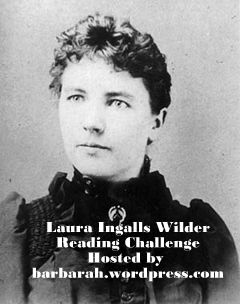
The month of February contains the dates of Laura Ingalls Wilder’s birth and death, so it seems a fitting month to focus on her life and writings. This is our fourth year to do so, and I have enjoyed it each time. Many of us grew up reading the Little House books. I don’t know if there has ever been a time when there wasn’t interest in the Little House series since it first came out. They are enjoyable as children’s books, but they are enjoyable for adults as well. It’s fascinating to explore real pioneer roots and heartening to read of the family relationships and values.

On Feb. 1 I’ll have a sign-up post where you can let us know if you’ll be participating and what you’d like to read. That way we can peek in on each other through the month and see how it’s going (that’s half the fun of a reading challenge). You can read anything by or about Laura. You can read alone or with your children or a friend. You can read just one book or several throughout the month — whatever works with your schedule. If you’d like to prepare some food or crafts or activities somehow relating to Laura or her books, that would be really neat too. In the past I think some have made food or clothing from the styles of the day: Annette even had a Little House-themed birthday party for one of her daughters, (and, unrelated to the challenge but just from her own interest she started the Little House Companion blog: you might find some neat ideas for activities and Laura-related books there.

On Feb 28 I’ll have a wrap-up post with a Mr. Linky so you can link back to any posts you’ve written for the challenge or to a wrap-up post. You do not have to have a blog to participate: if you don’t, you can just share with us in the comments that day what you’ve read.

Need some ideas beyond the Little House books themselves? Annette, as I mentioned, has shared several books for children here. I compiled a list of Books Related to Laura Ingalls Wilder, and some others are listed in the comments. Laura fan extraordinaire and historian Melanie Stringer has a treasure trove of information at Meet Laura Ingalls Wilder.

Have fun gathering your materials and planning what to read and do, and I’ll see you back here Feb. 1!

Here is a code for a button for the challenge:

Laura Ingalls Wilder Reading Challenge
<div align="center"><https://barbarah.wordpress.com/2015/01/19/the-laura-ingalls-wilder-reading-challenge-2015/" title="Laura Ingalls Wilder Reading Challenge"><img src="https://barbaraleeharper.com/wp-content/uploads/2011/11/liw.jpg"   alt="" width="144" height="184""" alt="Laura Ingalls Wilder Reading Challenge" style="border:none;" /></a></div>

Review: The Cricket on the Hearth

CricketThe Cricket on the Hearth: A Fairy Tale of Home is a novella by Charles Dickens, one of his five Christmas books. It’s one of the few where he does not engage in social commentary.

It’s the story of John Peerybingle, a carrier (someone who transports goods for others) and his wife, Dot. They live in a modest home with their baby and the baby’s nanny, Tilly Slowboy. They are good friends with Caleb Plummer and his blind daughter, Bertha, who both work by making toys for the Scroogish Mr. Tackleton to sell. Mr. Tackleton has somehow gotten a young friend of the group, May, to agree to marry him, though she has admitted to him that she does not love him and she still pines for Edward, Caleb’s son who is thought to have died in South America.

The story opens with John coming home to a scene of domestic tranquility, complete with a cricket on the hearth which Dot regards with special affection because she first heard it the night John brought his young wife home and  “It seemed so full of promise and encouragement. It seemed to say, you would be kind and gentle with me.” It’s “music” has cheered and encouraged her many a time, and she comments, “This has been a happy home, John; and I love the Cricket for its sake!”

John has brought home an elderly gentlemen whom he had picked up in his work, but those who were supposed to retrieve him did not come for him. They make him feel at home for the time being.

There are various comings and goings and discussion with and about their friends, particularly the upcoming wedding between Mr. Tackleton and May. In one conversation between John and Tacklelton,

“Bah! what’s home?” cried Tackleton. “Four walls and a ceiling! (why don’t you kill that Cricket? I would! I always do. I hate their noise.) There are four walls and a ceiling at my house. Come to me!”

“You kill your Crickets, eh?” said John.

“Scrunch ’em, sir,” returned the other, setting his heel heavily on the floor.

Everyone is invited to a pre-wedding celebration, and at one point there, Tackleton shows John a scene through a window where the elderly visitor takes off his wig, is revealed to be quite young, and interacts with Dot very familiarly. Tackleton assumes Dot is being unfaithful. John is at first quite angry and thinks murderous thoughts against the imposter, but the cricket somehow turns into a sort of a fairy and reminds him of all Dot’s good qualities. John decides that in his love for Dot, the best thing he can do is release her to marry the person she actually loves.

But, as you can guess, Dot is not being at all unfaithful or untrue. As to what is really going on and who the stranger is, I’ll leave for you to find out in the book.

I do like Dickens, and I have enjoyed listening to audiobooks of his works that I am already familiar with, but I am finding that when I listen to an audiobook of one of his books I haven’t read before, it takes me a very long time to get into them. It usually takes him a while to get through the characterizations and set-up, and my mind tends to wander in that part until he actually gets going with the story. But I enjoyed going back through the online version. So I don’t know if Dickens (at least unread Dickens) is better read rather than listened to, or if I just get more out of him the second time through a story rather than the first. I don’t think the narrator helped this version much, so that contributed as well. I didn’t enjoy the story much at the beginning, but by the end I thought it was very sweet, and enjoyed it much more going over it again. I especially liked what Dot said at the end of explaining to her husband what was going on:

“Now, my dear husband, take me to your heart again! That’s my home, John; and never, never think of sending me to any other!”

(This will also be linked to Semicolon‘s Saturday Review of Books.)
Back to the Classics Challenge Wrap-up

classics2014Karen at Books and Chocolate hosted the Back to the Classics Challenge this year, where we could choose to read and review classics that fit in certain categories, with drawings for prizes at the end of the year. There are some required categories and some optional categories, and, thankfully, I was able to finish them all. I will link each title back to my review.

Required:

  1. A 20th Century Classic: My Man Jeeves by P. D. Wodehouse
  2. A 19th Century Classic: Bleak House by Charles Dickens
  3. A Classic by a Woman Author: The Blue Castle by L. M. Montgomery
  4. A Classic in Translation  (A book originally written in a different language from your own.) The Brothers Karamazov by Dostoyevsky.
  5. A Classic About War  The Scarlet Pimpernel by Baroness Orczy.
  6. A Classic by an Author Who Is New To You: The Woman in White by Wilkie Collins
Optional Categories:
  1. An American Classic: Farmer Boy by Laura Ingalls Wilder
  2. A Classic Mystery, Suspense or Thriller:  A Study in Scarlet by Arthur Conan Doyle, the first Sherlock Holmes book
  3. A Historical Fiction Classic: I will Repay by Baroness Orzcy, part of The Scarlet Pimpernel series.
  4. A Classic That’s Been Adapted Into a Movie or TV Series: To Kill a Mockingbird by Harper Lee.
  5. Extra Fun Category:  Write a Review of the Movie or TV Series adapted from Optional Category #4: To Kill a Mockingbird

Karen asks us to “Please remember to indicate within your post how many entries you have earned for the prize drawing.  You earn one entry for completing the six required categories, an additional entry for completing three of the optional categories; complete all five optional entries, and you receive two additional entries for completing all of the optional categories. The most entries one person can earn is three. ” Since I completed all of the required and optional categories, I have three entries.

I did not grow up reading a lot of classics, so I have purposefully tried to incorporate a few classics into my reading the last few years. This challenge was a fun way to do that. I had pretty much decided not to do it next year, however, just because I had been involved in too many challenges this past year and felt a little constricted and constrained. But Karen changed the format for the Back to the Classics Challenge 2015: this time there are twelve categories of classics but we have the choice of reading from whichever category we want, with a minimum of six required to enter for a $30 Amazon prize, and more entries are earned at different reading levels. So I think perhaps I will join in after all, but I’m going to wait til after Christmas to decide whether to and which classics to read if I do.

Book Review: To Kill a Mockingbird

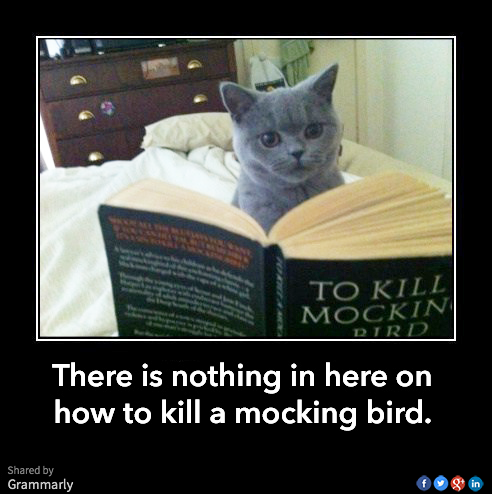
Despite its title, you won’t find anything like this in To Kill a Mockingbird by Harper Lee.
mockingbird

🙂 I’ll forewarn you that I will probably say more about the plot than I usually do. I don’t like to reveal key details in a review, but since I read this one this time in connection with Carrie’s  Reading to Know Classics Book Club, this discussion will involve others who have already read it, plus I am still processing some parts of it. But whatever I share about it, I will try not to spill all the major beans, and there will be much to discover if you do go on and read the book.

Published in 1960, To Kill a Mockingbird is set in the early 30s in a small Alabama town called Maycomb. The story is told through the eyes of Jean Louise Finch, known as Scout, who is six years old as the novel opens. She lives with her older brother, Jem, short for Jeremy, and her widowed father, Atticus, a lawyer. The first part of the book evokes a realistic feel of growing up in a sleepy Southern town. Jem and Scout and their friend, Dill, who comes to visit his aunt in Maycomb each summer, spend a great deal of their time trying to devise a way to get their reclusive neighbor, Arthur Radley, known as Boo, to come out. They meet with no success and get themselves in trouble over their escapades more than once. In these early scenes we get a picture of Scout, smart but bored at a school that scolds her for learning to read at home, Jem’s maturing into a young man, Atticus, who seems detached as a parent sometimes, but shows a depth of wisdom and integrity in handling his work, his life, and his children, and an overview of the citizenship of Maycomb.

There is something of a caste system in the South of this time, with “old” families concerned about their history and standing, to poor but decent folks, to uneducated “trash” who live near the dump. Then there are the Negroes or colored folks, as they are called in the book. There are varying degrees of feelings toward the colored people, with, sadly, most of the townsfolk considering them at least a race apart if not a race beneath. Atticus seems to be one of the few who believes that all people need to be treated with decency and respect no matter what their race.

The children get an inkling that their world is about to shift when they start getting taunted for their father being an “n-lover.” Scout is a scrappy tomboy and her first instinct in any confrontation is to answer with her fists. But her father asks her to refrain from fighting about this issue. The children learn that their father has been appointed the defense attorney for Tom Robinson, a black man accused of raping a white woman. Most of the town thinks, at the very least, that it is not a good idea, and some are quite caustic about it, even to the children (which is low-down and dirty in my opinion.)

Tension builds until the day of the trial. Scout, Jem, and Dill sneak in to watch, and there is no room in the courthouse except in the colored section of the balcony, which welcomes them. Lee deftly handles the details of the case even though her narrator doesn’t really understand what rape is. The evidence is only circumstantial, and Atticus brings out the fact that the alleged victim, Mayella Ewell, has flirted with and lured Tom into her home, and since no one took her to a doctor, there is no proof that a sexual assault occurred. Tom insists that none did. But even though Jem is sure they’ve won the case, the jury returns a guilty verdict.

Though the verdict went the Ewell’s way, Mr. Ewell is angry with Atticus for “destroying his credibility” and threatens to “get” Atticus if it is the last thing he does.

There were many things that stood out to me in this book. One was how Atticus tried to prepare his children for the trouble to come. He didn’t want them to fuss about it nor to think ill of their friends who might say unkind things. When asked why he took the case when the townspeople and even his own relatives think ill of him for it, he says things like he couldn’t live with himself, couldn’t go to church, couldn’t ask his children to obey him if he didn’t. It was the right thing to do, and his conscience would smite him if he didn’t. The children don’t learn until the court day that Atticus was appointed to the case. Scout says it would have saved them many fights if they could have defended him with that piece of information. It says a lot about Atticus that he did not use that fact to defend himself.

Another was how often innocence saw truth. When Scout hears her teacher at the courthouse saying this trial will “teach ’em a lesson, they were gettin’ way above themselves,” she wonders how her teacher can hate Hitler and feel sorry for the Jews in Europe in their classroom and “then turn around and be ugly about folks right at home.” “It’s not right to persecute anybody, is it? I mean have mean thoughts about anybody, even, is it?” It’s Scout innocently talking with one of her neighbors about his son at school that halts an angry mob, unbeknownst to her at first. It’s Dill who gets upset and sick at the courthouse over how the prosecuting attorney is treating Tom on the stand.

I appreciated how the children’s view of their father changes throughout the book. They love him, but compared to other fathers, he is “old,” doesn’t play football, doesn’t have an interesting job, and reads all the time. Their neighbor, Miss Maudie, helps them understand him a bit better, finding out he is a crack shot helps immensely, and the course of events eventually helps them to see him for the man that he is.

One of the most poignant parts of the book for me was when Scout was helping her Aunt Alexandra (who throughout the book tries to make Scout into a lady) at a ladies’ missionary meeting. There are poor examples of womanhood, such as when some of the women say embarrassing things to Scout for a laugh and when others gossip or others laud the heart of missionaries in other countries but fail to acknowledge needs in their own county. When Atticus comes in with bad news about Tom and asks his colored cook to go with him to Tom’s wife, Scout, Miss Maudie, and Scout are shaken. But they don’t want to let the ladies know what has happened, so they put on a brave face and go back out and serve refreshments. Aunt Alexandra smiles at Scout, who thinks to herself, “If Aunty could be a lady at a time like this, so could I.” That contrast between real womanhood and the silliness of so many, and Scout’s realization of it, just spoke volumes to me.

So what does a mockingbird have to do with all of this? When the children are given air rifles one Christmas, Atticus tells them they can “shoot all the bluejays you want, if you can hit ’em, but remember it’s a sin to kill a mockingbird.” Miss Maudie explains to Scout that mockingbirds don’t do people any harm, but they “sing their hearts out for us.” This metaphor of it being a sin to harm the innocent comes up throughout the book, especially beautifully near the end when Scout realizes its meaning and applies it to Boo Radley as well.

Miss Maudie tells the children after the trial,  “Atticus Finch won’t win, he can’t win, but he’s the only man in these parts who can keep a jury out so long in a case like this…We’re making a step – it’s just a baby step, but it’s a step.” Though the battle in this case was lost, there was much that happened that made it a baby step in the right direction. Race relations in this country are still not what they should be, but they’re a far cry from what they were in this time period, mostly due to individual steps along the way, some large and some small. I don’t know if massive cultural changes can be made by a revolution: I think they often come through slow change, through individual men and women standing up and doing the right thing within their sphere of influence.

Some quotes that especially stood out:

Atticus to Scout: “You never really understand a person until you consider things from his point of view…until you climb into his skin and walk around in it.”

Miss Maudie (a neighbor) to Scout: “Atticus Finch is the same in his house as he is in the public streets.”

Scout: “Atticus, are we going to win it?”

“No, Honey.”

“Then, why – “

“Simply because we were licked a hundred years before we started is no reason for us not to try to win.”

When Atticus tries to explain to Scout that “n-lover” is a term that “ignorant, trashy people use,” she ask, “You’re not rely one, then, are you?” He replies, “I certainly am. I do my best to love everybody.”

When Scout and Jem are asked to visit the crusty Mrs. DuBose, unaware that in her dying days she is trying to come out of a morphine addiction brought on my treatment of her illness: “I wanted you to see what real courage is, instead of getting the idea that courage is a man with a gun in his hand. It’s when you know you’re licked before you begin but you begin anyway and you see it through no matter what. You rarely win, but sometimes you do.”

Miss Maudie to the children: “There are some men in this world who are born to do our unpleasant jobs for us. Your father’s one of them…We’re so rarely called upon to be Christians, but when we are, we’ve got men like Atticus to go for us.”

Miss Maudie to Aunt Alexandra: “Whether Maycomb knows it or not, we’re paying the highest tribute we can pay a man. We trust him to do right…The handful of people in this town who say that fair play is not marked White Only; the handful of people who say a fair trial is for everybody, not just us.”

When Scout comments that a boy who was thought to have done certain misdeeds hadn’t and was actually “real nice,” Atticus replies: “Most people are, Scout, when you finally see them.”

I think Lee is an excellent author. There is so much that she brought out so well that I can’t explain or portray any more than I have. It is too bad she only wrote the one book.

The only thing that mars the book is a smattering of bad language – some “damns” and “hells” and a couple of instances of taking God’s name in vain. I am not shocked by them because I grew up in an environment where that kind of talk was common, but my family now doesn’t use that kind of language, and I usually avoid books with it. I don’t like to feed them into my brain. I had forgotten they were in this book. I always struggle with whether to recommend a book that is a great read in every way except this. That is up to the individual reader.

I first read this book in 2008, and I purposely didn’t read that review until I got done with this one. It was interesting to see what things stood out to me both times.

I’m thankful that Annette chose this book for Carrie’s  book club. I listened to the audiobook ably narrated by Sissy Spacek, and her Southern accent really added to the feel of the story.

(This will also be linked to Semicolon‘s Saturday Review of Books.)
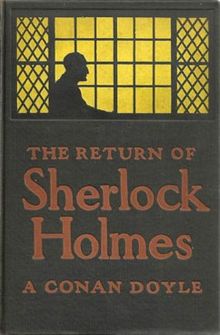
Book Review: The Return of Sherlock Holmes

TheReturnOfSherlockHolmesThis book by Arthur Conan Doyle is titled The Return of Sherlock Holmes  because Holmes was thought to have died at the end of The Memoirs of Sherlock Holmes. Doyle had wanted to end the Holmes series to concentrate on historical novels, but he published The Hound of the Baskervilles (set before Holmes’ supposed death though published after) a few years later, and it was such a success that he was pressured to revive the series. Holmes returns to a stunned Watson three years after his disappearance, explaining that though Moriarty died (at the same time Holmes was thought to), his men were still alive and knew that Holmes was as well – one of them sought to kill him in the moments after Moriarty’s death. But Holmes is on their trail and has returned in disguise back to London.

This book is a series of short stories that appeared first in a magazine called The Strand over 1903-1904. Holmes’s clients vary from a governess to the prime minister, and the cases include a missing heir, a stalker, a blackmailer, and crust ship’s captain, busted busts of Napoleon, a student cheating on an exam, a missing rugby player, a false testimony, and a stolen document which could lead to war if not found. Quite a variety! Watson says “As I have preserved very full notes of all these cases, and was myself personally engaged in many of them, it may be imagined that it is no easy task to know which I should select to lay before the public. I shall, however, preserve my former rule, and give the preference to those cases which derive their interest not so much from the brutality of the crime as from the ingenuity and dramatic quality of the solution.” Holmes accuses Watson once of sensationalism: “Your fatal habit of looking at everything from the point of view of a story instead of as a scientific exercise has ruined what might have been an instructive and even classical series of demonstrations. You slur over work of the utmost finesse and delicacy, in order to dwell upon sensational details which may excite, but cannot possibly instruct, the reader.”  When asked why Holmes doesn’t write them himself, he replies that one day he will in textbook form.

Holmes’s personality continues to unfold in these stories. Here are a few of Watson’s comments:

“My friend, who loved above all things precision and concentration of thought, resented anything which distracted his attention from the matter in hand. And yet, without a harshness which was foreign to his nature, it was impossible to refuse to listen to the story of the young and beautiful woman, tall, graceful, and queenly, who presented herself at Baker Street late in the evening, and implored his assistance and advice.”

“Holmes, however, like all great artists, lived for his art’s sake, and, save in the case of the Duke of Holdernesse, I have seldom known him claim any large reward for his inestimable services. So unworldly was he—or so capricious—that he frequently refused his help to the powerful and wealthy where the problem made no appeal to his sympathies, while he would devote weeks of most intense application to the affairs of some humble client whose case presented those strange and dramatic qualities which appealed to his imagination and challenged his ingenuity.”

“Lestrade and I sat silent for a moment, and then, with a spontaneous impulse, we both broke at clapping, as at the well-wrought crisis of a play. A flush of colour sprang to Holmes’s pale cheeks, and he bowed to us like the master dramatist who receives the homage of his audience. It was at such moments that for an instant he ceased to be a reasoning machine, and betrayed his human love for admiration and applause. The same singularly proud and reserved nature which turned away with disdain from popular notoriety was capable of being moved to its depths by spontaneous wonder and praise from a friend.”

“My friend’s temper had not improved since he had been deprived of the congenial surroundings of Baker Street. Without his scrapbooks, his chemicals, and his homely untidiness, he was an uncomfortable man.”

“I may have remarked before that Holmes had, when he liked, a peculiarly ingratiating way with women, and that he very readily established terms of confidence with them. In half the time which he had named, he had captured the housekeeper’s goodwill and was chatting with her as if he had known her for years.”

“Sherlock Holmes was a past-master in the art of putting a humble witness at his ease.”

Some of what I have read concerning modern depictions of Holmes seem to cast him as socially awkward, even rude, and perhaps having Asberger’s. I think these samples show that he was not socially awkward at all – he was described as being quite genial when he wanted to be, and he could carry on a conversation with anyone. But he preferred working alone or with Watson and one or two others – a classic introvert, in my opinion.

There were a few cases before now and a couple of cases here where Holmes decided justice was served, and he did not see a reason to report his findings to the police even when he was working with them. In one case he said, “No, I couldn’t do it, Watson…Once that warrant was made out, nothing on earth would save him. Once or twice in my career I feel that I have done more real harm by my discovery of the criminal than ever he had done by his crime. I have learned caution now, and I had rather play tricks with the law of England than with my own conscience. Let us know a little more before we act.” I wouldn’t advocate that in real life, but it did make sense in the context of the story.

At the end of this book Holmes was said to have retired, and only allowed Watson to tell a few of the stories long after they occurred. Since there are three more books about him, however, either he didn’t retire, or those stories are more past cases.

Once again I listened to the audiobook version superbly narrated by Derek Jacobi. In my journey through the Holmes books, I look for versions read by Jacobi now. I also looked at some portions in closer detail in the online version of the book provided by Project Gutenberg.

(This will also be linked to Semicolon‘s Saturday Review of Books.)

Book Review: The Old Curiosity Shop

Old Curiosity ShopThe Old Curiosity Shop by Charles Dickens was his fourth novel, originally published as a serial in his weekly periodical, Master Humphrey’s Clock. It was said to have been so popular that people clamored to the boats when the last shipment arrived, asking the sailors, who may have read it on the way, what happened to little Nell.

The story involves a girl of thirteen named Nell and her grandfather, who is never named. They live in her grandfather’s shop, which is kind of an odds and ends store. Her parents died long before, and she is content to live with and help her grandfather, even though it is something of a lonely existence for her. She rarely sees anyone her own age except Kit, who works for her grandfather and can make her laugh. Unbeknownst to her, Kit watches for her when she goes out on errands for her grandfather at night until she is safely home in bed.

The grandfather goes out at night as well, but no one knows where for several chapters. Later it is revealed that he has been gambling in order to try to give Nell what she deserves, but he has lost what money they had.

A dwarf named Daniel Quilp has loaned Nell’s grandfather money, and when he can’t repay, he takes over the curiosity shop and makes overtures to Nell about becoming his wife when she is older. He is already married but apparently doesn’t think his wife will live that long. Nell’s grandfather has something of a nervous breakdown, and when he recp0vers sufficiently, Nell convinces him that they should run away, that even if they have to beg for a living, they’ll be freer than they are now. Her grandfather agrees, and since he is weak and still not entirely in his right mind, Nell leads them and makes all the major decisions, at least for a time.

A great deal of the book deals with the different characters and situations they run in to. With Dickens’ penchant for unique characterizations, both good and villainous, you can imagine some of the ups and downs their path might take.

Quilp still seems to think they have a hidden fortune somewhere, so he tries to find them, and then sets his sights on Kit, whom he thinks is hindering him. He sets rather an elaborate scheme in motion to frame Kit for theft and have him imprisoned. The storyline spends a lot of time with Kit for much of the book before tying his situation back to Nell’s.

Meanwhile, someone else who is only called, at first, the Single Gentleman, comes to look for Nell and her grandfather, and it is not until later in the book that we discover what his purposes are.

Some of the quotes that stood out to me in the book:

For your popular rumour, unlike the rolling stone of the proverb, is one which gathers a deal of moss in its wanderings up and down.

There are chords in the human heart–strange, varying strings–which are only struck by accident; which will remain mute and senseless to appeals the most passionate and earnest, and respond at last to the slightest casual touch.

In the majority of cases, conscience is an elastic and very flexible article, which will bear a great deal of stretching and adapt itself to a great variety of circumstances.

From the death of each day’s hope another hope sprung up to live to-morrow.

The day was made for laziness, and lying on one’s back in green places, and staring at the sky till its brightness forced one to shut one’s eyes and go to sleep.

“Ahem!” coughed Miss Brass interrogatively.

“Places lie beyond these,” said the child, firmly, “where we may live in peace, and be tempted to do no harm. We will take the road that promises to have that end, and we would not turn out of it, if it were a hundred times worse than our fears lead us to expect. We would not, dear, would we?”

“The invading army of bricks and mortar whose station lay for the present nearly at his feet…” [I was amused at characterizing buildings as brick and mortar — I had thought that was a modern appellation!]

There is much I like about the book. Dickens characterizations are always rich, and there is a running note of sly irony connected with some of them that is quite amusing. Some sections are very touching. There is a lot of suspense both in what happens to Kit and and in the Single Gentleman’s pursuit. I especially liked how Richard Swiveller grew though the book : he started out as a friend of Nell’s brother, who was a ne’er-do-well who also thought the old man had money and was holding out on him, but the brother, Frederick, only has a small part. Richard, however, reminds me of the “simple” person in Proverbs – naive, easily swayed, in danger of going down the wrong path, but due to the circumstances he goes through, his eyes are opened to a great deal and he becomes a force for good. I could not stand him at first, but he grew to be one of my favorite characters.

But I am mad at Dickens for how the story ended. 🙂 And though Quilp is thoroughly villainous, it was hard for me to take him seriously. Maybe he was a little too villainous. No offense to little people, but I couldn’t comprehend how Quilp could intimidate all these people when any one of them could have taken him down.

But despite those complaints, I enjoyed the book and am glad to have read/listened to it. I had not known anything about it before except that I had heard about it being serialized and people were clamoring to know what happened at the end – understandable, especially when the end didn’t come for 73 weeks.

(This will also be linked to Semicolon‘s Saturday Review of Books.)

Book Review: The Princess and the Goblin

Princess_and_the_GoblinMy interest in George MacDonald was first piqued when I read of his influence on the life and writings of C. S. Lewis, whose imagination, he said, was “baptised” by reading MacDonald’s Phantastes. I’ve seen him quoted by various others, but somehow I don’t think I have ever read one of his books. I was especially interested in The Princess and the Goblin after listening to the funeral service of a young wife and mom who passed away last year (Julie Herbster, for those who knew her). Her pastor spoke of her love for literature and mentioned her hanging on to the truth she knew in the face of such devastating circumstances, just like the princess followed her great-great-grandmother’s thread through the goblin cave even though no one else could see it or believed it was there (more on that later). So I was delighted to see this title listed for this month for Carrie’s  Reading to Know Classics Book Club. That’s one of the values of these kinds of challenges and book clubs: they spur me to read books I might not otherwise have ever gotten around to.

The story begins with a bored 8 year old Princess Irene, inside on a rainy day, restless and dissatisfied with all her many wonderful toys. Her “King Papa” has sent her out into the country to be raised at first because her mother was not very strong, later because her mother died and her father was often away on kingdom business. On this rainy day her nurse, Lootie, leaves the room for a moment, and Irene notices another door left ajar, one that goes upstairs. She decides to investigate but gets thoroughly lost amidst seemingly myriad doors. She can’t find her way back down and gets quite upset until she finds a very old lady at a spinning wheel in one room. Though she was obviously very old and wise, with white hair, her skin was smooth. She told Irene she was her great-great-grandmother and that she was also named Irene. After her great-great-grandmother  wipes the tears from Irene’s dusty face and shows her her pigeons, she shows her the way back downstairs so that Lootie won’t be worried about her.

Irene tells Lootie all about her great-great-grandmother, but Lootie thinks she is just making up stories. Irene is quite offended, but after a while she wonders if perhaps her visit to her great-great-grandmother was all just a dream.

One thing the princess doesn’t know, but everyone else does, is that the mountains’ underground passages are full of goblins who used to be people but chose to live underground after some disagreements with the King. Eons of living “away from the sun, in cold and wet and dark places” had transformed them into hideous and grotesque creatures. Lootie is supposed to be keeping Irene safe especially from goblins, but one day as they are out exploring, Lootie realizes they’ve gone too far and won’t make it back home before dark. Frightened, she grabs Irene and starts running without having the time to explain why. They take a wrong turn and begin to see odd shapes in the rocks and hear laughter, when suddenly a young miner’s son named Curdie comes across their path singing a rhyme. He tells them the goblins can’t stand rhymes and songs, but they are out and about, and they need to get home as quickly as possible, so he helps them find the way and escorts them back.

Later, when Curdie works late in the mines one night to try to earn money to buy his mother a red petticoat, he overhears some goblins talking and hears reference to a plan that would endanger Irene, and another “Plan B” that isn’t exactly clear. In trying to find out more about it, he eventually is captured. Irene had found her great-great-grandmother once again, who had given her a ring filled with fine thread she had woven for her. She told her that when she needed to, she could put the ring under her pillow and follow the thread to guide her. One day she follows the thread to where Curdie is being kept, and helps him escape. Curdie can’t see the thread and can’t see Irene’s great-great-grandmother, either, when she tries to introduce him. He thinks Irene is trying to make a fool of him; Irene is hurt.

But Curdie determines that he will still try to find out the goblins’ plan and protect the princess. I’ll leave the story there for you to find out the rest if you choose to read the book, but you can be sure a confrontation with the goblins will occur.

One one level, this is a fairy tale with a classic good vs. evil battle and with young people learning and growing in the course of it. Unfortunately I couldn’t find any Spark Notes or Cliff Notes that discussed the plot, theme, and symbolism. Just Googling “symbolism in The Princess and the Goblin” and perusing a few of the posts that came up led to a wide variety of interpretations. Some see Irene’s sreat-great-grandmother as a fairy godmother, a goddess, or the Virgin Mary. Some sympathize with the goblins as victims of a classist society. Some took umbrage to MacDonald’s view that a princess (or anyone of royal blood) should have certain inherent qualities.

Since MacDonald was a Christian (though I’d disagree with some of his views as described in Wikipedia), I think we have to interpret the story in the light of basic Christian teachings. I don’t think the story is meant to be an overt allegory, but it does portray a beneficent being who cares for, heals, protects (and sometimes rebukes) its charges, who can’t be seen unless allowed and with some degree of faith. Light is associated with it, light that guides and protects, and a bird showing up at certain moments seems to invoke Biblical instances of the Holy Spirit in the form of a bird (though in the story the bird is a pigeon rather than a dove). I think the thread does represent truth, and Irene has to discern between what appears to be true and what her great-great-grandmother told her and choose which to trust, even (especially) when others don’t believe. I don’t think that royal blood really influences one’s behavior (except in fairy tales) – both history and modern times have given us royals with less than commendable character. But we can agree that a royal should have certain characteristics, and if Irene and Curdie are supposed to represent children of God, then, yes, they should have certain characteristics and should also be growing in them.

Besides the overall story and symbolism, there is a lot of humor in the book, especially in regard to the goblins. In one of my favorite passages, a goblin father is telling his son that humans have toes, which goblins apparently don’t have:

‘Why do they wear shoes up there?’

‘Ah, now that’s a sensible question, and I will answer it. But in order to do so, I must first tell you a secret. I once saw the queen’s feet.’

‘Without her shoes?’

‘Yes—without her shoes.’

‘No! Did you? How was it?’

‘Never you mind how it was. She didn’t know I saw them. And what do you think!—they had toes!’

‘Toes! What’s that?’

‘You may well ask! I should never have known if I had not seen the queen’s feet. Just imagine! the ends of her feet were split up into five or six thin pieces!’

‘Oh, horrid! How could the king have fallen in love with her?’

‘You forget that she wore shoes. That is just why she wore them. That is why all the men, and women too, upstairs wear shoes. They can’t bear the sight of their own feet without them.’

A few of my other favorite passages:

When Irene in fear unwisely runs right into the path of danger, “Not daring to look behind her, she rushed straight out of the gate and up the mountain. It was foolish indeed—thus to run farther and farther from all who could help her, as if she had been seeking a fit spot for the goblin creature to eat her in his leisure; but that is the way fear serves us: it always sides with the thing we are afraid of. “

“Lootie had very foolish notions concerning the dignity of a princess, not understanding that the truest princess is just the one who loves all her brothers and sisters best, and who is most able to do them good by being humble towards them.”

“…it is so silly of people to fancy that old age means crookedness and witheredness and feebleness and sticks and spectacles and rheumatism and forgetfulness! It is so silly! Old age has nothing whatever to do with all that. The right old age means strength and beauty and mirth and courage and clear eyes and strong painless limbs.”

“Here I should like to remark, for the sake of princes and princesses in general, that it is a low and contemptible thing to refuse to confess a fault, or even an error. If a true princess has done wrong, she is always uneasy until she has had an opportunity of throwing the wrongness away from her by saying: ‘I did it; and I wish I had not; and I am sorry for having done it.”

A comment I saw on Goodreads said that in one person’s edition, the story starts this way:

“THERE was once a little princess who—
“But Mr. Author, why do you always write about princesses?”
“Because every little girl is a princess.”
“You will make them vain if you tell them that.”
“Not if they understand what I mean.”
“Then what do you mean?”
“What do you mean by a princess?”
“The daughter of a king.”
“Very well, then every little girl is a princess, and there would be no need to say anything about it, except that she is always in danger of forgetting her rank, and behaving as if she had grown out of the mud. I have seen little princesses behave like children of thieves and lying beggars, and that is why they need to be told they are princesses. And that is why when I tell a story of this kind, I like to tell it about a princess. Then I can say better what I mean, because I can then give her every beautiful thing I want her to have.”
“Please go on.”

I love that – I don’t know why it is taken out in some editions.

Overall I loved this book and am so glad Bekah chose it for this months Reading to Know Classics Book Club selection.

(This will also be linked to Semicolon‘s Saturday Review of Books.)