Review: Always On My Mind

Always On My Mind by Susan May Warren

Always On My Mind is the fourth novel in the Christiansen family series by Susan May Warren.

Casper is the fourth child and middle son of the family. The previous book, When I Fall in Love, focused on his older sister, Grace, but also shared Casper’s budding relationship with a new girl in town, Raina.

After a big blow-up near the end of that book, Casper, an archeology major, accepted an invitation to a dig in Honduras. He’s always felt overshadowed by his brothers and wants to do something to stand out on his own. But this dig is going nowhere. Even a side project yields no results. He can’t get Raina off his mind. He decides to forgive the past, go home, and tell Raina he loves her.

But when he gets home, he is surprised to discover that Raina is pregnant and shocked to learn who the father is. Further, Raina wants him to go away and leave her alone.

Raina still loves Caspar, but feels she is damaged and no good for him.

Casper goes back to Deep Haven to help at his family’s resort and work in town until he can decide what to do next. He also helps out at the town Historical Society, where he’s surprised to discover that Raina has come back to Deep Haven, too. Their work throws them together, so they form a tentative friendship.

Caspar is dismayed when Raina starts dating Monty, a bully he knew from high school. But Monty turns on the charm with Raina, and she delights in feeling special in his eyes.

One subplot involves Casper’s discovery of clues from an old local legend about a missing gangster and the steel bonds he supposedly left hidden somewhere.

Another involves oldest brother Darek, featured in the first book in the series, who has taken over running his parents’ resort after they retired. But the responsibilities of repairs and projects and the lack of customers and therefore income weigh heavily on him. His long hours away from home start taking a toll on his family. He wonders if he should go back to firefighting.

I’ve mentioned before that I’m not keen on romances. But I do like good stories where people learn, grow, and overcome. Susan’s stories don’t have the silliness and physicality that some romances do. Plus, I got invested in the family in the first book, and since the series was free at Audible for a time, I decided to follow through.

Susan had written here that part of her reason for writing this series was that she and her husband were in the season of parenting adult children, and she wanted to write about “watching, hoping, praying your adult children into a legacy of faith.” The Christiansen parents, John and Ingrid, are somewhat background characters in the books, but emerge to share a word of wisdom, guidance, or encouragement here and there.

Each story begins a beautiful letter that Ingrid has written to the child featured in that book.

Susan writes that part of her focus in this particular novel is “What do you do when you love someone who seems bent on self-destruction? Worse, when they seem incapable of listening to reason? Pray. Hope. Love anyway.”

There’s kind of an obvious symbolism between Casper’s hunt for lost treasure and Raina being a type of lost treasure.

My only difficulty with this story is that I didn’t care for Raina at first. I didn’t have a problem with the fact that she was a “broken soul,” had a lot of baggage, and needed redemption. I just didn’t see any qualities that would cause Casper to fall in love with her. But by the end of this story, I did.

On a side note, for some reason, the audiobook covers are different from the e-book and print covers. I like the book covers much better.

Review: When I Fall in Love

When I Fall in Love by Susan May Warren

Susan May Warren’s Christiansen family series centers on six fictional adult siblings and their parents and friends in the small town of Deep Haven, Minnesota. The family runs an old-fashioned resort (cabins but no Internet).

Though all the family plus several side characters appear in each book, each focuses mainly on the story of one sibling.

When I Fall in Love is the third in the series, about second-oldest sister Grace. Grace loves cooking and wants to go to culinary school. But she’s also a homebody who doesn’t like to venture out of her comfort zone.

When she caters her oldest brother’s wedding, the family thanks her by pitching in to surprise her with a three-week trip to a cooking school in Hawaii.

But Grace is not pleased. She’s terrified.

Her sister’s fiance, a hockey player on the professional team in Minneapolis, chose this particular school because his teammate, Max Sharp, is going there, too. He asks Max to keep an eye on Grace and help her out.

Max is less than thrilled. He goes on a cooking vacation each year somewhere where he’s not known. He gives the bulk of his year to hockey. For that one month, he just wants to get away by himself and do something different.

Grace is not happy, either. She doesn’t want Max to feel he has to baby-sit her.

But when they meet on the airplane, each not knowing who the other is at first—well, this is a romance novel, so you know they are going to be attracted.

The problem is, Max never planned to be attracted to anyone. He’s the carrier for a disease that killed his father early and will probably take his life as well. He can never ask a woman to be part of his life knowing what she will have to go through, only to end up alone.

Grace tests his resolve, though.

In the subplot, Grace’s friend and coworker, Raina, had helped cater Grace’s brother’s wedding. She’s fairly new to town and has had a hard background. Her only remaining family is her aunt Liza in Deep Haven. Raina is not religious, but she attends church because her aunt requires her to.

Grace’s brother, Owen, seeks Raina out after the wedding, making Raina feel special. But she doesn’t know that Owen is in a downward spiral. He was a rising hockey star, only to be sidelined by a devastating injury. The fame and money had gone to his head, and the injury and loss of his career has sent him further to the wild side. He only uses Raina for a one-night stand.

Raina is bitter against all the Christiansen men. But when she gets to know Casper, the college-aged brother home for a semester, she finds he is much different from Owen.

I liked the themes of getting out of one’s comfort zone and trusting God with the unknowns in life.

I didn’t like so much the family pushing Grace out of her comfort zone. Older sister Eden, in particular, comes across really pushy and bossy here. I hadn’t gotten that vibe from her in the book focusing on her (It Had to Be You). Not only does she propel Grace into the trip, she wants Grace to cater her wedding with Hawaiian food–as if cooking in Hawaii for three weeks makes Grace an expert. The fact that Eden didn’t listen to Grace and kept insisting really bothered me.

Plus, the author has God answering Grace directly several times when she prays about something.

Also, though we’re spared a bedroom scene with Owen’s indiscretion, we’re still shown more than I would have liked.

Even with those caveats, though, I found much to enjoy in this story. Just like in real life, we get ourselves in messes. But God offers healing and redemption.

I had listened to the audiobook, which unfortunately didn’t contain any of the author’s notes about what inspired this story. However, I did find a bit of background on Susan’s site here.

Review: It Had to Be You

In It Had to Be You by Susan May Warren, Eden Christiansen feels like she’s forever on the sidelines. Her other siblings have stand-out talents. Eden always dreamed of being a reporter. She landed a job with the city newspaper, but she’s stuck as an obituary writer.

Since she lives in the same town as her younger hockey-player brother, Owen, and she’s the only family member there, she goes to his games and watches out for him. She sees that the fame, acclaim, and money has gone to his head. But he won’t listen to her admonitions. It doesn’t help that Owen idolizes his team captain, Jace, who has a bad-boy reputation on and off the ice.

When Jace and Eden meet, they clash immediately. She berates him for not being a better example to his team.

Jace, meanwhile, has his own problems. Several slams on the ice have resulted in too many concussions and regular migraines. He has nothing else but hockey, so he keeps going despite doctors’ warnings. When he tries to avoid fights during games, his value drops in the eyes of his team, agent, and the spectators.

And there is a side to Jace that others rarely see. He helps his best friend, Sam, run a restaurant and helps Sam take care of his daughter, a heart transplant patient.

Owen, in a moment of carelessness, sustains a devastating injury. While visiting him in the hospital, Jace and Eden accidentally discover a John Doe, an unidentified patient in a coma. They are thrown together to try to find John Doe’s family.

I don’t read romance novels very often. They can be somewhat silly and too focused on the physical. But Susan’s don’t seem to be that way so far.

I got a little irritated with both characters’ tendency to create a whole scenario of what they thought the other was thinking from a line or gesture or silence. It’s not usually good to assume motives no matter how well we know someone. But learning not to judge or assume is part of what they experienced here.

Another theme throughout the book is letting go of things we can’t and weren’t meant to control.

Overall, I enjoyed the story. A couple of my favorite quotes:

Minnesota grew hockey players like pine trees.

There’s always light . . . God’s love is too bright for the darkness to win.

This book is the second in the Christiansen family series. The first was Take a Chance on Me. Since the sequels were free in Audible’s Plus Catalog, I am listening to them before they are rotated out.

Review: Dandelion Summer

Dandelion Summer by Lisa Wingate

In Dandelion Summer by Lisa Wingate, J. Norman Alvord is a retired widower with heart trouble. As he fades in and out of consciousness from an angina incident, he has a vivid memory of a house with seven chairs and a black maid. His mother never had a maid, and he was an only child. Norman wonders if this is truly a memory or a figment of his imagination. If it’s real, where was this house and who was the woman?

Norman’s daughter, Deborah, is at her wit’s end with her curmudgeonly father. They’ve never gotten along, but she promised her mother she’d take care of him. She tries to nudge him to think about moving to a facility. but he refuses. So for the short term, she hires a woman to come in once a week to clean her father’s house and the woman’s daughter to come in two days a week after school to make dinner, clean up the kitchen, and keep an eye out for her dad.

The daughter, Epiphany, has an Italian mother and black father, though her father is long gone. Epiphany, or Epie, as she is sometimes called, doesn’t feel like she fits in anywhere. She’s bullied at school until the school’s basketball star takes a liking to her. But he is bad news.

Epie and Norman don’t hit it off at first. They are opposites in almost every way. But when Epie agrees to keep some of his secrets, like Norman’s searching for clues about the house in his dreams upstairs, where his daughter has forbidden him to go, Norman grudgingly accepts Epie’s presence. Eventually he tells her what he s searching for and accepts her help bringing boxes from the attic.

Clues and more emerging memories lead Norman and Epie to a road trip for more information. But with Norman’s heart trouble and Epie’s inexperience, will they make it?

The point of view switched back and forth between Norman and Epie. I listened to the audiobook wonderfully read by Jason Culp and Bahni Turpin. Their voices and expressions added so much more to the reading/listening experience.

This book was the fourth in Wingate’s Blue Sky Hill series. I hadn’t read any except the second book, The Summer Kitchen, but I didn’t feel there were any gaps that didn’t make sense. This book stood well enough on its own.

Though I thought the road trip was unlikely in real life, the author made it plausible. I enjoyed the slowly developing relationship between Norman and Epie–first just tolerating each other, then learning to appreciate things about each other, and then coming to truly care for each other like a grandparent and grandchild.

The mystery of Norman’s background was unraveled quite nicely, keeping me curious and invested throughout the book.

I was struck by how both Norman and Epie were misunderstood from the outside. In the book, we’re privy to their thoughts and circumstances that no one else knows. Epie seems like an underachieving student to her teachers, but they have no idea what she has to deal with from the other students and a mom who has gone from man to man. And they don’t take the time to find out what underlying problems there might be. Yet Norman can see her innate intelligence and the need to be nurtured.

Some quotes that stood out to me:

Maybe not everyone got the mom who baked cupcakes and showed up at all the school parties. There weren’t enough of those to go around, so maybe God used other people, like Mrs. Lora and J. Norm, to make sure you learned how to shell a purple hull pea or find Saturn in the night sky.

I would have lived more fully in the moment, realize how easily a perfect day can slip by unnoticed. Any day is the glory day if you choose to see the glory in it.

It’s funny how mistakes are so much clearer after you’ve already made them.

Wingate has a penchant for sometimes halting the flow of dialogue by putting extra information between the speaker’s answers (one of my writing pet peeves). But overall, I really enjoyed this book.

Review: Take a Chance on Me

In Take a Chance on Me by Susan May Warren, Darek Christiansen is a single father working with his parents on the resort they’ve had for years: Evergreen Lake Resort in Minnesota. Darek had been a firefighter, but when his wife died, he worked at the resort to help take care of his son.

He and his wife, Felicity, and friends Jensen and Claire had grown up together in the area. But Jensen was responsible for Felicity’s death. Darek is angry at Jensen, at himself, at God.

Ivy Madison has just moved to the area as the new assistant county attorney. When she bids on Darek for a date at a charity auction, she doesn’t know what to make of his curmudgeonly behavior. But she sees a tender side of him when he’s with his son.

Ivy had grown up in the foster care system, and Darek’s family feels like the one she had always longed for.

But then she has a stunning realization. Before moving here, she had been asked to write a proposed plea deal for a man guilty of vehicular homicide. Since the incident was an accident, she suggested that the man do hours of community service rather than jail time.

After learning Derak’s story, Ivy realizes Jensen is the man whose plea deal she crafted. When Darek learns that Ivy was the one who kept Jensen out of jail, will he forgive her?

Meanwhile, a wildfire rages nearby. Firefighters are on it, but can they keep it from engulfing the town and resort?

Another plot line involves Claire, her unrequited love for Jensen, and her desire to stay in town while her missionary parents want her to go to college at age 25. There’s also a tussle when Claire’s grandfather has an accident. She wants to take care of him; her parents want to move him to a home.

I thought this was the first Susan May Warren book I had read, but I see I had read a few of her Christmas books in past years: Evergreen: A Christiansen Winter Novella (which I just realized involved the family from this book), The Great Christmas Bowl, and Baby, It’s Cold Outside.

The point of view switches back and forth between Darek, Ivy, Jensen, and Claire. One interesting thing about this story is that at first, Darek seems like the innocent wounded party and Jensen seems like the bad guy. But as we learn more of what happened and get to know them better, we see Darek (as well as Felicity) has done things he’s not proud of, and Jensen has good qualities no one appreciates at first.

I thought the faith element was woven in naturally.

Favorite quotes:

I knew your future would take you far from Evergreen Lake. I feared it would take you far, also, from your legacy of faith. Watching your son leave your arms has no comparison to watching him leave God’s. You never seemed to question the beliefs your father and I taught you. Perhaps that is what unsettled me the most. Because without questioning, I wondered how there could be true understanding.

“Small acts of justice can make great ripples in the community.” “Or tear it apart.”

We can’t hold onto something so hard that it destroys everything else we love.

I disagreed with one character saying that God acts almost entirely out of the emotion of love. Love isn’t just an emotion. And I wouldn’t say God acts primarily on emotion.

And I was disappointed Susan spelled out a metaphor that arose with the wildfire and something that was going on in the plot. It was kind of neat to make that connection, and I felt it would have been stronger if the reader had been allowed to make it for herself rather than being told.

But overall I liked getting to know the characters and their situations and where everyone ended up in their journeys. I enjoyed the audiobook narrated by Carol Monda. I didn’t realize that this book was the first of seven involving the Christiansen family. I was able to find several of them for free with Audible’s Plus Catalog,

Review: When I Close My Eyes

When I Close My Eyes, a novel by Elizabeth Musser

When I Close My Eyes by Elizabeth Musser is told from three different viewpoints.

Henry Hughes is ex-military with a wife and young son, Jace. Jace has had heart problems most of his young life and needs open-heart surgery. Henry doesn’t know how he’s going to pay the medical bills. His friend mentions he could get him a “job” with another friend–a job as a hit man. Henry is so desperate, he agrees to take on such a job just this once.

He stakes out the lady he has been hired to kill on a street in Asheville, NC, takes aim as she goes to her car—but she turns her head just as he fires. Consequently, the bullet that went through her brain puts her in a coma, but doesn’t kill her. He won’t get his money if she doesn’t die, but he can’t do anything else since people come running.

Henry hadn’t known anything about the woman he tried to assassinate, but when her name is splashed all over the news, he learns she is a best-selling author, Josephine Bourdillon. He begins to read her books and wonders if she really believes what she’s written about faith and forgiveness. He vacillates between wanting to ask her and needing to finish the job.

In her coma, Josephine remembers her past: society parents who kept up appearances despite fighting, alcoholism, and philandering behind the scenes, a rebellious, dramatic sister, and her own struggle with depression. She felt she had to be the perfect daughter to maintain the family myth and had to carry the weight of helping her sister, who, more often than not, didn’t want help.

Josephine’s daughter, Paige, has rejected the faith of her parents due to the hypocrisy of her grandfather and another family friend. Paige is a junior in high school but mature for her age. Her sister, Hannah, comes home from her year of studying in France to be with the family in the wake of Josephine’s shooting.

As police investigate, Paige is concerned that they’ll find out about what the family calls “the awful year.” Besides the death of her mother’s parents that year, there are hints of a secret that Paige doesn’t want to get out, a secret that might implicate someone in the family.

The “whodunnit” part of the story was handled well. Henry, of course, pulled the trigger, but once police find him, they want to know who hired him. I was sure it was one character—not the character the story points to at first—but I was wrong.

Depression is a big part of the book. Elizabeth said in a couple of interviews (here and here) that though her family was different from Josephine’s, her journey with depression was very similar. She wanted to bring light to that topic and show that even people of deep faith can struggle with depression. I would caution readers who might be sensitive to this that there is a suicide attempt in the book.

Other themes are hypocrisy and God’s grace.

I love that Elizabeth draws from her own experiences. She grew up in Atlanta, and she and her husband have been missionaries to France for several decades. Both Atlanta and France are featured in this book. The bulk of the story takes place in Asheville, NC. I’m not sure if Elizabeth has connections there, but that’s a city I love to visit. The drive some of the characters took on I-40 through the mountains is very familiar to me.

Some of my favorite quotes:

Mama always said that the painful things of life got redeemed in her stories.

The bad stuff hadn’t been able to snuff out the good stuff, or maybe it even happened because of the bad stuff.

My parents knew a lot about real, deep-down love. They knew it hurt. They knew it cost something valuable. They knew it was worth keeping.

There were just a couple of things I didn’t like. One was the use of a couple of words that aren’t profanity, but aren’t usually found in Christian books (though one is in the KJV. However, it’s not used there like it is used today). The other was bedroom scenes with Josephine and her husband, and mention of Henry’s wife in a see-through nightie. Nothing explicit was shown, but it was still more than I wanted to read. None of these things needed to be in the book. They only make up maybe half of one percent of the total book, but they still marred it a little.

Overall, however, the story was very good and the characters were well-developed.

I listened to the audiobook nicely read by three different narrators.

Review: Aftermath

Aftermath, a suspense novel by Terri Blackstock

Terri Blackstock’s novel, Aftermath, opens with three young women at their favorite band’s concert. As the Libertarian political candidate the band was opening for came to the podium, an explosion rocked the stage area. Only one of the girls, Taylor, makes it out alive.

Just minutes after the explosion, policemen pull aside Dustin Webb’s car. They ask to search his trunk, and, having nothing to hide, he agrees. He’s shocked to see plastics for explosives in his trunk. He insists he doesn’t know how they got there and he didn’t put them there. The officers don’t believe him. They got an anonymous tip that he was the bomber, he worked with bombs in the Army, and his security company had a client which had explosives stolen from them. Everything adds up to Dustin being involved in the bombing.

Desperate, Dustin calls a friend from his past, Jamie Powell. She was the only person who believed in him when she lived next door. Perhaps she’ll believe in him now. They haven’t spoken since he went into the Army, but she’s a lawyer now, and he needs a good one.

Jamie drops everything to help Dustin. She has to fight for the right to represent him with the partners of her firm, who fear the repercussions of defending a suspected terrorist.

Meanwhile, Taylor’s fragile recovery from OCD is threatened by the tragedy she underwent. Despite seeing her psychiatrist, starting a new medicine, and being watched over by her sister, Taylor’s grief and guilt over not staying behind to help her friends escalates her symptoms. She feels the only way she can set things right is to find who did this.

I don’t often read suspense novels, but Terri is a master of them. This one had me on the edge of my seat, yet every character drew my sympathy. The faith element is clear and natural and not heavy-handed. If you like suspense—and even if you don’t—I think you would enjoy this book.

Review: What She Left for Me

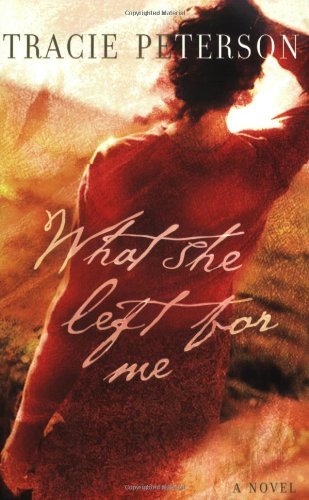
In Tracie Peterson’s novel, What She Left for Me, Jana McGuire is a pastor’s wife who just returned home to Spokane from a three-week missions trip to Africa. Puzzled that no one was at the airport to meet her, she hails a cab and arrives at home to a note on the table. Her husband wrote that he left her for his church secretary and wanted a divorce. Jana saw that he also took anything of value in the house, including her jewelry. At the bank the next day, Jana discovers her savings and checking accounts have been cleaned out, leaving her only $10.

Jana’s husband, Rob, told the deacon board at church two weeks previously that he was resigning because Jana wanted out of the marriage. The church searched for an interim pastor and found one, who was moving into the parsonage that weekend. Therefore Jana needed to move out of her home immediately. When Jana explained her circumstances, the men were more sympathetic. But by that time, the interim pastor was still coming, and Jana still needed to leave.

With no home or money, and finding out she is pregnant, Jana has only one choice. She has to call her mother, with whom she was not close: the mother who kept her at arm’s length all her life, wished she was a boy, sent her to boarding schools, and said she wished she had aborted Jana.

Jana’s mother, Eleanor, had moved to Montana to stay with her octogenarian Aunt Taffy. Eleanor doesn’t want Jana to come, but Taffy is thrilled.

As expected, arguments erupt between Jana and her mother frequently while Taffy tries to be a peacemaker. Jana questions her mother about her upbringing in an effort to understand her better, but her mother shuts down any discussion of her past.

Yet Jana’s presence cause Eleanor’s painful memories to resurface, told to the reader in flashbacks. Eleanor had coped by shutting down all past memories and refusing to be vulnerable or close to anyone.

And Jana, in her pain and bitterness, is beginning to follow in her mother’s footsteps.

Tracie includes a note at the beginning of her book forewarning readers that the book will deal with adultery and child abuse. Tracie avoids graphic details, but she wanted to write the book because, at that time (2005), one in four girls were molested before the age of eighteen. She wanted to help readers understand what people in these circumstances go through and encourage reaching out and offering love and help.

I felt Tracie achieved her goal. But I felt she could have done so a little more efficiently. There’s a lot of repetition of certain points in the book. It’s understandable that in real life, people will bring up the same points while arguing, or people processing situations will cover the same ground repeatedly. But fiction is usually a little more streamlined and progresses more logically from point to point.

Plus, a plot device of someone walking in unheard at a vital point in a conversation was used more than once, when once was enough.

But overall, I felt the book did a good job showing what people in Eleanor’s and Jana’s circumstances go through and answering common questions and feelings, like “What did I do wrong to deserve this?” and “Why didn’t God stop this from happening?” Though the subject matter is difficult, it’s also far too common. I applaud Tracy for writing about it.

Review: A Fool and His Monet

A Fool and His Monet

In the novel A Fool and His Monet by Sandra Orchard, Serena Jones is a new member of the FBI Art Crime Team. She was motivated by the death of her grandfather during an art theft and hopes her new position will help her find his killer.

Serena’s friend, Zoe, the temporary head of security at the local art museum, brings Serena in to report the theft of two paintings in storage, a Monet and a Rijckaert. Since the paintings were in storage, the theft had not been noticed immediately. So the case was already somewhat cold. But Serena immediately begins interviewing museum employees. Her trainer, Tanner, joins her on the case. Oddly, her supervisor makes her stop investigating her lead suspect.

Serena’s mother pesters her to get a nice, safe, normal job and give her grandchildren. Her aunt fancies herself an amateur sleuth and offers Serena advice. The aunt even inserts herself into some of Serena’s investigation.

Though the book has some serious and touching moments, it’s somewhat a comedy of errors. But the case eventually gets solved with many twists and detours along the way.

I enjoyed several art-related details sprinkled throughout the book, especially one quote from Stella Adler: “Life beats down and crushes the soul and art reminds you that you have one.”

There’s a light faith element: a few mentions of God and prayer.

This isn’t my usual genre of book. But that’s one nice thing about Kindle sales: trying something you might not have otherwise.

I admit I got a little lost on some of the details. And I wasn’t fond of Serena’s aunt’s involvement. But overall this was a fun book. If you like figuring out mysteries with comedic undertones, you might like this one.

Review Elderberry Croft

Elderberry Croft

Elderberry Croft by Becky Doughty is a series of stories that take place in the Coach House Trailer Park in southern California after Willow Goodhope moves into Space 12.

Willow is an enigma to her neighbors at first. She festoons her run-down spot with plants, wind chimes, fairy lights, and sun-catchers. She’s gorgeous enough to turn heads, but not at all flirtatious. She takes the initiative to introduce herself to her neighbors, even the standoffish ones, and seems to know just what everyone needs. She has a loud, outrageous laugh. But every now and then, someone will catch just a glimpse of hidden sorrow.

These stories are published in four books, with a sequel called Elderberry Days. I’ve wondered if they were originally published this way, or if they were blog posts or some other venue.

But here’s a little taste of the stories:

Elderberry Croft: Volume 1: January Breeze, February Embers, March Whispers

January Breeze: Kathy Kekoa watches from her window with binoculars as her strange new neighbor move in. Kathy is convinced that everyone in their trailer park has come there to die. Or, at the very least, they’re stuck. But Willow seems vibrant. Until Kathy hears her weeping one night. Willow’s gift of home-mixed tea leaves and other treats when Kathy is sick opens a door of friendship for them.

In her heart of hearts, Kathy yearns for her son, Makani, who hung up on her the last time she tried to call him.

February Embers: Richard Davis suffers from scarring resulting from extensive burns. His wife, Patti, has taken care of him for years. But she feels unappreciated, especially after she notices Richard eyeing the new neighbor. However, an unexpected gesture stirs the embers of the love they almost let die out.

March Whispers: Everyone thinks Joe Sanderson is single. He loves to cook and garden. He’s been content with his secrets. But Willow’s influence persuades him it’s time to step out of his comfort zone.

Elderberry Croft: Volume 2: April Shadows, May Enchantment, June Melody

April Shadows: Shelly keeps to herself, has several cats, follows a rigid routine, and only leaves her house once a week. But a seeming stalker in the neighborhood draws her out of her self-imposed isolation.

May Enchantment: Eddie is the manager of the trailer park. His new tenant, Willow, is sure shaking things up around the place. He feels protective of her, especially when his lazy lecherous brother notices her. When Eddie meets the reported stalker one night, nicknamed Shadowman by the park, his assumptions are upended and he doesn’t know what to think.

June Melody: Myra may be a hypochondriac, but she has a sharp eye to notice and welcome misfits and oddballs. She loves to be needed. But an accident lands her flat on her back, and Willow is the first to help her.

Elderberry Croft: Volume 3: July Madness, August Memories, September Longing

July Madness: Donny Banks, Eddie’s brother, is single again and moves in with his mother—again. She’s always been soft with him and let him get away with most anything. But he’s going too far, and she has to stop coddling him.

August Memories: No one knows Al Tanner’s deepest secret. The day of reckoning he always knew would come has finally arrived. He’s ready to take the consequences. But Willow presents him with another option. Dare he hope life could turn out differently?

September Longing: Prudence Merriweather loves hot pink and animal prints, both in her clothing and decor. She’s been dating Carney, a huge trucker, for ages. But his distance in their last phone call makes her wonder where his heart really is.

Elderberry Croft: Volume 4: October Mourning, November Awakening, December Dawning

October Mourning: Andrea and George met at the post office where they both work and love their lives. Andrea’s pregnancy was a surprise, but they’re both looking forward to their baby’s arrival. But Andrea’s past threatens everything. Willow offers to help, but doing so will mean sharing a painful part of her own past.

November Awakening: Doc is a pleasant man who drinks a little too much. But no one knows he suffers from post-traumatic stress which drove him from his wife and daughters. When he finds Willow burning letters in her yard late one night, he recognizes the pain in her eyes and tells his story, hoping to relieve her.

December Dawning: Willow is finally able to face what she was running from. She knows it’s time to start on the long road to healing. But how can she leave this community who has become family to her?

Elderberry Days: Season of Joy is the sequel to the series. Willow finds that reconciliation and facing the tragedy she ran from is just the first step in healing. The road back to wholeness is a long and slow journey. But her friends help her along the way. In-between chapters of this book are recipes for the elderberry treats and remedies that have been mentioned in the books.

Three things stood out to me in these stories. First, ministry to others doesn’t have to be demonstrated in grand gestures or “official” ministry channels. Thoughtfulness and kindness go a long way. Secondly, it can be therapeutic to help other people with their needs, but it’s no substitute for dealing with your own. Thirdly, everyone has a story. Someone who seems eccentric or oddballish may have hidden hurts.

I got the first set of three stories several years ago when it was free for the Kindle. I just recently rediscovered it when looking to catch up with some of my older Kindle volumes. Of course, when I read the first one, I had to continue with the rest of the series. Thankfully, each book was not expensive.

Willow might seem too good to be true from the description, or the stories a little fairy-taleish. But they are not. The characters and story lines are realistically drawn.

One thing I didn’t like, though, is the description that the author’s books include “a bit of magic now and then.” Magical realism was one of the categories for the book. The only way that really came out was in each character perceiving Willow’s scent in a different way, a way that reminds them of something from their past. Also, Willow often seems to know just what to do or what is needed, but she attributes that to God’s guidance as she prayed. If you’ve got the Lord’s guidance and provision, what do you need with magic? But, as I said, the “magic” wasn’t a major part of the story.

The only other negative was that all the books with the same name or similar names were confusing. Then, after I read all four, I discovered the first four books had been put together in one volume under Elderberry Croft: Seasons of the Heart. (which looks like a separate book until you read the description). It would have saved a little money (at least according to the current prices) to have gotten the one volume rather than four different Kindle books.

But other than that, I loved the stories. I had never read Becky Doughty before, but I’d be willing to read some of her other books now. I enjoyed all the characters (though I lost track of who a couple of them were) and story lines and how everything wrapped up.