Review: The Second Half

The Second Half novel

In The Second Half, a novel by Lauraine Snelling, Ken Sorenson is just about to retire from his university Dean of Students position. He’s looking forward to unstructured days, fishing, and traveling. But office politics threaten the department he spent his career building up and the students he wants it to serve. He struggles leaving all he’s worked for to the office vultures.

Ken’s wife, Mona, has started an event-planning business, which she hopes Ken will help her with when he retires. When a major client considers her services, Mona feels she’s about to get her big break that will establish her company. But Ken is worried that the stress will send her back into the depression that she took so long to recover from. And he keeps talking about traveling. How is she going to work a trip into everything else she has to do?

Then both Ken and Mona get the wind knocked out of them with a phone call from their son. He’s with the Army Special Forces, hoping he’ll get transferred near his parents. Instead, he’s being deployed to Pakistan. His wife left the family, and his parents are the only ones he can ask to take care of his ten-year-old daughter and five-year-old son.

Ken and Mona love their grandchildren, so of course they agree. But not only are their lives and plans are thrown into an upheaval, but they’re not as young as they used to be. Then as the weeks go by, they find that the children have been traumatized by their mother before she left.

On top of everything else, their son doesn’t contact them via Skype from Pakistan at the appointed time. Is he safe?

Lauraine dedicated this novel to all grandparents who have left plans and dreams to take care of grandchildren. “While there are joys as well as hardships and sacrifices, they are gallant people who step up because they love their children and grandchildren, no matter what.”

This story also demonstrates Proverbs 16:9, though I don’t think it’s stated there: “The heart of man plans his way, but the LORD establishes his steps.”

The plot seems chaotic at first, understandable with all that’s going on. But eventually the family works through the trials and issues and finds the aid they need.

Mona struggles with worry throughout the novel, which is also understandable. But one odd place puzzled me: “She’d never been so shocked as when Pastor Oliver preached on worry and used the word anathema. God didn’t just dislike his children worrying, it was anathema to Him” (p. 28, Kindle version). Though the Bible repeatedly directs us to trust rather than worry, I’m not aware of any passage that uses anathema in connection with worry. Plus, it would have been good to explain the term for readers who might not be aware of it.

But overall, this is a great novel. The characters and struggles are realistic, and the ending wraps up beautifully.

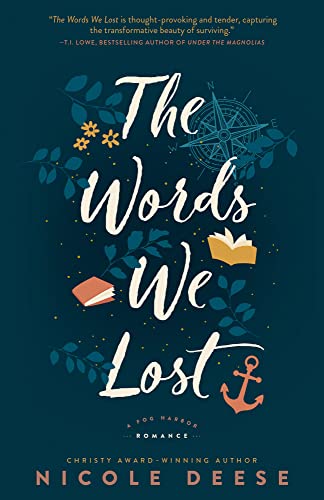
Review: The Words We Lost

The Word We Lost novel

In The Words We Lost by Nicole Deese, Ingrid Erikson moved to western Washington state with her father and became friends with cousins Cece and Joel Campbell when they were all teenagers.

Cece grew up to write a novel, which Ingrid, as an intern at a publishing house, sneaked to her editor. The editor loved the manuscript, bought it, and Cece’s series became runaway best-sellers.

But then Cece tragically died on the operating table during surgery to remove a brain tumor.

Besides losing Cece, Ingrid’s father died several years before. Ingrid blamed Joel and broke contact with him. So she lost all the people and the place she loved most and moved hundreds of miles away.

Ingrid is now a senior acquisitions editor, but she has a hard time functioning due to her grief. She relies heavily on her own intern, Chip. But her new boss can see she’s faltering.

Then Joel suddenly shows up unannounced. The family lawyer discovered a sealed letter addressed to him and Ingrid from Cece. She wanted them to come back home together to retrieve a package.

Ingrid’s boss gives her an ultimatum: find the rumored missing fourth manuscript to Cece’s series, or lose her job.

Ingrid isn’t sure she can go back to the area that she loves, but that brought her so much pain—and do so with Joel. But she doesn’t have a choice if she wants to keep her job.

I bought this book because I loved two of Nicole’s other books I had read. I got the audiobook at first, but the narrator just hit me wrong somehow. So I returned the book and got the Kindle version.

Then the first few pages held one of my pet peeves in writing. 🙂

But once we got past all that and I settled into the story, I loved it just as much as the others.

Some of the quotes I liked:

Success is a slow, long process of repetition (p. 90, Kindle version).

No heartache has ever gone unseen, and no darkness is ever too solid for light to overcome (p. 156).

God is often made visible by the hands and feet of the people He places in our lives (p. 177).

We can’t change the time we’ve spent, just how we choose to spend the time we have left (p. 228).

Even though there are still things to talk and sing and laugh about in this life, there are also things to miss and lament and grieve, too. Both are welcome and both are necessary (p. 367).

I enjoyed the depth of the characters and was pulled into their heartaches. The last few chapters unravel a bit of mystery. After the first few pages, I loved how the story developed and then concluded. I also loved the double meaning in the title. I’m happy to recommend this book to you.


All That It Takes

All That It Takes is a sequel to All That Really Matters by Nicole Deese. Val Locklier had been Molly McKenzie’s virtual assistant in the first book. As Molly’s business expanded, she invited Val to move from Alaska to Spokane for a full-time job.

Moving was a big leap for Val. Not only was she extremely cautious by nature, but she had her ten-year-old son, Tucker, to think about. Leaving the support system of her parents was hard. But she felt it was time to spread her wings.

Molly settled Val in the upstairs apartment her brother rents out. He’s out of the country and left Molly in charge. He usually rents to single guys, but Molly doesn’t think he’ll mind renting to Val. They had met a few months before.

As Val settles in, an opportunity for an elite film mentorship unexpectedly opens up. Val wants to expand in that area, but all her insecurities arise to talk her out of taking a chance.

Molly’s brother, Miles, is unhappily on his way home from Mexico. He is the outreach pastor, but the new senior pastor has cut down on outreach and travel–while setting up things like a gourmet coffee bar. Miles grew up with Pastor Curtis, but never felt Curtis adequately filled his pastor-father’s shoes. People seemed so much more earnest in Mexico, focused on the right things. Disillusioned, he thinks maybe he’ll resign his position and seek an opportunity there. He calls his missionary father to keep an eye out for a position.

When Miles arrives home, he finds two surprises. Val and Tucker now live above him. And Pastor Curtis reassigned Miles to the family resource center, a side ministry that is on its last legs.

Miles feels like he is set up to fail, just marking time until Pastor Curtis closes this ministry as well. But he begins to clean things up, gets to know the one or two people still on staff, and learns about what the facility does. Val agrees to take pictures and help him spiff up the web site, but is unexpectedly pulled into the needs of a young woman who visits the center.

As Val and Miles become more attracted, Val is not sure whether her reservations are her old insecurities or a warning sign not to get involved. “Pastor Miles McKenzie was an adventurer by nature, a traveler of exotic places and an extroverted humanitarian who never seemed to sit still for longer than a minute. And while he’d been nothing but kind to Tucker and me during our brief encounters at the fundraising event we attended last fall and again during Molly and Silas’s wedding this March, I was certain that other than his sister, the two of us had little in common” (p. 12). Val is a single mom certainly not looking for adventure.

As Miles seeks his own will for his future, he finds that God might be leading a different way, and he just might have been wrong about a couple of things.

Some of the quotes that stood out to me:

Give me an essay to write anytime. Or a ten-page paper, for that matter, on any number of subjects that I could research and put into my own words. But don’t ask me to think on the spot. Don’t ask me to provide meaningful answers that determine my future without adequate time to prepare (p. 67, Kindle version).

Every story is original not because of the plot . . . but because each storyteller behind the pen or camera or canvas has an original perspective (p. 107).

You might not be able to make sense of God’s plan or timing, but I can promise you that He isn’t confused (p. 126).

In the midst of trials, it’s tempting to confuse release with relief. But make no mistake, they are not interchangeable. One is long-lasting, the other fleeting (p. 126).

Sometimes all that it takes is one person being willing to step out in love for the betterment of another to change the trajectory of an entire life (p. 270).

I’d much rather my life be defined by a thousand little moments of faithfulness than by one big moment of fame (p. 389).

When I started this book, at first I missed the “sparkle” of Molly’s personality from the previous book. She’s in this story, but as a side character. Val and Miles are quieter people. But as I got to know them, I really enjoyed their story.

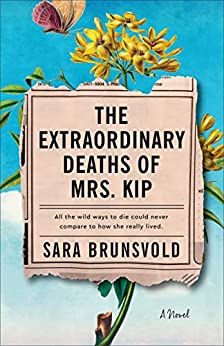
The Extraordinary Deaths of Mrs. Kip

In The Extraordinary Deaths of Mrs. Kip by Sara Brunsvold, Aidyn Kelley has been a cub reporter for the Kansas City Star for a year. But she feels more than ready for a real assignment, not the research she’s done for other reporters and the few light pieces she’s written. She was an award-winning student journalist at the University of Missouri, after all. So she sends a note to the managing editor, bypassing her supervising editor, laying out the reasons she is qualified and eager for meatier assignments.

Aidyn learns there is a reason not to bypass one’s supervisor. The managing editor wants to fire Aidyn, but her supervisor, Woods, advocates giving her a stern-talking to and low-level assignments until she learns humility and respect for the rules.

The first assignment is to interview and write an obituary for a dying septuagenarian, Mrs. Clara Kip. Aidyn dreads visiting the hospice center and talking to a dying woman. But if she wants to keep her job, she has no choice.

Aidyn finds more than she bargained for in Mrs. Kip. But Mrs. Kip isn’t going to unfold her story all at once. She wants Aidyn to make up some extraordinary deaths for her, and for every one, she’ll be allowed to ask Mrs. Kip three questions.

I don’t want to say too much more about the plot, because discovering Mrs. Kip’s personality and background along with Aidyn is half the pleasure of reading this book. I had thought, at first glance, that the story line would be pretty predictable. But the author throws in lots of surprises.

Alongside Aidyn’s journey, Mrs. Kip is dealing with the fact that she is dying, having to accept the weakening of her body and her confinement to the hospice center. Even so, she feels God has a couple more things He wants her to do before she runs out of steam.

Some of the quotes that stood out to me:

She could only trust that the Lord was up to something. Because he usually was (p. 2).

Clara gazed at the sliding glass doors of Sacred Promise. Such an odd feeling to know that once she walked in, she would not walk out. She clung to the belief the Lord had something for her here, so she shuffled forward. (p. 12.).

“I did nothing amazing, Miss Kelley,” she insisted. “Despite what you’ve been told. I simply tried to love people as best I could for as long as I was privileged to be with them. We don’t stay long in each other’s lives—that’s the crux of our humanness. You have to be the friend people need while they are there with you, because it’s the only chance you’ll get.” (p. 198).

The Lord will give you all the words you need. It’s not about whether they sound pretty. It’s about what he will do with them (p. 200).

This was a touching and encouraging story in many ways.I enjoyed both Aidyn’s and Mrs. Kip’s journeys.

All That Really Matters

In Nicole Deese’s novel All That Really Matters, Molly McKenzie’s video channel about makeup and fashion has over half a million followers. She has corporate sponsors, a virtual assistant, and a manager who became her boyfriend.

Her manager shares an opportunity to host a makeover show. But first, she needs to increase her followers even more. And she needs a cause to show her compassionate, involved side.

Molly seeks advice from her pastor brother, and he directs her to a mentor program for kids transitioning out of the foster care program.

But the program director, Silas, is not impressed by Molly at their first interview. His kids are dealing with serious, real-life problems Molly knows nothing about. How could she help them?

When Molly comes back to him with a well-thought-out plan for classes, Silas decides to give her a chance. And his life and program are never the same.

At first, Molly is motivated to simply get this requirement out of the way. But as she gets involved with the kids, especially Wren, a quiet outsider of the group, Molly begins to really care about them.

Just as Silas begins to appreciate that there’s more to Molly than her sparkling online presence, a series of crises come that cause Molly to question her identity and purpose.

The first part of this book was just delightful. Molly is not the kind of character I’d normally connect with, but Nicole took care not to make Molly a caricature. She’s enthusiastic, but not overly bubbly. And, as Silas discovered, she’s not empty and vain.

Silas is a serious, caring, but by-the-book director. I like how Molly’s influence loosened him up a little. One reviewer thought they had something like the Maria/Captain Von Trapp vibe in The Sounds of Music.

When the crises came, my heart went out to Molly and the other people involved. Nicole drew all the characters so well and infused the plot with both humor and pathos.

Here are a few of the quotes I loved:

Of helping without overstepping. It’s difficult to see real needs and not want to rush the process to appease our own desire for restoration (p. 125, Kindle version).

But more often than not, the best rescue plan we can offer someone we care about is our support for each step they take forward (p. 209).

I think we first have to understand just how deeply we are already loved that way—by God. Then we can love each other out of the response to His love for us (p. 247).

You don’t honor God with your life by changing your personality and tossing out everything that is unique about who you are. You honor Him by offering those very gifts back to Him (p. 331).

This is the first book I’ve read by Nicole, but it won’t be the last. In fact, I loved this book so much, I already started the sequel, All That It Takes.

Wrapping Up Two Christmas Reads

I just finished my last two Christmas novels and thought I’d review them together.

In Hope for Christmas: A Small Town Christmas Romance Novella by Malissa Chapin, Merry Noel (who insists her last name is pronounced Knoll, not No-el) is trying to close one last deal before Christmas Day. If she can’t get everything together for it, the client will call the deal off. But her office is in the midst of a Christmas party and she can’t get anyone to make copies or do the things needed to close the deal.

Even without the pressure of this last deal, though, Merry hated Christmas and wouldn’t be celebrating.

After a disastrous series of events, Merry ends up losing her job. She didn’t want to go home to Wisconsin, but she has nowhere else to turn.

Having gotten used to city life in Atlanta, Merry chafes at going back to the farm. And how crazy was it to come back when the whole town was in the throes of their annual community Christmas celebration.

But her mother’s new neighbor, time with her mother, a blizzard, and an unexpected visitor in need all help Merry face her issues.

When I first started reading this, I thought it was going to be a modern retelling of A Christmas Carol. A couple of Merry’s coworkers even call her Ms. Scrooge. But Merry’s motivations aren’t related to business or finance.

I very much enjoyed Merry’s journey and this story, which were both heart-warming and faith-filled.

Malissa is the author of a book I read and loved last year, The Road Home (linked to my review). She also wrote Murder Goes Solo: A Piper Haydn Piano Mystery, which I have not read yet. Cozy mysteries are not my favorite fare, but I do read them sometimes, so I probably will check this out at some point.

I had not heard of Beth Moran before. But I had finished my audiobook a few days before Christmas and wouldn’t get another Audible credit until the end of the month. So I looked around Audible’s “free with a subscription” selection, and Beth’s Christmas Every Day caught my eye. I’m wary of modern secular fiction because usually it has bad language or bedroom scenes. But I figured this was low risk–if I came across something objectionable, I could just delete it from my library.

Jenny is another Christmas-hater, but for different reasons. Since her parents’ divorce, she usually spent holidays alone. But in light of her impending engagement, she has every hope that she’ll spend Christmas in a lovely place with a real family this year.

But then her boss/secret boyfriend announces an engagement not with Jenny, but with her beautiful, popular twin sister.

Jenny leaves for an old cottage in Sherwood Forest that she inherited from her grandmother, who passed away six years earlier. She expected the place to need a little clean-up. But she hadn’t known her grandmother had become a hoarder or that the house would need so much.

She gets off on the wrong foot with her curmudgeonly neighbor, Mack. But slowly, she begins to form friendships with other people in the village and gets a job.

Then she’s invited to an unusual book club. A couple of the participants are so cantankerous that they can’t agree on what books to read. So the group decides to shift focus and work on a personal challenge for the coming year, reporting on their progress at the monthly meetings instead of books. A private investigator wants to learn to bake. A dying older woman has a list of daring feats she wants to accomplish. A single mom wants to find a good man with whom she can have a real relationship. A super-fan wants to find the location of a reclusive author said to live in their area and invite her to the book club.

As Jenny deals with the house, her new job of minding a lively family of five children, her neighbor, and her new friends, she finally learns what belonging and family are all about.

This story is funny in places and heart-warming in others. Jenny’s series of comedic disasters got a little old at one point—but I guess I got used to them, or maybe they just toned down a bit. They kept happening but didn’t seem so outlandish as at first.

Even though this is written from a secular standpoint, there was a really good section on forgiveness.

There was a smattering of bad words, but otherwise the story was very clean.

Helen Keely did a superb job narrating the audiobook. I had to slow down the narration just a tad, as the British accent spoken very quickly was hard to understand in places.

I liked this books so well that I am willing to try more from this author. And I hope Helen Keely narrates them all.

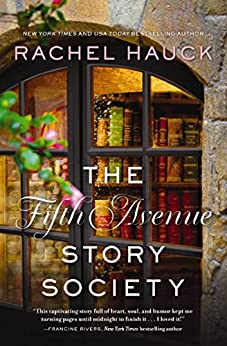
The Fifth Avenue Story Society

(I’m sorry not to have a “Laudable Linkage” post today. I just haven’t had time this week to do much online reading. But I did finish an audiobook I wanted to share.)

In Rachel Hauck’s novel, The Fifth Avenue Story Society, five New Yorkers receive a mysterious invitation to join said society at the library on Fifth Avenue.

Lexa is an executive assistant to the owner and originator of a growing fast food chain. She came up with her boss from the early days of the company to bring it into the limelight it enjoys now. Since she practically fulfills the CEO role, she pushes for that position. But her boss holds her off.

Jett is a college professor grieving over the loss of a marriage in which he’s not quite sure what went wrong. He’s writing his dissertation on his favorite author, determined to quell suspicions that the author is a fraud. But he secretly harbors his own doubts.

Chuck is an Uber driver. His angry response when he discovered his wife was cheating led her to acquire a temporary restraining order. Now he just wants to see his kids and be part of their lives.

Coral is the heiress and president of the multi-million dollar cosmetics company her grandmother founded. Coral became known publicly as the “panicked princess” when she fled her marriage to a prince at the last minute. And her first new product seems to be tanking, despite all the early promising test results.

Ed is an aging retired newspaper man. Now an apartment building superintendent, all he wants to do with his remaining time is write his memoir about his wonderful wife and the love they had together before she died.

When the five meet for the first time, no one knows who sent the invitation or why. After their initial wariness, curiosity and the need for friendship encourages them to continue.

Each is a wounded soul. Each has a dark, guarded secret they are not willing to share with the others. But as they get to know one another and their lives entwine, can they trust each other enough to share their deepest selves?

I had read only one Rachel Hauck novel before about nine years ago, and on purpose had not read her again. In that case, the story was mostly okay, but some of the writing grated. I did not see those problems with writing in this book. I enjoyed the characters’ stories quite a lot.

The one thing I didn’t like in this book was references to some of the characters’ intimate lives. There are no explicit sex scenes, but there are more references than I am comfortable with.

I’m also wary when both the author and one of her characters claim that God spoke audibly to them.

Also, each book had one mysterious character. The one in the previous book struck me as something of a fairy godfather. The one here merges as something akin to an angel in disguise, but is more likeable and believable than the character in the previous book I read. I don’t know if such characters are a hallmark of all this author’s books.

I had thought at first that this was a Christian fiction book, then thought that it wasn’t. But late in the story, one character does share her faith journey.

I’m left with mixed emotions. The overall story and the emerging of each character’s situation were very good. I was caught up in their lives and hoping for the best resolution for each of them. But some of these other elements put me off.

The London House

In Katherine Reay’s novel, The London House, Caroline Payne was working through an ordinary day until she received a phone call from an old college friend, Mat. He wanted to meet with her about her aunt, of all people. Caroline had been named for great aunt, the twin sister of her grandmother. But the older Caroline had died of polio when she was a child. What could Mat possibly want to know about her?

Mat was working on an article where he inadvertently uncovered information claiming that Caroline’s great aunt had been a Nazi collaborator who ran off with her German lover. As Caroline refutes Mat’s claim, Mat brings up evidence that looks genuine.

Caroline asks for time to research the issue on her own. She flies to London to the home of her late grandmother, now occupied by her mother. They find letters between the twins and diaries of Caroline’s grandmother, Margaret. As Caroline wades through them, she is taken back to the 40s and the twins’ coming of age in a life of privilege before war hit. But life-threatening illness and family tension separated them. Some of that tension remained to the current day in the distanced relationship Caroline has with her own parents. Will Caroline’s discoveries heal old wounds or make them worse?

I don’t know if this would be classified as a time-slip novel, but with some of the letters and diaries, we’re transported back to the setting and activities of the twins’ earlier days. In that sense, it’s also partly an epistolary novel. Katherine has a note at the end of the book sharing what elements were true or fictional.

I enjoyed the uncovering of clues in the older Caroline’s letters and the dynamics that brought healing to the younger Caroline’s family. Although WWII seems to be the setting of more novels than any other era, I do enjoy them even while I sometimes long for glimpses of other time frames.

It’s funny how certain themes seem to go around at the same time. For instance, I had never heard of the Monuments Men (who recovered art stolen by the Nazis) until the movie made about them a few years ago. But just this year I’ve read a book about them and seen them mentioned in others. Now there seems to be a theme of dressmakers involved in WWII, with The Paris Dressmaker by Kristy Cambron and this one and others. I hadn’t realized this book was going to involve haute couture and dressmaking until I got into it.

All of Katherine’s other books that I have read have been Christian fiction to some degree. I didn’t know that this one was not until I saw a review on Goodreads noting that this book was published under the new Harper Muse imprint and not Christian fiction. That’s not a problem in itself. Christian authors have many reasons for writing stories that aren’t blatantly Christian. Katherine does mention C. S. Lewis’s radio talks of the time which were later transformed into Mere Christianity.

But I was disturbed by a couple of elements in the book. One of the older Caroline’s letters describes her first sexual encounter. Thankfully, it stops before it gets too explicit. But the younger Caroline suspects her grandmother tore the rest of the description out of the letter because she was a “prude.” Then, the older Caroline was employed by Elsa Schiaparelli, a rival to Coco Chanel. She mentions the sexual innuendoes of some of the designer’s work, especially those in collaboration with Salvador Dali—and then proceeds to bring one beyond innuendo and spells out the sexual connotation of it. I could have done without that.

So, I have mixed emotions about the book. The story overall was good, but I was disappointed the sexual elements. Even though they probably would be considered tame by most other modern secular fiction, they were still too much for me.

I listened to the audiobook nicely read by Madeleine Maby, but then also caught the Kindle version on sale and read parts in it as well.

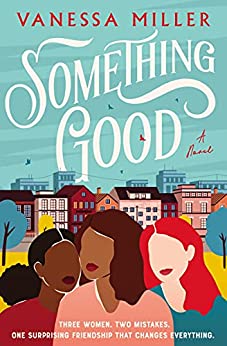
Something Good

The tagline for Vanessa Miller’s novel, Something Good, is “Three Women. Two Mistakes. One Surprising Friendship That Changes Everything.”

Alexis Marshall seemingly has it all: a good husband, family, home, and a generous source of income. She appreciates her husband’s rescuing her from an unstable home life. But it’s a strain living up to his standard of perfectionism.

Then the unthinkable happens. While fumbling to respond to a text while driving, Alexis loses control. The resulting accident leaves a young man paralyzed.

Alexis is consumed with guilt and wants to do something to help the young man. But her husband is about to make a lucrative deal selling the tech company he built. If it becomes public that Alexis caused an accident, the sale would be in jeopardy.

Marquita Lewis is a mouthy teenager who doesn’t understand why she can’t keep a job. She’s determined not to live in shelters as her mom did. She wants better for her baby son. When she loses her latest job, she decides maybe it’s time to confront the baby’s father.

Trish Robinson’s life was turned upside-down when her son, Jon-Jon, was paralyzed. He was in college on a football scholarship with a good chance of going pro. But that potential bright future is gone now. He is so depressed, he’s not even trying in his physical therapy sessions.

Trish’s husband, Dwayne, is enraged at the woman who caused the accident and feels she should be doing more. Trish thinks they should forgive and forget and move on. She’s doing all she can to help Jon-Jon, and now Dwayne is pressuring her to get a job. But how can she leave Jon-Jon alone when he can’t take care of himself?

Trish prays for something good to come from all their trials. But the answer comes in a surprising way.

It was enjoyable to read of friendships that crossed so many differences–race, economic status, personality. etc. It was difficult and took time, but the characters learned and grew through their interactions.

And it was especially refreshing to see a Christian fiction book that was all-out Christian. I know some stories call for subtlety, but some are so subtle that it’s not clear who the characters have faith in or what kind of faith they have. I’m thankful Vanessa created her characters to express their faith in natural and believable ways. Even though the faith element is clear, it’s not heavy-handed.

A couple of sub-plots deal with mental illness in a couple of the families.

My favorite quote from the book: “Sometimes our greatest tragedies become the greatest gifts we can give back to the world” (p. 298, Kindle version).

I had not heard of Vanessa Miller before seeing this book on a Kindle sale, but I am glad I did. I enjoyed this book quite a lot.

Christmas By the Sea

In A Christmas by the Sea by Melody Carlson, Wendy Harper and her son, Jackson, are in the midst of hard times. Wendy’s husband passed away, and she is left with a mountain of medical bills.

Then she learns that she has inherited her grandparents’ cottage by the sea. She had visited them several summers as she grew up. Though she loves the cottage, she knows she has to sell it to get back on her feet financially. So she and Jackson drive down to spend a few days fixing the cottage up.

Jackson, who has been having a hard time since his father died, is renewed by the town and the cottage. He thinks they are going to stay. Wendy doesn’t want to disappoint him, so she puts off telling him that they have to sell the place.

When Wendy goes shopping for supplies, she meets a helpful man, Caleb, who she takes to be store employee. Later she discovers he is a local craftsman who owns his own store, while his mother owns the tourist shop Wendy remembers from her childhood.

Wendy faces challenges in her renovations, her need to tell Jackson her plans for the house, her deciding what to do next in life, and her growing relationship with Caleb.

I loved the nontraditional setting for a Christmas story. As I’ve mentioned before, I grew up on the coast of southern Texas, so my early Christmases didn’t contain snow and sledding and such.

My one complaint is that the story wrapped up awfully quickly and a bit unrealistically. But otherwise, I thought it was a nice book.