Review: Dombey and Son

Dombey and Son

Mr. Dombey of Charles Dickens’ Dombey and Son was originally the son of the establishment by that name. Now he’s the father, his only son having just been born. Already he has plans and dreams for when his son is old enough to go into the family shipping business with him.

The Dombeys had a girl six years before, “But what was a girl to Dombey and Son! In the capital of the House’s name and dignity, such a child was merely a piece of base coin that couldn’t be invested” (p. 8, Kindle version).

Mr. Dombey’s wife, however, weakens fast and dies before the baby, little Paul, is a day old.

A wet nurse is hired, and Paul grows, but he’s never very strong. He and Florence are sent to Brighton to be aided by the sea air. Paul does so well that he stays there for school, with Florence helping him with his studies.

But Paul dies at age six.

Mr. Dombey does not open his heart to grieve with Florence. He’s barely aware of her.

Some years later, on a vacation with a friend, Mr. Dombey meets a widowed Mrs. Edith Granger, who is beautiful but proud and cold—just his type. Her mother and his friend connive to get the two together. Eventually they marry.

But once again, Mr. Dombey is disappointed. He had thought his wife’s pride would be blended with his own and transferred to his reputation, standing, and business. But proud people do not usually blend their pride with others. Thus the Dombey establishment is set for conflict.

In one brief scene, we see the reason behind Edith’s demeanor. For all her coldness to everyone else, the new Mrs. Dombey loves Florence. Yet Mr. Dombey is jealous that Florence receives the attention and warmth he doesn’t, and he takes it out on her.

Aside from his dysfunctional household, Dombey has a conniving, obsequious assistant named Mr. James Carker. We know Mr. Carker is up to no good, despite his flattery, but it takes a while before we find just what he is planning.

As always, Dickens weaves together many subplots into his narrative.

A young boy named Walter Gay works for Dombey. His uncle runs a shop where he makes and sells shipping instruments. One day when Florence is separated from the children’s nurse and lost, she runs into Walter, who sees her safely home. Though Mr. Dombey appreciates the effort, he doesn’t like him. When he misunderstands an action of Walter’s, he sends him to Barbados. But the ship is not heard of again, and Walter’s uncle goes to look for him.

A creepy, avaricious elderly woman named Mrs. Brown finds Florence when she is lost and makes her change her fine clothes and shoes for rags so she could sell them. Later, Mrs. Brown’s daughter returns from prison nursing a hatred for Mr. Carker, who had some part in sending her there. These two appear at intervals through the book.

Mr. Toots is a kind-hearted but weak-minded fellow student at Paul’s school who loves Florence and also turns up at intervals.

Mr. Carker’s brother, John, was guilty of wrongdoing in the firm some years earlier, but is repentant, humbled, and reformed. James continually belittles and argues with him. Their sister, Harriet, went to help John in his trouble, causing James to cut off relations with her. A mysterious stranger shows up later to John and Harriet’s home to offer help when they need it.

Besides these, there are a number of colorful characters, some comic and some cruel.

I love how Dickens phrases some things:

Son lay tucked up warm in a little basket bedstead, carefully disposed on a low settee immediately in front of the fire and close to it, as if his constitution were analogous to that of a muffin, and it was essential to toast him brown while he was very new (page 7, Kindle version).

Time and his brother Care had set some marks, as on a tree that was to come down in good time—remorseless twins they are for striding through their human forests, notching as they go (p. 7).

. . . the nurse, a simpering piece of faded gentility (p. 8).

He was a slow, quiet-spoken, thoughtful old fellow, with eyes as red as if they had been small suns looking at you through a fog (p. 27).

Snails were constantly discovered holding on to the street doors, and other public places they were not expected to ornament, with the tenacity of cupping-glasses (p. 70).

It being part of Mrs. Pipchin’s system not to encourage a child’s mind to develop and expand itself like a young flower, but to open it by force like an oyster . . . (p. 71).

There was never a man who stood by a friend more staunchly than the Major, when in puffing him, he puffed himself (p. 185).

Sometimes she tried to think if there were any kind of knowledge that would bespeak his interest more readily than another. Always: at her books, her music, and her work: in her morning walks, and in her nightly prayers: she had her engrossing aim in view. Strange study for a child, to learn the road to a hard parent’s heart!  (p. 208).

Harriet complied and read—read the eternal book for all the weary and the heavy-laden; for all the wretched, fallen, and neglected of this earth—read the blessed history, in which the blind lame palsied beggar, the criminal, the woman stained with shame, the shunned of all our dainty clay, has each a portion, that no human pride, indifference, or sophistry, through all the ages that this world shall last, can take away, or by the thousandth atom of a grain reduce—read the ministry of Him who, through the round of human life, and all its hopes and griefs, from birth to death, from infancy to age, had sweet compassion for, and interest in, its every scene and stage, its every suffering and sorrow (pp. 520-521).

I think I can say the story is redemptive without giving away the ending. And though this is a sad story in many ways, Dickens sprinkles many choice comic moments throughout.

I wanted to read this book partly because I’ve purposed to read the Dickens books I’ve not read yet, and partly because this book played a significant part in The British Booksellers by Kristy Cambron, which I recently read. I wondered if there was some connection between the stories or whether it was included because it would have been popular at the time.

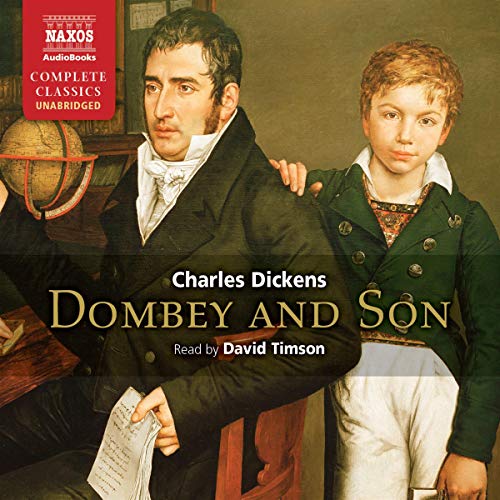
I listened to the audiobook superbly read by David Timson. His voice characterizations and inflections added so much to my enjoyment of the book. When I look for my next Dickens’ book, I am going to see if I can find one narrated by Timson. That may be soon, as this book reminded me how much I love Dickens.

Book Review: Bleak House

Bleak HouseIt’s hard to summarize in a line or two what Bleak House by Charles Dickens is about, as there are several story lines going on at the same time. In fact, it is a little hard to get into at first because, like A Tale of Two Cities, different strands of the whole are mentioned individually at first and not woven together until several chapters in (as opposed to David Copperfield, which starts at the beginning with David’s birth and progresses from there.) SparkNotes helped a lot with the early chapters, although I’d advise against reading the character list or overview until after you are well into the story due to spoilers (ditto with the Wikipedia article on the book). I followed the individual chapter discussions and analysis on Sparknotes.

The point of view switches back and forth from a third person present tense narrator to a first person past tense narrative of Esther, one of the main characters. From what little I’ve read Dickens was praised by some and criticized by others for this. The two viewpoints do give us the advantage of two perspectives and I enjoyed hearing both.

One strand of the story is the case of Jarndyce vs. Jarndyce which has been languishing in the Court of Chancery for years. Dickens based the Chancery on the real-life one, and the opening foggy scenes are symbolic of it. One note said the Jarndyce case was based on a real one that went on for 53 years. We’re not really told what the case is about except that the inheritance of some of the characters are tied up in it. John Jarndyce himself has given up on it and wants no more to do with it.

Another strand of the story involves bored, cold, haughty Lady Dedlock, whose demeanor, we discover, hides a secret sorrow and then a secret fear.

Another involves Esther Summerson, an orphaned girl who was raised by her aunt until the aunt dies, then sent to school, then asked by John Jarndyce to become a companion to his niece, Ada, who had become his ward as well as a nephew, Richard. Esther shares the narrative at points, and one of the interesting things about the writing is how her voice seems faltering at first (she claims she is not clever) and then gains confidence as she goes on.

Ada and Richard fall in love, which pleases Mr. Jarndyce, but he urges Richard to choose a profession before the relationship goes any further. Richard is affable and likable but doesn’t have any clear interests. He tries apprenticing at a few different professions before ending up in the military. However, after visiting the Chancery one day, he gets caught up in the Jarndyce case, and it becomes the focus of his life, despite his guardian’s warnings against pinning his hopes on the outcome of a case that could go on for years.

Another strand involves the poor of the town, particularly a mother, Jenny, whose baby dies, and a boy named Jo who is apparently homeless and constantly being told to “move on.” Others involve a somewhat flighty lady named Miss Flite who has been waiting for years for her own settlement and the noble soldier George Rouncewell.

One of Dickens’ skills is creating memorable characters, and there are some four dozen in this book. There is Mrs. Jellyby, caught up in the cause of Borrioboola-Gha in Africa while severely neglecting her own family. Inspector Bucket was based upon a real Scotland Yard detective and is reputed to be one of the first detectives in English literature. Mr Skimpole, whom I did not like, was also based on a real person (who evidently did not take kindly to the portrayal.) He calls himself “a child,” especially in business or money matters, but something about him seemed not quite right to me, which proved to be the case. He did not have the same endearing qualities as the feeble-minded Mr. Dick of David Copperfield.

There are different kinds of love portrayed – romantic, familial, friendship. If I can say this without giving away a major plot point, the Dedlocks certainly don’t seem the epitome of a warm and loving couple, but his response late in the novel showed he loved her deeply. I particularly loved the Bagnets and his calling her “the old girl” and asking her to tell his opinions. One of my favorite scenes was her birthday when the family was making her dinner while she tried to subtly signal to her daughters to add more of this, less of that, and nothing was done the way she would have done it herself, but she endured with grace out of love for them and their efforts.  There are a couple of mysteries, including a murder. There is a case of spontaneous combustion, which Dickens was severely criticized for including, but he countered that at the time he wrote it was thought to be a real phenomenon. There are different people affected by the Chancery, mostly negatively. There are observations of social injustice. There is sadness and joy and humor. There are a lot of secrets causing varying degrees of sorrow to those involved. There are a variety of reconciliations, a couple of them sorely delayed due to pride and shame, and the most heartbreaking is the one that did not occur but could have.

Esther’s story did end up where I hoped it would. One of the oddest things in the story (minor spoiler alert) was when her guardian proposed. That seemed a little creepy to me, but he releases her from the engagement later on. Another favorite scene is after he proposes, when Esther is in her room brushing her hair, determining to make him very happy, but crying, for reasons which she doesn’t quite know – or at least doesn’t tell the reader, but the reader guesses. It’s not a favorite scene because she is crying but because of Dickens’ way of showing what was going on in her heart without spelling it out.

I have heard the 2005 BBC production is really good and would like to see it some time. Here is a trailer for it:

But as it is over 8 hours long, I might have to wait for a heap of ironing or some sick days or summer break when there is nothing else on.

I listened to the audiobook narrated by Peter Batchelor but dipped into the hard copy at points and read its introduction and afterword as well.

Some say this is Dickens’ best; some disagree. I think it is masterfully written and I enjoyed it a lot (especially the last third or so of it), but I liked A Tale of Two Cities and David Copperfield much better. Dickens’ books usually improve upon rereading, though, so next time I visit Bleak House I might enjoy it even more.

(This will also be linked to Semicolon‘s Saturday Review of Books.)

This also completes one of my requirements for the  Back to the Classics Challenge hosted by Karen at Books and Chocolate.

classics2014

.