
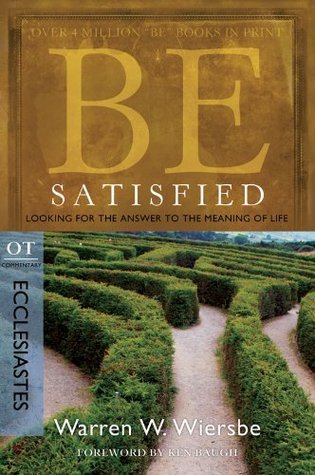
Be Satisfied (Ecclesiastes); Looking for the Answer to the Meaning of Life is Warren Wiersbe’s commentary on that book of the Bible.
Ecclesiastes is a little different from the rest of the Bible. It almost sounds pessimistic at first glance. I like to think of it as “Life in a fallen world from a human point of view.”
Solomon writes about the “vanity” (a word used 38 times in this short book, meaning “emptiness, futility, vapor, that which vanishes quickly and leaves nothing behind,” p. 15) “under the sun” (a phrase used 29-times along with “under heaven” ). It’s assumed that Solomon wrote this book later in life. He calls himself “the Preacher” here, which, Wiersbe said, comes from a word which is “the title given to an official speaker who calls an assembly” (p. 17). “The Greek word for ‘assembly’ is ekklesia, and this gives us the English title of the book, Ecclesiastes” (p. 17).
But the Preacher did more than call an assembly and give an oration. The word koheleth carries with it the idea of debating, not so much with the listeners as with himself. He would present a topic, discuss it from many viewpoints, and then come to a practical conclusion. Ecclesiastes may appear to be a random collection of miscellaneous ideas about a variety of topics, but Solomon assures us that what he wrote was orderly (12:9) (p. 17).
Some of the “vanities” Solomon observed:
You work hard all your life—and then you die.
Rich or poor, wise or foolish, everyone ends up in the grave.
The person you leave your accumulations and money to may not manage them well, but there’s nothing you can do about it.
Wealth and achievements don’t satisfy, at least for long.
There’s injustice even in the very places that are supposed to promote justice.
Power often rests with oppressors, leaving the oppressed no comfort or help.
Life seems like an endless cycle of the same old thing.
Sometimes good people suffer wrong and the wicked are rewarded.
We’ve all made some of the same observations, and that can make life seem pretty bleak.
Thankfully, though, those facts don’t tell the whole story.
Life is “not in vain” if it is lived according to the will of God, and that is what Solomon teaches in this neglected and often-misunderstood book (p. 17).
When you belong to the family of God through faith in the Son of God, life is not monotonous: It is a daily adventure that builds character and enables you to serve others to the glory of God. Instead of making decisions on the basis of the vain wisdom of this world, you will have God’s wisdom available to you (James 1: 5) (p. 22).
Face life honestly, but look at life from God’s perspective. Man’s philosophies will fail you. Use your God-given wisdom, but don’t expect to solve every problem or answer every question. The important thing is to obey God’s will and enjoy all that He gives you. Remember, death is coming—so, be prepared! (p. 24).
In Ecclesiastes 3: 11, Solomon explains why men and women are not satisfied with life: God has put “eternity in their heart” (NASB, NKJV) and nobody can find peace and satisfaction apart from Him. “Thou hast made us for Thyself,” prayed St. Augustine, “and our hearts are restless until they rest in Thee” (p. 31).
Life is something like a doctor’s prescription: taken alone, the ingredients might kill you; but properly blended, they bring healing. God is sovereignly in control and has a time and a purpose for everything (Rom. 8: 28). This is not fatalism, nor does it rob us of freedom or responsibility. It is the wise providence of a loving Father who does all things well and promises to make everything work for good (p. 54).
God balances our lives by giving us enough blessings to keep us happy and enough burdens to keep us humble (p. 105).
Solomon does mention some of the blessings of life as well: enjoying the rewards of your labor, companionship, food and drink, wisdom, and more.
He includes some general proverbs and warnings.
Solomon concludes his observations by saying, “The end of the matter; all has been heard. Fear God and keep his commandments, for this is the whole duty of man. For God will bring every deed into judgment, with every secret thing, whether good or evil” (12:13-14).
Solomon was not suggesting that we are passive actors in a cosmic drama, following an unchangeable script handed to us by an uncaring director. Throughout this book, Solomon has emphasized our freedom of discernment and decision. But only God knows what the future holds for us and what will happen tomorrow because of the decisions we make today (p. 124).
Though man’s wisdom couldn’t explain everything, Solomon concluded that it was better to follow God’s wisdom than to practice man’s folly (p. 147).
When Solomon looked at life “under the sun,” everything was fragmented and he could see no pattern. But when he looked at life from God’s point of view, everything came together into one whole. If man wants to have wholeness, he must begin with God (p. 157).
After the beautiful “For everything there is a season” passage, Solomon says this:
I have seen the business that God has given to the children of man to be busy with. He has made everything beautiful in its time. Also, he has put eternity into man’s heart, yet so that he cannot find out what God has done from the beginning to the end. I perceived that there is nothing better for them than to be joyful and to do good as long as they live; also that everyone should eat and drink and take pleasure in all his toil—this is God’s gift to man (3:11-13).
We won’t understand everything in this life. But we know everything is not as it appears. God sees the big picture. And this life is not the end. His ways are best.
I enjoyed this time with Ecclesiastes, and I feel I gleaned more from it than I have before. The ESV Study Bible notes and Wiersbe’s thoughts were a big help.
(I often link up with some of these bloggers.)

 Stray Thoughts