
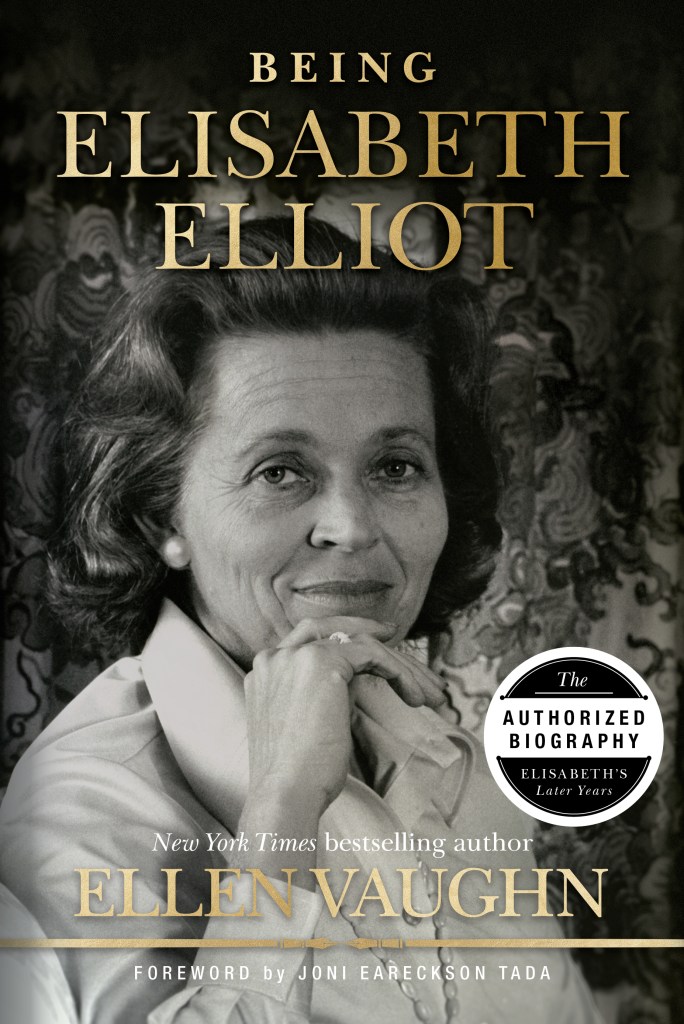
Review: Being Elisabeth Elliot

Being Elisabeth Elliot is the second of a two-part biography of Elisabeth by Ellen Vaughn. The first was Becoming Elisabeth Elliot (linked to my review).

I’ve written more about who Elisabeth was in that first review and her influence in my life here, so I won’t go into all that again.

Vaughn’s was the authorized biography: she had access to all Elisabeth’s remaining journals and many letters.

After spending months agonizing over whether to leave or stay in South America, Elisabeth finally felt God would have her go home and be a writer. This volume begins with Elisabeth’s return to the US from Ecuador in 1963 with her young daughter, Valerie.

But then she struggled with what to write, now that she had the time and freedom to.

Plus she was processing much of what had happened in her life so far. Christian literature and missions meetings were filled with victorious tales which she had not experienced. “She railed against the image-conscious habits of the Evangelical Machine, whose every story must end with glorious conversion and coherent happy endings, lest God look bad” (p. 272). She rethought some of her legalistic upbringing. She found that often, God’s ways were inscrutable. He couldn’t be boxed in, figured out, or predicted.

But she found Him trustworthy nonetheless. He may not respond the way we think He should. But He proves Himself good, wise, and holy.

Her private musings during this time period might be shocking and disturbing to some. But I think many of us ask some of the same questions at points in life.

In her first book after the initial ones about her husband, his friends, and their ministry trying to reach the Waorani tribe (then known as Aucas), she wrote a fictionalized account of her experiences in No Graven Image. The book was not well-received. Many misunderstood that the graven image in question was their man-made perceptions of what God should be like.

Vaughn goes on to tell of Elisabeth’s struggles with writing, her widening speaking ministry, her challenges raising Valerie, her surprising second marriage, her husband’s agonizing death from cancer, and her third marriage to Lars Gren. She mentions how some of her books came into being, especially the first few. I would have liked to learn more about the rest of her books.

I was surprised how often Elisabeth said in her journals that she never sought a platform, never wanted to get in the middle of a public debate on thorny issues (especially femininity in a feminist word). But she felt as God gave her openings, she needed to share His truth.

Though she came across as self-assured, she struggled with self-doubt.

I was surprised to learn that she dearly wanted to write a great work of fiction.

From the time Elisabeth Elliot returned to the United States from Ecuador in the early ’60s, she had devoured classic and modern literature that evoked the human condition against the backdrop of God’s mysterious universe. She wanted to write great novels. She wanted to engage and stir urbane New Yorkers. She wanted to call into being essential human truths through the power of story. She wanted pages that she had written to stir people’s hearts in the same way she was so deeply stirred, her heart and eyes lifted up, by well-crafted literature, visual art, and music (p. 253).

She attempted this, but ultimately felt it was beyond her. Many of us are glad God led her as He did, writing nonfiction for Christian women.

Much of what I would have liked to know more about was lost due to Lars burning “most of her journals from the years of their marriage, a choice he now regrets” (p. 274).

I started this book with reticence because I had heard negative things about it. I thought Vaughn’s writing was engaging and readable. I agree that she shared some things from Elisabeth’s journals about her physical relationship with her second husband, Addison, that would have been best left out. I agree, too, that she inserted herself into the narrative more than she should have. Vaughn’s husband died of cancer right after she wrote about Addison Leitch’s death, and having traveled this journey with Elisabeth through her journals was a help to her. But this would have been better placed in an appendix or afterword. Plus she “argues” with Elisabeth in an imaginary conversation as to whether or not she should have married Lars. In various other places, we’re aware of the author in ways we should not have been.

I appreciated Vaughn’s difficulty in trying to tell the truth about Elisabeth as best she could. I can’t imagine filtering through all the material available to her and trying to discern what to share and what to leave out. Though overall she covers the same ground as Lucy S. R. Austen in her biography, they bring out many different things as well.

Elisabeth never claimed to be perfect and would never wanted to have been portrayed as such. She was more complicated than many knew.

The very last page of the book tells about the Elisabeth Elliot Foundation, which is placing all her writings and radio programs in one spot. At the very bottom, the page says the foundation’s mission is to give “Hope in Suffering, Restoration in Conflict, and Joy and Obedience to the Lord Jesus Christ.” I thought this remarkably echoed Elisabeth’s ministry as well.
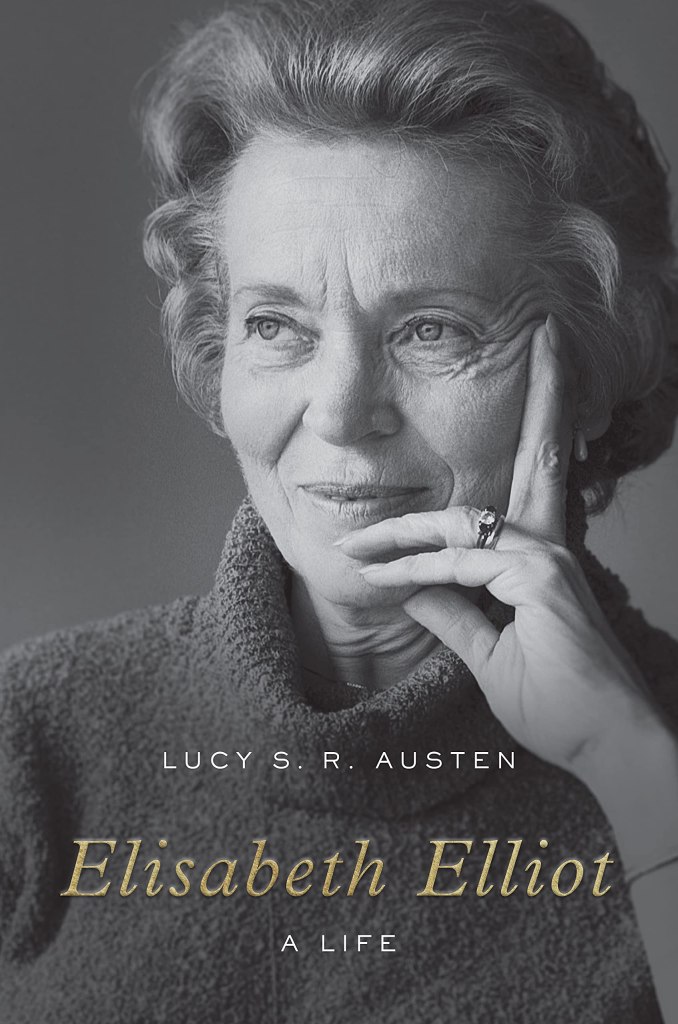
Review: Elisabeth Elliot, A Life

I’ve mentioned many times that I considered Elisabeth Elliot my “mentor from afar” for most of my adult life. I discovered her books in college, four decades ago, beginning with Through Gates of Splendor, Shadow of the Almighty, and The Journals of Jim Elliot. I’ve read almost all her books ever since, some of them several times, as well as her newsletters.

Most of you know that Elisabeth was the wife of Jim Elliot, one of five missionaries killed when trying to reach a tribe in Ecuador then known as “Aucas” (now known by their name for themselves, Waorani). A few years later, Elisabeth, her young daughter Valerie, and Rachel Saint, sister of one of the other missionaries, were invited to live with the Waorani. After writing Through Gates of Splendor about “Operation Auca” and the five missionaries, then her husband’s biography, and several articles, Elisabeth began to feel God called her into a ministry of writing. She and Valerie came back to the USA, where Elisabeth spent decades writing, speaking, and teaching.

Elisabeth’s public ministry ended in 2004 when her dementia began to make travel and speaking impossible. She passed away in 2015 at the age of 88. She’s regarded as one of the most influential Christian women of the last 100 years.

It was only a matter of time before biographers started telling her story. In Elisabeth Elliot: A Life, Lucy S. R. Austen harmonizes Elisabeth’s public writing with the journals and letters Austen had access to, which I feel is the strength of this book.

Elisabeth never put herself on a pedestal. She was quite honest about her faults and foibles. Austen takes care to present Elisabeth realistically, not idealistically.

However, I felt that Austen often sat in judgment on Elisabeth’s writing, criticizing such things as her approach to discerning God’s will in her early years, Jim’s behavior as they dated, the difference between what Elisabeth wrote in her journals and what she wrote publicly thirty years later, and so on. I have questions marks and notes of “author judgment” in several margins.

I knew much about Elisabeth’s earlier life from her books and writing. I was looking forward to learning more about what happened after she came back to the USA. But Elisabeth’s earlier life takes up two-thirds of the book, with her last fifty-two years filling only a third. That may be due to several factors: people’s interest in her missionary career; a number of questions and issues about that time; the decreasing number of family letters sent. And then, a lot of the narrative about her time in the States reads like lists of where she traveled and spoke, along with whom she visited and who visited her.

I was heartened to see some of her questions and struggles that emphasized that she was in many ways an ordinary Christian woman dealing with some of the same issues we all do. I was sad to hear of serious issues in her second and particularly third marriages.

Elisabeth seemed, by all accounts, to be a classic introvert. I was sad to see that introversion was thought to be unspiritual in her early life and that she fought against it rather than seeing it as the way God made her.

I was surprised to read that she thought speaking was not her main ministry and, in fact, took away from her writing ministry. I’m thankful to have heard her speak in person twice.

Her views on many things changed and solidified over the years, as happens with most of us. Her journals and sometimes her letters were ways of processing her thoughts. I wouldn’t be too alarmed by some of the views she seemed to hold or wrestled with along the way.

As it happened, I was midway through the book when I turned on the replay of Elisabeth’s radio program, Gateway to Joy, on BBN Radio one morning. She was doing a series called “Jungle Diaries,” reading from her journals of her time in Ecuador. She said she had not looked at them in forty years. She commented that people think she “has it all together,” but her diaries assured that she did not then, and she still did not claim to.

She also commented that her “theology has been developed” since those writings, but what she wrote was raw and real and honest. Then she mentioned that she was shocked to read of her desire to go to the Aucas. She “had no recollection of wanting to go to the Aucas, certainly not that soon after Jim died” (“Jungles Diaries #1:Journal Beginnings,” aired October 16, 2023).

I was quite surprised to hear her say that, as her books indicated that she strongly wanted to go. But then I thought about my own life forty years ago. I was four years married and would soon be expecting my first child. I remember where I worked, where we went to church, who our friends were. But there’s more I don’t remember than I do.

So I feel that Austen often made too much of the differences between what Elliot wrote over a span of forty or more years. But I think Austen tried to be faithful with the material she had.

In writing circles, we’re often told that we might have a perfectly fine manuscript that may be rejected because a similar book has just been published. For that reason, I was surprised to see Austen’s biography come out in-between the two parts of Ellen Vaughn’s “authorized” biography. Perhaps the publishers felt there was sufficient interest in Elisabeth to warrant two biographies of her published so close together. If so, I think they were right.

But I hope sometime someone writes a simple biography of Elisabeth, not analyzing or explaining or annotating, but just telling her story.

One of the main take-aways from listening to or reading about Elisabeth is that her supreme desires were to know and obey God. She was no-nonsense, yet she had a sense of humor. She was sentimental, but she wasn’t unfeeling. She wasn’t perfect, and she wouldn’t say this, but I think she went further than many of us in her spiritual journey.

(Updated to add: I thought I’d share a couple of other, more positive reviews from friends I know and trust: Ann’s is here, and Michele’s is here.)

(I often link up with some of these bloggers.)