
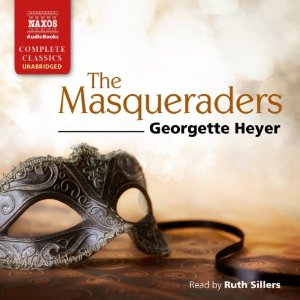
 I had not heard of Georgette Heyer until the last few years when I saw her name pop up on various blogs. Since I’ve been trying to read classics that I am not familiar with, I wanted to give one of her books a try. I thought I had remembered that Bekah enjoyed The Masqueraders, but as I tried to find her review of it, I couldn’t, so I guess I must have seen it recommended by someone else. At any rate, I decided to give it a listen.
The story was published in 1928 but set in the mid 1750s in Britain just after just after some rebellions by groups called the Jacobites, who wanted to restore King James II and his line to the throne. You can read more about them here if you’re interested, but let’s just say they were on the wrong side of the political climate at the time and their involvement would have been found treasonous.
To escape detection, brother and sister Robin and Prudence travel in disguise, he as Kate Merriot and she as Kate’s brother Peter. Prudence is a little tall for a woman and Robin a little short for a man, so that works to their advantage. Stopping by an inn on their travels, they overhear an argument between an older man and a teenage girl. Apparently the girl had said she would elope with the man but has changed her mind, and he is not taking it well. The Merriots decide to intervene by having their servant stage a distraction while they get the girl to safety. They discover her name is Letitia, or Lettie, and she is not only young and naive, but bored. She thinks her father has promised her to another older man, Sir Anthony Fanshawe, whom she does not want to marry, and that and a desire for “romance” and excitement led her to consent to Gregory Markham’s proposal, until she saw a side of him she did not like. Fanshawe soon arrives at Lettie’s father’s request, assures Lettie that he is not planning to marry her, and sees her back to London.
The Merriots end up in London as well, and renew their acquaintance with Lettie, meet her father, and become the darlings of London society. They meet several times with Sir Anthony, who comes across as sleepy and unobservant, but Prudence/Peter thinks he sees more and understands more than he lets on. Sir Anthony evidently desires to take Peter under his wing, and he/she finds herself attracted to him.
Meanwhile Robin has fallen hard for Lettie, but neither sibling can risk unmasking. Plus they are waiting to hear from their father, whom they call “the old gentleman.” He is the master planner for their adventurous schemes, and they discover his new one is very bold indeed and requires a masquerade of his own.
When I first started this audiobook, I admit it seemed a little silly to me at first. But it wasn’t long before I was drawn into the story, especially after it took a more serious turn.
I don’t know if all of Heyer’s heroines are this way, but Prudence is a strong female character as opposed to the more typical damsel-in-distress Victorian ideal (which is more like Lettie, although even Lettie proves to be not quite so flighty as she seems at first). Pru, as those who know her call her, is strong not only because she portrays a man and has had to learn to sword fight and such, but also because of her bravery, quick wits, and loyalty. But her strength doesn’t preclude her appreciation that “it was a fine thing to be so precious in a man’s eyes.”
I read a little more about Heyer at Wikipedia. That article says she “essentially established the historical romance genre and its subgenre Regency romance. Her Regencies were inspired by Jane Austen” – so wouldn’t that mean Jane Austen actually established Regency romances? I don’t know. But Heyer is known for her historical romances and thrillers: for several years she published one of each every year. Though she was evidently very popular in her day, she “was ignored by critics…none of her novels was ever reviewed in a serious newspaper” and she “was also overlooked by the Encyclopedia Britannica. The 1974 edition of the encyclopedia, published shortly after her death, included entries on popular writers Agatha Christie and Dorothy Sayers, but did not mention Heyer.”
I did enjoy learning more about Heyer and sampling one of her books. I will probably try another some time, but I am not eager to do so right away. The smattering of “damns” and minced oaths got on my nerves, I thought one man was unnecessarily killed in the story, and I could not stand “the old gentleman’s” arrogance, but overall I liked the suspense and intrigue of the plot as well as the humor sprinkled throughout. I thought the narrator did an excellent job as well.
(This will also be linked to Semicolon‘s Saturday Review of Books.)

 Stray Thoughts