
Whether we have our own children, or nieces and nephews, or friends’ children, or little ones at church, we expect to see them grow. Even though we marvel at how quickly they seem to grow, we would be concerned if they didn’t.
We also assume that children will grow mentally, emotionally, and spiritually. Moms might miss the cute antics of their little ones, but they’d be alarmed if their teenagers acted like toddlers.
Though there is an aspect of grief when children become adults and leave home, there is anticipation, too. We look forward to seeing what God will do in their lives.
As much as we miss our kids when they move away from home, we know something is wrong if they’re forty and still living in their parents’ basement, playing video games most of the day.
Maturity in the children we’re close to seems to be measured by their ability to stand on their own two feet–to function successfully as adults on their own. Though we welcome their coming to us for advice, and we love to help them in any way we can, we know we won’t be around forever.
Spiritually, though, we don’t grow independent from God. We don’t become spiritual adults as we move away from Him to live our own lives.
Instead, we grow spiritually when we realize how little we actually have control over, when we’re aware we need God every moment of every day. We grow more dependent on God as we mature.
How do we mature spiritually?
We take in His Word. 1 Peter 2:2, NKJV: “As newborn babes, desire the pure milk of the word, that you may grow thereby.” Acts 20:32: “And now I commend you to God and to the word of his grace, which is able to build you up and to give you the inheritance among all those who are sanctified.“
We grow in grace and knowledge of the Lord. 2 Peter 3:16-18: “There are some things in them that are hard to understand, which the ignorant and unstable twist to their own destruction, as they do the other Scriptures. You therefore, beloved, knowing this beforehand, take care that you are not carried away with the error of lawless people and lose your own stability. But grow in the grace and knowledge of our Lord and Savior Jesus Christ.”
We pray. Colossians 1:9-10: “And so, from the day we heard, we have not ceased to pray for you, asking that you may be filled with the knowledge of his will in all spiritual wisdom and understanding, so as to walk in a manner worthy of the Lord, fully pleasing to him, bearing fruit in every good work and increasing in the knowledge of God.”
We learn from the leaders God gave the church. Ephesians 4:11-13: “And so, from the day we heard, we have not ceased to pray for you, asking that you may be filled with the knowledge of his will in all spiritual wisdom and understanding, so as to walk in a manner worthy of the Lord, fully pleasing to him, bearing fruit in every good work and increasing in the knowledge of God.”
We develop discernment by learning to distinguish between good and evil. Hebrews 5:12-14: “For though by this time you ought to be teachers, you need someone to teach you again the basic principles of the oracles of God. You need milk, not solid food, for everyone who lives on milk is unskilled in the word of righteousness, since he is a child. But solid food is for the mature, for those who have their powers of discernment trained by constant practice to distinguish good from evil.”
Renew our minds. Romans 12:2: “Do not be conformed to this world, but be transformed by the renewal of your mind, that by testing you may discern what is the will of God, what is good and acceptable and perfect.“
Behold Christ. 2 Corinthians 3:18: “And we all, with unveiled face, beholding the glory of the Lord, are being transformed into the same image from one degree of glory to another. For this comes from the Lord who is the Spirit.”
What does spiritual maturity look like?
Stability. Ephesians 4:14: “That we may no longer be children, tossed to and fro by the waves and carried about by every wind of doctrine, by human cunning, by craftiness in deceitful schemes.”
Awareness of our weakness. 2 Corinthians 12:9-10: “But he said to me, ‘My grace is sufficient for you, for my power is made perfect in weakness.’ Therefore I will boast all the more gladly of my weaknesses, so that the power of Christ may rest upon me. For the sake of Christ, then, I am content with weaknesses, insults, hardships, persecutions, and calamities. For when I am weak, then I am strong.”
Endurance and hope. Romans 5:3-4: “Endurance produces character, and character produces hope, and hope does not put us to shame, because God’s love has been poured into our hearts through the Holy Spirit who has been given to us.”
Fruit of the Holy Spirit evident in our lives. Galatians 5:22-23: “But the fruit of the Spirit is love, joy, peace, patience, kindness, goodness, faithfulness, gentleness, self-control.”
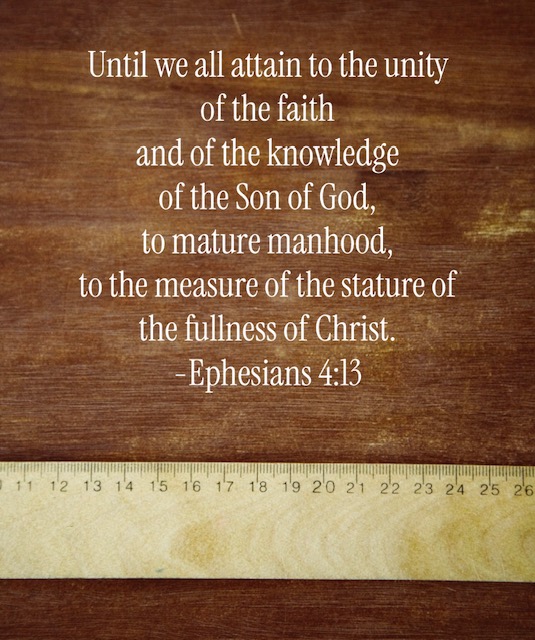
Jesus. Ephesians 4:13: “Until we all attain to the unity of the faith and of the knowledge of the Son of God, to mature manhood to the measure of the stature of the fullness of Christ.”
Maturity doesn’t always accompany age. Some older people aren’t very mature at all, and some young people can display remarkable maturity. But the good news is, whatever stage we are in now, we can grow spiritually and become more and more like Christ.
(I often link up with some of these bloggers.)

 Stray Thoughts