Review: Made for More

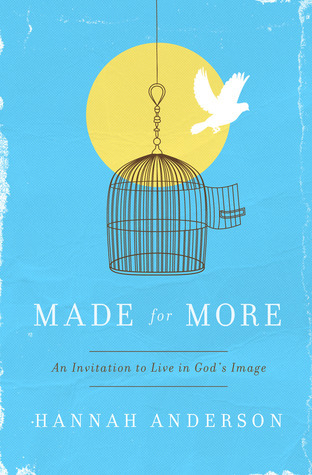
Made for More by Hannah Anderson

In Made for More: An Invitation to Live in God’s Image, Hannah Anderson writes, “the goal of this book is to call women to recover an understanding of ourselves that is more basic than our gender. It’s a call to recover the image of God in our lives—to re-imagine not simply what it means to be a woman but what it means to be a person made in the very likeness of God Himself” (Location 131, Kindle version).

We tend to link our identity to various categories: gender, religion, vocation, location, political affiliation, etc. But such labels not only can’t embrace all of what we are, they can be divisive with people in other categories.

In order to know who we really are, we must first know who our Creator is—“accepting Him for who He is, not who we can conceive Him to be” (Location 287). Acts 17:28, Paul said, “In him we live and move and have our being.” “Simply put, there is one God and He is the Giver of all life. He created the world, and everything in it finds its source, its purpose, and its goal in Him” (Location 263).

Literally translated, imago dei simply means “in the image of God.” But in reality, imago dei means so much more. Imago dei means that your life has purpose and meaning because God has made you to be like Himself. Imago dei means that your life has intrinsic value, not simply because of who you are as an individual, but because of who He is as your God. Imago dei means that your life is sacred because He has stamped His identity onto yours (Location 402).

Yet God did not make us all alike. “We are different from each other and therefore dependent on each other. In other words, while each of us is fully made in the image of God, none of us can fully reflect and represent God alone. Instead we reveal the nature of God together; and as a result, we also find identity together” (Location 470).

Even though God created humans in His image, the first two sought their identity elsewhere, creating an identity crisis for the rest of the human race. “If they disobeyed, they would not simply be rejecting Him—they would be rejecting everything that was true about themselves as well. By choosing to turn from God to something else for knowledge, they would blind themselves to their own nature. And they would die because they would cut themselves off from the only thing that made them alive in the first place—God Himself” (Location 580).

Now, “Instead of living in dependent communion with Him, we fight for autonomy and the ability to rule our own lives; instead of loving and serving each other, we manipulate others to serve our own purposes; instead of exercising creative care of the earth, we consume it in our own greed and lust. Instead of unity, there is disunion; instead of harmony, there is brokenness” (Location 615).

The only way to get back to living in God’s image was for Jesus to identify with us that we might identity with Him.

The greatest identity shift that has ever happened was when God Himself became human and lived and died for us so we once more might live in Him. . .

[Jesus] is both the Image and the perfect Image Bearer, the Creator who deigns to live in His own creation. Despite being God, Jesus humbled Himself, took on human flesh, and came to live and die so that through His very life, death, and resurrection—through His metamorphosis—we ourselves might be changed (Location 764).

However, “Finding identity in Christ cannot be confined to one moment, because union with Christ is not simply an event; it is a state of being, a way of existing” (Location 810).

And that’s just the first third of the book. Hannah goes on to show how being made in God’s image affects what and how we love, our desires, roles, relationships, how we care for creation. Being made in God’s image, reflecting Him, guides our intellect, work, talents, and gifts.

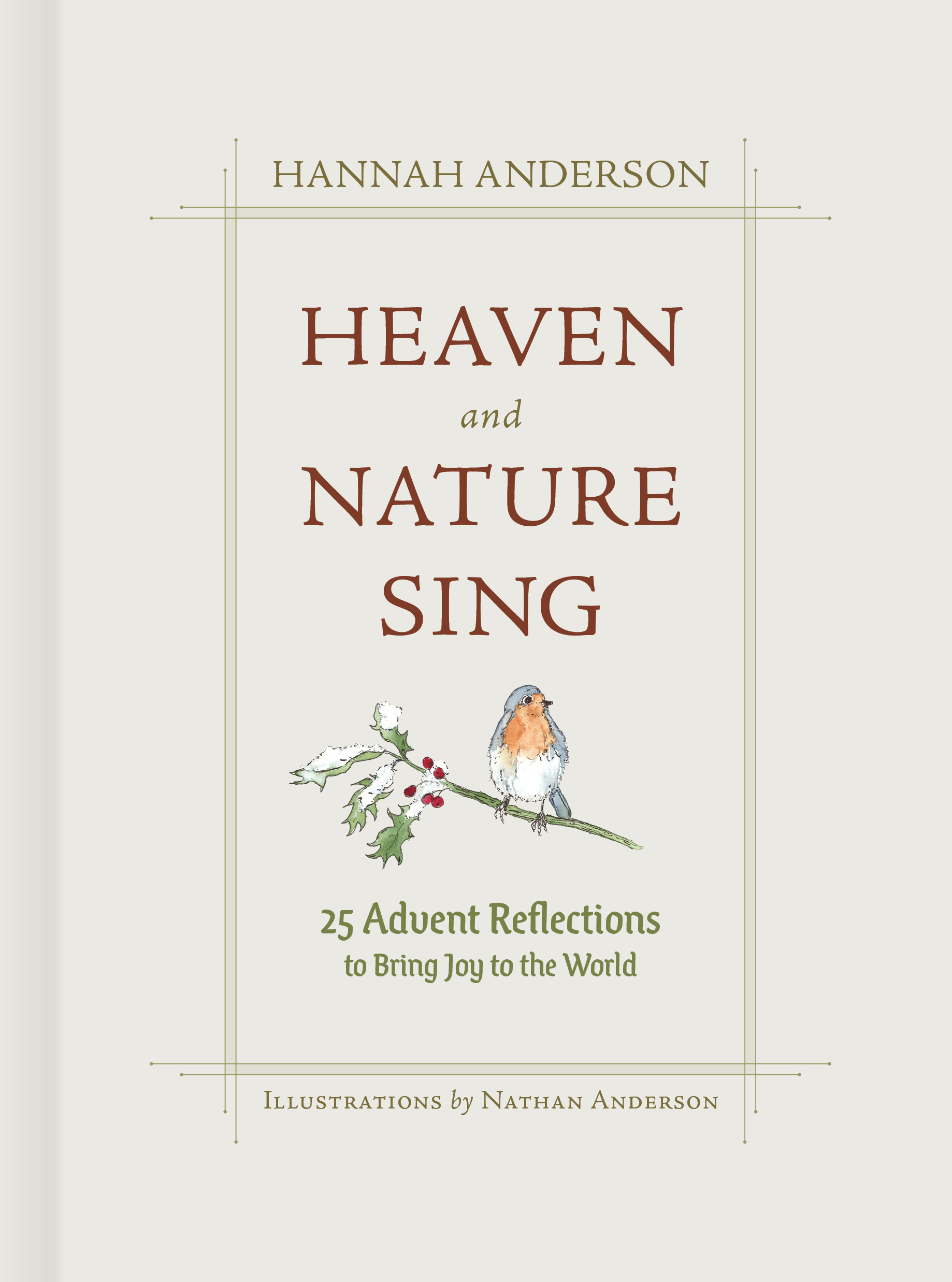
The first book I read of Hannah’s was her advent book, Heaven and Nature Sing: 25 Advent Reflections to Bring Joy to the World, last December. I liked it so well, I wanted to read her other books. Though I didn’t do this on purpose, I ended up reading her books published at that time (two more have been written since) in reverse order according to my interest. Made for More was her first, but I read it last. Every time I considered it, I thought, “But I know what it means to be made in God’s image.” However, even though I knew basically what it meant, I had not considered it in all the depth and fullness and implications Hannah detailed here.

This is a book I should probably reread at regular intervals to remind myself of its truths.

I highly recommend this book to you, whether you have a working knowledge of what it means to be made in God’s image or not. If not, Hannah will explain it well. If so, you’ll understand it more fully and beautifully.
Humble Roots

If people think about humility at all these days, they usually envision self-deprecation, playing down one’s attributes, talents, or accomplishments, or, at the very least, not bragging.

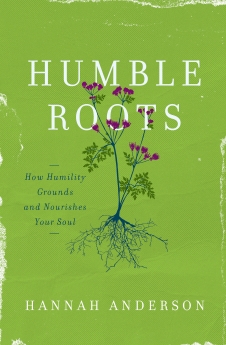
In Humble Roots: How Humility Grounds and Nourishes Your Soul, Hannah Anderson explores humility from a Biblical angle. Instead of viewing humility as a club or prod when we’re feeling too proud, humility frees us and leads us to rest.

I defined humility as a correct sense of self, as understanding where you come from and where you belong in this world (p. 64, Kindle version).

Theologically speaking, humility is a proper understanding of who God is and who we are as a result (p. 102).

I would describe it as a creaturely dependence. We’re “made in His image, but we are made nonetheless (p. 11)—made originally from dirt, to which our bodies return. As Paul reminds Timothy, “we brought nothing into the world, and we cannot take anything out of the world” (1 Timothy 6:7). Everything we are and everything we have comes from God.

The problem is our obsession with ourselves. With our need to fix things, our need to make ourselves better, our need to be approved by God and others, our need to “count for something.”

But this is also why Jesus calls us to come to Him. By coming to Jesus, we remember who we are and who we are not. By coming to Him, we come face to face with God and with ourselves. “It is only in our encounter with a personal God,” writes philosopher Dietrich von Hildebrand, “that we become fully aware of our condition as creatures, and fling from us the last particle of self-glory” (p. 55).

If I can’t handle little things, what can I handle? Failure at small things reminds us of how helpless we are in this great, wide world. When little things spiral out of control, they remind us that even they were never within our control in the first place (p. 26).

Humility, instead of being a negative concept, frees us:

to be the people God created us to be (p. 11).

from the cycle of stress, performance, and competition (p. 12).

from our burdens . . . by calling us to rely less on ourselves and more on Him (p. 32).

to redirect our energies toward God and those whom He has given us to love (p. 3).

from the condemnation of others, . . . from self-condemnation and unnecessary guilt (p. 108).

to hear God’s call and leads you to a place of both rest and flourishing (p. 110).

from the oppression of our emotions, when we finally learn that “God is greater than our heart (p. 114).

from the responsibility of feeling like you have to “do it all.” You are free to do only what you have been made to do (p. 163)

. . . and so much more.

Hannah follows Jesus’ admonition to consider birds and flowers by grounding each chapter in something from the garden or nature. For instance, the chapter “Vine-Ripened” begins with all the work that goes into growing garden tomatoes, then being fooled every year into thinking the ones gassed for redness in stores will be the same. That leads into a discussion of wisdom being rooted not in acquiring facts, but in submitting to the source of wisdom–the fear of the Lord. Then an 1800 court case over whether tomatoes are vegetables or fruit is tied in, along with our relentless desire to be “right.” “Humility simply leaves room that my understanding of a situation could be wrong” (p. 124). We may not have all the facts or may be influenced by culture. Because we’re limited, “my faith cannot rest on my own knowledge . . . or ability to understand . . . humility leaves room for grace” (p. 124). How unlike most social media discussions, where everyone is right in their own eyes. Hannah then refers to an Isaac Watts book which discusses a “dogmatical spirit.” Our wisdom and safety come not from our being right, but from Jesus being right. Then the chapter goes back to the process of creating store-bought tomatoes, compares that with our search for wisdom, and extols the wisdom of waiting: “Humility teaches us to let knowledge ripen on the vine” (p. 129). The chapter is much more beautifully woven together than my cobbled summation here.

Hannah points us to Jesus, “who, though he was in the form of God, did not count equality with God a thing to be grasped, but emptied himself, by taking the form of a servant, being born in the likeness of men. And being found in human form, he humbled himself by becoming obedient to the point of death, even death on a cross (Philippians 2:6-8) and who invites us to “Take my yoke upon you, and learn from me, for I am gentle and lowly in heart, and you will find rest for your souls” (Matthew 11:20).

Besides benefiting from the truths Hannah shares, I marvel at the way she is able to weave together facts from nature, literature, Scripture, and personal example seamlessly into each chapter. I don’t know how she accomplishes this without time to just sit and think, but as a busy pastor’s wife and mom, I’m sure such time is at a premium. I first read one of her books during Advent and have been working my way through her others. She has quickly become one of my favorite authors.

Even though I just finished this book, reading one chapter a week, I am thinking about going through it again. I need to soak in its truths more.

(I often link up with some of these bloggers.)

The Lost Art of Discernment

Most of think of discernment from the negative side. We want to discern good from bad so we can avoid the bad. We want to teach our families to avoid the bad as well. And that’s necessary. There is a lot of bad to avoid.

But constantly looking out for the potential bad can warp our thinking. Hannah Anderson says, “Facing so many variables, with good and bad so quickly blurring, most of us find it easier to retreat to safe spaces, cluster in like-minded tribes, and let someone else do our thinking for us” (p. 11). She goes on to share:

For a long time, I didn’t think very clearly at all because my actions and choices were shaped more by the brokenness around me than the reality of God’s goodness and nearness. When faced with a decision, I played defense: What will keep me safe? What are other people expecting me to do? What will happen if I make a mistake?

But in trying to keep myself safe, in obsessing over making the “right” choices, I found myself making a whole lot of wrong ones. Because I lacked a vision for goodness, I also lacked discernment. And without discernment, I had little chance of finding the security and happiness that I wanted—that I think we all want (pp. 11-12).

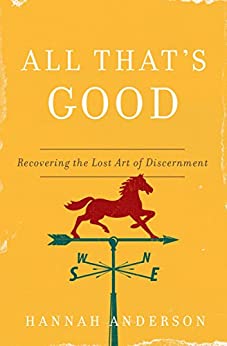
Hannah suggests a different approach. Why not discern good from bad in order to pursue the good? That’s just what she proposes and demonstrates in All That’s Good: Recovering the Lost Art of Discernment.

But what if there were a way to see clearly once again? What if we could see the world as God sees it—in all its brokenness and beauty—and in seeing, be able to do more than endure this life? What if we could flourish in it? I think we can. In fact, I’m convinced of this good news: Despite all the pain, all the sorrow, all the questions, goodness still exists because God still exists. And because He does, He has not left us to sort through the mess alone (p. 11).

God created the world and the people in it and pronounced them good (Genesis 1). But sin marred the world and our hearts (Genesis 3). Yet God has promised to restore goodness some day. And for now, even in spite of a marred visage, we can still trace God’s goodness in what He created. As we believe in and follow Him, “He is busy transforming you, renewing your mind ‘so that you may discern what is [His] good, pleasing, and perfect will'” (Romans 12:2) (pp. 12-13).

Hannah explains what discernment is and isn’t, what hinders “our ability to experience His goodness,” how “simply reacting to established culture is not enough, why naïveté and isolationism can cause us to misstep just as quickly,” how discernment and virtue intertwine,  what habits we can employ, and how God walks with us (p. 12).

Then Hannah devotes a chapter apiece to the things Paul told us in Philippians 4:8 to think on: “whatever is true, whatever is honorable, whatever is just, whatever is pure, whatever is lovely, whatever is commendable, if there is any excellence, if there is anything worthy of praise.”

Hannah weaves each of these truths with observations from everyday life: detective stories, vacations, pearls, art museums, making pies.

I took this book slowly, just reading one chapter a week and letting it sink in. I appreciated so much not only what Hannah said, but how she said it. I marveled at how she wove different elements together in her chapters.

I’ve got dozens of quotes marked, but here are just a few more:

There are no hacks to discernment. No three easy steps to follow, no lists or tricks or tips to ensure that you’ll be able to make good decisions when you need to. In order to make good decisions, you must become a discerning person, a person skilled in wisdom and goodness itself. And to be these kinds of people, we must be humble enough to be willing to learn (p. 27).

What Solomon realizes is that our life on earth, all the things we experience, all the work we do, all the good things we enjoy, aren’t simply a hurdle to the next life. They are designed by God to lead us to the next life. They are designed to lead us to Him. Like the grooves on a record, God’s good gifts are designed to draw us closer and closer to the center, to draw us closer and closer to eternity and Him (p. 53).

At its essence, worldliness is a disposition of the heart—the belief that goodness comes from the immediate satisfaction of temporal desire. But because worldliness is a disposition of the heart, we can’t simply retreat into religious contexts to escape it. We also can’t rely on adopting certain positions or practices to avoid it—especially if we use them to avoid the more difficult task of examining our own heart motives. As long as we’ve picked the “right” education for our children, go to the “right” church, watch the “right” movies, and vote for the “right” candidate, we won’t have to face the deeper truth about how easily our hearts are led astray. We could be consumerist, pragmatic, and completely worldly but never know it because we see our choices as “right” and thus are convinced that we are as well (pp. 53-54).

You develop discernment by becoming a person who knows how, not simply what, to think (p. 57).

In order to become discerning people, we also must separate our need for approval from our decision making. But to do that we’ll need a source of honor that is not dependent on how people perceive us. We’ll need a source of honor that doesn’t rest on presenting just the right look at just the right moment. And we find that honor, not in image crafting, but in the One who first crafted us in His own image (p. 84).

I didn’t realize until I was almost finished with the book that the last chapter contained review points and discussion questions for each chapter. That would have been helpful to know and use.

Hannah hosts a podcast called Persuasion along with Erin Straza.

If you are a member of Audible.com, the audiobook of All That’s Good is currently free with your subscription. They shuffle their free titles around at intervals, so I am not sure how long this one will be free. I did not listen to the audiobook—I can’t listen to books like this and get as much out of them as I can when highlighting and occasionally rereading parts. But I know some of you prefer nonfiction via audio.

But I encourage you to get and partake of this book. I can’t recommend it highly enough.

(I often link up with some of these bloggers.)


Heaven and Nature Sing

Heaven and Nature Sing: 25 Advent Reflections to Bring Joy to the World by Hannah Anderson was just released last fall. I’m so glad I heard of it in time to use for Advent.

“Heaven and nature sing” is a phrase from “Joy to the World,” written by Isaac Watts. Watts’ hymn looks forward to Jesus’ second coming more than His first, but it’s regularly used as a Christmas carol. Hannah took inspiration from this phrase and wrote 25 Advent devotions based on various aspects of nature connected with the birth of Christ. The Bible tells us creation groans from the effects of sin, waiting for redemption. We also groan or yearn for things to be set right. Hannah writes, “I want to offer you hope—not by ignoring the brokenness but by looking it squarely in the face, knowing your Redeemer has and will come” (p. 1).

One thing that struck me about these meditations was how much sheer thought must have been behind them, to weave so many threads together.

For instance, in the chapter “Family Tree,” Hannah writes of her husband’s discovering some old family genealogies which were written not in flow charts like we’re used to, but in concentric circles. Then she tells of a family visit to see the redwood trees in CA. One cross-section of a stump showed rings developed over the millennia the tree had been alive, and Hannah contemplates all the history the tree lived through. Then she brings up the records of Jesus’ human genealogy. His people were often faithless and disobedient, resulting in judgment by enemy armies taking over Israel and exiling its people. Isaiah compares this to God lopping boughs off a tree (Isaiah 10:33). But He promises “There shall come forth a shoot from the stump of Jesse, and a branch from his roots shall bear fruit. And the Spirit of the Lord shall rest upon him. . . In that day the root of Jesse, who shall stand as a signal for the peoples—of him shall the nations inquire, and his resting place shall be glorious” (Isaiah 11:1-2, 10).

“The story of Christmas is this: the tree is not dead” (p. 20). And eventually, others were grafted into the family (Romans 11:17-24), “strangers and foreigners and all those who thought they’d never know family again, those who never dared to hope that life would run through them” (p. 20).

You and I are links in the chain of generations, called to steward the fragile hope we’ve received. The seventy or eighty years given to us on this earth pale in light of those who have come before us and those who follow after. . .

So whether his work happens over the course of a thousand years or one day, whether it is given to us to play a prominent role in it or simply to stand as a faithful witness to the promise, we will wait on him. And we will wait in hope.

The tree is not dead. The quiet, steady work that came before us will continue on after us. The quiet, steady work we do today—even if it’s as simple as celebrating the Promised Son during this season—will echo through the years (pp. 20-21).

And thus Hannah writes about winter, stars, serpents, holly, evergreens, swaddling bands, shepherds, stars, and more.

One of my favorite quotes is in the chapter “Among the Beasts.”

Yes, the manger signals something about this baby, but it is not simply his poverty. By being placed in the manger, he is revealed as both the rightful son of Adam charged with caring for his creation and also the eternal Son of God who created them and who provides for them. So instead of filling the manger with hay or corn, he fills it with himself (p. 80).

I spent many mornings after my reading in this book in tears or joy, touched and awed by the contemplation of the “old, familiar” Christmas story.

Each devotion is about five pages long and written in an easily readable style. The illustrations on the cover and between chapters were drawn by Hannah’s husband, Nathan.

I can’t recommend this book highly enough. I’m sure I’ll use it again in future Advent seasons. But since these truths are timeless, you could read it any time of year.

I have some of Hannah’s other books in my Kindle app, and I am eager to read them. The only trouble is deciding which one to start with!