Review: This Promised Land

This Promised Land

In Cathy Gohlke’s latest novel, This Promised Land, Ginny Pickering Boyden is finally about to realize her dream of traveling to her family’s ancestral home in England. Decades earlier, she had run away to marry her boyfriend before he shipped out to WWII. Her mother and brother disowned her; she lost the baby she was expecting; and her husband came back maimed in body and mind. She cared for him as long as she could, and then he spent the rest of his years in a nursing home. When he died, Ginny spent years recovering and paying off her debts so she could travel.

Now she has just retired from her job when she gets a letter from a lawyer in New Scrivelsby, VA–the town where her family owned a Christmas tree farm for generations. The letter says her brother has died and there is a problem with his will. She needs to come and settle the family business.

Ginny doesn’t want to go, but doesn’t seem to have a choice. She plans for a quick trip to sign whatever papers are needed, see her parents’ graves, and then get on with her life.

But the situation is more complicated than she thought. Her mother, who had died long before, had actually left the Christmas tree farm and family home to her. Her brother, Harold, had told his sons he was leaving everything to them, but he couldn’t since he didn’t rightfully own it.

On top of that, Harold was not in his right mind his last few years. Despite his son’s efforts, Harold took out a sizeable loan and didn’t pay two years worth of taxes.

Even if Ginny wanted the farm, there’s no way she could pay its debts. She has no choice but to sell.

Harold’s son, Luke, has been running the farm almost single-handedly. He believes his father’s lies about Ginny and figures she’s swooping to claim everything and sell it all, leaving him high and dry.

And then Harold’s other son, Mark shows up. A Vietnam veteran, Mark has been in and out of trouble with drugs and alcohol. He did some time in jail while his three children were placed in separate foster homes. All he wants is to sell out his part of the farm to his brother so he can try to make a new start with his children. He’s stunned to learn that his brother doesn’t own the farm.

All the branches of the family tree are fractured and barely holding on. Harold is angry and barely gives Ginny or Mark a chance. His longsuffering wife, Bethany, urges patience and grace. Mark’s children desperately need stability, but his addiction recovery is fragile.

They decide to try to maintain the farm through one more Christmas season to see if they can recover their losses. If not, Ginny will sell and divide the proceeds between them. Though keeping the farm is uncertain, Ginny hopes the rifts can heal and they can become a true family, something they all need.

Unbeknownst to them all, they have enemies without as well as within.

The Bible story of the prodigal son comes up often in this story, with Ginny realizing she has been in the place of both the prodigal and the resentful older brother. Now she wants to be like the welcoming father. But all the family’s problem make it difficult.

Ginny enjoys the hobby of pressing flowers and making pictures with the dried blooms. She shares this with the children and even uses their creations to make framed art to sell to help the farm. Along with the interesting process of how flowers are dried and pressed, the process symbolized that “something so pretty and permanent could come out of something as short-lived as a rose” and “life was not done–simply waiting to bloom again.”

I have enjoyed all of Cathy’s books that I have read, and this one is no exception. The characters are well-developed, and the faith element is woven in naturally. It’s easy to sympathize with all the characters and their struggles. I like how the author brought everything together in the end.

I listened to the audiobook, nicely read by Sarah Zimmerman.

(Sharing with Bookish Bliss)

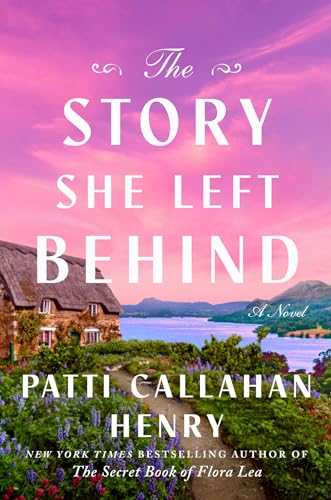
Two Books by Patti Callahan Henry

I’ll say upfront that I have mixed emotions about these two books by Patti Callahan Henry. I’ll explain why a little later.

In the first one, The Story She Left Behind, Clara Harrington lives in Bluffton, SC in 1952. Her mother, Bronwyn, was a child prodigy who wrote a best-selling book at the age of twelve. But Bronwyn disappeared twenty-five years ago, taking her dictionary of a language she had created with her. The family’s boat was found, but Bronwyn and her dictionary were not. Most assumed both were at the bottom of the sea.

Clara was eight when her mother disappeared, and she lived under the shadow of that event all her life. Now she’s a divorced mom with an eight-year-old daughter. They live with Clara’s father. Clara is a successful children’s book illustrator who is about to receive the Caldecott medal.

Then one day, out of the blue, Clara receives a phone call from England. A man tying up his father’s affairs found an old satchel in his father’s study. Inside was a stack of papers with words he couldn’t understand, along with a note and a sealed letter addressed to Clara. The note said the contents of the satchel were to be given only to Clara in person. They must not be mailed.

At first, Clara thinks the caller is another scammer, looking for information or seeking remuneration for false information. But as the man, Charlie, describes the satchel and reads the note, Clara realizes they are truly her mother’s.

With her father’s help, Clara and her daughter, Wynnie, take a ship and then a train to England.

The story was inspired by a true one concerning Barbara Newhall Follett, a child prodigy who wrote a book at age eight and had it published at age twelve. She also developed a language for her stories. And she disappeared at age 28. But the comparisons seem to end there. She didn’t have a daughter, and nothing is known about her since her disappearance.

The bones of Henry’s story are very good. I enjoyed the unrolling of the mystery. I liked the historical references, including Beatrix Potter and T. S. Elliot. Clara and Wynnie arrive in London during the “great smog,” a period of several days in which London was covered in an unusually thick fog caused by weather conditions and coal used for heating. Some 4,000 people died and a hundred thousand more were made ill by the air. I had also read of this in Christmas with the Queen by Hazel Gaynor and Heather Webb. In Henry’s story, the smog causes a crisis for Wynnie, who has asthma.

In the two previous books by Henry that I have read, Becoming Mrs. Lewis and Once Upon a Wardrobe, the author expressed some Christian-ish beliefs. That may have been just because C. S. Lewis, a major character in each book, was a Christian. I don’t know what Mrs. Henry’s personal beliefs are. But this book was thoroughly secular. That’s not so much a problem in itself–I wouldn’t expect anything different from a non-Christian. But I was very sorry to see a sex scene in the book plus continued reference to two characters sleeping together. One is even concerned that the other will somehow think less of her because she had only been intimate with her husband until now.

There were a lot of references that made me think the book was going to delve into magical realism. Emjie is the main character in Clara’s mother’s book and also Wynnie’s invisible friend (Wynnie insists she is invisible, not imaginary). There’s talk of Emjie being “sent” to Wynnie. Gaelic curses are mentioned, plus a couple of times the author writes variations of “All things are one and we are all things.” I’m not sure what philosophy that comes from, but I disagree with it.

There was a lot of repeat information, a lot of convenient coincidences, a smattering of “damns” and similar words and way too much taking the Lord’s name in vain. The romance developing over ten days seems unrealistic.

I listened to the audiobook wonderfully narrated by Julia Whelan and Theo Solomon. And I appreciated that the author’s end notes were included, which isn’t often the case in an audiobook.

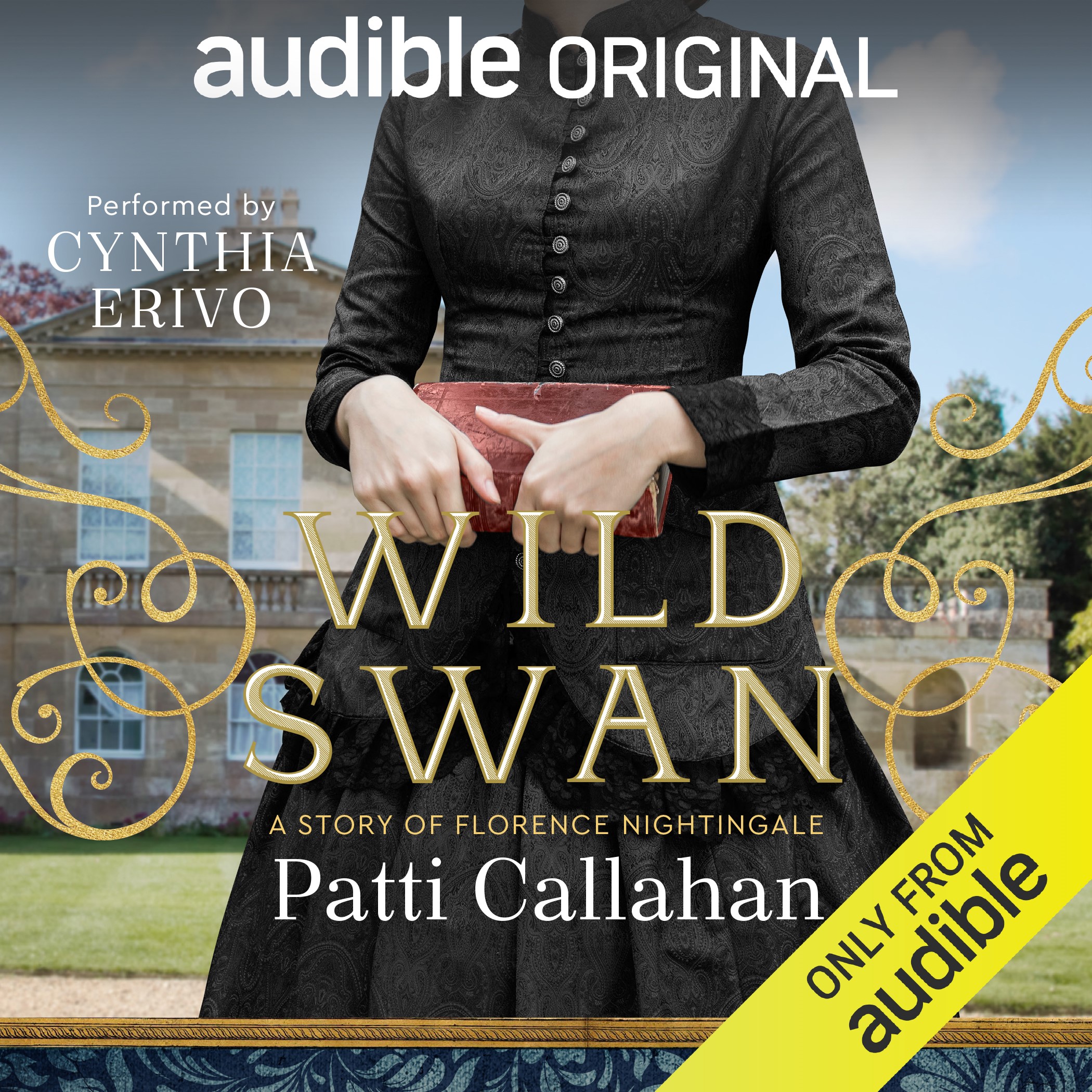
Wild Swan

Wild Swan is only available on Audible at this point, and is included with an Audible membership. It’s short, less than two hours. This book tells about Florence Nightingale’s “calling” to become a nurse in an era when cultured, privileged young ladies did not do such things.

When Florence accompanies a friend and her ailing husband on their travels, she spends two weeks at a religious medical community in Germany. The simple, almost spartan lifestyle appealed to her. She felt confirmed in her calling as a nurse.

But when she returned home, her mother and sister called her ambition selfish and said they needed her.

The rest of the story tells her inward struggles and her family’s eventual agreement to let her pursue her calling. A brief few paragraphs at the end tell of her accomplishments as well as a scene at the beginning when she meets with Queen Victoria.

This audiobook was narrated by Cynthia Erivo, who did a great job except for speaking a little too quietly sometimes.

I thought this story was very good. Mrs. Henry portrays Florence as a little too “Woe is me,” but then, she would have been greatly frustrated at being expected to fritter away her life in idle pastimes when she wanted to be useful.

The is the second book of Henry’s in which she compares mountains or hills to a resting woman’s breasts. I don’t see any need to inject a sensual element into such descriptions. It made a little more sense for Joy Davidman in Becoming Mrs. Lewis, but it doesn’t seem like Florence would think in those terms.

Several times, Henry has Florence referring to the Victorian era or Victorian women. I wondered if that term would have been used during Queen Victoria’s lifetime. Perhaps so. But it seems like people in later eras would have referred back to this time as Victorian rather than the people living during that time.

Henry is a gifted writer, and her books are wildly popular (the library’s waiting lists for both the print and Kindle versions of The Story She Left Behind had about thirty people each). Once Upon a Wardrobe was my favorite and had the fewest objectionable elements. Personally, though I liked the main stories in each book, I had reservations about some of the content.

(I often link up with some of these bloggers.)

Review: All the Lost Places

All the Lost Places

In All the Lost Places by Amanda Dykes, Daniel Goodman is a former thief in 1904 California who is trying to make restitution. He saves money from his lowly wages to repay those he robbed from. He has not seen his mother since he got out of prison: he feels he can’t face her until he has righted his wrongs.

When he hears that his mother may lose her home due to lack of finances, he looks for additional work. A seemingly chance encounter finds him interviewing with a man whose boss wants to make a “little Venice” in CA. At first Daniel applies just for physical labor. But upon finding out that someone is needed to translate one of Daniel’s favorite books and travel to Venice to sketch famous buildings, Daniel pushes hard for that role. His mother had come from Venice. She had sent him the book in question when he was in prison. He used to be able to draw–a head injury has left him unable to draw from memory any more, but he can draw something if he can see it.

The man is skeptical at first, but when Daniel draws a nearby building for him, the man agrees.

Daniel had kept himself pretty isolated after his prison confinement, so traveling and interacting with so many people is a strain on his nerves. He barely arrives in Venice when he literally runs into Vittoria, a bookseller. One of his tasks is to try to find the original copy of the book he’s supposed to translate, The Book of Waters. Daniel’s copy is one of only a few, which are all unfinished. It’s hoped that the original will have the closing chapters. He enlists Vittoria’s help to try to find the book.

As Daniel translates, he’s drawn into the story of Sebastien, who was put in a basket and floated toward an orphanage in Venice in 1807. Instead, a gondolier notices the basket, picks him up, and takes him to a guild of five artisans, who adopt him and train him in each of their skills. Though Sebastien loves his blended family, he wrestles all his life with his identity and purpose. One day, a woman washes up on the shore of the island Sebastien lives on, changing both their lives forever.

Sebastien’s story occurs when Napoleon had taken over Venice. Some Venetians planned that at some point, they would revolt and set up their Doge, or governor.

Sebastien and Daniel wrestle with some of the same questions. Though Daniel knows his origins, he can’t free himself from the guilt and losses of his past. Yet just as Venice was “the city that came from a swamp . . . a lost place that grew hope,” perhaps God can build something new and beautiful on the swampy places of a man’s life.

The Napoleonic era is one I know very little about, and I was glad to learn more of that time frame and Venice’s history. Amanda shares a lot of interesting details in in her end notes, including the fact that an Abbot Kinney really did build a “Venice of America” in CA in the early 1900s.

Some of the quotes that stood out to me:

Isn’t that the way of miracles? Something extraordinary because of the faithful ordinary (p. 53, Kindle version).

Found means someone was searching for you, running after you. You, the greatest treasure in all the world. That is what Trovato—Found—means. Sebastien Trovato, you are Found. Always and forever (p. 74).

Life had taught them hope was a dangerous and fragile thing . . . Faith sang a different song: hope was as necessary as breath, and so strong that it carried its own heartbeat (p. 115).

He dug instead for the tiniest slip of hope. And in doing so, hope became . . . purpose (p. 120).

Mosaic . . . it is the art of empty spaces. Broken things, harvested as treasure and pieced together into something entirely . . . different. Old, but new. Broken, but whole (p. 219).

“Do not be downcast, O your soul!’” He raised his face to the sun, reciting a psalm—or what sounded like one.
“Do you mean ‘O my soul’?”
“My soul is very happy in this moment. I mean your soul” (p. 249). 

Perhaps you are becoming a new tool for a new work. God is not bound by the way things used to be (p. 254).

She stood before him, inches and a universe away, all at once (p. 285).

Amanda’s writings always touch the heart. This book took a little longer for me to get into than some of her others, but I loved how all the threads came together in the end.

(I often link up with some of these bloggers.)
Review: Up from the Sea

Up from the Sea by Amanda Dykes

Amanda Dykes’ novella, Up from the Sea is a prequel to Whose Waves These Are, one of my all-time favorite Christian novels.

Savannah Mae Thorpe was raised in Georgia, but is taken in by an aunt and uncle in Maine after her parents die. Savannah is more comfortable walking in the forest than the ballroom with her cousins.

When her cousins and their friends tell of an old legend, Savannah recognizes it as a variation on a story her mother told of a young woman who buried a small chest under what came to be known as the Atonement Tree, asking forgiveness while an unknown observer watched.

When Savannah discovers an updated version of the map her mother drew as a child, she goes with her cousins and Alistair Bliss, a local woodsman and employee of the family, to see if they can find the tree. What they discover has ramifications for all of them.

Along with Savannah’s “fish out of water” story, there are hints of troubled secrets in Alistair’s past, Savannah’s uneasy relationship with the cousin she used to count as a friend, and some Revolutionary War history.

Some of my favorite quotes:

Darkness comes, Savannah my girl. But don’t you let it steal your light.

I have a feeling no matter how mixed up the problem is, the answer’s almost always the most simple thing hiding beneath all our worries. That if we scale it back and look for the simplest truth—there lies the thing to do.

So many dashed hopes between the three women present within, yet it felt like a gathering place. God’s hand moving and weaving, stitching these unlikely hearts to one another.

So far, I have loved everything I’ve read of Amanda’s. This was such a sweet story. I loved the development of Savannah’s relationship with Alistair (who becomes the father of the brothers in Whose Waves These Are). I think both books could be read on their own, but they go well together.

Review: The Librarian of Saint-Malo

The Librarian of Saint-Malo

In the novel, The Librarian of Saint-Malo, by Mario Escobar, World War II broke out on the day Jocelyn and Antoine married. She developed tuberculosis on their honeymoon and struggled with her health for a long time.

Jocelyn worked as a librarian’s assistant in Saint-Milo, France, a port city that was once a haven for privateers. Antoine was eventually called for military service. When the Nazis invaded France, Jocelyn and her friend, bookstore owner Denis, hid some of the most valuable and important books away before the Nazis could either destroy or steal them.

A Nazi officer took over one of the bedrooms in Jocelyn’s apartment. The officer in charge of going through the books at the library was kinder and did not search as thoroughly as he could have for forbidden or valuable books.

The longer the Nazis occupied the area, the worse things got: food shortages, restrictions, people being herded and sent to concentrations camps–including Denis.

When the tide turned and the Nazis saw they were beginning to lose the war, they refused to surrender or retreat from Saint-Malo in an effort hold off Allied forces from getting further inland. So the city was besieged by American bombs to try to drive out the Nazis, leaving it nearly totally destroyed.

The book is written as a series of letters from Jocelyn to an author she admires so that he might tell her story. But most of the chapters weren’t really written as letters. When Jocelyn addresses the author at intervals, it seems she does so almost as a reminder to the reader that she’s writing letters.

Escobar writes in his author notes that this book was inspired by a visit he took to Saint-Malo as well as an account of a love story someone shared with him. He shares what circumstances and characters were based on real people.He writes that he “wanted to show the suffering of the common people during the German occupation of France and home in on the terrible persecution that the occupation unleashed on culture and books in particular” (p. ix).

I’ve read a number of WWII novels, mainly because that seems to be the most popular era for historical fiction. Usually this genre details some of the awful things people went through during that time but also highlights the bravery and humanity of the characters and leaves one feeling inspired and hopeful.

But this book fell flat for me, especially the ending. I never really connected with Jocelyn. The fact that this book was translated from another language and written by someone from another culture may have contributed to some of the thinking and conversations seeming a little unnatural to me.

Plus the author had characters, mainly Jocelyn, making sweeping generalizations. At one point she comes to see the wife of the marshal’s daughter because she’s been told letters from her husband have been sent there. She remarks, “I thought about how the rich and powerful never lose a war; they can adapt to any circumstance, as if pain and suffering were never meant for them (p. 46)–as if no one rich or powerful ever suffers. In another place, she says, “Heroism is just selfishness” (p. 46). She writes to her author-correspondent, “Being a writer means feeling things at a deeper level than everyone else and knowing how to communicate those depths, helping readers to see reality in a way they never have before” (p. 112). I agree with the second half of the sentence, but not the first. She tells an officer, “You fail to understand women, Lt. Bauman. We are not moved by ideals—that is a banal game ever played by men. We’re driven by something much deeper that really makes the world turn: affections” (p. 116). That doesn’t make sense to me at all.

And then there’s a vulgar expression that I thought was more modern uttered by the Marshall.

I had thought this was a Christian fiction novel, but it doesn’t seem to be. “Fate” is mentioned several times.

One good thing from the book was learning about Saint-Malo, which I had never heard of before. Somehow it was rebuilt after all the destruction and is now a resort town.

Plus there were a few quotes I loved. A couple of my favorites:

My hope is that someday, when humanity regains its sanity, people will know that the only way to be saved from barbarianism is by love: loving books, loving people, and, though you may call me crazy, loving our enemies. There’s no doubt that love is the most revolutionary choice and, therefore, the most persecuted and reviled (p. 2).

Literature is a weapon against evil (p. 124).

Since Escobar is a new author to me, I looked up several reviews of this book when I saw it on sale. Opinions were mixed. Some, like me, felt the book fell short in some ways; others loved it.

(Sharing with Bookish Bliss Quarterly Link-Up)

Two Reading Challenge Wrap-Ups

Though I’ll finish a couple more books by the end of the year, I thought this would be a good time to report on a couple of reading challenges I participate in.

Shelly Rae at Book’d Out hosts the Nonfiction Reader Challenge. Shelly has twelve different categories that we can aim for. Or we can be a “Nonfiction Grazer” and make our own goals. I chose the latter course, because I was only interested in a handful of the categories listed.

My own goals for this challenge and the results were (linked to my reviews):

Memoirs/Biographies:

Books About Writing:

Bible Study Books:

Christian Living Books:

Letters/Journals:

The Collected Letters of C. S. Lewis, Volume III. I’m maybe halway through this one.

A Book by C. S. Lewis I Have Not Read:

Same as above.

Organization/Productivity:

Related to a Holiday:

The only category I missed was aging/midlife.

By my count, that’s 28 nonfiction book (or 29 if I count reading Adorning the Dark twice. I’m satisfied–all these were informative and some were profound.

The Intrepid Reader hosts the Historical Fiction Reading Challenge. I like a variety of fiction categories, but historical fiction is probably what I read most. I aimed to read fifteen for the Medieval category. I completed twenty-four.

Linked to my reviews:

I love that there are classics here as well as some hot off the press, old favorites as well as newly-discovered authors.

Next week I’ll share my completed list of books read this year and my top favorites.

Review: Christmas at Sugar Plum Manor

Christmas at Sugar Plum Manor

Christmas at Sugar Plum Manor by Roseanna M. White is a sweet (pun intended) Edwardian-era novella with shades of Jane Austen and The Nutcracker.

Lady Mariah Lyons’ step-father, the Earl of Castleton, has to leave his estate to a distant cousin due to an entail on the property. His heir, Cyril Lightbourne, had visited the manor as a child, where he and Mariah became fast friends. They were both imaginative and fun-loving, renaming Plumford Manor as Sugar Plum Manor and writing tales set in the woods.

But due to a misunderstanding, Cyril thought the Earl didn’t really want him as an heir, so he’s been absent for twelve years. Now he’s been invited to Plumford Manor for Christmas and is not quite sure what to expect.

Mariah isn’t sure, either, whether Cyril will be the same friend he was, or whether he will be distant and aloof. She’s heard he is courting Lady Pearl, and she doesn’t know why the men who flock to Pearl can’t see the cruelty behind the beauty.

Another guest arriving at the manor for Christmas is a Danish Greve (Count) who specifically wants to seek Mariah’s hand in marriage because his prince wants to strengthen ties with England by having a member of the royal court marry into a leading English family. He doesn’t love her: he thinks she is pleasant enough, though a bit silly, but he attributes that to her youth. Though handsome, he comes across as almost emotionless, cold, and calculating.

The two men had an altercation in the past, which sets the tone for their meeting at Plumford. Their pursuit of Mariah adds to their animosity and desire for revenge.

Mariah is a sweet girl, though not as beautiful as her widowed older sister. Her siblings and mother think she’s a bit immature, even ridiculous. Now the Greve feels the same way. Is what she always thought of as joyfulness truly childishness? Does she need to tone herself down to marry the Greve, or will Cyril ever see her as more than a childhood friend?

Embedded in the story are themes of faith, forgiveness, redemption, and being who God created you to be. I listened to the audiobook nicely read by Liz Pearce. This was a nice Christmas read.

(Sharing with Bookish Bliss Quarterly Link-Up)

Review: Christmas with the Queen

Christmas with the Queen

I’ll say up front that I have mixed emotions about this novel.

Christmas with the Queen by Hazel Gaynor and Heather Webb opens in 1952 with Elizabeth II in the first year of her reign, planning to continue the Christmas radio broadcast her father and grandfather had begun. She’s finding her footing as a young monarch, as well as juggling royal and family duties. Plus the nation is undergoing changes following WWII.

Olive Carter is a reporter trainee with the BBC. She lives with her parents and young daughter, Lucy. She wears a wedding ring and tells people her husband died in the war, but she was never married. Lucy’s father is revealed about a third of the way through the book, but it’s no surprise.

Olive can’t seem to get any serious stories to cover. She’d love the royal news, but an older man, Charlie, has been covering the royal family for decades. However, when he gets sick over Christmas, Olive asks to take his place at Sandringham for the Queen’s first radio address. Her boss agrees.

Jack Devereux is an American from New Orleans who stayed in England after his time in the Navy was over in WWII. A group of friends found each other on VE Day and kept in touch afterward. Jack is attracted to Olive Carter, but once he gets to know Andrea, he develops a serious relationship with her. Jack and Andrea marry, and he works in a restaurant with the hopes of starting his own someday.

But then Andrea is killed in an accident. At loose ends, Jack doesn’t know what to do with himself in his grief. Finally a friend urges him to spend Christmas with him and his family, where Jack meets his brother, Mason, who works as an assistant chef with the royal family. There’s an opening, so Mason invites Jack to apply, which Jack does. In Sandringham, Jack is surprised to run into Olive Carter again.

Jack and Olive run into each other at intervals through the years, usually at Christmastime in Sandringham. At first Jack is too lost in grief to consider Olive any more than an old friend. But over time, he wonders if he can love again.

Olive, meanwhile, has an important secret to share with Jack, but never seems to find the right opportunity to do so.

They both have interactions with Elizabeth and Philip.

I enjoyed the story about the queen quite a lot. From the title, you’d think her story would have been the main one. But it’s not. I got frustrated with Jack and Olive going around the same circles so many times.

I also liked Jack’s journey from his grandfather’s restaurant in New Orleans to a chef in the royal kitchen, trying to balance his love for experimentation and spices with the more traditional fare he’s expected to serve.

It was fun to see Elizabeth’s and Philip’s interactions with each other and with Jack and Olive. I was surprised, but shouldn’t have been, that girls kept scrapbooks with news and pictures of Elizabeth just like they did for Diana years later.

However, I am sorry to say I didn’t like Olive much. She’s kind of a party girl at first and has no problem with lying to get ahead at work.

But what bothered me most was the attitude about Olive’s one-night stand when she got pregnant. Nothing explicit is shown, but neither she nor her best friend feel she’s done anything wrong, and that night is referred too often through the book as “delicious.” Then later, tired of being alone, Olive decides to go out with an old flame just for fun. Her friend says, “Sex, you mean,” and encourages her to go.

Yes, this is a secular book, so I don’t expect it to have Christian values. And, yes, non-Christian characters are going to act like non-believers. Secular authors have the right to write what they want, but I have the right to express when I don’t like something. Plus, there was none of this kind of thing in the previous book I had read from these authors, so I wasn’t expecting it here–nor the amount of bad words and taking the Lord’s name in vain.

I loved The Last Christmas in Paris by these authors and I am sad this book was not the same caliber.

(Sharing with Bookish Bliss Quarterly Link-Up)

Review: The Painted Castle

The Painted Castle by Kristy Cambron

The Painted Castle is the third in Kristy Cambron’s Lost Castle series, the first two being The Lost Castle and Castle on the Rise.

In modern-day Dublin, Keira Foley is the sister of the two main characters in the previous books. She is an art historian but lost her job, and her fiance broke up with her. She’s working in her brother’s pub for now, until she’s asked to authenticate a portrait of Queen Victoria painted by Franz Xaver Winterhalter. It was discovered in an old manor home whose owner just wants to sort through and sell everything. But Keira doesn’t know if she can trust the man asking: a rumored American art thief. She decides to go with him, and uncovers more questions than answers.

In 1833 England, Elizabeth Meade is shattered when her beloved father is killed. He left her and her mother in dire financial straits, which her mother tries to hide from society. Elizabeth’s only goal in life to to find the man who killed her father and take revenge. Her favorite pastime, painting, is not approved by her mother, but brings Elizabeth joy. When Elizabeth is grown, her mother arranges her marriage to a Viscount Huxley, and Elizabeth is startled to learn he is the very man she thinks murdered her father.

During WWII, Amelia Woods turned the estate into a haven for refugee children after her beloved Arthur died. But now she’s ordered by the English military to house a group of American pilots. Amelia does her best in a difficult situation, trying to shelter the children from the war as much as she can and manage amidst rationing. She and the American captain bond over the books in her husband’s library.

A main character in each timeline is recovering from some kind of loss. Many of the characters learn that though our path isn’t always what we’d planned, we can trust God through it.

Partway through the book, I began to wonder if Winterhalter was a real artist. He was! And the portrait of Victoria was real as well, commissioned by her for her husband’s birthday. It was unconventional for the time, showing Victoria with her hair down and a bit more shoulder uncovered than usual. Albert loved it, but felt it was too intimate for public display, and hung it in his study.

Much historical fiction these days is written with two timelines. Kristy is the only writer I’ve known to weave together three, and though she does it well, I hope this does not become a trend. 🙂 She does a good job keeping us from getting confused by naming the date and location at the beginning of each chapter and orienting us quickly with pertinent details.

I enjoyed the settings and stories as well as the way details were unfolded throughout the book. Each of the characters seemed relatable.

A couple of favorite quotes:

Books are a completely personal kind of journey. On the first page, they ask us not only to be willing but to be moved, changed, persuaded, even made new by the time we reach the end. Everyone’s walk-through is different (p. 104).

Parham Hill seemed to own the strange combination of both peace and pain. Beauty and bitterness. A lavishness surrounded by a coldness . . . They were strange bedfellows to find hidden in the shadow of Framlingham Castle and its quaint little country hamlet (p. 131).

In her author’s notes, Kristy shares that her father was an American pilot in WWII who flew in the very area she wrote about here. And she shares other bits and pieces that inspired her plots.

There are also some interesting bits in the book about H. A. Rey and his wife, Margret. He was born in Germany, and he and his wife were Jews living in France. They escaped on bicycles not long before Paris fell, taking their manuscript of Curious George with them, which became an instant success when they got it published.

Though it’s been a while since I read the previous two books, I felt the last chapter pulled everything together very well and was a fitting conclusion.

(Sharing with Bookish Bliss Quarterly Link-Up)

Review: An Honorable Deception

An Honorable Deception

An Honorable Deception is the third in Roseanna M. White’s Imposters series about an aristocratic English pair of siblings in the early 1900s whose father left them nearly penniless. One of the father’s extravagant expenditures was a circus, whose residents now make their home at the Fairfax tower and whose staff taught the siblings, Yates and Marigold, skills to help them in their venture as private investigators

Yates heads to the church of a friend, James, who allows him to conduct interviews with potential clients in the confessional booth. Yates poses as “Mr. A” with an accent, Scottish this time. A “Miss B” on the other side of the booth asks him to help find her ayah, Samira. Miss B had been raised in India when her father was a viceroy there. Samira was with the family until they moved back to England, and since then she has traveled back and forth in several similar situations. Miss B. and Samira have remained close and meet whenever Samira is in town. But Samira missed their scheduled meeting, and so did a friend who was supposed to give Miss B. some news.

As Mr. A. and Miss B talk, they hear banging doors and hurried footsteps. Before Yates can stop her, Miss B leaves the confessional, says, “You!” and is shot three times.

Yates is in danger of blowing his cover, but he has to help Miss. B. As he leaves the confessional, the men have gone, and he discovers Miss B. is none other than Alethia Barremore, daughter of one of London’s leading families.

James and Yates bring Alethia to the Fairfax’s London home for her safety, fearing her attackers would find her in a hospital. As she slowly recovers, they learn more of her story and start looking into her case.

Also with the Fairfax siblings is a longtime friend, Lavinia Hemming.Yates had loved Lavinia when they were teenagers, but she developed scarlet fever which damaged her heart, leaving her ill for several years. Then when Yates discovered he had no money, he knew her parents would never consent to him asking for her hand. And Lavinia herself seemed totally uninterested in him.

In one of the previous books, Lavinia discovered her mother was a traitor who threatened her life, her father’s and Yates’. Her mother was killed, leaving Lavinia to recover from the disillusionment of her deception. With her father away, Lavinia accompanies the Fairfax siblings to their Northumberland tower, where she accidentally learns that they are the Imposters. She recruits herself into the group to help.

Their investigation turns out to be involve more than a missing ayah as they uncover some of society’s seedier secrets.

I don’t want to spoil the story, but some readers would want to know the last half of the book shares details of child abuse and sex trafficking. However, nothing explicit is shown.

As almost always, I loved Roseanna’s story. Though dealing with a serious subject, there are moments of lively banter. And Lavinia and Alethia wrestle with several emotional issues in the wake of their parents’ sins.

A fun surprise in this book was the appearance of Barclay Pearce from Roseanna’s Shadows Over England series about a group of street kids who form their own family.

There’s an interview with Roseanna about this new book here. I assume this is the last of the Imposters books–Roseanna’s series all seem to form groups of three. If so, I’ll miss these characters.

(Sharing with Bookish Bliss Quarterly Link-Up)