Review: Secrets She Kept

Secrets She Kept by Cathy Gohlke

In Secrets She Kept by Cathy Gohlke, Hannah Stirling’s mother has just passed away. More than mourning her mother, she mourns the loss of what could have been. Hannah’s mother had been distant from Hannah and her father for as long as she could remember.

Going through her parents’ home for some clue about her mother’s past turns out to be fruitless. When she sees the lawyer to finalize her mother’s affairs, Hannah is surprised to be given a key to a safe deposit box that Hannah had never known about. But all she finds there is her parents’ wedding certificate, her father’s military discharge papers, and a few empty envelopes with German addresses and stamps on them.

The paperwork, however, lets her know a shocking surprise: the man she called Daddy all her life could not have been her real father.

The point of view switches to thirty years earlier in Germany, when Hannah’s mother, Lieselotte Sommer, was a teenager just before Kristallnacht. Her mother lay dying, her brother was a whole-hearted member of the Hitler Youth, and her father was a rising member of the Nazi party. Lieselotte had loved her brother’s friend, Lukas Kirchmann, for as long as she could remember. She helps him and his family help Jews with food, false papers, and anything else they can. She longs for the day they can marry.

But Lieselotte’s father puts pressure on her to marry a Nazi officer and raise Aryan children for the Fuhrer. Her father has been distracted, but she never guessed the depths he would go to to further his own ends.

Switching back to Hannah again, her lawyer researches the German addresses on the envelopes in her mother’s safe deposit box. He discovers that she has a grandfather she never knew about. Her mother, Lieselotte, had said she was from Austria and her family all died in the war.

Hannah travels to Germany to meet her grandfather, to try to find out more about her mother, and to discover who her father was. At first she enjoys the connection with her grandfather. But her research uncovers horrifying family secrets.

This book was riveting. I listened to the audiobook, free at the time from Audible’s Plus Catalog, and eventually began looking for extra time to listen more. All the characters, including side characters, are well-developed and the plot. There’s so much more I’d love to say, but I don’t want to spoil anything for potential readers. So I’ll just say it’s a really good book and highly recommended.

Review: The Book of Lost Friends

Book of Lost Friends, a novel by Lisa Wingate

The Book of Lost Friends by Lisa Wingate follows two different, but connected timelines in Louisiana.

In 1875, the Civil War has ended, but life is dangerous for Black people. Besides the activities of the Klan, unscrupulous men are willing to steal Black people and ship them off to countries that still buy slaves.

Hannie Gossett is a freed slave, having lived with the Gossetts all her life. She and a few others work as sharecroppers, coming close to the time when the land they’ve been working will be theirs. But Mr. Gossett has been gone for ages. Hannie is afraid his wife, who is most unsympathetic to the freed slaves, will somehow find a way out of keeping her husband’s obligations to them.

Juneau Jane has similar concerns. She’s Gossett’s daughter by his Creole mistress. Her father has told her he has provided for her. But she doesn’t trust that she’ll receive her inheritance unless she can get the legal paperwork to prove she’s entitled to it.

In a set of unexpected circumstances, Hannie, Juneau Jane, and Gossett’s legitimate daughter, Lavinia, find themselves on a journey to Texas to find Mr. Gossett.

Hannie had gone along mainly to help the other two when they were in a bind. But the further west she travels. the more she wonders about her people. When she was young, a man who was supposed to take the Gossett slaves to Texas as refugees during the Civil War sold them along the way instead. Hannie was the only one sent back to Louisiana. But her mother urged her to remember who was sold where. Now Hannie holds out hope that she may yet find some of her family.

At one stop, the girls see notices on a church wall from a newspaper column where Black people sought for information about loved ones they’d been separated from. The girls took the notices and added to them as they traveled.

In 1987, Benedetta (Benny) Silva is a first year teacher in a poor school in Louisiana to help work off her student loans. Her students, for the most part, are uninterested in learning. Most of the other teachers just try to make it through the week without any altercations. Gossett Industries is the major business in town. Members of the Gossett family are in control of much of the area, even the school board, though their own children attend a more prestigious school.

Benny’s landlord is a Gossett, but an illusive one who disassociates himself from the rest of the family. She finally tracks him down to ask about borrowing some books for her class: she’s been told they are sitting in the old Gossett home, unused. He grants permission. What Benny discovers sets of a chain of events that might help her students, but might also cause a rift in town.

In-between chapters, various narrators read examples of the real Lost Friends advertisements (the text of which can be seen here).

Some of the quotes that stood out to me:

I’m trying to impress upon my students that everyone has history. Just because we’re not always happy with what’s true doesn’t mean we shouldn’t know it. It’s how we learn. It’s how we do better in the future. Hopefully, anyway.

Books made me believe that smart girls who didn’t necessarily fit in with the popular crowd could be the ones to solve mysteries, rescue people in distress, ferret out international criminals, fly spaceships to distant planets, take up arms and fight battles. Books showed me that not all fathers understand their daughters or even seek to, but that people can turn out okay despite that. Books made me feel beautiful when I wasn’t. Capable when I couldn’t be.

Stories change people. History, real history, helps people understand each other, see each other from the inside out.

I ponder how we can put a man on the moon, fly shuttles back and forth to outer space, send probes to Mars, and yet we can’t traverse the boundaries in the human heart, fix what’s wrong. How can things still be this way?

The past travels with you. It’s whether you run from it or learn from it that makes the difference.

I loved the historical aspect of this book. It’s important to remember that, as wonderful as the Emancipation Proclamation was, it didn’t solve all the problems Black people had. Though they weren’t enslaved in the 1980s, they were still hindered by the policies and attitudes of the times. I love how the book made connections between the two eras.

I thought the characters were well-developed. I especially loved Hannie, Juneau Jane, Granny T, and “Aunt Sarge.”

I thought the ending overall was rather abrupt. It seemed like the author just wanted to wrap everything up by telling us what happened rather than showing us. But I loved how Hannie’s story ended.

The author dropped a lot of new information about Benny’s background right in the last few minutes of the book. I wondered if I had missed something, if there was a previous book or a sequel. But there doesn’t appear to be at this point.

Though there was much I enjoyed about the book, that plot seemed to drag. I finally realized that was because the author had a penchant for interrupting conversations and scenes with backstory, explanations, and descriptions. I don’t know how many times individual lines of conversation, or one person waiting for a response, would be sandwiched in-between several paragraphs of all this other information.

I listened to the audiobook, wonderfully read by several narrators. The author herself came on at the end to tell a bit about how the story came to be.

I would call this historical fiction rather than Christian fiction. Though others of the author’s books are Christian, there’s not much of a Christian nature here. Hannie mentions prayer, but her faith is mixed in with superstition (which is probably historically accurate for her circumstances).

Though I was frustrated with the writing in places, the overall story is good and worth reading.

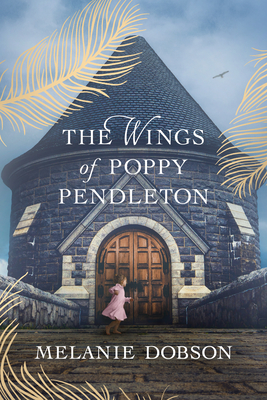
Review: The Wings of Poppy Pendleton

In The Wings of Poppy Pendleton, a novel by Melanie Dobson, the newly rich Pendleton family is trying to find a place among the top Gilded Age society families. Mr. Pendleton had built a stunning castle on Koster Island among New York’s Thousand Islands, and the family is hosting a fete for elite guests. Their almost five-year-old daughter, Poppy, is sleeping in the castle’s tower, supposedly under the care of one of the maids, while the guests party.

But in the morning, Poppy is missing and Mr. Pendleton is dead.

Police, detectives, and curious seekers investigate for years, trying to determine what happened. But Poppy’s disappearance remains a mystery.

In 1992, Chloe Ridell is the only resident on Koster Island. Her grandfather, Cade, had been the caretaker of the castle and island in the Pendleton’s time and decades afterward. Mrs. Pendleton willed the property to Cade, who then passed it along to Chloe.

Chloe is uninterested in the castle and has never been in it. She runs a candy store started by her grandparents, and she just wants to maintain their legacy. But her funds are running low.

Then one stormy night, a young girl shows up on Chloe’s porch. Her name is Emma, but she refuses to say much else about who she is or why she is there. She’s frightened, though, especially of a man named Mitch. Chloe feels led to let Emma stay while her situation is investigated by the police. Eventually, Emma lets Chloe see her scrapbook, which is filled with drawings, magazine cutouts, and descriptions of birds. On the last page is a picture from a news article about the magnificent aviary Mrs. Pendelton’s husband had constructed at her request and filled with dozens of birds and their native trees. The aviary burned down decades ago. But Chloe wonders at the oddity of Emma’s connection to the Pendletons.

Then another visitor shows up out of the blue. A reporter, Logan, arrives in Chloe’s candy shop. Poppy Pendleton’s ninetieth birthday is coming soon. Logan thought it would be a good time to look into her case again. Chloe has no interest. But Logan convinces her that solving the mystery will not only bring justice for Poppy, but it will stop the curious from tramping around her island and asking her questions.

The point of view switches between characters and timelines to uncover what happened to Poppy, her mother, and Emma.

So far I have loved all of Melanie’s novels, and this is no exception. She explores some darker themes than usual. But, sadly, the issues in the story are all too real.

I felt the faith element was woven in naturally and not at all preachy or stilted.

I listened to the audiobook nicely read by Nancy Peterson. Many audiobooks don’t include the author’s afterword or notes, but this one did. Plus Melanie tells a little bit about her research for the novel, with pictures from a trip to the Thousand Islands and its castles, here.

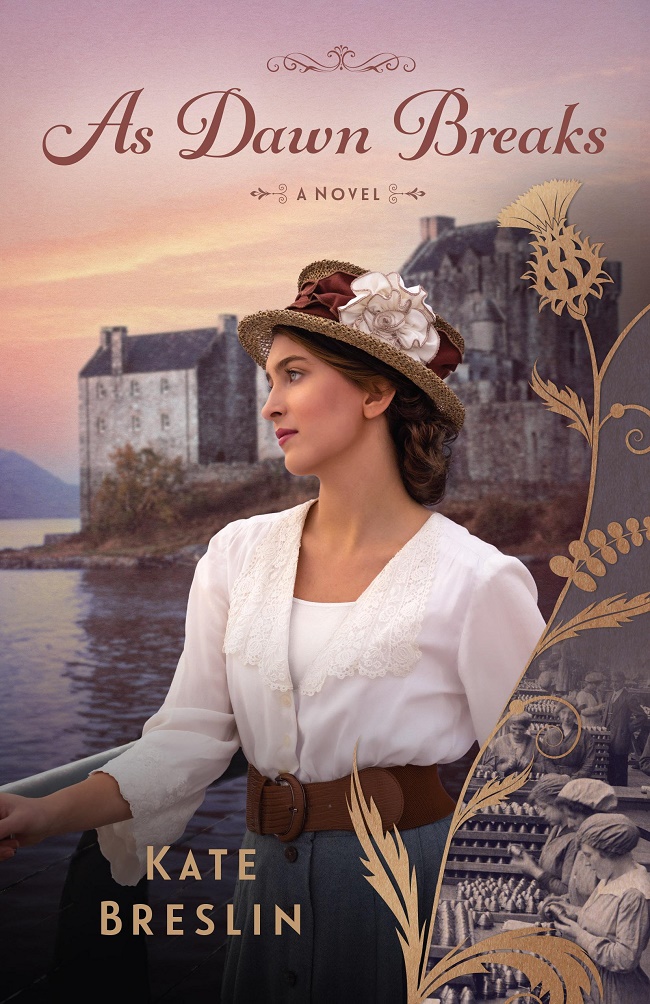
Review: As Dawn Breaks

As Dawn Breaks

In Kate Breslin’s novel, As Dawn Breaks, Rosalind Graham works in a Chilwell munitions factory in England in 1918. Her parents had passed away long ago, and her uncle took Rosalind and her two brothers in. But the arrangement was far from cozy. Rosalind’s uncle is forcing her to marry a ruthless man she doesn’t love.

Shortly before the wedding, Rose’s best friend from the factory, Tilly, sends her to her apartment to get ready for a bridal shower. But while Rose is away, the factory blows up, killing hundreds, including Tilly.

Stunned and devastated, Rose eventually realizes the explosion offers her a way out of her dilemma. She can take on Tilly’s identity and leave, and everyone will think Rose died in the explosion. Though she hates to make her brothers think she’s dead, it’s the only way she can see to help herself and them. She plans to find a job in another town and then retrieve her brothers when she has saved enough money.

Rose/Tilly ends up in another munitions factory in Gretna, Scotland. She’s put in charge of a group, and one of the young women says her family will let her rent a room. She revels in a warm, caring, normal family life.

RAF Captain Alex Baird heads for home in Gretna on an undercover mission. Sources indicate the Gretna factory might be next for the saboteur. Alex is charged with working in the factory to find clues as to what might happen and who might be involved.

Alex is stunned to find a woman, Rose, who he knows as Tilly, renting his bedroom. He didn’t know his father was unable to work and needed to make money by renting out his room. Rose and Alex don’t get on well at first, but eventually they form a bond over their love for his family.

Then Alex receives word to surveil Tilly, who is suspected of having some connection in the Chilwell bombing. Rose knows nothing of Tilly’s involvement and wonders at Alex’s sudden interest in everything she does.

Meanwhile, Alex has secrets of his own that not even his parents know.

I didn’t know, when I read Kate Breslin’s Far Side of the Sea a couple of months ago, that it was the third of a five-part series. As Dawn Breaks is the fourth and has been in my Kindle app for a couple of years now. Each of the books is understandable alone, but it’s fun to follow some of the characters through the series.

I enjoyed the characters, and there was plenty of suspense in wondering what Tilly had been involved in, whether Rose would be blamed, whether the saboteur would be found in time, and other plot lines. I thought one of the threads was wrapped up a little too easily, but overall I enjoyed the book very much.

Review: The Rose of Winslow Street

The Rose of Winslow Street book

In The Rose of Winslow Street by Elizabeth Camden, Libby Sawyer and her elderly father were spending their summer visiting with her brother and his family when they received astonishing news. A group of people had moved into their long-time home in Colden, Massachusetts, claiming they owned it.

Michael Dobrescu fled from Romania with his sons, sister, and two friends in 1879. His late uncle had willed him the house on Winslow Street. So Michael took ownership, figuring the court system would work everything out in the long run.

As it turned out, Michael and his family were not gypsies, as Libby’s father asserted. And he did have a valid claim to the house. But Mr. Sawyer did as well.

The two families were at a standoff as the lawyers researched their claims. The townsfolk stood solidly behind the Sawyers, even to the point of refusing to do business with the Dobrescus.

But Libby felt that the family shouldn’t be mistreated, even as she hoped they’d move out soon. She started bringing them baskets of food. She found Michael infuriating and distrustful at first. But over time, she got to know the family and their story.

She grew to care for the Dobrescus, especially Michael. But she could not be disloyal to her father.

I liked that this story was a different premise than anything I had ever read before. It showed well how we can misjudge and make assumptions about people who are different from us.

There are other layers to the story as well. Libby can’t read, though she’s had multitudes of lessons and tutors. Her father thinks her mentally deficient, and Libby has always lived in her “perfect” brother’s shadow, even though she has gifts and talents of her own.

Also, Michael’s sister experienced horrors at the hands of the Ottomans who were fighting the Romanians. Broken and fragile, she has a long road to recovery.

I had never read anything by Elizabeth Camden. I thought the writing was mostly good, but there were a few inconsistencies in the plot line and writing pet peeves that marred it a little.

I’ve been struggling with whether to say this, and I want to say it carefully. Let me preface it by saying I believe a person is saved by believing in Jesus Christ as Lord and Savior, repenting of their sins, relying on His death on the cross for their sins and His perfect life lived in their place. I believe a person can be saved no matter what denomination they are in. I have known Catholics who I believe are saved. But the Catholic church as a whole, though it teaches faith in Christ, also adds extra-biblical requirements from the church. So it concerns me when the main spiritual emphasis in a book is Catholic. It makes sense from a historical standpoint that the Dobrescus are Catholic. But when going further into that denomination is the answer to part of their situation, I see that as a problem from a Christian fiction viewpoint.

I listened to the audiobook when it was free on Audible’s Plus Catalog. I thought narrator Barbara Rosenblat did a wonderful job, especially with the accents.

Review and Giveaway: Chasing Shadows

Chasing Shadows by Lynn Austin

In Chasing Shadows, a novel by Lynn Austin, people of the Netherlands thought they would be safe during WW2 because their country was neutral. But the Nazis invaded and took over anyway.

Lena de Vries is a farmer’s wife with a son and two daughters. She loves her life, though she has frequent arguments with her daughter, Ans.

Ans doesn’t care for farm life and doesn’t embrace her family’s faith. When she has an opportunity to move to Leiden, she takes it. She’s offered a job as a companion to a woman named Eloise with “melancholia”–her symptoms sound like what we would call bipolar disorder today. Eloise is depressed by her losses during WW1. When the Nazis invade, she’s in danger of sinking further. Ans starts helping in small, but ever-increasing ways with the Resistance. When Eloise finds ways she can help, too, she’s energized.

Ans had begun dating a Dutch policeman, Erik. The Nazis took over the police force, but Erik thought the best way to cope was just to get along with them. But they increasingly require more and more, and he and Ans differ about where they should draw the line.

Jewess Miriam Jacobs fled Germany with her father, who procured a teaching position in Leiden. They planned to send for Miriam’s mother later. But when the Nazis came, there was nowhere to escape. The coastline and borders were monitored. Some Jews who had escaped to other countries were turned away. One by one, the Nazis followed the same procedures as they had in Germany: limiting Jewish activity, requiring yellow stars on their clothing, eliminating their positions. When word came that Jews were being deported to settlement camps, Miriam and her father know they have to hide.

Meanwhile, Lena has to learn to let go—first of Ans when she leaves, then her husband Pieter when he trains for fighting, then her teenage son when the Nazis scoop up young men to build trenches and such. She and her husband hide both Jews and Dutch police who went underground rather than work for the Nazis. Though their food supply continues to dwindle, Lena can’t turn away the hungry that come to her farm.

I loved that this book didn’t cover just one thread–the Jewish persecution or the dangers of being in the Resistance or strains on the homefront—but dealt with facets of all of them. It was fully orbed, covering how the war affected and caused suffering for everyone. For instance, when the queen, in exile, orders railroad workers to strike, deportations of the Jews cease and Nazi supplies are stopped–but so are everyone else’s. There was widespread starving, especially in cities. People who had homes chopped up furniture to burn to keep warm, and animals of any kind (including cats and horses) weren’t safe from being caught and eaten.

Plus the three main characters are at different stages in life and at different levels in their faith. And each has to make nearly impossible choices.

I was so attached to these characters that I was sad to let them go when the story was over.

As it happens, I somehow ended up with two copies of this book. I think I bought it on sale but maybe forgot I had already received it for my birthday. Then the audiobook (nicely read by Stina Nielsen) came up free in the Audible “Plus” catalog, and I figured I’d get to it sooner via audio. But I still liked having the print books to refer to certain passages and read the book’s back material.

So I’d like to offer these two paperback books to a couple of my readers. I’m sorry I’ll have to restrict the giveaway to continental US addresses due to postage prices. If you’d like to enter a drawing for a copy of this book, leave a comment on this post. I’ll count all the comments on this post as entries unless you tell me you’d rather not be in the drawing. I’ll draw two names one week from today and contact the winners via email. If I can’t reach you or don’t hear back from you within a couple of days after that, I’ll draw another name.

I wish I could give you all a copy!

The giveaway is closed. Congratulations to Kitty and Sarah!

Review: Far Side of the Sea

In Far Side of the Sea by Kate Breslin, Lieutenant Colin Mabry had been on the front in WWI. After recovering from a serious accident and the loss of his hand, he’s assigned to MI8, decoding messages sent by carrier pigeon. He’s troubled by the sounds of battle he hears across the channel as well as any loud, sudden noises.

One day he finds a carrier message to himself from a woman he thought dead, Jewel Reyer. She had taken him in, at great risk and cost to herself, when he was injured in France. He had promised to return for her. But then he had his accident and recovery, and afterward heard her entire village had been attacked with no survivors.

He obtains permission to travel to France. He is stunned to find that the message was sent not by Jewel, but by her half-sister Johanna, who works with doves for the French Army Intelligence. Johanna found Jewel’s diary, where she mentioned Colin. Johanna has reason to think her sister is alive and in the custody of a German agent who had been in charge of her village. Johanna wants Colin to help her find Jewel.

Colin is angry at the deception and wary of Johanna. But if there is a chance Jewel is alive and needs his help, he must look for her. He owes her that. Plus, the two were just beginning to develop feelings for each other, and he must know if she still feels the same way.

So he sets aside his anger at Johanna, and they travel to Jewel’s last known location with more questions than answers.

But they find themselves in danger, not knowing whom to trust.

This is the first book I’ve ever read by Kate Breslin, and it definitely reeled me in after the first few chapters. Johanna has several secrets she has not shared with Colin, and bits of her story and background are revealed through the book, as well as her reasons for not sharing all. It takes a while to decide whether she is trustworthy and someone we should be pulling for.

Then they meet an array of iffy characters and situations and face multiple twists and turns.

The story also deals with Colin and Johanna’s inner issues as well. Colin not only suffers from what we now know as PTSD, but he’s lost confidence in himself. Johanna had a checkered upbringing and struggled to find a place to belong or believe that there was a God who was interested in her.

I didn’t know at first that this book was a sequel to another, Not By Sight. Far Side of the Sea read well on its own, but I might like to go back and read the first book some time if I catch it on sale.

I enjoyed the author’s notes at the end, where she tells more about carrier pigeons used in war and what details and people were real or made up.

I’d had the Kindle version of this book for a while, but recently saw the audiobook was among Audible’s free titles. It was nice to switch back and forth between reading or listening, depending on my circumstances.

As I said, this was the first of Kare Breslin’s books I’ve read, but it won’t be the last.

Review: Bleak Landing

Bleak Landing

In Terrie Todd’s novel, Bleak Landing, Bridget O’Sulliovan’s family had come to the small town of Bleak Landing in Canada from Ireland when she was seven. But her mother and brother died on the voyage. Her father took to drinking, gambling, and beating Bridget, making sure she knew he wished she had been the one to die.

Bridget didn’t fare much better at school. Her fiery red hair, Irish accent, rundown home, and drunken father all made her a target for bullying. Her two worst enemies were Victor Harrison and Bruce Nilsen, who locked her in the school outhouse one day. She vowed then that she’d leave Bleak Landing the first chance she got.

Her resolve was strengthened when she learned that one of her father’s gambling debts involved her.

Leave she did when she was fifteen, finding a job in a textile mill, then in a mansion as a cook’s helper, rising up the ranks to lady’s maid.

She becomes best friends with Maxine, a chatty girl she met at the mill. Maxine and her family are Christians. Bridget thinks they are nice and appreciates their hospitality, but doesn’t feel God has done her any favors.

Several years later, Bridget learns in a roundabout way that her father died and there’s some dispute about his property. At first she doesn’t care. She doesn’t want to see Bleak Landing again, and the property wasn’t much to speak of anyway. But when she loses her job and apartment during the Depression, her father’s property is the only thing in the world she owns besides the clothes she wore.

When she gets back to Bleak Landing, though, no one recognizes her except Victor. She looks much different and doesn’t have any identification.

Victor, during all these years, fought during WWI, was injured, came home, and trained to be a pastor. He regretted the way he treated Bridget when they were kids, but had no way to make amends to her. But will she forgive him and let him help her?

Bridget’s story was heart-breaking at first. She rises above her circumstances, but she doesn’t let anyone in and doesn’t share anything about her past with anyone. It’s a wonder, humanly speaking, that Maxine put up with her negativity, especially not knowing what caused it.. But eventually Bridget’s heart softens as she realizes she might need more than spunk to get through life.

I wouldn’t agree with every little theological point made, and I am not a fan of ecumenism between gospel-preaching and works-based churches.

But otherwise, I loved the characters and story.

Review: A Beautiful Disguise

A Beautiful Disguise by Roseanna M. White

In A Beautiful Disguise, a novel by Roseanna M. White, siblings Yates and Marigold Fairfax had an idyllic childhood in Edwardian England. Their father loved entertainment and spent lavish money on it, even buying a circus. They grew up playing with the animals, learning the trapeze, loving the performers like family.

The Fairfaxes didn’t know, until their father’s death when they were young adults, that all the entertainment came at a steep price. They weren’t in debt, but there was no money. They needed not only to take care of themselves and the family estate, but the circus performers who depended on them.

They decided to use their skills to start an investigations company: The Imposters, LTD. They’d maintain their positions as Lord and Lady Fairfax in 1908 British society, not so much because they cared about position, but because that’s the world they knew and moved in and where their clientele would come from. Marigold remade many of her mother’s beautiful old gowns into outlandish costumes with ostrich plumes and wide hat brims so that people would notice her persona, not her. Her friend, Gemma, alias newspaper columnist G. M. Parker, played up Marigold’s “Lady M” by reporting on her lavish clothing. It worked so well that Gemma could sometimes pose as Marigold because people usually looked at her outfits, not her face.

Sir Merritt Livingstone was a faithful soldier for ten years. But a severe bout of pneumonia took ages to recover from. He’s still not at full steam, so he’s been given a desk job in the War Office Intelligence Division. One of his agents has not been heard from in an unusual amount of time. His most recent coded telegram simply contained the name of Merritt’s boss, Lord Henning. Merritt doesn’t want to believe anything ill of Henning, but he has to discreetly find out what’s going on.

Sounds like a job for the Imposters.

When Merritt meets the intriguing Lady M. at a ball, he has no idea she’s half the team looking into his request.

At first it might sound odd for a titled family to own a circus. The Fairfaxes family home was in Northumberland while they spent “the season” in London, so much of society didn’t know they had a lion in their back yard and a high wire set-up in their gym. But the circus situation worked into the story believably and smoothly. In fact, it was fun and different. Yates’ and Marigold’s acrobatic training came in handy climbing window ledges to eavesdrop, and their stage makeup allowed them to disguise themselves.

The characters and plot are well-drawn and compelling. The faith element is woven in naturally.

I listened to the audiobook wonderfully read by Susan Lyons. I missed the author’s notes at the end, which I wished audiobooks included. But I did see this blog post where Roseanna introduced the series and this interview, in which she shares some of her inspiration.

I thoroughly enjoyed this book and can’t wait for the sequel.

Review: Hannah Coulter

Hannah Coulter is Wendell Berry’s seventh book, published 44 years after Nathan Coulter. But the action picks up right where Nathan Coulter left off. I’ve only read these two books and Jayber Crow, but I understand that Hannah appears in some of the other Port William books as well.

Hannah tells her story as an elderly woman, twice widowed, looking back over her life. She was born in 1922 as the only daughter to her parents. Their farm was owned by her father’s mother, Grandmam, who lived and worked with the family.

Hannah had responsibilities around the farm from the time she was five or six. By the age of twelve, when her mother died, Hannah could do “a woman’s part.” She tells of her father’s remarrying a woman who “lived up to the bad reputation of stepmothers.” Grandmam watched out for Hannah, though, providing for her to go to high school and secure her first job.

Hannah met her first husband, Virgil Feltner, at work. He died in WWII while Hannah was expecting her first child. Hannah lived with her in-laws, who loved her like a daughter.

Then Nathan Coulter came back from the war and helped the Feltners out on their farm. Hannah tells of his budding interest, then hers, until they finally married and moved into the fixer-upper farm he bought.

Along with the details of their lives together, Hannah shares the history of the times and the community of neighbors that they called “The Membership.” The Membership wasn’t an official club; rather, that’s what they called the group who lived near each other and helped each other on their farms.

Over the course of Hannah’s long life, Port William saw many changes. Hannah decried many of the changes, like not knowing many of the families in the community any more, some technologicaladvances, and so on. Many of the “Membership’s” young people did not stay on the family farms, including Hannah’s.

Hannah Coulter reminds me of Laura Ingalls Wilder’s Little House books in the sense of showing how people used to live and how things changed over the decades of one person’s life. But Berry’s voice is quite different from Wilder’s.

Hannah is my favorite of the three Port William books I have read so far. There’s an unfortunate smattering of bad language, as with the other books. Michele Morin had hosted a discussion of Jayber Crow (which I think is what prompted me to read it) and mentioned once that it sometimes felt that Berry took the microphone in place of Jayber. I had that same feeling in a couple of places here, particularly in passages about the war.

But Hannah seems the most authentically Christian of Berry’s characters that I’ve encountered so far. And the main strength of Berry’s writing is the lyricism, the sense of place, community, love, and relationships.

A few quotes that stood out to me:

Love is what carries you, for it is always there, even in the dark, or most in the dark, but shining out at times like gold stitches in a piece of embroidery.

The living can’t quit living because the world has turned terrible and people they love and need are killed. They can’t because they don’t. The light that shines into darkness and never goes out calls them on into life. It calls them back again into the great room. It calls them into their bodies and into the world, into whatever the world will require. It calls them into work and pleasure, goodness and beauty, and the company of other loved ones.

I began to trust the world again, not to give me what I wanted, for I saw that it could not be trusted to do that, but to give unforeseen goods and pleasures that I had not thought to want.

Sometimes…I wander about in this house that Nathan and I renewed, that is now aged and worn by our life in it. How many steps, wearing the thresholds? I look at it all again. Sometimes it fills to the brim with sorrow, which signifies the joy that has been here, and the love. It is entirely a gift.

It is hard to say what it means to be at work and thinking of a person you loved and love still who did that same work before you and who taught you to do it. It is a comfort ever and always, like hearing the rhyme come when you are singing a song.

He was a humorous, good-natured man, maybe because he hoped for little and expected less and took his satisfactions where he found them.

A lifetime’s knowledge shimmers on the face of the land in the mind of a person who knows. The history of a place is the mind of an old man or an old woman who knows it.

Even old, your husband is the young man you remember now. Even dead, he is the man you remember, not as he was but as he is, alive still in your love. Death is a sort of lens, though I used to think of it as a wall or a shut door. It changes things and makes them clear. Maybe it is the truest way of knowing this dream, this brief and timeless life.

Any time an eighteen-year-old boy tells you not to worry, you had better worry.

Members of Port William aren’t trying to get someplace. They think they are someplace.

One theme that comes up continually is something Nathan says. When unexpected changes come, even his own terminal diagnosis, Nathan says he’s just going to “live right on.” “Living right on called for nothing out of the ordinary. We made no changes. We only accepted the changes as they came.”

I listened to the audiobook nicely read by Susan Denaker.

Have you read Hannah Coulter or others of Berry’s books? What did you think?