Review and Giveaway: Chasing Shadows

Chasing Shadows by Lynn Austin

In Chasing Shadows, a novel by Lynn Austin, people of the Netherlands thought they would be safe during WW2 because their country was neutral. But the Nazis invaded and took over anyway.

Lena de Vries is a farmer’s wife with a son and two daughters. She loves her life, though she has frequent arguments with her daughter, Ans.

Ans doesn’t care for farm life and doesn’t embrace her family’s faith. When she has an opportunity to move to Leiden, she takes it. She’s offered a job as a companion to a woman named Eloise with “melancholia”–her symptoms sound like what we would call bipolar disorder today. Eloise is depressed by her losses during WW1. When the Nazis invade, she’s in danger of sinking further. Ans starts helping in small, but ever-increasing ways with the Resistance. When Eloise finds ways she can help, too, she’s energized.

Ans had begun dating a Dutch policeman, Erik. The Nazis took over the police force, but Erik thought the best way to cope was just to get along with them. But they increasingly require more and more, and he and Ans differ about where they should draw the line.

Jewess Miriam Jacobs fled Germany with her father, who procured a teaching position in Leiden. They planned to send for Miriam’s mother later. But when the Nazis came, there was nowhere to escape. The coastline and borders were monitored. Some Jews who had escaped to other countries were turned away. One by one, the Nazis followed the same procedures as they had in Germany: limiting Jewish activity, requiring yellow stars on their clothing, eliminating their positions. When word came that Jews were being deported to settlement camps, Miriam and her father know they have to hide.

Meanwhile, Lena has to learn to let go—first of Ans when she leaves, then her husband Pieter when he trains for fighting, then her teenage son when the Nazis scoop up young men to build trenches and such. She and her husband hide both Jews and Dutch police who went underground rather than work for the Nazis. Though their food supply continues to dwindle, Lena can’t turn away the hungry that come to her farm.

I loved that this book didn’t cover just one thread–the Jewish persecution or the dangers of being in the Resistance or strains on the homefront—but dealt with facets of all of them. It was fully orbed, covering how the war affected and caused suffering for everyone. For instance, when the queen, in exile, orders railroad workers to strike, deportations of the Jews cease and Nazi supplies are stopped–but so are everyone else’s. There was widespread starving, especially in cities. People who had homes chopped up furniture to burn to keep warm, and animals of any kind (including cats and horses) weren’t safe from being caught and eaten.

Plus the three main characters are at different stages in life and at different levels in their faith. And each has to make nearly impossible choices.

I was so attached to these characters that I was sad to let them go when the story was over.

As it happens, I somehow ended up with two copies of this book. I think I bought it on sale but maybe forgot I had already received it for my birthday. Then the audiobook (nicely read by Stina Nielsen) came up free in the Audible “Plus” catalog, and I figured I’d get to it sooner via audio. But I still liked having the print books to refer to certain passages and read the book’s back material.

So I’d like to offer these two paperback books to a couple of my readers. I’m sorry I’ll have to restrict the giveaway to continental US addresses due to postage prices. If you’d like to enter a drawing for a copy of this book, leave a comment on this post. I’ll count all the comments on this post as entries unless you tell me you’d rather not be in the drawing. I’ll draw two names one week from today and contact the winners via email. If I can’t reach you or don’t hear back from you within a couple of days after that, I’ll draw another name.

I wish I could give you all a copy!

The giveaway is closed. Congratulations to Kitty and Sarah!

Review: Far Side of the Sea

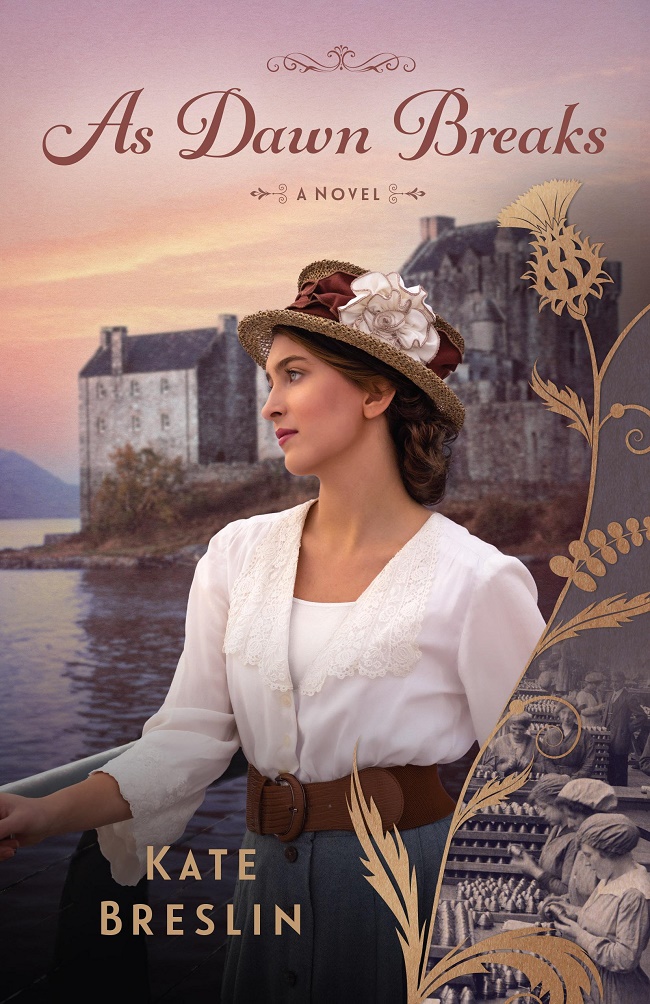
In Far Side of the Sea by Kate Breslin, Lieutenant Colin Mabry had been on the front in WWI. After recovering from a serious accident and the loss of his hand, he’s assigned to MI8, decoding messages sent by carrier pigeon. He’s troubled by the sounds of battle he hears across the channel as well as any loud, sudden noises.

One day he finds a carrier message to himself from a woman he thought dead, Jewel Reyer. She had taken him in, at great risk and cost to herself, when he was injured in France. He had promised to return for her. But then he had his accident and recovery, and afterward heard her entire village had been attacked with no survivors.

He obtains permission to travel to France. He is stunned to find that the message was sent not by Jewel, but by her half-sister Johanna, who works with doves for the French Army Intelligence. Johanna found Jewel’s diary, where she mentioned Colin. Johanna has reason to think her sister is alive and in the custody of a German agent who had been in charge of her village. Johanna wants Colin to help her find Jewel.

Colin is angry at the deception and wary of Johanna. But if there is a chance Jewel is alive and needs his help, he must look for her. He owes her that. Plus, the two were just beginning to develop feelings for each other, and he must know if she still feels the same way.

So he sets aside his anger at Johanna, and they travel to Jewel’s last known location with more questions than answers.

But they find themselves in danger, not knowing whom to trust.

This is the first book I’ve ever read by Kate Breslin, and it definitely reeled me in after the first few chapters. Johanna has several secrets she has not shared with Colin, and bits of her story and background are revealed through the book, as well as her reasons for not sharing all. It takes a while to decide whether she is trustworthy and someone we should be pulling for.

Then they meet an array of iffy characters and situations and face multiple twists and turns.

The story also deals with Colin and Johanna’s inner issues as well. Colin not only suffers from what we now know as PTSD, but he’s lost confidence in himself. Johanna had a checkered upbringing and struggled to find a place to belong or believe that there was a God who was interested in her.

I didn’t know at first that this book was a sequel to another, Not By Sight. Far Side of the Sea read well on its own, but I might like to go back and read the first book some time if I catch it on sale.

I enjoyed the author’s notes at the end, where she tells more about carrier pigeons used in war and what details and people were real or made up.

I’d had the Kindle version of this book for a while, but recently saw the audiobook was among Audible’s free titles. It was nice to switch back and forth between reading or listening, depending on my circumstances.

As I said, this was the first of Kare Breslin’s books I’ve read, but it won’t be the last.

Review: Bleak Landing

Bleak Landing

In Terrie Todd’s novel, Bleak Landing, Bridget O’Sulliovan’s family had come to the small town of Bleak Landing in Canada from Ireland when she was seven. But her mother and brother died on the voyage. Her father took to drinking, gambling, and beating Bridget, making sure she knew he wished she had been the one to die.

Bridget didn’t fare much better at school. Her fiery red hair, Irish accent, rundown home, and drunken father all made her a target for bullying. Her two worst enemies were Victor Harrison and Bruce Nilsen, who locked her in the school outhouse one day. She vowed then that she’d leave Bleak Landing the first chance she got.

Her resolve was strengthened when she learned that one of her father’s gambling debts involved her.

Leave she did when she was fifteen, finding a job in a textile mill, then in a mansion as a cook’s helper, rising up the ranks to lady’s maid.

She becomes best friends with Maxine, a chatty girl she met at the mill. Maxine and her family are Christians. Bridget thinks they are nice and appreciates their hospitality, but doesn’t feel God has done her any favors.

Several years later, Bridget learns in a roundabout way that her father died and there’s some dispute about his property. At first she doesn’t care. She doesn’t want to see Bleak Landing again, and the property wasn’t much to speak of anyway. But when she loses her job and apartment during the Depression, her father’s property is the only thing in the world she owns besides the clothes she wore.

When she gets back to Bleak Landing, though, no one recognizes her except Victor. She looks much different and doesn’t have any identification.

Victor, during all these years, fought during WWI, was injured, came home, and trained to be a pastor. He regretted the way he treated Bridget when they were kids, but had no way to make amends to her. But will she forgive him and let him help her?

Bridget’s story was heart-breaking at first. She rises above her circumstances, but she doesn’t let anyone in and doesn’t share anything about her past with anyone. It’s a wonder, humanly speaking, that Maxine put up with her negativity, especially not knowing what caused it.. But eventually Bridget’s heart softens as she realizes she might need more than spunk to get through life.

I wouldn’t agree with every little theological point made, and I am not a fan of ecumenism between gospel-preaching and works-based churches.

But otherwise, I loved the characters and story.

Review: A Beautiful Disguise

A Beautiful Disguise by Roseanna M. White

In A Beautiful Disguise, a novel by Roseanna M. White, siblings Yates and Marigold Fairfax had an idyllic childhood in Edwardian England. Their father loved entertainment and spent lavish money on it, even buying a circus. They grew up playing with the animals, learning the trapeze, loving the performers like family.

The Fairfaxes didn’t know, until their father’s death when they were young adults, that all the entertainment came at a steep price. They weren’t in debt, but there was no money. They needed not only to take care of themselves and the family estate, but the circus performers who depended on them.

They decided to use their skills to start an investigations company: The Imposters, LTD. They’d maintain their positions as Lord and Lady Fairfax in 1908 British society, not so much because they cared about position, but because that’s the world they knew and moved in and where their clientele would come from. Marigold remade many of her mother’s beautiful old gowns into outlandish costumes with ostrich plumes and wide hat brims so that people would notice her persona, not her. Her friend, Gemma, alias newspaper columnist G. M. Parker, played up Marigold’s “Lady M” by reporting on her lavish clothing. It worked so well that Gemma could sometimes pose as Marigold because people usually looked at her outfits, not her face.

Sir Merritt Livingstone was a faithful soldier for ten years. But a severe bout of pneumonia took ages to recover from. He’s still not at full steam, so he’s been given a desk job in the War Office Intelligence Division. One of his agents has not been heard from in an unusual amount of time. His most recent coded telegram simply contained the name of Merritt’s boss, Lord Henning. Merritt doesn’t want to believe anything ill of Henning, but he has to discreetly find out what’s going on.

Sounds like a job for the Imposters.

When Merritt meets the intriguing Lady M. at a ball, he has no idea she’s half the team looking into his request.

At first it might sound odd for a titled family to own a circus. The Fairfaxes family home was in Northumberland while they spent “the season” in London, so much of society didn’t know they had a lion in their back yard and a high wire set-up in their gym. But the circus situation worked into the story believably and smoothly. In fact, it was fun and different. Yates’ and Marigold’s acrobatic training came in handy climbing window ledges to eavesdrop, and their stage makeup allowed them to disguise themselves.

The characters and plot are well-drawn and compelling. The faith element is woven in naturally.

I listened to the audiobook wonderfully read by Susan Lyons. I missed the author’s notes at the end, which I wished audiobooks included. But I did see this blog post where Roseanna introduced the series and this interview, in which she shares some of her inspiration.

I thoroughly enjoyed this book and can’t wait for the sequel.

Review: Hannah Coulter

Hannah Coulter is Wendell Berry’s seventh book, published 44 years after Nathan Coulter. But the action picks up right where Nathan Coulter left off. I’ve only read these two books and Jayber Crow, but I understand that Hannah appears in some of the other Port William books as well.

Hannah tells her story as an elderly woman, twice widowed, looking back over her life. She was born in 1922 as the only daughter to her parents. Their farm was owned by her father’s mother, Grandmam, who lived and worked with the family.

Hannah had responsibilities around the farm from the time she was five or six. By the age of twelve, when her mother died, Hannah could do “a woman’s part.” She tells of her father’s remarrying a woman who “lived up to the bad reputation of stepmothers.” Grandmam watched out for Hannah, though, providing for her to go to high school and secure her first job.

Hannah met her first husband, Virgil Feltner, at work. He died in WWII while Hannah was expecting her first child. Hannah lived with her in-laws, who loved her like a daughter.

Then Nathan Coulter came back from the war and helped the Feltners out on their farm. Hannah tells of his budding interest, then hers, until they finally married and moved into the fixer-upper farm he bought.

Along with the details of their lives together, Hannah shares the history of the times and the community of neighbors that they called “The Membership.” The Membership wasn’t an official club; rather, that’s what they called the group who lived near each other and helped each other on their farms.

Over the course of Hannah’s long life, Port William saw many changes. Hannah decried many of the changes, like not knowing many of the families in the community any more, some technologicaladvances, and so on. Many of the “Membership’s” young people did not stay on the family farms, including Hannah’s.

Hannah Coulter reminds me of Laura Ingalls Wilder’s Little House books in the sense of showing how people used to live and how things changed over the decades of one person’s life. But Berry’s voice is quite different from Wilder’s.

Hannah is my favorite of the three Port William books I have read so far. There’s an unfortunate smattering of bad language, as with the other books. Michele Morin had hosted a discussion of Jayber Crow (which I think is what prompted me to read it) and mentioned once that it sometimes felt that Berry took the microphone in place of Jayber. I had that same feeling in a couple of places here, particularly in passages about the war.

But Hannah seems the most authentically Christian of Berry’s characters that I’ve encountered so far. And the main strength of Berry’s writing is the lyricism, the sense of place, community, love, and relationships.

A few quotes that stood out to me:

Love is what carries you, for it is always there, even in the dark, or most in the dark, but shining out at times like gold stitches in a piece of embroidery.

The living can’t quit living because the world has turned terrible and people they love and need are killed. They can’t because they don’t. The light that shines into darkness and never goes out calls them on into life. It calls them back again into the great room. It calls them into their bodies and into the world, into whatever the world will require. It calls them into work and pleasure, goodness and beauty, and the company of other loved ones.

I began to trust the world again, not to give me what I wanted, for I saw that it could not be trusted to do that, but to give unforeseen goods and pleasures that I had not thought to want.

Sometimes…I wander about in this house that Nathan and I renewed, that is now aged and worn by our life in it. How many steps, wearing the thresholds? I look at it all again. Sometimes it fills to the brim with sorrow, which signifies the joy that has been here, and the love. It is entirely a gift.

It is hard to say what it means to be at work and thinking of a person you loved and love still who did that same work before you and who taught you to do it. It is a comfort ever and always, like hearing the rhyme come when you are singing a song.

He was a humorous, good-natured man, maybe because he hoped for little and expected less and took his satisfactions where he found them.

A lifetime’s knowledge shimmers on the face of the land in the mind of a person who knows. The history of a place is the mind of an old man or an old woman who knows it.

Even old, your husband is the young man you remember now. Even dead, he is the man you remember, not as he was but as he is, alive still in your love. Death is a sort of lens, though I used to think of it as a wall or a shut door. It changes things and makes them clear. Maybe it is the truest way of knowing this dream, this brief and timeless life.

Any time an eighteen-year-old boy tells you not to worry, you had better worry.

Members of Port William aren’t trying to get someplace. They think they are someplace.

One theme that comes up continually is something Nathan says. When unexpected changes come, even his own terminal diagnosis, Nathan says he’s just going to “live right on.” “Living right on called for nothing out of the ordinary. We made no changes. We only accepted the changes as they came.”

I listened to the audiobook nicely read by Susan Denaker.

Have you read Hannah Coulter or others of Berry’s books? What did you think?

Review: Nathan Coulter

Nathan Coulter was Wendell Berry’s first book, published when he was 27. This is the beginning of his eight novels set in Port William, a fictitious town based on his own Port Royal.

Nathan grows up on a family farm in Port William with his brother Tom, who he usually just calls Brother, and his parents. His father’s parents live next door on the farm that had been passed down through the generations.

Nathan’s mother is sick, so he and his brother are told to stay out of the house in the afternoons so she can rest. They wander all over, getting into various kinds of mischief.

When Nathan’s mother dies, he and Brother go to live with their grandparents. One source said this was so because the father blamed the boys for their mother’s death, but I don’t recall that being the case. One problem with an audiobook is that it’s hard to go back and look up details like this. Another source cited the father’s depression.

Whatever the father’s issues, he was a taciturn man, generally quiet, tending to motivate the boys by taunting them rather than encouraging them. His reason for living was work. He handled everything by working. He was determined to outwork everyone else.

We see events unfold from Nathan’s point of view, though he doesn’t say much. The book mainly describes life on a farm in a small Kentucky community. But the theme seems to be Nathan’s journey to becoming a man. One scene where all the men are working hard to get a tobacco harvest in on time reads with the tension of Ben-Hur’s chariot race as the father challenges Tom, who has never beat him before but is coming closer all the time. The men seem to be in the various stages of manhood: the grandfather lamenting his decline and inability to do what he used to, the father in his prime, the oldest son growing in strength almost to the point of the father.

Unfortunately, Nathan doesn’t have many good examples. His grandfather and father are harsh and distant. His uncle Burley is kind, but has a wild streak.

The version of the book I read ends with the death of Nathan’s grandfather, when Nathan was sixteen, almost like the baton is passing to the next generation. I’ve read that the book originally was longer, telling of Nathan’s growing into adulthood.

I got this audiobook (wonderfully read by Paul Michael) because it’s currently in Audible’s Plus Catalog of free titles for members and because I wanted to read more of Berry. I’ve only read his Jayber Crow until now, which I had mixed emotions about.

I had mixed emotions about this book, too. Berry’s writing is lyrical in places, his characters well-drawn, and with a strong sense of place. None of my relatives were farmers, but many did live in rural settings which Berry’s story reminded me of.

There’s a smattering of bad language. But the most offensive thing in the book is when Tom and Nathan go to a carnival, part of which has a strip-tease act–which, for some reason, boys were allowed into. Berry describes the act in too much detail, and I almost stopped the book there. The only reason I continued was because the act was presented as somewhat sad rather than titillating. If this is a story about becoming a man, unfortunately, men at some point come across this type of thing. Thankfully Nathan felt sorry for the woman and wasn’t attracted by the display. But I think the author could have gotten across his point with much less visual detail.

Also, most of the characters who are religious to any degree are odd.

I got Hannah Coulter at the same time as this book, for the same reason. I was going to review the books together, but I ended up saying more about this book than I planned to. So I’ll wait til next week to talk about Hannah, though I’ll say that I liked her story much, much more. Some of the themes Berry is know for are represented in seed form in Nathan Coulter but come to fruition in Hannah Coulter. Hannah is Berry’s seventh novel. It was written 44 years after Nathan, but its story begins just a few years later.

I started reading Berry because I know so many people who love him. His poem “The Blue Robe” is one of my favorites, along with “They Sit Together on the Porch” and “To Tanya on My Sixtieth Birthday.” I love the way he writes, lyrical and tender in places, with a strong sense of place and relationships. But I disagree with him in some areas. I’m still trying to figure him out.

Are you a Wendell Berry fan? What do you like about him?

Review: Ladies of the Lake

In Cathy Gohlke’s novel, Ladies of the Lake, Addie MacNeill is orphaned at age twelve. Her older half-brother sells the family home in Prince Edward Island and ships Addie off to a Lakeside Ladies’ Academy in Connecticut.

Some of the older girls pick on Addie for her newness and different ways. But she surprises herself by finding three dear friends: Dot, Susannah, and Ruth. Eventually they dub themselves the “ladies of the lake” and plan to meet together regularly once they’ve graduated.

When Lucy Laude Montgomery publishes Anne of Green Gables, set in Addie’s beloved PEI, Addie writes to her. The two begin a regular correspondence, and Montgomery encourages Addie in her own writing endeavors.

But trouble stirs when Addie and Dot fall in love with the same young man, Stephen. Over time as he favors one over the other, jealousy and deceit escalate between the girls and ruins their friendship.

WWI is brewing, and Ruth lost her brother in the Lusitania bombing, so she’s prejudiced against Germans. Stephen Meyer and his brother, Jonas, are as American as they come. But their parents still have a heavy German accent. Soon the rest of the community joins in persecuting and ostracizing the Meyers.

Addie is called to Halifax to help her sister-in-law through the end of her pregnancy and delivery. While there, the colliding of two ships sparks the Halifax Explosion, which killed and injured thousands and destroyed homes and buildings. Addie lost her brother and his family and was deeply burned and scarred. Believing that Steven had chosen Dot, Addie decides to change her name to Rosaline Murray and make a new start.

Seventeen years later, Rosaline’s daughter, Bernadette, is about to graduate from Lakeside Ladies’ Academy and dearly wants her mother to come. Rosaline is sensitive about traveling outside of Halifax with her scars. But worse than that, she doesn’t want to face Dot, who is now the headmistress of the Academy.

Dot herself has struggled with secrets for seventeen years now. Believing Addie died in the explosion, Dot has no way to make things right. But when Bernadette starts reminding her of Addie, Dot wonders if Addie could possibly be alive. Could she ever face her again?

Rosaline and Dot resist the things they need to do the most: face each other and confess their wrongdoings and apologize. Their inner torment threatens to hurt themselves and those they love.

I enjoyed this story so much. I loved the characters and how the plot unfolded. The correspondence with Montgomery was a fun element. I had never heard of the devastating Halifax explosion. I loved how the author told it from the standpoint of those affected.

I listened to the audiobook which, sadly, did not contain the author’s end notes. I would have loved to learn more about what inspired the author.

Cathy Gohlke has written another winner that I can highly recommend.

Review: Yesterday’s Tides

Yesterday's Tides novel by Roseanna M. White

Roseanna M. White’s novel, Yesterday’s Tides, has two related story lines taking place in 1914 and 1942 on Ocracoke Island in North Carolina’s Outer Banks.

In 1914, Louisa Adair helps her mother and “Grann” run an inn. She’d like to go to teacher’s college, but there isn’t enough money. Plus, she’s needed at home.

Though Louisa has blue eyes, her skin coloring is darker than most people’s. Her mother will not tell her anything about her deceased father except that he was a good man. A few people are prejudiced against her, thinking she must be of mixed race.

When two college-age cousins, one from Maryland and one from England, come to the inn for the summer, Louisa has no idea how her life will change as a result. Louisa has no plans to fall in love: she keeps a polite reserve with the inn’s male guests. But she and Remington Culbreth, from England, find themselves in each other’s company often. Just after they do fall in love, WWI breaks out and Remington is called to service at home. Will their relationship survive not only the war, but the differences in their families and lifestyles?

In 1942, Evie Farrow now runs the inn with her grandmother. One day while taking some baked goods to the neighbors, a loud explosion is heard in the distant waters. While Evie’s Coast Guard friends prepare to investigate and help, Evie heads home to pray. When a badly burned Englishman washes up near the inn, somehow Evie knows not to report him. He says he is military, but he’s not in uniform. What mutterings she hears as he goes in and out of consciousness alert her to the fact that he is an intelligence officer. But what would an English spy be doing in Ocracoke?

When he wakes up, she learns his name is Sterling Bertrand and he is tracking a German operative. But it will take weeks for his wounds to heal. Meanwhile, he wonders just how far he can trust Evie, who seems to have secrets of her own.

I’ve read many dual timeline novels, and usually there are enough differences between the two timelines to keep from getting confused. I had a little harder time with this one, since both stories took place at an inn in Ocracoke and involved a visiting Englishman. I think I would have had an easier time with reading rather than listening. I didn’t catch some of the names that were the same in both timelines, so I kept getting surprised at the connections. I don’t think that would have happened if I were reading instead of listening.

As it happened, partway through the audiobook I discovered that I did have a Kindle copy! So I went back and forth between reading and listening.

One delight with this book was running into some characters from Roseanna’s previous books. I won’t say which ones, as that might give away parts of the plot. You don’t have to have read those books to understand this one, but it was a fun surprise to see those characters again. Evidently Remington was in an earlier book as well, but, though I remember the story and situation, I don’t remember him.

I’m sorry to say I was not thrilled with the audiobook narrator. Some of her accents seemed a little off to me. Plus she had an odd cadence, her inflection going up when it didn’t need to.

There are so many layers to this novel, and so much more to it than there appears to be at first. I loved the stories, and after finishing the book, I just wanted to sit with the characters a bit more before saying goodbye to them and starting another story.

Review: Dreams of Savannah

In Dreams of Savannah by Roseanna M. White, Cordelia Owens is a pampered Southern belle who loves to dream and write stories. She also loves Phineas Dunn, a lifelong friend newly recruited to the Confederate Navy, and promises to wait for him forever.

When she learns Phineas has been lost at sea, she weaves heroic tales for his mother and sister to help them keep up hope.

When Phineas was shot and fell overboard, he thought he was done for. But somehow he washes up on an island near Cuba. He’s rescued by a person he never imagined existed: an educated free black man from England. He has no way to let his family or his commanding officer know what has happened to him. All he can do is try to get well as fast as possible and get home. But his injuries are severe.

As the weeks drag by, a distant cousin of Cordelia’s comes to Savannah, assigned to the Confederate regiment there. Her parents are impressed by his manners, standing, and wealth. They like Phineas well enough, but his family’s credentials just don’t compare. They put pressure on Cordelia to turn her attention to her cousin. But even if she had not promised Phin she would wait forever, she would not have her cousin. There’s a predatory gleam in his eyes when her parents aren’t around.

When Phineas finally returns, he is still suffering from his injury. Worse, he has fallen in his own estimation. He wanted to be the hero of Cordelia’s stories. He doesn’t feel worthy of her, but he still vies for her hand. Her parents keep pushing her toward her cousin.

Both Cordelia and Phineas are from good families who are known to be kind to their slaves. Phineas’ father was, in fact, planning to free his slaves until doing so became illegal in Georgia.

But different experiences and people begin to change their perspectives. The question now is what to do. Is it enough just to be good to one’s slaves? Could they be mocked, scorned, or even arrested if their views on slavery changed? And how could their views change without changing their actions as well?

At the beginning of this book, Cordelia came across to me as young and somewhat silly (one of her fears for Phineas was that he might be attacked by a giant squid. . . ). I’m not sure how old she was, something hard to go back and find in an audiobook. Also, the Southern belle vibe came across a little too thick, replete with “fiddale-faddle” and “fiddel-dee-dee” (making me wonder for the first time why “fiddle’ was in so many expressions then).

But after I settled into the story, I began to enjoy it more. Cordelia is immature at the beginning. But the circumstances of the story cause her to grow. Even her story-telling matures over time.

It would be hard to write a book of changing viewpoints towards slavery and black people set in the 1861 South without attributing to the characters twenty-first century sensibilities. But Roseanna avoided that and had beliefs change and grow in the context of what was going on at the time.

A couple of my favorite quotes:

She certainly shouldn’t be refused happiness because of your convoluted ideas about your precious blood making her better than her mother . . . Because let me just tell you . . . your blood doesn’t have that power. There’s only one Man’s blood in all of history that can make us better than we are—and your are not Him.

She didn’t need to be a heroine in some fantastic tale of derring-do. That wasn’t what the Lord had given her. No, He’d given her words. Words to live by. Words to create with. Words that maybe, just maybe, could change the world beyond her house as surely as they had changed the one within.

I listened to the audiobook nicely narrated by Sarah Zimmerman.

So far, I have loved every book of Roseanna’s that I have read, including this one.

Review: In This Moment

In This Moment is the sequel to When the Day Comes by Gabrielle Meyer. Maggie is the youngest daughter of Libby from the first book. Like Libby, Maggie is a time crosser. But because both Maggie’s parents were time crossers, she has three paths instead of two.

One of her timelines is in Washington D.C. in 1861, where she goes by Margaret and is the daughter of a senator. The Civil War has begin, and after hearing of Confederate spies in the area, she keeps alert. She helps Clara Barton nurse wounded soldiers, but incognito, because such work would be frowned upon in society. Maggie wouldn’t care what people thought, but she has to think of her father’s reputation.

When Maggie goes to sleep in 1861, she wakes up in 1941. Her time crossing parents reside in Williamsburg, VA. Maggie is a nurse who joins the Navy along with her sister, Anna. But when they are asked to join a team on a hospital ship in Pearl Harbor, Maggie wrestles with what she knows will happen.

When Maggie goes to sleep in 1941, she wakes up in 2001 in D. C., where she is in medical school training to become a surgeon.

Though it takes Maggie 30 years to get through 10 normal years, no time is lost between her timelines. When she wakes up in one timeline, it’s the next day after the last time she was there.

Like her mother, Maggie will have to choose which timeline she wants to stay in by her twenty-first birthday. Then her body will die in the other two time periods.

Her mother knew all her life which timeline she wanted, though she had to wrestle with the fact that her preference might not be what God wanted. However, Maggie has no clear preference. She loves all of her timelines and her families. She has important work to do in each one. She’s frustrated that God seems silent on the matter.

Maggie has determined not to become romantically involved in any timeline before her twenty-first birthday because she doesn’t want the complication for her decision-making. But an attractive man becomes part of each of her lives.

Since Maggie is involved in medicine in all three lives, it’s hard not to let her twenty-first century medical knowledge impact her work in 1861 and 1941. If she knowingly tries to change history in any timeline, she’ll forfeit her life in that timeline early. She also struggles with the knowledge of what will happen in 1861 and 1941 and the desire to warn people. But no one in any of her timelines knows that disaster is looming in September 2001.

i loved this book just as much as the first one. I wondered how Gabrielle could write another book about time crossers without repeating some of the same scenarios in the first book. But though Maggie and her parents wrestled with some of the same things, their circumstances and challenges were very different.

I liked the fact that the 1861 and 2001 timelines both occurred in Washington, D. C., but with vast differences.

Happily, the audiobook this time included the author’s notes about what circumstances and people were real and which were made up. I always enjoy that information after finishing a historical fiction book.

There were just a couple of small things I disagreed with here—one character saying he had to learn to love himself before others could love him, and another who determines to “follow her heart.”

But overall, I loved this book. I kept looking for ways to sneak in a few minutes listening more than my usual times. There is at least one more book coming in this series, and I am looking forward to it.