

Every Ocean Has a Shore

Every Ocean Has a Shore, a novel by Jamie Langston Turner, opens with a few people in a small diner in Chicago. Suddenly a young man with a gun comes in, locks the door, and starts barking orders.

Tragedy is averted, but everyone is shaken. The three adults in the main dining room don’t know it yet, but they are bonded together even after they go their separate ways.

The only customers in the diner at the time were an older woman, Alice, and a young boy. Alice had been estranged from her daughter for years before her daughter died. Alice just found out that her daughter left behind a young son, Ian, who had been cared or by his father. But now the father is dying, and someone finds Alice’s contact information. Alice flew from South Carolina to Chicago to pick up five-year-old Ian, who doesn’t speak. They’ve just stopped at the diner for lunch when the incident occurred.

Gary is the owner of the diner. He was always a quiet man, but became quieter still after his wife died. He’s intelligent, but it takes him a while to think through things. His loneliness and the crime in the city cause him to consider moving, but he doesn’t know where or what he would do with himself. He has a sister in Vermont who needs help fixing up her home. Maybe he’ll start there.

Fawna is the waitress, a college dropout with a birthmark on her cheek in the shape of Borneo and a penchant for saying weird things. She rents a room from a crotchety old woman named Mrs. Welborn and helps her out. Her parents died, leaving her with money to live on. She’s drifted around for the past eight or nine years, but thinks she might like to settle down somewhere. The problem is, she doesn’t know where to go or what she wants to do.

The point of view switches between these three as they go on with their lives but keep in touch. We learn some of their background and issues. Fawna discovers C. S. Lewis and begins to wonder if, as Lewis suggests, someone has been orchestrating all the events of their lives.

Fans of Jamie Langston Turner will welcome this, her first new book in nine years. A few characters from her earlier books make an appearance, particularly Eldeen, the larger-than-life older woman from Jamie’s first book, Suncatchers. But this is a stand-alone novel that can be enjoyed even if you haven’t read the previous books.

Jamie’s books are character-driven, not plot-driven. This isn’t an edge-of-your-seat kind of story. In fact, the story seems pretty slow in places. But as we learn more about each character and see how everything is woven together, we find great depth. I’ve seen many people who don’t normally like Christian fiction say that they like Jamie’s books.
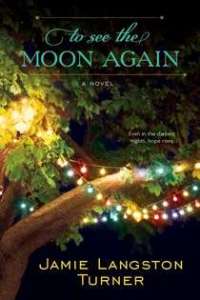
Book Review: To See the Moon Again

ToSeeTheMoonAgainTo See the Moon Again by Jamie Langston Turner begins with Julia, a widowed, middle-aged, introvertish teacher of Creative Writing at a university in South Carolina. Her tightly-controlled world has been shaken up a little by the award of a sabbatical, a paid year off from teaching, and she is not quite sure what to do with herself. But it is shaken up even more by a message on her answering machine: Carmen, a niece she has never met, daughter of her estranged brother, is in the state and planning to come to see her. While Julia hopes with everything in her that Carmen doesn’t come, of course, she does, and while Julia plans to send her off again as soon as possible, for various reasons she can’t.

Carmen is Julia’s opposite in many ways: she is free-spirited, open, gregarious, and a Christian. Julia thinks Carmen’s faith is naive and unrealistic. But as the two women get to know each other, we learn more of what makes each of them the way they are. Both have had a number of hard breaks and tragedies, both have actions in their pasts that they can’t forgive themselves for. Julia takes Carmen along on a trip which takes them both literally and figuratively to far different places than they had first imagined.

I identified with Julia and her introverted way of thinking quite a bit, but I can understand that some readers may not like her. Sometimes introverts can come across as standoffish, and Julia has other reasons as well for holding people at arm’s length. Although I like Julia, I haven’t liked many of Mrs. Turner’s main characters in other books, but as I got to know them, their background, what makes them tick, and came to understand them better, I could at least empathize and usually came to like them as well.

I like the way Mrs. Turner gradually reveals the depth of her characters. I like that the spiritual truth in the book comes not from an expert who has it all together, but from a young woman who is still dealing with issues herself. I also like that the ending isn’t tied up with a neat bow: things are left a little more open, but you know both characters are on their way to where they need to be. I have to admit to a little disappointment with the ending: without revealing anything, I had hoped it would go the way Julia was thinking it would. Yet I can see that the choices that were made were necessary to the growth of both Julia and Carmen.

Many of Mrs. Turner’s books have the aspect of an outsider looking in on someone else of faith, and that is an interesting and refreshing perspective. They also have grace and redemption as major themes. She’s often described as a different kind of Christian fiction author, and I would agree.

Since I spent 26 years of my adult life in South Carolina, fourteen of them in the town where Mrs. Turner lives, which is near the town many of her books are set in, I very much enjoyed that aspect of the book as well. I knew some of the places mentioned and knew the pattern of spring blooming that she described and could very much picture it. And some of the different types of Southerners were familiar as well.

Since Mrs. Turner is also a teacher of Creative Writing, there are often literary references in many of her books. This one contains a lot of mention of Flannery O’Connor, someone I have never read but now want to.

An interview with the author about this book is here. I think this is my favorite of her books, and I hope you’ll give it a try.

(This review will also be linked to Semicolon‘s Saturday Review of Books.)