

Several years ago, our ladies’ group asked some older married women in the church to be on a panel for discussion about marriage at a ladies’ meeting. We didn’t want to put them on the spot: we just figured they had more experience, and we wanted to glean their wisdom.
However, we had the hardest time getting anyone to agree to be on the panel. Some ladies didn’t want to participate because they thought their own marriages were far from perfect. Some felt that they were still learning: rather than answering other women’s questions, they still had plenty of their own.
In hindsight, it probably would have been better not to have particular women on a panel in front of everyone. One advantage to a panel is having known and trusted people there, whereas opening questions to the crowd in general might lead to some questionable answers. But perhaps the disadvantages outweighed the advantages.
Still, the evening ended up going very well (details are here). One even said we needed a session like that once a year.
Many of us would shy away from portrayal as an expert in most areas, especially areas of Christian life. We know we fall short. We don’t want anyone looking to us for answers, because we still struggle ourselves.
But an experienced Christian is not the same as an expert Christian.
When we’re struggling in a given area–marriage, devotions, hospitality, motherhood, work environments, or life in general–we’re not drawn to those who have their act together, whose lives are perfect, who never seem to struggle.
We want to hear from people who have been in the trenches, who know how we feel, who won’t give us pat answers, who have experienced the things we have and overcome them.
Andrew Peterson writes in Adorning the Dark: Thoughts on Community, Calling, and the Mystery of Making:
“O God,” you pray, “I’m so small and the universe is so big. What can I possibly say? What can I add to this explosion of glory? My mind is slow and unsteady, my heart is twisted and tired, my hands are smudged with sin. I have nothing—nothing—to offer.
Write about that.
“What do you mean?”
Write about your smallness. Write about your sin, your heart, your inability to say anything worth saying. Watch what happens (p. 11, Kindle version).
Though Peterson was praying about song-writing here, the principle is true in any area of life.
We can’t bless others with packaged advice from a position of perfection. Even if we could, our ministrations would probably be rejected as cold and unfeeling.
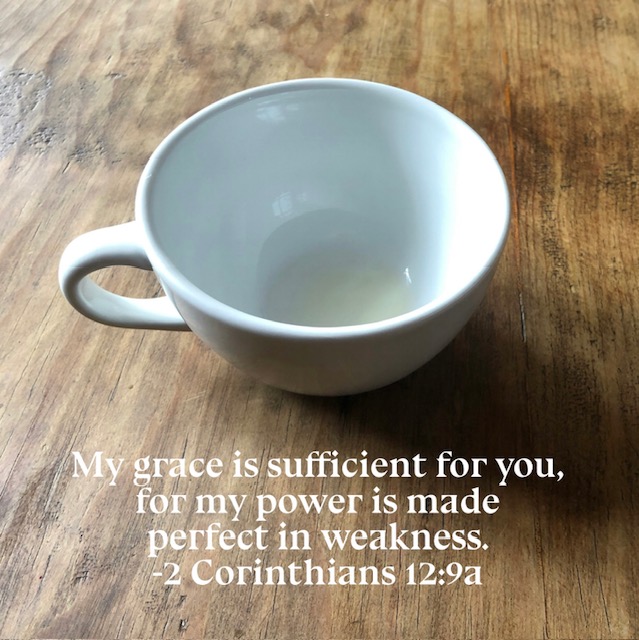
But God says His power is made perfect in our weakness (2 Corinthians 12:9).
One day on a hillside, over 5,000 people came to hear Jesus teach. Jesus had compassion on their physical needs as well as their spiritual needs. He told the disciples, “You give them something to eat.”
Of course, the disciples didn’t have the means to feed so many people. Philip indicated they didn’t have enough money to buy even a little food for everyone. Andrew found a boy with five barley loaves and two fish, but then asked, “what are they for so many?”
Jesus already knew what He was going to do to provide for the people. But He wanted the disciples to realize that they could not meet the need on their own.
Jesus had the people sit down, gave thanks, and then distributed the food to the disciples, who gave it to the people. Not only did they have “as much as they wanted,” but they gathered twelve baskets of leftovers.
We don’t have the wherewithal to feed people spiritually. But when we give ourselves to Him, He can work through us to help others. He will take our not-enoughness and work through us to display His more-than-enoughness.
(I often link up with some of these bloggers.)
 Stray Thoughts