Review: The Painted Castle

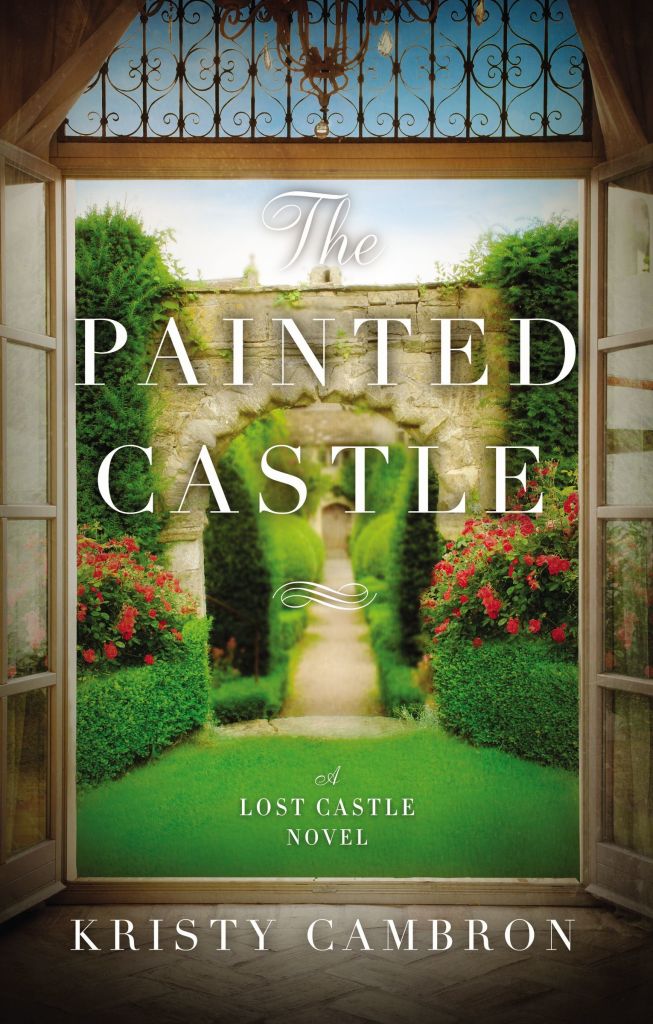
The Painted Castle by Kristy Cambron

The Painted Castle is the third in Kristy Cambron’s Lost Castle series, the first two being The Lost Castle and Castle on the Rise.

In modern-day Dublin, Keira Foley is the sister of the two main characters in the previous books. She is an art historian but lost her job, and her fiance broke up with her. She’s working in her brother’s pub for now, until she’s asked to authenticate a portrait of Queen Victoria painted by Franz Xaver Winterhalter. It was discovered in an old manor home whose owner just wants to sort through and sell everything. But Keira doesn’t know if she can trust the man asking: a rumored American art thief. She decides to go with him, and uncovers more questions than answers.

In 1833 England, Elizabeth Meade is shattered when her beloved father is killed. He left her and her mother in dire financial straits, which her mother tries to hide from society. Elizabeth’s only goal in life to to find the man who killed her father and take revenge. Her favorite pastime, painting, is not approved by her mother, but brings Elizabeth joy. When Elizabeth is grown, her mother arranges her marriage to a Viscount Huxley, and Elizabeth is startled to learn he is the very man she thinks murdered her father.

During WWII, Amelia Woods turned the estate into a haven for refugee children after her beloved Arthur died. But now she’s ordered by the English military to house a group of American pilots. Amelia does her best in a difficult situation, trying to shelter the children from the war as much as she can and manage amidst rationing. She and the American captain bond over the books in her husband’s library.

A main character in each timeline is recovering from some kind of loss. Many of the characters learn that though our path isn’t always what we’d planned, we can trust God through it.

Partway through the book, I began to wonder if Winterhalter was a real artist. He was! And the portrait of Victoria was real as well, commissioned by her for her husband’s birthday. It was unconventional for the time, showing Victoria with her hair down and a bit more shoulder uncovered than usual. Albert loved it, but felt it was too intimate for public display, and hung it in his study.

Much historical fiction these days is written with two timelines. Kristy is the only writer I’ve known to weave together three, and though she does it well, I hope this does not become a trend. 🙂 She does a good job keeping us from getting confused by naming the date and location at the beginning of each chapter and orienting us quickly with pertinent details.

I enjoyed the settings and stories as well as the way details were unfolded throughout the book. Each of the characters seemed relatable.

A couple of favorite quotes:

Books are a completely personal kind of journey. On the first page, they ask us not only to be willing but to be moved, changed, persuaded, even made new by the time we reach the end. Everyone’s walk-through is different (p. 104).

Parham Hill seemed to own the strange combination of both peace and pain. Beauty and bitterness. A lavishness surrounded by a coldness . . . They were strange bedfellows to find hidden in the shadow of Framlingham Castle and its quaint little country hamlet (p. 131).

In her author’s notes, Kristy shares that her father was an American pilot in WWII who flew in the very area she wrote about here. And she shares other bits and pieces that inspired her plots.

There are also some interesting bits in the book about H. A. Rey and his wife, Margret. He was born in Germany, and he and his wife were Jews living in France. They escaped on bicycles not long before Paris fell, taking their manuscript of Curious George with them, which became an instant success when they got it published.

Though it’s been a while since I read the previous two books, I felt the last chapter pulled everything together very well and was a fitting conclusion.

(Sharing with Bookish Bliss Quarterly Link-Up)

Review: The British Booksellers

The British Booksellers by Kristy Cambron

The British Booksellers by Kristy Cambron shifts back and forth from WWI to WWII.

Amos Darby and Charlotte Terrington are secret childhood friends with a love for books. But that’s all they can ever be. Amos is a tenant farmer’s son, and Charlotte is an earl’s daughter. Though Charlotte loves Amos, her parents arrange her marriage with Will Holt, the future Earl of Harcourt.

Amos goes off to WWI and comes back scarred. He opens a book shop on Bailey Lane in Coventry, England, but becomes something of a recluse.

Charlotte, now widowed Lady Harcourt, has opened a bookshop as well across the lane with her daughter, Eden. The booksellers have been rivals and enemies for over twenty years, though Eden has tried to negotiate a peace between them.

When an American lawyer, Jacob Cole, shows up with alarming news for Charlotte and Eden, they fight back to keep their estate, even though it is becoming ever harder to maintain.

But when WWII begins and German bombers fly across Coventry, Amos, Charlotte, Eden, and Jacob have to work together to help each other and their neighbors survive.

The Coventry Blitz is referred to as the Forgotten Blitz. The London Blitz received so much attention, Coventry was overlooked in the press. Kristy Cambron says in her author’s notes that some officials suppressed news of the devastation of Coventry so as not to damage morale.

The story includes four Land Girls, part of the Women’s Land Army in Britain who helped out at various farms and homes across the nation. I had read of these women in other books, so it was neat to see their roles fleshed out a bit more.

The historical story was quite interesting, but Charlotte and Amos’ story was so touching.

With characters who have a common love for books and who become rival booksellers, the importance of books comes up often. One of my favorite quotes about this aspect:

Books are an escape that beckons the reader from the heavy burdens of this world.’ Isn’t that what you told me once? They can challenge as well as comfort. Entertain and educate. Even save us in ways we’d never expect. You’ve used the words art, oxygen, and life all to describe them. Anyone who can see such value in these pages ought to also see that they could take him away from a future he doesn’t want. If anything, that is what Dickens wrote for his characters. Isn’t that what you wish for yourself?

I listened to the audiobook, beautifully read by Barrie Kreinik. Happily, this time the audiobook did contain author’s notes about the historical aspects of the book. There weren’t any notes about what inspired the personal stories, though.

With going back and forth between timelines, it was a little hard to keep up sometimes with where we were in the story. It’s not as easy with an audiobook to flip back to the beginning of the chapter to check the dates. Plus 1914 and 1940 sound alike. But it didn’t take too long to get oriented.

Overall, I loved the book and the characters and felt for them.

Book Review: Castle on the Rise

Castle on the Rise by Kristy Cambron Castle on the Rise is the sequel to The Lost Castle novel by Kristy Cambron. I think they could be read as standalones. But I’d recommend reading both.

Laine Forrester travels to France to be the matron of honor at her best friend’s wedding. The castle setting and the events leading up to the wedding make it seem like something out of a fairy tale.

But a couple of events bring the fairy tale crashing into real life problems. For one, the groom’s estranged brother from Ireland, Cormac, shows up just before the wedding to ask him to come back to the Foley home for an urgent need.

Laine’s friend asks her to come along. Laine hasn’t told her of her own crisis and crossroads. Now doesn’t seem like the time. But the invitation is a perfect excuse to get away for a while with her adopted daughter, Cassie.

The Foleys have been bequeathed a castle from a customer’s will. They didn’t know her well and can’t figure out why she willed them a castle. Cormac’s father, Jack, just wants to call an auction house and sell everything. But Cormac feels he needs to find out what’s behind the gift. Laine’s father was an antique dealer, so she helps Cormac evaluate which items are of value.

This novel weaves together stories from three timelines, all revolving around the castle. One takes place in the 1790s during an uprising between the Irish and English. Maeve’s family owns the castle, but her father is immobilized in grief over the loss of his wife and son. So she has to take the reins. One of her first tasks is to deal with a wounded enemy.

Another strand of the story takes place during the 1916 Easter Rising. Issy’s family now lives in the manor house, but her brother goes against her father’s wishes to join the rebels. Issy feels compelled to join him, and her budding interest in photography helps document events.

As Laine and Cormac investigate, they discover more of the castle’s surprising past. They each take steps to overcome their own past wounds to be open to new possibilities.

I knew, of course, that the Irish had fought against English control at intervals. But I didn’t know many of the details. I enjoyed learning some Irish history through this book. But I also enjoyed the stories in each timeline and the obstacles each character had to overcome.

And often, whenever I cam to a stopping place, music from the Irish Tenors sprang to mind for the next little bit. 🙂

A few quotes:

[Sean] was of a sort to look far down a path—he always said, to see the good that could come of something God was crafting behind the scenes, one had to keep an eye out for it. And Issy needed that view at present because she failed to see it (p. 50).

The talk of luxuries went far deeper than a gift of fruit. Maeve knew that. Theirs were the longstanding divides between the rich and poor, Protestant and Catholic, Anglo and Irish, even oppressed and free—for hundreds of years. They’d bled into the very earth beneath their boots, and it was tasked to her to either uphold or endeavor to change attitudes around them (p. 162).

Writers are the caretakers o’ history, Byrne. We document the livin’ and dyin’ of the human cause. But our pen, however noble, however well-intended, will always bleed the color of our convictions (p. 181).

I also enjoyed Kristy’s notes at the end concerning what led to her writing the novel, her research trip to Ireland, and the true historical details she included.

All in all, this is another great book by Kristy with three stories in one.

(Sharing with Booknificent Thursday, Carole’s Books You Loved)