Review: A Thousand Voices

A Thousand Voices

A Thousand Voices is the fifth and final novel in Lisa Wingate’s Tending Roses series.

Dell Jordan was a side character in the first couple of books but is the main character in this one. She was Grandma Rose’s neighbor as a child, living with an ailing grandmother. Her father had not been around since her birth. Her mother had been in and out with drug addictions but died a few years before. After she and Grandma Rose became friends, she became an unofficial part of the family until Rose’s granddaughter and her husband, Karen and James, officially adopted Dell.

When Dell was discovered to be something of a musical prodigy, Karen enrolled her in a performing arts magnet school. Dell had trouble adjusting, but eventually found her way.

As this story begins, Dell graduated two years earlier, spent one year touring Europe with an orchestra, and a second year working in a Ukrainian mission orphanage. Her parents and teachers want her to apply to Julliard. But the appeal of music has faded with the pressures of performance and expectations.

She loves her new family, but she still feels “different,” with her brown eyes and hair and “cinnamon” skin amidst everyone else’s fair skin, blue eyes, and blond hair. She grieves over her birth father’s desertion, her birth mother’s neglect, and the derogatory comments from her uncle.

All she knows about her father is his name on her birth certificate and the fact that he was part Choctaw. When she learns about agencies in Oklahoma that help find Choctaw ancestors, she drives there from Kansas City to see if she can find any information about her father. She doesn’t tell her adoptive parents, feeling they wouldn’t understand and might be hurt.

After a series of mishaps in her travels, including losing most of her money, she arrives at a campground and sleeps in her car. A large group of tents and motor homes in the next campsite hold an extended Choctaw family, there for the annual Choctaw festival. They invite Dell into their gathering, where she becomes friends with several of them and feels a sense of belonging that she has never experienced before. A couple of them help her in her search.

A few quotes that stood out to me:

It’s a powerful thing to realize you were put in this world on purpose. It changes the way you feel about everything afterward (p. 2, Kindle version).

The past, even if you don’t talk about it, still exists, and no matter how hard you try to turn your back, no matter how dangerous it is to look at, part of you cries out to understand it.

Part of growing up is learning that people can’t give what they don’t have. The rest you have to find in yourself (p. 310).

The plot moves rather slowly until the last couple of chapters. There are some scenes that don’t seem to advance the plot at all, like a lengthy encounter with a skunk at the campground.

I was frustrated with Dell’s lying to her parents concerning her whereabouts, especially since she also lied to them in the previous book about her problems at school.

I wondered if Lisa intended for the series to lead to Dell’s journey from the beginning, or if Dell’s story emerged along the way. Apparently, the latter scenario was the case. Lisa said in the discussion questions at the end that the first book in the series was written with no thought of a sequel. But readers’ questions as well as her own musings about the characters grew into subsequent books. She also says there, “Dell was, in many ways, the catalyst for change in Grandma Rose’s family, and in turn she was changed by Grandma Rose’s family.”

I also wondered if Dell was originally thought of as Native American. She has always been described as having cinnamon-colored skin, but in a previous book, her uncle uses a different racial epithet about her. I wasn’t sure if that was just to show his ignorance, or if Lisa switched gears about what race Dell was part of.

I was dismayed by minced oaths (like “Geez”), language that was not profanity but also was not polite, and especially a bawdy description of an old woman whose robe had come undone. On the one hand, the people involved didn’t profess to be Christians. On the other hand, that was conveyed well enough without those elements. Because of this, the sheen of Wingate’s appeal has been a little tarnished for me.

It was interesting to read of Choctaw history. If this is an accurate representation, it seems that, among modern Choctaw, some are really into their heritage while others are not.

I thought the last couple of chapters were the best in the book. My heart went out to Dell in her struggles.

I know some don’t like neatly-wrapped-up-in-a-bow endings. But this book had more loose threads than I like. I would have enjoyed an epilogue, if not one more chapter.


Review: Drenched in Light

Drenched in Light

Drenched in Light is the fourth novel in Lisa Wingate’s Tending Roses series.

Julia Costell trained all her life as a ballerina, but crashed soon after being accepted into the Kansas City ballet troupe. The emphasis on body line and thinness and the stress of competition led to an eating disorder, which led to a ruptured esophagus and near death.

Now she’s 27, living at home with worried helicopter parents, and working as a guidance counselor at the same performing arts magnet school she attended.

Julia feels lost and without purpose. But then one day a student named Dell Jordan is sent to her office with a troubling essay she had written for English.

Dell was the impoverished neighbor of Grandma Rose in the first book in this series. She started out as a side character, but now has moved to the forefront. The previous book, The Language of Sycamores, ended with Dell being adopted by Karen and James, Karen being Grandma Rose’s granddaughter. Dell is something of a musical prodigy–she has an a beautiful voice and an aptitude for piano even though she had no training.

Her adoptive parents thought the performing arts school would be the best for Dell. But the students there are from well-to-do and high-level families. Some of the administration, as well, as the students, don’t see Dell as the “right kind of student.” Though she excels in music, she’s behind in her other subjects. Furthermore, though she knows her new parents love her, she feels a need to keep everything “perfect” before them. So they don’t know she’s struggling.

Julia sees something of herself in Dell–their circumstances are different, but they both deal with pressure and expectations. So she offers to tutor Dell privately.

Meanwhile, Julia becomes aware of other problems within the student body. But the principal and school board members want to keep up the school’s reputation, so they want problems handled discreetly or swept under the rug. Julia is advised to “play the game.” Yet she sees the kids are hurting. If she pushes the issues, she might lose her job.

There’s a fun side story with Julia’s sister’s upcoming wedding and the wedding dress restorer Julia finds to repair their mother’s wedding dress.

Also, some of the characters from the previous books make appearances here.

I thought the book started a little slowly at first, but gained traction in the last third or so, becoming very exciting towards the end. I enjoyed Julia’s and Dell’s journeys.

I was dismayed by instances of taking God’s name in vain, using “Good God!” and such as expressions.

But otherwise, I thought this was a great story. I listened to the audiobook nicely read by Erin Spencer but also checked out the e-book from the library for the author’s notes.

Review: The Language of Sycamores

The Language of Sycamores

The Language of Sycamores is the third novel in Lisa Wingate’s Tending Roses series.

Karen Sommerfield received two blows in one day. A routine test at the doctor’s office indicates her cancer may have returned. And her whole department, of which she was the head, has just been eliminated at her firm in their downsizing efforts. “I sat back in my chair, looked around my office, and for the first time in my life, felt completely worthless. What do you do when the thing you’ve put your time and effort, your heart and soul, into, the thing that is the biggest part of who you are, is gone? Where do you go from there?”

When her sister, Kate, calls with an invitation to come to Missouri, Karen agrees. Normally, she avoids Missouri. Her lifelong rivalry with her seemingly perfect sister, their different lifestyles, the difficulties with their father, all contribute to keeping her distance. But, learning that her pilot husband, James, is going to MO for the weekend as well, Karen decides the trip will take her mind off her troubles. She doesn’t tell anyone about her double dose of bad news at first. She’s still processing it, and she doesn’t want to seem any more imperfect.

Kate has made contact with some long lost cousins who have some old letters between their grandmother and Kate and Karen’s Grandma Rose. They discover the two grandmothers had a sister they never spoke of.

Meanwhile, Dell, an young girl from an impoverished neighbor of Grandma Rose’s, spends much of her time at Kate’s. Dell’s grandmother isn’t well, and Uncle Bobby, who lives with them, is an unsavory character.

As Karen makes discoveries about her family and tries to help Dell, her eyes are opened to her own misconceptions and to the needs of others. She’s reawakened to old interests she had closed the door to. And Grandma Rose’s advice comes back to her.

A couple of the quotes that stood out to me:

Grandma saw the poetry in ordinary things. She mused on the meaning of life while her hands were busy with everyday chores. Anything else would have been far too impractical to suit her.

It’s those little nicks and dents and imperfections of spirit that allow us to flow out into a thirsty world. It’s our scars that allow us to relate to the scars of others, our suffering that connects us to others who suffer.

The first two books, Tending Roses and Good Hope Road, didn’t seem to be connected. But this book ties them together with the cousins finding out about each other.

The title comes from something Grandma Rose used to say: when some surprise was coming or something was brewing, she’d say she heard it in the sycamores.

I did have a couple of problems with the book: the use of minced oaths and Dell’s supposedly somehow getting messages from the deceased Grandma Rose.

But otherwise, I enjoyed Karen’s journey from being self-absorbed and defensive to seeing people for who they are, not who she thought they were.

Review: Firefly Island

Firefly Island

Firefly Island is the third of four novels in Lisa Wingate’s Shores of Moses Lake series. This story doesn’t start there, however.

Mallory Hale is a congressional staffer in Washington, D. C. following in the footsteps of her lobbyist father, when she unexpectedly meets Daniel Webster Everson, a biochemist working for the USDA. After a whirlwind romance, Daniel is offered a job in tiny Moses Lake, Texas. He asks Mallory to marry him and move to Moses Lake with him and his four-year-old son, Nick.

Mallory agrees. She’s not sure kind of job a congressional staffer can find there, but she can’t live without Daniel and Nick.

A series of mishaps begins their married life in less than fairy-tale happily ever afters. The house provided with Daniel’s job has not been lived in and is infested with vermin. Daniel’s new boss, Jack, is taciturn and erratic. The small community seems to eye Jack warily.

Suddenly thrust into a new marriage, motherhood, and setting, Mallory struggles. She finds friendship with her cowgirl neighbor, Al, and a young teacher, Keren.

Mallory is suspicious of Jack. Rumors circulate about his possible involvement in the disappearance of his wife and son. He’s secretive to the point of paranoia about his business. When his politician older son, with whom he has not been involved with in years, comes to visit, more details don’t add up. Jacks’ old cabin on Firefly Island is supposedly deserted, yet there are strange boats moored there. Mallory’s search for information leads to tie-ins with her old job. Can Mallory find out what’s going on and bring it to light before a disaster happens?

If I had read this book first in the series, I probably would not have continued. It starts out like a romance novel with what seems to me a lot of silliness (does anyone say hubba hubba any more?) Though there are no explicit scenes, there are more references to the couple’s physical relationship than I care for. Then the plot seems to drag in the middle.

But the latter half of the novel comes together nicely with mystery and intrigue. I enjoyed the interactions with characters from the first two books.

Besides the adjustments with a new marriage and the mystery behind her husband’s boss, Mallory deals with interactions with the more disadvantaged section of Moses Lake. Mallory has been raised the sheltered youngest daughter of a comfortable family. When she takes Nick to a children’s activity and sees a lot of unkempt kids, she worries about lice and bad attitudes. But over time she gets to know the kids and their needs, sees them differently, and looks for ways to help. “Was I really so entrenched in the world I’d been raised in, so set in my ways that I couldn’t look beyond the surface of another person and see a human being? Was I that shallow?” (p. 214).

I also thought this was a sweet line after an encounter with Nick: “Watching him skitter away, I felt the process of loving and parting and holding on and letting go that would be our future together, his and mine” (p. 203).

So, while this wasn’t my favorite of Lisa’s books, I gained from it.

(Sharing with Bookish Bliss)

Review: Blue Moon Bay

Blue Moon Bay

Blue Moon Bay is the second novel is Lisa Wingate’s Shores of Moses Lake series, contemporary fiction set in a small town in Texas. The first was Larkspur Cove (linked to my review).

In Blue Moon Bay, Heather Hampton is an architect working in Seattle. Her father was from Moses Lake, but the family only lived there a short time when Heather was in her teens. She felt like an outcast at school and protested the family’s presence in Moses Lake by dressing somewhat Goth-style. Her mother wasn’t very popular in Moses Lake, either, since she stole away a hometown guy.

When Heather’s father died, Heather, her mother, and brother moved away as soon as they could. Heather never wanted to look back.

Now her firm is about to negotiate a big deal for an industrial plant in Moses Lake, with the sale of the family’s land as part of the deal. Heather’s two older great uncles (called the “Uncs”), have plans to move to live with one of their sons. Heather thinks this is the ideal solution to provide for the family, settle the land, and close the door to Moses Lake forever–as well as look good to her boss.

Everything is set, only awaiting her mother’s signature on the documents.

But her mother doesn’t show up for the appointment.

When Heather calls her mother, she gets vague references about considering another offer, which is total news to Heather. And what’s weirder is that her mom is actually in Moses Lake with Heather’s brother, Clay.

Since Heather can’t get any clear details on the phone, she decides to fly to Moses Lake. After a series of mishaps, she finally gets there. But she still can’t get any answers from anyone. And, mysteriously, Blaine Underwood, the handsome football hero of her high school days, is somehow involved.

I know a story needs conflict to have any kind of plot. But the kind of conflict here frustrated me. It’s supposed to, though–the main character is frustrated as well. Heather is more like her father, and her mother and brother are like each other. Her free-spirited mother gives ambiguous answers, getting Heather nowhere in figuring out what’s going on. The Uncs and Clay and Blaine are not much help, either.

Nevertheless, the story wraps up nicely in the end, including some edge-of-your-seat action. Then the reason for the lack of details becomes clear.

A subplot involves the Uncs’ former housekeeper, Ruth, the one person whom Heather had loved when she lived in Moses Lake. Ruth now has cancer, and Heather visits her several times, learning more of her Mennonite history and how she came to the US from Germany as a child. I had thought this was just an interesting side trail, but it ties into the main plot.

Like the first book in the series, this one opens each chapter with “Wall of Wisdom” quotes left by visitors at the Waterbird Bait and Grocery. Some characters from the first book show up there as well as in the story.

Even though I didn’t enjoy this book quite as much as the first, I did like how it came together in the end.

(Sharing with Bookish Bliss)

Review: Larkspur Cove

Larkspur Cove

Larkspur Cove is the first of Lisa Wingate’s Shores of Moses Lake series.

Andrea Henderson has moved into her parents’ lake house in Texas with her teenage son after her husband’s betrayal and abandonment. She’s found a job as a social worker and wants to make a new start for herself and her son.

Her son, Dustin, is having a hard time making the transition. Left alone while his mom works, he ventures out with some new friends into an area of Moses Lake where boats are not supposed to go, ignoring the posted warning signs. Mart McClendon, the fish and game warden (or “boat cop,” as some call him), takes the teens in and calls their parents.

When Mart and Andrea meet, sparks fly. She thinks he is overreacting. He thinks she is some over-busy rich mom who doesn’t keep an eye on her son.

When Mart offers to let the teens take a water safety course in lieu of a fine, Andrea agrees despite Dustin’s protests.

Andrea’s work takes her into remote areas. One day when she sees an older man with a little girl in his truck, she suspects something is wrong. The little girl is not in a seat-belt and her hair is tangled with bits of leaves.

Later, Mart’s friends at a diner tell of seeing an old man with a little girl in the hills across the lake. The man, Len, is not known to have a family. He hasn’t been right mentally since he returned from Viet Nam. But he has seemed harmless. Yet, where had this little girl come from, and can a recluse like Len take care of her?

As Mart and Andrea investigate the situation, they learn more than Len’s situation. They discover their own purposes and more about each other.

I enjoyed this story. The little community around Moses Lake seems like real people, characters without being caricatures.

The Waterbird Bait and Grocery has a “wall of wisdom” where people write little sayings, and these proverbs and observations begin each chapter.

Some of the themes: first impressions aren’t always accurate; the best solutions are not always the most obvious; it takes time to heal from trauma, and others.

The audiobook was nicely read by two narrators, Johanna Parker and Scott Sowers. It was free from Audible’s Plus Catalog at the time I listened.

My only complaint is that this author has a penchant for putting several paragraphs of description or backstory in-between lines of dialogue. It can make discussions seem really stilted, especially while listening to an audiobook. I picture the other characters waiting patiently for the one with the next line to come back out of his or her thoughts and speak.

But otherwise, this was a great story. I’m looking forward to the rest.

(Sharing with Bookish Bliss)

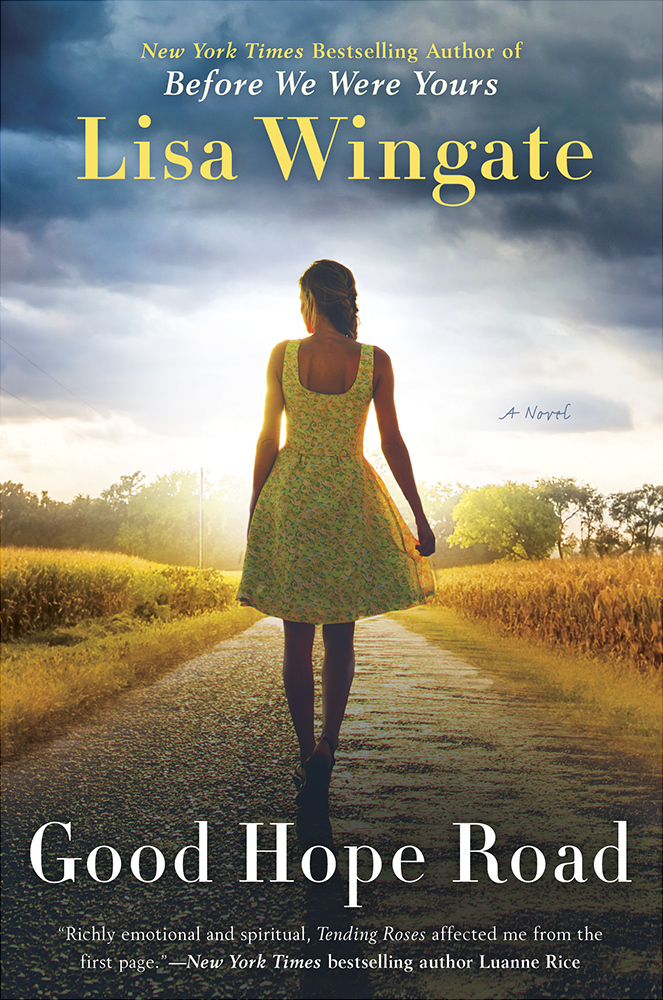
Review: Good Hope Road

Good Hope Road by Lisa Wingate

Good Hope Road by Lisa Wingate begins with a tornado hitting the small town of Poetry, Missouri. Twenty-one-year-old Jenilee Lane is home alone, her father and brother having gone to a cattle auction in Kansas City.. Their house is spared, but Jenilee discovers her elderly neighbor, Mrs. Gibson, and the woman’s granddaughter trapped under debris across their storm cellar.

Jenilee and her family had not been close to their neighbors. Jenilee’s father had a bad temper and kept the family to themselves. They were often regarded as “white trash” by the townspeople. But Jenilee is the only help available, so she gets her neighbors out from the cellar just before Mrs. Gibson’s son and daughter-in-law come.

To keep busy, Jenilee and Mrs. Gibson go to the armory, the only large building in town still standing. Along the way, Jenilee picks up pieces of debris she finds: parts of letters, pictures, certificates.

The veterinarian is the only medical help at the armory until a doctor stranded in the storm is brought in. Jenilee had worked for the vet and seems to have a natural way of calming frightened people while they wait for help.

Jenilee continues going to the armory while waiting to hear about her father and brother. One day she decides to tape the paraphernalia she found on a wall there so people can find their lost treasures. This blossoms into giving hope to people.

Mrs. Gibson begins to see there is more to Jenilee than she’d thought. She also runs into an injured man at the armory with whom she’d had a long-running feud. At first she can’t spare a kind word for him. But she sees sides to him that she had forgotten were there.

As neighbors help neighbors and helpers come from others areas, they see each other with fresh vision and discover good things can arise from tragedies.

The book touches on multiple themes: the difficulties of an abusive family; how we can too easily misjudge others; the need to let go of the past; the fact that difficulties can bring out the best and worst in people; and faith, hope, and forgiveness

Some of my favorite quotes:

I walked to the kitchen, shuffling the way I do when my knees are like old plow handles and my joints are rusted shut.

It’s humbling to realize maybe you ain’t as good as someone you’ve spent years looking down on.

That part of you that wants to care for other folks is like fresh milk. You might as well pour it out as you go along the path. It don’t . . . keep in a bucket . . . very long.

In town after town, people were building anew. Towns just like our own—small, imperfect places beneath which hid the potential for something larger, something stronger, something we may never have seen, if not for the disaster.

The book is the second in a series of five, the sequel to Tending Roses (linked to my review). It’s been a few months since I read the first book, but I didn’t see any characters I recognized in this one. In the author’s notes at the end of the book, she explains one distant connection with the first book which will be delved into later.

There were a few “damns” and misuses of the Lord’s name. But otherwise, this was a great book.

Review: Tending Roses

In Tending Roses by Lisa Wingate, Kate Bowman drives with her husband and baby son to her grandmother’s Missouri farm a few weeks before Christmas. But this will be no idyllic holiday season.

Kate’s grandmother “had a talent for stirring up unpleasantness, she was an expert on every subject, and she felt the need to control everyone” (p. 16). She acted like a martyr when she didn’t get her way. She was so fussy about her house, Kate often felt she loved it more than her.

Kate’s grandmother has become forgetful and nearly burned the farmhouse down. Kate’s father and aunt are coming for Christmas and planning to move Grandma Rose into a nursing home.

All the family has not been together and has rarely spoken to each other since Kate’s mother died.

So this holiday family reunion has all the makings of a potential war.

Kate and her husband have been elected to go to the farm early, under the guise of an extended visit, to help keep an eye on Grandma and prevent any other fires or disasters til the rest of the family comes. Kare is still on maternity leave due to her son’s heart condition, and her husband works remotely, so they are the perfect candidates.

But worries over the baby’s health, the piles of medical bills, and her assistant taking over her job have Kare distracted.

At first the visit goes about as well as Kate expected. But one day she finds her grandmother’s journal and discovers the hopes, dreams, and trials she experienced as a younger woman. That and getting to know her on an everyday level have Kate questioning her own future as well as the family’s decision about Grandma’s.

There’s naturally a lot of tension at first in the book with all the personality clashes and problems. But I loved the story arc and the slow understanding that developed between Kate and her grandmother.

A secondary story line involves Dell, an impoverished child living nearby in a shack with her ailing grandmother. “Poverty and ignorance were characters we saw on TV, or sometimes passed on the highway while traveling to some vacation hideaway. They were not our neighbors. They did not have faces with soft brown eyes and down-turned mouths that never smiled” (p. 83).

A few sentences that stood out to me:

I felt a little like a wishbone in a tug-of-war (p. 146).

Grandma sensed World War III coming on and stepped in like Switzerland (p. 175).

That’s the problem with people. We’ll starve to death looking over the fence when we’re knee-deep in grass where we are (p. 206).

Years have mellowed my joy in Christmas, as in all things. The packages, the tree, the fire, all carry memories to me—reminders that I am the last. Looking at them, I relive, remember, and regret. And an ache blossoms in my breast that I am no longer young (p. 232).

This had been the hardest year of my life, when all the colors ran outside the lines I had drawn, but also the year when I finally discovered myself (pp. 272-273).

This story is more than a reminder to “stop and smell the roses.” It weaves together themes of family, forgiveness, faith, materialism versus contentment, aging, caring for each other, especially the elderly.

This book is the first in a series of five. I’m looking forward to the rest of the series.

Review: A Month of Summer

In Lisa Wingate’s novel, A Month of Summer, Rebecca Macklin lives in LA, has a legal practice with her husband, and runs her 9-year-old gymnast daughter to practices and meets.

Then Rebecca receives a devastating phone call. She has not seen her father in over thirty years. She was supposed to spend a month of every summer with him and his new family as part of the custody arrangement of her parents’ divorce when she was twelve. But she refused to go. Her father honored her wishes.

Her stepmother has written over the last couple of years that Rebecca’s father developed dementia and urged her to make peace before it was too late. But Rebecca ignored her. Why bother making contact with him now?

But a phone call from Dallas puts Rebecca in a tough spot. Her step-mother has had a stroke. Her developmentally disabled step-brother was roaming town alone, having gotten on a bus without being able to figure out how to find his way home. Her father was totally confused. The police found Rebecca’s name on a contact list. If she didn’t come to take care of her father and step-brother, Social Services was going to get involved.

Reluctantly, Rebecca makes plans to go. But on the day she leaves, she sees her husband at an outdoor cafe holding hands with one of his clients. Is this why he has been working late? Without time to confront him, she boards her flight, with all the problems of her life weighing her down.

But when she arrives in Dallas, things are worse than she imagined. A housekeeper who was supposed to keep things in order has disappeared. Dirty dishes and molded food are everywhere as is dirty laundry. Wet laundry has mildewed in the washer. And money is missing from her father’s accounts.

The point of view shifts back and forth from Rebecca and her step-mother, Hanna Beth. Hanna Beth is cognizant, but can’t express herself or control her movements. When she learns that Rebecca has come, now of all times, she wonders what will happen. Will Rebecca ship her father and step-brother off to institutions before Hanna Beth can recover enough to go back home?

As each woman painfully peels back layers of the last several years, they learn things aren’t always as they appear.

I saw one reviewer call this a light and easy read. I didn’t think so, myself. It was a good read, but felt very heavy sometimes, except for the knowledge (or at least the hope) that things would work out somehow in the end.

There’s a delightful cast of side characters in the book: a sweet older woman Rebecca meets on the flight who she runs into again later, a talkative older man in Hanna Beth’s nursing center, a stern German physical therapist, a sweet aide with two boys, a nurse from Ghana. I loved one teasing line from the nurse who was trying to get the older man back to his room: “Old rooster, he loud on the fence, quiet in the stew.”

This book is the first in Lisa’s Blue Sky Hill series about a neighborhood in Dallas. I had read the second book in the series, The Summer Kitchen, as well as the fourth, Dandelion Summer. But there were so many years between each read, I could not remember if any of these characters showed up in the later books. I probably would have caught more of the connections if I had read them in order and closer together, but each book does hold up well as a stand-alone.