What Would Mary Say?

What Would Mary Say?

Mary, the mother of Jesus, is called the “favored one” and “blessed among women” in Luke 1. She’s such a wonderful example of someone wholly yielding to the Lord even though His plans for her would drastically affect her life.

As blessed and favored as Mary is, some go beyond what the Bible says to elevate her to a position almost alongside Jesus. What would Mary say about that?

We only have a few of her words recorded in Scripture, but I think they reveal a firm grasp of who she was.

She’s not sinless. A Christmas special we watched posited that because Mary didn’t have original sin, she might not have experienced labor pains. Yet the Bible doesn’t portray her as sinless. Jesus is the only person who was born without a sin nature and who never sinned once. Mary said, “My spirit rejoices in God my Savior” (Luke 2:47), acknowledging her own need for a Savior.

She is not the one we pray to. I suppose some might get the idea of praying to Mary from the incident where Jesus and his family attended a wedding where the wine ran out. Mary went to Jesus and told Him of the problem. He eventually turned water into wine, even though He told her his “hour has not yet come” (John 2:1-12). Some have taken from this scene the idea that we can go to Mary to get her to persuade Jesus to meet our needs.

Yet the Bible doesn’t advocate praying to anyone but God. Even here, Mary was not asked to appeal to Jesus for help.

Even in Mary’s prayer in Luke 1:46-55, her emphasis is on magnifying the Lord.

The Old Testament emphasized that we don’t have access to God except through the sacrificial system He gave to Israel. When Jesus died on the cross, the veil of the temple, which was a barrier only the high priest could enter once a year on the Day of Atonement, was torn from the top to the bottom. Hebrews 10:19-22 says, “Therefore, brothers, since we have confidence to enter the holy places by the blood of Jesus, by the new and living way that he opened for us through the curtain, that is, through his flesh, and since we have a great priest over the house of God, let us draw near with a true heart in full assurance of faith, with our hearts sprinkled clean from an evil conscience and our bodies washed with pure water.” We have direct access to God! As blessed and wonderful as Mary is, why would we try to go through her (which the Bible never tells us to do) when we can go directly to Him?

In the last scene where we see Mary in the Bible, she is with the other disciples of Jesus, male and female, after His ascension back into heaven. Acts 1:12-14 shows them “with one accord . . . devoting themselves to prayer.” She wasn’t being prayed to: she was praying along with them to God.

Mary’s last recorded words. The last thing that the Bible tells us Mary said was to the servants at the wedding in Cana, where Jesus turned water into wine: “Do whatever he tells you” (John 2:5). Her emphasis is always on Him. Do what He says. She claims no authority for herself. Even with Jesus’ followers in Acts, the disciples are in leadership, not Mary.

There’s much we can admire and emulate about Mary. Her humility. Her faith. Her willingness to do God’s will. Her grasp of God’s truth shown in her prayer. Her tendency to treasure and ponder in her heart things that occurred when Jesus was born. Her faithfully standing by Him during His crucifixion.

But she wouldn’t want us to worship her or elevate her to the same, or nearly the same, status as her Son. She would want us to honor, believe in, and glorify Him.

He is the way, the truth, and the life. He is our mediator. He is the one who changes us as we behold Him. He is our peace. In Him is our wisdom, righteousness, sanctification, and redemption.

Let’s proclaim along with Mary, “My soul magnifies the Lord, and my spirit rejoices in God my Savior” (Luke 1:46-47).
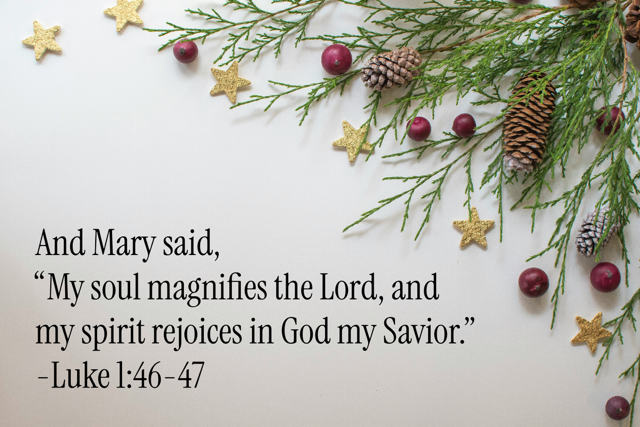
Luke 1:46-47

(I often link up with some of these bloggers.)

When God wants me to do something I don’t want to do

img_0047

I had another interesting intersection between my devotions, messages at church, and my other reading last week.

I’m in Exodus in my Bible reading just now, and I can always empathize with Moses’s reaction when God calls him to lead the children of Israel out of Egypt. Overwhelmed, he he responds with all the reasons he couldn’t possibly do such a thing, and God graciously promises His provision in every facet.

Who am I? Why would they listen to me? I will be with thee.

What if they ask me what God sent me to them? I AM THAT I AMThus shalt thou say unto the children of Israel, the Lord God of your fathers, the God of Abraham, the God of Isaac, and the God of Jacob, hath sent me unto you

They will not believe me, nor hearken unto my voice: for they will say, The Lord hath not appeared unto thee. God provided three signs to demonstrate before Israel.

O my Lord, I am not eloquent…I am slow of speech, and of a slow tongue. Who hath made man’s mouth? or who maketh the dumb, or deaf, or the seeing, or the blind? have not I the Lord? Now therefore go, and I will be with thy mouth, and teach thee what thou shalt say.

God was very patient with Moses until, at this point, Moses says, “O my Lord, send, I pray thee, by the hand of him whom thou wilt send.” I’m not sure exactly what all that means, but it seems to indicate he’d really rather God sent someone else. God tells him his brother Aaron will be his spokesperson, and sends him on his way.

I would probably have had all the same objections Moses did, and more. They make sense and seem quite valid, except that God promises to overcome each one, no matter how the situation seems to appear at this vantage point.

Some of our Sunday evening services have dealt with Jonah, who, as you know, disobeys God’s command to preach to the Ninevites and goes in the opposite direction. His reasons are less sympathetic; in fact, they are wholly unnoble. The Bible doesn’t say he was afraid of them or afraid to speak to them. He was afraid they would actually respond to his message, and he was so prejudiced against them that he did not want that result. His chastening was pretty severe, and he repented in the belly of a fish. But his heart still wasn’t entirely right. “It displeased Jonah” when the people of Nineveh repented. In fact, he tells God that was why he didn’t want to come to them in the first place, because “Therefore I fled before unto Tarshish: for I knew that thou art a gracious God, and merciful, slow to anger, and of great kindness, and repentest thee of the evil” (Jonah 4:2).

Then, when I’ve had time after my devotions, I’ve been reading in The Women of Christmas: Experience the Season Afresh with Elizabeth, Mary, and Anna by Liz Curtis Higgs. Around the time I was reading about Moses in my Bible and hearing about Jonah in church, I came to the section about Mary in this book. What a contrast. She may have had concerns and fears, but didn’t voice them. Or she may have just believed that God was sufficient to take care of whatever the repercussions would be. No objections. No “what ifs.” No apparent anxieties or apprehensions. Just, “Behold the handmaid of the Lord; be it unto me according to thy word.

I found in my quote file this from Elisabeth Elliot, though I failed to note which book or newsletter it came from:

The story of the glory of heaven brought into a common, little house in Nazareth to a simple peasant girl, who must have been amazed and baffled, but she was instantly obedient. How often you and I insist on explanations and understanding before we’re willing to be obedient. There are many things in God’s world that will never be understood until we obey. Her response, Mary’s response—”Let it be to me according to your word. I am the handmaid of the Lord” — should be our response, too, shouldn’t it? Whatever He asks us to do.

I haven’t been called to anything of the magnitude of these three, but sometimes my response is more like Moses’s to what God has called me to do. First, “Who, me?!” Then, “I can’t, for all these very good reasons.” Sometimes, “That’s not my spiritual gift.” And sometimes, sad to say, “I know You will be with me; I know You will enable and provide. But I’d really rather not.” I’d like my nice, quiet, even life with very few and very minor bumps in the road, if that’s ok.

But that’s not ok. My life is not about my ease and comfort, or at least it’s not supposed to be. It’s about glorifying God and allowing Him to work through me in whatever way He wants to. I may not feel equal to the task, but that’s ok. That reminds me the strength to do it is not my own, but His. His provision and enabling usually comes at the time of obedience, not before. And what times I have cooperated with Him in this way, it has been wonderful to see how He has worked and to experience His presence through those things. When we believe on Jesus Christ as our Savior, we know God is with us by faith even if we don’t always feel it. But somehow when we trust Him through difficult things, we experience His presence and help and grace in ways not known before.

Sometimes I get to the, “Yes, Lord, I am Yours: Your will be done” after reluctance, objections, repentance, and reassurance. I hope, like Mary, to get to the place where I can go there directly.

(Sharing with Inspire Me Monday, Literary Musing Monday, Testimony Tuesday, Woman to Woman Word-Filled Wednesday, Thought-provoking Thursday)

Save

Save

Save

Save

31 Days With Elisabeth Elliot: Ordinary Work

Elisabeth Elliot2

This is from a longer article “The Mother of the Lord” in the November/December 1986 issue of Elisabeth’s newsletters (it may be in a book as well – some material from the newsletters came from one of her books or later found its way into a book). At first I was only going to quote the last paragraph before the final Scripture verse, but then decided to include the last few paragraphs. Most of us find our ministries in places that Mary did, hidden away at home, and her faithfulness there is an example to us:

The apostle Paul tells us we are “hidden with Christ in God” (Colossians 3:3, NIV.) There is mystery there, but when I think of the life of Mary, I see some facets of that mystery that I missed when I read the apostle. Hers was a hidden life, a faithful one, a holy one–holy in the context of a humble home in a small village where there was not very much diversion. She knew that the ordinary duties were ordained for her as much as the extraordinary way in which they became her assignment. She struck no poses. She was the mother of a baby, willing to be known simply as his mother for the rest of her life. He was an extraordinary baby, the Eternal Word, but His needs were very ordinary, very daily, to his mother. Did she imagine that she deserved to be the chosen mother? Did she see herself as fully qualified? Surely not. Surely not more than any other woman who finds herself endowed with the awesome gift of a child. It is the most humbling experience of a woman’s life, the most revealing of her own helplessness. Yet we know this mother, Mary, the humble virgin from Nazareth, as “Most Highly Exalted.”

I am thanking God that unto us a Child was born. I am thanking Him also that there was a pure-hearted woman prepared to receive that Child with all that motherhood would mean of daily trust, daily dependence, daily obedience. I thank Him for her silence. That spirit is not in me at all, not naturally. I want to learn what she had learned so early: the deep guarding in her heart of each event, mulling over its meaning from God, waiting in silence for His word to her.

I want to learn, too, that it is not an extraordinary spirituality that makes one refuse to do ordinary work, but a wish to prove that one is not ordinary–which is a dead giveaway of spiritual conceit. I want to respond in unhesitating obedience as she did: Anything You say, Lord.

Blessed are the pure in heart, for they shall see God.

You can read more of this article here.

See all the posts in this series here.

It-is-not-an

_____________________________________________________

DaySpring.com is celebrating all of the amazing Write 31 Days readers who are supporting nearly 2,000 writers this October! To enter to win a $500 DaySpring shopping spree, just click on this link & follow the giveaway widget instructions by October 30. Best wishes, and thanks for reading!