Who Was Isobel Kuhn?

Who was Isobel Kuhn?

Several weeks ago, the chapter I submitted to my critique group mentioned Isobel Kuhn a couple of times. I was surprised that several of the women in the group weren’t familiar with her.

In my early married life, the ladies’ group of the church we attended had a lending library. Isobel’s books were among the most often checked-out. She was as well known in that time and place as Elisabeth Elliot or Amy Carmichael. I believe that’s where I first heard of Isobel: I know that’s when I started reading her books.

Isobel was a Canadian missionary with China Inland Mission (founded by Hudson Taylor) to the Lisu tribe in China from 1928 to 1950, when forced out by the Communists. She and her husband, John, ministered in Thailand for just a few years until she was diagnosed with cancer. She died in 1957 at the age of 55.

She had grown up in a Christian home in Vancouver. In her book, By Searching: My Journey Through Doubt Into Faith, she writes that when she left for a secular college, her parents armed her with all kinds of arguments against modernism.

In one of her first classes, her professor asked if anyone still believed in heaven and hell, in Genesis, etc. Only Isobel and one other student raised their hands. The professor didn’t present arguments against the Bible: he only said, “Oh, you just believe that because your papa and mama told you so.”

On the way home from class, Isobel examined why she believed what she believed in light of what she was learning in her classes and concluded the professor was right: she only believed because of what her parents said. She determined to “accept no theories of life which [she] had not proved personally” (p. 7). She wouldn’t say there was no God, but rather that she didn’t know whether there was or not. Instead of seeking out the answer to such an important question, she determined that, since one can’t know, then it really didn’t matter what one did. She gave up going to church so she could sleep in on Sunday to rest up after parties and dances through the week. She set aside Bible reading, and she gave herself to the activities she had always been taught were “worldly.”

At first everything was pleasant and fun, but she discovered before long that nothing satisfied. One night she was so low that she even contemplated taking her own life. A groan from her father in his sleep in another room reminded her of the devastating effect suicide would have on her family. She prayed, “God, if there be a God, If You will prove to me that You are, and if You will give me peace, I will give you my whole life.”

The rest of the book tells how He answered that prayer. “To find that He is, this is the mere starting-point of our search. We are lured on to explore what He is, and that search is never finished, for it grows more thrilling the further one proceeds” (p. 94).

God led her to a few summer missions conference at The Firs. During one conference, she heard J. O. Frasier speak about the Lisu tribe he ministered to. Her heart was stirred, and eventually she felt led to go to China herself. Frasier became a mentor to Isobel and later to John.

The problem was Isobel’s mother. For all of her missionary work in the church, Isobel’s mother declared that her daughter would go to the mission field only over her dead body. Her mother wanted her to marry well and move in “good society.” The thought of her daughter depending on the charity of others was more than she could bear. Isobel consulted with Frasier, who gave her some sound advice.

Isobel’s second book, In the Arena, tells how God turned her mother’s heart, provided for Isobel to go to Moody Bible College, led her to her husband, John, and then led them both to China. She tells of different events in their family and ministry, then her cancer diagnosis.

Some incidents in Isobel’s life were highly influential to my own. Here are a few of them:

She had covenanted with a group of friends to read the Bible an hour a day for a year. She divided up her hour into two thirty-minute sessions. One day she got back to her room right before dinner. She hadn’t had her second session with the Bible that day and only had the next thirty minutes in which to do so. She had a program to participate in that night and a devotional she was supposed to give which she had not even started to prepare for. She knew she’d be dead tired when she got home: her class was supposed to clean up after the event as well. She debated whether to have her devotional time, go to dinner, or prepare for her talk. Finally she said, “Lord, I choose you.” And in the time with Him, she felt He gave her what to say for her talk.

When she was a little older and living in a noisy boarding house, she couldn’t find a quiet time to read her Bible. She asked God to wake her up at 2 a.m., when the house was quiet.

In her early married life, she joyfully set up her home with weddings gifts. She was excited to receive her first women guests. As she began to talk with them, one blew her nose and wiped the stuff on a her new rug. The other’s baby was allowed to wet all over another rug. Isobel knew that they were not being deliberately offensive: those were just the customs of the country people in that time and place. Yet, naturally, resentment welled up and she had a battle in her heart. She wrote, “If possessions would in any way interfere with our hospitality, it would be better to consign them to the river. In other words, if your finery hinders your testimony, throw it out. In our Lord’s own words, if thine hand offend thee, cut it off. He was not against our possessing hands, but against our using them to hold on to sinful or hindering things.”

Whom God Has Joined is a collection of essays about marriage. It was originally titled One Vision Only and published with biographical remarks by a Carolyn Canfield. I think later versions were published without Canfield’s remarks.

When John proposed, Isobel wrote, “John and I are of very opposite dispositions, each rather strong minded. Science has never discovered what happens when the irresistible force collides with the immovable object. Whatever would happen if they married one another?”

One incident she writes of here occurred when she was telling a story to friends. She was artistic and exuberant and commented that it was “pouring rain.” John corrected her, saying it was “merely raining.” She was indignant that her story was being interrupted by such a minor detail and said, “I didn’t stop to count the raindrops.” He replied that that was just what she should do. He felt she exaggerated and wanted to break her of it. He began “correcting” her prayer letters and stories and began to use the catch-phrase, “Did you count the raindrops?” It was discouraging and distressing to her and she felt it had a stilted effect on her writing. She tells how over time the Lord used this to help her husband appreciate his wife’s gift of imagination and expression and helped her to be more accurate. She commented on the need for prayer, bearing with one another, and forgiveness. “The passion for accuracy plus a sympathetic imagination which relives another’s joys and sorrows—that is double effectiveness. Either quality working unrestrained by itself would never have been so effective. But it cost mutual forgiveness and endurance to weld these two opposites into one!”

Another time, she and her husband had a sharp disagreement. Angry and resentful, she walked out of the house, not caring where she went, just to get away from it all. Gradually she came to herself and realized she was in a little Chinese village as darkness was nearing. In that time and culture that was not done: “good women were in their homes at such an hour.” She felt as if the Lord were saying to her, “You have not considered Me and My honor in all this, have you?” She felt convicted her that she had not even invited Him into the situation. She confessed that was true, asked Him to work it out, and went home. And He did.

One of my favorite pieces of Isobel’s writings was a chapter titled “A Sense of Him” in her book, Second-Mile People. I wrote more about it here. She tells of one particular friend who carried a sense of God’s presence and peace through everything she did, even laughing and chatting.

Her book Green Leaf in Drought is not about her at all, but rather about Arthur and Wilda Mathews, who were the last CIM missionaries to leave China after it fell under Communist rule. Even though they were not welcome, they were not allowed to leave for some time. I was moved by the hardships they endured, what they learned, and how God provided for them (my review is here).

Most of her other books are about their work in China and Thailand. Some of the people they ministered to became dear to me as well. I anticipate meeting them in heaven some day!

Through her mentions of J. O. Fraser, I read two good biographies of him: Behind the Ranges by Geraldine Taylor and a later one, Mountain Rain, by his daughter, Eileen Crossman.

Isobel’s writing style was engaging and relatable. She was transparent about her faults and foibles and the hard lessons she had to learn.

As I suppose could be said about anyone, I wouldn’t agree with every little thing Isobel said and did. But overall, she sought to follow, serve, love, and obey God. Her life inspired me many times over. If you’ve never read her books, I hope you will.

(Note: some portions of this post were taken from previous posts about Isobel.)

(I often link up with some of these bloggers.)
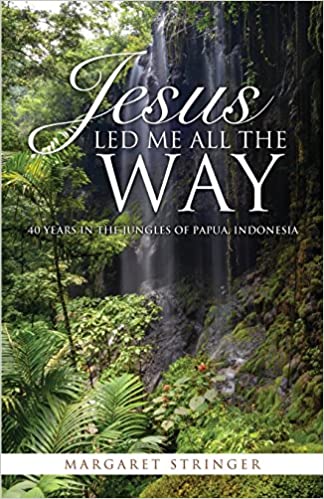
Jesus Led Me All the Way

I’ve mentioned before that Margaret Stringer is one of my favorite people. She was a missionary in Indonesia for forty years among former headhunters and cannibals. Though she had a variety of ministries among the people, one of her main jobs was reducing their language to writing, translating the New Testament into their language, and then teaching the people how to read.

The church we attended in SC supported Margaret. When she “retired,” she lived close enough to the church that she was available to come speak to the ladies’ group several times. She could have us laughing til we were in tears telling us about incidents that would have been quite scary when they happened to her.

Jesus Led Me All the Way is her second book about her time in Indonesia, the first being From Cannibalism to Christianity.

Margaret tells how from a very early age, she was sure God had called her to be a missionary. She had a hard time getting the first visa she needed, and it seemed like everyone brought up to her how Paul wanted to go to Macedonia in Acts, but God wouldn’t let him. Margaret wanted God’s will, whether that was Indonesia or somewhere else. But the delays and obstacles just made her more sure that Indonesia was where God wanted her. Later on the field, she was grateful for the hard time she had getting there because of the assurance it gave her that she was in God’s will.

She tells of her arrival on the field, early missionary life, learning the customs and language, getting adjusted to jungle food (like grub worms). She talks about how important it is to understand the world view of the people you’re trying to witness to.

It took a lot of patience to teach people who had not been taught before or hire helpers to learn the language when they had not had paying jobs before. If they wanted to go fishing instead of come to “work,” they did.

One chapter is on “People I Can’t Forget,” most of whom became part of the church there. It took much time and patience and prayer and overcoming many mistakes, but what a joy to see God open people’s eyes to His truth at last.

Margaret includes here one of my favorites of her stories. Once she was in an area where no house or huts were available, so she stayed in a small metal building with open windows (screens but no glass). Once when a terrible storm hit, rain blew in, destroying about 90% of her handwritten translation work. As she tried to salvage what she could and mop up the rest, she felt discouraged. She “fussed” with the Lord about dropping her down in the jungle and leaving her all alone. When she went to bed, something fell off the wall and hit her on the head. She felt like that was the last straw. She turned on her flashlight to see what had fallen. It was a plaque that said, “He cares for you.” She started laughing and said, “OK, Lord, I get it. Thank you.” She comments, “For some people, God speaks in a still small voice. Others of us, however, He conks on the head” (p. 125).

Margaret tells of difficulties in the translation work. She had to consider not just getting the words into Citak, but making them understood in their culture. For instance, they did not have a word for sister or brother—their words were older sister, younger sister, older brother, younger brother. That took some thought when dealing with Mary, Martha, and Lazarus. All of their verbs incorporated time of day, so that had to be considered when translating narratives. The suffix “na” at the end of a sentence indicated the information was heard from someone else rather than witnessed directly. In Luke 11:11, when Jesus asks whether a father would give a serpent to his child when asked for a fish, they said, “Of course.” “The Citak people love to eat snake, and a good-sized python has much more meat on it than the average fish, so who wouldn’t want a snake instead of a fish?” (p. 205). they had to find a different word for a poisonous snake that conveyed the idea of the passage, that “no good father would give his son a poisonous snake when he asked for a fish.”

The Citak people had a big celebration day with invited guests, including dignitaries, when they handed out the completed New Testaments. One of Margaret’s greatest joys was seeing the Citak people’s joy at having the Word of God for themselves and their ability to read and understand it. But one of her greatest sorrows was when people from other villages with different dialects wanted the Bible in their language, too. She knew that it would take more time than she had left on the field to translate the NT for all the people there that needed it.

Margaret writes that the people “went from naked cannibals, without the Bible or ability to read, to 23 churches, and having the New Testament in their language. The journey was sometimes funny, sometimes frustrating, sometimes discouraging, sometimes dangerous, but always rewarding” (p. xvii). I’m thankful she shared glimpses of that journey with us.

Hudson Taylor and Maria

Imagine a group of expats working in China in the 1850s. Two of the young people fall in love. The young man asks the girl’s guardian for permission to marry her—and receives a resounding “No.”

This was Hudson Taylor’s experience. He had come to China as a missionary in 1854. He had been interested in someone else back in England. After a lot of correspondence and angst, he finally accepted the fact that this woman would never consent to go to China.

A few years later, he met Maria Dyer. She and her sister were orphans under the care of a single lady missionary in China. As Hudson and Maria grew attracted to each other, Hudson sent a letter to Maria’s guardian requesting Maria’s hand in marriage.

The guardian, Miss Aldersey, not only said no: she stood over Maria while requiring her to refuse Hudson and request him to never broach the subject again.

Part of Miss Aldersey’s objection was that Hudson was not a “gentleman” by the standards of rank at that time. But more than that, Hudson was unwittingly and not on purpose a polarizing figure at the time.

Anti-foreign sentiment was high in China then. Just the presence of Europeans could start a riot in some areas. On top of that, their foreign ways were a distraction. Once while Hudson was speaking, a man watched him in rapt attention. Hudson thought the gospel was finally breaking through to someone. But the listener questioned him, not about his message, but his jacket: why in the world did it have decorative buttons that didn’t fasten to anything, and what a silly waste was that.

Hudson decided to dress as a Chinese. He shaved his head except for a patch at the back to have extension woven in for the long queue fashionable at the time. He dressed in the style of a Chinese teacher.

And it worked. He could move about freely, and the Chinese were not immediately put off by him. It didn’t take them long to realize he was a foreigner, but his integration into their way of life went a long way toward furthering his mission. In later years, his dress and demeanor also helped establish the fact that he was not trying to establish an English church or convert people to English ways, but to Christ.

But much of the European community found his actions eccentric or even harmful.

By the Victorian standards at the time, Hudson couldn’t just rush over to Maria’s house to talk things out or ask her to meet him at a coffee shop. But as God arranged things, they found a few moments alone together while at a mutual friend’s house. When he found that Maria did love him, he felt he could pursue their engagement.

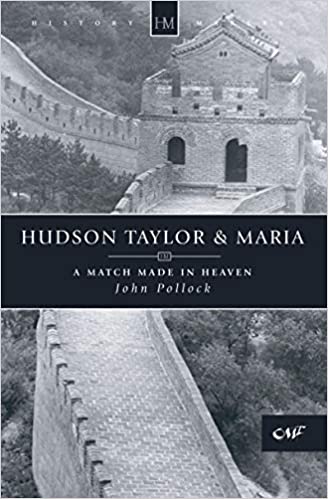
John Pollock tells their story in Hudson Taylor and Maria: A Match Made in Heaven. He begins with Hudson’s salvation story and leading to China, then he details their work together.

I love the passages describing Maria’s influence on Hudson. “Her religion had been more orderly; she served to steady Hudson’s faith while he deepened hers” (p. 113). Furthermore:

Maria tempered without quenching his zeal, was largely responsible for the common sense and balance characteristic of Taylor at the height of his powers. She made him take holidays. Under the influence of her less mercurial yet gay temperament he shed those moods of melancholy; he could discuss every matter with her and forget to be introspective. He became more assured, grew up.

Though his was the finer intellect, Maria had a more thorough education. She improved his cumbrous style, teaching him to write good English though she never cured him of split infinitives.

Together they had such a reservoir of love that it splashed over to refresh all, Chinese or European, who came near them (p. 114).

Hudson Taylor had not intended to start a new mission agency. But while home in England recovering from some physical problems, he wanted to recruit more people to go into the interior of China. Most missionary effort was on the coast, leaving the biggest part of the country unreached.

The agency under whose auspices Hudson had come had failed him miserably, leading him to resign them while still in China.

Between the new recruits and Hudson’s experiences, the necessity for a new mission agency became apparent. The pressure on Hudson was excruciating until finally, after a friend’s sermon, he realized:

If we are obeying the Lord, the responsibility rests with Him, not with us. Thou, Lord! Thou shalt have the burden. All the responsibility lies on Thee, Lord Jesus! I surrender. The consequences rest with Thee. Thou shalt direct, care for, guide me, and those who labour with me (p. 141).

Thus the China Inland Mission was born. Taylor needed those assurances for the rocky path ahead.

One of Hudson’s mottoes was “Move man, through God, by prayer alone.”

In later years Hudson said, “As a rule prayer is answered and funds com in, but if we are kept waiting the spiritual blessing that is the outcome is far more precious than exemption from the trial (p. 125).

Another of his principles was this:

Pray ye to the Lord of the harvest that he will send forth labourers unto the harvest.’ Taylor decided that the divine method of riding missionaries did not lie in ‘elaborate appeals for help, but, first, earnest prayer to God to thrust forth labourers, and, second, the deepening of the spiritual Life of the Church, so that men should be unable to stay at home‘ (p. 128).

Although I don’t think this was meant to be a theme in Pollock’s book, one factor that stood out to me was that many of Hudson’s main problems were not with anti-foreign sentiment or the government: his most trying problems came through other Christians. The criticism of his Chinese dress, the division over his proposal to Maria (one of the leaders refused to give him communion over the issue!), the new recruits grumbling and fussing like the Israelites in the wilderness, dissension in the ranks, people spreading disinformation, and armchair commentators from afar touting uninformed opinions about everything he did, all weighed on him. He tried to be gracious, and he was not above rebuke or correction. But a lot of the opposition to his work and methods was fleshly and burdensome.

I also noticed with him as with Jim Elliot, whose story I reread a few weeks ago, that in their twenties, they were not at their most mature state (who is at that time?). For instance, in Hudson’s youthful zeal, he “suffered scruples about putting on a life jacket” during a storm at sea because he felt it showed “lack of faith in God’s power to intervene.” In later years, “he laughed at such extravagance. ‘I believe I can trust the Lord in some respects as much as I ever could, but I am a good deal modified in some of my views and do not think it right to neglect proper precautions'” (p. 84). But they still had a willingness to do God’s will no matter the cost to themselves and to think outside the box. They both grew in wisdom with more experience of walking with God.

After a particularly lengthy and trying period in his early days, he wrote to someone:

At home, you can never know what it is to be alone—absolutely alone, amidst thousands, as you can in a Chinese city, without one friend, one companion, everyone looking on you with curiosity, with contempt, with suspicion or with dislike. Thus to learn what it is to be despised and rejected of men—of those you wish to benefit, your motives not understood or respected—thus to learn what it is to have nowhere to lay your head, and then to have the love of Jesus applied to your heart by the Holy Spirit—His holy, self-denying love, which led Him to suffer this and more than this—for me; this is precious, this is worth coming for (pp. 81-82).

Sadly, Hudson and Maria only had twelve married years together. Pollack ends the book a little abruptly right after Maria’s death. He has a recommendation elsewhere in the book for the rest of Hudson’s life story. I had not read the one he mentioned, but I’ve read others. the classic is a large two-volume set written by Taylor’s son and daughter-in-law (though Pollock asserts that the daughter-in-law revised and left out some things, it’s still a great set). Even though I was familiar with much of Taylor’s life, I was blessed by going over parts of it again in this book.

Though this book was originally written in the 1960s, the style of writing seems much older to me. But the book is easily readable and well worth one’s time.

(Sharing with Grace and Truth, Senior Salon, Hearth and Soul,
InstaEncouragements, Booknificent, Carole’s Books You Loved)

Laudable Linkage

IMG_0195

Here are some thought-provoking reads discovered this week.

Regeneration, HT to Challies. “We’ve dropped being born again from our vocabulary as evangelicals as it smacks of being American from the 1950s and yet the doctrine of regeneration couldn’t be more vital. If you’ve not been born again/regenerated you cannot enter the kingdom of God (John 3:3,5 which fulfils Ezekiel 36:25,26). If you don’t understand regeneration you will misunderstand the whole of the gospel.”

The Race. I could identify with this both as a mother watching a child race and as someone who will never cross any finish line first. “I have a feeling that it isn’t only the Olympic gold medalists who bring God pleasure when they run, limp, or crawl across a real finish line.”

Rescued, Resilient, and Resisting—Even in a Pandemic. I love this post from Michele about riding out the end of the pandemic with a “Resolve to finish well. Foiling Satan’s attack on our human tendency to ‘yield just when … relief was almost in sight,’ let us rather lean in to the struggle against impatience or petulance.”

On the Question Every Heart Asks: Why? HT to The Story Warren. “It is comforting to know that even Solomon in his wisdom, also asked why.”

The Counsel and Care of the Elderly, HT to Challies. “Society feeds the pride of young men and women by telling them that they can change the world–regardless of God-given giftings, intellect, upbringing, associations, providential encounters, guidance, or hard work. Society tells us that the elderly are a burden to progress. While there is nothing new under the sun (Ecclesiastes 1:9), ours is an increasingly narcissistic culture. This is nowhere more evident than in our disdain and disregard of the elderly.”

The Risky Upside of Missionary Biographies. And some advantages. I shared some others a few years ago in Why Read Biographies?

When Amazon Erased My Book, HT to Challies. Scary.

There were a number of posts on emotions this week:

Dealing with Anger. “Most of us will agree that when we get angry we lose much more than our temper. We say or do terrible things that we regret later, and we wish we could take them back.”

Engaging Our Emotions, Engaging with God, HT to Challies. “God doesn’t call us to avoid or squash our emotions (as Christians often suppose). Neither does he call us to embrace them unconditionally (as our culture often urges). Rather, he calls us to engage them by bringing our emotions to him and to his people.”

Lament Is for Little Ones, Too, HT to The Story Warren. “These psalms typically follow a threefold structure: tell God how you feel; ask for help; respond in trust and hope. We can use this pattern to help our children learn to lament to God all that they are feeling.”

31 Days of Missionary Stories

I’ve seen that several bloggers are participating in a 31 Days series hosted by Nesting Place. The basic idea is to choose a topic that you write about each day of October. I thought, “Hmm, that sounds interesting…but what in the world would I write about?” Then it hit me this morning: I love to read missionary biographies or stories: when I first started my blog I did a series for a few weeks on different missionary stories or anecdotes, and I have been doing the same in a church ladies’ newsletter for years. What a great opportunity to share some of those here! Some times it will be an overview of a person’s life: some times it will be just one incident or anecdote.

Why missionary stories? Because it increases my faith to see men and women “of like passions as we are” who learn, grow, overcome, and are used by God. I wrote more about reading missionary biographies before, and an excerpt from that is:

We learn history for a number of reasons, among them: to better understand our current times, to appreciate our heritage, to avoid repeating mistakes. There are heroes in our national history who inspire us to a love of country and duty and courage. There are heroes of our spiritual heritage who inspire us in love and dedication to God and to greater faith in remembering that the God they served and loved and Who provided for and used them is the very same God we love and serve today and Who will provide for us and use us. Though times and culture change, human nature at its core doesn’t change much, and God never changes.

This poem, which I first saw in Rosalind Goforth’s book, Climbing, embodies my own thoughts and feelings as well.

Call Back!

If you have gone a little way ahead of me, call back-
It will cheer my heart and help my feet along the stony track;
And if, perchance, Faith’s light is dim, because the oil is low,
Your call will guide my lagging course as wearily I go.

Call back, and tell me that He went with you into the storm;
Call back, and say He kept you when forest’s roots were torn;
That when the heavens thunder and the earthquake shook the hill.
He bore you up and held where the very air was still.

O friend, call back, and tell me for I cannot see your face;
They say it glows with triumph, and your feet bound in the race;
But there are mists between us and my spirit eyes are dim,
And I cannot see the glory, though I long for word of Him.

But if you’ll say He heard you when your prayer was but a cry,
And if you’ll say He saw you through the night’s sin-darkened sky-
If you have gone a little way ahead, O friend, call back-
It will cheer my heart and help my feet along the stony track.

I hope you’ll join me as we look to those who have gone on before us and learn from them.

I’ll be using this post as a directory to list the posts in the series.

Day 1: This post
Day 2: Rosalind Goforth; Answer to a Mother’s Prayer.
Day 3: Adoniram Judson’s Conversion.
Day 4: Adoniram Judson’s biography: To the Golden Shore.
Day 5: John Paton, Missionary to Cannibals.
Day 6: Darlene Deibler Rose: Missionary POW.
Day 7: Gracia Burnham and God’s Grace in Captivity.
Day 8: Isobel Kuhn Learns to Put God First.
Day 9: Isobel Kuhn’s Marriage: Whom God Hath Joined.
Day 10: Don Richardson: How to minister to a culture that values treachery?
Day 11: Amy Carmichael: With All Our Feebleness: Victory Through Pain and Illness.
Day 12: Amy Carmichael Learns to Die to Self.
Day 13: Amy Carmichael and Singleness.
Day 14: Gladys Aylward: The Small Woman With Big Faith.
Day 15: Mary Slessor and the Power of a Woman’s God.
Day 16: Spirit of the Rainforest: A Yanomamo Shaman’s Story
Day 17: Eric Liddell: Olympian and Missionary.
Day 18: Dr. John Dreisbach: Modern Missionary Statesman and Surgeon.
Day 19: The “Cambridge Seven
Day 20: William Carey: “Attempt great things for God. Expect great things from God.
Day 21: Rosalind Goforth, A Woman “Of Like Passions” As We Are.
Day 22: J. O. Fraser: Pianist and Engineer Turned Missionary.
Day 23: Dallas and Kay Washer, Candles in the Darkness.
Day 24: Margaret Stringer: Missionary to Cannibals With a Merry Heart and a Faithful Spirit.
Day 25: Clint and Rita Vernoy: On Ethnocide and Raising Children in the Jungle.
Day 26: Verda Peet: Sometimes I Prefer to Fuss.
Day 27: Jim Elliot’s Journals.
Day 28: Hudson Taylor, Pioneer Missionary.
Day 29: Not Only Preachers Are Called To Be Missionaries.
Day 30: Different ways to support and encourage missionaries.
Day 31: Thoughts on pedestals and missionary biographies with a list of my favorites.

You can see what other people are writing about for this 31 day challenge here: there are nine different categories.

(Photo courtesy of MorgueFile)