Review: Everything Sad Is Untrue

Everything Sad Is Untrue (A True Story) by Daniel Nayeri is, on one level, a story about a boy who came to America as a refugee from Iran. Besides encountering a different language, different ways of doing things, even different kinds of toilets, Daniel has to deal with losses.

First he lost his name, Khosrou, because no one could pronounce it. He lost the presence of his father, who stayed behind in Iran. He lost his language and culture. He lost his position in society: his mother had been a doctor in Iran but worked cutting cardboard in a company that made business cards in the US. And he lost his connection with his extended family, his memories of them in fragments. “A patchwork memory is the shame of a refugee” is something he says often.

That was when I realized I had to write down the memories and myths and the legends—and even the phrases and jokes. Or I’d lose everything. Maybe even the recipes (p. 235, Kindle version).

Another layer of the story is the sad human tendency not only not to welcome anyone “different,” but to actively persecute them.

Yet another major facet is Daniel’s mother’s conversion to Christianity and the fatwa that was placed on her head, which led to her fleeing Iran with her two children. They ended up in a refugee camp in Italy for three years before finally making it to the US.

Sima, my mom, read about him and became a Christian too. Not just a regular one, who keeps it in their pocket. She fell in love. She wanted everybody to have what she had, to be free, to realize that in other religions you have rules and codes and obligations to follow to earn good things, but all you had to do with Jesus was believe he was the one who died for you (p. 195).

How can you explain why you believe anything? So I just say what my mom says when people ask her. She looks them in the eye with the begging hope that they’ll hear her and she says, “Because it’s true.” Why else would she believe it? It’s true and it’s more valuable than seven million dollars in gold coins, and thousands of acres of Persian countryside, and ten years of education to get a medical degree, and all your family, and a home, and the best cream puffs of Jolfa, and even maybe your life. My mom wouldn’t have made the trade otherwise (p. 196).

If you believe it’s true, that there is a God and He wants you to believe in Him and He sent His Son to die for you—then it has to take over your life. It has to be worth more than everything else, because heaven’s waiting on the other side. That or Sima is insane (pp. 196-197).

Daniel tells his story from his viewpoint as a twelve-year-old boy in the style of Scheherazade, the storyteller in One Thousand and One Nights. Sometimes he addresses the reader directly. Sometimes he addresses his teacher as if what he is writing is for an assignment.

If you listen, I’ll tell you a story. We can know and be known to each other, and then we’re not enemies anymore (p. 1).

The point of the Nights is that if you spend time with each other—if we really listen in the parlors of our minds and look at each other as we were meant to be seen—then we would fall in love. We would marvel at how beautifully we were made. We would never think to be villain kings, and we would never kill each other. Just the opposite. The stories aren’t the thing. The thing is the story of the story. The spending of the time. The falling in love. All the good stuff is between and around the things that happen (p. 299).

Being a Persian/Eastern tale, it isn’t told in a way we’re used to.

Mrs. Miller says I have “lost the plot,” and am now just making lists of things that happened to fill space. But I replied that she is beholden to a Western mode of storytelling that I do not accept and that the 1,001 Nights are basically Scheherazade stalling for time, so I don’t see the difference. She laughed when I said this (p. 299).

I had heard marvelous things about the book, but was confused when I started reading it. It jumps from a scene at school to a story about Daniel’s ancestors to a story about his mother or something that happened on their journey here. At first I thought this was because the narrator is a twelve-year-old boy. Then I realized it was a different style. I don’t often do this with fiction, but when I finished the book, I immediately started rereading it. I understood it much better the second time–I felt I had all the pieces, so I wasn’t confused. Plus, I just wasn’t ready to let go of the book yet.

I hadn’t paid much attention to the cover until another reviewer mentioned the tornado (which is in the book) is swirling around various things Nayeri mentions throughout his story. Plus, his style of storytelling is cyclical, like the tornado. That helped things click into place for me, plus it made me think the cover designer was a genius.

The title of the book comes from a scene in The Lord of the Rings when Samwise Gamgee “sees Gandalf come back and it’s like seeing his grandpa return from the land of death and memories.” “And Sam thinks maybe all the sad parts of the adventure will come untrue, now that this one has. And the beautiful part is that they do” (p. 232).

Though the story stops at a sad place, it seems a turning point towards hope.

Daniel makes his mother the heroine of story, the one who always had hope, who was unstoppable. “What you believe about the future will change how you live in the present” (p. 347).

The legend of my mom is that she can’t be stopped. Not when you hit her. Not when a whole country full of goons puts her in a cage. Not even if you make her poor and try to kill her slowly in the little-by-little poison of sadness. And the legend is true. I think because she’s fixed her eyes on something beyond the rivers of blood, to a beautiful place on the other side (p. 213).

Once I got into the book, I totally loved it. Well—almost totally. There were a lot of poop stories—maybe because the narrator is a twelve-year-old boy. But there were such poignant moments as well as many funny ones. I couldn’t help but admire and connect with Daniel’s mother. But my eyes were also opened to what refugees experience and to Persian culture.

Some of my other favorite quotes from the book:

I am ugly and I speak funny. I am poor. My clothes are used and my food smells bad. I pick my nose. I don’t know the jokes and stories you like, or the rules to the games. I don’t know what anybody wants from me. But like you, I was made carefully, by a God who loved what He saw. Like you, I want a friend (p. 2).

To lose something you never had can be just as painful—because it is the hope of having it that you lose (p. 51).

The lesson here is that people have scales in their heads and they measure other people for their value and ugly refugee boys are near the bottom and pretty blond girls are at the top. This is not a happy lesson. But you either get the truth, or you get good news—you don’t often get both (p. 80).

Does writing poetry make you brave? It is a good question to ask. I think making anything is a brave thing to do. Not like fighting brave, obviously. But a kind that looks at a horrible situation and doesn’t crumble. Making anything assumes there’s a world worth making it for . . . making something is a hopeful thing to do. And being hopeful in a world of pain is either brave or crazy (p. 122).

My mom comes home exhausted every night. I have never seen her not exhausted. And also, I have never seen her not working (p. 154).

Love is empty without justice. Justice is cruel without love (p. 217).

I found this video of the author and his mother making cream puffs, which I thought was really sweet. I had almost finished my second reading of the book when I saw this, and it was neat to actually see Daniel and his mother

I loved what Kathryn Butler said in her review of this book: “He weaves fragments of myth and personal history into his story, with threads intricately looping like the magnificent Persian rugs he describes (some of them studded with jewels, as can also be said of his prose).”

I’m sure this will be one of my favorite books of the year . . . and of all time.

Review: Lenten Lands: My Childhood with Joy Davidman and C. S. Lewis

Douglas Gresham was the son of Joy Davidman Gresham, who married C. S. Lewis when Douglas was eleven years old. In 1973, ten years after Lewis’s death, Gresham wrote Lenten Lands: My Childhood with Joy Davidman and C. S. Lewis, partly because he was asked to, partly to correct some misconceptions concerning C. S. Lewis. Yet Lenten Lands is his own biography, not Lewis’s.

The title of the book comes from a poem that Lewis had originally written for a friend, but then adapted to be put on Joy’s tombstone:

Here the whole world (stars, water, air,
And field, and forest, as they were
Reflected in a single mind)
Like cast off clothes was left behind
In ashes, yet with hopes that she,
Re-born from holy poverty,
In lenten lands, hereafter may
Resume them on her Easter Day.

Joy married fellow writer William Gresham in 1942. They had two sons, David and Douglas. But their marriage was troubled. They had been atheists, but searched other religions. Joy was drawn to the writings of C. S. Lewis as he told of his own journey from atheism to Christianity. She began writing to Lewis and eventually visited him in England.

When she returned home, she found that her husband was having an affair with the cousin she had left to keep house for her husband and sons while she was away. She tried to reconcile the marriage, but it was too late. Joy took her two sons and moved to England.

Joy and Lewis and Lewis’s brother, Warnie (Warren) enjoyed a strong, intellectual friendship. Joy and Lewis influenced each other’s writing. When Joy’s visa was not renewed in 1956, Lewis married her in a civil ceremony.

But before long, the couple grew to love each other as more than friends and sought a Christian marriage, difficult since the church of England did not condone Joy’s divorce. But they found someone who would perform the ceremony.

Joy developed bone cancer but went into remission. The cancer came back a few years later, and Joy died in 1960. C. S. Lewis wrote A Grief Observed under a pseudonym. He had not been well himself, and died three years after Joy.

Douglas experienced all these things as a child: he was just eighteen when Lewis passed. He kept in touch with Warnie for some years, but Warnie’s grief and alcoholism were too much for Douglas to bear. He later regretted that he was not more attuned to Warnie’s grief and more of a help to him.

Douglas then tells of his various jobs, marriage, and children.

In his afterword, written in 2003, thirty years after the original publication of the book, he tells how he “committed [his] life to Christ and His service.” He had “always believed in God and in Jesus Christ; my problem was not one of belief, but one of arrogance and pride. I did not want to submit my life to any authority other than my own and it took me a long time to realize that I am simply not qualified to run it myself.” At that time he “was working more and more for the C. S. Lewis Literary Estate.” His Wikipedia page says he “hosted Focus on the Family Radio Theatre’s adaptations of his stepfather’s most famous works, and he was named co-producer for the series of theatrical films adaptations of The Chronicles of Narnia” and is now a “stage and voice-over actor, biographer, film producer, and executive record producer.”

Not much is said of his brother, David, in the book. Douglas’s Wikipedia page says David returned to Judaism and was later diagnosed as a paranoid schizophrenic.

My heart went out to Douglas, having experienced so much loss at heartache at such a young age. His young adult years were somewhat tumultuous. A good talking to by the woman who would become his wife helped set him on the right course.

One of my favorite moments in the book was when Douglas actually met Jack. He had regarded him as “a cross between Sir Galahad and Merlin the Wise (p. 27), “on speaking terms with King Peter, with the Great Lion, Aslan himself” (p. 55). But Jack was “a slightly stooped, round-shouldered, balding gentleman whose full smiling mouth revealed long, prominent teeth, yellowed like those of some large rodent, by tobacco staining” (p. 55). “Well, so much for imagery,” Douglas concluded. But he also noticed “His florid and rather large face was lit as if from within with the warmth of his interest and his welcome. I never knew a man whose face was more expressive of the vitality of his person” (p. 55).

Another favorite part was when Douglas said “When I was home from school, the dinner table of The Kilns was the scene of my real education. Jack and Warnie were both brilliant at sustaining a conversation at any one of a dozen different levels and on almost any topic, and I learnt more sitting and conversing over meals than I ever learnt at school (p. 81). I imagine so!

I appreciated what was said about the interaction between Joy and a friend named Jean: “Though they did not always agree upon matters of religion, politics, or taste, they could argue for hours and finally simply agree to disagree, without the dissent having the slightest adverse effect on their friendship” (p. 92).

I became interested in this book after reading a fictional account of the relationship between Joy and Lewis, Becoming Mrs. Lewis by Patti Callahan (linked to my review). Since much of what the author wrote (like letters between the two) was made up, I wanted to read the account from one who was actually there at the time. It’s taken me a few years to get to it, but I am glad I finally did.

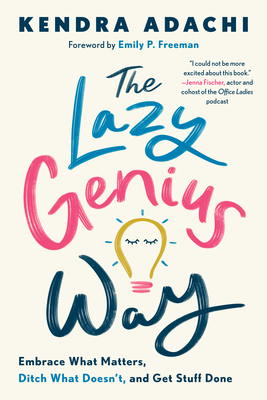
Review: The Lazy Genius Way

The Lazy Genius Way

Suppose you want to reorganize your pantry. You might research organizational systems, pull everything out, dust shelves and canned goods, check expiration dates, sweep, buy cute containers, make labels, and spend the better part of a day, if not days, placing items in just the right order. And then you get frustrated when that order is not maintained.

Or you might go the opposite extreme and decide nobody has the time and energy for that.

Kendra Adachi calls these the “genius” and “lazy” approaches. She proposes a happy medium: that we be geniuses about what matters and lazy about what doesn’t. She shares thirteen principles for implementing this in her book, The Lazy Genius Way: Embrace What Matters, Ditch What Doesn’t, and Get Stuff Done.

For those of us who tend to make any small need into a major project, Kendra says, “When you care about something, you try to do it well. When you care about everything, you do nothing well, which then compels you to try even harder. Welcome to being tired” (p. 11. Kindle version).

On the other hand, “Little did I know you can be just as exhausted from not trying as you can from trying too hard. Managing apathy and survival mode takes as much energy as managing rules and perfection” (p. 15).

One of her premises is that there is no one right method or tool that will appeal to and work for everyone. If we’re to be geniuses about what matters, that will differ from person to person.

She mentioned that she likes to make bread. She cares about it and puts a lot of effort into it. But it’s fine if others have no desire to make bread and buy the bargain brand.

She likes comfortable clothes in neutral colors and doesn’t like top spend a lot of time on clothing decisions. But she acknowledges that others like to pill out five different outfits before they decide what to wear, and that’s fine.

That’s why she comes back again and again to acknowledging what’s important to you, not Instagram or the neighbors or whoever.

Some quotes that stood out to me:

I want to stop judging women who have it all together, assuming they have something to hide. I want to stop applauding chaos as the only indicator of vulnerability (p. 16).

You might think a routine is nothing more than doing the same things in the same order every day, but that’s not the whole story. Routines are meant to lead you into something else (p. 74).

It’s easier to clean up a cup of spilled milk than it is to mend a second-grader’s hurt feelings (p. 89).

House rules are about connection, not protection. They keep the first domino from tipping and knocking over a lot more (p. 99).

The goal isn’t to maintain control but to be in a better headspace to engage with what matters—namely, your people (p. 99).

You can celebrate where you are without being distracted by where you’re not yet (p. 210).

You’re tired because you’re trying to overcome the world. but we can take heart because the God of the universe has already done that (p. 211).

Though this book is not advertised as a Christian book, and the author doesn’t base her principles on the Bible, a few sentences like that last one are sprinkled through the book.

One thing I loved about the book is the recap statements at the end of each chapter. I get frustrated wishing I could retain everything I read from nonfiction. Having the key points collected at intervals helps me pull things together at the end of each chapter plus provides a quick place to review.

Kendra writes in an easily understandable and relatable way. Don’t miss her footnotes—many of them are funny asides.

My only minor criticism is that the explanations and examples seemed perhaps a little overdone in places. But I suppose a wide variety of examples makes the book applicable to more people.

Kendra also has a Lazy Genius Podcast, but I have not listened to it yet.

This book was all the rage a few years ago. I kept seeing it mentioned everywhere. I was intrigued, but didn’t get around to it. I’m glad I finally did.

(I often link up with some of these bloggers.)

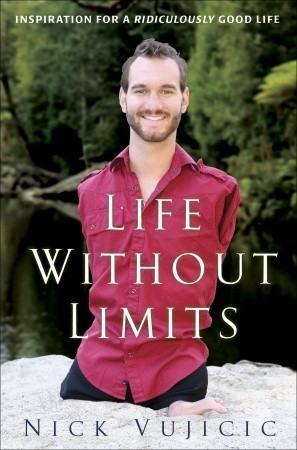
Review: Life Without Limits

When Nick Vujicic was born without arms and legs, his parents were shocked and grieved. They were concerned about how he could ever grow up to be independent. They were devout Christians yet wondered why God would allow such a thing to happen.

Nick wondered the same thing as he got older.

I have to confess, I wondered the same thing. Even with as much comfort and reassurance I’ve received studying God’s reasons for allowing suffering, and as much as I have come to trust His character and will, thinking of a person growing up in this condition was hard to come to grips with.

Maybe that’s why I had Nick’s book, Life Without Limits: Inspiration for a Ridiculously Good Life, on the shelf for so long without picking it up. It was one we had bought for my husband’s mother. I remember her saying her tears were streaming as she read this, and she felt she had nothing to complain about after reading this book.

Recently, I saw several Facebook posts from friends about a young wife and mother they knew who ended up in the hospital with several severe infections. The doctor said her condition was a 10 out of 10 on the scale of a serious illness. The treatment reduced blood flow to her limbs, which resulted in amputation of both arms and legs. She’s been in the hospital since December.

As my heart went out to this family and I’ve been praying for them, I decided to pick up Nick’s book to see how he dealt with his situation.

After his parents’ initial shock, they strove to give him as normal a life as possible. He was a determined little boy and found ways to do most things he wanted to do.

However, school was a different story. His family wanted him to attend regular classes rather than special-needs classes. He faced the cruel remarks of some of his classmates, which was depressing. He was even suicidal at one point until his father encouraged him.

Nick found that often he had to be the one to reach out to make people feel comfortable approaching him. That and a good sense of humor helped people to see he was just a regular guy on the inside.

Discussions with others about how he coped with no limbs led to speaking to student, church, and youth organizations. In the years since, speaking became Nick’s vocation and ministry, not only in his native Australia, but around the world.

This book is part memoir, part motivational encouragement. He does include Christian principles but also a lot of secular motivation (love yourself, etc.).

Some of the quotes that stood out to me:

Experiences like that helped me realize that being “different” just might help me contribute something special to the world. I found that people were willing to listen to me speak because they had only to look at me to know I’d faced and overcome my challenges. I did not lack credibility. Instinctively, people felt I might have something to say that could help them with their own problems (pp. 20-21).

As difficult as it might be to live without limbs, my life still had value to be shared. There was nothing I lacked that would prevent me from making a difference in the world. My joy would be to encourage and inspire others. Even if I didn’t change this planet as much as I would like, I’d still know with certainty that my life would not be wasted. I was and am still determined to make a contribution (p. 24).

Often the very challenges that we think are holding us back are, in fact, making us stronger. You should be open to the possibility that today’s handicap might be tomorrow’s advantage (pp. 43-44).

Nick was encouraged by the man who was born blind in John 2. The disciples asked Jesus, “Who sinned, this man or his parents, that he was born blind?” Jesus responded, “It was not that this man sinned, or his parents, but that the works of God might be displayed in him.”

This book was published in 2010. Since then, Nick has gotten married, had four children, written more books and traveled and spoken to even more people.

I appreciated Nick’s attitude and willingness to help and encourage others.

You might be interested in this piece about Nick on Australia’s 60 Minutes program:

(I often link up with some of these bloggers.)

Review: Organizing for the Rest of Us

Organizing for the Rest of Us

In my early married life, I read Sandra Felton’s The Messies Manual and received her newsletter for several years. Those helped me immensely. I don’t know if my husband realizes how much he’s indebted to Sandra. 🙂

But I realized that organization isn’t a destination. It’s a continual journey. You can’t just set up routines and places for things: you have to maintain them. And you continually get new things, get rid of old things, or get ideas of ways your organization could work better.

So I still read occasional books about organization. I don’t read books on decluttering because, though decluttering is a part of organization, it’s just one part. I don’t read books on minimalism because they go too far for my tastes.

Some of the more recent books I’ve read on time management and productivity focus on the larger principles. Those are needful and foundational. I need those reminders sometimes. But I’m more in need of practical everyday life hacks, those “Why didn’t I ever think of that?” ideas and solutions.

I just recently discovered Dana K. White’s Organizing for the Rest of Us: 100 Realistic Strategies for Keeping Your House Under Control when it was on sale for the Kindle. It’s full of great ideas, laced with humor, and written concisely. You could easily skim through chapter titles and just read about the areas you want help with. But I enjoyed the whole book.

Dana started sharing tips on an originally anonymous blog titled A Slob Comes Clean. It resonated with so many people that it grew into books, podcasts, and speaking engagements.

Dana was one of those people (like me) who wasn’t naturally organized. She discovered her tips one at a time while trying to “deslobify” her own house.

One of her principles I liked is that clutter is personal. Maybe that’s why I don’t like decluttering and minimalist books—I didn’t always agree with what they said I needed to get rid of. Dana defines clutter as “anything that gets out of control in your home” (p. 6, Kindle). “You can keep anything. You just can’t keep everything” (p. 58).

One of my favorite tips from this book was not to take everything out of a closet or cabinet when trying to organize it. Most of us do that, then we get tired or need to go tend to something else, and we have a massive mess on our hands. Instead, Dana urges taking one thing out at a time and deciding immediately what to do with it. Have a trash bag and donation box handy to put items that you want to get rid of. If you decide the item is something you want to keep, immediately put it where it goes. That may seem to take longer in the short run. But dealing with the item immediately saves having a pile of items to put away when you’re done and fatigued. Plus handling it just once cuts down on rethinking it. And if you’re interrupted or tired, you don’t have a mess to clean up (or shove back into the closet) before you can move on.

This was a fun and very helpful book. Highly recommended.

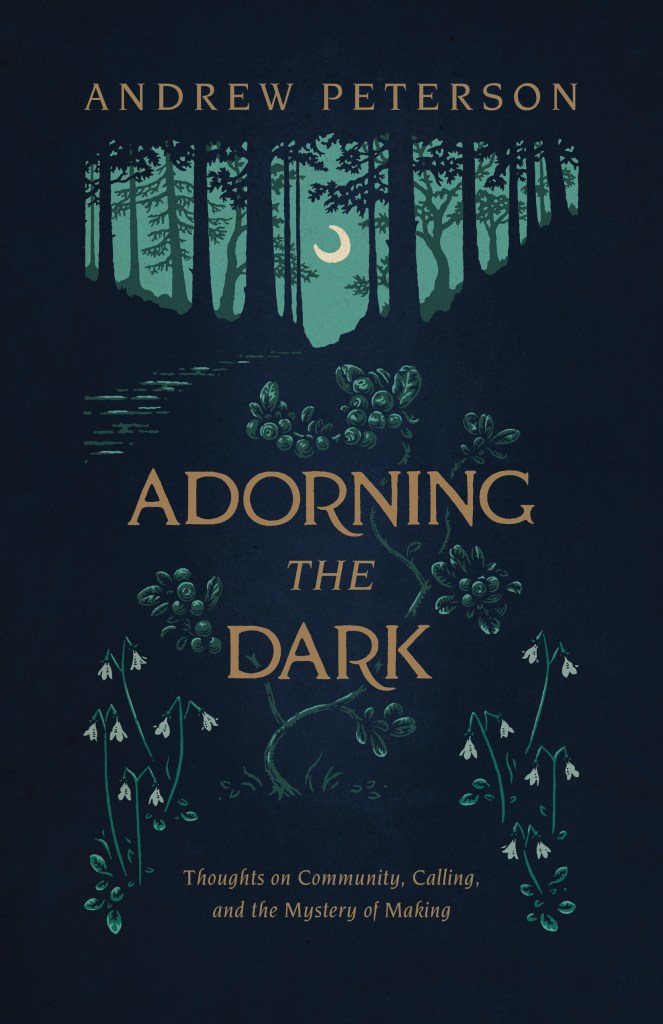
Review: Adorning the Dark

Adorning the Dark by Andrew Peterson

My first encounter with Andrew Peterson’s music was when a friend put the music video for “Dancing in the Mine Fields” on Facebook. The song is sweet one about marriage, and the video features several older couple holding their wedding portraits.

Then when I read The Yearling by Marjorie Kinnan Rawlings, I loved it so much I looked up some background information about it. I discovered another music video of Andrew’s called “The Ballad of Jody Baxter,” Jody being the main character in The Yearling.

Those songs are folksy, but many of you might be familiar with a contemporary song of Andrew’s titled “Is He Worthy?” We sing this at church sometimes.

I knew that Andrew had written a series of fantasy novels for children called The Wingfeaher Saga. I have not read them yet, but I want to. I’ve heard good things about them.

And somewhere along the way, I learned that Andrew was instrumental in forming The Rabbit Room, a site dedicated to “Cultivating and curating story, music, and art to nourish Christ-centered communities for the life of the world.” I have read a few articles there.

Even with that limited knowledge, I was interested when I saw Andrew’s Adorning the Dark: Thoughts on Community, Calling, and the Mystery of Making come up for a Kindle sale.

Andrew says he writes and speaks on this topic as “a practitioner, not an academic,” which means he “learned by doing, which is a nice way of saying that that I learned by doing it wrong half the time” (p. 4, Kindle version).

But not writing as an academic made the book extremely relatable. Andrew shares his journey, his testimony, and what he learned along he way.

Though he writes frequently of song-writing, many of of illustrations work for other kinds of writing and artistic expression as well.

In the first chapter, Andrew shares that many people know Bach wrote S. D. G., standing for Soli Deo Gloria (“glory to God alone”) on his manuscripts. But Andrew shares what few people know: that Bach also wrote “Jesu Juva,” Latin for “Jesus, help!” on his manuscripts as well. That’s an emphasis throughout the book. Andrew says is calling is “to use whatever gifts I’ve been given to tell the truth as beautifully as I can” (p. 4), and “to make known the heart of God” (p. 5).

He writes about battling self-doubt, creating as an act of worship, the fact that creating is work, not magic, that writing what we know doesn’t mean the polished end, but the struggle. He writes about humility, self-consciousness, and the fact that we don’t create to draw attention to ourselves even though “art is necessarily created by a Self” (p. 28). He references Lewis and Tolkien and others and talks about imagination, serving the work, and serving the audience.

One of the references to Lewis described his use of the word sehnsucht, an inconsolable longing which is evidence we were made for something more than we see and experience in this world.

One favorite section was about the tension between art and agenda and what makes Christian art Christian.

One great problem with much art that’s called “Christian” is agenda, which is to say that it’s either didactic, or manipulative, or merely pragmatic—in other words, the artistic purity of the work tends to take a back seat to the artist’s agenda (p. 47).

Art and agenda can and do coexist . . . Agenda is bad when it usurps the beauty. Christian art should strive for a marriage of the two, just as Christ is described as being “full of grace and truth” (John 1: 14). Truth without beauty can be a weapon; beauty without truth can be spineless. The two together are like lyric and melody (p. 47).

He describes revision, or selectivity, as “[pulling] the weeds before they choke the flowers” (p. 61) and being “able to discern what’s necessary to the aesthetic of the song and what isn’t. Then lose what isn’t” (p. 59). He points out that it takes forty gallon of maple sap to make one gallon of maple syrup. You wouldn’t put the sap on your pancakes. But once it’s boiled down, it’s perfect. On the other hand, “Revision is crucial . . . but it’s possible to monkey with something so much that the magic dies” (p. 99).

He writes that creating is not just inspiration, but also discernment and discipline—or dying to self.

He tells how art nourishes community and community nourishes art.

One of my favorite sections talks about how creativity isn’t just being “artsy.” We’re creative because we’re made in the Creator’s image. Andrew says the Rabbit Room’s conference, Hutchmoot, was meant to “encourage people to look for the glimmer of the gospel in all corners of life, that they would see their God-given creativity in both their artistic works and their front gardens, in their home repair and the making of their morning coffee, and that they would call out that glorious creativity in everyone they meet” (p. 89). His wife would “never claim to be an artist, but she’s one of the most creative people I know. Her song is our family” (p. 104).

I have multitudes of quotes marked besides what I’ve already shared. Here are a few:

Who do I think I am, anyway? We need not look anywhere but to the eyes of our Savior for our true identity, an identity which is profoundly complex, unfathomable, deep as the sea, and yet can be boiled down to one little word: beloved. That’s it. And that’s why it’s so silly (and perilous) to use your gifting to clothe yourself with meaning. Those clothes will never quite fit (p. 15).

Living as we do in dying bodies in a dying world, our best work always falls short of the initiating vision (p. 16).

If you wait until the conditions are perfect, you’ll never write a thing (p. 26).

Jesus, you’re the source of beauty: help us make something beautiful; Jesus, you’re the Word that was with God in the beginning, the Word that made all creation: give us words and be with us in this beginning of this creation; Jesus, you’re the light of the world: light our way into this mystery; Jesus, you love perfectly and with perfect humility: let this imperfect music bear your perfect love to every ear that hears it (p. 10).

The reintroduction of fairy tales to my redeemed imagination helped me to see the Maker, his Word, and the abounding human (but sometimes Spirit-commandeered) tales as interconnected. It was like holding the intricate crystal of Scripture up to the light, seeing it lovely and complete, then discovering on the sidewalk a spray of refracted colors. The colors aren’t Scripture, nor are they the light behind it. Rather, they’re an expression of the truth, born of the light beyond, framed by the prism of revelation, and given expression on solid ground (p. 41).

Somewhere out there, men and women with redeemed, integrated imaginations are sitting down to spin a tale that awakens, a tale that leaves the reader with a painful longing that points them home, a tale whose fictional beauty begets beauty in the present world and heralds the world to come. Someone out there is building a bridge so we can slip across to elf-land and smuggle back some of its light into this present darkness (p. 42).

The real flash of inspiration came not before they started working, but during the process (p. 47).

Keep working, keep straining toward a level of excellence that will most likely elude you forever, but it’s the only way your songs are ever going to move from bad to decent to good (p. 74)

Become a student of the craft. Have conversations with people whose insight dwarfs your own; they’ll teach you what to look for (p. 74).

Constraints are wonderful things, and lead you down paths you might not otherwise take (p. 99).

One holy way of mending the world is to sing, to write, to paint, to weave new worlds. Because the seed of your feeble-yet-faithful work fell to the ground, died, and rose again, what Christ has done through you will call forth praise from lonesome travelers long after your name is forgotten. They will know someone lived and loved here.

Whoever they were, they will think, they belonged to God. It’s clear that they believed the stories of Jesus were true, and it gave them a hope that made their lives beautiful in ways that will unfold for ages . . .

This is why the Enemy wants you to think you have no song to write, no story to tell, no painting to paint. He wants to quiet you. So sing. Let the Word by which the Creator made you fill your imagination, guide your pen, lead you from note to note until a melody is strung together like a glimmering constellation in the clear sky. Love the Lord your God, and love your neighbor, too, by making worlds and works of beauty that blanket the earth like flowers. Let your homesickness keep you always from spiritual slumber. Remember that it is in the fellowship of saints, of friends and family, that your gift will grow best, and will find its best expression (p. 98).

My only tiny quibble with the book is the title. Andrew speaks throughout the book of pushing back the darkness by shining light. To me, that sounds more accurate than adorning or decorating or enhancing the darkness.

Even though our tastes in music are different and I didn’t know many of the artists or songs Andrew referenced, I got so much from this book. I did add several of the books he mentioned to my want-to-read list. Parts of this book brought me to tears. But it also stirred my soul, fired my imagination, and left me with a burning desire to keep writing.

(I often link up with some of these bloggers.)

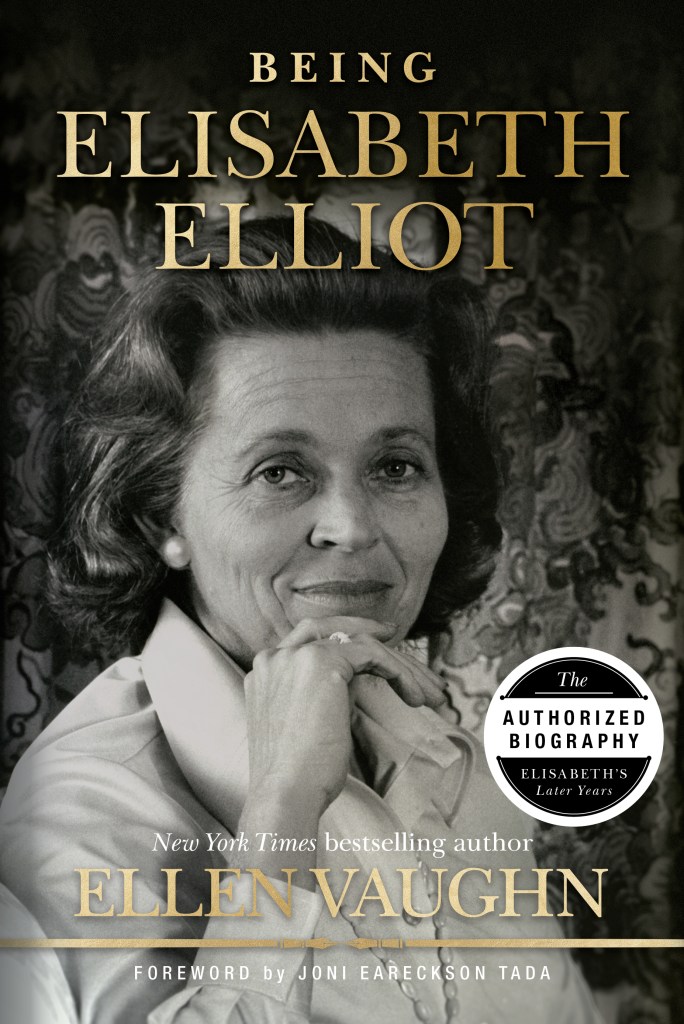
Review: Being Elisabeth Elliot

Being Elisabeth Elliot is the second of a two-part biography of Elisabeth by Ellen Vaughn. The first was Becoming Elisabeth Elliot (linked to my review).

I’ve written more about who Elisabeth was in that first review and her influence in my life here, so I won’t go into all that again.

Vaughn’s was the authorized biography: she had access to all Elisabeth’s remaining journals and many letters.

After spending months agonizing over whether to leave or stay in South America, Elisabeth finally felt God would have her go home and be a writer. This volume begins with Elisabeth’s return to the US from Ecuador in 1963 with her young daughter, Valerie.

But then she struggled with what to write, now that she had the time and freedom to.

Plus she was processing much of what had happened in her life so far. Christian literature and missions meetings were filled with victorious tales which she had not experienced. “She railed against the image-conscious habits of the Evangelical Machine, whose every story must end with glorious conversion and coherent happy endings, lest God look bad” (p. 272). She rethought some of her legalistic upbringing. She found that often, God’s ways were inscrutable. He couldn’t be boxed in, figured out, or predicted.

But she found Him trustworthy nonetheless. He may not respond the way we think He should. But He proves Himself good, wise, and holy.

Her private musings during this time period might be shocking and disturbing to some. But I think many of us ask some of the same questions at points in life.

In her first book after the initial ones about her husband, his friends, and their ministry trying to reach the Waorani tribe (then known as Aucas), she wrote a fictionalized account of her experiences in No Graven Image. The book was not well-received. Many misunderstood that the graven image in question was their man-made perceptions of what God should be like.

Vaughn goes on to tell of Elisabeth’s struggles with writing, her widening speaking ministry, her challenges raising Valerie, her surprising second marriage, her husband’s agonizing death from cancer, and her third marriage to Lars Gren. She mentions how some of her books came into being, especially the first few. I would have liked to learn more about the rest of her books.

I was surprised how often Elisabeth said in her journals that she never sought a platform, never wanted to get in the middle of a public debate on thorny issues (especially femininity in a feminist word). But she felt as God gave her openings, she needed to share His truth.

Though she came across as self-assured, she struggled with self-doubt.

I was surprised to learn that she dearly wanted to write a great work of fiction.

From the time Elisabeth Elliot returned to the United States from Ecuador in the early ’60s, she had devoured classic and modern literature that evoked the human condition against the backdrop of God’s mysterious universe. She wanted to write great novels. She wanted to engage and stir urbane New Yorkers. She wanted to call into being essential human truths through the power of story. She wanted pages that she had written to stir people’s hearts in the same way she was so deeply stirred, her heart and eyes lifted up, by well-crafted literature, visual art, and music (p. 253).

She attempted this, but ultimately felt it was beyond her. Many of us are glad God led her as He did, writing nonfiction for Christian women.

Much of what I would have liked to know more about was lost due to Lars burning “most of her journals from the years of their marriage, a choice he now regrets” (p. 274).

I started this book with reticence because I had heard negative things about it. I thought Vaughn’s writing was engaging and readable. I agree that she shared some things from Elisabeth’s journals about her physical relationship with her second husband, Addison, that would have been best left out. I agree, too, that she inserted herself into the narrative more than she should have. Vaughn’s husband died of cancer right after she wrote about Addison Leitch’s death, and having traveled this journey with Elisabeth through her journals was a help to her. But this would have been better placed in an appendix or afterword. Plus she “argues” with Elisabeth in an imaginary conversation as to whether or not she should have married Lars. In various other places, we’re aware of the author in ways we should not have been.

I appreciated Vaughn’s difficulty in trying to tell the truth about Elisabeth as best she could. I can’t imagine filtering through all the material available to her and trying to discern what to share and what to leave out. Though overall she covers the same ground as Lucy S. R. Austen in her biography, they bring out many different things as well.

Elisabeth never claimed to be perfect and would never wanted to have been portrayed as such. She was more complicated than many knew.

The very last page of the book tells about the Elisabeth Elliot Foundation, which is placing all her writings and radio programs in one spot. At the very bottom, the page says the foundation’s mission is to give “Hope in Suffering, Restoration in Conflict, and Joy and Obedience to the Lord Jesus Christ.” I thought this remarkably echoed Elisabeth’s ministry as well.

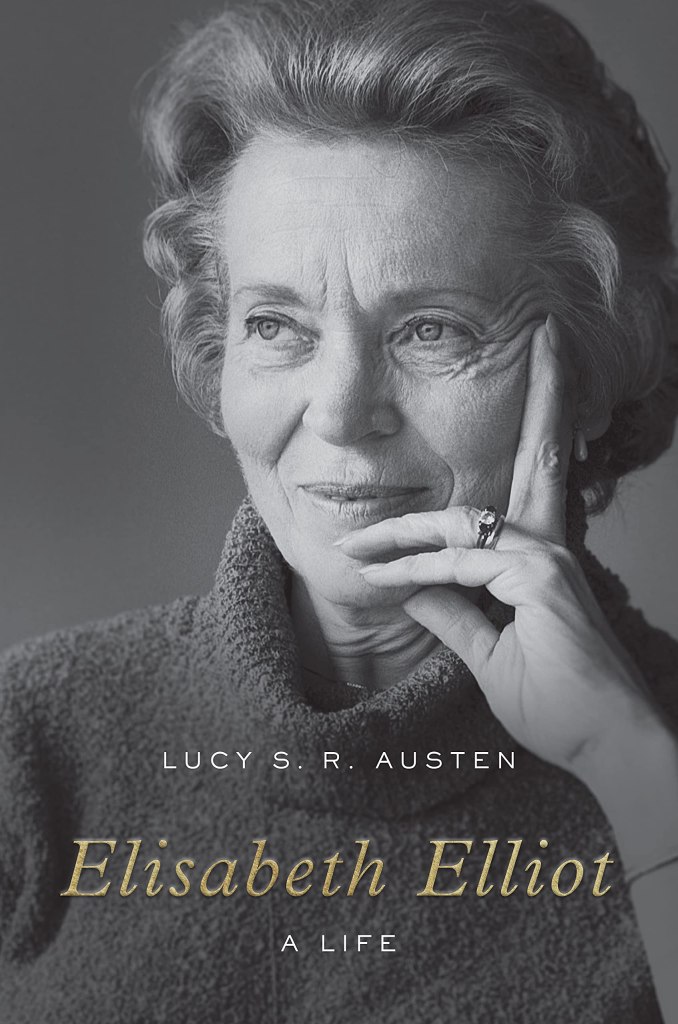
Review: Elisabeth Elliot, A Life

I’ve mentioned many times that I considered Elisabeth Elliot my “mentor from afar” for most of my adult life. I discovered her books in college, four decades ago, beginning with Through Gates of Splendor, Shadow of the Almighty, and The Journals of Jim Elliot. I’ve read almost all her books ever since, some of them several times, as well as her newsletters.

Most of you know that Elisabeth was the wife of Jim Elliot, one of five missionaries killed when trying to reach a tribe in Ecuador then known as “Aucas” (now known by their name for themselves, Waorani). A few years later, Elisabeth, her young daughter Valerie, and Rachel Saint, sister of one of the other missionaries, were invited to live with the Waorani. After writing Through Gates of Splendor about “Operation Auca” and the five missionaries, then her husband’s biography, and several articles, Elisabeth began to feel God called her into a ministry of writing. She and Valerie came back to the USA, where Elisabeth spent decades writing, speaking, and teaching.

Elisabeth’s public ministry ended in 2004 when her dementia began to make travel and speaking impossible. She passed away in 2015 at the age of 88. She’s regarded as one of the most influential Christian women of the last 100 years.

It was only a matter of time before biographers started telling her story. In Elisabeth Elliot: A Life, Lucy S. R. Austen harmonizes Elisabeth’s public writing with the journals and letters Austen had access to, which I feel is the strength of this book.

Elisabeth never put herself on a pedestal. She was quite honest about her faults and foibles. Austen takes care to present Elisabeth realistically, not idealistically.

However, I felt that Austen often sat in judgment on Elisabeth’s writing, criticizing such things as her approach to discerning God’s will in her early years, Jim’s behavior as they dated, the difference between what Elisabeth wrote in her journals and what she wrote publicly thirty years later, and so on. I have questions marks and notes of “author judgment” in several margins.

I knew much about Elisabeth’s earlier life from her books and writing. I was looking forward to learning more about what happened after she came back to the USA. But Elisabeth’s earlier life takes up two-thirds of the book, with her last fifty-two years filling only a third. That may be due to several factors: people’s interest in her missionary career; a number of questions and issues about that time; the decreasing number of family letters sent. And then, a lot of the narrative about her time in the States reads like lists of where she traveled and spoke, along with whom she visited and who visited her.

I was heartened to see some of her questions and struggles that emphasized that she was in many ways an ordinary Christian woman dealing with some of the same issues we all do. I was sad to hear of serious issues in her second and particularly third marriages.

Elisabeth seemed, by all accounts, to be a classic introvert. I was sad to see that introversion was thought to be unspiritual in her early life and that she fought against it rather than seeing it as the way God made her.

I was surprised to read that she thought speaking was not her main ministry and, in fact, took away from her writing ministry. I’m thankful to have heard her speak in person twice.

Her views on many things changed and solidified over the years, as happens with most of us. Her journals and sometimes her letters were ways of processing her thoughts. I wouldn’t be too alarmed by some of the views she seemed to hold or wrestled with along the way.

As it happened, I was midway through the book when I turned on the replay of Elisabeth’s radio program, Gateway to Joy, on BBN Radio one morning. She was doing a series called “Jungle Diaries,” reading from her journals of her time in Ecuador. She said she had not looked at them in forty years. She commented that people think she “has it all together,” but her diaries assured that she did not then, and she still did not claim to.

She also commented that her “theology has been developed” since those writings, but what she wrote was raw and real and honest. Then she mentioned that she was shocked to read of her desire to go to the Aucas. She “had no recollection of wanting to go to the Aucas, certainly not that soon after Jim died” (“Jungles Diaries #1:Journal Beginnings,” aired October 16, 2023).

I was quite surprised to hear her say that, as her books indicated that she strongly wanted to go. But then I thought about my own life forty years ago. I was four years married and would soon be expecting my first child. I remember where I worked, where we went to church, who our friends were. But there’s more I don’t remember than I do.

So I feel that Austen often made too much of the differences between what Elliot wrote over a span of forty or more years. But I think Austen tried to be faithful with the material she had.

In writing circles, we’re often told that we might have a perfectly fine manuscript that may be rejected because a similar book has just been published. For that reason, I was surprised to see Austen’s biography come out in-between the two parts of Ellen Vaughn’s “authorized” biography. Perhaps the publishers felt there was sufficient interest in Elisabeth to warrant two biographies of her published so close together. If so, I think they were right.

But I hope sometime someone writes a simple biography of Elisabeth, not analyzing or explaining or annotating, but just telling her story.

One of the main take-aways from listening to or reading about Elisabeth is that her supreme desires were to know and obey God. She was no-nonsense, yet she had a sense of humor. She was sentimental, but she wasn’t unfeeling. She wasn’t perfect, and she wouldn’t say this, but I think she went further than many of us in her spiritual journey.

(Updated to add: I thought I’d share a couple of other, more positive reviews from friends I know and trust: Ann’s is here, and Michele’s is here.)

(I often link up with some of these bloggers.)

Review: Lament for a Father

Playing catch is a time-honored father-son interaction. Marvin Olasky’s only baseball-related encounter with his father resulted in a missed throw and his father walking away to go back inside.

Marvin uses this incident to typify his relationship with his father, who he says “never laughed and rarely spoke.” His father had been a Harvard graduate with high hopes, but now was frequently chided by his wife for having IQ but no DQ (“determination quotient”).

Marvin’s father, Eli Olasky, died in 1984. In a quest to understand his father better, Marvin used his investigative journalism skills to research Eli’s history. When Marvin, long-time editor of WORLD Magazine, wrote an article about his dysfunctional relationship with his father, letters poured in from readers with their own father difficulties. So Marvin shared his research into his father in Lament for a Father: The Journey to Understanding and Forgiveness.

Marvin interviewed family members, requested his father’s service records, and pieced together what he knew of history at the time and places his father lived. He traces Eli’s progression from a Jewish neighborhood and Hebrew school in addition to day school, Harvard attendance, WWII, where he assisted displaced Jews right after the war, when the Nazis hadn’t had time to dispose of all the bodies before fleeing, disappointment in graduate study opportunities, his series of short-lived teaching or administrative jobs.

His father was a quiet man, probably suffering from PTSD. He avoided arguments, walking away to go to his office and read. He avoided answering questions as well, brushing the questioner off by saying “It’s not important.”

Eli believed in ethnic and cultural but not religious Judaism. He thought the biblical miracles didn’t happen and the narratives were inspirational stories rather than history.

Marvin admits to not respecting his father in his teen and young adult years. He came to regret that later in life. His research made his father come alive in his mind and helped him understand him better. His change of heart toward his father is clear, but he doesn’t say much about processing forgiveness. Obviously, understanding his father better made forgiveness easier, which is a lesson for us all.

At the end of the book, at his publisher’s request, Marvin included his testimony of how he grew up Jewish, became an atheist and Communist, but was converted to Christianity.

Blogging for God’s Glory in a Clickbait World

Blogging for God's Glory

In Blogging for God’s Glory in a Clickbait World, Benjamin Vrbicek and John Beeson propose this definition of blogging for God’s glory: “Blogging for God’s glory means . . . first, to have our motivations aligned with God’s, and second, to pursue excellence in the craft, including theological precision, beautiful prose, visual appeal, and the edification of readers, all drawing from the best industry practices” (p. 14).

First they deal with aligning our motivation with God’s. That’s often the most difficult part to maintain. Usually a Christian blogger begins by wanting to share posts that glorify God and help others. But “our own motives . . . are always layered and mixed” (p. 3). And though Christian writing instructors tell us not to worry about the numbers of those following, liking, and sharing our posts, those who want to move from blogging to publishing a book are told agents and publishers will look at those numbers and won’t consider taking a writer on unless those numbers are high. It’s a continual but necessary struggle to keep our focus on writing for God’s glory and purposes and trusting Him with the results, even when it doesn’t seem like many people are reading.

The authors apply the goal of writing for God’s glory into the everyday nuts and bolts of writing. Write with the reader in mind rather than anticipating accolades. Know your why, what difference you want to make. Serve others, not yourself. But that doesn’t mean never talking about yourself: Paul wanted to proclaim “not ourselves, but Jesus Christ as Lord” (2 Corinthians 4:5), yet 2 Corinthians is “Paul’s most autobiographical letter. He shares much of his own story not because he is narcissistic, but because he knows the church is struggling to trust him and he needs to build rapport” (p. 22).

“If we have any hope of offering others wisdom, listening to God must become a primary and ongoing habit.” We can’t share what we haven’t first taken it. That doesn’t mean every blog post needs to exposit Scripture or be a devotional, but it should still be “subject to God’s truth and ought to reflect His light” (p. 31).

Then, “Christian writers must labor not only to write what is true but also write in a manner that adorns the truth” (p. 38). We need to focus on building up, not tearing down. That doesn’t mean we never share what’s wrong, but we do so with discernment and with the purpose of helping.

The authors give helpful advice with the mechanics of blogging: discerning how much time to give to it, in connection with your other obligations; setting a schedule that works for you; dealing with writer’s block; engaging social media; blogging costs, platforms, layouts; using photos without plagiarizing; networking; monetizing; and more.

They include several appendices. One is a compilation of several bloggers’ answers to the question of whether blogging is dead. One is a glossary of blogging terms. One is a collection of sidebar quotes in the paper version that wouldn’t work in the e-book formatting.

A few other quotes that stood out to me:

Where can you offer yourself to your audience for the sake of proclaiming Jesus Christ as Lord? How can your life become a bridge for the gospel to travel? What work has God done (or is doing) in you that will encourage others? (p. 22).

Don’t feel compelled to chase whatever is hot. Be true to who God has made you to be (p. 23).

Blogging ought to grow us in holiness. When we blog for God’s glory, the discipline of writing becomes integrated into the web of our spiritual disciplines (p. 29).

It is not the size of our platform that assures us how far our words will reach, but rather it is our trust in a God whose word never returns void (Isa 55: 11) (p. 32).

Writing comes down to making and remaking slight improvements to achieve better clarity and aesthetic; writing is the pursuit of marginal gains, insignificant by themselves but significant in the aggregate (p. 37). (I loved the illustration they used here of an eye doctor trying different lenses, asking each time which is better.)

So why should we worry about getting the tone and the content right when we know fewer people will read an article if we write with discernment? We bother because God is God, and on the day of judgment we will give an account for every careless word we have ever blogged (Matt 12: 36) (p. 42).

I think this book is an excellent resource, especially when we need to adjust our motives away from the manipulative and self-focused approach of the world and remind ourselves of our real purpose: glorifying God.