Review: What’s a (Dis)Organized Person to Do?

What's a Disorganized Person to Do?

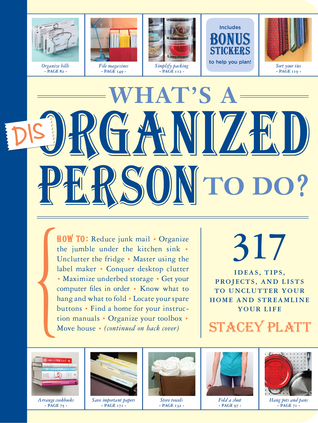
Stacey Platt’s What’s a (Dis)Organized Person to Do? is subtitled 317 Ideas, Tips, Projects, and Lists to Unclutter Your Home and Streamline Your Life.

Stacey is a professional organizer and runs a company in New York with a wide variety of clients. One reviewer described this book as an organizer’s Pinterest board.

The book is organized according to different rooms in a house, except that the last chapter deals with trips and moves. Yet within each chapter are tips not just for the physical objects there, but for saving time and energy. Scattered throughout the book are one-hour projects, like organizing under the sink, the junk drawer, the bathroom vanity, or making a master grocery list.

I appreciated that the book was filled with specific tips, though some principles were discussed. Many books on organizing/productivity/time management that I have read are filled with broad principles, or are so rigidly organized as a whole system that they are overwhelming. This books lets you pick and choose what works best for you.

The book is probably meant to be dipped into as a reference resource rather than read straight through as I did. But I didn’t want to miss anything. 🙂

Some of the tips didn’t appeal to me; some I already used; some seemed like overkill. A few were outdated (this book was written in 2010. But I marked many tips to remember.

This appears to be the only book Stacey has written. I didn’t find a website for her. I did find one with her company name, but I am not sure it’s hers.

I can recommend this book as a good resource if you’re looking for organizational tips.

Review: The Lazy Genius Way

The Lazy Genius Way

Suppose you want to reorganize your pantry. You might research organizational systems, pull everything out, dust shelves and canned goods, check expiration dates, sweep, buy cute containers, make labels, and spend the better part of a day, if not days, placing items in just the right order. And then you get frustrated when that order is not maintained.

Or you might go the opposite extreme and decide nobody has the time and energy for that.

Kendra Adachi calls these the “genius” and “lazy” approaches. She proposes a happy medium: that we be geniuses about what matters and lazy about what doesn’t. She shares thirteen principles for implementing this in her book, The Lazy Genius Way: Embrace What Matters, Ditch What Doesn’t, and Get Stuff Done.

For those of us who tend to make any small need into a major project, Kendra says, “When you care about something, you try to do it well. When you care about everything, you do nothing well, which then compels you to try even harder. Welcome to being tired” (p. 11. Kindle version).

On the other hand, “Little did I know you can be just as exhausted from not trying as you can from trying too hard. Managing apathy and survival mode takes as much energy as managing rules and perfection” (p. 15).

One of her premises is that there is no one right method or tool that will appeal to and work for everyone. If we’re to be geniuses about what matters, that will differ from person to person.

She mentioned that she likes to make bread. She cares about it and puts a lot of effort into it. But it’s fine if others have no desire to make bread and buy the bargain brand.

She likes comfortable clothes in neutral colors and doesn’t like top spend a lot of time on clothing decisions. But she acknowledges that others like to pill out five different outfits before they decide what to wear, and that’s fine.

That’s why she comes back again and again to acknowledging what’s important to you, not Instagram or the neighbors or whoever.

Some quotes that stood out to me:

I want to stop judging women who have it all together, assuming they have something to hide. I want to stop applauding chaos as the only indicator of vulnerability (p. 16).

You might think a routine is nothing more than doing the same things in the same order every day, but that’s not the whole story. Routines are meant to lead you into something else (p. 74).

It’s easier to clean up a cup of spilled milk than it is to mend a second-grader’s hurt feelings (p. 89).

House rules are about connection, not protection. They keep the first domino from tipping and knocking over a lot more (p. 99).

The goal isn’t to maintain control but to be in a better headspace to engage with what matters—namely, your people (p. 99).

You can celebrate where you are without being distracted by where you’re not yet (p. 210).

You’re tired because you’re trying to overcome the world. but we can take heart because the God of the universe has already done that (p. 211).

Though this book is not advertised as a Christian book, and the author doesn’t base her principles on the Bible, a few sentences like that last one are sprinkled through the book.

One thing I loved about the book is the recap statements at the end of each chapter. I get frustrated wishing I could retain everything I read from nonfiction. Having the key points collected at intervals helps me pull things together at the end of each chapter plus provides a quick place to review.

Kendra writes in an easily understandable and relatable way. Don’t miss her footnotes—many of them are funny asides.

My only minor criticism is that the explanations and examples seemed perhaps a little overdone in places. But I suppose a wide variety of examples makes the book applicable to more people.

Kendra also has a Lazy Genius Podcast, but I have not listened to it yet.

This book was all the rage a few years ago. I kept seeing it mentioned everywhere. I was intrigued, but didn’t get around to it. I’m glad I finally did.

(I often link up with some of these bloggers.)

Review: Organizing for the Rest of Us

Organizing for the Rest of Us

In my early married life, I read Sandra Felton’s The Messies Manual and received her newsletter for several years. Those helped me immensely. I don’t know if my husband realizes how much he’s indebted to Sandra. 🙂

But I realized that organization isn’t a destination. It’s a continual journey. You can’t just set up routines and places for things: you have to maintain them. And you continually get new things, get rid of old things, or get ideas of ways your organization could work better.

So I still read occasional books about organization. I don’t read books on decluttering because, though decluttering is a part of organization, it’s just one part. I don’t read books on minimalism because they go too far for my tastes.

Some of the more recent books I’ve read on time management and productivity focus on the larger principles. Those are needful and foundational. I need those reminders sometimes. But I’m more in need of practical everyday life hacks, those “Why didn’t I ever think of that?” ideas and solutions.

I just recently discovered Dana K. White’s Organizing for the Rest of Us: 100 Realistic Strategies for Keeping Your House Under Control when it was on sale for the Kindle. It’s full of great ideas, laced with humor, and written concisely. You could easily skim through chapter titles and just read about the areas you want help with. But I enjoyed the whole book.

Dana started sharing tips on an originally anonymous blog titled A Slob Comes Clean. It resonated with so many people that it grew into books, podcasts, and speaking engagements.

Dana was one of those people (like me) who wasn’t naturally organized. She discovered her tips one at a time while trying to “deslobify” her own house.

One of her principles I liked is that clutter is personal. Maybe that’s why I don’t like decluttering and minimalist books—I didn’t always agree with what they said I needed to get rid of. Dana defines clutter as “anything that gets out of control in your home” (p. 6, Kindle). “You can keep anything. You just can’t keep everything” (p. 58).

One of my favorite tips from this book was not to take everything out of a closet or cabinet when trying to organize it. Most of us do that, then we get tired or need to go tend to something else, and we have a massive mess on our hands. Instead, Dana urges taking one thing out at a time and deciding immediately what to do with it. Have a trash bag and donation box handy to put items that you want to get rid of. If you decide the item is something you want to keep, immediately put it where it goes. That may seem to take longer in the short run. But dealing with the item immediately saves having a pile of items to put away when you’re done and fatigued. Plus handling it just once cuts down on rethinking it. And if you’re interrupted or tired, you don’t have a mess to clean up (or shove back into the closet) before you can move on.

This was a fun and very helpful book. Highly recommended.

Ten Time Management Choices

My husband has no idea how much he owes Sandra Felton.

I did not come to marriage very organized in either my time or my stuff. In college, I wasn’t lazy, but I was always running behind. Many of my grades suffered from late deductions. And I can’t tell you how many times I got frustrated over not being able to find an item or paper I needed.

Sometime during early marriage, I came across Sandra Felton’s book, The Messies Manual. Then I subscribed to her newsletter for years until I knew by heart what each one was going to say.

I put a lot of Sandra’s principles into practice. I can’t say I became a paragon of organizational virtue, but I definitely improved from where I was.

But I learned something else about organization on my own. We can’t make up a workable schedule and put everything in its rightful place and then be done organizing. We have to maintain our systems and adapt them to new demands on our time and new items in our home.

So I have decided organization is not a destination. It’s a journey. And, therefore, I continue to occasionally reads books or articles about organization.

When I saw that Sandra had coauthored a fairly new book with Marsha Sims, and it was on sale for the Kindle app, I got it. That book is titled Ten Time Management Choices that Can Change Your Life.

The authors state that “One of the goals of this book is to help you accomplish easily and quickly those necessary but uninspiring activities that comprise much of our daily lives so you can turn your attention to the significant things you want to do” (p. 9).

They point out how the advent of modern technology eased life in some ways but created a lot more things to do, some necessary and some distracting.

They say some authors “downplay organizing systems and indicate that if you have enough focus and self-control, you’ll be okay. Not so. You need good skills as well” (p 21.) So they point out overarching principles but also offer practical tips.

They remind us often that “time management is not the art of getting everything done. It is the art of getting the most important things done. To put it another way, it is priority management.” (p. 63).

The authors offer a variety of ways to determine priorities, make schedules, etc. I love that. Some time management books promote a very rigid system. I don’t usually like everything about other people’s systems, so I appreciate the variety of methods to experiment with to find one that works best.

They also tackle multitasking, interruptions, procrastinating, delegation, time wasters, schedules, developing good habits.

They apply principles to home and business.

Each chapter has several vignettes of people with organizing problems and the solutions they found.

The end of each chapter and the end of the book contain questions and activities to help implement the principles. The sessions at the end of the book could be done alone or with a group.

Here are a few more quotes that stood out to me:

Creative people have more ideas and interests than any one person can do in a lifetime, and we accumulate the paraphernalia to prove it. (p. 54.)

A word of explanation is necessary to those who fear setting up a schedule because it feels rigid and stifling. Scheduling is not an inflexible list that is written in stone. It is a statement of what regular tasks are important to accomplish each day and when you plan to do them during the day. As you become experienced in using and tweaking your schedule, you will find it meets your needs more and more successfully and will become your friend. (pp. 163-164).

When you create a schedule for routine tasks, you open a tap through which good time management can flow. A schedule is absolutely necessary because 1. It keeps you from forgetting what needs to be done. 2. It protects you from the unsuccessful “What do I feel like doing today?” approach (p. 164).

Although I would not classify this as a Christian book overall, the authors do employ some biblical principles.

There was only one place I strongly disagreed with the authors.

Organized people work dispassionately. That frees them from a lot of stress. Disorganized people wear themselves out by investing emotion in the things they have to do. They work while saying, “I hate making the bed every day” or “Unloading the dishwasher is such a drag.” The way to take the emotion out of doing what you need to do regularly is to make the activity into a habit (p. 196).

I can’t say that making activities into habits takes the emotion out of them. I still chafe at a lot of things that have to be done. However, making them a habit gets them over with rather than pushing them to the background. And I look forward to the satisfaction of getting them done.

I don’t think I learned much that was totally new to me from the book. But many of the principles I had formerly learned were applied in new ways, and all of the book was a much-needed reminder.

If you need to organize your time better or need to brush up on organizing principles, this book would benefit you.

(I often link up with some of these bloggers.)

Laudable Linkage

Here are some great reads discovered in the last couple of weeks:

America, I Still Believe in You (But, Only Because I Believe in Him)

Serving in Church: When Your Spiritual Gift Isn’t Changing Diapers. “Sometimes the need for a servant is greater than my need to use a specific gift.”

What About Your Desire to Do Something Great For God? “When the desire to do for God supersedes the desire to obey God, it reveals that God is no longer the source of joy. A heart delighted in God desires to obey Him. A heart delighted in self desires to see what self can accomplish. A person delighted in God doesn’t care so much how God uses her, but rather that she is useful to God, the object of her delight. A person delighted in self cares deeply about how God uses her, because seeing the self she loves underused causes grief.”

Elizabeth Prentiss: Joyfully Embracing Motherhood and Suffering. Elizabeth is the author of the hymn “More Love to Thee” and the book Stepping Heavenward.

Brexit and the Coming of the Last Days.

Assisted Suicide: A Quadriplegic’s Perspective.

A Well-Ordered Life and Scruffy Hospitality might seem like opposite viewpoints. But I think the key is balance. We don’t need to wait for a “Pinterest-perfect” house or party to have people over, but some degree of order makes life go more smoothly. Personalities are probably inclined more one way or the other.

How Schools Can Help Notice and Serve the Quiet Kids.

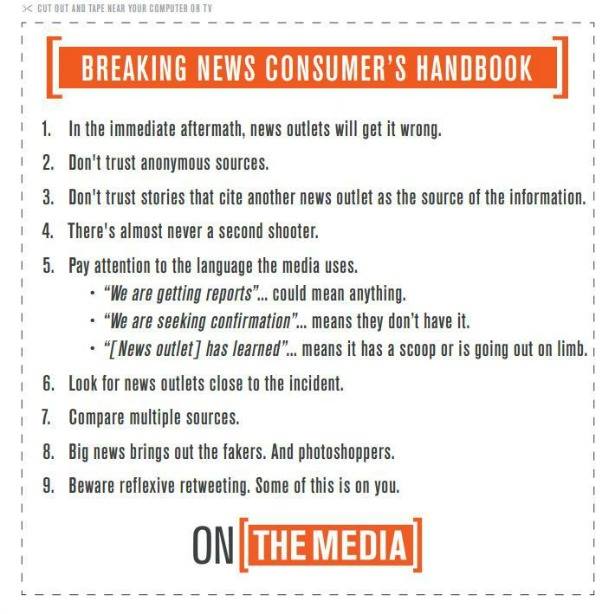
Finally, my oldest son posted this on Facebook. I don’t know who made it, but it’s good advice when watching and passing on news.

13626960_10153618154706820_7479503557540693697_n