Many of us cringe at the popular saying that “God doesn’t give us more than we can handle.” I wonder if people who say that have not experienced many trials in life. God often puts people in situations that bring them to the end of their own strength in order that they might rely on His.
But there are clues in the Bible that God knows how much we can take and adjusts our experiences accordingly.
For instance, there is an often overlooked passage right after the ten plagues in Egypt and the institution of the Passover.
When Pharaoh let the people go, God did not lead them by way of the land of the Philistines, although that was near. For God said, “Lest the people change their minds when they see war and return to Egypt.” But God led the people around by the way of the wilderness toward the Red Sea (Exodus 13:17-18).
Did you catch that? God didn’t lead the people out of the promised land by the shortest route because they might “change their minds if they see war.” From what I have read, this means that the Philistines would have seen the coming Israelites as an invasion, and Israel, just coming out of 400 years of slavery, would have been frightened out of their wits and tempted to turn back.
But when God takes them through a longer route, they end up caught between the Red Sea and the Egyptians, who had decided to come after then.
Didn’t God know they would still be scared out of their wits? (I’m not judging them: I would have been, too!) Of course He did. But the fact that He led them this way on purpose seems to me to indicate this is a situation they could have have trusted Him for. They had just seen Him challenge and defeat all the Egyptian deities by the plagues He sent. He miraculously delivered them from captivity. He led them with a pillar of fire by night and a pillar of cloud to this very place.
Another example even before the exodus was when God called Moses to be Israel’s leader and bring His people out of Egypt. Moses gave every excuse in the book as to why he couldn’t (and I am sure I would have done the same). But God had all the details worked out and would equip Moses for what He called Him to.
One more: when God called Gideon to deliver Israel from the Midianites, Gideon obeyed, but with some trepidation. In Judges 7, right before a major battle, God whittled his army down to 300 men to face “the Midianites and the Amalekites and all the people of the East . . . like locusts in abundance, and their camels were without number, as the sand that is on the seashore in abundance.” God told Gideon He had given the Midianite camp into Gideon’s hands. But, God said, “If you are afraid to go down, go down to the camp with Purah your servant. And you shall hear what they say, and afterward your hands shall be strengthened to go down against the camp.“
So they went down to the enemy camp and overheard one of the soldiers telling about a dream in which a barley cake rolled into the camp and hit a tent so hard that the tent fell, turned upside down, and then lay flat. “His comrade answered, ‘This is no other than the sword of Gideon the son of Joash, a man of Israel; God has given into his hand Midian and all the camp.’”
Gideon responded by worshiping God and then arousing the Israelite camp with confidence. The confidence wasn’t in himself. The main reason God had reduced the army to 300 was so that Israel couldn’t boast in saving themselves. It was still a task they couldn’t do on their own. But God “knows our frame; he remembers that we are dust“ (Psalm 10:14), and He stoops to our weakness, as one old hymn says.
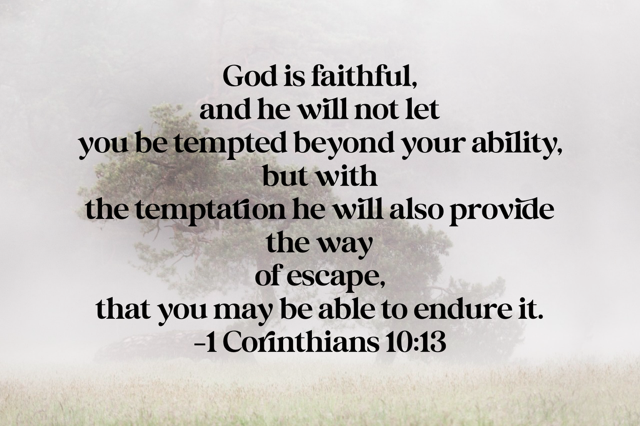
For a New Testament example, 1 Corinthians 10 tells of several in the Old Testament who failed in some way. Then Paul writes, “Therefore let anyone who thinks that he stands take heed lest he fall. No temptation has overtaken you that is not common to man. God is faithful, and he will not let you be tempted beyond your ability, but with the temptation he will also provide the way of escape, that you may be able to endure it.” There’s the warning: take heed. Don’t trust in yourself. But there’s also reassurance: God is faithful and will provide a way of escape.
In John 15, Jesus tells us to abide in Him, for without Him we can do nothing. And Philippians 4:13 says we “can do all things through him who strengthens me.”
God does bring us to more than we can handle in ourselves. Paul says in 1 Corinthians he had been at a point where he was “so utterly burdened beyond our strength that we despaired of life itself”. But, he said, “that was to make us rely not on ourselves but on God who raises the dead” (verses 8-9).
When God brings us to a situation that seems too much to handle, we can ask Him for deliverance. I’ve always been heartened by the fact that Jesus prayed in Gethsemane, “Father, if you are willing, remove this cup from me. Nevertheless, not my will, but yours, be done” (Luke 22:42).
But if God doesn’t remove the situation, we can trust Him for the grace to go through it. He knows our limits and weaknesses. He wants to grow our faith, character, and reliance on Him, and that will take us out of our comfort zone many times. Warren Wiersbe says, “When God puts us in the furnace, His hand is on the thermostat and His eye is on the clock.” He won’t keep us there longer than necessary. He promises His strength for our weakness, His presence, and His care for every step of the way.
(I often link up with some of these bloggers.)


 Stray Thoughts