What’s On Your Nightstand: April 2015

 What's On Your NightstandThe folks at 5 Minutes For Books host What’s On Your Nightstand? the fourth Tuesday of each month in which we can share about the books we have been reading and/or plan to read.

Wow – it’s hard to believe we’re in the last week of April. Where did it go so fast?

Since last time I have completed:

A Million Little Ways: Uncover the Art You Were Made to Live by Emily Freeman, reviewed here. Had some issues with parts of it but overall it’s a good message.

He Is There and He Is Not Silent by Francis Schaeffer, reviewed here. A short book about philosophy, apologetics, metaphysics, epistemology – good but stretches one’s brain to the limit.

Being Mortal: Medicine and What Matters In the End by Atul Gawande. As I said in my review, if you’re planning on getting old, dying, or helping a parent as they age, you need to read this book.

War and Peace by Leo Tolstoy, audiobook, reviewed here. Glad to be know the story now but glad to be done with it finally. 🙂

The Swan House by Elizabeth Musser, reviewed here. Loved.

Songs of the Morning: Stories and Poems for Easter compiled by Pat Alexander, including excerpts from C. S. Lewis, E. B. White, and others, reviewed here.

I’m currently reading:

The Monday Morning Club: You’re Not Alone — Encouragement For Women in Ministry by Claudia Barba.

Feeding Your Appetites: Taking Control of What’s Controlling You by Stephen Arterburn

His Last Bow: Some Later Reminiscences of Sherlock Holmes by Sir Arthur Conan Doyle, audiobook

A pre-reading of a friend’s novel – will be happy to share more with you when the time comes! 🙂

Gentle Savage Still Seeking the End of the Spear: The Autobiography of a Killer and the Oral History of the Waorani by Menkaye Aenkaedi with Kemo and Dyowe. Just  started this one. These men were among the Waorani (or Aucas, as they were then known) who killed the five men who came to share the gospel with them (Jim Elliot, Nate Saint, and the others) and who later became Christians, Menkaye becoming like a grandfather to Steve Saint’s children. I am very curious to read their story in their own words.

Next Up:

Walking With God in the Season of Motherhood by Melissa B. Kruger

Christy by Catherine Marshall for Carrie‘s Reading to Know Classics Book Club for May. Read this years ago and am eager to revisit it.

Taken, the latest by Dee Henderson. Just got word it’s on it’s way!!! Can’t wait!

The Valley of Fear and The Case-Book of Sherlock Holmes by Sir Arthur Conan Doyle, audiobooks, to finish off the good detective’s stories.

Pioneer Girl: The Annotated Autobiography by Laura Ingalls Wilder, edited by Pamela Smith Hill. I don’t know if I will actually get to this in the coming month: I hope so.

That should keep me busy for a while. 🙂 What are you reading?

What’s On Your Nightstand: March 2015

 What's On Your NightstandThe folks at 5 Minutes For Books host What’s On Your Nightstand? the fourth Tuesday of each month in which we can share about the books we have been reading and/or plan to read.

Often I am caught off guard when the fourth Tuesday of the month is not the last Tuesday, but this time I saw it coming. 🙂

Since last time I have completed:

Out of a Far Country: A Gay Son’s Journey to God. A Broken Mother’s Search for Hope by Christopher and Angela Yuan, reviewed here. Excellent – I am predicting it will be one of my top ten books of the year.

I Deserve a Donut (And Other Lies That Make You Eat) and Taste For Truth: A 30 Day Weight Loss Bible Study, both by Barb Raveling, reviewed together here. Excellent.

She Is Mine: A War Orphan’s Incredible Journey of Survival by Stephanie Fast, review and a giveaway here. Riveting.

To See the Moon Again by Jamie Langston Turner, reviewed here.

The Pursuit of God by A. W. Tozer, reviewed here.

My Emily by Matt Patterson, a family’s true story of a young daughter born with Down’s Syndrome who is then diagnosed with leukemia at the age of two, reviewed here.

Better To Be Broken by Rick Huntress, his personal testimony of God getting hold of his heart after an accident left him in a wheelchair, reviewed here.

The Long Winter by Laura Ingalls Wilder, reviewed here.

The Pound a Day Diet by Rocco DiSpirito, reviewed here.

That looks like more than usual – but one was a children’s book, and two were very short.

I’m currently reading:

A Million Little Ways: Uncover the Art You Were Made to Live by Emily Freeman. Got off on the wrong foot with this one but am settling into it now. Will explain more when I review it.

War and Peace by Leo Tolstoy, audiobook. I’m about 2/3 of the way through.

The Swan House by Elizabeth Musser

Songs of the Morning: Stories and Poems for Easter compiled by Pat Alexander, including excerpts from C. S. Lewis, E. B. White, and others.

Next Up:

Hard to say. I’m working on my reading plans for the year, and you people keep adding to my lengthy list of books I want to get to. 🙂 Once I finish War and Peace, I think I’ll get back to the Sherlock Holmes series via audiobook. Pioneer Girl by Laura Ingalls Wilder had been delayed but I am informed it is on its way now just arrived. I’ve seen several people mention Being Mortal by Atul Gawande, and I just ordered it. I may need something lighthearted to break up some of the heavier reading.

What are you reading now?

Finding Time to Read

girl reading

(Photo Courtesy of Wallpaper Craft)

I frequently get asked how I find time to read, so I thought I would expand on the answer here.

If you’ve been reading here any length of time, you know books are important to me. A few months ago I listed every reason to read I could think of, and all of those reasons are important. So because reading is a priority, I make time for it. But I really don’t find that hard to do. Granted, I am in a season of life that makes it a little easier: when I had young children in the home, I may not have read as much, but I did always try to spend some time each day reading. A few years ago I saw a comment on 5 Ways to Make More Time to Read that resonated with me: a Michael D. Perkins commented, “Reading allows me to thrive.  If I don’t, then I feel stagnant.” I feel exactly the same way. If I don’t have some time to read every day, I feel mentally and intellectually dry and dull.

I read more some days than others, but I do try to read (from books, not just the computer) every day. I rarely just sit down during the day for a lengthy time with a book unless I’m in a part where I don’t want to put it down or unless I am not feeling well. Here’s where I usually fit in in:

1. In the bathroom. I hope that isn’t crass or TMI. 🙂 I used to have a link to a cute article on that, but apparently it has been taken down. In searching for it I did find Why Do Some People Read in the Bathroom amusing. It’s mainly a profitable way to spend the necessary time in there, rather than just staring at the wall. More than one person referred to it as their Fortress of Solitude. 🙂 Some think it is unsanitary, but I don’t think a book left in the bathroom is tainted any more than the clothes you’re wearing while in there, your toothbrush, etc.

2. Any waiting time. If I am going to a doctor or dentist, a book is a must. Not only does it help pass the time in an edifying way, but it helps me combat nervousness by occupying my mind. Also, before the boys started driving on their own, I usually took a book with me when I picked them up from a youth activity or ball practice. That way if their event ran overtime, instead of stewing in impatience I looked on it as a few stolen moments to read.

3. Driving. Well, not while I’m driving. But if we’re going somewhere more than 20-30 minutes away, I bring something to read. I’m thankful I can do that: I know it makes some people carsick to read in the car.

4. Sundays. We’re not legalistic about it, but we try to make Sundays different and more restful than other days by not doing any work other than what it takes to get to and from church and meals on the table and then cleaned up. Sometimes we don’t really get to rest until after the evening services, but it’s nice to come home then and relax, knowing that I don’t have to toss some laundry in or whatever. Sometimes these days we’re Face Timing with Jeremy or doing something with the kids or doing stuff on the computer on Sunday evenings, but otherwise, if there is time, I like to stretch out on the couch with a good book.

5. Evenings. If there’s nothing on TV and everyone is otherwise occupied, I might pull out a book.

6. Meals. Usually if I am home by myself, I am at the computer for breakfast and lunch. But sometimes when I have had enough of the computer, I’ll read a bit while eating.

7. In conjunction with devotions. If I am reading a Christian non-fiction book that is not a biography, this is when I’ll usually work it in. Just occasionally I will take a break from reading the Bible through and read a book like this in place of devotions, or I might read it after devotions. But it takes a different mindset for me to read non-fiction: I can’t just pick it up here and there and get as much out of it like I can with fiction. I like to read it in chapters or at least in sections at a time.

8. Audiobooks. I began listening to them when we moved to our present location and I had more driving time than I was used to. I don’t enjoy time in the car at all, and I used to chafe at a 20-minute drive (though I know some people would think that is a dream commute time). But listening to an audiobook if I am by myself makes the time fly by. Now I also listen to them while getting dressed and fixing my hair in the mornings and occasionally while cooking. Classics are especially good for that: they often have some slow passages, and I don’t mind that nearly as much if I am doing something with my hands while listening. They’ve enabled me to get to many more books that I would otherwise.

9. Exercising. I know some who read while on the treadmill or stationary bike. I couldn’t do that on the treadmill – I guess my head bobs too much, but the constant up and down motion made it hard to read. I have listened to audiobooks, however, while exercising, and they made the time go much faster.

I used to be pretty much a one book at a time person. But now I usually have one in the bathroom, one with my Bible, one  audiobook, and one on my Kindle app for those unexpected waiting times. As I said earlier, I rarely just sit down and spend an hour with a book: usually I read in snatches anywhere from 5-20 minutes at a time. But you can get through a decent amount of material in 15 minutes or so a day.

How about you: do you fit reading into times I haven’t thought of?

Laudable Linkage

Here are some noteworthy reads discovered in the last couple of weeks:

My Love List, for when you need to remind yourself of God’s love for you.

One Indispensable Rule for Bible study.

9 Things You Need to Know About Widows.

What Everybody Ought to Know About Moms and Sons.

The Lens of Attention. Loved this.

What to Say to That Immodestly Dressed Girl at Church. Mentioned this last Thursday but wanted to list it here as well.

Stages of Grief: Anger. Alicia has been discussing stages of grief, and Christian ways to handle them, in reference to a life-changing condition.

How to Write Good.

Finally, Carrie shared some bookworm problems earlier this week, and I could identify with many, especially these:

bookworm7

bookworm1

bookworm4

Hope you have a great weekend!


Top Books Read in 2014

From the books I have read in a year I like to list my top ten or so. These weren’t published this year: these were just my favorites that I read in this particular year. So without further ado, here they are, linked back to my reviews of them:

1. How I Know God Answers Prayer by Rosalind Goforth. I have read this multiple times and am always blessed and inspired by it.

2. Mere Christianity by C. S. Lewis. This was my second time through this book, and it is one I should probably reread every few years.

3. Seeking Allah, Finding Jesus: A Devout Muslim Encounters Christianity by Nabeel Qureshi. This account of Nabeel’s attempts first to argue and disprove Christianity and then to grapple with the implications of coming to believe it was true was both riveting and informative.

4. The Weight of Glory and Other Addresses by C. S. Lewis. As I said in my review of it, I don’t think any other author makes me long for heaven more.

5. Why We Are Not Emergent: By Two Guys Who Should Be by Kevin DeYoung and Ted Kluck. Whether you have any knowledge or care about what the emergent or emerging church is, this is a vital book for our times, dealing with postmodern thought applied to Christianity and the good and bad aspects of it.

6. Women of the Word by Jen Wilkin. One of my passions is to get women into the Word of God. Jesus said, “The words that I speak unto you, they are spirit, and they are life” (John 6:63). No other book, no other words have the power to change us or to make us think and live in accord with God’s will. Jen shares that passion, and her book was a great blessing to me.

7. Walking From East to West: God in the Shadows by Ravi Zacharias, an autobiographical account of Ravi’s journey to believing faith in Jesus Christ and God’s leading and shaping him for the ministry He called him to.

8. Dear Mr. Knightley by Katherine Reay. Katherine’s debut epistolary novel about a girl’s letters to an anonymous benefactor, which reveal her own blossoming and is replete with literary allusions, particularly to Jane Austen’s books, won me over right away. I have her next book on my TBR shelf right now!

9. Somewhere Safe With Somebody Good by Jan Karon, her newest Mitford book. It was a joy to read this after thinking that we probably wouldn’t hear about Father Tim again. Her Mitford books are a joy in any case.

10. The Seamstress: A Memoir of Survival by Sara Tuvel Bernstein was about a Romanian young woman’s experiences surviving WWII during the hardships and shortages of war time, then in a prison camp. It was riveting reading. I was saddened that Sara concluded that there must not be a God if such atrocities were allowed to happen and I hope she discovered at some point before her death that He was the one who gave her the spirit and determination she needed as well as sometimes seemingly “coincidental” provisions just at the right times.

If I were going to go beyond ten, I would also name:

Number the Stars by Lois Lowry, a children’s book about a girl in Denmark during WWII and the effects of the war on her family and friends as well as herself.
The Hound of the Baskervilles by Sir Arthur Conan Doyle
The Princess and the Goblin by George MacDonald
Undetected by Dee Henderson
Unspoken by Dee Henderson

What were your favorite books of the year? Have you read any of the ones mentioned here?

(This will also be linked to Semicolon‘s Saturday Review of Books, where this week she is welcoming book lists for the year.)

I’m also linking this week to:

btt  button

Booking Through Thursday, a weekly meme which poses a question or a thought for participants to discuss centering on the subject of books or reading. The question for 1/1/15 asks about books that impacted us in 2014.

Books Read in 2014

I like to list and look over what I have read for the year, and Sherry at Semicolon, who hosts a weekly Saturday Review of Books where we can link up our book reviews, is setting aside this last Saturday of the year for books lists – what we’ve read this year, favorite books of the year, books we are planning to read next year, etc. I included audiobooks in with the the others because I do consider them “read” even though I “listened,” and for many of them I reread or looked at excerpts from online versions or library or Kindle copies. But all of the audiobooks this year were classics except for one in the “other fiction” category.

I’m just listing the titles read and not including commentary, but I am linking the titles to my reviews.

Non-fiction:

Come, Thou Long Expected Jesus: Experiencing the Peace and Promise of Christmas, essays compiled by Nancy Guthrie, not reviewed yet
Crowded to Christ by L. E. Maxwell
Gospel Meditations for Missions, not reviewed.
Gospel Meditations for the Hurting by Chris Anderson and Joe Tyrpak, not reviewed.
The House Is Quiet, Now What? by Janice Hanna and Kathleen Y’Barbo
How I Know God Answers Prayer by Rosalind Goforth
How to Read Slowly by James W. Sire
Ida Scudder: Healing Bodies, Touching Hearts by Janet and Geoff Benge
Jesus, My Father, the CIA, and Me: A Memoir of Sorts by Ian Morgan Cron
The Knowledge of the Holy by A. W. Tozer
Loving the Church by John Crotts
Made to Crave Action Plan Participant’s Guide by Lysa TerKeurst and Ski Chilton
Made to CraveSatisfying Your Deepest Desire with God, Not Food by Lisa TerKeurst
Mere Christianity by C. S. Lewis
On Stories and Other Essays on Literature by C. S. Lewis
Seeking Allah, Finding Jesus: A Devout Muslim Encounters Christianity by Nabeel Qureshi
Walking From East to West: God in the Shadows by Ravi Zacharias
Walking in the Spirit: A Study Through Galatians 5 by Steve Pettit
Wednesdays Were Pretty Normal: A Boy, Cancer, and God by Michael Kelley
The Weight of Glory and Other Addresses by C. S. Lewis
Why We Are Not Emergent: By Two Guys Who Should Be by Kevin DeYoung and Ted Kluck
Women of the Word by Jen Wilkin

By the end of the year I will also have finished another round through Daily Light on the Daily Path, plus Traveling Toward Sunrise, a daily devotional by Mrs. Charles E. Cowman, and Let Every Heart Prepare Him Room by Nancy Guthrie

Classics:

The Adventures of Sherlock Holmes by Sir Arthur Conan Doyle
Bleak House by Charles Dickens
The Blue Castle by L. M. Montgomery
The Brothers Karamazov by Fyodor Dostoyevsky
The Cricket on the Hearth by Charles Dickens
Farmer Boy by Laura Ingalls Wilder
The Gift of the Magi and Other Christmas Stories by O. Henry, Dostoyevsky, Henry Van Dyke, and Leo Tolstoy
The Great Divorce by C. S. Lewis
The Hound of the Baskervilles by Sir Arthur Conan Doyle
I will Repay by Baroness Orzcy
The Little White Horse by Elizabeth Goudge
The Memoirs of Sherlock Holmes, by Sir Arthur Conan Doyle
My Man Jeeves by P. D. Wodehouse
Northanger Abbey by Jane Austen (did not review this time, but a review from a previous year is here.)
Number the Stars by Lois Lowry
The Old Curiosity Shop by Charles Dickens
Persuasion by Jane Austen (did not review this time, but a review from a previous year is here.)
The Princess and the Goblin by George MacDonald
The Return of Sherlock Holmes by Arthur Conan Doyle
The Scarlet Pimpernel by Baroness Orczy
The Sign of the Four by Sir Arthur Conan Doyle
A Study in Scarlet, the first Sherlock Holmes book by Sir Arthur Conan Doyle
To Kill a Mockingbird by Harper Lee
The Woman in White by Wilkie Collins
The Wonderful Wizard of Oz by L. Frank Baum

Christian fiction:

Courageous by Randy Alcorn
Dear Mr. Knightley by Katherine Reay
The Girl in the Gatehouse by Julie Klassen
In Perfect Time by Sarah Sundin
Jennifer: An O’Malley Love Story by Dee Henderson
Just Jane: A Novel of Jane Austen’s Life by Nancy Moser
The Last Bride by Beverly Lewis
Lost and Found by Ginny Yttrup
Merry Humbug Christmas by Sandra D. Bricker
Somewhere Safe With Somebody Good by Jan Karon
Undetected by Dee Henderson
Unspoken by Dee Henderson

Other fiction:

The Book of Three by Alexander Lloyd
The Incorrigible Children of Ashton Place: Book IV: The Interrupted Tale by Maryrose Wood
The Seamstress: A Memoir of Survival by Sara Tuvel Bernstein

62 books in all (65 if you count the three I’ll complete by the end of the year): 20 audiobooks and 42 made of paper. There were maybe three or so I wasn’t so thrilled with, but overall it was a good reading year. There was a lot less Christian fiction than usual and a lot more nonfiction, due mostly to the reading challenges I participated in this year, especially the TBR challenge. A lot of my TBR books are nonfiction because I tend to gravitate to fiction. I do enjoy nonfiction when I get into it, but I usually have to “make” myself pick it up. Yet my top ten or so books of the year usually are nonfiction. That’s coming up next!

(This will also be linked to Semicolon‘s Saturday Review of Books.)

Book Review: To Kill a Mockingbird

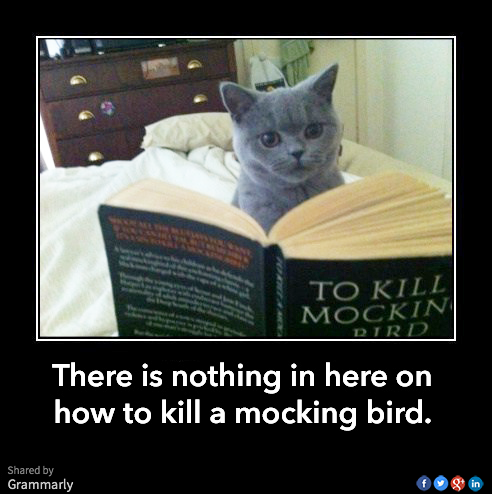
Despite its title, you won’t find anything like this in To Kill a Mockingbird by Harper Lee.
mockingbird

🙂 I’ll forewarn you that I will probably say more about the plot than I usually do. I don’t like to reveal key details in a review, but since I read this one this time in connection with Carrie’s  Reading to Know Classics Book Club, this discussion will involve others who have already read it, plus I am still processing some parts of it. But whatever I share about it, I will try not to spill all the major beans, and there will be much to discover if you do go on and read the book.

Published in 1960, To Kill a Mockingbird is set in the early 30s in a small Alabama town called Maycomb. The story is told through the eyes of Jean Louise Finch, known as Scout, who is six years old as the novel opens. She lives with her older brother, Jem, short for Jeremy, and her widowed father, Atticus, a lawyer. The first part of the book evokes a realistic feel of growing up in a sleepy Southern town. Jem and Scout and their friend, Dill, who comes to visit his aunt in Maycomb each summer, spend a great deal of their time trying to devise a way to get their reclusive neighbor, Arthur Radley, known as Boo, to come out. They meet with no success and get themselves in trouble over their escapades more than once. In these early scenes we get a picture of Scout, smart but bored at a school that scolds her for learning to read at home, Jem’s maturing into a young man, Atticus, who seems detached as a parent sometimes, but shows a depth of wisdom and integrity in handling his work, his life, and his children, and an overview of the citizenship of Maycomb.

There is something of a caste system in the South of this time, with “old” families concerned about their history and standing, to poor but decent folks, to uneducated “trash” who live near the dump. Then there are the Negroes or colored folks, as they are called in the book. There are varying degrees of feelings toward the colored people, with, sadly, most of the townsfolk considering them at least a race apart if not a race beneath. Atticus seems to be one of the few who believes that all people need to be treated with decency and respect no matter what their race.

The children get an inkling that their world is about to shift when they start getting taunted for their father being an “n-lover.” Scout is a scrappy tomboy and her first instinct in any confrontation is to answer with her fists. But her father asks her to refrain from fighting about this issue. The children learn that their father has been appointed the defense attorney for Tom Robinson, a black man accused of raping a white woman. Most of the town thinks, at the very least, that it is not a good idea, and some are quite caustic about it, even to the children (which is low-down and dirty in my opinion.)

Tension builds until the day of the trial. Scout, Jem, and Dill sneak in to watch, and there is no room in the courthouse except in the colored section of the balcony, which welcomes them. Lee deftly handles the details of the case even though her narrator doesn’t really understand what rape is. The evidence is only circumstantial, and Atticus brings out the fact that the alleged victim, Mayella Ewell, has flirted with and lured Tom into her home, and since no one took her to a doctor, there is no proof that a sexual assault occurred. Tom insists that none did. But even though Jem is sure they’ve won the case, the jury returns a guilty verdict.

Though the verdict went the Ewell’s way, Mr. Ewell is angry with Atticus for “destroying his credibility” and threatens to “get” Atticus if it is the last thing he does.

There were many things that stood out to me in this book. One was how Atticus tried to prepare his children for the trouble to come. He didn’t want them to fuss about it nor to think ill of their friends who might say unkind things. When asked why he took the case when the townspeople and even his own relatives think ill of him for it, he says things like he couldn’t live with himself, couldn’t go to church, couldn’t ask his children to obey him if he didn’t. It was the right thing to do, and his conscience would smite him if he didn’t. The children don’t learn until the court day that Atticus was appointed to the case. Scout says it would have saved them many fights if they could have defended him with that piece of information. It says a lot about Atticus that he did not use that fact to defend himself.

Another was how often innocence saw truth. When Scout hears her teacher at the courthouse saying this trial will “teach ’em a lesson, they were gettin’ way above themselves,” she wonders how her teacher can hate Hitler and feel sorry for the Jews in Europe in their classroom and “then turn around and be ugly about folks right at home.” “It’s not right to persecute anybody, is it? I mean have mean thoughts about anybody, even, is it?” It’s Scout innocently talking with one of her neighbors about his son at school that halts an angry mob, unbeknownst to her at first. It’s Dill who gets upset and sick at the courthouse over how the prosecuting attorney is treating Tom on the stand.

I appreciated how the children’s view of their father changes throughout the book. They love him, but compared to other fathers, he is “old,” doesn’t play football, doesn’t have an interesting job, and reads all the time. Their neighbor, Miss Maudie, helps them understand him a bit better, finding out he is a crack shot helps immensely, and the course of events eventually helps them to see him for the man that he is.

One of the most poignant parts of the book for me was when Scout was helping her Aunt Alexandra (who throughout the book tries to make Scout into a lady) at a ladies’ missionary meeting. There are poor examples of womanhood, such as when some of the women say embarrassing things to Scout for a laugh and when others gossip or others laud the heart of missionaries in other countries but fail to acknowledge needs in their own county. When Atticus comes in with bad news about Tom and asks his colored cook to go with him to Tom’s wife, Scout, Miss Maudie, and Scout are shaken. But they don’t want to let the ladies know what has happened, so they put on a brave face and go back out and serve refreshments. Aunt Alexandra smiles at Scout, who thinks to herself, “If Aunty could be a lady at a time like this, so could I.” That contrast between real womanhood and the silliness of so many, and Scout’s realization of it, just spoke volumes to me.

So what does a mockingbird have to do with all of this? When the children are given air rifles one Christmas, Atticus tells them they can “shoot all the bluejays you want, if you can hit ’em, but remember it’s a sin to kill a mockingbird.” Miss Maudie explains to Scout that mockingbirds don’t do people any harm, but they “sing their hearts out for us.” This metaphor of it being a sin to harm the innocent comes up throughout the book, especially beautifully near the end when Scout realizes its meaning and applies it to Boo Radley as well.

Miss Maudie tells the children after the trial,  “Atticus Finch won’t win, he can’t win, but he’s the only man in these parts who can keep a jury out so long in a case like this…We’re making a step – it’s just a baby step, but it’s a step.” Though the battle in this case was lost, there was much that happened that made it a baby step in the right direction. Race relations in this country are still not what they should be, but they’re a far cry from what they were in this time period, mostly due to individual steps along the way, some large and some small. I don’t know if massive cultural changes can be made by a revolution: I think they often come through slow change, through individual men and women standing up and doing the right thing within their sphere of influence.

Some quotes that especially stood out:

Atticus to Scout: “You never really understand a person until you consider things from his point of view…until you climb into his skin and walk around in it.”

Miss Maudie (a neighbor) to Scout: “Atticus Finch is the same in his house as he is in the public streets.”

Scout: “Atticus, are we going to win it?”

“No, Honey.”

“Then, why – “

“Simply because we were licked a hundred years before we started is no reason for us not to try to win.”

When Atticus tries to explain to Scout that “n-lover” is a term that “ignorant, trashy people use,” she ask, “You’re not rely one, then, are you?” He replies, “I certainly am. I do my best to love everybody.”

When Scout and Jem are asked to visit the crusty Mrs. DuBose, unaware that in her dying days she is trying to come out of a morphine addiction brought on my treatment of her illness: “I wanted you to see what real courage is, instead of getting the idea that courage is a man with a gun in his hand. It’s when you know you’re licked before you begin but you begin anyway and you see it through no matter what. You rarely win, but sometimes you do.”

Miss Maudie to the children: “There are some men in this world who are born to do our unpleasant jobs for us. Your father’s one of them…We’re so rarely called upon to be Christians, but when we are, we’ve got men like Atticus to go for us.”

Miss Maudie to Aunt Alexandra: “Whether Maycomb knows it or not, we’re paying the highest tribute we can pay a man. We trust him to do right…The handful of people in this town who say that fair play is not marked White Only; the handful of people who say a fair trial is for everybody, not just us.”

When Scout comments that a boy who was thought to have done certain misdeeds hadn’t and was actually “real nice,” Atticus replies: “Most people are, Scout, when you finally see them.”

I think Lee is an excellent author. There is so much that she brought out so well that I can’t explain or portray any more than I have. It is too bad she only wrote the one book.

The only thing that mars the book is a smattering of bad language – some “damns” and “hells” and a couple of instances of taking God’s name in vain. I am not shocked by them because I grew up in an environment where that kind of talk was common, but my family now doesn’t use that kind of language, and I usually avoid books with it. I don’t like to feed them into my brain. I had forgotten they were in this book. I always struggle with whether to recommend a book that is a great read in every way except this. That is up to the individual reader.

I first read this book in 2008, and I purposely didn’t read that review until I got done with this one. It was interesting to see what things stood out to me both times.

I’m thankful that Annette chose this book for Carrie’s  book club. I listened to the audiobook ably narrated by Sissy Spacek, and her Southern accent really added to the feel of the story.

(This will also be linked to Semicolon‘s Saturday Review of Books.)

Reading Challenge Wrap-Up

I’ve been finished with the TBR Pile Challenge for a while and finished or close to finished with the others as well, so I thought I would wrap them up all in one post except for the Back to the Classics Challenge, which I should complete within a few days. Some of these will overlap – I could not have participated in multiple challenges if they hadn’t.

2014tbrbutton

The 2014 TBR Pile Challenge hosted by Roof Beam Reader was to read 12 books in a year that have been on your shelves unread with a publication date before 2013. My original post is here. My links are to my reviews:

1. Made to CraveSatisfying Your Deepest Desire with God, Not Food by Lisa TerKeurst

2. Crowded to Christ by L. E. Maxwell

3. Ida Scudder: Healing Bodies, Touching Hearts by Janet and Geoff Benge

4. The House Is Quiet, Now What? by Janice Hanna and Kathleen Y’Barbo

5. How to Read Slowly by James W. Sire

6. How to Be a Writer by Barbara Baig

7. Walking From East to West: God in the Shadows by Ravi Zacharias

8. The Great Divorce by C. S. Lewis

9. Loving the Church by John Crotts

10. The Book of Three by Alexander Lloyd

11. Wednesdays Were Pretty Normal: A Boy, Cancer, and God by Michael Kelley

12. Why We Are Not Emergent: By Two Guys Who Should Be by Kevin DeYoung and Ted Kluck

I did not read How To Be a Writer. I want to some time, but just couldn’t get motivated to start it this year. However, we were allowed two alternates and I read both of them, totally 13 books for this challenge:

Girl in the Gatehouse by Julie Klassen

Just Jane: A Novel of Jane Austen’s Life by Nancy Moser

I haven’t decided yet if I will do this challenge next year, but I did like that it did motivate me to get to books that had been untouched on my shelves or in my Kindle app for too long.

bible-verse-christian-hebrews-12-1-2The Cloud of Witnesses Challenge was sponsored by Becky at Operation Actually Read Bible, and the idea was to read nonfiction books by godly authors who have gone on to be with Jesus. Sermons or articles could count as well, but I did not keep track of those. I did plan to read at least four books, but got a little more in:

Crowded to Christ by L. E. Maxwell

How I Know God Answers Prayer by Rosalind Goforth

Mere Christianity by C. S. Lewis

The Knowledge of the Holy by A. W. Tozer

On Stories and Other Essays on Literature by C. S. Lewis. I am not sure if this counts – it is non-fiction, and C. S. Lewis is in heaven, but though it is not a theological book, it does apply spiritual truth to the topic.

The Weight of Glory and Other Addresses by C. S. Lewis

By the end of the year I will also have completed Traveling Toward Sunrise, a daily devotional by Mrs. Charles E. Cowman, Daily Light, a devotional of Scripture verses compiled by Samuel Bagster, and Come Thou Long Expected Jesus, a compilation of essays compiled by Nancy Guthrie having to do with Christmas (some of those authors there would fit this category – Luther, Whitefield, Lloyd-Jones, Edwards, Spurgeon, Augustine, Schaeffer, etc.).

I am thankful to Becky for this challenge. It had been a long time since I had read Tozer and some of these types of books, and it was very beneficial to get back into them.


Nonfiction Challenge hosted at The Introverted ReaderThe Nonfiction Reading Challenge was to read any non-fiction book on any topic. There were different levels one could aim for:

Dilettante–Read 1-5 non-fiction books

Explorer–Read 6-10

Seeker–Read 11-15

Master–Read 16-20

I was aiming for Seeker. The non-fiction books I read so far this year are:

Come Thou Long-Expected Jesus compiled by Nancy Guthrie

Crowded to Christ by L. E. Maxwell

Gospel Meditations for Missions, not reviewed.

Gospel Meditations for the Hurting by Chris Anderson and Joe Tyrpak, not reviewed.

The House Is Quiet, Now What? by Janice Hanna and Kathleen Y’Barbo

How I Know God Answers Prayer by Rosalind Goforth

How to Read Slowly by James W. Sire

Ida Scudder: Healing Bodies, Touching Hearts by Janet and Geoff Benge

Jesus, My Father, the CIA, and Me: A Memoir of Sorts by Ian Morgan Cron

The Knowledge of the Holy by A. W. Tozer

Loving the Church by John Crotts

Made to Crave Action Plan Participant’s Guide by Lysa TerKeurst and Ski Chilton

Made to CraveSatisfying Your Deepest Desire with God, Not Food by Lisa TerKeurst

Mere Christianity by C. S. Lewis

On Stories and Other Essays on Literature by C. S. Lewis

Seeking Allah, Finding Jesus: A Devout Muslim Encounters Christianity by Nabeel Qureshi

Walking From East to West: God in the Shadows by Ravi Zacharias

Walking in the Spirit: A Study Through Galatians 5 by Steve Pettit

Wednesdays Were Pretty Normal: A Boy, Cancer, and God by Michael Kelley

The Weight of Glory and Other Addresses by C. S. Lewis

Why We Are Not Emergent: By Two Guys Who Should Be by Kevin DeYoung and Ted Kluck

Women of the Word by Jen Wilkin

In addition to Traveling Toward Sunrise and Daily Light, mentioned above, I will also have completed Let Every Heart Prepare Him Room by Nancy Guthrie.

So that’s 22, or 25 including the ones I will finish by year’s end, more than I had planned. Since I usually gravitate toward fiction, I am pleased. The TBR Challenge contributed greatly to this one: most of the books I have on my shelves but have not read yet are non-fiction.

As I said with the TBR challenge, I have not yet decided whether to participate in any of these next year, assuming all of the hosts will be hosting them again. I did enjoy that they got some books into my reading that might not have gotten there otherwise, but I didn’t like the self-imposed feeling of  pressure at the beginning of the year that I “had” to get these done before I could pick up any book just for pleasure. I am not going to think about it until after Christmas. But I would recommend any of these challenges to you: they were all beneficial.

Book Review: The Return of Sherlock Holmes

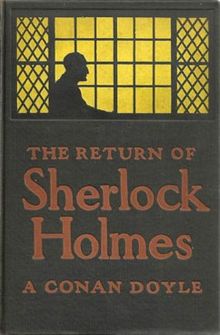
TheReturnOfSherlockHolmesThis book by Arthur Conan Doyle is titled The Return of Sherlock Holmes  because Holmes was thought to have died at the end of The Memoirs of Sherlock Holmes. Doyle had wanted to end the Holmes series to concentrate on historical novels, but he published The Hound of the Baskervilles (set before Holmes’ supposed death though published after) a few years later, and it was such a success that he was pressured to revive the series. Holmes returns to a stunned Watson three years after his disappearance, explaining that though Moriarty died (at the same time Holmes was thought to), his men were still alive and knew that Holmes was as well – one of them sought to kill him in the moments after Moriarty’s death. But Holmes is on their trail and has returned in disguise back to London.

This book is a series of short stories that appeared first in a magazine called The Strand over 1903-1904. Holmes’s clients vary from a governess to the prime minister, and the cases include a missing heir, a stalker, a blackmailer, and crust ship’s captain, busted busts of Napoleon, a student cheating on an exam, a missing rugby player, a false testimony, and a stolen document which could lead to war if not found. Quite a variety! Watson says “As I have preserved very full notes of all these cases, and was myself personally engaged in many of them, it may be imagined that it is no easy task to know which I should select to lay before the public. I shall, however, preserve my former rule, and give the preference to those cases which derive their interest not so much from the brutality of the crime as from the ingenuity and dramatic quality of the solution.” Holmes accuses Watson once of sensationalism: “Your fatal habit of looking at everything from the point of view of a story instead of as a scientific exercise has ruined what might have been an instructive and even classical series of demonstrations. You slur over work of the utmost finesse and delicacy, in order to dwell upon sensational details which may excite, but cannot possibly instruct, the reader.”  When asked why Holmes doesn’t write them himself, he replies that one day he will in textbook form.

Holmes’s personality continues to unfold in these stories. Here are a few of Watson’s comments:

“My friend, who loved above all things precision and concentration of thought, resented anything which distracted his attention from the matter in hand. And yet, without a harshness which was foreign to his nature, it was impossible to refuse to listen to the story of the young and beautiful woman, tall, graceful, and queenly, who presented herself at Baker Street late in the evening, and implored his assistance and advice.”

“Holmes, however, like all great artists, lived for his art’s sake, and, save in the case of the Duke of Holdernesse, I have seldom known him claim any large reward for his inestimable services. So unworldly was he—or so capricious—that he frequently refused his help to the powerful and wealthy where the problem made no appeal to his sympathies, while he would devote weeks of most intense application to the affairs of some humble client whose case presented those strange and dramatic qualities which appealed to his imagination and challenged his ingenuity.”

“Lestrade and I sat silent for a moment, and then, with a spontaneous impulse, we both broke at clapping, as at the well-wrought crisis of a play. A flush of colour sprang to Holmes’s pale cheeks, and he bowed to us like the master dramatist who receives the homage of his audience. It was at such moments that for an instant he ceased to be a reasoning machine, and betrayed his human love for admiration and applause. The same singularly proud and reserved nature which turned away with disdain from popular notoriety was capable of being moved to its depths by spontaneous wonder and praise from a friend.”

“My friend’s temper had not improved since he had been deprived of the congenial surroundings of Baker Street. Without his scrapbooks, his chemicals, and his homely untidiness, he was an uncomfortable man.”

“I may have remarked before that Holmes had, when he liked, a peculiarly ingratiating way with women, and that he very readily established terms of confidence with them. In half the time which he had named, he had captured the housekeeper’s goodwill and was chatting with her as if he had known her for years.”

“Sherlock Holmes was a past-master in the art of putting a humble witness at his ease.”

Some of what I have read concerning modern depictions of Holmes seem to cast him as socially awkward, even rude, and perhaps having Asberger’s. I think these samples show that he was not socially awkward at all – he was described as being quite genial when he wanted to be, and he could carry on a conversation with anyone. But he preferred working alone or with Watson and one or two others – a classic introvert, in my opinion.

There were a few cases before now and a couple of cases here where Holmes decided justice was served, and he did not see a reason to report his findings to the police even when he was working with them. In one case he said, “No, I couldn’t do it, Watson…Once that warrant was made out, nothing on earth would save him. Once or twice in my career I feel that I have done more real harm by my discovery of the criminal than ever he had done by his crime. I have learned caution now, and I had rather play tricks with the law of England than with my own conscience. Let us know a little more before we act.” I wouldn’t advocate that in real life, but it did make sense in the context of the story.

At the end of this book Holmes was said to have retired, and only allowed Watson to tell a few of the stories long after they occurred. Since there are three more books about him, however, either he didn’t retire, or those stories are more past cases.

Once again I listened to the audiobook version superbly narrated by Derek Jacobi. In my journey through the Holmes books, I look for versions read by Jacobi now. I also looked at some portions in closer detail in the online version of the book provided by Project Gutenberg.

(This will also be linked to Semicolon‘s Saturday Review of Books.)

Why Read? Why Read Fiction? Why Read Christian Fiction?

photo 1(1)

I have been reading Christian fiction for some 35 years or so, and for the most part have loved it. It has ministered to me in many ways. I always wince a bit when I hear someone “slam” it. Especially when they say “All Christian fiction is…” whatever it is they don’t like about it. My snarky(and probably fleshly) inward response is “You haven’t read all of it.” 🙂

I’m probably not going to convince anyone who is dead set against it, and that’s fine. We can still be friends. 🙂 But I wanted to share why I find it valuable, and to do that, it seems to me I need to start with reasons to read anything in the first place, and then reasons to read fiction, and then Christian fiction.

Why Read?

God chose to communicate to us through words. He created the world by speaking. His Son is called “the Word.” The Bible contains a number of different genres (poetry, history, letters, narrative, forensics).

To gain information

To learn – about other people’s experiences, other points of view, any of the many things we don’t know yet or know as much as there is to know

To understand how things work

To understand how others feel and develop empathy.

To gain perspective

To gain wisdom

To broaden horizons. There are places you’ll likely never go, experiences you’ll likely never have, except by reading about them. On the other hand, something you read may spark an interest in a new venture.

To understand your own culture better

To understand other cultures

To strengthen your views

To know you are not alone in your views.

To test your own beliefs against others

To understand others’ views

To improve reasoning skills

To find others who express thoughts you’ve had but couldn’t quite put into words

To improve concentration and focus

To improve vocabulary and communication skills

To relax

To be amused

To be challenged

To profitably pass time

To be surprised

To stave off boredom

To be inspired

To become a more well-rounded person

To become more creative

To immerse oneself in a subject. Randy Alcorn wrote at the end of Courageous that they wanted to write a full book after the movie partly so that people could spend 10 hours in a book thinking over the topics involved rather than just 2 hours of a film.

For enjoyment and pleasure

To understand cultural references so that when someone quotes Dickens or Frost or Shakespeare you have some idea who they’re talking about. If someone mentions “Two roads diverged….,” knowing the poem and its subject enriches your understanding of what the person is referring to.

To have a point of contact with one’s fellow man or woman. A friend’s son was planning to go into a vocational job working with his hands and struggled with literature classes. She felt that her son’s time and mental powers would be better employed just reading and studying the Bible. But even the apostle Paul quoted poets and took time to understand other people’s culture as a way of understanding them as a people and having a point of reference from which to share the gospel (Titus 1:11-13, Acts 17:21-23).

To inspire “noble action.”

“All literature, all philosophy, all history, all abounds with incentives to noble action which would be buried in black darkness were the light of the written word not flashed upon them.” – Cicero, Pro Archia

“I believe stories can broaden our empathy, helping us to love. They tell us we’re not alone. But they can also give us something to live up to, whetting our appetite for virtues we don’t yet have.” James D. Witmer, Stories That Lead By Example

To think. I found it interesting that a daughter of a friend teaching English and American culture in a Communist country said that parents there did not read books to their children for pleasure.

“Books are weapons in the war of ideas.” – U.S. Government Printing Office, Office of War Information, S. Broder (artist) 1942 World War II Poster. In totalitarian societies, books that disagree with national policy are banned.

“The books that help you most are those which make you think the most. The hardest way of learning is that of easy reading; but a great book that comes from a great thinker is a ship of thought, deep freighted with truth and beauty.” Theodore Parker (1810 – 1860) (seen at Carrie’s)

To glean from the minds of great thinkers.

“The reading of all good books is indeed like a conversation with the noblest men of past centuries who were the authors of them, nay a carefully studied conversation, in which they reveal to us none but the best of their thoughts.” Rene Descartes (1596 – 1650) (seen at Carrie’s).

To comprehend right and wrong

“The great fairy tales and fantasy stories capture the meaning of morality through vivid depictions of the struggle between good and evil, where characters must make difficult choices between right and wrong, or heroes and villains contest the very fate of imaginary worlds.” Vigen Guroian, Tending the Heart of Virtue

To gain power. Thanks to Janet for this one. She shared that

“In his autobiography, Frederick Douglass writes that his owner forbade his wife to teach a slave to read on the grounds that it would ‘forever unfit him to be a slave.’ ‘I now understood what had been to me a most perplexing difficulty — to wit, the white man’s power to enslave the black man,’ writes Douglass. ‘It was a grand achievement, and I prized it highly. From that moment I understood the pathway from slavery to freedom… I set out with high hope, and a fixed purpose, at whatever cost of trouble, to learn how to read.’”

Why Read Fiction?

You may agree with all the reasons listed so far for reading, but you want to read what’s “real” and have no room for fiction in your life. Here are some things to think about regarding reading fiction. I believe all of the above reasons apply to fiction as well as non-fiction, but here are some that apply primarily to fiction:

God employed fiction in the Bible (Nathan to David, parables in the NT, story of the bramble in the OT, plus many others). We have to be careful not to fictionalize or label as myth what the Bible indicates as fact – as someone once said of Bible interpretation, “Where common sense makes good sense don’t seek any other sense.” Some people want to categorize much of the Old Testament as myth, and that is going way too far for too many reasons to go into here. But God does make use of stories.

God created imagination and stories employ it.

A story might provide conviction and instruction when we see ourselves in the story (Nathan to David in the story about a lamb, Aesop’s fables). A lecture or direct confrontation is not always the best approach. In It Takes a Pirate to Raise a Child by Daniel B. Coupland, he tells of a time when he was trying to get across to his young son why the way he was acting towards his sisters was wrong. The son did not comprehend or agree with what his father was saying until he said, “You’re acting like Edmund” in The Lion, the Witch, and the Wardrobe by C. S. Lewis. Then he “got it” and not only realized where he was wrong, but “The reference to Edmund hit my son in a very deep place in his heart, which only stories can reach.”

Fiction fleshes out truth. Sometimes during a sermon I am following along and understanding but find myself wondering what that truth looks like in real life. A story or illustration helps us know how to apply truth or helps us understand the truth better.

Fiction appeals to our minds. Somehow most of us are wired to tune in to a story. I read one preacher who lamented that his listeners got drowsy while he exposited Scripture but perked up when he told a story. That doesn’t necessarily mean they are unspiritual and shallow. I have often fought sleepiness during a message I really wanted to hear but then found myself wide awake when the preacher began to tell a story. That’s not to say preachers should tell more stories than preach the Bible – we do need to discipline ourselves to hear sound doctrine. But it is not always due to laziness that are minds are attracted to stories.

Here are what greater minds than mine have said about fiction:

“The appeal of stories is universal, and all of us are incessant storytellers during the course of a typical day.” Justin Taylor, How Stories Work

“Good literature erects bridges between different peoples, and by having us enjoy, suffer, or feel surprise, unites us beneath the languages, beliefs, habits, customs, and prejudices that separate us. When the great white whale buries Captain Ahab in the sea, the hearts of readers take fright in exactly the same way in Tokyo, Lima, or Timbuctu.” ~Mario Vargas Llosa, Seen at Semicolon

“Reading is to the mind what exercise is to the body. As by the one, health is preserved, strengthened and invigorated; by the other, virtue (which is the health of the mind) is kept alive, cherished and confirmed. But as exercise becomes tedious and painful when we make use of it only as the means of health, so reading is apt to grow uneasy and burdensome, when we apply ourselves to it only for our improvement in virtue. For this reason, the virtue which we gather from a fable, or an allegory, is like the health we get by hunting; as we are engaged in an agreeable pursuit that draws us on with pleasure, and makes us insensible of the fatigues that accompany it.” -Joseph Addison and Richard Steele, The Tatler No. 147

“Stories give children the opportunity to think about morals, lessons, and conflict resolution. With practice, children begin to search for the moral at the end of the story, and some will even structure their own stories around a specific message. Children who listen and tell many stories begin to recognize trends in human behavior. Their perspectives expand, and they become more critical, observant thinkers. They begin to consider in broader terms what it means to be helpful, mean, practical, hopeful, spiteful or considerate. Creating characters – which teaches that multiple perspectives exist at every moment – gives children invaluable tool for understanding others and for finding their way in the world.” (page 13)  Show Me a Story: 40 Craft Projects and Activities to Spark Children’s Storytelling, HT to Carrie.

“Some Christians view fiction as the opposite of truth.  But sometimes it opens eyes to the truth more effectively than nonfiction.” – Randy Alcorn.

“It is only a novel… or, in short, only some work in which the greatest powers of the mind are displayed, in which the most thorough knowledge of human nature, the happiest delineation of its varieties, the liveliest effusions of wit and humour, are conveyed to the world in the best-chosen language” ― Jane Austen, Northanger Abbey

“Fairy Tales are more than true; not because they tell us that dragons exist, but because they tell us that dragons can be beaten.” – G.K. Chesterton

“It might be expected that such a book would unfit us for the harshness of reality and send us back into our daily lives unsettled and discontent. I do not find that it does so….Story, paradoxically enough, strengthens our relish for real life. This excursion into the preposterous [speaking here of The Wind in the Willows] sends us back with renewed pleasure to the actual” –C. S. Lewis, On Stories and Other Essays on Literature, p. 14

Since it is so likely [children] will meet cruel enemies, let them at least have heard of brave knights and heroic courage.C. S. Lewis, On Stories and Other Essays on Literature, p. 39

“The value of myth is that it takes all the things we know and restores to them the rich significance which has been hidden by the ‘veil of familiarity.’ The child enjoys his cold meat (otherwise dull to him) by pretending it is buffalo, just killed with his own bow and arrow. And the child is wise. The real meat comes back to him more savory for having been dipped in a story…If you are tired of the real landscape, look at it in a mirror. By putting bread, gold, horse, apple, or the very roads into a myth, we do not retreat from reality: we rediscover it. As long as the story lingers in our mind, the real things are more themselves. This book [LOTR] applies the treatment not only to bread and apple but to good and evil, to our endless perils, our anguish, and our joys. By dipping them in myth we see them more clearly.” – C. S. Lewis, On Stories and Other Essays on Literature, p. 90
Fairy Tales

Why Read Christian Fiction?

In addition to all of the above reasons for reading, which I believe can be applied to Christian fiction as well, here are some reasons particular to Christian fiction:

The missing element. Even the best of secular stories tends to leave God out of the picture and have the characters acting on their own initiative. Christian fiction shows how a Christian might act in dependence on God in some of these scenarios.

To see how Christians act in everyday life. I’ve mentioned here before that my mother was not, as far as I know, a Christian as I was growing up. In her later years she had some questions and concerns about it, but she did not want to discuss it. It was too sensitive, too personal for her to open up about it. I began sending her some of the Christian fiction I was reading. Not only did she enjoy the stories (Terri Blackstock and Dee Henderson were a couple of her favorites), but it helped her to see what Christianity in action looked like (we lived 1,000 miles away, so though we talked and wrote, we didn’t have that everyday life contact back when there was no texting or Facebook to keep in touch every day).

To display the gospel. I don’t think every Christian story has to include the plan of salvation or show a conversion, but if the gospel affects every aspect of our lives, that would be displayed in the stories in some way. I went into this further in an earlier post titled The Gospel and Christian Fiction. To repeat one thought from that post, while not every Christian story needs to explain the whole gospel, what it does share needs to be accurate. Because some have accused Christian fiction of being too “preachy” (more on that later), the pendulum has swung the other way lately, and some authors have tried to make their message a little more subtle. That can be fine: some stories would call for the book’s message to be a little more explicit, some call for more subtlety. But in some cases subtlety has generated obscurity or even misleading statements. I would not have sent those kinds to my mom so as not to confuse her, though a mature Christian might benefit from them.

To learn spiritual truth.

To be helped in your own life by another’s example. Just one instance of this in my life: for several years of our married life, my husband had to travel quite a bit, and I was often discouraged about it. During one of those periods I was reading Janette Oke’s A Quiet Strength, and the young wife in the story was experiencing something similar with her husband having to be away much of the time to work. Even though our ages, life situations, time in history, and number of years married was different, I was still encouraged by what she found that encouraged herself.

It’s clean – or should be. There is a growing trend to use bad language or sexual scenes to be more “realistic,” but I think explicitness in either vein is detrimental. I wrote about these elements in The Language of Christians and Sexuality in Christian Fiction, so I won’t reproduce those thoughts here.

Charges against Christian fiction:

Here are some complaints about Christian fiction that I have heard or read:

“It is predictable.” The person who is not a Christian becomes one or the problem a Christian has is solved or the lesson learned. But isn’t there a measure of predictability in every genre? Usually the guy and the girl get together in a romance, the detective figures out the mystery and “whodunnit,” the good guys win in the Western, the doctor helps save the patient, etc. (unless it is a series, and then a few lost cases are thrown in for realism). We expect a certain ending with most of the books we read, and the fun is in seeing how it is done and what unexpected twists and turns arise on the journey.

“It’s too preachy” or it is more of a sermon in the guise of a story. I’ve only found that occasionally. Of course authors, Christian or secular, usually do have some kind of truth they are trying to convey, but usually they try not to be blatant about it. Sometimes they are accused of being blatant when they are not: in C. S. Lewis’s book On Stories, he quotes Dorothy L. Sayers as saying, about the assumption that she wrote to “do good”: “My object was to tell that story to the best of my ability, within the medium at my disposal — in short, to make as good a work of art as I could. For a work of art that is not good and true in art is not good and true in any other respect” (p. 93). An author’s worldview is going to seep out into his story in some way. Lewis said that the Narnia stories were not intended as an allegory. They started with a couple of pictures in his mind, one of a faun, and some “supposings,” and developed from there.

I mentioned earlier that Christian fiction will show the everyday activity of Christians, so obviously there will possibly be prayer, reading and discussing Biblical truths, going to church, etc., in the story. But those elements should be woven in as naturally as possible and not just tossed in to label a character as Christian. One of the best at this is Jan Karon in her Mitford books, which are not even marketed as Christian fiction but convey a definite element of faith.

“The characters are too perfect.” I have rarely found this to be the case in the Christian fiction I have read. Most writers strive to make their characters realistically flawed.

“It’s poorly written.” I have only a handful of times found a Christian fiction book that I thought was truly terrible. There are some Christian novels that are mediocre, but, again, that could be said of any genre. I have found plenty of Christian fiction that has kept me glued to the page, instructed or inspired me, and some that had me looking up at the ceiling thinking, “I wish I could write like that.”

“As soon as someone becomes a Christian in the book, all of their problems are solved and they live happily ever after.” Again, I have rarely found that to be the case in the Christian fiction I have read, especially in recent years.

I think some of these charges might have been more true of some of the earliest Christian fiction, but most authors I have read over the last 25+ years have striven to make their characters and plots and realistic as possible.

If someone truly feels convicted that they should not read Christian fiction, of course one shouldn’t violate conscience. I have mentioned missionary Isobel Kuhn many times. For a time she came to a place of laying aside fiction because one time, after finishing a very exciting novel, she tried to read her Bible and couldn’t engage with what she was reading. She felt the Lord was telling her that trying to read the Bible after a novel was like trying to eat dinner after ice cream. She felt the fiction was stunting her taste for the Bible (I don’t know what kind of fiction it was). To that I would say, as parents the world over have, don’t eat your dessert before your main course. 🙂 Make sure to put Bible reading before any other reading. Probably that same kind of thing would happen if trying to read the Bible just after an exciting ball game or social gathering or play: it takes a bit of time to “change gears.” But I wouldn’t argue with someone who felt this way: sometimes God does call us to put aside things that aren’t harmful in themselves in order to give first place to the best things. Later on when Isobel’s husband became a superintendent for their mission and had to travel frequently, and she was left alone in lonely mountain villages for long periods of time, she did come back to the classics for moments of respite and company. She felt like she was visiting with old friends, and because she was familiar with them, she didn’t have the temptation to neglect duties to stay glued to the book to see what happened.

I am not saying Christians should only read Christian books – not at all. One good post I’ve seen on that subject is Three Reasons to Diversify Your Reading.

I am also not endorsing all Christian fiction. Just as I wince when someone says they think it is all bad, I would also wince to hear someone say it is all good. We need to use discernment in everything we read. I have found some Christian fiction that I did feel was either poorly written or was off-base in something it said, but those have been the minority.

Conventional blogging wisdom would suggest that I divide this up into several posts – but personally I like having it all in one place even though it makes for too long a post. I hope you don’t mind. I also have a few more quotes I was going to share about books and reading, but I think I will save those for another time.

I’d love to hear your thoughts about reading fiction and Christian fiction.

“Every great story tells in some part The Great Story. Each truth revealed helps us make sense of our world. And through each tragedy, comedy, and fairy tale, the Truth is woven through the fabric of our being.” – Julie Silander, Threads

(Sharing with Booknificent Thursday)