Laudable Linkage

Here are some noteworthy reads found this week:

Whispers of Eternity: Hope Beyond Death. “The Bible teaches that physical death is not the end. Every one of us—believer and unbeliever alike—will continue to exist somewhere. Scripture is clear: we will spend eternity either with God in heaven or separated from Him in eternal torment (Matthew 25:46).”

America: From Civility to Savagery? “The way that Christians responded to the Aucas in 1956 can guide believers as they respond to Americans in 2025. Rather than rise up to take their revenge against that Ecuadorian tribe, Christians chose to seek reconciliation. Today is no time to meet political violence with more violence by mimicking the perpetrators. Now is the time for believers to be what they want others to become, leading by example (1 Corinthians 11:1).”

A Question for All the Teens Who Saw Charlie Kirk Die. “I just want to ask the question: Are you okay? I want to consider what you saw and acknowledge that it may be sitting heavily on your heart and may be troubling your soul. I want to acknowledge that you might be frightened about your future now that you have witnessed a man being assassinated for simply expressing his political and religious viewpoints. With these things in mind, I have three brief matters I would like you to consider.”

The Blood of Charlie Kirk Speaks: A Missionary Perspective. “When horrible events of such import happen and you are far away from home, it lends itself to a different perspective on those events. We have been surprised by how much of a global event this is.”

Talking to Your Family about Your Coming Death. “The atmosphere in the hall with his wife, son, sister, mother and all the extended family was remarkable. There was sorrow, but not despair, surprise but not shock. This family was prepared for this moment. It was not the case a year ago.”

5 Ways Love Is the Secret to Better Bible Teaching, HT to Knowable Word. Though this is aimed at Bible teachers, I think it can apply to writers, speakers, bloggers–anyone who tries to share God’s truth with others.

I’m Triggered, HT to Challies. “In a world overcome with blaming and discrediting, Christians need to pause and ask how we contribute to divisive discourse. One subtle way that we disengage and cause further disunity is by developing ‘hot-topic’ words or phrases that we dislike, and then implicitly, or even explicitly, dismissing someone’s message (or even dismissing them) when they use these terms.”

Health Anxiety and Avoidance: Why Running From Fear Makes It Worse, HT to Challies. “Avoidance feels safe. When something makes us anxious, the simplest solution seems to be: stay away. Don’t go to the appointment. Don’t open the bill. Don’t step into a situation that makes your stomach tighten and your heart race. . . . But here’s the catch: avoidance doesn’t solve anxiety. It strengthens it. Like feeding a stray cat, avoidance keeps coming back for more. The more we avoid, the more powerful the fear becomes.”

This One, She’s Mine. I actually came to this post from a link that was supposed to go somewhere else, but I thoroughly enjoyed reading this sweet testimony.

Jane Austen quote

“Incline us, O God, to think humbly of ourselves, to be severe only in the examination of our own conduct, to consider our fellow-creatures with kindness, and to judge of all they say and do with that charity which we would desire from them ourselves” (Jane Austen).

Is Your Testimony Dramatic?

Is your testimony dramatic?

Adoniram Judson, one of America’s first missionaries in the early 1800s, has one of the most dramatic testimonies I ever heard. He came from a Christian home, but in college fell in with a group who didn’t believe as he had been taught. His best friend was Jacob Eames, a “free-thinker” who was a skeptic. Though Jacob believed there was some type of God, he rejected the Bible.

Adoniram’s departure from the faith broke his parents’ hearts. His father tried to talk with him, but could not match Adoniram’s brilliant reasoning.

Adoniram wanted to go into the theater and perhaps become a playwright. But when the theater group he found had appalling morals.

He traveled more, ending up one night at an inn that had only one room left. The innkeeper apologized, saying the man in the next room was dying. Adoniram assured the man he would not be bothered. But he could hear the man’s groaning all through the night. Adoniram was shaken with thoughts of what happens after death.

As Adoniram sought the innkeeper the next morning to settle his account, he asked about the dying man. The innkeeper confirmed that the man did die. As they discussed the situation further, it came out that the dead man was Adoniram’s friend, Jacob Eames.

Adoniram was stunned–not only because Eames was so young and his friend, but because he wondered for the first time if he might be wrong. He felt that only God could have orchestrated events that led him to this time and place.

He wasn’t saved immediately, but this was the first step in his coming to true faith in God.

I’ve heard other thrilling conversion stories through the years: twin brothers in a former church and half-brothers in our current church who were miraculously saved from drug addiction, a man caught in a piece of machinery who would have died without God’s intervention, the apostle Paul’s Damascus Road experience.

Such exciting accounts can make some of us feel our testimonies are a little lacking.

But consider what salvation is: a new birth. We’ve known people with exciting birth stories as well: One friend made it to the hospital, but not past the lobby when her baby came. My brother was born at home, too quickly to go anywhere, even though the doctor had told my mother that day that the baby wouldn’t come for a few days yet. Another friend planned to deliver at a small university hospital, but complications led to being transported by ambulance to a larger hospital in town.

Yet every birth is a miracle to those involved. Parents greet their newborns with love and joy no matter what details led to the baby’s arrival.

Jesus told about a man leaving ninety-nine sheep behind to find the one lost one and rejoicing when he found it. He went on to say, “There will be more joy in heaven over one sinner who repents than over ninety-nine righteous persons who need no repentance” (Luke 15:7). He told of a woman finding a lost coin and then calling her friends in to rejoice with her when she found it. Then He reiterated, “Just so, I tell you, there is joy before the angels of God over one sinner who repents.”

The little child who comes to saving faith at home, in Sunday School, or in VBS causes just as much joy in heaven as the hardest criminal who believes.

We tend to think of drug dealers, prostitutes, gangsters, and such as the “worst” sinners. Proverbs 6:16-19 says, “There are six things that the Lord hates, seven that are an abomination to him: haughty eyes, a lying tongue, and hands that shed innocent blood,
a heart that devises wicked plans, feet that make haste to run to evil, a false witness who breathes out lies, and one who sows discord among brothers.” Pride, lying, and discord are right up there with shedding innocent blood.

When Jesus was asked which was the greatest commandment, He replied, “You shall love the Lord your God with all your heart and with all your soul and with all your mind and with all your strength” (Mark 12:30). If that’s the greatest commandment, it follows that the greatest sin is breaking that commandment. And all of us do so every day.

Salvation is turning from darkness to light, becoming God’s child, receiving forgiveness and eternal life, and beginning a personal relationship with God. That’s pretty dramatic in itself, no matter the circumstances that led to it.

Acts 26:18

(I often link up with some of these bloggers.)

Tending the Soil of Your Heart

Tending the Soil of Your Heart

In Mark 4, Jesus tells a story about different kinds of soil and how they each react to seed. Later, the disciples come to Him privately and ask what the story means.

Jesus said that the seed is the word of God. Some seed in the story fell on the hardened pathway, and birds came and ate the seed. This represents people for whom Satan immediately comes and takes the word from their minds.

Others are like rocky ground. The seed may sprout, but there’s no depth of soil, so the plant dies.

Others are like ground covered with thorns, which represent “the cares of the world and the deceitfulness of riches and the desires for other things.” These “choke” the word, so, again, plants can’t grow.

But the good soil is like people who hear the word, accept it, and bear fruit.

On first reading this parable, you might get to the end of it and think something like, “Well, that’s that. I feel bad for the people whose hearts didn’t receive the word, but what can you do?”

I don’t think that’s meant to be the end of the story, though. Surely, at the end of our lives when we stand before the Lord, we’ll be responsible for how we heard and received God’s word.

But right now, there’s still time to hear and respond.

The word “hear” is repeated eleven times in this chapter. Twice, Jesus says, “If anyone has ears to hear, let him hear.” Then “he said to them, ‘Pay attention to what you hear: with the measure you use, it will be measured to you, and still more will be added to you. For to the one who has, more will be given, and from the one who has not, even what he has will be taken away.'” When you listen and respond, you’ll hear more. But if you turn away, you can lose whatever you have heard.

So what do we do if our hearts seem unfruitful, rocky, shallow, or choked by distractions and concerns?

Pray, asking God to search us and change our hearts:

Search me, O God, and know my heart! Try me and know my thoughts! And see if there be any grievous way in me, and lead me in the way everlasting! (Psalm 139:23-24).

Incline my heart to your testimonies, and not to selfish gain! Turn my eyes from looking at worthless things; and give me life in your ways (Psalm 119:36-37).

Examine ourselves:

Let us test and examine our ways, and return to the Lord! Let us lift up our hearts and hands to God in heaven (Lamentations 3:40-41).

Break up our fallow ground:

Sow for yourselves righteousness; reap steadfast love; break up your fallow ground, for it is the time to seek the LORD, that he may come and rain righteousness upon you. (Hosea 10:12).

For thus says the LORD to the men of Judah and Jerusalem: “Break up your fallow ground, and sow not among thorns (Jeremiah 4:3).

Fallow ground is unplowed, uncultivated. It needs to be dug into, loosened, aerated, so seed can grow down deep. The Hosea passage goes on to talk about plowing iniquity and trusting in one’s own way. Jeremiah adds, “Circumcise yourselves to the Lord; remove the foreskin of your hearts.” We need to get rid of anything we know is standing between us and the Lord. 

Don’t harden your heart.

Today, if you hear his voice, do not harden your hearts as in the rebellion, on the day of testing in the wilderness, where your fathers put me to the test and saw my works for forty years (Hebrews 3:7-9; also verses 13 and 15 and 4:7; also Psalm 95:8).

Other passages associate hardened hearts with pride, unbelief, willfulness, and disobedience.

God would not have said “Don’t harden your hearts” if there was no hope. We can ask Him to soften us and help us to repent of our unbelief and pride. Hebrews 3:13 says, “Exhort one another every day, as long as it is called ‘today,’ that none of you may be hardened by the deceitfulness of sin.” If we haven’t been listening to that exhortation, it’s a good time to start.

Pull out the weeds.

“The cares of the world and the deceitfulness of riches and the desires for other things enter in and choke the word, and it proves unfruitful (Mark 4:19).

This reminds me of the man we call the “rich young ruler” in Mark 10. He came to Jesus asking what he could do to inherit eternal life, thinking he had a pretty good chance since he kept the commandments. But Jesus told him to sell all he had, give it to the poor, and follow Him. Jesus does not call everyone to do this, but he knew this man loved his possessions too much. The man went away sorrowing rather than obeying.

Jesus remarked how difficult it was for a wealthy person to be saved–more difficult than a camel going through the eye of a needle. Astonished, the disciples wondered who then could be saved. Jesus said it was impossible with man, but not with God. Because of what Jesus said here, and the man’s sorrowfulness, and the fact that the text says Jesus loved him, I have hope that this man eventually did repent and turn to God.

But riches and possessions aren’t the only “thorns” that can choke the word. The cares of this world can distract us as well, like John Bunyan’s muckraker in The Pilgrim’s Progress, who wouldn’t look up from his busyness to see the hand of mercy extended to him.

Jesus warned that the desire for other things can distract us from His word as well. Five seconds after we die, we’ll realize that whatever we were holding onto wasn’t worth it. “For what does it profit a man to gain the whole world and forfeit his soul? For what can a man give in return for his soul?” (Mark 8: 36-37).

Sometimes the rocks or weeds in our hearts are intellectual. A woman in one of our former churches had been a biology major, and her biggest obstacle to salvation was her belief in evolution. One doesn’t have to believe in creation rather than evolution to be saved, but evolution was a hindrance to this particular woman’s faith. When God opened her heart to believe in His creation, she was able to believe in Him for salvation as well.

Likewise, Lee Strobel (author of The Case for Christ) and Viggo Olsen (Daktar) didn’t believe in God because they didn’t believe in things like the Bible’s reliability or the resurrection of Christ. Both men set out to disprove Christianity. But each became believers when they researched the truth. What we call apologetics (“the study and practice of giving answers for the reasonableness and truth of the Christian faith,” as defined by Answers in Genesis), is not in itself the gospel, but it can pave the way for the gospel by removing intellectual obstacles.

Read the Bible.

The unfolding of your words gives light; it imparts understanding to the simple (Psalm 119:130).

So faith comes from hearing, and hearing through the word of Christ (Romans 10:17).

Even if you don’t believe the Bible yet, or you’re not sure, God can speak to you through scripture and open your heart to Him.

If you don’t know the Lord, I pray you’ll leave no stone unturned to come to Him, and that He’ll give you understanding, repentance, and faith. 

Jeremiah 24:7

(I often link up with some of these bloggers.)

Laudable Linkage

Laudable Linkage

Comfort and Joy: How God Used the Loss of a Loved One to Save the Life of Another, HT to Challies. “Grief is painful, angry, messy, and real. But God does not abandon us in the midst of it. In fact, from soil soaked by tears, He can cultivate healing, goodness, and beauty—even if our broken hearts can’t see it right away.”

Christianity Is not Colonial: An Autobiographical Account, HT to Challies. “According to this ‘Christianity is colonial’ narrative, Christianity is the ‘white,’ ‘western’ religion which permitted all the above. Therefore, the Christian God is himself a racist colonialist who deserves, not to be worshiped, but to be denounced. This association of Christianity with colonialism is so out of step with reality as to be literally ridiculous.”

COVID’s Gift: The Gem We Should Now See We Were Missing. “If I asked you to make a list of the ten two-word phrases most common in the New Testament, the phrase ‘in Christ’ wouldn’t make it on most of our lists. Yet that phrase and its variants occur more times in the New Testament than the phrases ‘the cross,’ ‘eternal life,’ or even ‘Jesus Christ.'” The author posits that understanding our unity in Christ would reignite our love and understanding of the church. The best part of the article is under the heading “How are believers unified with Jesus?”

I’m Fine! “How are you today? No, I mean really, how are you today? I know you know the socially, western culturally correct response is that you are fine, however, that’s not what we’re about here, in this space.”

Purposes of Predictive Prophecy. “Certainly prophecy is intended to have a present impact on the believer’s faith and practice. No one should dispute that. But some posit that viewing eschatological prophecy as a detailed prediction of specific events short-circuits the ethical intention of such prophecy. I am positing that God tells us about the future because He actually wants us to know what is going to happen and expects us to believe that it is going to happen just as He says.”

We Need to Sing More Than Songs of Praise, HT to Challies. I agree, though I think singing does more than express emotion.

Sanctification and Sexual Purity: God’s Will for Your Life, HT to Challies. “There is a direct link between our holiness and our sexual purity. There’s a direct link between your body which is united to Christ and what you do with your body. And that my friends is not popular.”

Finally, I don’t know David and Ciara Dierking, but evidently many of my friends do, because I started seeing requests for prayer all over Facebook back in December when Ciara and her young son Colton became ill. Colton had COVID and strep, I believe, and two abscesses of infection in his neck. Once he had surgery to drain those, he was well on the road to recovery. Ciara had influenza B, group A strep, severe pneumonia, which sent her into toxic shock (sepsis). She nearly died. The medicine to treat the sepsis narrowed her blood vessels to the point that her extremities couldn’t get enough oxygen. She ended up having both arms and both legs amputated.

You can imagine how devastating that would be, especially for a young wife and mother. As I have prayed over and ached with this sweet family these last several months, there have been so many signs of God’s hand on them.

Ciara was rereading Nancy DeMoss Wolgemuth’s book, Choosing Gratitude, when all of this happened. As her family put excerpts from the book that Ciara had underlined on their Facebook page, somehow Nancy learned of it and asked if she could interview Ciara and David. That episode will air November 11 and 12 on the Revive Our Hearts app or website or podcast. But as part of that interview, ROH made this video. I encourage you to watch, be encouraged, and pray for this family. They’ve all overcome many challenges, but still have many more ahead. I’m going to leave this here in place of my usual Saturday morning graphic.

Review: Stop Asking Jesus Into Your Heart

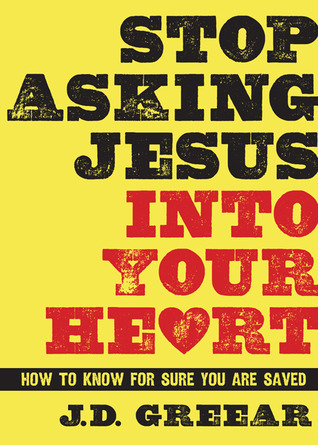
Stop Asking Jesus Into Your Heart

Perhaps you know someone who can’t seem to come to assurance that they are Christians.They’ve asked Him to save them several times, and feel content each time, but sooner or later, they question whether they really believed or repented, or did so the right way or “enough.”

Perhaps that person is you.

It was me for a couple of decades. I shared my struggle with assurance and how God helped me with it here.

Satan can trip people up over assurance because if we’re insecure about our salvation, we come to a standstill in our Christian growth. We don’t have the confidence to serve the Lord in any way. Instead of going forward in our Christian lives, we’re spinning our wheels over the same issues.

On the other hand, there is such a thing as false assurance. Jesus said there would be people who stand before Him some day, fully assured that they are all right spiritually. They’ll be shocked to hear Him say, “I never knew you; depart from me, you workers of lawlessness.”

So the stakes are high.

In Stop Asking Jesus Into Your Heart: How to Know For Sure You Are Saved, J. D. Greear says he might hold the “Guinness Book of World Records entry for ‘amount of times having prayed the sinner’s prayer.'” He shares his own testimony of struggles with assurance.

Then he explains that God truly wants us to have assurance. He shares what it means that Jesus died in our place and why we can trust Him, along with separate chapters on the nature of true faith and repentance. Another chapter discusses the seeming contradiction between Bible verses that say we will never lose our salvation with other verses that appear to indicate we can. The last two chapters cover evidences of salvation in 1 John and what to do with continued doubts. One appendix deals with whether one needs to be baptized again if they’ve made subsequent professions of faith after baptism. The second deals with the “indispensable link between assurance and the doctrine of justification by faith alone.”

At first glance, I thought this book was about reasons not to use the terminology of “asking Jesus into your heart” as a way of telling people how to be saved. Greear discusses this briefly, saying he thinks it can be used as long as the gospel has been fully understood.

Some of the quotes that stood out to me:

Salvation comes not because you prayed a prayer correctly, but because you have leaned the hopes of your soul on the finished work of Christ (Location 269, Kindle).

I can say with certainty that God wants you to have certainty about your salvation. He changes, encourages, and motivates us not by the uncertainty of fear, but by the security of love. That is one of the things that makes the gospel absolutely distinct from all other religious messages in the world (Location 295).

We don’t hope we are forgiven, we know it, because our standing before God has nothing to do with our worthiness, but the worthiness of the Advocate who now stands in our place (Location 551).

If you base your assurance on what you do or how well you do it, you’ll never find assurance. You’ll always be wondering if you are doing enough. If your assurance is based on what Christ has done, however, you can rest in His performance. Your salvation is as secure as His finished work (Location 654).

When we come to Jesus nothing can be off-limits. We cannot come with preconditions or limitations. To possess eternal life, we must be willing to let everything else go. We don’t approach Jesus to negotiate eternal life; we approach Him in total surrender. As C. S. Lewis famously said, “We don’t come to Him as bad people trying to become good people; we come as rebels to lay down our arms” (Location 887).

You don’t follow Jesus like you follow someone on Twitter, where you are free to take or leave their thoughts at your leisure. Following Jesus is not letting Him come into your life to be an influence, even if it’s a significant influence. Following Jesus means submitting to Him in all areas at all times regardless of whether you agree with what He says or not (Location 979).

If repentance were perfection, none of these people repented. Repentance, however, means recognizing Jesus’ authority and submitting to it, even though you know your heart is weak, divided, and pulled in conflicting directions. Repentance includes a plea for God to change your inconsistent, divided heart (Ps. 86: 11; Mark 9: 24) (Location 1019).

Greear writes pastorally, basing his answers firmly in Scripture but with everyday rather than academic language. I’ve not read him before, and I might disagree with a couple of his minor points. But overall I think this book was tremendously helpful both for those who have made a false profession and those who fear they might have.

Merry Christmas!

Merry Christmas!

I wish all of you a wonderful, special, merry Christmas.

May the love our Savior showed in leaving heaven’s splendor to come to earth, live a righteous life in our place, die for our sins, and rise again
fill your hearts and draw you to Him.

Infant holy, Infant lowly, for His bed a cattle stall;
Oxen lowing, little knowing, Christ the Babe is Lord of all.
Swift are winging angels singing, noels ringing, tidings bringing:
Christ the Babe is Lord of all.

Flocks were sleeping, shepherds keeping vigil till the morning new
Saw the glory, heard the story, tidings of a Gospel true.
Thus rejoicing, free from sorrow, praises voicing, greet the morrow:
Christ the Babe was born for you.

Tra­di­tion­al carol, trans­lat­ed from Po­lish to Eng­lish by Edith M. Reed, 1921.

Do You Want to Be Free?

I did not start going to church regularly until my mid-teens. It seems like we sang a lot of songs then about being free from sin.

One our youth choir sang was called “Set Me Free.” That’s the only place I ever heard this particular song. I haven’t been able to remember enough of the words to look it up.

One we sang often in my early married years was “Free From the Law.”

Then there was, “Power in the Blood“:

Would you be free from the burden of sin?
There’s pow’r in the blood, pow’r in the blood;
Would you o’er evil a victory win?
There’s wonderful pow’r in the blood.

Would you be free from your passion and pride?
There’s pow’r in the blood, pow’r in the blood;
Come for a cleansing to Calvary’s tide–
There’s wonderful pow’r in the blood.

There is pow’r, pow’r, wonder-working pow’r
In the blood of the Lamb;
There is pow’r, pow’r, wonder-working pow’r
In the precious blood of the Lamb.
– Lewis E. Jones

And “I Will Sing the Wondrous Story“:

I was bruised, but Jesus healed me;
Faint was I from many a fall;
Sight was gone, and fears possessed me,
But He freed me from them all.
– Francis H. Rowley

There are a couple I haven’t heard in church, like “For Freedom, Christ Has Set Us Free” and “Glorious Freedom.”

It occurred to me that I don’t hear these kinds of songs, or the theme of freedom from sin in Christ, much any more.

Jesus once said “if the Son sets you free, you will be free indeed” (John 8:36). I wonder if the world doesn’t appreciate the impact of that statement because they don’t understand that they’re not free.

They think they are.

2 Peter warns of false prophets and teachers who use false words to entice people. They appeal to greed and lust to deceive. “They promise them freedom, but they themselves are slaves of corruption. For whatever overcomes a person, to that he is enslaved” (verse 19).

Their chains are so pleasurable, they don’t realize they are bound. They’re so comfortable and having such fun, they don’t want to be free.

But the pleasures of sin, Hebrews 11:25 says, are only for a short season.

Jesus also said that He is the light of the world. We need to pray that He will shine in people’s hearts and show them their need of Him and His love for them.

Jesus said He is the bread of life. He invites, “If anyone thirsts, let him come to me and drink” (John 7:37). We need to pray God would create in hearts hunger and thirst for Him greater than what the world has to offer.

And we need to tell them about Him. May they find that “the law of the Spirit of life has set you free in Christ Jesus from the law of sin and death” (Romans 8:2).

The whole world was lost in the darkness of sin,
The Light of the world is Jesus!
Like sunshine at noonday, His glory shone in;
The Light of the world is Jesus!

No darkness have we who in Jesus abide;
The Light of the world is Jesus!
We walk in the light when we follow our Guide!
The Light of the world is Jesus!

Ye dwellers in darkness with sin-blinded eyes,
The Light of the world is Jesus!
Go, wash at His bidding, and light will arise;
The Light of the world is Jesus!

Come to the light, ’tis shining for thee;
Sweetly the light has dawned upon me;
Once I was blind, but now I can see:
The Light of the world is Jesus!
– P. P. Bliss

(I often link up with some of these bloggers.)
Review: Gay Girl, Good God

I think I first came across Jackie Hill Perry on Twitter. I wasn’t familiar with her work, but somehow I saw things that she had tweeted. I liked what she said, so I followed her. Unfortunately, she’s not on Twitter any more.

I don’t know at what point I learned that Jackie had written a book, Gay Girl, Good God: The Story of Who I Was and Who God Has Always Been. I saw some good reviews and put it on my To Be Read list.

Jackie grew up with a single mother and a father who breezed in and out of her life. Her father once told her that he loved her, but it wouldn’t bother him if she never wanted to see him again. His absence and lack of love plus Jackie’s being sexually abused by a boy at a young age were major factors in Jackie’s gender confusion, which then led to her becoming a lesbian.

Jackie had attended church and knew that Christians believed homosexuality was wrong. She fully believed she was going to hell. But she didn’t care.

Yet she felt God’s pursuit of her. She felt Him calling her, “haunting” her.

The only thing that made sense was that someone had obviously been talking to God about me and it was the reason why God wouldn’t leave me alone. Obviously, whatever was being asked of Him, regarding me, was making my little sinful world spin. It was dizzying to live on now-a-days. Trying to stand up straight (or should I say, queer), made everything I loved, mainly myself and my girlfriend, blurry. Nothing was clear except God’s loud voice saying, “Come.” (p. 50, Kindle version).

Eventually, Jackie did come. Yet life was not then miraculously easy. She wasn’t just saved from homosexuality. She was saved from sin, any and all sin. And like every other new believer, she learned that discipleship consists of taking up one’s cross daily and following Jesus, just as He said it would.

In the last section of her book, Jackie deals with Biblical truths like our identity in Christ and some common misconceptions, especially of what she calls the “heterosexual gospel.” In witnessing to homosexuals, well-meaning Christians sometimes promise or emphasize things which the Bible does not.

A few quotes that stood out to me:

Why hadn’t they ever mentioned the place happiness had within righteousness, or how the taking up of the cross would be a practice of obtaining delight? Delight in all that God is? Even their Savior had this kind of joy in mind as He endured His cross. So why hadn’t they set their focus on the same? In their defense, they were not to blame for my unbelief. I just wonder if they would’ve told me about the beauty of God just as much, if not more, than they told me about the horridness of hell, if I would’ve burned my idols at a faster pace (p. 64).

Because a good God made the woman, then being a woman was a good thing (p. 87).

Our sexuality is not our soul, marriage is not heaven, and singleness is not hell (p. 139).

To tell you about what God has done for my soul is to invite you into my worship (p. 140).

Do you know why we have a hard time believing that a gay girl can become a completely different creature? Because, we have a hard time believing God. The Pharisees saw the man born blind, heard his testimony, heard about his past and how it was completely different from the present one, and refused to believe the miracle because of Who the miracle pointed to. They were skeptical of the miracle because they didn’t have a real faith in the God who’d done it. The miracle was less about the blind man and more about a good God. It showed Him off. His power. His ability to do what He wants. How He wants, when He wants, and to whomever He chooses (p. 107).

I especially loved this, in telling about the man who had been born blind whom Jesus healed by combing His spit with dirt, rubbing the mixture on the man’s eyes, then telling hm to go wash in the pool of Siloam: “Using his palms to brush the stubborn sections away from his eyelids, light startled him. As more mud fell, more sight came. Until at once, he could see” (p. 106).

I looked at Goodreads yesterday to see what some of the reviews said. Not surprisingly, I saw review after review with one star scathingly critical of Jackie’s story. I thought, how sad it is that her book is rated so low just because people disagree with her. But then I scrolled up and saw that only three percent of the reviews were one star. 83% were four and five stars. Yet of the ten reviews Goodreads showed on the first page, seven were one-star.

I would love to say to those who discount Jackie’s story (one review accused her and her husband of pretending to be heterosexual)—if, according to the world, life is all supposed to be about choice these days, why would anyone argue with Jackie’s choices? If everyone’s supposed to have their own truth (which I disagree with, and Jackie would, too), why would you discount the truth of her experience? Why is it that if someone has lived a heterosexual lifestyle but then thinks they might be gay, that determination is supposed to be the real, lifelong one and there’s no turning back? Why can one supposedly only turn one way, and not the other?

One can, of course. But Satan wants to blind and deceive people.

I enjoyed Jackie’s story of God’s grace. I have not heard or read her poetry, but she has a poet’s heart and her expressiveness shines through here. Her knowledge of Biblical truth is solid.

I’d recommend her books to anyone, gay or straight, Christian or not. I think it would be particularly eye-opening to Christians who can sometimes come across as glib in their witness or opinions.

I listened to the audiobook, read by Jackie. At the moment, it’s free to those with an Audible subscription. Then I bought the Kindle version so I could keep this book on hand.

Seven Words You Never Want to Hear

The Seven Words You Never Want to Hear that Denise Wilson writes about are from Jesus: “I never knew you; depart from me” (Matthew 7:23). Those are frightening words indeed. I struggled with them when I was unsure of my salvation. Thankfully, as Denise’s subtitle indicates, she doesn’t stop there: she tell How to Be Sure You Won’t hear those words.

Those words of Jesus occurred in what we call the Sermon on the Mount in Matthew 5-7. The full paragraph is as follows:

Not everyone who says to me, ‘Lord, Lord,’ will enter the kingdom of heaven, but the one who does the will of my Father who is in heaven. On that day many will say to me, ‘Lord, Lord, did we not prophesy in your name, and cast out demons in your name, and do many mighty works in your name?’ And then will I declare to them, ‘I never knew you; depart from me, you workers of lawlessness.’ (7:21-23).

It’s possible to “do many mighty works in your name” and yet still miss salvation, miss knowing Jesus personally.

Denise discusses several ways that could happen. One is praying “the sinner’s prayer” without faith or repentance. Another is growing up in a Christian atmosphere without ever believing on Christ personally. Or one could be deceived by the prosperity gospel or a works-based religion. Perhaps we haven’t counted the cost of discipleship and only wanted passage to heaven rather than a life of denying ourselves, taking up our cross, and following Him.

People might need to examine their hearts if they say they have been saved yet their life has not changed. We won’t be perfect after salvation. We’re forgiven and cleansed, but we still have an old nature and still need to grow. We’ll still battle with sin—yet if we’re not battling it, but letting it have full sway on our lives, something is amiss.

Denise points out that Jesus did not use a cookie-cutter approach in dealing with people. Years ago I attended classes where we were trained in how to lead someone to the Lord using the “Romans Road,” a series of verses in Romans that explain salvation. That approach is fine as far as it goes. But leading someone to the Lord is not just a matter of getting them to allow you to read them a handful of verses and then you getting them to pray. We need to be open to the Lord’s leading as we speak to people. Only He knows what obstacles to salvation are in their hearts.

Denise includes several testimonies from the Bible, from history, and from modern times. Some of them, she points out, don’t look like what we think salvation looks like. Take the thief on the cross next to Jesus. He knew he was guilty and Jesus was innocent. He asked, “Jesus, remember me when you come into your kingdom” (Luke 23:39-42). Was anyone else ever saved using those words? I don’t know. But one thing I learned in my own struggle was that becoming a Christian was not a matter of saying the “right” words, like a magic formula or an initiation rite. It’s a matter of repentance and faith in Jesus.

2 Corinthians 13:5 tells us to, “Examine yourselves, to see whether you are in the faith.” Denise provides helps to do that in this book.

Laudable Linkage

Some of the thought-provoking reads from this week:

The Worshiper, HT to Challies. Interesting twist at the end of this one.

How to Make the Bible Come Alive. I always cringe at this phrase, because the Bible IS living (Hebrews 4:12)–we don’t make it come alive. But that’s exactly what Ryan Higginbottom talks about here: how to deal with and present the Bible in the faith that it is living and active. I especially liked this: “Some leaders break out the bells and whistles. They think that if they jazz up the setting, or the presentation, or the activities, then people will really pay attention and get a lot out of the Bible study. However, this approach is doomed from the start. It presumes that the Bible is (at worst) boring or (at best) inert, and that what God really needs is a good carnival barker.”

The Halloween Night That Changed My Life, HT to Challies. I loved reading this testimony that “God’s grace is stronger than the hardest heart.”

When Art Reminds Us of Eternal Truth, HT to the Story Warren. “‘…The Lion of Lucerne is the most mournful and moving piece of stone in the world.’ —Mark Twain. Art has a transcendent quality. It can cause us to contemplate the struggles and joys of human experience. Sometimes it overwhelms us with the beauty of the mundane or the eternal. I believe that the search for truth, beauty, and goodness is inherent to the artistic process and is so embedded in the human heart that even if artists do not acknowledge the Creator in their hearts, their art often communicates some truth of the Divine.”

Toxic, HT to Challies. “‘Toxic’. It’s a word that has invaded Christian speech, but could I suggest a moratorium on this adjective, please? For two reasons: . .” I especially like the second one.

In the End, There Are Yellow Tulips, HT to Challies. “When I walked into the church, she stood there with an apron on and a bouquet of yellow tulips extended towards me. I put my hands out and took them as she pulled me close in a hug. She knew those yellow tulips wouldn’t fix the hurt. She knew those yellow tulips would die in a few days. But that wasn’t the point. She saw me.”

A Grandmother’s Heart for Her Loved Ones, HT to Challies. “Grandmama bear wanted to confront those who’d wreaked havoc, demand an explanation, and describe the painful aftermath of their actions. But in the two decades since the horn-blowing incident, my spirit has become quieter and gentler because of the influence of the Spirit that dwells within me. So instead of lashing out, I took my jumbled emotions to the One who hears it all and bears it all.”

Should I Charge Other Christians for My Expertise? HT to Challies. “People just ask them to do little jobs or little consultations, say, in the evening or after church — it’s their gift, after all — without even thinking how this may be unbiblical by mooching or exploiting.”

It’s not about the nail, HT to Tammy. This video is a hilarious take on the “Don’t try to fix it, just listen” stance.

Thankful quote from Spurgeon