

I became a Christian in my later teen years, when one faces myriad choices that will affect the rest of life: college or not, and where; majors; vocations; mates, location.
In the years since my teens, I’ve read a number of opinions about discerning God’s will for your life, or for specific decisions.
Some say God does not have a specific will for whom you marry, what job you do, etc. Big and small decisions are up to you–if you love God, whatever you want to do is fine. I assume they base that view on Proverbs 16:9: “The heart of man plans his way, but the Lord establishes his steps.”
And while that verse is true and comforting, I don’t really see a “do whatever you want” attitude in Scripture.
God had a specific will at least for some people:
- Rebekah to marry Isaac.
- David, not his brothers, to be king.
- Not David, but his son to build the temple (2 Samuel 7).
- Moses to lead the children of Israel from Egypt (Exodus 3)
- Mary to bear Jesus.
- Paul to go to Macedonia, not Asia (Acts 16:6-10).
Furthermore, James 4:3-17 warns against planning to go to another town and trade without taking God’s will into account. I would assume that principle applies to all our plans, not just travel and trade.
And then, Ephesians 2:8-10, after the famous verses about being saved by grace through faith and not our works, informs us that “we are his workmanship, created in Christ Jesus for good works, which God prepared beforehand, that we should walk in them.” God saves His people by His grace, and their faith is then expressed in good works. But could it also mean that, in God’s workmanship, He prepared each person for specific works? Some commentators seem to think so. Speaking of this passage, Warren Wiersbe says:
These works are not only good; they are also “prepared.” “Good works which God hath before ordained [prepared] that we should walk in them” (Eph. 2: 10). The only other time this word is used in the New Testament is in Romans 9: 23: “vessels of mercy, which he had afore prepared unto glory.” The unbeliever walks “according to the course of this world” (Eph. 2: 2), but the believer walks in the good works God has prepared for him.
This is an amazing statement. It means that God has a plan for our lives and that we should walk in His will and fulfill His plan. Paul is not talking about “kismet”—an impersonal fate that controls your life no matter what you may do. He is talking about the gracious plan of a loving heavenly Father, who wills the very best for us (Be Rich [Ephesians]: Gaining the Things That Money Can’t Buy, pp. 60-61, Kindle version).
On the other end of the spectrum, conscientious people who care very much about God’s will can become almost obsessed with finding and following it, and fearful of missing it. This is where I was in my early twenties.
One example was in dating my husband. When we began to get more serious, I struggled with whether he was the man God wanted me to marry. My parents were divorced, so I knew love didn’t always last. I had been engaged before. But in processing things after we broke up, I realized we were not right for each other. I was stunned that I didn’t see that in the first place. If I could have been so mistaken then, how could I be sure now?
It took me a long time to realize that if I earnestly wanted and asked for God’s guidance, He would answer that prayer. I had grown tired of the “dating game” in college and prayed that no one would ask me out that God didn’t want me to go out with. Jim was the very next person to ask me out. Unlike in my previous relationships, I was praying for God’s guidance in dating and finding the person He wanted me to marry. There was no reason to think my relationship with Jim was not God’s leading.
On the other hand, for many years I feared I had missed God’s will in my college major. I wanted to major in English, but felt Home Economics Education would be more practical. By the time I got to my senior year, I knew I did not want to teach in high school. With a later interest in writing, I wished I had chosen that English major. I grieved that I had “wasted” my college education by choosing wrong.
However, I realized God did use my major tremendously in my life, even though the outcome was not the intended one. More than anything, I wanted to establish a Christian home, and what I learned in my major fueled that desire. The Bible classes and Christian influence and teaching all through school fed my soul and grounded me spiritually. The education classes helped with people skills. I realized writing can be a form of teaching. I minored in English, so I did get a few classes in writing. And I’ve had opportunity since to take in writing instruction through books, blogs, webinars, and conferences.
God doesn’t make His will elusive. He wants to lead and guide us.
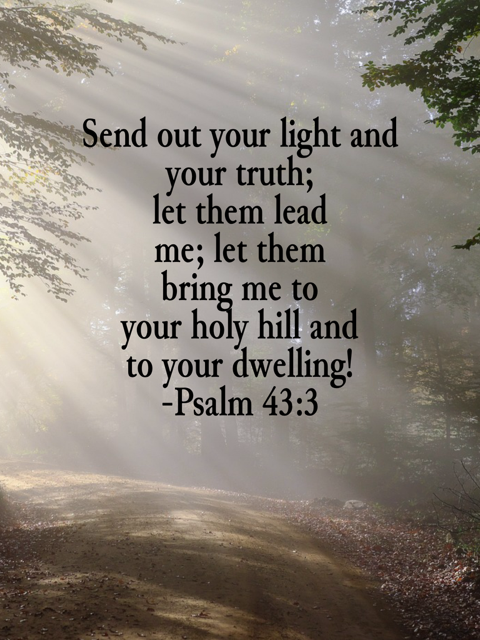
This is God, our God forever and ever. He will guide us forever (Psalm 48:14).
For you are my rock and my fortress; and for your name’s sake you lead me and guide me (Psalm 31:3).
You make known to me the path of life; in your presence there is fullness of joy; at your right hand are pleasures forevermore (Psalm 16:11)
I will instruct you and teach you in the way you should go; I will counsel you with my eye upon you (Psalm 32:8).
Trust in the Lord with all your heart, and do not lean on your own understanding. In all your ways acknowledge him, and he will make straight your paths (Proverbs 3:5-6).
I’ve often wished that God told us exactly what He wants us to do, as He did for some in Bible times. But I think seeking His will is an exercise in faith that can result in drawing closer to God as we evaluate and pray over aspects of our life that we might not otherwise.
I think finding God’s will is somewhere between the two extremes of not considering it at all and considering it overmuch.
So how do we find God’s will?
Pray. “If any of you lacks wisdom, let him ask God, who gives generously to all without reproach, and it will be given him” (James 1:5). “We do not know what to do, but our eyes are on you” (2 Chronicles 20:12). “We have not ceased to pray for you, asking that you may be filled with the knowledge of his will in all spiritual wisdom and understanding” (Colossians 1:9).
Be humble and willing for whatever God wants. “He leads the humble in what is right, and teaches the humble his way” Psalm 25:9).
Read God’s Word regularly. “You guide me with your counsel, and afterward you will receive me to glory” (Psalm 73:24). However, the Bible is not like a “Magic 8 Ball.” We don’t open the Bible, let our finger fall on a verse, and take that as God’s answer.
Even in our regular reading, we have to be careful not to take a verse out of context and apply it to ourselves. Let’s say you are considering the mission field. In your daily quiet time, you come to God’s call to Abraham in Genesis 12: “Go from your country and your kindred and your father’s house to the land that I will show you.” That may seem like a direct answer. But what are you going to do when you come across Mark 5:19: “Go home to your friends and tell them how much the Lord has done for you, and how he has had mercy on you.” God may use these verses to help you be willing to go or stay, but the main point of the verses concerns what God is doing in the lives of those in the passage.
Instead, as we read the Bible day by day, we get to know our God better. As we do, we discern more how He might be leading.
Do what you know to be the will of God now. “But seek first the kingdom of God and his righteousness, and all these things will be added to you” (Matthew 6:33). Many verses speak of God’s will:
Finally, then, brothers, we ask and urge you in the Lord Jesus, that as you received from us how you ought to walk and to please God, just as you are doing, that you do so more and more. For you know what instructions we gave you through the Lord Jesus. For this is the will of God, your sanctification: that you abstain from sexual immorality; that each one of you know how to control his own body in holiness and honor (1 Thessalonians 4:1-4).
Give thanks in all circumstances; for this is the will of God in Christ Jesus for you (1 Thessalonians 5:18).
I appeal to you therefore, brothers, by the mercies of God, to present your bodies as a living sacrifice, holy and acceptable to God, which is your spiritual worship. Do not be conformed to this world, but be transformed by the renewal of your mind, that by testing you may discern what is the will of God, what is good and acceptable and perfect (Romans 12:1-2).
There’s a lovely song titled “This Is the Will of God” incorporating several verses about God’s will.
Consider your gifts and bent. “Having gifts that differ according to the grace given to us, let us use them” (Romans 12:6a). “As each has received a gift, use it to serve one another, as good stewards of God’s varied grace” (1 Peter 4:10). As a quiet, bookish person who doesn’t like crowds, I’m not likely to be called to something involving lots of noise and activity and people. An extrovert who loves being with and talking to people likely will not thrive alone in an office eight hours a day.
Sometimes you discover your gifts by trying different things. In my early Christian life, I was often asked to participate in children’s ministries. I did, and I hope it was useful to those involved. But I didn’t really enjoy it and often had to deal with myself about a less-than-enthusiastic attitude. Then one day our Awana secretary at church asked me to be her assistant, helping with ordering and checking in supplies, keeping score during games, adding up points and assembling awards. I loved it.
One caveat here: God may call you to something you don’t feel gifted for, like He did for Moses, Gideon, Jeremiah, and others. In that case, either He has already gifted you, and you don’t realize it yet, or He will when your gifts are needed.
Ask others. “Where there is no guidance, a people falls, but in an abundance of counselors there is safety” (Proverbs 11:14). Sometimes another person’s insight can be very helpful. They might have wisdom in the area you’re wondering about, or they might see something in you that you don’t see. It helps to ask more than one person, because one opinion might be a little off.
Take the next step. God usually leads step by step, without giving us the whole roadmap at once. If you think God might be leading you to a particular college, look into it. Ask for materials from them. Perhaps go visit. If you think God may be leading you to a certain vocation, read about it, learn about it, maybe take an internship in it. Those experiences, bathed in prayer, can help you know whether to take the next step.
What do you want to do? “Delight yourself in the Lord, and he will give you the desires of your heart” (Psalm 37:4). This doesn’t mean God will give you every little thing your heart desires. As a good parent, He sometimes has to say no. But as we delight ourselves in Him, He puts the right desires in our heart. Again, sometimes He calls us to do what we don’t want to at first. But often, what we yearn to do is what He is leading us to do.
Serve faithfully where you are. As a young man, Joseph could not have known all that was ahead for him: being sold into slavery by his brothers, being wrongly accused, sent to prison, and then becoming second to Pharaoh in Egypt. But He was faithful to God in every situation. Likewise, as a shepherd boy, David had no idea he would someday be king. Even after he was anointed by Samuel, it was years before he came to the throne. Yet he followed and served God all along the way.God
Consider open and closed doors. “A wide door for effective work has opened to me, and there are many adversaries” (1 Corinthians 16:9). Once I planned to go on a school-sponsored mission trip over Christmas break. But the school officials would not approve my going because I was in debt to the school: they felt I needed to work to take care of my obligations before asking people to give to a mission trip.
A closed door doesn’t necessarily mean that opportunity is not God’s will. It may not be the right time. Or the closed door may be an obstacle rather than a “no”–some Christians have gotten into countries that are closed to missionaries by pursuing other vocations within those countries. Gladys Aylward was not approved by China Inland Mission to be one of their missionaries, but she worked and saved money to go to China on her own. She had a long, fruitful ministry.
Likewise, an open door doesn’t necessarily mean that situation is God’s will. There may be several open doors, and discernment is needed to know which one. But by and large, this is one way God guides.
Trust God for the answer. Once my husband had an opportunity for a new job in another state. He was happy in his work, but he felt he should investigate the other possibility. He interviewed and was offered the job.
But he wasn’t sure what to do. There were no red flags, no extenuating circumstances that would point to one job or the other. He was willing to stay or go.
He went to our pastor for counsel, who shared with him Proverbs 16:11: “The plans of the heart belong to man, but the answer of the tongue is from the Lord.” The pastor told Jim that as he had prayed for God’s guidance and was willing to do whatever God wanted, he could trust that when the time came to give a final answer, whatever God laid on his heart at that moment was the right thing to do.
When discussions on God’s will come up, someone will say, “Does God have a will about everything? Even what cereal you eat?” Well–some cereals are certainly better for you than others. There are times in Scripture when circumstances are left up to the individual, like the differences in Romans 14, or the famous disagreement between Barnabas and Paul in Acts 15. Paul once said of Apollos, “Now concerning our brother Apollos, I strongly urged him to visit you with the other brothers, but it was not at all his will to come now. He will come when he has opportunity” (1 Corinthians 16:12). We don’t know what steps Apollos took to come to that decision. Paul shares general thoughts about marriage in 1 Corinthians 7 and distinguishes between God’s instruction and his own advice, but he doesn’t seem to tell any one individual what to do. 1 Corinthians 10 deals with different situations involving meat offered to idols, something common in that day and time. Many of these situations may not have God’s exact will expressed, but they involve wisdom, spiritual maturity, love and concern for others, and a concern for God’s glory over selfish desires.
Multitudes of books have been written on this topic, so there’s much more that could be said and a variety of opinions. But I think we would agree that God promises to lead us and wants us to seek to follow Him closely.

(I often link up with some of these bloggers.)

 Stray Thoughts