

Review: Set the Stars Alight

Set the Stars Alight

In Amanda Dykes’ novel, Set the Stars Alight, Lucy Claremont is the daughter of an English watchmaker whose family invites a young “lost boy” into their circle. Dash grew up in America until both parents died. He lived with a distant aunt who wasn’t home much and seemed not very interested in him.

Lucy’s father loved to tell stories and riddles to the children. Many of his stories centered on a legend about a man who lived 200 years before, Frederick Handford. Handford was a seaman who, accused of treason, stole a boat called the Jubilee and was never heard from again. Many had searched for any sign of Handford or the Jubilee, to no avail. Many stories had been told about what might have happened.

Lucy grew up with a love for the ocean and a desire to research and find the Jubilee. Dash grew up loving the stars, after hearing about them from Lucy’s father and using his homemade telescope. Their interests and circumstances seemed to take them in opposite directions until their paths crossed again while researching the Jubilee.

The story shifts back and forth from 2020 to the 1800s and what really happened with Frederick Handford. He was the son of a respected admiral who, since his own glory days, fell to drink. Frederick grew up with his father on one end of the house, drinking and raging, and his mother at the other end, playing parts of Handel’s Messiah. When his mother died, he ran away to escape his father’s rage and neglect. He was taken in by a kind local shepherd, but inadvertently brought tragedy to the man and his family. Frederick spent the rest of his life trying to make it up to them, especially the man’s daughter, Juliette.

Amanda writes in her author’s notes that this story felt like a set of nesting dolls, with many layers and stories within stories. That’s an apt description.

Amanda’s stories have a way of deeply touching hearts. Her characters are real and flawed, yet their stories are redemptive.

One of my favorite quotes comes from the book comes from a poem titled “The Old Astronomer to His Pupil” by Sarah Williams:

Though my soul may set in darkness, it will rise in perfect light;
I have loved the stars too fondly to be fearful of the night.

A few more quotes that stood out to me:

He is coming, and coming, and coming, and coming after you. In every sunset, in every snatch of birdsong In everything that stirs deep into you and makes you hungry for bigger things, eternal things. That is Him, pursuing you with tenderest grace. In the places so hard they wring your soul. In the places so beautiful they steal your breath. He is there, filling your soul, giving you breath.

Made-up tales that stand through time . . . they are echoes . . . of truth.

I think it’s our duty to keep the stories, to pass them on. It is our duty—and our honor. In a world as dark as ours, we—that is, people—forget how to see the light. So we remind them by telling the truth, fighting the dark, paying attention . . . setting the stars alight. There are things shining brightly all along, if we will notice.

Such freedom, to know our limits. And to know the God who has none.

God had a way of redeeming wounds with the strength of others.

Surprise gave way to curiosity, And curiosity–as it was meant to from the time God breathed life into the great wide world–made way for wonder.”

I listened to the audiobook, which was mostly good except the narrator’s diction wasn’t clear in places. I checked out the e-book from Libby to get the author’s notes and look up some passages.

I thought the modern-day part of the book moved a little slowly at times. But overall, this was a lovely, touching story.

(Sharing with Bookish Bliss Quarterly Link-Up)
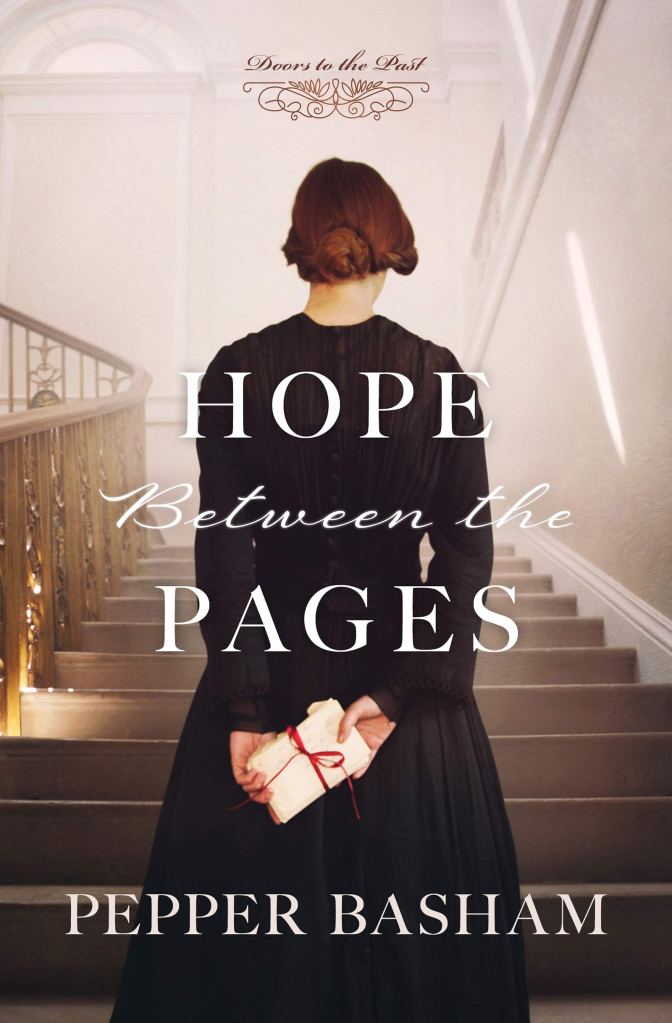
Review: Hope Between the Pages

Hope Between the Pages by Pepper Basham

Hope Between the Pages is a split-time novel by Pepper Basham.

In 1915, Sadie Blackwell is the resident library servant in charge of the books in the Biltmore House in Asheville, NC. A book-lover herself, Sadie enjoyed keeping the library tidy, leaving books guests might like on a library table, and reshelving the books once guests were done with them.

Just a year after George Vanderbilt’s passing, Sadie continued in the position her mother held before her.

As a servant, Sadie was supposed to be “invisible,” vacating the room when guests came in. But one day, she couldn’t get to the door in time and hid. She overheard a British father and son, the Camdens, talking with Mrs. Vanderbilt about books. The son, Oliver, appeared to love books as much as Sadie did. Based on his remarks, she later pulled some books she thought he might like. He responded with a note for the “Library Fairy” whose selections matched his tastes so well.

Not content with a thank you note, Oliver wanted to meet this Library Fairy. She found it difficult to remain invisible from such a pursuit.

In present day Asheville, Clara Blackwell owns a bookstore in Biltmore village, inherited from her father, who recently died. Though she loves her work, the bookstore is faltering a bit since the new big chain bookstore opened nearby. And her uncle Julian, her father’s half-brother, is making a nuisance of himself, trying to encourage Clara to sell. On top of all that, Clara is informed by her lawyer that he does not have a deed for the bookstore on file. If she can’t find the deed, Clara may lose the bookstore anyway.

In searching for the deed, Clara finds a box of her grandmother’s with a couple of notes addressed to a “Library Fairy.” The notes led to a series of discoveries about Sadies’s life previously unknown to the family.

Both women’s journeys take them beyond their predictable environments to step out on faith.

The Biltmore House library is my favorite room in one of my favorite places. I’ve wished many times that I could go beyond the cordoned-off path on one side of the library and walk into the room. I wouldn’t disturb any of the books, but I’d like to scan the titles up close, sit in one of the chairs, and soak up the ambience. However, I imagine if all of us who wanted to did that, we’d probably wear out the furniture and carpet. So you can imagine my delight to find so much of the book connected to Biltmore’s library!

The scenes in the rest of the house and the imagined conversations with Mrs. Vanderbilt were fun as well.

And with a librarian and bookstore owner as main characters, the book contained many literary references.

But beyond the bookishness of the stories, I loved the characters and their arcs. Besides the theme of stepping out of faith, being willing to leave the familiar behind, another undercurrent was being seen beyond the surface to what we really are underneath.

A few of my favorite quotes:

Few people are as they appear at first, and it behooves the heart of a Christian to see with gracious eyes our fellow humans, whether of high-bred means or low. After all, I’d been a servant, or the daughter of a servant, my entire life, and certainly hoped, if given the chance, people would see me for more than a quiet worker with nothing of interest to say. I had plenty to say—too much, really, for my occupation (p. 42).

God was there. And here. And all the places in between. Couldn’t I trust Him with the horizon as I trusted this ship to carry me . . ? (p. 147).

I’d lived a quiet life as long as I could remember, so solitude didn’t frighten me. In fact, I slipped it on like a pair of well-loved shoes (p. 164).

Maybe the definition of romance wasn’t some generic ideal dispersed among the romance-reading masses. Perhaps, in real life, romance corresponded to the intimate and individual needs of the two hearts. Unique. A handcrafted, heavenly match (p. 219).

Keep to your Bible and to your fairy tales, sweet girl. One is for your soul and the other is for your daydreams. Both will help you through this, and in both you’ll find your story (pp. 245-246).

My father always told me to never outgrow my belief in faith and fairy tales, but fear has a way of darkening one’s vision, and so I’d lost of the beauty God displayed through magical stories. Not so much the glass slippers or the poisoned apples, but the deeper truths. The light overcoming darkness. The rewards of perseverance. The beauty that can come through trials of thorns or battles or even sleeping death. I’d forgotten that imagination gives me so much more than the ability to fall into the world of a book. It motivates my dreams, inspires remarkable love, and helps me see beyond this world to a greater one (pp. 249-250).

I’d never considered how some of our greatest losses lead us to choices that God uses for bigger things than we could have ever imagined. Sometimes brokenness and heartache force us into self-seclusion and fear, and sometimes they can propel us into something amazing, if we let them (pp. 251-252).

I think many people would love this book even if they weren’t so much interested in the Biltmore House and classic literature.

This book is one in a Doors to the Past series. Each is written by a different author and involves a historic American landmark. I think each may be a split-time novel as well. This is the only book I’ve read in the series.

This is also the first book of Pepper’s that I have read, but it won’t be the last, especially knowing she lives in and writes about the Blue Ridge Mountains area of North Carolina.

Book Review: The Road Home

In Malissa Chapin’s debut novel, The Road Home, Cadence Audley has started a new life with a new name—for the second time. Her past has dogged her steps, but she’s determined to lead a quiet, peaceful life in Deercrest, Wisconsin. She’s found a good job as a barista with a great boss. Antique stores in the area fulfill her taste for vintage purchases.

On one such shopping trip, Cadence finds an old recipe box filled with hand-written recipes. Her coworker Googles the name written inside the box and found that the owner had lived in town. Thinking to return a valued heirloom, Cadence finds Fredonia, the middle-aged daughter of the recipe box owner. Fredonia had donated the recipe box in the first place and is not thrilled to see it again—or Cadence, for that matter. But, upon learning that Cadence likes antiques, Fredonia invites the younger woman to drive with her to Kentucky to help clean out her mother’s home.

Fredonia’s offer comes just in time, because Cadence’s past has caught up with her—again.

This is a split-time novel. The second timeline belongs to Ida Beale Evans, owner of the recipe box. She had been a banker’s daughter in Indiana when she married her sweetheart, Bud, and moved with him to his new pastorate in Kentucky. Though she enjoys life as a country preacher’s wife, she has one sorrow. Suddenly one night, her deepest desire is unexpectedly fulfilled—but to keep it will call for a lifetime of secrecy.

Though Ida is a Christian and Cadence is not, both women struggle with trusting that the truth will set them free. The truth seems like it will destroy them. But Cadence has come to the end of her road. Can she escape and start over yet again? Or must she face her past and its consequences, even though doing so means losing everything she holds dear? Can she trust the young preacher who tells her, “Your sin caused problems everywhere, but God is bigger than this. He’s big enough to help you live a new life” (Location 3415, Kindle version).

I enjoyed following the journey of both women and the truths they learned. I also enjoyed the sense of place in the book, especially the Kentucky sections. There was a nice mix of both funny and poignant moments in the story. Sprinkled throughout the book are recipes from Ida Beale’s box. It was fun to learn on Malissa’s blog what inspired the pink Cadillac road trip in the book and to peruse her Pinterest board for the people and items that inspired or contributed to the story.

As of this writing, the Kindle edition is $2.99, but a paperback version is also available.