Review: Every Hour Until Then

Every Hour Until Then

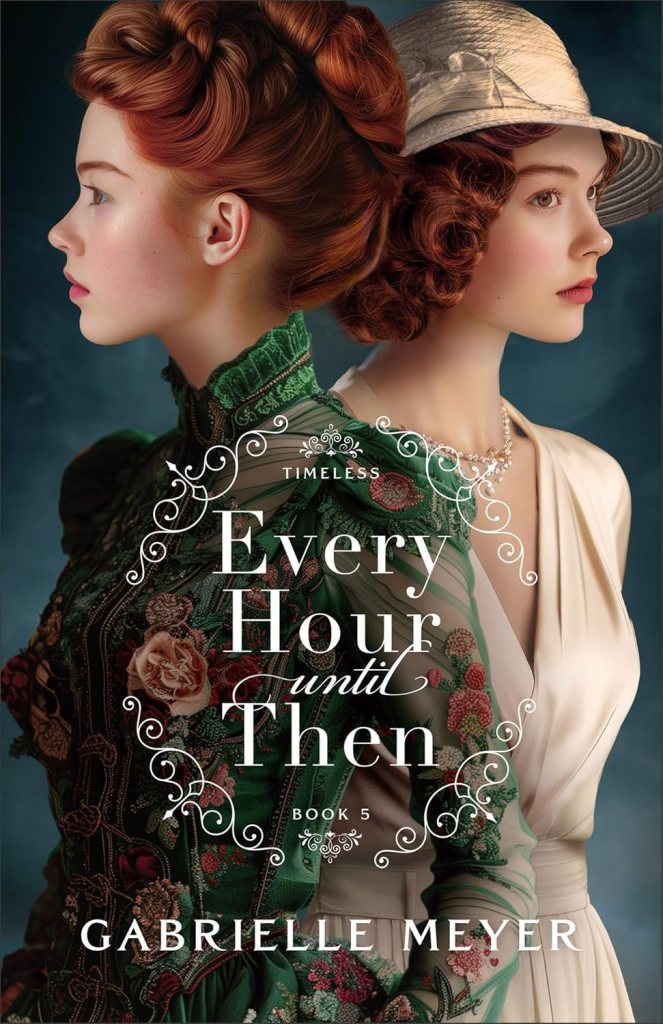
Every Hour Until Then is the fifth in Gabrielle Meyer’s Time Crosser novels about a handful of people who lead double lives. They live a day in one year, and when they go to sleep, they wake up in another year and place, centuries before or after. The next day, they wake up in the first timeline as if no time had passed there. They have until their twenty-first or twenty-fifth birthdays (depended on a number of factors) to chose which path they want to stay in. At that time, they’ll lose the other path.

Twenty-three-year-old Kathryn Kelly lives a privileged life in 1888 London with her parents and sister, Mary. As the book opens, Mary is packing to leave home but won’t tell Kathryn why. Kathryn runs to her father to stop Mary, but he insists Mary is now dead to them. But Kathryn is determined to find out what’s going on. She learns that Mary has gone to live as a charwoman in the Whitechapel district, a poor and dangerous part of London.

Kathryn’s neighbor, Austen Baird, has been her best friend since childhood. But he’s been distant since his parents died a few years ago. Still, she hopes he’ll accompany her to Whitechapel since she can’t go there alone.

In 1938, Kathryn Voland lives with her parents in Washington D.C. She has a lifelong interest in history and works as an assistant exhibit curator at the Smithsonian Arts and Industries Building. Her father is famous aviator Luke Voland. Her mother is another time crosser, Grace from For a Lifetime. They’ve just come to London because Kathryn has been invited to be a guest curator for a special exhibit at the London Museum. However, Kathryn has ulterior motives for being in London. Kathryn’s two timelines are only fifty years apart, closer than most time crossers. She hopes to find clues in 1938 that might help her find Mary in 1888. Yet with the threat of war with Germany looming, she doesn’t know how long she’ll be able to stay in London.

As Kathryn meets with the museum’s Keeper, Sir Bryant Rothschild, she learns that the special exhibit will feature Jack the Ripper on the fiftieth anniversary of his crime spree.

As Kathryn researches Jacks’ gruesome murders, she’s horrified to learn that her sister in 1888, Mary Jane Kelly, is Jack’s fifth victim.

Her first instinct is to put all her energy into finding and saving Mary. But one of the time crossers’ rules is that if they knowingly change history, they’ll lose their lives in that timeline. Kathryn’s planning to stay in 1938 anyway, so leaving 1888 a couple of years early is not a great loss. But her mother has warned her that changing history can have serious unintended consequences.

And her relationship with Austen is just beginning to reconnect. She believes he feels something more than friendship for her. Does she really want to leave without exploring whether they could have a future together?

She decides that, whatever the risks or consequences, she must save Mary.

I’ve enjoyed all of Gabrielle’s Time Crossers stories, but this one was riveting, especially the last half. Often I can guess at the ways a plot might go, but this one had a twist that gobsmacked me.

I had known very little about the Jack the Ripper murders before reading this book. They remain some of the worst murders of all time. I felt the author did a good job conveying what Jack did without going into unnecessary details.

I got a little irritated at Kathryn’s penchant for getting herself into dangerous situations. However, she does begin to realize that she is impetuous, headstrong, and stubborn, and that those qualities are not always good. She also finds that she runs ahead of God, hoping He’ll approve her plans, instead of waiting on His leading.

I enjoyed the audiobook read by Liz Pearce. I am used to Liz’s voice on some of Roseanna M. White’s books, so it took some adjustment to remember I was in another author’s stories.

I’m glad this audiobook contained the author’s historical notes, sharing where she got her inspiration and what facts were true or fiction. There are several theories about who Jack was and why he committed his crimes. Gabrielle chose one of the theories to incorporate into her novel.

I’ve wondered how many ways Gabrielle can take this time crossing theme. All of the books have been excellent so far, and another is due out this fall. I can’t wait.

(Sharing with Bookish Bliss)

Review: Across the Ages

Across the Ages

Across the Ages is the fourth in Gabrielle Meyer’s novels about time crossers: people who live in more than one timeline until their twenty-first birthdays, at which time they can choose which of their timelines to stay in and which to forfeit.

In all the previous books, the time crosser had a parent to tell them what was going on and share the rules. In this book, Caroline’s mother left her as a baby with her grandfather in South Carolina in 1727 and then fled, never to be heard from since.

Caroline goes to sleep in South Caroline and wakes up in Minnesota in 1927, where she is the dutiful daughter of a famous pastor. The next night, she goes to sleep in MN and wakes up in SC on a plantation with her grandfather, without having lost a day in-between.

When Caroline tried to tell either family about her strange existence as a child, they scolded her for making up stories. Her grandmother from her 1727 life had been burned at the stake as a witch. All Caroline can figure is that she’s under a curse from that grandmother.

When her grandfather in 1727 plans to force her into an arranged marriage with a man she doesn’t love, she decides to try to find her mother to get some answers. Caroline dresses as a boy and finds work on a ship to Nassau, the last known location of her mother. Everything goes well—until her boat is captured by pirates.

In 1927, Caroline’s brothers don’t live up to her father’s standards. One is a crooked cop, the other a crooked businessman. She tries to keep her brothers’ activities secret so as not to harm her father’s reputation. But she admits that living under public scrutiny is wearing. Her own search for answers leads her to places her parents wouldn’t want her to go.

Gabrielle Meyer keeps finding ways for new takes on this unique concept. This is the first book where the main character isn’t related to the main characters in the previous books. But I realized further in that there was a connection in this book with some of the side characters from the third book, For a Lifetime.

I listened to the audiobook, nicely read by Rachel Botchan, who has narrated all the books in this series. Thankfully, the audiobook included the author’s historical notes.We meet Ernest Hemingway and Charles Lindbergh as characters in this book, and several others are based on real people. Caroline’s preacher father is based on Billy Sunday, which I had guessed due to his having been a professional baseball player. However, I had not known that Sunday’s sons did not share his faith and dabbled in the things he preached against, like Caroline’s brothers did.

Some readers would want to know that there is mention of adultery and brothels with the corrupt brothers, but nothing explicit is shown.

Part of the history also included in this novel was the O’Connor agreement in St. Paul, MN, whereby criminals could stay in the city without being bothered as long as they checked in with the police, paid bribes, and did not commit crimes while there.

But besides the fascinating historical detail, I enjoyed Caroline’s personal journey, though it was painful for her in parts. She struggles to discern what true belief in God is, rather than just performing outwardly to her parents’ expectations. And she finds that she is not cursed, but blessed.

Although this book could be read alone, I’d recommend the whole series.

Review: For a Lifetime

For a Lifetime by Gabrielle Meyer

For a Lifetime is Gabrielle Meyer’s hot-off-the-press third book in her Timeless series about time crossers.

In this series of novel, a time crosser is one who lives in two timelines. They live in one period of history, and when they go to sleep, they wake up in a different time without any loss of time between. When they go to sleep again, they wake up back in the first time as the very next day, going back and forth. They all bear a sunburst birthmark that marks them as time crossers, some over their heart, some on the back of their heads. The ones with the head marking have until their twenty-fifth birthday to decide which time they want to live the rest of their lives in. If they knowingly try to change history at all, they’ll forfeit their lives in that time period.

In this book, the time crossers are twin girls, Faith and Hope. One of their timelines is in Salem Village, Massachusetts, in 1692, just before the Salem witch trials begin. The twins are twenty-four, working at their father’s tavern and restaurant. They never knew their mother, having been told she died in childbirth. Their father is harsh and distant, treating them more like servants than daughters.

Their second timeline in in 1912, where Grace is a journalist and Hope is a beginning aviatrix in New York. Their mother in this timeline is a time crosser as well (from the previous book) and lives in Washington DC, where her husband had been a Pinkerton agent during the Civil War and then helped start the Secret Service.

The young women have both decided to stay in 1912 on their twenty-fifth birthdays. Hope thinks they should change history in 1692 so they can go ahead and stay in 1912. Grace thinks the risks are too great–one change could cause a catastrophe.

Grace is dutiful, thoughtful, kind, and level-headed. Hope is adventurous, strong-willed, and prefers acting to thinking.

In 1912, one of Grace’s articles exposed an owner of shirtwaist factories for his unsafe practices which resulted in a serious fire. He struck back by trying to buy the building her parents rented for their orphanage, offering three times the amount the building was worth. Grace wants to confront him, but her father warns that it’s unsafe. So they try to find another way to raise the money to purchase the orphanage themselves.

Also in 1912, Hope is attracted to her flying instructor, well-known aviator Lucas Voland. But he wants to keep their relationship professional. When she introduces Luc to Grace, they instantly dislike each other.

In 1692, Grace is attracted to a neighboring farmer named Isaac, but he only has eyes for Hope. Hope, however, wants nothing to do with him.

In 1912, Grace once looked up a history book about the Salem witch trials and saw, to her horror, that she was said to have accused Hope of being a witch. Grace shut the book and didn’t look up any more information about it. She didn’t tell anyone, and has no intention of accusing Hope–she doesn’t see how such a thing could ever be.

Meanwhile, some young girls are said to be “afflicted,” experiencing convulsions and complaining of being pinched, etc. They accuse a few women in the village of afflicting them. Thus the hysteria begins.

The Salem witch trials are not my favorite time in history to read about. They seem a blight not only on American history, but on church history. The lack of common sense, much less spiritual sense, among the leadership in the village is troubling. If this account is true, if anyone challenged to accusations, then they became a target.

But it was interesting to read how Grace, Hope, and Isaac dealt with life under such situations.

Plus I didn’t like Hope much as first. She seemed immature and selfish. But part of her story arc includes her realizing that about herself.

I had thought, with twins being the main characters, that the major conflict would go one particular direction. It didn’t appear to go the way I was thinking at first until a major, shocking, unexpected plot twist occurred. My interest in the book increased after that.

I listened to the audiobook, nicely read by Rachel Botchan. Happily, this audiobook did include the author’s historical notes at the end. She had ancestors on both sides of the Salem trials, sparking her interest. Her research shows that some of the afflicted girls probably had some form of mental illness, which would not have been understood at the time. But others took advantage of the hysteria. She said the reasons for the hysteria were many and complicated.

She also said both Grace’s and Hopes characters in 1912 were inspired by Harriet Quimby, who was both a journalist and flyer, the first woman to fly across the English Channel. (if you’re interested in reading this book, I would hold off reading about Harriet, or you might get some spoilers.)

I loved how everything ended up in both timelines. There are a number of themes in this book, but one that stood out to me was that God often works the most in our lives through circumstances that we did not want.