
Review: North! Or Be Eaten

North! Or Be Eaten

North! Or Be Eaten is the second of Andrew Peterson’s Wingfeather Saga for children.

In the first book, On the Edge of the Dark Sea of Darkness (linked to my review), we met the Igiby family: grandfather Podo, mother Nia, sons Janner and Tink, and daughter Leeli. They lived in Skree, which is under the domination of the Fangs of Dang, headed by Gnag the Nameless.

At the end of the first book (spoiler alert if you haven’t read it), the children are stunned to learn that they are the lost Jewels of fabled Anniera. Their father was the High King.

Unfortunately, the Fangs figure this out as well. They raze the town, burn the Igiby’s home, and pursue them. Podo’s plan is to make it to the Ice Prairies, which the lizard-like Fangs can’t tolerate. Once there, they can decide what to do next.

Thus the family sets out on an epic quest “through many dangers, toils, and snares.”

They are accosted by the Stranders, rough, fierce people who live in Glipwood Forest and have no conscience about stealing and kidnapping. Yet they find a couple of people of character even there.

They get separated at Dugtown, which, oddly, lacks children–and soon find out why.

While searching for the lost Tink, Janner gets whisked away to the deceptively named Fork Factory, where there is no escape.

They are betrayed by those they thought were friends. But they find aid in unexpected sources.

Along the way, they battle not only the enemies pursuing them, but themselves. When the journey is quiet, the children are told more about the kingdom and their established roles in it. Leeli is fine with hers and seems to have been fulfilling it already. But the boys take longer to absorb the news and aren’t so sure they want the responsibility.

However, their trials and hardships bring home to their hearts what is most important. And when things seem at their lowest, “darkness is seldom complete, and even when it is, the pinprick of light is not long in coming–and finer for the great shroud that surrounds it” (p. 312).

One whose hidden past caught up with him “moved through the days in peace and wonder, for his whole story had been told for the first time, and he found that he was still loved” (p. 323).

The first book took a while to set up the characters and situation. This book dove right into the action. There’s a lot less humor in this book than the first, but I felt the first went a little overboard in that department. There aren’t many occasions for full-blown humor in this book, but it’s tucked in here and there.

Besides trusting “the Maker,” family, bravery, and overcoming, it seemed to me that identity was a key theme. Though Janner struggled with his role in the kingdom, remembering who he really was helped him in the Fork Factory, where all the workers were only called “Tools” and treated as such.

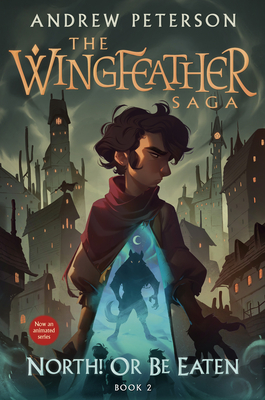
The book is wonderfully illustrated by Joe Sutphin. I think the boy on the front cover is supposed to be Tink, who looks a lot like former Monkee Michael Nesmith. 🙂 I don’t think that’s purposeful, as neither author nor illustrator are old enough to have been Monkee’s fans. But it was a fun connection.

I enjoyed the book a lot, especially the latter third of it. There are two more books in the series. I look forward to what happens to the Igiby family next.
Review: On the Edge of the Dark Sea of Darkness

Dark Sea of Darkness

On the Edge of the Dark Sea of Darkness is the first in the four-part Wingfeather Series by Andrew Peterson. Amazon recommends it for children in third through seventh grades

The story takes place in the mythical land of Skree, which has been taken over by life-size lizard-like people called Fangs, whose leader is Gnag the Nameless.

The book’s main focus is the Igiby family: mother Nia, grandfather Podo, and children Janner, Tink, and Leeli. Podo is an old pirate with a pegleg, but he’s amazingly agile. Leeli’s leg is crooked, and she walks with a crutch. The children’s father died some time ago, and Janner is disturbed that his grandfather and mother won’t allow questions about him.

Despite the oppressive Fangs, life is fairly peaceful in Skree.

Oh, yes, the people of Skree were quite free, as long as they were in their homes by midnight. And as long as they bore no weapons, and they didn’t complain when their fellow Skreeans were occasionally taken away across the sea, never to be seen again. But other than the cruel Fangs and the constant threat of death and torture, there wasn’t much to fear in Skree (p. 3).

But then the children have an altercation with one of the Fangs, Slarb. The children are put in jail but released when their mother gives the commander some of her jewels.

But now they are on Slarb’s radar.

And Janner didn’t even know his mother had jewels. Between that and the secrets surrounding his father, Janner wonders what else his mother is hiding.

The tension escalates into a classic battle of good-vs.evil with a surprise revelation at the end.

Alongside this plot, the children have normal fusses with each other and learn to face fears.

There seems to be some symbolism or allusions to Christian themes like in the Chronicles of Narnia. The family prays to “the Maker.”

One GoodReads reviewer said “Peterson intended this to be the ‘vastness of Lord of the Rings’ with the ‘whimsey of the Princess Bride.'” I don’t know if she read that in an interview: if so, I’d love to find it. It does help understand the tone of the story.

Some of the animals that live in Skree and the nearby forest are skonks, toothy cows (like our cows except they have long fangs and are omnivores), thwaps–like squirrels, a menace to gardens, and flabbits–like rabbits bur hairless with exceptionally long ears..

The danger is real and scary, but humor is sprinkled throughout. In fact, there seemed too much humor in the first part of the book.

I had a hard time getting into the book at first. But once the action picked up and some of the things hinted at came to light, I thought it was very good.

Some of my favorite quotes:

Blood was shed that you three might breathe the good air of life, and if that means you have to miss out on a Zibzy game, then so be it. Part of being a man is putting others’ needs before your own (pp. 23-24),.

There’s just something about the way he sings. It makes me think of when it snows outside, and the fire is warm, and Podo is telling us a story while you’re cooking, and there’s no place I’d rather be–but for some reason I still feel… homesick (p. 70).

Even if hope is just a low ember at night, in the morning you can still start a fire.

An animated series has been made of the books–at least the first two, I think. I have not seen it but want to with my son’s family. It appears to be very well done.

(Sharing with Bookish Bliss)