Spontaneity vs. scheduling

This was originally posted two years ago almost to the day. I was working on post in which I was going to link to it, but as I read through it, I realized it said what I wanted to say already.
____________________________________________________________

933343_i_love_you.jpgI’ve always loved holidays and the opportunity to celebrate something special, to do something a little different from the ordinary. I look forward to them eagerly.

But over the last few years I’ve increasingly heard sentiments along the lines that, “I’d rather have spontaneous everyday expressions than a scheduled one dictated by greeting card companies with all the pressure and expectations.” I’ve probably heard it most in connection with Mother’s Day and Valentine’s Day, but there seems to be a growing anti-holiday mentality in general.

Well, we do have to be careful about unrealistic expectations and pressures. Traditions can be wonderful elements in one’s life, but if they add pressure and we feel enslaved to them (“It just wouldn’t be Christmas without….”), then they’ve gone too far. If our schedules are over-flowing and we feel we have to add 50 things to it to celebrate a holiday, then we need to reevaluate. A commemoration of a holiday can be very simple: most years our Valentine’s Days have just involved a card by everyone’s plate at dinner and heart-shaped cupcakes for dessert, though some times we’ve done more.

And it is true stores commercialize just about every holiday. But commercialization in itself isn’t a reason not to celebrate.

I look at it this way: we’re supposed to be thankful every day, but Thanksgiving is a special opportunity to take the time to sit down and take stock of all that we have to be thankful for and to actually spend time giving thanks to the One who has blessed us. It doesn’t mean any less because we gave thanks according to a date on the calendar rather than spontaneously.

In the same way, I love my family every day and I hope I show it at least often enough that they don’t doubt it. But lives get busy and distractions multiply, so it’s nice to have an occasional time to focus on the other people in our lives and let them know how much we love them. It doesn’t mean any less because it’s a “scheduled” time to show love. If my husband gives me a nice card on Valentine’s Day, as he usually does, I’m not going to toss it aside and think, “He just did that because he felt he was ’supposed’ to.” I am going to enjoy it and appreciate it for what it is: an expression of his love. It’s the same with Mother’s Day: we should honor our parents every day, but there is nothing wrong with a special day set aside to sit down, take stock, remember how much we love them and appreciate them, and let them know that.

Holidays and celebrations can even be a reminder or add a bit of revival to the appreciation we should feel every day. I honestly don’t think about patriotism very much on an everyday basis, but patriotic holidays remind me that I am extremely glad to live in my country and I am extremely thankful for those who make it possible.

One quote in my files attributed to Samuel Johnson says, “The Church does not superstitiously observe days, merely as days, but as memorials of important facts. Christmas might be kept as well upon one day of the year as another; but there should be a stated day for commemorating the birth of our Saviour, because there is danger that what may be done on any day, will be neglected.”

“What may be done on any day” may be neglected because we don’t often think about it in the course of busy everyday responsibilities.

I’m not saying I think everyone should keep holidays. “He that regardeth the day, regardeth it unto the Lord; and he that regardeth not the day, to the Lord he doth not regard it” (Romans 14:6a).

I’m just saying that a scheduled time for honoring someone or showing appreciation doesn’t negate the everyday expressions and doesn’t mean any less. It’s nice to have both the spontaneous and the scheduled.

(Photo courtesy of the stock.xchng)

Booking Through Thursday: Encouragement

btt button The Booking Through Thursday question for this week is one I submitted how to encourage non-reading older children to read.

Reading was one of our favorite activities when the kids were little. We read all through the day, every night before bedtime, took regular trips to the library, signed up for reading programs with fun prizes, end-of-summer parties, etc. They all loved to read as young children. Or maybe I should say they loved being read to. Only one grew up to read regularly, though. Beyond the star-on-a-chart types of encouragement, they didn’t seem open to suggestions about books they might like. One regularly responded to any suggestions about reading with, “I’m just not a reading kind of guy, Mom.” Which of course broke this book-loving mom’s heart.

Some years ago I read Ben Carson’s autobiography, Gifted Hands. One of the major factors in his life was that his mother required Ben and his brother to read a certain amount every day beyond classroom requirements. I’ve toyed with making reading a requirement in the hopes that it would “grab” them, but feared it would backfire, human nature being what it is, and make them resent a book that they might otherwise like.

Most suggestions for creating readers include:

Parents actively reading. √
Read to them as children. √
Take them to the library. √
Keep interesting reading material on their level. √
Read aloud to them. I did this for years but fell away as they got older and busier. I wish I’d kept it up.

What does it matter whether they read or not? Well, I just hate for them to miss out on all that can be gained by reading — enrichment, learning, broadening horizons, useful ways of passing time, even spiritual growth. My friend Janet came up with 25 great reasons to read, one of my favorites being that God relates to us through words; Jesus Himself is called the Word.

I have one teen-ager left at home. How would you encourage an older child, teen, or young adult to read?

Wednesday’s Random Dozen


Linda at
2nd cup of coffee created and hosts the Random Dozen meme every Wednesday. You can answer the questions on your blog and link up to Linda’s plus find more participants there.

1. Are you pleasant when you’re ill, or are you a grumpy, fussy patient?

I’m not pleasant, but I don’t think I am grumpy or fussy. It depends on what it is, how long it has been going on, etc. I tend to want to be left alone when I am not feeling well.

2. When you find out that school is canceled (due to inclement weather) what is your gut reaction?

Joy that we get to sleep in!

3. What is one domestic skill you wish you could improve?

Oh, it’s hard to say. I’m not “expert” in any area. I probably most need to improve on bargain hunting/thriftier spending.

4. Do you decorate your home for Valentine’s Day?

Some years more than others. This year all I’ve put up is a wreath on the door.

Heart wreath

Other years I’ve gone all out. This year — just recovering from being sick and having a very busy several days and needing to catch up around the house — I don’t think I’ll be getting into the extra decorations as much.

5. What song is on your mind today?

At the moment, “Nothing but the blood” by Ron Hamilton. It changes throughout the day.

6. Do you prefer contemporary movies or classic?

Again, it all depends — what I am inclined toward at the time, whether I am watching with someone and what they want. I like them both. The main disadvantage with a lot of contemporary movies is overt sexuality, so we don’t actually watch that many, but we do find a few to enjoy. We do wait til they come out on DVD so we can screen them better rather than just being at the mercy of whatever comes on the big screen at a theater.

7. How well do you “compartmentalize” your feelings? For example, how well can you put aside a really trying moment to deal with the immediate situation which is not related to the trying moment, e.g., putting aside a tiff with your spouse in order to finish wallpapering a room.

I can set aside feelings in the sense of not saying anything about them at the moment. I can’t just turn off the feelings themselves, though.

8. What is the first thing that attracted you to your spouse? (Or if you’re single, to your best friend.)

The first thing I noticed about him before we met was that he was nice looking. I enjoyed the fact that he was fun to be around once we did meet. But I think what really attracted me to him was seeing his kindness toward others.

9. When was the last time your heart raced?

Well, I have physical problems with that, so I am happy to report not lately, at least not enough to require care. But I did have a dream last night that there was a tornado coming — we could hear the freight-train sound — and no one was concerned or doing anything about it. So my heart probably raced a bit then! I had to listen for a few minutes when I first woke up to make sure there wasn’t really anything going on (we don’t live near train tracks, so I know it wasn’t that.)

10. What are your memories of Valentine’s Day at school?

I enjoyed making the little boxes or pockets to hold the Valentines from classmates and I enjoyed buying and addressing the little kiddie Valentines. I think we had refreshments of some sort while we opened our Valentines at the end of the day.

11. If you were going to receive candy for Valentine’s Day, which would you prefer?

It would have to be some form of chocolate. 🙂 I like many types of candy, but I think at the moment Lindt truffles are my favorites.

12. Red or pink?
Pink….as you can probably tell. ♥♥♥♥♥

Book Review: Words Unspoken

I don’t remember where I saw a recommendation for Words Unspoken by Elizabeth Musser. I keep an ever-growing list of books I want to look into, and I usually note what led me to interest in the book, but I failed to this time.

But I am glad I saw it recommended somewhere.

In Tennessee in the mid-eighties, the mother of teen-ager Lisa Randall dies right in front of her in a traffic accident, and Lissa blames herself. Eighteen months later, every time she tries to drive very far, she experiences severe panic attacks. Life is at a standstill. A brilliant, competitive student, she can’t face the possibility of college now. Her father does not seem open to discuss anything and does not seem to acknowledge any underlying problems.

A casual mention of Ev MacAllister’s driving school leads Lissa to a kindly older man nearing retirement who seems to know so much more than driving, who seems to understand what is going on beneath the surface.

But then chapter 2 brings a whole slew of new characters who don’t seem at all related to each other or the main story:

A young, cocky, ambitious Italian editor.

A depressed missionary wife in France who has lost a child.

An overconfident stockbroker.

A Southern socialite trying to keep up appearances while her marriage is crumbling.

A wildly successful but reclusive author.

At first the introduction of all these other people and plot lines was a little jarring, partly because it was so unexpected. This is not an uncommon plot device, but there was nothing on the back of the book or in descriptions I read about it to indicate there was any story other than the main one. Yet as a reader I trusted that it would all come together somehow…and oh, how it did. One by one connections are revealed, paths intersect, mysteries unfold and then resolved. Everything is masterfully woven together.

I don’t want to take away from any of that discovery, so I’ll not reveal more than that of the plot.

In one sense, it is hard to sum up what the book is about. Depression in some. Ambition in others. Character, good and bad. But ultimately…hope.

(This review will be posted to Semicolon‘s Saturday Review of Books.)

The Week in Words

http://breathoflifeministries.blogspot.com/2010/01/announcing-week-in-words.html Melissa at Breath of Life hosts a weekly carnival called The Week In Words,which involves sharing some words from your reading. Melissa explains,

“Playing along is simple, just write a post of the quote(s) that spoke to you during the week (attributed, of course) and link back here [at Melissa‘s]. They can be from any written source, i.e. magazine, newspaper, blog, book. The only requirement is that they be words you read.”

Here are a few things that stood out to me this week:

From Elisabeth Elliot’s book On Asking God Why as quoted in the daily e-mail devotional:

There are those who insist that it is a very bad thing to question God. To them, “Why?” is a rude question. That depends, I believe, on whether it is an honest search, in faith, for his meaning, or whether it is a challenge of unbelief and rebellion. The psalmist often questioned God and so did Job. God did not answer the questions, but he answered the man–with the mystery of himself.

He has not left us entirely in the dark. We know a great deal more about his purposes than poor old Job did, yet Job trusted him. He is not only the Almighty–Job’s favorite name for him. He is also our Father, and what a father does is not by any means always understood by the child. If he loves the child, however, the child trusts him. It is the child’s ultimate good that the father has in mind. Terribly elementary. Yet I have to be reminded of this when, for example, my friend suffers, when a book I think I can’t possibly do without is lost, when a manuscript is worthless.

From the same source, a quote she included which I’ve found all too true in myself:

Sir Joshua Reynolds wrote, “There is no expedient to which a man will not resort to avoid the real labor of thinking.”

From the chapter “A Wife’s Responsibility to Help Her Husband” by Barbara Hughes in Becoming God’s True Woman:

No one wants to play second fiddle. But the fact is, without a second violin there is no harmony.

From Mrs. Dunwoody’s Excellent Instructions for Homekeeping (I quoted extensively from this book in a review here):

She taught that women were not just doing chores, they were creating — creating a home, a place of security, warmth, contentment, and affection (p. xii).

From a friend’s Facebook wall:

I have cast my anchor in the port of peace, knowing that present and future are in nail-pierced hands –Valley of Vision

From the Facebook wall of a friend battling cancer:

As we remember the lovingkindness of the Lord, we see how good it was to find our own strength fail us, since it drove us to the strong for strength. ~ Spurgeon

What interesting finds have you come across in your reading this week?

Microfiction Monday

Welcome to Microfiction Monday,
where a picture only paints 140 characters.

microfictionmonday

Susan at Stony River has begun a Microfiction Monday wherein participants write a story in 140 characters or less based on a particular image that Susan has chosen for the day.  Design 215’s Character Counter helps keep track of the number of characters. It’s a fun exercise in creative conciseness…or concise creativity… You can visit Susan’s to see some very creative stories for today.

The picture for today and my take on it:

“Jane, darling, it’s John. I was wrong. I’ve been so miserable. Could I see you again?”

“Jane,” called Rob from the kitchen, “Who called?”

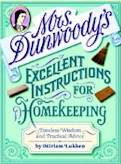
Book Review: Mrs. Dunwoody’s Excellent Instructions for Homekeeping

Some time back I found this quote somewhere online (I forgot to note where) from a book titled Mrs. Dunwoody’s Excellent Instructions for Homekeeping:

In these notes, I have endeavored to impart knowledge necessary for keeping a neat, well-ordered home. But beyond that, I wish for you to understand the larger issues of homekeeping — creating an environment in which all family members grow and thrive, a place where each member may evolve to the full extent our Creator intended.

I liked that, and I further liked the information posted with it, that  “Mrs. Dunwoody, the wife of a judge in Georgia, was the ‘Martha Stewart’ of her time during the Civil War. She started her journal (notes) on homemaking in 1866, and would spend the next 50 years to complete her notes.”

I liked this so much that I asked for this book for the next Christmas or birthday. When I received it and started looking through it, though, I found that it was not written by a real 1860s Mrs. Dunwoody: It was written by a modern Miriam Lukken in 2003 in the style of the “receipt books” “that nineteenth century Southern women penned as a record of all they knew and thought meaningful,” and Mrs. Dunwoody was a character based the author’s great-grandmother and other Southern women.

At first I was sorely disappointed. But then as I began reading, I realized that I still did like the philosophy of housekeeping represented.

She believed that the ordinary acts we practice every day at home are of more importance to the soul than their simplicity might suggest. Taking care of our home enables us all to feel nurtured and safe; it brings comfort and solace both in the fruits of our labor and in the freedom it affords to experience life to its fullest.

She taught that women were not just doing chores, they were creating — creating a home, a place of security, warmth, contentment, and affection (p. xii).

Home reflects the creativity, serenity, and beauty we hold dear (p. 7).

Homekeeping is a fine art. It grasps with one hand beauty, with the other utility; it has its harmonies like music, and its order like the stars in their courses. I fear really good homekeeping — which exhibits itself not in occasional entertainment or a handsome parlor, but in good housekeeping which extends from the attic to the cellar, and through every hour in the year — is far from common (p. 8).

I’ll admit that my home is not in complete order from attic to the first floor every hour…but I do see her point.

Organization has more benefits than mere efficiency…Knowing your life and home are in order reduces strife and anxiety, and increases confidences. In short, establishing your own routine for tackling domestic chaos makes the task less burdensome. And everyone feels the effects of that (p. 8).

Homekeeping is an ongoing art, a process, not an end product. It will never be “all done.” Bathrooms, clothes, and dishes, once clean, have a way of getting dirty again. But home is meant to be lived in, in the fullest, most potentially filling way for everyone in it. That means that every room does not need to be picture perfect and waiting for a perfect display, but rather, each room has a sense of order and calmness to it. The home looks like someone lives there, without appearing messy or cluttered (p. 8-9).

The rest of the book is filled with household tips and snippets of wisdom on everything from laundry, etiquette, health, garden, what to do for spring cleaning, etc.

In some parts of the book she sounds a little too rigid with her routines for my taste: I think an overly rigid housekeeper who only tolerates things done in specified ways and at specified times can make her household and guests as miserable as the lax housekeeper. Balance is needed.

And she mentions that home is “a place where even the everyday things in our lives were held sacred and should therefore be cared for and treated in a special and orderly way” (p. xii). We women do have our little treasures around the house, but I would not call them sacred. We have to remember not to “lay up treasures where moth and rust doth corrupt and where thieves break through and steal” but rather in heaven. I prefer to think in terms of stewardship: the things we “own” are given to us by God, and we should therefore take care of them.

But overall her reminders help me refocus on the fact that housework isn’t just “drudgery” — it is a ministry to family and guests, it fosters order and tranquility, and it is a testimony of a God of order, creativity, and beauty.

(This review will be posted to Semicolon‘s Saturday Review of Books.)

Friday’s Fave Five

Susanne at Living to Tell the Story hosts a “Friday Fave Five” in which we share our five favorite things from the past week. Click on the button to read more of the details, and you can visit Susanne to see the list of others’ favorites or to join in.

1. One of my favorite things this week, this month, this year, in a long time, was getting together with some of our dearest friends Saturday night. We’ve known each other since early married days. We only live about 45 minutes apart from each other now, but it is hard to coordinate schedules and make time, especially hard to get whole families together now that some of the kids are grown and away from home. Jason and Mittu coordinated a get-together at their house — these had not yet met Mittu — and it was such a good time.

2. We didn’t have a snow day exactly, because we didn’t get snow last weekend — some areas not far from us got 4″, but we only got sleet and ice pellets. But the overnight temperature of about 16F froze all the slush and made for hazardous driving, so our church canceled both services. Though I did miss them, and Sunday seems so strange without church, it was nice to just have a day of rest. We try to keep Sunday as restful as we can anyway — though we’re not legalistic about it, we try not to do work that day unless it just has to be done. So to just nap or read or visit without feeling like I needed to be getting to something else was refreshing.

3. Pudding chip cookies. I’d been craving them for weeks and finally made them.

4. Jeremy and I got a take-out lunch at McAlister’s Deli yesterday. We hadn’t ordered from there in a long time. I love their potato soup. We don’t usually get dessert from there, but this time I got a brownie and Jeremy got a ginormous chocolate chip cookie, and we each split ours to share with each other.

5. Puffs Plus tissues with lotion. Jim doesn’t like them as they tend to shred if he has any whiskers at all, so I don’t keep them around all the time, but they really do help an aching nose. I’ve unfortunately needed them this week. Jim and Jason were sick earlier in the week and now Jeremy and I are. This is not a good time to be sick as I have a lot that needs to get done over the next few days.

I’m also glad for a better weekend forecast than what they were saying earlier in the week: they were predicting snow, sleet, and ice, but now it looks like it will be just rain. Yet the excess rain from last time still hasn’t evaporated or soaked in yet — there’s still standing water throughout town. I’m hoping we don’t have a repeat of our flooding incident.

And I’m glad I finished The Tartan Pimpernel.

And, oh yeah — Lost is back on!!!

Happy Friday!

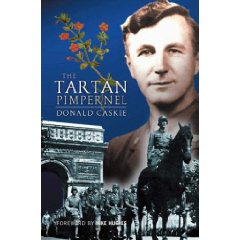
Book Review: The Tartan Pimpernel

The title of The Tartan Pimpernel hearkens back to the The Scarlet Pimpernel, the imaginary but legendary rescuer of those unfairly appointed to death during the French Revolution. In this case, however, the rescuer was a very real Scottish pastor in France during World War II.

On the brink of the German invasion of Paris, Donald Caskie, pastor of the Scots Kirk there, led his people in considering Psalm 46:1, “God is our refuge and strength, a very present help in trouble,” and Matthew 24: 6-8: “And ye shall hear of wars and rumours of wars: see that ye be not troubled: for all these things must come to pass, but the end is not yet. For nation shall rise against nation, and kingdom against kingdom: and there shall be famines, and pestilences, and earthquakes, in divers places. All these are the beginning of sorrows.” He commended them to God and told them good-bye: though he thought perhaps a minister might have met with some respect of enemy soldiers, he had publicly denounced Hitler more than once and knew his record might put him in danger. He decided to go back to Scotland to render service there and “take stock of [his] future.”

He joined the multitude of other refugees fleeing the city on foot, rejoicing whenever he could find a pile of straw to sleep on, a cow to sleep next to for warmth, or a grapevine from which to eat along the way. Days later, nearing exhaustion, receiving timely aid from a couple of good Samaritans, he finally reached the British Consulate only to decide he must stay in France. There was a ship available, but he felt the wounded men needed the space more than he, while his help was needed in his besieged adopted country.

Praying for guidance, he was led in a marvelous way to the abandoned British Seamen’s Mission in Marseilles and told he could aid seamen and civilians, but not soldiers, and to expect surveillance and raids to make sure he was keeping within those parameters. Caskie had a clear conscience about “going underground.” Though being closely watched, somehow he was able to hide and aid soldiers, becoming a major link in their escape route back to England. Food, clothing, false identification, guides, everything needed was marvelously provided time and again. The elaborate details needed to secretly get these men out of the country are amazing, especially in that time without the ease of communication we have these days with cell phones, GPS devices, etc. It is estimated some 2,000 sailors, soldiers, and airmen were aided by him in their escape back to England.

Donald was arrested and eventually sentenced to death, but a German pastor intervened for him. Though nearly starving and in solitary confinement for much of his imprisonment, he felt the interruption in his work, the worry his situation caused his mother, and the inability to minister help to those in prison were his crosses to bear. He remained a prisoner until liberation, when he again began to minister, reopening Scots Kirk, becoming a visiting minister to those in camps, prisons, and elsewhere, and aiding the British with his experience and knowledge of the area and the happenings during the war.

He was urged to write of his war-time experiences and finally did in the mid 1950s, using the book as a fund-raiser to rebuild the church, which had been damaged and decayed. (An interesting side note is that Eric Liddell preached in this church instead of running on Sunday during the Olympics, though a different church than this is actually shown in the film Chariots of Fire.)

Though words like “brave” and “inspiring” describe Caskie in the blurbs on the outside of this republished edition, he wrote the book in an unassuming, matter-of-fact way laced with quiet humor. Some sections are quiet suspenseful, as when a traitor is suspected in the ranks.

This book spoke to me on many levels, a couple of which I elaborated on in an earlier post, especially the quiet heroism and bravery of men and women who weren’t trying to be heroes, but had to stand up and do the right thing, as well as those behind the scenes who aided them.

Though the Lord’s hand is evident throughout, I would recommend the book more from a historical vantage point than a spiritual one, as I would disagree with Caskie on a few points, especially calling a works-based denomination “Christian.” A little odd is his claiming of a Celtic gift of “second sight,” an “uncanny ability to anticipate events.” I don’t know what to make of that, but as the introduction concludes, “The Tartan Pimpernel illustrates the tremendous height to which the human spirit can soar in the horrors of war and is a fitting legacy of a man of outstanding courage and integrity.”

Random Dozen Meme

Linda at 2nd cup of coffee created and hosts the Random Dozen meme every Wednesday. The first 6 questions today come from Kelley at I Didn’t Know That!

1. Do you use the labels various charities send you as “free gifts?”

If I like them I do; otherwise I throw them away. I used to feel guilty about doing either, but some of them, I’m sure, send them for that very purpose: that people would feel obligated to send a donation for these unasked for gifts. I refuse to feel manipulated like that.

2. What is your favorite time of day (or night) for skywatching?

Sunrise or sunset if I am at the window or outside for either.

3. What is the most adventurous you’ve ever been with trying a new food?

My daughter-in-law is Indian, so I have tried various Indian foods. Generally they are more spicy than I like and a different type of spicy than I am used to, but she made some chicken curry last weekend that was my favorite Indian food so far. Also a few years ago at a seafood restaurant in Charleston I tried alligator. I don’t remember being impressed one way or the other. Normally I am not an adventurous eater at all.

4. Have you ever heard a rock sing? (Trust me, there’s a reason for this one!)

It will be interesting to hear your reason! No, I never have, but I can imagine if it had a crack in it for wind to pass through or a build-up of air pressure inside, it might make some melodious-sounding noises. Luke 19:39-40 does say, “And some of the Pharisees from among the multitude said unto him, Master, rebuke thy disciples. And he answered and said unto them, I tell you that, if these should hold their peace, the stones would immediately cry out.” So He could have them say something if He wanted to.

5. If you could learn a language you don’t presently speak, what would it be?

I honestly can’t think of any, unless I were to someday live in an area with a lot of non-English speakers. There is no language I want to learn just for the “fun” of it.

6. Al Capone’s tombstone read, “My Jesus, Mercy.” If you could write your own epitaph, what would it say?

“I told you I was sick.” No, not really. I don’t really know yet, but I like William Carey‘s: “A wretched, poor, and helpless worm, On Thy kind arms I fall.” Probably a verse of Scripture like John 3:16 or John 11:25: “Jesus said unto her, I am the resurrection, and the life: he that believeth in me, though he were dead, yet shall he live.”

7. If you were a famous musician who was known by one name, like “Cher,” “Sting,” or “Jewel,” what would it be? It doesn’t have to be your first name, but it can be, if you’d like.

I have no idea, but there is little probability of that ever happening.

8. Have you ever been inordinately “into” a television show?

Yep. 🙂

9. When you sneeze, do you go big, or do you do that weird “heenh!” sound that makes people think you’re going to blow your brains out? Any other variation we should know about?

Much bigger than I like. I can’t seem to sneeze in a delicate lady-like manner.

10. Do you still read an actual newspaper that you hold in your hands, or do you get your news elsewhere?

If one is around when I am eating breakfast or lunch, I’ll flip through it. But we don’t take it any more. I get most headlines online or through radio news, and if there is anything I am interested in, I’ll look it up online. I like to get the Sunday paper for the sales fliers and coupons.

11. Are you a good speller?

I used to be. I think I have gotten too dependent on spell check. But I have more of a problem with typos or lack of attention than actual misspellings.

12. At what time each day do you start thinking about lunch?

It depends on what I had for breakfast and when I had it. Some breakfasts don’t last as long as others. If I have plans with someone for lunch, I think about it as soon as plans are made.

And that’s it for today! Have a good one.