Thoughts on Audiobooks

I’ve listened to one and a half audiobooks now and thought I’d pass along my thoughts on them. Several years ago we also listened to the Focus on the Family Radio Theater productions of Chronicles of Narnia and Les Miserables, but I think those were dramatizations rather than readings.

In general I would still prefer actual books. I just prefer reading that way and I like being able to mark specific passages, to linger over some spots or reread them, or trip a little more lightly through others. Plus I can read with other people around and still be available to them: with an audiobook, I either have ear buds in or am in another room, so I tend to listen to them when alone. That’s not really a problem unless it’s a really exciting part of the book and I’d love to listen to a few pages but can’t!

However, audiobooks have helped immensely with driving time. It’s about a 20-minute drive to my mother-in-law’s place and to a few other destinations, and I’m hardly aware of the time going by, whereas beforehand I was chafing at the time in the car not accomplishing anything except moving from one destination to another. I’ve also started listening to them while getting ready in the mornings and want to incorporate them while exercising or house-cleaning.

I don’t think I could listen to a non-fiction book that way that wasn’t in story form. Those kinds of books take a little more concentration, anyway, and I tend to mark passages, place sticky tabs all over to try to help me retain information from them. I could listen to them and glean something, I’m sure, but I just wouldn’t get the full benefit of them just by listening. That might be a good way to review a book I’ve already read, though, or preview one I plan to read.

I am more of a visual learner. A few times just when my attention has lagged or I’ve forgotten something in the audiobook that I can’t then go back and look up (without listening to significant portions again), I’ve wondered how difficult it must have been for people to retain Scripture when they primarily heard it, when they didn’t have written portions for everyone, when the Colossians got a letter from Paul that was read at their assembly. I don’t know how easy it would have been to make copies. They were probably more trained to really listen then than we are now, but I am still glad to have lived in an era of the written word.

But I find I am enjoying audiobooks immensely at times when I can’t get into a paper book.

I started a trial subscription on Audible.com that is $7-something a month for the first three months, and you’re able to get one credit (which usually gets you one book) each month. After that trial period it goes up to the regular $14-something a month, which seems pretty high to me. If I am going to pay that much I’d rather get the actual book. I’m not sure why they’re that expensive: I know the author needs to be paid royalties and the reader and producers need to be paid, but it seems if you’re making one file that multiples of people can download, that would be less expensive than making multiple copies of the actual book. So I may drop the Audible account after that, I’m not sure.

I have discovered some good resources in learnoutloud.com and http://gobible.com/. They’re regular prices seem expensive but they do have good sales or occasional free downloads.

How about you: do you know of any good resources for audiobooks? Do you enjoy them? What is your experience?

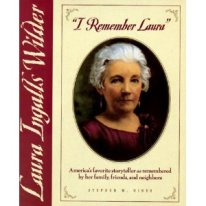
Book Review: I Remember Laura

Stephen W. Hines read the Little House books several times as a child and then introduced them to his wife after they were married. Upon finding that Laura had been a columnist for the Missouri Ruralist before she wrote her books, Hines published those columns together in a book, Little House in the Ozarks: the Rediscovered Writings of Laura Ingalls Wilder (I’m a little over halfway through with that one). He heard from many readers who loved and wanted to know more about Laura. He discovered no one had ever conducted interviews with the people who knew her at her last home in Mansfield, Missouri, so he decided to do so, publishing those and several articles by and about Laura in I Remember Laura. This book, then, is not so much a biography as it is a companion book to Laura’s other work or to biographies of her. At its publication (in 1994), Hines felt that there had not been a definitive biography of Laura written which included new papers and letters that had since come to light.

These articles and interviews are grouped into sections, the two biggest being reminiscences of her life in De Smet, South Dakota, where many of the Little House books took place, and then reminiscences of Mansfield, Missouri, where she spent most of her adult life. There are other sections on “Women in the 1920s” and “Laura and Rose,” her daughter. There is a bit of overlap with Hines’ book of her columns: he reprints a few of them here.

Laura was in her mid-60s when she began writing the Little House books. It seems they began as a way to preserve family memories. There is a bit of controversy over whether publication was her idea or her daughter Rose’s, and several people take credit for urging her to make a book out of them. But however they came to be, her town of 800 had thought she and her husband were retired, and then “took many years to become reconciled to Mrs. Wilder’s latter-day fame as a story-teller.” Many people the author talked to began by saying, “If I had only known that she would become famous, I would have paid more attention to what she said and did” (p. 61). It’s a little ironic that some of the people Hines interviewed said they hadn’t read her books until she either gave them a copy (they were expensive back then at $2.75 🙂 ) or until they got to know her a bit. It’s amusing, then, that in a piece on the Wilders for Mansfield’s centennial album, one writer says, “We know Laura was special. But there has to be something special about the town that provided the environment necessary for her talent to shine through” (p. 274).

Most remember the Wilders as fairly quiet people who kept to themselves, Almanzo especially, but many had memories of visiting with Laura or seeing her in town. She was generally regarded as friendly and industrious. At the dedication of the local library, it was noted she was “famous in her own community for her fine needlework, delicious gingerbread, and in general known as a good neighbor” (p. 269).

When asked why she didn’t write more books, one time she replied that the money she received from them cost her more in taxes. “She never found taxes on those who had labored their way to prosperity to be an incentive for even more labor” (p. 97). But another time she said that if she wrote more, she’d have to get into some of the sad times of her life (p. 122).

Her first years with Almanzo were pretty sad, marked by the loss of a baby, years of drought and crop failure, then his diptheria and a stroke which left him unable to work a full day. They arrived in Mansfield in that condition, with enough money to put a payment down on a rocky piece of land where they literally built an existence with their bare hands, cutting and selling wood until they could grow crops and build a house. That is truly amazing to me: I don’t know if most people these days would have either the knowledge or the spirit to do such a thing. “The Story of Rocky Ridge Farm” and “My Apple Orchard” tell in their own words how they started and then improved upon the grounds and land through the years.

A few other highlights I noted:

When a friend commented that life begins at forty, Laura replied, “No, dearie. It begins at eighty” (p. 134).

She told another friend how, after her sister Mary became blind, Laura “would make word pictures for Mary so she could ‘see'” (p. 136). Perhaps that was early training for the stories she would write later on.

It was especially interesting to me that, with all the opportunities opened to women as a result of their needing to work in a variety of places during WWI, she wasn’t against those opportunities, but she urged, “We must advance logically, in order, and all together if the ground gained is to be held. If what has hitherto been woman’s work, in the world, is simply left undone by them, there is no one else to take it up. If in their haste to do other, perhaps more showy things, their old and special work is neglected and only half done, there will be something seriously wrong with the world, for the commonplace, home work of women is they very foundation upon which everything else rests” (p. 170). She was at least one voice who didn’t dismiss that “home work” as drudgery or demeaning but rather as a meaningful contribution to home and society.

I hadn’t realized before that there was a bit of controversy over how much Laura’s daughter, Rose, contributed to the writing of the Little House books. Rose was a known writer and editor, and speculation runs from the thought that Rose only advised her mother and used her own connections to get the books published, to the other extreme that Laura’s writing only the bare bones of the books, and Rose arranged and ghost-wrote much of them. The truth is likely in-between.

There are a few photos of Laura throughout the book, and to me she seems one of those rare people who become prettier as they get older.

There are even a few recipes in the book. Hines and his family tried many of them. Most came out fine, but the results of a few left them wondering if what constituted a successful cake or dish then might be different from our preferences mow.

The book was a little dry in places: many of the interviews Hines conducted and published cover some of the same information, and perhaps that  could have been summarized and harmonized rather than recorded individually. But his affection for Laura shines through.

Overall this was an interesting book that gave a fuller picture of Laura in her adult years and helped separate fact from fiction.

On another note, I didn’t realize until last night that Februray 7 was Laura’s 145th birthday. I had originally chosen February as the month for the Laura Ingalls Wilder Reading Challenge specifically because her birth and death both occurred in February, but it didn’t even occur to me to have a “birthday party” or some kind of special remembrance of her on that day. I’ll have to keep that in mind for next year.

”"

(This review will also be linked to Semicolon‘s Saturday Review of Books.)

Women in Ministry

Over the years I’ve written a number of posts about women ministering: Church Ladies GroupsMentoring Women, Why Older Women Don’t Serve and Ways Older Women Can Serve. But I’ve skirted around the issue of women preachers and pastors. I think partly I just wasn’t ready to get into the controversy, and also I know some of my online friends are of a different opinion about this issue. But I think the time has come. I do think this is something we can disagree on and still be friends. I hope you feel the same way.

I do want to be very careful in my tone. I actually began this post in early January and amended it as I’ve thought and studied and prayed over it. Some of these thoughts have been incubating for years and I am just now putting them down, but I didn’t want this particular post to be “off the cuff.” I’ve seen harshness, scoffing, sarcasm, derision and false accusations about motives from both sides of this issue. I’m all for discussing differences of opinion, but I hope we can keep it gracious.

I believe a woman should not pastor or preach to men for the following reasons:

1. Explicit statements of Scripture

I Timothy 2:11-12 says, “Let the woman learn in silence with all subjection.  But I suffer not a woman to teach, nor to usurp authority over the man, but to be in silence.”

I Corinthians 14:34-35: Let your women keep silence in the churches: for it is not permitted unto them to speak; but they are commanded to be under obedience as also saith the law.  And if they will learn any thing, let them ask their husbands at home: for it is a shame for women to speak in the church.

These passages are the main crux of the matter. I’ve never heard these verses adequately argued away. A former pastor once said that any interpretation of Scripture that leaves different passages in contradiction to each other is wrong: they’re to harmonize with each other. But usually what happens when there is a seeming contradiction is that people take one side or the other.

I’ve heard these statements brushed off as cultural. One women ventured that women had not been allowed in services before this time, and they were so excited and chatty that Paul had to tell them to be quiet. But Paul goes on to explain his reasoning in I Timothy 2:13-14, and it doesn’t have anything to do with the culture of the times. Even if it were a cultural issue, the Holy Spirit did not waste space in the Bible. Of all the things that could have been written, He chose what material to share. When a cultural issue is mentioned in the Bible that we don’t deal with today, like the matter of meat offered to idols, there are still principles we’re to draw from it. We don’t pass over any Scripture as worthy of being ignored because it was “just cultural.”

I don’t think these verses mean that a woman is not to open her mouth to say anything from the moment she steps into the church til the moment she leaves. I don’t know anyone who takes that extreme a view. I Corinthians 11:5 speaks of a woman not praying or prophesying at church without her head covered, so obviously women did speak in church sometimes. There were women prophets in the Bible. But the context of the of the I Cor. 14 passage above was both speaking in tongues and prophesying. Did women prophets prophesy away from church, or only to women? I don’t know. But it was evidently not considered the same as teaching and not viewed as usurping authority. And then you have the whole issue of whether prophecy, or at least a certain type of prophecy, is a spiritual gift that was exercised in the first century but which was done away once the full Bible came into being, but that’s a whole ‘nuther can of worms. But the fact that I Cor. 11 says the woman should have her head covered when she prophesies and I Cor. 14 that says she shouldn’t prophesy in the public assembly leads me to believe there were two different types of prophesy. I’m of the opinion that there was one kind of prophecy (which I Corinthians 14 does forbid women to engage in in church, along with speaking and interpreting tongues), but there is a general type of prophecy that’s just “forthtelling,” not new revelation, but something else. In I Chronicles 25:1, David separated certain men out to “prophesy with harps, with psalteries, and with cymbals.” I don’t think that means prophetic utterances were accompanied by music: I think that means music is one form of expressing God’s truth.

But whatever exactly prophecy is,  these passages makes it pretty clear that women aren’t meant to preach or teach Scriptural truth to men in an authoritative manner in a church setting.

2. Biblical example.

With the exception of the prophetesses, you don’t see women teaching, preaching, or being ordained in the Bible. You also don’t see any of the passages of instruction specifically to or about women mentioning them in this role.

Over the years I’ve seen a number of objections to the view that women can’t teach or preach, I’ll go over just a few of them.

Aren’t those passages just Paul’s opinions?” There are places Paul says that what he is sharing is his own personal opinion or application, but these aren’t among them, therefore we must take them as inspired by God.

If women aren’t allowed to preach, that makes them feel like second-class Christians.” It shouldn’t. This is one of the most erroneous assumptions. A person under authority is not inferior to a person in authority. Jesus was in submission to God the Father, yet they were equals. David was not a second-class citizen to Solomon when God chose Solomon to build the tabernacle and not David. The rest of Israel was not inferior to the Levites since the Levites were the only ones who could minister in the temple and tabernacle.  It’s a matter of function, responsibility, and God’s will and calling. And Biblical limitations aren’t in place to make us feel bad. Both men and women had various limitations set on them throughout the Bible. Elisabeth Elliot said limitations help define ministry.

Some women are gifted to teach.” Yes, they are. I’ve been blessed to read and listen to many of them. But that doesn’t mean they’re meant to teach men.

If I desire to be a pastor or Bible teacher, doesn’t that mean God is leading me to do so?” Desires can be indicators of the Lord’s will, but they’re not fool-proof. David desired to build a temple, but it was not God’s will for him. Moses desired to go to the promised land, but God said no. Paul desired to be healed of his thorn in the flesh, but God said no.

What about women teaching men in college classes or being supervisors over men at work?” The passages in question are talking about spiritual authority in the assembly of believers. I don’t see a problem with a woman teaching men math or English or being a man’s supervisor on a secular job.

Mary was given a message to give to Peter and the disciples after the resurrection.” Yes, but that was hardly a sermon or a teaching situation, nor even an authority issue.

What if a woman teaches in a book or online and a man sees it? Or what if she’s speaking and there is a male overseeing the sound system?” If her intended audience is not adult men, I don’t think she has to worry about whether one overhears or happens upon what she says. God recorded Mary’s Magnificat and men have learned from it and preached from it, but as far as she knew she was only speaking to God and Elisabeth at the time. God also recorded Hannah’s prayer in I Samuel 2, but as far as we know she was only speaking to Him. Lemuel’s mother’s instruction was preserved in Proverbs 31, but it seems she had given it directly to him. These passages are not saying that a man can never learn or benefit from a woman’s words, just that she is not to express them in a position of authority over him or as if she were teaching him.

What about Priscilla and Aquilla, who took Apollos in and ‘and expounded unto him the way of God more perfectly’?” Priscilla wasn’t acting independently of her husband, and talking over the kitchen table or in the living room (which is how I picture this scenario) is a different thing than leading a Bible study or preaching in church.

What about single women on the mission field?” That’s a thorny issue I don’t have all the answers to. The single female missionaries I’ve known have ceded authority to the national males as soon as possible.

What about Deborah?” Deborah’s judgeship occurred before this was clearly written in the NT, and she was not in a NT church. Though a judge is a position of authority, it’s different from teaching and preaching. It’s clear that the main authority structure was male.

“Galatians 3:28 teaches that ‘There is neither Jew nor Greek, there is neither bond nor free, there is neither male nor female: for ye are all one in Christ Jesus,’ so there are no distinctions.” Obviously this verse doesn’t remove every difference between any of these groups, because Paul writes in other places specifically to men, women, Jews, slaves, masters, etc. about their unique roles. The context shows that this is speaking of our standing before Christ. We all come to Him the same way (v. 26) and are one body.

Sometimes I wonder if, like Eve, who could have eaten from any tree of the garden of Eden but fixated on the one she was not supposed to have, some women are discontent with the multitude of things women can do and fixate on the one thing they’re not supposed to. Someone shared with me a statistic that 80% of the world’s population is women and children. I haven’t been able to find that online, but it does seem to me we have an ample mission field and more than enough to do.

Here are some of the ways we see New Testament women ministering:

“And certain women, which had been healed of evil spirits and infirmities, Mary called Magdalene, out of whom went seven devils,  And Joanna the wife of Chuza Herod’s steward, and Susanna, and many others, which ministered unto him of their substance” (Luke 8:2-3).

“And I intreat thee also, true yokefellow, help those women which laboured with me in the gospel, with Clement also, and with other my fellowlabourers, whose names are in the book of life” (Philippians 2:3) (Some have claimed this as a passage one promoting women pastors/teachers, but “laboring in the gospel” is not confined to those offices.)

“Now there was at Joppa a certain disciple named Tabitha, which by interpretation is called Dorcas: this woman was full of good works and almsdeeds which she did…Then Peter arose and went with them. When he was come, they brought him into the upper chamber: and all the widows stood by him weeping, and shewing the coats and garments which Dorcas made, while she was with them” (Acts 9: 36,39).

“The aged women likewise, that they be in behaviour as becometh holiness, not false accusers, not given to much wine, teachers of good things;  That they may teach the young women to be sober, to love their husbands, to love their children,  To be discreet, chaste, keepers at home, good, obedient to their own husbands, that the word of God be not blasphemed” (Titus 2:3-5).

“And he began to speak boldly in the synagogue: whom when Aquila and Priscilla had heard, they took him unto them, and expounded unto him the way of God more perfectly” (Acts 18:26).

“I commend unto you Phebe our sister, which is a servant of the church which is at Cenchrea:  That ye receive her in the Lord, as becometh saints, and that ye assist her in whatsoever business she hath need of you: for she hath been a succourer of many, and of myself also” Romans 16:1-2).

“Well reported of for good works; if she have brought up children, if she have lodged strangers, if she have washed the saints’ feet, if she have relieved the afflicted, if she have diligently followed every good work” (I Timothy 5:10).

“And she [Anna] was a widow of about fourscore and four years, which departed not from the temple, but served God with fastings and prayers night and day. And she coming in that instant gave thanks likewise unto the Lord, and spake of him to all them that looked for redemption in Jerusalem” (Luke 2:37-38).

“These all continued with one accord in prayer and supplication, with the women, and Mary the mother of Jesus, and with his brethren” (Acts 1:14).

“In like manner also, that women adorn themselves in modest apparel, with shamefacedness and sobriety; not with broided hair, or gold, or pearls, or costly array;  But (which becometh women professing godliness) with good works” (I Timothy 2:9-10).

There may be other ways I am not thinking of right now, and things like “good works” can be expanded on beyond some of the specific mentions here (for instance, many churches have ladies who coordinate meals for those who are sick, or have some kind of women’s missionary group, or send care packages to college students, etc.). But even if one were to quibble about the meaning of the verses discussing women teachers, it’s clear from Biblical example that by and large, women ministered in various other ways and that their teaching was primarily to women.

I did hear that one preacher taught that women should only teach even women the things mentioned in Titus 2:3-5 and not doctrine, but I have not heard of anyone else who takes that view. All of those traits are based on doctrine. Teaching a woman to be chaste, for example, is based on God’s holiness and our reflection of Him.

One of the things that concerns me most in this debate is the tone on both sides. I think, I hope, anyway, that we can concede that those on both sides of the issue truly want to seek God’s will in the matter even if we come out with different conclusions. Those who feel women aren’t to preach or exercise spiritual authority over men are primarily motivated by the verses mentioned at the beginning and a desire to make sure everything we do is in accord with Scripture, not by a desire to put women down. I’ve seen some awful accusations that are just unfounded but are expressed with sarcasm and condescension. If this is a limitation God has put in place, then we need to take it as from Him and serve Him in the ways He wants us to.

I welcome your comments but I do ask you to keep them gracious and respectful, not only to me, but also to other commenters.

The Week in Words

”"

Welcome to The Week In Words, where we share quotes from the last week’s reading. If something you read this past week  inspired you, caused you to laugh, cry, think, dream, or just resonated with you in some way, please share it with us, attributing it to its source, which can be a book, newspaper, blog, Facebook — anything that you read. More information is here.

Here are a few quotes that spoke to me this week:

From Diane‘s Facebook:

“What would you expect? Sin will not come to you, saying, ‘I am sin.’ It would do little harm if it did. Sin always seems ‘good, pleasant, and desirable,’ at the time of arrival.” ~ J.C. Ryle

So very true.

From Chris Anderson‘s Twitter:

The inevitable fruit of any fleshly attempt to engineer unity apart from truth will be worse division than ever. ~ Phil Johnson

Unity just for unity’s sake usually involves a compromise of truth. There are multitudes of personal preferences it’s ok to compromise on, but we dare not compromise truth.

From the chapter “Not One Thing Has Failed” in Elisabeth’s Elliot‘s book Love Has a Price Tag, quoted in her e-mail devotional:

“I visited Indians at Crossweeksung,” [David] Brainerd records, “Apprehending that it was my indispensable duty…. I cannot say I had any hopes of success. I do not know that my hopes respecting the conversion of the Indians were ever reduced to so low an ebb … yet this was the very season that God saw fittest to begin His glorious work in! And thus He ordained strength out of weakness … whence I learn that it is good to follow the path of duty, though in the midst of darkness and discouragement.”

You can share your family-friendly quotes in the comments below or write a post on your blog and then put the link to that post (not your general blog link) in Mr. Linky below.

I hope you’ll visit the other participants as well and glean some great thoughts to ponder. And I hope you’ll leave a comment here, even if you don’t have any quotes to share.

Nearer My God to Thee

This is a beautiful rendition of this familiar hymn.

Nearer, my God, to Thee, nearer to Thee!
E’en though it be a cross that raiseth me,
Still all my song shall be, nearer, my God, to Thee.

Refrain

Nearer, my God, to Thee,
Nearer to Thee!

Though like the wanderer, the sun gone down,
Darkness be over me, my rest a stone.
Yet in my dreams I’d be nearer, my God to Thee.

Refrain

There let the way appear, steps unto Heav’n;
All that Thou sendest me, in mercy given;
Angels to beckon me nearer, my God, to Thee.

Refrain

Then, with my waking thoughts bright with Thy praise,
Out of my stony griefs Bethel I’ll raise;
So by my woes to be nearer, my God, to Thee.

Refrain

Or, if on joyful wing cleaving the sky,
Sun, moon, and stars forgot, upward I’ll fly,
Still all my song shall be, nearer, my God, to Thee.

Refrain

There in my Father’s home, safe and at rest,
There in my Savior’s love, perfectly blest;
Age after age to be, nearer my God to Thee.

Refrain

~ Verses 1-5, Sarah E. Adams; Verse 6, Edward H. Bickersteth, Jr.

Laudable Linkage, Pics, and Videos

I didn’t think I had enough “laudable linkage” to make a post this week, but I find that I do have a few things you might find as interesting as I did.

How Much Is a Homemaker Worth?

Why Do We Write?

Dancing Duets: lovely post on helping our children fulfill their dreams rather than ours.

Seen on Facebook:

Seen at Pinterest:

Seen at Challies: this had me literally laughing out loud (note: though the guy uses a cigarette in the last part of his routine, I don’t promote or condone cigarette smoking.)

Friday’s Fave Five

Welcome to Friday’s Fave Five, hosted by Susanne at Living to Tell the Story, in which we can share five of our favorite things from the last week,  wonderful exercise in looking for and appreciating the good things God blesses us with. Click on the button to learn more, then go to Susanne’s to read others’ faves and link up your own.

I’m late to the party — it’s been a busy morning to a busy day. But here are some of my favorite things from the last week:

1. More daylight. I mentioned just after the winter solstice that I was glad the days were beginning to get longer even though I had to take it on faith since I couldn’t really tell it yet. But now I can tell! A couple of days this week I was surprised to look up at the clock and see it was time to start dinner — it still looked like bright outside.

2. New smooth pavement. We have to cross a set of railroad tracks on most of our journeyings, and it has been pretty bumpy. They just paved that area recently and it’s much nicer — hardly any jostling now when we go over them.

3. A good visit with my mother-in-law. Lately it has been kind of sad to go see her: either she’s asleep or too drowsy to really talk, or, even when she’s been awake she just hasn’t been conversant. We weren’t sure if she was just tired or was continuing to decline or what. But this morning she was pretty awake and had that old sparkle back in her eyes, and we had a good visit.

4. Inspired Reads. Lizzie mentioned this last week and an author I follow posts some of their offerings on Facebook. They post “free for a limited time” downloads of Christian books for the Kindle. And these days you can download a Kindle app to read e-books on your computer or other device. I’ve gotten several through them — enough to keep me busy for a good while.

5. Learn Out Loud. They have similar “free for the day” downloads of audiobooks. I’m currently listening to one I downloaded from there by Terri Blackstock, and today’s free download is the Chronicles of Narnia. Good deal!

Off again for a bit — I’ll be back later on to visit with you. Happy Friday!

The Laura Ingalls Wilder Reading Challenge

”"

Welcome to the Laura Ingalls Wilder Reading Challenge!

Many of us grew up reading the Little House on the Prairie series, unwittingly getting our first taste of American history and laughing and sorrowing along with the Ingalls family. Every time I read them, at different ages and stages of life, I get a little something more or something different out of them and I enjoy them all over again. That is a characteristic of a true classic.

After participating in a couple of Carrie‘s reading challenges and discovering how fun it is to read an author at the same time with others, I decided to host a reading challenge based on Laura.

You can read the Little House books (any one or all of them if you’re up to that!), a biography of her, or any book somehow related to her. If you’d like to prepare a meal from the Ingalls’ recipes or do some other related project, we’d love to see it! You can read or do as little or as much as you’d like.

In the comments below you can leave a link to your blog post about what you plan to do for the challenge (or just tell us in the comments if you’d rather), and at the end of the challenge on Feb. 29, four weeks from today, I’ll post a wrap-up post so everyone can tell us how they did. I would encourage you to write a wrap-up post listing what you read and perhaps what you learned or enjoyed (or didn’t) about your reading time. If you want to write reviews of the individual books as you read them and then list your reviews in your wrap-up, that would be great, too.

I’ve had several books relating to Laura on my shelf unread for years, I am embarrassed to say, and I’d like to read them for this challenge. They are:

I Remember Laura by Stephen Hines. It’s not exactly a biography: the author states it is more a mosaic or cornucopia of letters, poems, columns, etc. from Laura and from various other people that shed more light on her life.

Little House in the Ozarks: the Rediscovered Writings of Laura Ingalls Wilder edited by Stephen Hines. This is a collection of newspaper columns and magazine articles Laura wrote before she wrote the Little House books, arranged by subject. I have looked at bits and pieces of this but I’ve never read it all the way through.

Saving Graces: the Inspirational Writings of Laura Ingalls Wilder edited by Stephen Hines.

I don’t know how I came to have three books written or edited by Stephen Hines!

I’d also like to reread at least the first book in the series, Little House in the Big Woods. If I have time I may read the next one as well.

I usually go through nonfiction much more slowly than fiction, so to have three nonfiction titles in a month is pushing it. But I’ve also hand on hand for a while The Wilder Life: My Adventures in the Lost World of Little House on the Prairie by Wendy McClure about seeking “the Laura experience” by going to some of the places and doing some of the activities mentioned in the books. I’m wary of it — I got kind of burned by recent experiences with modern secular books and bad language, and I’ve been told this is “irreverent,” and I am not quite sure how that will play out. But if I have time I might give it a try.

So…those are my plans. Will you join me? What are you planning to read?

Thanks to the Grab My Button Code Generator for the button and grab box below!

The Laura Ingalls Wilder Reading Challenge
<div align="center"><a href="https://barbarah.wordpress.com/2011/11/15/announcing-a-laura-ingalls-wilder-reading-challenge/" title="The Laura Ingalls Wilder Reading Challenge" target="_blank"><img src="https://barbaraleeharper.com/wp-content/uploads/2011/11/liw.jpg" alt="" width="144" height="184"" alt="The Laura Ingalls Wilder Reading Challenge" style="border:none;" /></a></div>