Friday’s Fave Five

FFF daisies

Welcome to Friday’s Fave Five, hosted by Susanne at Living to Tell the Story, in which we can share five of our favorite things from the last week,  wonderful exercise in looking for and appreciating the good things God blesses us with. Click on the button to learn more, then go to Susanne’s to read others’ faves and link up your own.

It’s turned out to be a busier week than I thought it would be at the beginning. Here are some of the highlights:

1. Mother’s Day Eve dinner. We don’t like to eat in restaurants on Mother’s Day because it is so crowded, so Jason and Mittu took us out to eat Saturday night. I think that may be the first time they’ve ever done that, so that was a treat in many ways.

2. Mother’s Day. Traditionally Jim and the kids have worked together to prepare lunch on Mother’s Day after church, and they did so again this year. It’s lovely to come home from church and have nothing to do. 🙂

Barbara's Cell phone pics 158

CIMG5837

I enjoyed the thoughtful gifts and cards and time with the family together (though Jeremy was there via FaceTime, it’s still nice he can be a part of it.)

Barbara's Cell phone pics 164

Fun with Jesse. 🙂

3. Getting caught up on the housework. That may seem like an odd one. 🙂 The last couple of weeks had been kind of a whirlwind, and I was heartily ashamed of the dust accumulated on horizontal surfaces. Housework isn’t necessarily my favorite thing to do, though I don’t mind it as much once I get started, and I do love the results. It felt good to get caught up — well, with the major tasks, at least. There’s always something more that can be done around the house.

4. Well-used leftovers. I don’t always plan for leftovers carefully and hate when I end up throwing them out when they’ve gotten old. Casseroles I usually just reheat for lunch, but some other things get neglected. We had had boneless pork chops leftover one night, more than I would probably use for lunches, so I chopped up the leftovers into a stir-fry dinner another night that was really good, if I do say so myself. 🙂 Then we had hamburger buns, potato salad, and baked beans leftover from the Mother’s Day lunch, so I made Sloppy Joes last night to use them up.

5. Scoring a great deal. Jesse is going to a friend’s Junior-Senior banquet and wanted to find a shirt to coordinate with her dress, which was various shades of brown. He has a black suit, so we were thinking a brown shirt and then a tie that had black and brown in it to tie them together. We couldn’t find either of those. He suggested a new suit, and though he could probably use one, I wasn’t ready to lay out the cash for that, especially without talking to Jim first. But we walked over to where the suits were, looked at the clearance rack, found some suit coats, marked $25 and $36, found one he really liked, and when he tried it on, we discovered it was marked down to $15, originally $120. I could have done a happy dance right there in the store. Then we found some dress slacks on sale for $25 and a tie for $8. And he really, really likes it, so maybe he will wear it for more than those occasions when he “has” to wear a suit.

Update: Now that the banquet is over, here is a picture:

CIMG5844

So, that’s my week. How was yours?

Why I Wear a Hat to Church

Every now and then someone sends around those “getting to know you” questions, and I’ve answered them a few times on my blog. Sometimes one of the questions is “What is one thing people might not know about you?” One good answer to that question is that I wear a hat, or headcovering, to church, but I have never mentioned it on my blog because I don’t want to be thought weird or misjudged because of it.

But in real life, of course, a hat in church is obvious and sticks out like a sore thumb, even though I try to keep them unobtrusive and not overly decorative. My husband and I don’t want to make it our “pet issue,” soapbox, or hobby horse by bringing it up and discussing it excessively with people, so we usually only explain it when asked. I don’t think we have ever been asked, though I was once accused of “formalism” by someone who pronounced that judgment without trying to find out our reasons.

Online discussions of those who wear headcoverings often pronounce them as legalists. Since I am neither a formalist or a legalist, I thought perhaps an explanation would be in order.

The practice comes from I Corinthians 11:1-16, which I’ll include here for easy reference:

Be imitators of me, as I am of Christ. Now I commend you because you remember me in everything and maintain the traditions even as I delivered them to you. But I want you to understand that the head of every man is Christ, the head of a wife is her husband, and the head of Christ is God. Every man who prays or prophesies with his head covered dishonors his head, but every wife who prays or prophesies with her head uncovered dishonors her head, since it is the same as if her head were shaven. For if a wife will not cover her head, then she should cut her hair short. But since it is disgraceful for a wife to cut off her hair or shave her head, let her cover her head. For a man ought not to cover his head, since he is the image and glory of God, but woman is the glory of man. For man was not made from woman, but woman from man. Neither was man created for woman, but woman for man. That is why a wife ought to have a symbol of authority on her head, because of the angels. Nevertheless, in the Lord woman is not independent of man nor man of woman; for as woman was made from man, so man is now born of woman. And all things are from God. Judge for yourselves: is it proper for a wife to pray to God with her head uncovered? Does not nature itself teach you that if a man wears long hair it is a disgrace for him, but if a woman has long hair, it is her glory? For her hair is given to her for a covering. If anyone is inclined to be contentious, we have no such practice, nor do the churches of God.

There are several different ways of interpreting this passage, so I’ll just go through them to explain the conclusions we came to.

1. It’s a cultural issue. I’m told that in the days in which this was written, respectable women wore veils in public and women of ill repute did not, so it was a matter of good reputation to be veiled in public. While that may be true, that’s not the reason given here (and the apostle probably would not have needed to encourage them to do what they were already practicing as a culture anyway). The reason given here for a woman to wear a head covering is to illustrate that her husband is her head and she is honoring him, and she is specifically to have it on when she is “praying or prophesying” in a public assembly of the church.

2. It’s just talking about hair. Verses 14-15 cause some people to attribute the whole discussion to hair length. There are a few reasons I don’t agree that that’s the case. The phrasing of the passage seems to indicate that this is an example of the same principle in nature, not the culmination of the discussion. And if it is talking about hair, wouldn’t it be saying that men should be bald when they pray (verses 4 and 7)? When it says a woman should have her head covered when she prays or prophesies, that seems to indicate something she puts on at that time.

3. Women should cover their heads all the time. Some people who do believe in using head coverings take this view because a woman needs to be ready to pray or prophesy (verse 5) at any time. However, the context of the passage is public worship (verse 1 talks about keeping the ordinances, then the remainder of the chapter after this discusses communion [or the Lord’s Table or the Lord’s Supper, whatever you choose to call it]). The early New Testament church participated in the Lord’s Table much more often than modern churches do (I was told once that they did so every time they met, but I don’t know how to find out whether that is true). Therefore, since the context of the passage is public worship with both men and women present, I don’t wear a hat around the house or at the grocery store or to women’s meetings at church.

4. A head covering in Bible times is like a wedding ring now, just a symbol that a woman is married. They may both indicate marriage, but the instruction in this passage seems to me to go beyond just being married, particularly since the head covering seems to be something they put on while meeting together, not something that is kept on all the time.

5. Woman should wear a headcovering in a public assembly of the church to illustrate that she is under the headship of her husband and honoring him. That’s obviously the view that I hold.

What is the verse about angels referring to (verse 10)? Some think that is a reference to pastors, as the angel of each church in Revelation is its pastor. Some think it refers to actual heavenly angels and that God shows something of Himself to them through us (“so that through the church the manifold wisdom of God might now be made known to the rulers and authorities in the heavenly places,” Ephesians 3:10, ESV).

To me the cultural difference comes in the type of head covering. Woman in Western societies don’t wear veils, so at some point they began wearing hats. Amish and Mennonite women wear prayer kapps. In some Eastern European churches, the woman wear scarves over their heads. Some of the women who wear headcoverings all the time here use a bandana style, though often they use white fabrics.

Women wearing some type of head covering in American churches was practiced up until the 50s or 60s, not that long ago. Somehow the practice fell away, maybe because it was no longer taught. Gradually people forgot the basis for it, and then didn’t see a need to keep on with it. Or maybe the practice was rejected because the world in general rejected the idea of man being head over a woman. Oddly, society has kept the practice of men praying with their heads uncovered. You do still see men removing their hats when during public prayer, though I think even that is beginning to decline.

There are some fundamental Biblical issues for which there is no wiggle room: the Deity of Christ, salvation by grace through faith, and others. But on other issues, Romans 14 has instructions for those who come to different conclusions about what the Bible teaches in those issues that aren’t fundamental to the Christian faith (though the passage is discussing weaker brethren, I think some of these overarching principles apply). Some people can read the same passage, like this one, and come to different conclusions about what is taught or meant. Each should do whatever they do as unto the Lord (verse 6), not judging or condemning each other, (verses 3, 10,13), being fully persuaded in their own minds (verses 5, 22), remembering they’re accountable to the Lord (verse 12), not being contentious about it (verses 1, 17-19).

As I said at the start, this isn’t a soapbox issue and I rarely mention it. I don’t judge other women who don’t wear hats or headcoverings because I understand that they may read the passage differently. But because I see the passage the way I do, I need to follow what I believe it is teaching. I thought perhaps explaining where the conviction comes from would help others not to judge the practice unfairly.

This post will be also linked to Women Living Well.

The Hidden Art of Homemaking, Chapter 4: Painting, Sketching, and Sculpturing

It’s Week 4 of  The Hidden Art of Homemaking Book Club hosted by Cindy at Ordo Amoris where we’re discussing Edith Schaeffer’s book, The Hidden Art of Homemaking a chapter at a time.

In Chapter 4 Edith discusses how to incorporate “Painting, Sketching, and Sculpturing” into everyday life as an expression of creativity and encourages us that we can do so without having formal training or making a career of it. It can be used, just like the other categories of creativity that she’s discussed, to enrich our lives and stimulate our imaginations.

This chapter was a little harder for me because I have absolutely no talent in this area. In fact, a photo I saw on Pinterest pictures this perfectly:

drawing

I don’t even do stick figures very well, though they were useful at times when I had a little one on my lap that I was trying to entertain and keep relatively still and quiet, in church or a doctor’s waiting room. I’d draw something and ask them what it was, and they’d recognize my fledgling attempts to portray a duck or a car (I had to laugh when the Cube first came out because they looked just like the cars I used to draw.)

I don’t even remember doodling much in high school or college. In Junior High a new classmate said something about having had art in her previous school, and I was incredulous and envious. I don’t remember having any kind of artistic instruction in school (until a college Art Appreciation class), and no one in my family, as far as I knew, had any artistic tendencies. Somehow my middle son developed a talent for drawing quite well in his later high school and college years, mostly teaching himself with various art books, except for a year or when he was under the instruction of a gifted art teacher who helped him refine his talents.

I went through a “paint by number” phase in elementary school. I did enjoy a little bit of painting when a talented lady in one church we were in hosted a night to teach other ladies how to paint a flower on a tote bag. She used the same pattern with everyone to make easier to teach en masse but had different paints so we could each choose our own colors. It was exciting to me to learn to use light and shade to make a flat blob of a flower appear more realistic. I took a couple of One Stroke painting classes at Michael’s and loved them, but just never went any further with it.

But though I can’t draw well, I can use aids. I went through periods of using stamps or stencils or even stickers to make cards or decorate various things. I like to buy decorative Post-it notes or notepads rather than plain ones. I disagree with Edith when she says “Original ideas carried out can be an expression of love and care which cannot be made by buying something  ‘ready made’ or plastic” (p. 50). I think that kind of thinking can be burdensome and guilt-inducing, to feel personally or to make our loved ones feel that a gift that’s store-bought doesn’t “measure up” to something hand-made.

She didn’t discuss art appreciation in this chapter, but she has discussed in other chapters that we can come to appreciate forms of creativity that we may have no talent in ourselves.  I did mention an Art Appreciation class in college: I enjoyed it, but didn’t retain much from it, perhaps because one can’t go over the material as readily as one can music from Music Appreciation.

Unfortunately we did not go to museums much as the children were growing up, so I’m afraid I’ve perpetuated my ignorance in this area. I found one neat book about identifying art and artists that I wanted to use some time with them, but we never got around to it. These days, however, there is so much information available on the Internet that one can learn something of classic art if one wants to. I did discover over the years that I seem to like realistic more that abstract art, like that of Normal Rockwell and some of the old masters, though I liked some of the Impressionists, too, like Mary Cassatt. I find that I do enjoy art more by learning about it: the last time we were at a museum, as we were leaving I saw there were headphones one could use for a self-guided tour, and I thought that would be the way to really get the most out of it (for me).

But besides learning about great paintings and painters, one can develop an eye for artistry, for appreciation of color and design. I think for me that happened mostly through a Home Interiors class (thankfully interior decorating is the next chapter!) and then grew through various craft classes and helped as I started doing a newsletter for our church ladies’ group in terms of layout, making a cover page that is reasonably attractive, etc. Someone who really knew what they were doing in that area could probably point out many ways in which I could improve, and that’s fine – we all can grow, no matter what our level of knowledge or talent. But I am thankful for the ways I have grown so far.

I liked her idea of using drawing, even simple stick figures, to not only help keep a child’s interest during a sermon but also to help them grasp what was being taught. A former pastor used to say that it helped him in his Bible study to draw things out as he read.

My favorite line in this chapter, which really could be applied to the whole book, is “Ideas carried out stimulate more ideas” (p 49). I tend to gather a lot of ideas and my imagination can be stimulated by perusing Pinterest or web sites or books, but even that doesn’t compare to actually carrying out those ideas. Whatever area of creativity we’re discussing, just starting in some way or another stimulates more ideas, more creativity.

You can find more discussions on this chapter here.

Previous chapters discussed:
Chapter 1: The First Artist.
Chapter 2: What Is Hidden Art?
Chapter 3: Music.

Laudable Linkage

Here are some interesting reads from the last couple of weeks:

The Boundaries of Evangelism. I’ve been coming across what he’s talking about here, elements of mysticism creeping into evangelicalism, so this was a timely read, though I’m not of a Reformed denomination and believe you don’t have to be Reformed to be Evangelical.

Some Things You Should Know About Women and the Old Testament. Excellent treatment of passages that many find troubling.

Building An Effective Scripture Journal.

The New Legalism. “How the push to be ‘radical’ and ‘missional’ discourages ordinary people in ordinary places from doing ordinary things to the glory of God.”

Mommy. Sweet post about becoming Mommy and then Mom.

An open letter to pastors {A non-mom speaks about Mother’s Day}

Why Reading That Novel Makes You Smarter, More Empathetic, and Closer to God.

10 Texts That Will Make You Appreciate Mom. Funny.

This is cute – a baby duck trying to stay awake. Though I don’t know why it’s in a classroom.

That’s one way to kill a spider – probably not the best way…

Hope you have a great weekend!

Friday’s Fave Five

FFF daisies

Welcome to Friday’s Fave Five, hosted by Susanne at Living to Tell the Story, in which we can share five of our favorite things from the last week,  wonderful exercise in looking for and appreciating the good things God blesses us with. Click on the button to learn more, then go to Susanne’s to read others’ faves and link up your own.

It’s been rather a heavy week here, as friends on several fronts are facing various battles. In our old church in SC, one friend discovered she had thyroid cancer and is facing surgery, another had a massive heart attack, and one of the star athletes from the school there died unexpectedly. In our own family, my nephew that I mentioned a few weeks ago as having multiple tumors and undergoing massive amounts of chemotherapy discovered a new “knot.” It’s hard to fathom that some new tumor could spring up with all the chemo he has had, so perhaps it’s something else. They can’t see the doctor til next week.

In the midst of all the heaviness, God has placed some bright spots:

1. Faith, hope, and grace. I’m so thankful that when we believe on Jesus Christ as our Savior, we have the surety of heaven, even though it is still painful to be separated from loved ones through death. It would be unbearable otherwise. And the grace God gives to endure as we undergo hardships is priceless.

2. Facebook has been great for disseminating news to large communities of people at once and for keeping up with what’s going on. Since we’ve moved, I probably would not have heard of some of these issues for a long time, if at all, without Facebook. It’s a blessing to be able to keep informed and to pray as soon as possible for each one.

3. Camaraderie. Jim’s first day back at work after his eye surgery, he faced this:

Eye patches

4. Less rain than expected. When I looked at my weather app on my phone at the beginning of the week, it showed not just rain but thunderstorms almost every day. Thankfully we haven’t had nearly as much as predicted, and so far it’s been mostly gentle rain rather than storms.

5. A good helper. I feel for Jesse being the only son left at home sometimes, but he has been a great help as Jim is still not supposed to do any lifting or straining. He just spent his first morning of summer break cutting the grass. He changed his first flat tire last Saturday – I had meant to mention that as a fave and forgot, that it went flat in the garage and not while I was driving.

Happy Friday!

Myths and Maxims of Ministry

IMG_1791

Recently a friend told me that she was somewhat overwhelmed with the details of a particular ministry she had started and had trouble finding joy in it until she reminded herself of the reason she began it in the first place. That got me to thinking about some of the misconceptions I had about ministry over the years, and  I thought I’d share some of those here. I’m not talking about “the” ministry: the paid professional, full-time minister of some sort, though some of these may apply there as well, but rather I am talking about the average Christian who participates in some ministry and then gets dismayed with it.

Here were some of my faulty assumptions:

1. Since this is being done for the Lord, everything should go smoothly. I can picture some of you smiling. Though I don’t see the devil behind every little problem, we do have an active enemy behind the scenes, and we do live in a fallen world where things break down and problems occur. The icemaker doesn’t know it’s in a church and shouldn’t fall apart just before a banquet that has been planned for months (just one of my “things gone wrong” scenarios.) The microphone makes an excruciating noise just as the soloist steps up, the babysitter forgot she should be there, etc. etc. It just happens.

2. Since we’re all Christians here, we should all agree on how everything should be done. If you read through the book of Acts, you see that the early church leaders had to hammer some things out. Even Barnabas and Paul had a major disagreement, causing them to part ways (and the Bible doesn’t really say who was right and who was wrong there. Some have faulted Paul for not being gracious, but maybe John Mark needed to know how serious his previous failure was. At any rate, they all reconciled later and God used it to multiply the number of people sent out). Leaders should not expect a panel of “yes men” (or woman), no one should be oversensitive about their proposals or ideas, we should all be open to differing opinions but be prepared to stand firm when something needs to be done a certain way.

3. Since we’re all Christians here, we should all have the best attitudes and act in an exemplary way. We should. But we don’t. We’re sinners. That’s not an excuse, but it is a truth. We fail. We disappoint each other. We display selfishness. We need to react to each other with grace, remembering our own faults and failures and need for grace. We might get our feelings hurt, but we need to take it to the Lord: we might need to go to the other person and let them know and try to explain and apologize to each other, or we might need to just let it go, but what we should not do is get bitter and drop out of church or avoid that person forevermore.

4. I should always feel joyful in my ministry. There are times when we get bogged down in details, feel overwhelmed, get tired of it, just don’t enjoy it, wish we hadn’t signed up, etc. And if we think about it a minute, we can feel that way in other areas of life as well. We don’t always respond to our loved ones with love and joy, though we want to and strive and pray for help to. We can get bogged down in the daily duties at home and get irritable about them instead of lovingly ministering to our families. A lack of joy in a ministry may be an indication it’s time to make changes, but more often than not it just means we’re human and, like my friend at the beginning, need to remind ourselves of why we’re doing what we’re doing and for whom we’re doing it. And I usually find that the joy comes not before or even during a task, but afterward.

5. If God calls me to do something, I should always feel sufficient for it. I have found just the opposite to be true. Usually, like Moses, I feel insufficient for it even before I start, but sometimes even if I am asked to do something that I feel God has equipped me for, there is always a point where I feel overwhelmed (I mean locked in the bathroom crying type of overwhelmed). But that’s a good place to be, because that’s when we learn by experience and not just principle that His strength is made perfect in our weakness.

6. If this ministry is in God’s will, there should be plenty of people willing to help with it.  Not necessarily. A lot of ministries end up being understaffed because others don’t catch the vision or feel just too busy. Once when I needed to round up some helpers for a particular endeavor, I asked someone who looked to me like she’d have time, but she didn’t feel she did. Then another lady whom I would never have asked because she had so much on her plate volunteered. You just never know, but instead of getting frustrated, just pray about whom to ask. In some cases, it might need to be laid aside until enough people get burdened for it. Once when we were part of a Christian homeschooling ministry, the lady who had started it had her seventh child and just could not carry on with it. We went without it for a year, and then several ladies volunteered to take it up again, breaking it into more manageable pieces for each one rather than having the whole thing on one person’s shoulders. Praying for laborers isn’t restricted to the mission field.

Those are some myths, or misconceptions. Here are the maxims, which will overlap a bit with the above.

1. Something will go wrong, some times worse than others, no matter how well you plan. Take it patiently and pray for wisdom about what to do. God’s given me some marvelous ideas right in the midst of a crisis. And on the other side, if a lady comes tearing out of the church asking you if you’d be willing to go buy some ice because the icemaker  stopped working and the banquet starts in half an hour and 100 ladies are coming — please don’t act grumpy and displeased and take 20 minutes to get going (yes, that happened). You don’t know what a balm you can be for someone in the throes of a major problem. And if you come to an event and it’s starting late, don’t be critical: you never know what has happened behind the scenes.

2. Disagreements will occur no matter how much you prayed beforehand. But don’t just dismiss them: sometimes they are God’s way of showing you an aspect you may not have thought of. Even if you can’t make a change and do what the other person suggested, you can make sure they feel heard and respond graciously.

3. You won’t always feel like doing whatever it is you’ve agreed to do. Pray for grace and do it anyway. You’ll probably feel better about it afterward.

4. Realize you can’t do it on your own. Jesus said, “without me ye can do nothing” (John 15:5b), but “I can do all things through Christ which strengtheneth me” (Philippians 4:13).

5. People will fail you. They failed Jesus, too. We have failed Him and others. We may need to discuss the specific matter with the person involved as part of their growth and training, but we also need to forgive as we have been forgiven.

6. People will surprise you with sometimes with their willingness to pitch in and help, to support you, to do what needs to be done, to have a great idea just when you can’t think any more, to say a word of encouragement to edify you.

7. Ministry will stretch you. If we never venture out of our comfort zones, we’ll never grow. It’s scary, but we can find God meeting us in our need and providing in the most wonderful ways when we let Him stretch us.

8.Get adequate rest before or in the midst of extra-busy or pressured times.

9. Delegate. Easier said than done sometimes, but pray not only for helpers, but the right helpers. Be prepared that they might not do everything just the way you would and pray for wisdom about when to insist on something being done a certain way and when to go with the flow.

10. Sometimes it is best to say no or step down. A principle instilled in me early on is not to say “no” unless I’ve prayed about it. But sometimes the answer should be No, and sometimes the desire to step down from the ministry is from the Lord. I don’t know how to tell you five easy steps to discern that, but as you walk with the Lord, He’ll show you. Don’t throw in the towel at the first sign of weariness or problems, but take it to Him to see whether he wants you to lean on Him more to carry on, or whether He wants you to make way for someone else to step in.

11. There is nothing like seeing God provide strength and ideas and and even tiny barely-significant details that make you marvel at His attention and care.

12. There is nothing like being used of God (which is what ministry comes down to: allowing God to work through you in some way to minister to another). When someone lets you know that they were blessed or instructed or encouraged through some small thing you said or did, and you know it was only through His grace that it was accomplished, it rejoices your heart, encourages your faith, and spurs you to minister for Him even more. And even if no one else notices, you can be sure that God does.

13. We’re all called to ministry. We may not be a part of an official ministry within the church, but all those who know God are called to minister to one another, to exercise the spiritual gifts He has given, whether in an official church-based capacity or just quietly behind the scenes.

14. Keep first things first. Like Martha, we can be “cumbered about much serving,” “careful and troubled about many things,” and forget the one needful thing: fellowshipping with our Savior. Serving is no substitute for engaging with Him, getting to know Him better, growing in love for Him, believing in Him. Sometimes weariness in service is an indication we’re off track just here.

A beloved former pastor, Jesse Boyd, once said:

Worship without service is a hollow farce.
Service without worship is a hectic fervor.
But worship which issues in service is a holy force.

There is much more that can be said about ministry: there are whole books written on the subject. But I hope some of these thoughts help encourage you in your ministry for the Lord.

What have you learned about ministry along the way?

Other posts about ministry here at Stray Thoughts:

Am I Doing Any Good?
Women in Ministry.
Why Older Women Don’t Serve.
How Older Women Can Serve.
God’s Help for God’s Assignment.
Whose life is it, anyway?
Mentoring Women.
Church Ladies’ Groups.

This post will be also linked to  Women Living Well.

Save

Book Review: Betrayal

BetrayalBetrayal by Robin Lee Hatcher is the second in her Where the Heart Lives series about three orphans who were separated and try to find each other as adults. Each book focuses on one of the siblings: the first book in the series, Belonging, reviewed here, featured older sister Felicia.

In Betrayal older brother Hugh Brennan has just been released from prison where he had served as a result of his father’s betrayal. He has heard that Felicia is in Idaho and sets out to find her, but then his horse is injured and he has to stop for a while. He comes across the ranch of Julia Grace who, though wary, offers him food, a place to stay, and a few days work while his horse heals. Hugh, of course keeps his background as private as possible.

Julia has secrets of her own. She was plunged into a marriage of convenience to escape a lifetime of shame, but her husband abused and belittled her. He has passed away, and her one security is the ranch he left her, which she steadfastly refuses to sell to her husband’s brother.

Can these two wounded souls ever come to trust each other with their futures as well as the  secrets of their pasts?

I enjoyed the story and the journey Robin led Hugh and Julia through and the things they learned along the way about trust and true security.

(This will also be linked to Semicolon‘s Saturday Review of Books.)

The Hidden Art of Homemaking Book Club, Chapter 3: Music

It’s Week 3 of  The Hidden Art of Homemaking Book Club hosted by Cindy at Ordo Amoris where we’re discussing Edith Schaeffer’s book, The Hidden Art of Homemaking, a chapter at a time.

In Chapter 1, “The First Artist” (linked to my thoughts) Edith makes the case that because God as Creator is artistic, making the world not just functional but beautiful, and we’re created in His image, it follows that we’re created to be creative and to appreciate the artful and beautiful. In Chapter 2, “What Is Hidden Art?” (also linked to my thoughts), she goes on to explain that she is talking primarily about everyday endeavors, not necessarily pursuing the Arts as a profession (though some are called to that), and encourages us that though we’re finite and limited, though being creative requires some discipline and prioritizing, there are ways we can pursue it. The next several chapters are going to delve into some specific areas where we can learn to appreciate and perhaps even incorporate beauty and creativity. Chapter 3 discusses music in particular.

Experiencing music together as a family or with friends gives an outlet for expression, for relaxation, for “creative ideas and imagination [to be] sparked off” in each other, for enjoyment, and for personal development. She encourages letting children start off with their natural inclination to explore sound and rhythm (I can remember mine banging pans and such as toddlers).

She spends only the last few paragraphs talking about musical expression in the Bible, but that would be a very rich study to pursue further. We have the Psalms with their variety of emotions expressed in song, we have the encouragement to “make a joyful noise” unto the Lord, the instruction to teach and admonish one another with psalms and hymns and spiritual songs. God tells Job about when the morning stars sang together and is Himself called a song: “Behold, God is my salvation; I will trust, and not be afraid: for the Lord Jehovah is my strength and my song; he also is become my salvation” (Isaiah 12:2).

To my regret, I don’t know how to play a musical instrument, but I do enjoy singing around the house, in the car, etc. I can’t say I know a lot about music, but I have always enjoyed it, and one of my favorite classes in college was Music Appreciation. I did not grow up with classical music but developed a love for it in college. I’m not much into pop music – the closest I get to it is some of Josh Groban, Michael Buble, Il Divo, etc. I love “the standards” – “I’ll Be Seeing You,” “The Way You Look Tonight,” etc. I also grew to enjoy folk songs – American, Irish, Scottish, English – a lot of songs from musicals, and a rich variety of hymns. Music, even secular music, touches the soul in a particular way that nothing else does.

I remember having a little toy drum and piano when my kids were toddlers, and if I remember correctly, our library had a regular time for preschoolers that involved musical instruments. Of course I sang to them from their infancy, we sang a variety of songs together, and they grew up hearing music at home. They all went to sleep listening to Patch the Pirate and other musical tapes. We didn’t start any formal lessons until they were 8: that was the age recommended to me by a friend who is the mom of a very musical family, and coincidentally, the age their school began piano lessons. I wanted them to take piano because it would give them a good foundation for singing, for choir, and for any other instrument they wanted to take, plus it’s a good discipline and use of time. I don’t know if any of them liked it. They were excited to begin, not so excited about practicing. They would have liked it a lot better if they hadn’t had to play in front of people at recitals. Only one taught himself a variety of other instruments (guitar, penny whistle, ocarina). But they do all enjoy listening to music. They all sang in school choirs, one sang in the church choir for a while, and one sang with an ensemble at school.

Edith mentioned at some point in the first couple of chapters that even if we don’t have talent or skill in a given area of art or creativity, we can learn to appreciate it, to see the beauty in it. I had not originally planned to do this when I first started this post, but this morning I was thinking that it might be helpful to some to share a little bit about listening to classical music from an amateur. I mentioned earlier that I didn’t have much exposure to classical music until college. I grew up with “You’re Cheatin’ Heart” and other such lovely little ditties. 🙄 I can remember going to hear an orchestra with my Girl Scout troop and being fascinated, hearing a high school concert of Handel’s Messiah, and a few other exposures, and then when I got to college, I not only heard more classical music from some of the programs we were required to attend, but I had a Music Major roommate who got me started with some basic classical records. Then my senior year I was required to take Music Appreciation and loved it. But the first time or two I heard a whole concert, I was lost. I found a couple of parts that particularly appealed to me, but afterward I couldn’t have told you what they were. Listening more and learning more about classical music helped immensely. I don’t know a whole lot, but here are a few pointers for enjoying classical music:

1. Listen for the theme, a few notes put together in a specific pattern that repeats. This is easiest to do at first with something that is a variation on the same theme, like the second movement from Hayden’s Symphony No. 94, the Surprise Symphony (so called because it has some unexpected loud parts designed to wake up those who were dozing :)) or Ravel’s Bolero or the first movement of Beethoven’s Fifth Symphony. The composer takes the same series of notes and repeats them with different variations: different instruments, different themes, different harmonies, different tempos and rhythms, etc. It’s similar to your music leader at church saying, “Everyone sing harmonies on the first stanza of this hymn, men sing the second stanza, ladies the third, then we’ll all join in unison on the fourth without the instruments.”

2. Listen for how the themes work together. This is easiest to do if the themes mean something to you, like in Tchaikovsky’s Romeo and Juliet Overture: the first part is here, the second part is here – I guess maybe it was too big for one YouTube video. It begins with what some people would consider high church or holy-sounding music, representing the friar, then goes into the the fight theme, representing the discord between the two families (the music picks up, clashes, you can imagine sword thrusts back and forth), then goes into the love theme (which you’ve probably heard at some point),  – and then all these themes start interacting, playing over and above each other as the young lovers try to connect amidst the fighting, the friar tries to help out, etc. Even if you can’t follow it line by line, you can get the overall feel of it. One of my favorite examples is The Moldau by Smetana, representing one of the rivers in his native Czechoslovakia. It begins with two streams that merge into a river, then the river flows alongside a country wedding, through mermaids, rapids, etc. It wasn’t until the Romantic Era that music was made to represent nature or literary themes on a large scale: before that it was mostly “absolute music” the same interplay of themes, but just as themes and not meant to represent something in life. Still nice, but a bit harder to pick out sometimes.

Two good piece for children are Peter and the Wolf and Carnival of the Animals (especially the latter with Odgen Nash’s poems in-between.

3. Listen for the progression. Like a good story, most classical pieces have a beginning, build to a climax, and then resolve.

4. Read up just a bit on the different kinds of compositions. A symphony, for instance, has 2 or 3 “movements,” and each one usually following certain parameters (the second is usually slower, for instance) and each with its own themes. It helps you not to feel so lost if you know a little bit about how it is put together and what to expect.

5. Learn a bit about the piece. Knowing that Dvorak’s New World Symphony was written when he felt America didn’t have a”national sound,” and that he invoked a lot of Native American and African-American-sounding themes in it, helps you get more out of it. The song “Going Home” is from the second movement.

6. Learn about the composer. A friend did this once: chose a composer and read about him while listening to various works of his to get the flavor of them. Knowing that Hayden’s situation and personality were both different from Beethoven’s, for instance, helps to account for some of the differences in their music.

You can see why Easy Listening music is called that. 🙂 It’s not that classical music is hard, necessarily, but you do get more out of it if you put a little more into it. And then just like any other song or story, once you’re familiar with a piece, you enjoy it, anticipate your favorite parts of it, etc.

I wish I had listened to more classical music with my kids. I had planned to have some sessions with one of these pieces playing in the background while we did other things, but I either never thought about it when we could have done it, or it never worked out as they got older and busier.

I mentioned my thirteen favorite classical music pieces here and some favorite CDs here (though I’d have several to add to that list now). Here are some of my favorite selections from different genres:


Friday’s Fave Five

FFF daisies

Welcome to Friday’s Fave Five, hosted by Susanne at Living to Tell the Story, in which we can share five of our favorite things from the last week,  wonderful exercise in looking for and appreciating the good things God blesses us with. Click on the button to learn more, then go to Susanne’s to read others’ faves and link up your own.

It’s been…a somewhat stressful week, actually. As regular readers hear have already heard, my husband had a detached retina earlier this week and had to have surgery on it. My head was spinning with the coming and going to different doctors’ offices for three days in a row. Things have been a bit more peaceful the latter part of the week. We won’t know for about three weeks how much vision has been restored, but we’re hoping for the best. The highest highlight of the week was God’s peace and help during Jim’s surgery, as well as many expressions of people caring and praying. Here are a few others:

1. A church ladies’ fellowship at a restaurant in town. We only have them about once a quarter, and I had missed the Christmas one. It’s easy to skip these, especially when life is busy and hectic, but I do always enjoy them when I get there. The testimonies were a special blessing.

2. Chocolate pie. I had planned to get dessert to take home at the restaurant after the fellowship, but they had closed and were just waiting on us to get done. 🙂 I had really been set for a piece of chocolate pie, so I stopped at a store on the way home and bought one to share with the family.

3. At-home visits. Our church started an at-home ministry a few months ago to encourage and coordinate visiting some of the church members who can’t make it out very often, and my mother-in-law is on the list of those to visit. They took the Sunday night church service to divide the whole congregation into groups to go visit the various at-home members. They had done this at Christmas and decided it would be a good idea to do it through the year. We had about ten people go to see Jim’s mom, and not only was she blessed by the singing, but another lady in the room sang along as well, and many staff and residents stopped by to listen.

4. Finishing the cabinet for my sewing/craft room.

5. Talking with an old friend of my mother-in-law’s on the phone last night. She’s a dear lady: she and my m-i-l have been friends since childhood. It was good to catch up with her.

Hope you have a great weekend!

Sewing/Craft Room Cabinet

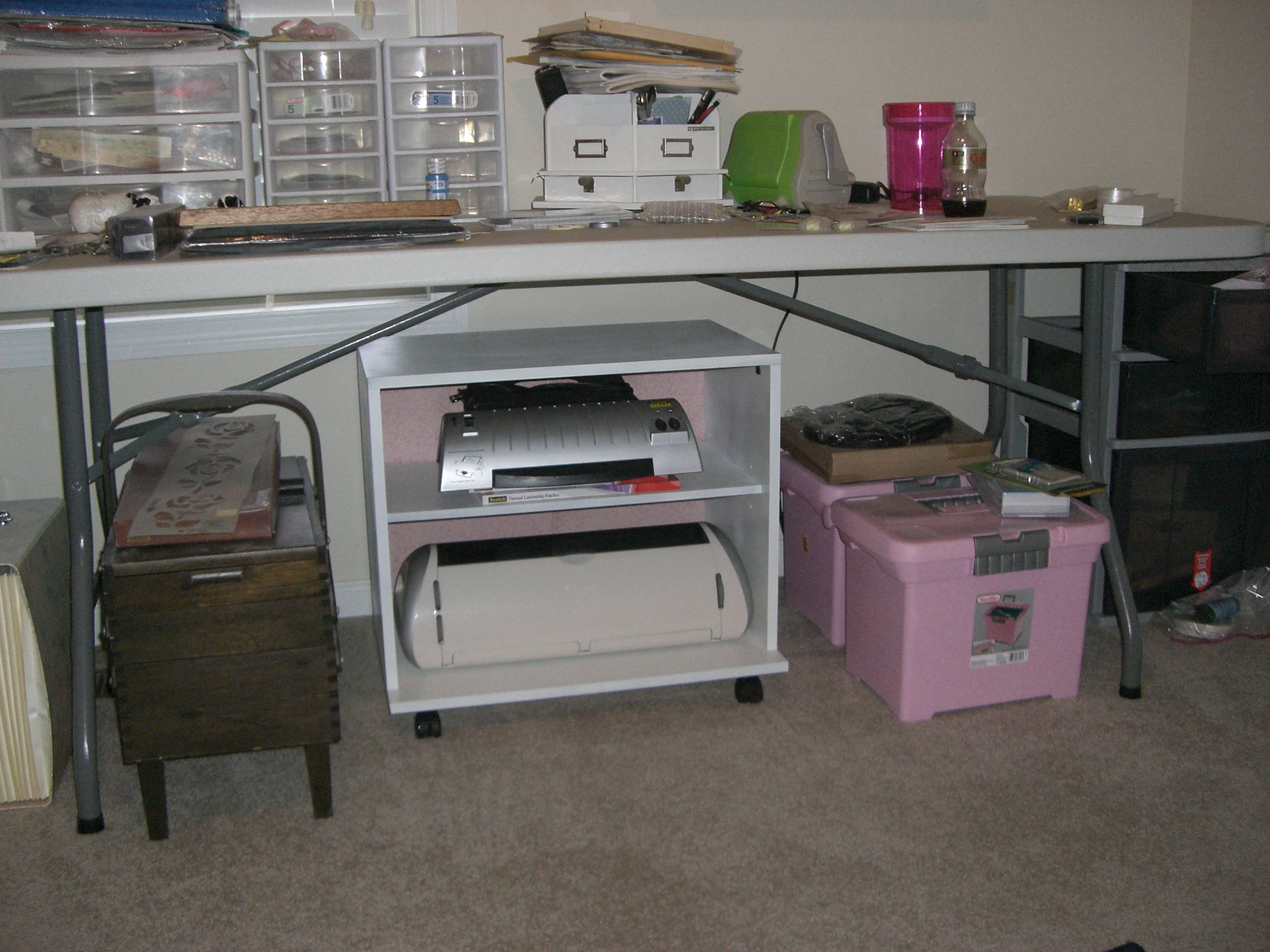
For some months now I’ve been searching for some way to keep my laminator and Cricut close by and ready to use, but off my work table so I have more space there. The room is small, so I didn’t have much wall space or closet space to put another storage unit (and I didn’t want to keep them in the closet anyway.) I wanted something on wheels, and because the laminator gets so hot, I wanted to avoid plastic storage.

I’ve been looking at various storage units and ideas and not seeing anything that would really work, and then one day this caught my eye in W-Mart:

CIMG5816

I had taken measurements of my work table and saw that this would fit underneath it! And it was the right width and already on wheels — perfect!

Except it was black. I appreciate black furniture in other people’s houses, but it’s just not my preference, and it just wouldn’t “go” in this room.

So, inspired by DIY projects I’ve seen on Pinterest and elsewhere online, I decided to spray paint it white. I knew it would take several coats, but otherwise it should be simple: just point and shoot, right?

Wrong.

I did know to paint the pieces before putting them together. At first I was holding the can too far away, so most of the paint went into the air rather than on the cabinet. (I was thinking, “Wow, there is more aerosol than paint in this thing! Then I realized the problem.) But when I got close enough for the paint to stick, then I had problems with drips, sputters, puddles, and uneven coverage. When I tried to dab off some of the drips, it took a whole chunk of paint out, down to the wood. I was SO frustrated. My husband came home at that point and took pity on me and helped me. I had been holding the button on the paint can down continuously while spraying back and forth, but he took short quick individual strokes back and forth. He sanded off some of the problems areas, and multiple coats of paint evened out everything else. I also learned the cheap 96 cent spray paint is not the best. Krylon worked the best for us.

We let the pieces cure for about a week, and then Jim assembled the cabinet for me last weekend. I had also wanted to put some decorative scrapbook paper on the back wall of the cabinet, to look something like this or this or this or this. But I just used two-sided tape because I wasn’t sure if I’d leave it and wanted it to be easy to get off or change.

So, here is the finished product:

CIMG5820

CIMG5824

(Kindly ignore the other junk stuff on and around the work table – I’m still working on the rest of the room. 🙂 )

I love it. I like that it’s near at hand and I can roll it out when desired and put whichever machine I’m using on top, but I can keep it all tucked here out of the way otherwise.

I may decide I want to keep the Cricut out on the table after all, but if I do, I have plenty of other things I could store here.

The pink floral paper at the back really doesn’t show up except when I use the flash on the camera: otherwise it just looks dark back there. So in a sense that was kind of a waste, but mentally I’m glad to know it’s there.

I’m just tickled that this worked so well. This room is really starting to come together and be more functional.

I’m linking this project up with:

WYWWAnd

This post will be also linked to Women Living Well.