Laudable Linkage

Here are some of the good reads found this week:

Do You Want to Be Well? “Jesus specialized in asking simple, straightforward questions.  They weren’t designed to trick people and went straight to the heart of the matter.  They invited people to pause and look deep inside at their aching spiritual poverty. John 5:6 says, ‘would you like to get well?’ or ‘wilt thou be made whole?’ Well, of course we want to be well.  Why would He even ask?” Plus, Linda links to this printable of verses that share Who Am I in Christ?

How to Transform Your Personal Bible Study with an Easy Perspective Shift. “I tossed my Bible aside in frustration. What on earth did Jeroboam, Rehoboam, Abijam, Asa, Nadab, and a series of other kings whose names I couldn’t pronounce have to do with me?

How Can We Avoid Putting a Band-Aid on Others’ Grief and Pain? “A reader recently asked me a searching question about this scene from Mark’s Gospel: ‘Mark describes Jesus as greatly distressed and troubled, sorrowful to death. If Jesus felt this way, why do we, as Christians, often just try to put a band-aid on others’ grief and pain?'”

Learning a Lesson from Scandals Close to Home. “Though we would never wish for a scandal to take place and make its way into the headlines, and while we should always regret the circumstances that bring one about, a scandal does offer the opportunity for personal introspection. A wise man will heed its lessons, for it inevitably provides the context to consider whether sin is sneaking up on us as it has on someone else, to practice the biblical admonition ‘let anyone who thinks that he stands take heed lest he fall’ (1 Corinthians 10:12).”

“No Celebrities Except Jesus”: How Asbury Protected the Revival, HT to Challies. Interesting article about how school officials responded and some of the behind-the-scenes logistics.

More Than Music: How the Congregation Plays a Part in Every Element of Worship, HT to Challies. “We equate worship with music because we have been trained to think that singing is the only way in which congregations actually participate in worship. But Scripture is clear: corporate worship encompasses much more than music. In fact, every element of Christian worship involves the active participation of the entire congregation.”

Weaknesses: Our Unlikely Ally, HT to Challies. “If you want to turn the world’s wisdom on its head completely, this is it. The Apostle Paul says he will boast about his weaknesses (2 Cor. 12:9). We do not boast of weaknesses; we hide them because they hold us back from being who we should be. They threaten our competence. They are faults and defects. Instead, we boast of accomplishments, skills, talents, and abilities, but biblical wisdom says this is backward.”

Thoughts on Lent. I appreciate the balanced approach here.

Split or Stay: Encouragement for Anglican Pastors, HT to Challies. Though the context here is Anglican pastors, the principles about considering separation from one’s denomination or church are very helpful.

This as as good a time as any for my occasional reminder that a link here does not mean 100% endorsement of everything on the site.

Friday’s Fave Five

I couldn’t help but use the spring icon this week, though spring is officially a few weeks away. It looks like we’ll still have some cold nights over the next week, but pleasant days.

It’s been a quiet, fairly low-key week. Today it’s time to pause with Susanne and friends at Living to Tell the Story to look back at the highlights of the week.

1. Time with Timothy. My son and daughter-in-law asked me to watch Timothy for a few hours one afternoon.

2. A light cooking week. If you’ve been reading here long, you know that’s a favorite for me. 🙂 Jason and Mittu brought dinner in a crock pot when they brought Timothy and ate with us after they got back. Then we got take-out a couple of nights. Jim was away last night, so I just had frozen pizza.

3. Lunch with Melanie. We talked about the world’s problems and didn’t come up with any solutions except that people need Jesus and we look forward to His coming.

4. A Crumbl cookie. I tried the Maple Bacon one this time. Soooo good. But so sweet and rich I couldn’t eat much at one time. I don’t think I’ll get any of their frosted cookies any more—normally with cakes I scrape off the excess frosting. For just a cookie, it seems silly to pay premium price for a special treat just to scrape off 1/3 of it.

5. Blooms and new growth. I mentioned daffodils last week. Flowering tress are blooming all over town. I just noticed yesterday my roses are leafing out. After the barren landscape of winter, I always look forward to the new growth and color as spring approaches.

How was your week?

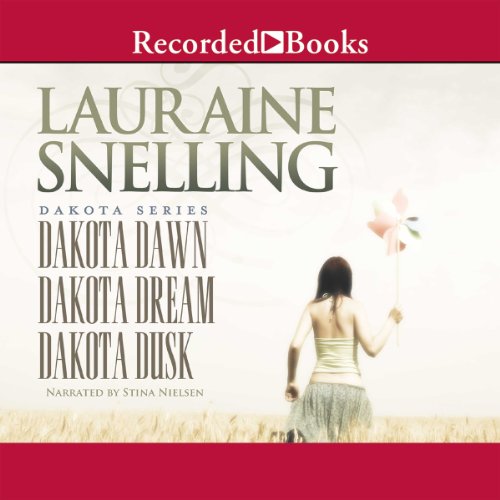
Dakota Dawn, Dream, and Dusk

Dakota series by Lauraine Sneling

Lauraine Snelling wrote a series of five novellas about Norwegian immigrants to North Dakota in the 1900s. The first three, Dakota Dawn, Dakota Dream, and Dakota Dusk, were packaged together in a free-with-my-subscription audiobook. I don’t know what’s up with the picture on the cover—no one dressed that way in the 1900s!

In Dakota Dawn, Norah Johanson’s fiance had gone to America three years ago, promising to send for her. Now she’s on her way. But when she arrives, she finds that Hans has just recently died. Reverend and Mrs. Moen take her in for as long as she needs to decide what to do. She doesn’t have the money to go back home, so she must find work.

Carl Detchman is a quiet but stubborn German immigrant whose wife has just died in childbirth. The Moens have taken care of his young daughter and infant son, but he can’t expect them to do so forever. The Moen’s house guest who has been helping with the children seems capable. But he can’t invite a beauitful young single woman to his home without tongues wagging. So he proposes a marriage of convenience. If she’ll come and keep house and take care of the children until he can make other arrangements, then they can annul the marriage and he’ll pay for her ticket back home.

Norah is shocked at first, but agrees. And, of course, the two fall in love. This is a frequently seen story line with an inevitable conclusion, but it was enjoyable to see the two work through their issues and come first to appreciate, and then to love each other.

In Dakota Dream, Clara Johanson, Norah’s sister, received a ticket to her sister’s town and a picture from a handsome stranger offering to pay her way to Dakota if she’ll be his wife. Clara agrees. But when she arrives at her sister’s house, no one knows who this man is.

What she doesn’t know is that Jude Weinlander brought Clara over to play a trick on his brother, Dag. He signed Dag’s name to the letter but sent his own picture. Dag is tasked with meeting Clara at the train station and taking her to the Detchman’s. He does not make a good first impression, with matted hair and beard and filth from the livery where he works.

Clara stays with her sister until the pastor asks if she can come and stay with an elderly woman who is not doing well and needs full time care. Clara has no idea the change this will make in her life—and in her relationship with Dag.

In Dakota Dusk, Jude Weinlander is disgusted. His trick on Dag backfired. He’s run out of money due to drinking and gambling and has to move with his wife back to his mother’s house.

When a fire destroys his home, after he heals, he becomes a drifter, traveling from place to place looking for work. He doesn’t drink or gamble any more, but he can’t go home. He comes upon a town rebuilding their school after a prairie fire. He stays to help, and then is asked to stay on to help rebuild other homes.

He can’t help but notice the pretty school teacher, Rebekka Stenesrude. But he can never pursue a relationship. He’s not worthy. No one could love him if they learned what he had done.

These stories were set some years after Laura Ingalls Wilder’s Little House series, so there are many similar incidents—grasshopper infestations, prairies fires, etc .But these stories are told primarily from the viewpoint of immigrants adjusting to a new land. I felt the same way I did after reading Laura’s books—glad I was born in my time and not hers!

There were so many hardships in those times. The services for help that we take for granted didn’t exist then, so people had to help each other, and accept help, or die.

But great faith and character emerged as well. I enjoyed these stories as well as the characters and the obstacles they overcame.

The Space Between Words

In The Space Between Words by Michele Phoenix, Jessica and two friends in Denver take a vacation to Paris. Though they’ll do some sight-seeing, they are mainly there to scout out treasures at antique stores and flea markets.

But then Jessica is shot during the Paris attacks in 2015. She’s traumatized by all she saw in the attacks. When she heals enough to be moved, she wants to get out of Paris as quickly as possible.

But one of her friends talks her into staying, at least for a little while. In one flea market, Jessica find an antique sewing box that seems to draw her. Back at her room, she discovers a secret compartment in the box which contains several sheets of handwritten paper and a few pages from an antique French Bible.

A new friend helps Jessica translate the ancient French. The sheets held the writing of a young woman named Adeline Baillard in 1695. She and her family were Huguenots when the Catholic King outlawed their faith and sanctioned torture and persecution against them. Adeline’s family gets her sister and brother and his family out, but Adeline stays with her parents. She’s a teacher and wants to help her students as much as she can while there is time.

As Jessica reads Adeline’s words, she feels compelled to find what happened to her and her family, especially her sister. Her own healing and mental and spiritual health are wrapped up in Adeline’s fate. She can’t understand how Adeline could believe so strongly in a God who would allow such atrocities to happen.

I’m sorry to say that I had completely forgotten about the Paris attacks of 2015. The year isn’t given in the novel, but the details seemed more reality than fiction, so I looked up and read more about them in Wikipedia.

This is the first book of Michele’s I have read, and I was captivated. So much of the story is touching, but subtle humor is sprinkled throughout as well. One surprise twist was heart-wrenching.

Just a few quotes that stood out to me:

I knew he worried, as I did, that that part of my life had been amputated by fear.

Father held what remained of our Bible in both hands and declared, “This is the Truth that binds us to each other and to God. These are the words exhorting us to faithfulness and strength. These are the pages that emancipated our faith from the dictates of a King. We will carry them with us as a testament to our resistance, as a reminder of all the Huguenot community has endured” (p. 115).

My grandmother believed in the power of words, in the capacity of story to transcend both time and place. This scroll is evidence of the temerity of her escape, a tribute to the ancestors who lost their world to save their faith (p. 288).

There were a couple of odd places where a child seemed to see someone who wasn’t there. But other than that, I loved everything about this book.