It’s Friday, time to look back over the blessings of the week with Susanne at Living to Tell the Story and other friends.
The first FFF of July! Here are some highlights of the week:
1. Retirement home ministry. Our church does this once a month—the place we visit rotates groups who hold services on Sunday afternoons. The people seem very attentive, and we all hang around and visit with them for a good while afterward. The lady we spent time with the first week looks for us now each week and even gave me a hug.
2. Impromptu lunch get-together. There wasn’t enough time to go home after church and come back for the retirement home service, so we stopped for lunch at McAlister’s Deli. There we ran into our pastor and his family, who were doing the same thing. We sat at adjacent tables and enjoyed the fellowship while we ate.
3. More time off from cooking. I mentioned last week that I hadn’t done any real cooking while Jim was out of town. Then my son and daughter-in-law invited us over both Friday and Saturday night. Then we went out for the lunch mentioned above on Sunday. That’s the first time in my adult life I’ve had a whole week off from cooking! Even though I could get used to that pretty easily, I did miss the things I make and missed having leftovers to reheat for lunch. So I was more or less ready to get back at it Monday.
4. A remade desk. I wish I had thought to take a “before” picture. An old one which shows a bit of the desk is here:
Old desk in old sewing room
More than anything else, I wanted to change out the old Colonial-style knobs and handles. But I wanted to lighten it up, too. I decided to keep the top stained–I figured that way we wouldn’t have to worry about paint chipping there. But Jim painted the rest of it white for me.
Desk makeover
I was originally thinking about glass knobs, but when I saw these vintage-looking ones, I loved them.
5. An uneventful cardiologist visit. I almost could have just phoned it in except for his needing to listen to my heart and run a EKG. Even though I’d just had an episode of afib last week, we pretty much just discussed increasing medicine if it happened again.
In Kim Michele Richardson’s novel, The Book Woman of Troublesome Creek, Cussy Mary Carter was one of the Pack Horse Librarians. A Works Progress Administration (WPA) initiative by FDR during the Depression employed librarians to bring books to people in the Appalachian mountains. Books were donated, and the Pack Horse Librarians sorted, distributed them, and made scrapbooks for residents which included recipes and tips. The librarians, mostly women, rode hundreds of miles.
Many of the residents were eager for books and magazines. Some were suspicious.
Cussy Mary had to fight more than the usual amount of suspicion and superstition because she was colored: blue.
A family line in Kentucky produced people with a blue tint to their skin due to a recessive gene, though the cause wasn’t known at the time. Some people treated the “blues” like anyone else, but negative reactions ranged from a desire to keep a distance to fear of disease to superstitions to hatred. “Blues” were included in “No coloreds allowed” signs and laws.
The story begins with Cussy Mary’s father trying to arrange courtship for her, though she doesn’t want to be married. He has worked in the mines all his life, and his lungs are affected. He wants to make sure Mary is provided for before he dies. But no one is interested until he offers the deed to his land. A disastrous wedding night leaves Mary a widow.
We follow along with Mary on her travels, meet her patrons, hear their stories, see her interactions with townspeople, encounter the dangers on the trail.
The town doctor has always wanted to take blood samples and study Mary and her father, but they’ve resisted—until the father has a secret he needs the doctor to keep. The only way the doctor will agree is if Mary’s dad will let him take her to the hospital in Lexington for tests. Against Mary’s will, she’s subjected to all kinds of indignities. When the doctor finds a temporary “cure” for Mary’s blue skin, she enjoys being white at first. But the side effects and the lack of change in how people treat her leave her wondering if the change is worth it. The author says in her notes that the study and treatment she described didn’t actually occur until about thirty years later.
Mary’s courage and determination shine throughout. She remembered being read to by her mother, who passed away. That hunger for learning stayed with Mary, and she wants to help those with the same hunger.
I first became aware of this book through reviews by Susan and Susanne.
There is a smattering of bad words, and Mary’s wedding night is told with more detail than I’d like.
But otherwise, this was a fascinating story.
I listened to the audiobook, which I was pleased to get for free–it was included with either my Audible subscription or Amazon Prime, I forget which. Katie Schorr did a wonderful job with the narration. I checked out the book from the library to read back matter not included with the audiobook, including a nice interview with the author.
Had you heard of blue people or the Pack Horse Librarians? Would you be willing to brave mountainous trails in the back woods on a mule to get books to people?
Even though we’ve only officially been in summer ten days, I think of the whole month of June as summer. We spent more time outside over spring, but it’s getting too hot and humid to be outside much until evening.
Family
Around the house, Jim painted the “guest room” (or spare oom) and a desk and put some shelves and decorations on the walls of the sewing room for me. I finally dug up an aggressive ivy from the front planters and planted a bunch of flowers that are flourishing nicely thanks to my husband remembering to water them. I’ve done some pockets of reorganization—I tend to do just a shelf or corner or box at a time.
Our two main celebrations were Timothy’s finishing first grade and Father’s Day. Everyone helped to bring over the queen-sized bed Jason and Mittu gave us and set it up in our new official guest room, then Mittu made dinner for us all. I had searched for bedspreads and placed the one I liked on Amazon’s wishlist. But when I went to order it, it was “currently unavailable,” and they had no idea when or if they might get more. So I had to start from scratch. The bed is bigger than I was thinking. I realized the futon we had in there before was a full size and therefore smaller. So I don’t think I’ll be able to get an extra chair in there like I wanted. But that’s okay.
Timothyisms
Timothy asked his parents when the next paycheck was coming. When they asked why, he said he was making a list of toys for the next paycheck.
Creating
I didn’t make a Father’s Day card for Jim this year. When I searched for ideas, I found an already-made card that was just perfect, so I got that instead of making one.
The card I made for my step-father draws on his love for a certain sci-fi franchise:
I found a Star Trek font online and then found a template for the badge and colored it in with a gold paint pen.
This was for Jason:
Reading
Since last time, I finished (titles link to my reviews):
The Sign Painter by Davis Bunn. A young mom fallen on hard times finally gets a job and a place to stay. But a situation in her place of employment puts her in a dangerous moral dilemma. Meanwhile, a former cop tries to help a church deal with a drug house nearby.
Saving Alice by David Lewis. A young man’s first love is killed in an accident. He eventually marries their mutual friend and has a comfortable life, until he has a falling out with his daughter. Trying to reconcile with his daughter brings a lot of things to light in his life.
The Orchard House by Heidi Chiavaroli. A time slip novel. One plot line involves Louisa May Alcott and a close friend. The modern story tells of an adopted girl betrayed by her sister who reconciles over the mystery some poems by a friend of Louisa’s discovered in Louisa’s old house.
A Room with a View by E. M. Forster (audiobook). While traveling in Italy, a girl in a conventional lifestyle meets a free-spirited brooding man who eventually changes her life.
The Adventures of Pinocchio by Carlo Collodi (audiobook). A little darker and more involved than the Disney version we’re used to. But a good moral illustration of what happens when boys don’t heed advice and instruction.
Our Town by Thornton Wilder. A play about treasuring ordinary life.
The House at the End of the Moor by Michelle Griep. A woman in hiding has to take in an injured man found on her property, and her anonymity and his safety is threatened.
Is It Wrong to Be Right? We don’t have to set up a false dichotomy between being nice or right. We should strive to be right, but we can be nice about it.
Giving and Receiving God’s Word. Our hope and comfort come from the Bible, but sometimes we share it in a way that short-circuits its message.
What Are You Looking For? Nothing in this life will be perfect. Only as we look to God will we find perfect love, peace, justice, and so much more.
A Better Blade for Killing Sin. Even if we could cut off everything that leads us to sin, we’d still have trouble with our hearts. Only God’s Word pierces there.
As we turn the corner from June to July, we look forward to the Fourth of July weekend. We haven’t made sure plans yet, but they’ll definitely include family and burgers. We also look forward to my son, Jason’s, birthday this month. I hope to finish setting up the guest room in the next few weeks before Jeremy comes in August.
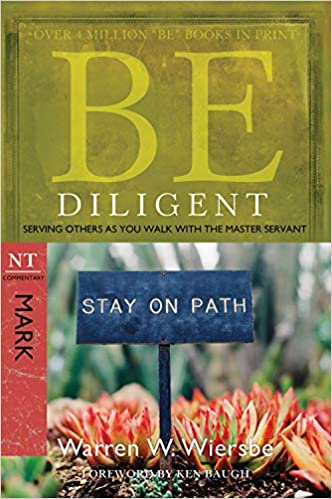
The gospel of Mark is a book of action. Many of the verbs are present participle, indicating continuing action: saying, going, teaching. The word “immediately” occurs in Mark 35 times (in the ESV), more than any other book, though Mark is the shortest of the four gospels.
Mark wrote for the Romans, and his theme is Jesus Christ the Servant. If we had to pick a “key verse” in this gospel, it would be Mark 10: 45—“For even the Son of man came not to be ministered unto, but to minister, and to give his life a ransom for many.”
The fact that Mark wrote with the Romans in mind helps us understand his style and approach. The emphasis in this gospel is on activity. Mark describes Jesus as He busily moves from place to place and meets the physical and spiritual needs of all kinds of people.
Mark does not record many of our Lord’s sermons because his emphasis is on what Jesus did rather than what Jesus said.
Mark was written by a man known elsewhere in Scripture as John Mark. He and his mother were among the early disciples. When Peter was supernaturally released from prison, he fled to the house of Mark and his mother, where a prayer meeting was held. Mark left early from a mission trip with Paul and Barnabas for unnamed reasons, causing Paul to decline taking Mark along the next time. But later on in 2 Timothy 4:11, Paul asks for Mark to come, “for he is profitable to me for the ministry.” So they must have reconciled. Peter calls Mark “my son” (1 Peter 5:13), indicating Peter was probably the one who led Mark to the Lord. Most of Mark’s material came from Peter.
A few more observations from Wiersbe:
Jesus placed a great deal of importance on the hearing of the Word of God. In one form or another, the word hear is used thirteen times in Mark 4: 1–34. Obviously, our Lord was speaking, not about physical hearing, but about hearing with spiritual discernment. To “hear” the Word of God means to understand it and obey it (see James 1: 22–25).
Faithful women were the last at the cross on Friday and the first at the tomb on Sunday. What a contrast to the disciples, who had boasted that they would die for Him! The church of Jesus Christ owes much to the sacrifice and devotion of believing women.
The world’s philosophy is that you are “great” if others are working for you, but Christ’s message is that greatness comes from our serving others.
Because Mark’s gospel was so jam-packed, it was a little hard to discuss in our church’s Bible study time. But the study of Mark was profitable, as were the insights offered by Wiersbe.
There’s one piece of chocolate cake on the counter.
I love chocolate cake. But I’ve already had something sweet today, and I want to save that last piece of cake for my husband. So I am resisting temptation.
There’s nothing inherently sinful about chocolate cake. But a lack of self-control is sinful. And chocolate cake tests my self-control.
If I start thinking about the cake, I’ll think about how good it tastes. Then I’ll think about maybe taking a sliver of it. Then half. And then I’ll think, “Well, it’s just this once. It’s not like I feast on chocolate cake every day.” I might even talk myself into eating the whole piece: my husband doesn’t know it’s there, so he isn’t expecting cake when he comes home.
Each thought is like laying kindling to the initial flame of temptation. Instead of feeding that flame, I need to stomp on it, douse it, dump sand on it.
That’s the kind of thing that comes to mind when someone talks about killing sin.
Romans 8:13 says, “For if you live according to the flesh you will die, but if by the Spirit you put to death the deeds of the body, you will live.” Colossians 3:5 says, “Put to death therefore what is earthly in you” and then names several wrong desires.
When something is killed, it’s . . . dead. Unresponsive. Not going to bother us any more.
But the problem is, wrong desires don’t stay dead. The next time chocolate cake is here, I’ll face the same temptation. So does that mean I didn’t “kill sin” in the first place?
Same with selfishness, probably my most besetting sin. Have you ever tried to kill selfishness in your life? It doesn’t stay dead. We might resist it one moment, but then it’s back soon.
So how can we kill it? I’ve supposed that the Bible means we kill sin in the moment. When I am tempted to sin, instead of entertaining the idea, I should look for ways to resist. God promises that “No temptation has overtaken you that is not common to man. God is faithful, and he will not let you be tempted beyond your ability, but with the temptation he will also provide the way of escape, that you may be able to endure it” 1 Corinthians 10:13). Too often I look for an excuse to indulge instead of the way of escape.
Instead of indulging the desire, I resist it–strangle it. Am unresponsive to it. It may come up again tomorrow. But for now, it’s slain.
Still, I wrestled with what it really meant to kill sin. Like the old slogan that promised Raid “kills bugs dead,” how could I kill sin dead?
A passage in Jen Wilkin’s book, Ten Words to Live By: Delighting In and Doing What God Commands, helped shed some light. The book is about the Ten Commandments, what they mean, how they apply today. In the seventh chapter on honoring marriage, Jen brings up Jesus’s command to cut off one’s eye or hand if those members cause us to sin, because “it is better that you lose one of your members than that your whole body go into hell” (Matthew 5:27-30). Jesus is obviously using hyperbole, exaggeration, to make a point.
Jen points out that even if we could cut off any body part that causes us to sin, we’d still have a problem in our hearts. Jesus made the same point when He said it’s not just committing adultery that’s a sin, but lusting. Jen goes on to say:
We need a better blade than any formed by human hands, one aimed at ridding our hearts of disordered desires.
Praise God, we have one. The blade that slays the beast is the word of God, made living and active by the Spirit of God, dividing thoughts and intentions of the heart (Heb. 4:12). By the word of God we learn to delight our hearts in the Lord, and the outcome is that which the psalmist predicts: “Delight yourself in the LORD, and he will give you the desires of your heart” (Ps. 37:4) (p. 106).
Then Jen shares what was for me a light-bulb moment:
As we confess and repent, God puts to death our disordered desires and gives us rightly ordered ones. And our eyes and hands and feet and lips and tongues and noses begin to serve at the pleasure of a heart that delights in him.
“If your eye is healthy, your whole body will be full of light” (Matt. 6:22). The antidote to the lust of the eyes is not self-inflicted blindness, but seeing as God sees (pp. 106-107).
Being tempted is not sin. Jesus was tempted, yet never sinned. He resisted Satan with the Word of God. The more we know God’s Word, the better we’ll be able to resist sin.
But we put sin to death in our lives not just by resisting temptation in the moment, but by exposing ourselves to the blade of the Word of God, by delighting ourselves in the Lord and letting Him change our desires.
Killing sin doesn’t mean that I’ll never be tempted by a particular thing again or that all outward influences to sin will die. I wish. That won’t happen until heaven. But by God’s grace, I am supposed to kill sin in me. Sin lost its power over me at the cross. But I have to learn to live in newness of life—a process called sanctification, which won’t be complete until heaven. As I grow in the Lord, take in His Word, delight in Him, He changes my desires, and sin loses more power.
Scripture describes the Christian life as the source of such great joy that temptations lose their appeal. Like the feeling we have after Thanksgiving dinner, we should be so full of Christ that we don’t have room for sin!…Does obeying Christ mean saying no to sinful pleasures? Sure. However, saying no to sin in favor of Christ is like saying no to a scooter in favor of a sports car, or no to peanuts in favor of filet mignon. Life with Christ is a feast, not a famine (Chris Anderson, Gospel Meditations for Women).
One of Jen’s discussion questions at the end of this chapter says, “If you believe that the sharp blade of the Scriptures can put [sin] to death and reshape your desires, what regular practice of gazing on them do you follow?” (p. 110, emphases mine).
Here are some of the online reads that caught my eye this week:
Providential Dullness. Ever wonder why the disciples didn’t “get it” when Jesus foretold His death and resurrection? The answer may surprise you.
Help Wanted: The Vanishing Work Ethic. “When God made the first man, He placed him in the Garden of Eden and gave him a job. Adam was to dress the garden and keep it (Gen. 2:15). God designed man to have both activity and responsibility. Sometimes we imagine that Adam lived a life of leisure in Eden. But that is not the case. God’s design for man’s health and happiness involved work.”
Each Man Before the Mob. “We should be happier if a man follows a different path than we do while heeding his conscience than if he imitates us while violating it. We should affirm him in making a decision that is different from our own, as long as that decision is consistent with his conscience.”
Why Our Secular Age Needs Ecclesiastes, HT to Knowable Word. “This world is desperate for answers to life’s fundamental questions. What is life about? Why is life so unjust? Why does work have to be so toilsome? How can I be happy when the world seems pointless?”
Christians, Beware the Blame Game, HT to Challies. “By all means, call out the moral failings of Christians, congregations and denominations, left and right; but be specific, do so without slander and vitriol, and make a clear distinction between the church and the specific failings to which you allude in order to promote clear thinking. And remember—if your critique of Christians is not balanced by a Pauline emphasis on the church, the body of Christ, as the answer to the world’s problems, you ultimately offer no true Christian commentary on the contemporary scene.”
The Word that Never Fades, HT to Challies. “Though her memories collide with the present and it’s challenging for her to stay rooted in the moment, the habits of faith that she has built her life upon still seem to anchor her with recognition of the Lord’s presence. Wherever her mind may travel, He is ever with her.”
Widowhood: More Than Grief. “Despite being a large number in our population (and with the boomer generation, the number will grow), widows may be overlooked in society and are often on the periphery in groups. Our culture is a Noah’s Ark culture, where much is geared to couples, including the advantage of filing joint US tax returns.”
When I Discovered I Had Three Fathers, HT to Challies. “I am still walking through the very real effects of all of this new information. I am grappling with how to establish a relationship with the father I have found at this point of my life—or with whether I should even try. There’s no playbook for this. But through it all, I have started to see what has anchored my soul through this period of uncertainty and upset.”
Jen Hatmaker quits “church” and invites you to join her, HT to Challies. “Actually, Jesus met us in our sin, adopted us into an eternal family, and started a supernatural movement that was defined by believers getting together for worship, teaching, and serving together. It’s defined by people in relationships that are centered on Christ. Church is bigger and more mature than a life of casually hanging out with your favorite people on your porch.”
And for a bit of fun, here are different kinds of beach people:
It’s Friday, time to look back over the blessings of the week with Susanne at Living to Tell the Story and other friends.
It’s been quite the week. Jim was out of town from Monday through Thursday. The power was out twelve hours Monday night. I was in atrial fibrillation most of Tuesday, but thankfully that resolved overnight without my having to go to the ER. The rest of the week was better! Here are some of the best parts:
1. Father’s Day. We enjoyed the opportunity to honor Jim with cards, gifts, a spaghetti dinner, and chocolate cake. We had a lot of fun with this gift that Mittu got for Jason.
2. Power. There’s nothing like losing power for a while to truly appreciate it when it comes back on. Thankfully I had just heated up some soup for dinner when the power went off during a storm. Also, the temperature never got uncomfortably hot–mainly because the outage occurred from about 5:30 p.m. until 7:30 a.m. I could have called Jason and Mittu and gone to their house, and I would have if I had been uncomfortable. But it’s still light late enough that I could sit by a window and read for several hours. I finished off two books that night! And I understood why people used to go to bed and get up with the sun—there’s not much you can do in the evenings once it gets dark.
3. Lunch with a friend. The last time we saw each other, we talked about this new weird virus going around and wondered if it would turn out to be a big problem. It did! It was so good to catch up in person. This was my first time to eat inside a restaurant since the pandemic started. We ate at Cracker Barrel, and they had a delicious new entree that we both tried: Maple Bacon Grilled Chicken.
4. Not cooking. With Jim gone, I’ve just heated up leftovers or canned stuff. Jason and Mittu brought me dinner the night I was in afib. I got takeout I was craving from Red Lobster one night.
5. A bit of closet reorganization. I’m not doing a full scale closet clean-out or re-do. But every now and then I get an idea for a better way some things would work. So I’ve chipped away at that a little every morning this week and also pulled a few things out to donate or trash while I was at it.
As I write this Thursday afternoon, I’m looking forward to Jim coming home tonight (he did arrive safely!) How was your week?
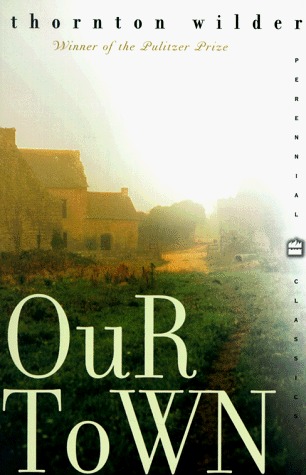
Thornton Wilder wrote the play Our Town in 1938 and it won him the Pulitzer Prize for Drama.
One distinguishing feature of the play is the minimal use of scenery and props. Only a couple of tables and ladders appear on stage at certain points. Actors mime cooking, eating, etc. According to Wikipedia, Wilder said, “I tried to restore significance to the small details of life by removing the scenery. The spectator through lending his imagination to the action restages it inside his own head.”
Another distinguishing feature is the Stage Manager. He’s the main character in the play and directs the action of everything else, but also speaks directly to the audience. He calls in a couple of experts for information and explains some of the things going on. He also plays a couple of parts, like the preacher officiating at a wedding.
The play takes place in the fictional Grover’s Corners, New Hampshire, in 1901. The newspaper editor says it’s a “Very ordinary town if you ask me. Little better behaved than most. Probably a lot duller. But our young people here seem to like it well enough. Ninety per cent of ’em graduating from high school settle right here to live.”
The story is told in three acts: Act I, Daily Life, introduces the characters and feel of the town. The two main families are the Webbs and the Gibbs. Emily Webb and George Gibbs are neighboring teens who are just starting to notice each other.
Act II, Love and Marriage, takes place three years later on George and Emily’s wedding day.
The title of the final act, Death and Eternity, gives you a hint what happens there nine years later. It’s not much of a spoiler to say that one of the main characters dies. She wants to go back and spend one day of her past life. The other dead advise her not to, but she insists. As she looks at everything with new eyes, she wants everyone to slow down and savor it. “Oh earth,” she says, “you’re too wonderful for anybody to realize you.” She asks the stage manager, “Do any human beings ever realize this life while they live it?—every, every minute?” He answers, “No . . . The saints and poets maybe. They do some” (p. 108).
The ending would almost seem a little depressing, except for the implied message that life goes too fast and we should savor time with loved ones while we have it.
A few observations that particularly stood out to me:
In Act I, the Stage Manager discusses all that the town is putting into a time capsule. He wants to put in a copy of the play because:
Y’know—Babylon once had two million people in it, and all we know about ’em is the names of kings and some copies of wheat contracts . . . and contracts for the sale of slaves. Yet every night all those families sat down to supper, and the father came home from his work, and the smoke went up the chimney,—same as here. And even in Greece and Rome, all we know about the real life of the people is what we can piece together out of the joking poems and comedies they wrote for the theatre back then. So I’m going to have a copy of this play put in the cornerstone . . . so—people a thousand years from now . . .This is the way we were: in our growing up and in our marrying and in our living and in our dying (p. 33).
Of the two mothers in the main characters:
I don’t have to point out to the women in my audience that those ladies they see before them, both of those ladies cooked three meals a day—one of ’em for twenty years, the other for forty—and no summer vacation. They brought up two children a piece, washed, cleaned the house,—and never a nervous breakdown (p. 49).
Before the wedding, encouraging people to remember their twenties, the Stage Manager says:
You know how it is: you’re twenty-one or twenty-two and you make some decisions, then whisssh! you’re seventy: you’ve been a lawyer for fifty years, and that white-haired lady at your side has eaten over fifty thousand meals with you. How do such things begin? (p. 62).
Ironically, one of the dead says of the living, “They’re sort of shut up in little boxes, aren’t they?” (p. 96).
At the cemetery:
Now there are some things we all know, but we don’t take’m out and look at’m very often. We all know that something is eternal. And it ain’t houses and it ain’t names, and it ain’t earth, and it ain’t even the stars . . .everybody knows in their bones that something is eternal, and that something has to do with human beings. All the greatest people ever lived have been telling us that for five thousand years and yet you’d be surprised how people are always losing hold of it. There’s something way down deep that’s eternal about every human being (pp. 87-88).
Reminds me of Ecclesiastes 3:11 (NKJV): “He has made everything beautiful in its time. Also He has put eternity in their hearts, except that no one can find out the work that God does from beginning to end.”
I’ve never seen the play. I read the library book rather than listening to a performance because I wanted to read the stage directions. The play has been filmed a number of times, and some versions are on YouTube. Here’s a scene from a 1977 production with Robby Benson as George:
Have you ever read or seen Our Town? What did you think?
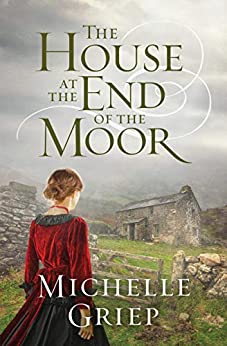
A woman known as Mrs. Dossett lives at the title house with only a sheepdog, mute maid, and a manservant. It’s obvious she’s in hiding, but we don’t know from whom at first.
So when she finds a severely wounded unconscious man on her property, she’s torn. It can only mean trouble to bring him home. But she can’t leave him to the elements.
As the man, Oliver, heals and his head becomes clearer he and the woman are wary of each other. He’d like to leave, but he’s too injured.
Just as the two are beginning to trust each other, Oliver opens the door to a room where a beautiful gown is displayed along with a gorgeous red jeweled necklace–the very necklace he was falsely accused of stealing and for which he was thrown in prison.
The mystery of who each of the characters are, where the jewels are from, and what the characters decide to do all make for an interesting read. The faith element is naturally woven into the characters’ makeup and thinking.
A secondary character, Barrow, is the constable seeking Oliver since his escape from prison. Barrow is similar to Javert in Les Miserables but is much more cruel. His motivation is seeking justice for righteousness’s sake. But he has to learn what justice truly is and who is supposed to mete it out.
Somehow I ended up with both a Kindle and paperback version of this book. So I’d love to give away the physical copy to one of you. I can only offer it to someone in the US due to mailing costs. If you’d like to enter the drawing for this book, just leave a comment on this post before Wednesday, June 30. I’ll draw a name then from among the entries. I’ll count all comments on this post as entries unless you mention that you’re not interested in winning the book. Also, I must have a way to contact you to let you know you have won. If I don’t hear back from the winner within a couple of days, I’ll draw another name. Best wishes to each of you!
(Update: I originally scheduled the contest to end Saturday, but decided to extend it to Wed., June 30.)
The giveaway is now closed. The winner is Paula! Congratulations!
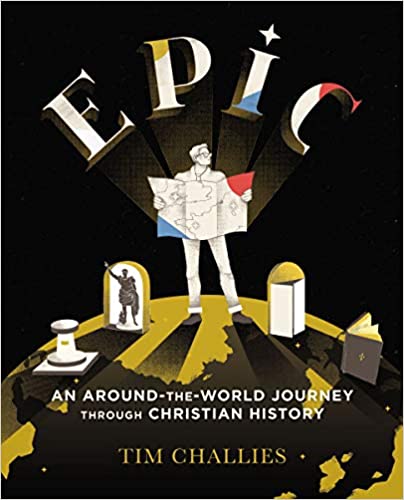
When Tim Challies first mentioned traveling all over the world looking for objects connected with Christianity for a book he wanted to write, I was puzzled. Our faith rests on the unseen—so why all that trouble for objects?
But then I remembered God used physical things all through the Bible. Stones piled up for a memorial. A brass serpent. A tabernacle and temple. A stone to kill a giant. Even His Son took on a physical body in which to die, be buried, and be resurrected to accomplish the means of our salvation.
Plus, Tim was not looking for these items to revere them, but to learn from them.
Tim’s travels culminated in EPIC: An Around-the-World Journey Through Christian History. Tim takes a close look at 33 objects and the stories behind them. They cross the centuries from the oldest known fragment of Scripture to the YouVersion app, from the statue of the Augustus who ushered in the Pax Romana, to the traveling pulpit someone made Billy Graham after observing him struggle in a small one.
Each chapter gives a brief background of the person or situation the object represents, then shares what that object tells us about God’s movement through the ages. None of the chapters are very long, and they include a few pictures each. It’s easy to pick up the book here and there and read a chapter or two at a time.
The most meaningful chapter to me focused on Amy Carmichael. Frank Houghton’s biography, Amy Carmichael of Dohnavur, was one of the first missionary biographies I read. That book and Amy’s own writings had a deep influence on me since my early adulthood. And Amy had a profound influence on Elisabeth Elliot, who impacted my life even more. So when Tim had a post about visiting not only Dohnavur, but also the room where Amy spent the last 20 years of her life as an invalid—that was when I began to get really excited about his book! Here is his video of that visit.
Another chapter that meant a lot to me was the one showing Nate Saint’s airplane. The story of the five missionaries killed in 1956 by the savage Indian tribe they were trying to reach has had a far-reaching impact ever since. I had not known that parts of Saint’s aircraft, which had been stripped at the time, had been recovered and reassembled.
I knew of most of the people mentioned in the book: William Carey, Hudson Taylor, David Livingstone, and others. Even Selina Hastings, or Lady Huntingdon, as she was known, one of my favorite people in Christian history. I enjoyed revisiting their stories and even learning a thing or two I hadn’t known.
Some of the folks mentioned were new to me: Marie Durand, Lemuel Haynes, and the folks who built the Papallacta Dam just so they could reach people in the area via radio.
Most of the objects discussed have positive stories and repercussions. A couple do not. One is known as the Slave Bible. Some missionaries wanted to reach slaves for the Lord, but “How could these missionaries teach the Bible to slaves without condemning slavery and therefore angering the slave owners?” Appallingly, they cut out “any passages or verses that condemned slavery or condoned racial equality. So pervasive is the message of freedom in the Word of God that only 232 of the Bible’s 1,189 chapters made the final cut” (p. 119).
One thing that becomes clear in a view over large swaths of Christian history is the realization of how God brought so many things together to accomplish His purposes. The Pax Romana and the system of roads created by the Romans allowed for the rapid spread of Christianity in the years after Jesus died and rose again. The invention of the printing press changed the world in many ways, but perhaps none more so than making the Bible available to the common man.
In one chapter, Tim said, “If I learned anything from my journey around the world, it’s the simple truth that the Lord is always at work” (p. 94). It was enjoyable and encouraging to see some of the Lord’s works in Tim’s book.
A DVD series was also made of Tim’s travels here. And here’s a trailer that gives an overview of the book:










 Stray Thoughts