Unknown's avatar

About Barbara Harper

https://barbarah.wordpress.com

Stray thoughts about racism

Justice and righteousnessI usually avoid controversy here. But several things have been on my heart the last few days.

I appreciate what one pastor said about feeling the need to make a statement, yet needing time to process and be with his people first. I’m not in any kind of leadership. No one is waiting on me to make a statement. But I have felt the need to say something while also needing to listen and take in and process before responding to horrible events that have happened in our country the last several days.

Some have decried white silence. Personally, my social media accounts have been filled with posts denouncing Floyd’s death. But, please understand, some are fearful of saying something wrong and making things worse.

Others accuse whites who speak out of virtue signalling. Some have said they don’t need whites standing up for them.

What to do? I don’t have all the answers. I don’t even know all the questions. But here are some things on my heart:

No question, what happened to George Floyd was atrocious and criminal. I was sickened, saddened, and angry by his unjust death. I’ve read opposite views about what kind of person he was. But that doesn’t matter. No one deserves to be kneed in the back, pinned to the ground and unable to breathe, until their breath is gone. I’m thankful the officers involved have been arrested.

No question there are bad policemen on the force. But I know they are not all bad. I know many are just as grieved as everyone else over Floyd’s death.

I have friends and relatives on the police force. I appreciate their service. Many take their lives in their hands every day. They never know when a seemingly everyday traffic stop or call will escalate into violence. I would guess that the great majority of law enforcement personnel are just trying to do the best job they can.

However. I don’t think anyone can deny that there have been too many instances of black men unjustly stopped, arrested, and killed. One instance would be too many.

I think racism is only part of the problem, though it’s a big part. The other is power. We’ve personally experienced and observed instances where a policeman has been unnecessarily aggressive and unwilling to listen. Authority is one thing, and I appreciate a policeman’s authority to step in when needed. But stepping in on the basis of snap judgments and a desire to exercise one’s own power is another.

These issues need to be addressed before they end up in abuse and murder. I’ve seen a meme going around listing several previous issues with the policeman who killed George Floyd. If these are true, action on them would have prevented Floyd’s death. If this policeman had been reprimanded or removed from his position earlier, the events on that fateful day would have turned out differently.

Racist and power-hungry people will show themselves. They need to be called on the carpet and either educated or removed. Other law enforcement people need to feel free to report questionable actions of their brother officers. The public good needs to be more important than protecting the brotherhood. Really, the brotherhood is not protected by covering for abusive officers, because reactions to the abuse will come back to haunt everyone, as we’ve seen in the recent riots.

I believe in peaceful protests. I can understand the anger and frustration spilling over. But rioting and looting only hurt the cause, harming innocents. It’s not even revenge, because it’s not aimed at the people who have done wrong. People have died in these riots, and those who killed them are no better than the policeman who killed George Floyd. There have to be more productive ways to demand justice.

But from comments on social media, it seems that outrage over the riots is superseding the outrage over George Floyd’s death.

Some of the rioters are not after justice. Some are opportunists. I’ve seen accusations of political involvement from both parties. It will take time to sort all that out. But don’t let the riots drown out the voices that need to be heard.

As I’ve read and listened to several responses, the one that resonates most with me is, “I’m listening.” James 1:19 tells us to ” be quick to hear, slow to speak, slow to anger.”

I admit that for most of my adult life, I didn’t think racism was much of a problem. Sure, in some places and among some people. But I thought that, by and large, we were mostly past that. I grew up in the 60s. With all the strides that have been made in the decades since, surely people had equal opportunities now. But I was wrong.

I bristled at the mention of white privilege. “Privilege” brought up images of mansions and butlers and high society, which most of us have not experienced.

Buy my friend Laurie put it this way: ” White privilege doesn’t mean your life hasn’t been without struggles; it means those struggles weren’t brought about by the color of your skin.”

As I have listened, I’ve learned that racism is still prevalent despite progress since the 60s.

A friend shared on Facebook My White Friend Asked Me to Explain White Privilege. I Decided to Be Honest (warning: a couple of bad words). Just one instance: her boyfriend had been repeatedly stopped by police while driving. He started keeping a teddy bear in the back windshield and baby wipes in the car so he’d look like a family man and would be stopped less frequently.

Some of you might know Paul Whitt. He was with the Northland camps for many years and is now an assistant pastor. He was a friend of our former pastor and spoke at our church. He interviewed four African-American friends here, all Christians, about their experiences, feelings, and fears. I don’t know Paul or any of these men personally, but I share several friends in common with a couple of them. This is a long recording, but well worth listening to.

My daughter-in-law is Indian. She has sometimes been mistaken for black. I’ve been astounded by ignorant and racists remarks and actions she has experienced. I’m sorry to say that sometimes I tried to explain away what she told me. For instance, once a lady almost mowed her and Timothy down with her cart in the grocery store. Mittu felt it was because they were brown. But, I said, not all offenses are racially motivated; some people are just rude. In fact, the very next week, the same thing happened to me.

But I should not have responded that way. I wasn’t there; I didn’t see the woman’s expression. Just like when someone has been abused, our first response should be to listen and protect.

A few of my daughter-in-law’s other experiences, shared with her permission:

She recently told us of working in an office as the only female. The men would constantly attribute something she said to did to her “just being Indian.” If she tried to say that those comments bothered her, they said they were just teasing, the same as if they teased someone about having red hair. One of them, while leaning over her desk to look at or answer a question about what she was working on, said, “You’re making me hungry for brownies,” referring to the color of her skin. That is a horrible thing to say on many levels.

She worked at a Christian camp one summer. After the counselors met with a particular speaker, he handed her a tract. He knew she was a counselor. She explained that she was saved, and suggested he keep the tract to give to someone who needed it. He insisted that she take it—as if, since she was brown and he was white, he needed to be a missionary to her.

My daughter-in-law told me of being in a store with her mother and aunties, who all spoke in Hindi. Someone passing by muttered “Stupid foreigners.”

I admit, I used to be of the mindset that people who move here should learn English. I still think that’s a good idea for a number of reasons. But then I realized that if I moved to another country, even if I learned the language there fluently, I would still speak English when with other English-speakers. So why should it bother me when other people speak in their native tongue?

I didn’t know until recently that on the day my grandson was born, one of my daughter-in-law’s reactions was fear and dismay that she had brought a brown boy into the world because of what he would have to face growing up. A lot of things that she just put up with before, she’s speaking out about now so that we understand the kinds of things Timothy might have to deal with.

It breaks my heart that my sweet, adorable, witty, kind grandson may someday be stopped and harassed, or worse,  just because of his beautiful skin tone. Recently his school assigned a book on Martin Luther King, Jr. My grandson was horrified as my daughter-in-law explained what civil rights meant and what happened to Dr. King. I was sad not only that his innocence was stripped away, but that he’ll have to hear more on these topics in the future.

As I said, I don’t know all the answers. The problem is so big and pervasive, it’s hard to know where to start. But I think these are good steps:

  • We need to invite friends from other races to share with us, safely and openly. Ignorance is not the same thing as malice, and some of us are just ignorant and need to be helped to understand. I saw one post that said education is not the answer; reconciliation is the answer. But education is a step towards reconciliation.
  • We need to listen to and take seriously these kinds of experiences without trying to explain them away.
  • When someone says we’re making them uncomfortable or they’re offended by what we say and do, we need to stop.
  • We need to avoid sweeping generalities. All white people are not racist; all cops are not abusive; all black people are not threats. All Indians are not doctors and lawyers. All middle Eastern men are not terrorists.
  • We need to get over our idea that anything “other” is bad. God made a big, wide, wonderful world with people in all shades and cultures of every kind.
  • We need to be careful what we post on social media. We need to take the time to fact-check anything we post so that we’re not spreading misinformation.
  • We need to teach our children from their earliest years that “different” is okay. We need to get over the idea that “kids are going to be kids” and it’s okay to tease. Along with racial slurs and digs, we need to eliminate words like “four-eyes” and “retard” and anything else that’s demeaning and hateful. We need to model kind and thoughtful speech for our children.
  • We need to be genuine and consistent. I saw on someone’s Facebook post one meme with a white and black hand intertwined and a promise of standing with the other, and a meme just below it with the “n” word. Posting “I’m with you” memes doesn’t mean anything if our other words and actions contradict it.
  • We need to understand that every person is created in God’s image (Genesis 1:26-27). We all come from the same ancestors: God “made from one man every nation of mankind to live on all the face of the earth” (Acts 17:26). Heaven will be filled with “people for God from every tribe and language and people and nation” (Revelation 5:9).
  • We need to ask God to search our hearts and show us whatever is wrong there. We need to confess and repent of our wrong heart attitudes.
  • We need to weep with those who weep. (Romans 12:15).
  • We need to “Love one another with brotherly affection. Outdo one another in showing honor” (Romans 12:10).
  • We need to “Do to others as you would have them do to you” (Luke 6:31, NIV).

I heard the story of the Good Samaritan for years before I realized the racial implications. The Jews and Samaritans were enemies in New Testament times. When a man was beaten, robbed, and left for dead, two of his own countrymen, religious leaders, passed him by. But a Samaritan, a person of a mixed race, the Jews’ enemy, stopped, helped the man, took him to an inn, and paid for his care. Jesus told this story as an example of what it meant to love your neighbor. Jesus ministered specifically to a woman of Samaria, who then led her whole village out to hear Him (John 34). How have Christians missed the implications of this for so many years?

I’ve seen many good people say that there is no such thing as race, that we’re all one race, that race was not a thing until Darwin. It’s true that, as I said above, we’re all from the same ancestors. But there are different people groups or ethnicities or whatever you want to call them. The Bible speaks of different people groups, especially Jews and Gentiles, and their conflicts through the years. I think people who emphasize this point that we’re all one race are trying to emphasize the unity we should have as people made by God in His image. However, think how that makes a person of color feel when they express sorrow and dismay at mistreatment because of their color, and we say, “We’re all one race. There are no distinct races.” It’s like we’re deflecting and not taking seriously their very real pains and problems.

Forgive me, this has become twice as long as my usual Monday posts. There’s even more swirling in my head, but this is enough for now.

For he himself is our peace, who has made us both one and has broken down in his flesh the dividing wall of hostility (Ephesians 2:14).

Do justly, love mercy, walk humbly with thy God

(Sharing with Inspire Me Monday, Global Blogging, Hearth and Home, Senior Salon,
Literary Musing Monday, Tell His Story, Purposeful Faith, InstaEncouragement,
Anchored Abode, Recharge Wednesday, Worth Beyond Rubies,
Share a Link Wednesday, Let’s Have Coffee, Grace and Truth,
Faith on Fire,
Blogger Voices Network)


Laudable Linkage

A collection of good reading onlineHere are some great reads collected in the last couple of weeks.

How to Be Refreshed by Opening Your Bible.

It’s Time to Conquer that Midyear Bible Reading Slump. What a great idea to revisit the plans we made for Bible reading back in January. Michele suggests several great resources.

A Statement About Statements, HT to Challies. I appreciate the difficulty of being expected to come up with a statement on issues while still processing them.

We Need Rainy Times, HT to Challies. “We all love the sunshine, but the Arabs have a proverb that ‘all sunshine makes the desert.'”

I Know a Place, of justice, righteousness, mercy, grace, and more. HT to Challies.

Dear Worthless Cockroach, HT to Challies. “Is there anything about me (as myself, as the person I am apart from God’s saving grace) that is actually worthwhile or lovable? Am I just a worthless, sinful cockroach that God has chosen to love? And if so, am I wrong to feel bad or uneasy about this? To feel (as I sometimes do) that underneath everything, I really am pretty worthless and unlovable?”

The Exchange of Pleasures, HT to Challies. “Achieving a fitness goal and killing sin both happens through the exchange of pleasures.”

Pluckers. Proverbs 14:1 in the KJV says, “Every wise woman buildeth her house: but the foolish plucketh it down with her hands.” I enjoyed this post about ways we might unwittingly be “pluckers.”

A Cake on the Back Seat, HT to to Challies. “Dear sister, don’t underestimate your voice, especially when many others do. In speaking wisdom to us, reminding us of cakes being carried on back seats, you carry with you the spirit of Abigail as she rode out in 1 Samuel 25.”

Ten Questions Missionaries Love to Answer, HT to to Challies.

From Camping To Dining Out: Here’s How Experts Rate The Risks of 14 Summer Activities, HT to Lisa.

Giant List of Indoor Activities for Kids, HT to Story Warren. With playgrounds and restaurants closed and play dates off the calendar, this is good if you need some fresh ideas for the kids.

The Elisabeth Elliot.org site has gotten a complete overhaul in order to put the writings of Elisabeth, Jim Elliot, and their daughter, Valerie Elliot Shepard all under one “roof.” I miss “Ramblings from the Cove” that Elisabeth’s third husband, Lars, used to write, and I hope they include a word from him sometimes.

And finally, this was pretty clever. HT to Steve Laube.

Happy Saturday!

Friday’s Fave Five

It’s Friday, time to look back over the blessings of the week
with Susanne at Living to Tell the Story and other friends.

There are so many sorrowful things going on in the world today. It takes intention sometimes to look for the good. Here are some of the bright spots in my week:

1. Little Caesar’s. We haven’t felt comfortable getting take-out while the pandemic is going on. Some of you know how much I love take-out, so I have missed the breaks in cooking. We decided we’d be fine with something like pizza, which isn’t touched by the makers after it’s done and put into a box. A couple of times in the past couple of weeks we’ve been out just before dinner and brought Little Caesar’s pizza home. Hit the spot.

2. Ankle feeling better. Ever since contracting transverse myelitis, my right lower leg registers pain as tingling. I had a few days where my right ankle was tingling like crazy and giving out sometimes when I put my weight on it. We decided to give it a couple of days to see if it righted itself, and it did, thankfully. I remembered later that when I had gone to my sewing machine a few days earlier, the foot pedal was too far away and in an odd position. I tried to maneuver it with my right foot. I must have wrenched my ankle somehow then without realizing it.

3. Time at my son’s house. My son and daughter-in-law invited us over for dinner last Saturday. We had a nice meal and visit and ended by eating brownies and ice cream while watching Timothy play outside.

4. Submission acceptance. A writing blog I follow has people guest post sometimes. I submitted a post, and it was accepted this week! I’ll let you know when it comes out.

5. Ladies’ Zoom Bible study. We were a bit fewer in number than usual, but we had a great time.

Bonus: These beauties are blooming:

HydrangeasWhat are some bright spots from your week?

Book Review: The Wonder Years: 40 Women Over 40

The Wonder Years 40 Women over 40 The Wonder Years: 40 Women over 40 on Aging, Faith, Beauty, and Strength is a collection of essays compiled by Leslie Leyland Fields .

Many of the authors are well known (Elisabeth Elliot, Joni Eareckson Tada, Madeleine L’Engle, Ann Voscamp, Brene´ Brown). A few have passed on. Some are bloggers. Most have published a book.

They come from a variety of faith communities. I wouldn’t agree with every theological point or endorse every person or ministry represented, but I appreciated the perspective of each writer on midlife and aging.

Some of the entries came from published books; others appear to be written for this collection.

The essays cover just about every topic one could think of in connection with aging as a Christian woman. Physical issues. Changes in marriage, new marriage, new singleness. New challenges. Attitude adjustments. The empty nest. Care-giving. Preparing for our inevitable end.

As I read the first entries, I found several instances of “doing new big things.” I appreciated the emphasis that life doesn’t end at 40—or 50 or 60. But I hoped all the essays weren’t going to be like this. I didn’t particularly want to learn to ride a horse, row a canoe for ten hours, climb a mountain, move to a different country, or start a major ministry any more at this stage of life than I did when I was thirty. Or twenty. Some of us like more sedate lifestyles. I looked back at the table of contents and saw that this beginning sections was appropriately labeled “Firsts.”

The next section is labeled “Lasts.” This stage of life brings some things to an end. Some are laid aside gratefully, other regretfully.

The last section’s title and theme is “Always”—things that ring true at any age but perhaps became more poignant or are brought more into focus the older we get.

To give you just a sampling, here are some of the quotes I highlighted:

But maybe all this is more than the universal human hunt for the fountain of youth and innocence. Maybe it’s something more modest, more possible. Maybe we older women just want to be seen again. Leslie Leyland Fields, Introduction

It takes courage to stop and take stock of who we are, where we’ve been, and where we’re going. It takes strength to keep our hearts open. It takes fearlessness to keep questing after the good, the beautiful, the true. We’ll do exactly that in these pages, knowing that no matter our age, it’s never too late to keep becoming the women God wants us to be. Leslie Leyland Fields, Introduction

I want to maintain the balance between foolish risk and boring safety. I dread growing stale, losing energy. I know my senses need awakening. Luci Shaw, “Rowing into the Wild”

At fifty-one, I was learning that maturity involves living with unmet needs and unanswered questions. I began to realize that in beauty or in tragedy, God alone is in control. He is the source of my real security. Sheila Wise Rowe, “Awakened to Adventure”

Unresolved regret is a leech that steals from our present in order to feed the pain of our past, hindering our future in the process. Michelle Van Loon, “The Gift of Regret”

As the Creator of years and time, he advises us to “number our days,” not to count down to retirement, but to “gain a heart of wisdom” (Psalm 90: 12). Patricia Raybon, “Answer the Phone”

When we get old, in many situations we must either act foolishly or look foolish. It may be wise to walk more slowly, carry a cane, whatever else is needed. Even if it looks foolish to onlookers, to be prudent, we must change our ways to match our season. We needed grace to be diminished. Win Couchman, “The Grace to Be Diminished”

If you’ve read or listened to Elisabeth Elliot much, you’ve heard her talk about offering whatever happens to us up as an offering to God. Her entry here talks about the origin of that concept for her, something I had not heard before. I found that was because this entry was from the only book of hers that I had not read: A Path Through Loneliness.

Many of the entries are humorous, many are challenging. I found myself nodding along in several places, and tucking away thoughts for the future in others.

Despite my light-hearted (but true!) comment about not wanting to face certain kinds of challenges at this stage of life, I agree with Luci Shaw that I don’t want to become stale. I want to keep growing, learning, being useful.

I loved that the title proclaims this season a time of wonder. There’s still a lot of life left in us “women of a certain age,” a lot to learn, a lot to do. We become more settled in some areas, but we can always find new areas to serve and show love to others.

My blog friend Michele also reviewed this book here. I don’t remember for sure, but her post may have been what prompted me to put this book on my TBR list.

(Sharing with Booknificent, Grace and Truth, Hearth and Home, Global Blogging,
Senior Salon, Literary Musing Monday, InstaEncouragement, Worth Beyond Rubies,  Carole’s Books You Loved, Booknificent Thursday)


The Louisa May Alcott Reading Challenge

Louisa May Alcott Reading ChallengeTarissa at In the Bookcase hosts the Louisa May Alcott Reading Challenge in June. You can read all the particulars here. She’s also offering a nice little prize here.

Louisa is one of my favorite authors, so I am happy to be joining in again. I plan to read:

  • The Mother-Daughter Book Club by Heather Vogel Frederick, a modern story about four girls who read through Little Women with their moms.
  • Eight Cousins by Louisa
  • Rose in Bloom, the sequel to Eight Cousins, if there’s time.

I’ve read Little Women multiple times, Little Men and Jo’s Boy’s just a few, but some of Louisa’s other books only once. So I wanted to reread a couple of those this time.

If you’ve wanted to read, or reread, something by or about Louisa, now is the perfect time!

When the props are removed

Have you ever felt like the rug has been completely pulled out from under you? Or have the props you leaned on been pulled away? Are the things you always depended on just not there for you any more?

Those hard times of life contain some of the greatest potential for spiritual growth.

Here are some of my prop-removal times:

Family

When I was fifteen, my mother left my father and took us children to Houston. My parents’ marriage had been floundering for some time, so I knew something was bound to happen. But the family break-up was still a shock to my system.

We also moved from a very small town (less than 200 people) to a teeming metropolis of over a million. The culture shock hit me the worst when I went to register at the local high school. I left without registering.

To further complicate matters, these were the days before Internet and cell phones. We had moved during the summer. I had no way to make new friends and couldn’t afford land line long distance calls to my old ones.

So there I was in a new and vastly different city, a new family situation, facing a new school I did not want to go to. I felt alone and cast adrift.

Ours had not been a church-going family, but my parents had let me attend services with my aunt and grandfather or friends. I didn’t know a lot, but I knew I could go to God for help. I prayed.

God answered by leading us to a Christian school and laying it on someone’s heart to pay my tuition for two years. I started attending the church connected to the school and started reading my Bible at the pastor’s urging. I had prayed and asked the Lord to save me several times over the years, but this time I finally understood and believed. My life turned totally around.

Marriage

Fast-forward four years. God provided for me to go to a Christian college, where I met my husband. When we were first married, I still had one semester left and he had two. We went to school together and worked together. I guess I thought that blissful togetherness would continue!

But I graduated, he went back to school, and we had separate jobs. I spent a lot of time at home alone. Then he took a third shift job, and I was a basket case home alone at night. Then, after graduation, his jobs required traveling. With two different moves, while kids finished their school year, my husband worked in the town we were moving to during the week and came home on weekends. Before the last move, we lived like that a whole year.

I cried and wailed to the Lord. It’s not supposed to be like this. I didn’t get married to spend so much time alone.

It’s natural to want companionship and to depend on a spouse. But God wants us to know our ultimate source of companionship, provision, protection, and security come from Him. A few years ago I shared some of what I learned through this experience in Coping When a Husband Is Away, and that has been my most-viewed post several years in a row.

Health

I’d had some health issues, but most were fixed by surgery and/or medication. But when I was 38, one morning my left hand felt numb, like I had slept on it wrong. Within three hours, my left arm and both legs were numb, I couldn’t walk, and I was having trouble using the restroom. I thought I was having a stroke.

After eight days in the hospital and multitudes of tests, the diagnosis came back: transverse myelitis. A virus attacks the spine, and the body’s autoimmune system attacks the myelin sheath around the nerves as well as the virus. Symptoms vary depending on where the virus hits the spine. Some have mild numbness and tingling; on the other end of the spectrum, some are paralyzed and ventilator-dependent.

I was fortunate that my symptoms were somewhere in the middle. With physical therapy and much prayer, I progressed from a wheelchair to a walker to a cane, and finally to my own wobbly gait.

But the body I had always depended on was changed. Continuing numbness, weird nerve signals, balance and urinary issues plagued me the first few years. My neurologist told me whatever I didn’t gain back, I’d get used to. No way, I thought. I could never get used to this.

But I did. And in the meantime, I had to draw close to God in the midst of uncertainty and limitations. In the early days, it was hard to make plans because I never knew how I would be feeling. Any outing or exertion would set me back for a day or two. I often asked God for complete healing, pleading that I could serve Him so much better without the distractions and frustrations my body experienced.

But Elisabeth Elliot’s words about limitations helped me. “My limitations…become, in the sovereignty of God, gifts. For it is with the equipment that I have been given that I am to glorify God. It is this job, not that one, that He gave me.” Limitations didn’t hinder my ministry; they defined it.

I’ve always loved this poem, which I found in Amy Carmichael of Dohnavur by Frank Houghton:

Two glad services are ours,
Both the Master loves to bless.
First we serve with all our powers —
Then with all our feebleness.

Nothing else the soul uplifts
Save to serve Him night and day,
Serve Him when He gives His gifts —
Serve Him when He takes away.

C. A. Fox

Other health issues have sprung up over the last couple of decades, reinforcing my dependence on God day by day.

Pandemic

When this pandemic first started, I was shaken. We know much more about it now, and the recovery rate is high for most. But at first, I felt like I was taking my life in my hands any time I left the house. I’d seen shortages of bread and milk before a snow forecast, but nothing like store shelves completely empty of paper products. I was grateful for directives to stay home, but worried about the economy.

Our total way of life had been affected by an unknown invader.

I had to remind myself of lessons learned before: God is in control. He’s not taken by surprise. He has promised to take care of His children.

Our church has been reading through the Old Testament prophets. God often had to deal with His people’s trust in everything else but Him. Some objects of their trust were bad, like false gods and despicable religious practices. Some were not wrong in themselves, like other nations or their own wealth and military might; but those things could and did fail them. Some were even wonderful things, like the fact that they were God’s people, and they had the temple and the holy city. But they didn’t realize that they were trusting in everything except God Himself.

Family, a spouse, a healthy, capable body, and our normal routines are not sinful things: they are God’s good gifts. There’s nothing wrong with depending on them and enjoying them.

But sometimes, instead of seeing God worth through those “props,” we lean on them instead of Him. God weans us away from depending on anything instead of Him, because nothing else will satisfy or help in the long run, and because He alone is capable and worthy.

The eternal God is your dwelling place, and underneath are the everlasting arms. Deuteronomy 33:27

The Lord is my light and my salvation; whom shall I fear? The Lord is the stronghold of my life; of whom shall I be afraid? Psalm 27:1

God is our refuge and strength, a very present help in trouble. Psalm 46:1

And we know that for those who love God all things work together for good, for those who are called according to his purpose. Romans 8:28

Trust in the Lord with all your heart, and do not lean on your own understanding. In all your ways acknowledge him, and he will make straight your paths. Proverbs 3:5-6

Blessed is the man who trusts in the Lord, whose trust is the Lord. He is like a tree planted by water, that sends out its roots by the stream, and does not fear when heat comes, for its leaves remain green, and is not anxious in the year of drought, for it does not cease to bear fruit. Jeremiah 17:7-8

When our props are pulled away, we’re shaken for a bit til we remember the One who never fails. He may not answer prayer just the way we’d like, but we learn to trust His will. When we know God and rely on Him, we find Him abundantly faithful and capable. Then we come to know Him better and our faith grows even more.

Have you ever struggled with the loss of something you depended on and learned to lean more on God? I’d love to hear about it in the comments.

IMG_0653

(Sharing with Global Blogging, Senior Salon, Hearth and Home, Inspire Me Monday,
Purposeful Faith, Tell His Story, InstaEncouragement, Anchored Abode,
Recharge Wednesday, Worth Beyond Rubies, Share a Link Wednesday,
Let’s Have Coffee, Grace and Truth, Faith on Fire, Blogger Voices Network)

(On a side note: The original graphic I had here showed feet with clouds underneath and a building off to the side. I wanted to convey the idea of free-falling, the way we sometimes feel when props are taken away. It didn’t occur to me until Facebook showed only a grey area in place of the picture that perhaps that image might have been disturbing to some. It was obviously photoshopped and edited by the person who originally made it (I found it in the WordSwag app). But it could have conveyed the idea of jumping off a building. We knew a family whose son committed suicide that way. I didn’t realize that connotation at first, and I apologize if that was a trigger or unsettling for anyone. Also, if the graphic you clicked on to get here had a different picture than the one above, this is why I decided to change it.)  

Friday’s Fave Five

It’s Friday, time to look back over the blessings of the week
with Susanne at Living to Tell the Story and other friends.

Once again we’re pausing to commemorate and “give thanks in all circumstances; for this is the will of God in Christ Jesus for you” (1 Thessalonians 5:18). Here are some of the things I am thankful for this week.

1. Memorial Day. We often watch the Memorial Day concert on PBS the Sunday night before Memorial Day. They usually have actors portraying real-life stories of veterans. I’m so moved by what people went through for their fellow men. It’s good to remember how much our freedoms cost and to appreciate those who fought for us.

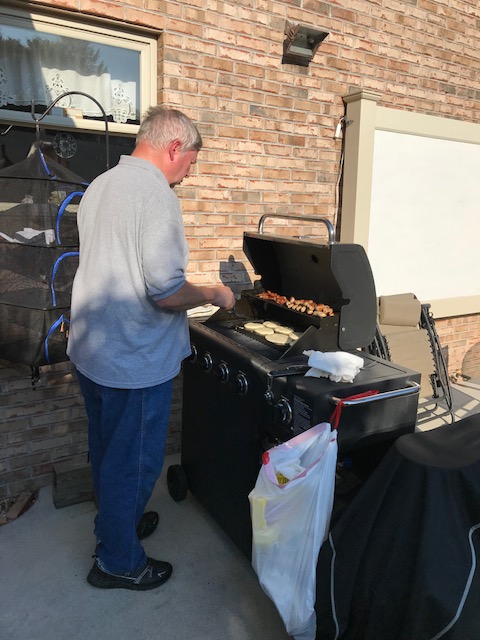
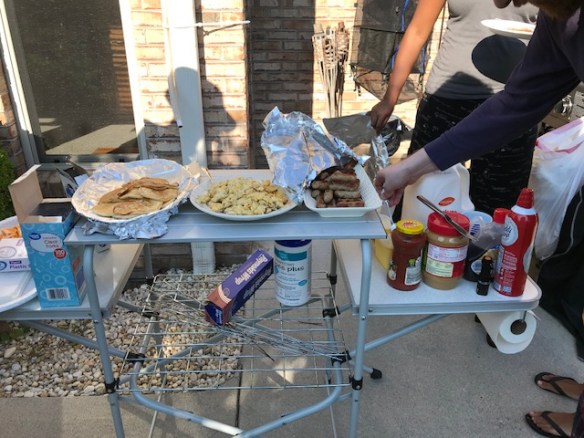
2. Roasting hot dogs and marshmallows. We often grill burgers on Memorial Day, but since we’d just had them on Mother’s Day, we went for hot dogs with all the trimmings. Jim grilled some but set up his fire pit for those who wanted to roast hot dogs and marshmallows. Timothy had his first s’more, and evidently loved it, because he chowed it down. It was a fun time.

3. A productive day. Saturday I got lots done, and it felt so good. I think the brain fog from the first few weeks of the pandemic is lifting. Maybe because I’m getting used to the new normal, or because we know more about COVID-19 than we did, or because there’s hope that the pandemic is starting to lift a little—or all of the above.

4. An apple pie visit. My daughter-in-law and grandson are gluten-intolerant, and their favorite bakery advertised apple pies this week. They got one and brought it over to share with us. This place has really perfected gluten-free pie crusts. The frozen ones I buy aren’t nearly as good.

5. Celebrating the end of kindergarten. Timothy finished up his first school year yesterday, and we went over for a visit. We ended up at an outdoor shaved ice place that had a fenced-off area of picnic tables with umbrellas. I didn’t have any this time—I wish they had servings about half the size that they offer. But everyone else enjoyed theirs, and the place itself was set up nicely to be out yet distanced from the other tables.

For those of you who prayed for Mason, the grandson of a former pastor who has been battling leukemia, there have been some small improvements since last week. He’s still sedated while his lungs heal from the bleeding and pneumonia. They’d had him on a paralytic so he wouldn’t move and worsen his bleeding, but they’re starting to take him off of it for a few hours at a time. It did his mom’s heart good to see him moving a bit. He still has a long way to go.

I’ve grieved over sad things happening in our country this week, and may post about them once my own thoughts have been sorted out. It’s timely that my Bible reading was in Amos 5 today, with some of these phrases:

  • 14: Seek good, and not evil, that you may live; and so the Lord, the God of hosts, will be with you…
  • 15: Hate evil, and love good, and establish justice in the gate…
  • 24: But let justice roll down like waters, and righteousness like an ever-flowing stream.

Amen.

What’s something good from your week?

End-of May Reflections

May ReflectionsAs I am sure has been true for many of you, May was a rather quiet month. Mother’s Day was the only big event on the calendar. We enjoyed roasting hot dogs and making s’mores for Memorial Day. Most days just held everyday activities.

We had several socially-distanced visits outside with my son’s family at our house and theirs. Thankfully the weather has been pretty comfortable this month for outdoor gatherings. Since our state began opening up a little, and since the COVID cases in our area are low compared to others, we did start visiting inside (just in time to come into the air conditioning from hot weather). But otherwise we’re holding back from jumping full-fledged back into the fray.

Our church discussed meeting together again, and most wanted to wait for a bit. So we’ll still Zoom for now.

I’ve been distressed by the judgmentalism and name-calling in social media over simple things like wearing face masks, even among Christians, even among friends. I’ve had some ideas brewing for a post about it all, but probably should abstain. There are multiple facets to the COVID-19 crisis and multiple opinions even among experts, so it seems like we should give each other plenty of grace and room to differ.

But…on to more pleasant topics.

Family

Besides what I mentioned above, some of us were watching or listening to the SpaceX launch preparations, which had to be scrapped due to weather. Jason texted this picture of Timothy.

I asked Jim why the astronauts were being strapped in so early, then answered my own question by saying they probably had a lot of pre-checks and such to go through. Then I said, “If it were me, I’d have to say ‘You can strap me in now, but you’re going to have to let me up to use the bathroom before we leave.'”

Jim said, “That’s why you’re not an astronaut.”

Not the only reason, but, yes. 🙂

Timothyisms

I mentioned on a Friday’s Fave Five that my son’s Ring camera caught a guy peeking into their window for several minutes. My son spoke through the camera and the guy ran off, but the police were called and investigated the area. My son had recently had a run-in with poison ivy in their back yard, even though he had been wearing gloves. When Timothy learned that the “peeper” had run towards the back, he said in a singsongy voice, “There’s lots of poison ivy back there.” 🙂

Timothy just turned six in April. This month he was telling me about something that happened “a long time ago when I was five.”

I’ve mentioned before that Timothy loves to mow, especially when his Granddad brings over the riding lawn mower. Timothy has his own toy riding and push lawn mower and garden tools. His dad recently texted this comment from Timothy: “If you have a big yard, a push mower will make you very tired. I did that one time, and I wanted to stop, and I changed my mind to not give up.”

His mom and dad will sometimes take a bite from his plate and call it a “dad tax” or a “mom tax.” Monday, when we were eating outside for Memorial Day, Timothy had finished and gotten down to play. Then he came back, grabbed a couple of french fries from the bowl, and said, “Tim tax.”

Creating

It was sad to realize that all of the older women I had looked up to as moms, in addition to my own mom, are gone now.

The only Mother’s Day card I made this year was for my daughter-in-law, who likes purple and lavender. It didn’t turn out quite like I was picturing it in my mind, but I think she liked it. 🙂

I also finally finished making masks for the family. I had done them for everyone except Jesse and me, since we haven’t gone anywhere (and Jeremy in RI, because he already had some). But I wanted to get them done just so we’d have them when we needed them. Plus, we’re talking about using them even after our church meets in person. I’m not a good enough seamstress to do this for others, and none of them is perfect, but at least we’re covered—literally and figuratively. 🙂 And it was good to finally cross them off my to-do list.

Watching

Laura and Hope had both recommended This Beautiful Fantastic, and I loved it. It’s on Amazon prime, but I think it’s also on YouTube. It’s about a very OCD girl who learns that letting other people into her life can be messy but beneficial. It’s also about writing and gardening and grumpy neighbors. It’s quirky and had me smiley and teary at the end. Objectionable elements: I think there are a couple of “damns” or similar bad words, and an old man in a Speedo near the beginning (but that’s more gross than sexy).

I also very much enjoyed The English Game, a six-episode mini-series. I care very little about football (soccer), but I could appreciate the struggles of changing it from a “gentleman’s” game to make it more accessible to working men, and the controversy over whether to allow paid (professional) players. Differences got violent a couple of times, but I loved how the two main characters strove to come to an understanding of each other and wanted what was best for the good of the game. I read later that though the people and some of the plot basics were real, some of the points weren’t historically accurate. But I still enjoyed it. There are a few bad words, and sadly, a couple of instances of taking Jesus’ name in vain.

I also enjoyed some of John Krasinski’s “Some Good News” YouTube videos.

Reading

This month I completed (titles link back to my reviews):

  • Dying to Read by Lorena McCourtney, a cozy, somewhat comedic mystery about a young woman filling in for her uncle’s private investigation firm while looking for a new job. On her first minor case, she finds a dead body. I liked it okay, but this is not my favorite genre. If it’s yours, you might enjoy it more.
  • Castle on the Rise by Kristy Cambron, a story spanning three timelines around a castle in Scotland. Excellent.
  • A Season to Dance by Patrica Beal, about a ballerina seeking love and stardom. Interestingly, the author became a Christian during the course of writing this book.
  • Over to Candleford by Flora Thompson, the second in the Lark Rise to Candleford trilogy (audiobook).
  • Amberwell by D. E. Stevenson (audiobook). My first book of hers, but definitely not my last.

I’m currently reading:

Up next, I have these to choose from, plus scores on my Kindle app. I need a reading vacation! 🙂

Blogging

Here are some of the posts from this month:

  • Come, Let Us  Return to the Lord. “Wiersbe says, ‘One of the greatest judgments God can inflict on any people is to let them have their own way.’ Fortunately, God doesn’t give people up easily.”
  • How Do You Know if God Is Displeased with You? A Twitter thread on this question listed a vague uneasiness, a sinking feeling, life not working out right. None mentioned asking Him or going to His Word.
  • Real Life Devotions. We set ourselves up for failure if we wait for the perfect plan, time, or setting.
  • Why Doesn’t God Explain? Maybe because we couldn’t understand if He did. But because we know Him, we can trust Him.
  • Real Life Prayer. “Prayer isn’t a ritual or a performance. It’s a conversation with God.”

Writing

I still haven’t gotten to my WIP (work in progress). But I did submit a devotional and a guest post and am waiting to hear if they are accepted.

I also listened to several webinars and podcasts on writing. I appreciated that the webinars were offered for free to make up for some of the writing conferences that had been canceled. I got a few nuggets from each one. But I am thinking that, for the time spent, reading books might be better for me. With the webinars and podcasts, there’s always a bit of banter and often a rabbit trail or two. The q-and-a webinars were great to submit questions to, but they also covered a little bit of ground on a great many aspects of writing. But a book would present whole topics from start to finish, and I think my particular learning style would benefit from them more. I have several books on writing on my shelf and in my Kindle.

But beyond reading about writing—I need to just write!

Even though summer doesn’t officially start for a few weeks now, June 1 always signals the first of summer to me. Since our children are no longer in school, our schedule doesn’t change much any more between spring and summer. We don’t have any major plans until August, when we hope our oldest will be able to come for his and my birthdays. We’ll see what happens! This is a season of holding plans loosely, for we truly don’t know what  day will bring forth.

How was your May? What are you looking forward to in June?

(Sharing with Let’s Have Coffee, Grace and Truth, Faith on Fire, Global Blogging,
Senior Salon, Hearth and Home, Inspire Me Monday, Tell His Story,
InstaEncouragement, Worth Beyond Rubies)

Book Review: Amberwell

AmberwellI had not heard of D. E. Stevenson until a few years ago. I’ve seen her name mentioned favorably, but had never felt inclined to check our her books. But then Hope‘s mention of Amberwell led me to try it.

Amberwell is the name of the house owned by multiple descendants of the Ayrton family in Scotland. The residents in this book have five children, two boys from a previous marriage and three girls. The parents are aloof, authoritarian, and imperious. The children are kept in the nursery much longer than usual, and the parents don’t attempt to get to know them well.

But the children are allowed to roam free on the estate, and spend most of their time outdoors playing all sorts of imaginative games.

The next section of the story jumps ahead ten years. The two boys are in the service during WWII. One daughter has married, one’s whereabouts are unknown, and one is left to keep things together on the home front. Each faces their own struggles and heartaches.

Amberwell falls into disrepair due to shortages of supplies and manpower. But it draws each of the children back like a beacon.

My thoughts:

It took me two or three chapters to get into the story, but once I did, I loved it. The last third or so of the book, I wanted to set everything else aside and just read.

At first I wondered if this was a children’s book, not only because the children were the main characters, but also because the writing seemed simple. But by the next section, the writing and the plot shifted into a higher gear.

There was one odd place where one of the girls witnessed something untoward from their father, but nothing was ever said about it again.

I listened to the audiobook read exceptionally well by Leslie Mackie. She has a lovely, soft Scottish accent but could bring out the brogue with some characters. That’s one advantage to audiobooks: I don’t usually think in the accent of the characters when I’m reading, unless the dialect is written well. But hearing a whole book set in Scotland with a Scottish accent really added to the enjoyment.

I’m delighted to have discovered D. E. Stevenson, and now I have a whole list of her books to explore. In fact, I’ve already started on the sequel to Amberwell, Summerhills.

I’m counting this book for the Back to the Classics Reading Challenge under the Classic About a Family category.

(Sharing with Carole’s Books You Loved, Booknificent)

Real Life Prayer

IMG_2234 ?ver2A couple of weeks ago I wrote about #RealLifeDevotions, which often look different from Instagram-worthy ideals. That post focused on Bible reading, but the other half devotions, or quiet time, or “God and I” time, or whatever we want to call the time we meet with the Lord, is prayer. Just like Bible reading, we often neglect to pray until we can set aside a certain amount of time or set up prayer time the way we think is ideal.

Like Bible reading, my prayer time has varied through different seasons of life. For a while I had a regimented system of what to pray for on certain days. Another season, I used the acronym ACTS: Adoration, Confession, Thanksgiving, Supplication (requests). That seemed a little artificial (who else do we talk to in acronyms?), but it did help me to include other elements besides requests. When my children were young, I prayed while rocking or nursing or falling asleep.

I used to think I hadn’t officially prayed for something unless I brought it before God during devotional time. But then I reasoned that real life conversations aren’t crammed into one 10-15 minute segment of the day. We speak to those closest to us throughout the day as well as setting aside special times to talk.

The Bible is the best textbook on prayer. God gives us instruction about prayer, more than can be included in one blog post (avoid vain repetitions, empty phrases, praying for “show,” ask in faith, confessing known sin, etc.).

Not only does God give us specific instructions about prayer, but He also gives us examples of how and when people prayed and what they prayed for.

Prayer isn’t a ritual: it’s a conversation with God. Like any other relationship, we need one-on-one time, with everything else set aside. Daniel had set times to pray. Jesus’ life on earth was incredibly busy, but He got up early in the morning to be alone with His Father or prayed through the night. His prayer time was interrupted, just as ours sometimes is.

But Jesus and others Bible people also prayed “in the moment.” One of my favorite prayers in the Bible is Nehemiah’s quick appeal sent up to God right after the king asked him a question. So I began praying for a need as soon as I heard it, or thanking God for something just as it happened, or asking for wisdom, forgiveness, guidance, strength, etc., all through the day.

The psalms give us examples all over the spectrum, from the highest praise to the deepest lament. The epistles share some of the deepest prayer requests I’ve seen. For a long time, I had a sheet of Paul’s prayers typed out and tucked in my Bible, and I would pray through them for myself and loved ones. One of my favorites is Colossians 1:9-12:

And so, from the day we heard, we have not ceased to pray for you, asking that you may be filled with the knowledge of his will in all spiritual wisdom and understanding, so as to walk in a manner worthy of the Lord, fully pleasing to him: bearing fruit in every good work and increasing in the knowledge of God; being strengthened with all power, according to his glorious might, for all endurance and patience with joy; giving thanks to the Father, who has qualified you to share in the inheritance of the saints in light.

We’re not restricted to Biblical language, but Biblical prayers help us know we’re praying God’s will. But, really, we can turn almost any Scripture into prayer. We can ask God to help us heed the warning we’ve read, obey the command, trust in the promise, etc.

Usually I speak to God off the top of my head with whatever I’m thinking or concerned about at the moment. But sometimes I feel the need of structure to corral my wandering thoughts. The acronym mentioned above helps, but often I like to use what we call “the Lord’s prayer” in Matthew 6 as a basis. I first saw this idea in a book by Anne Ortland. It might go something like this.

Our Father

Thank you for being my Father. Thank you for drawing me to yourself and making me your child. Thank you for your tender love and care for me.

Which art in heaven

I’m grateful that You are not just my father, but my heavenly Father. You are all-wise, all-knowing, all-powerful.

Hallowed be thy name.

Help me to honor your name in everything I say and think and do. May the nations come to know you and consecrate your name.

Thy kingdom come

I look forward to the day when your kingdom comes, when sin is done away, when all wrongs will be made right.

Thy will be done in earth, as it is in heaven.

Help me to know and do your will. Help me to trust, when the world seems so far from you, when circumstances seems most antithetical to your will, that you are working all things together for good behind the scenes. I pray that you would turn people’s hearts toward you, open their eyes, that they might clearly understand who you are and believe on you.

Give us this day our daily bread.

Thank you that you have always supplied all that I needed and much that I wanted. I ask and trust you for today’s needs.

And forgive us our debts

Please search my heart and show me anything I need to confess to you, anything I need to turn from or make right.

As we forgive our debtors.

Help me to remember I have no right to ask your forgiveness if I am not willing to forgive others (Matthew 6:14-15). Help me not to hold grudges or resentment, but to forgive as freely and fully as you have forgiven me.

And lead us not into temptation

You know what’s ahead today. You know my weaknesses. Please strengthen me and help me to remember your truth to combat the devil’s lies.

But deliver us from evil

I’m trusting you for protection, spiritually, physically, emotionally, and mentally.

For thine is the kingdom, and the power, and the glory, for ever. Amen.

Then there are times in life we just don’t have the words. “Likewise the Spirit helps us in our weakness. For we do not know what to pray for as we ought, but the Spirit himself intercedes for us with groanings too deep for words. And he who searches hearts knows what is the mind of the Spirit, because the Spirit intercedes for the saints according to the will of God” (Romans 8:26-27). A favorite from the OT that I love is when Jehoshaphat says, “We do not know what to do, but our eyes are on you.” I’ve had to say something like that often.

The more we know what the Bible says about prayer, the more we can pray confidently, asking God to “do as you have spoken” (2 Samuel 7:25). “And this is the confidence that we have toward him, that if we ask anything according to his will he hears us” (1 John 5:14).

I saw a Twitter post once that spoke of “throwing the promises of God back in His face.” It’s good to base prayer on God’s promises, but not like this. Some have advocated storming heaven and demanding God answer a certain way. No, we approach Him in humility. That doesn’t mean we’re not honest or fervent. But we’re not belligerent or demanding. We don’t remind Him of His promises because He doesn’t remember them. He does. We plead them to be in accord with His will and to pray in faith.

You’ve heard the phrase “Prayer changes things.” Sometimes it does. More often, prayer changes us. Elisabeth Elliot once said, in answer to the question, “Does prayer work?”:

The answer to that depends on one’s definition of work. It is necessary to know what a thing is for in order to judge whether it works. It would be senseless, for example, to say that if a screwdriver fails to drive nails into a board it doesn’t “work.” A screwdriver works very well for driving screws. Often we expect to arrange things according to our whims by praying about them, and when the arrangement fails to materialize we conclude that prayer doesn’t work. God wants our willing cooperation in the bringing in of his kingdom. If “Thy kingdom come” is an honest prayer, we will seek to ask for whatever contributes to that end. What, after all is said and done, do you want above all? Is it “Thy will be done”? If so, leave it to Him.

Is it “My will be done”? Don’t waste your time and God’s by praying. Have it your way (A Lamp for My Feet).

Even knowing how beneficial prayer is, sometimes we just don’t feel like praying. A former pastor once said that one of his best times of prayer started out with confessing to the Lord that he didn’t want to pray. J. Sidlow Baxter has an almost amusing story of praying despite his emotions until they came along.

Elisabeth Elliot wrote of starting prayer time saying, “Lord, here I am again to talk to you. It’s cold. I’m not feeling terribly spiritual,” but then finding help in the psalms and hymns.

The point of praying isn’t to have an Exhibit A of ideal form. It isn’t about impressing God. It’s about getting to know Him, growing in our love for Him and likeness to Him. The more we read His Word, the more we talk to Him, the more natural and effectual prayer will be.

Has your prayer life changed through the years? Has prayer been a struggle? What has helped you learn to pray?

(Sharing with Inspire Me Monday, Global Blogging, Senior Salon, Hearth and Soul,
Purposeful Faith, Tell His Story, InstaEncouragement, Anchored Abode,
Recharge Wednesday, Worth Beyond Rubies, Share a Link Wednesday,
Let’s Have Coffee, Grace and Truth, Faith on Fire,
Blogger Voices Network. Links do not imply 100% agreement.)