Unknown's avatar

About Barbara Harper

https://barbarah.wordpress.com

When You’re Not Number One

When You're Not Number One

Fans of ball games across the country shout, “We’re Number One!” from the stands.

In reality, everyone can’t be number one. Someone has to be the second banana, play the second fiddle, act as the sidekick.

Many of us have the sad experience of not even being second. We were the last ones chosen for any kind of physical game.

One of the most dramatic battles for first place occurred between twins Jacob and Esau. In Old Testament times, the oldest son received the most inheritance, a blessing from his father, and the chosen leadership of the family.

Esau was the oldest. But God chose Jacob for a special blessing. Jacob would someday become Israel, head of the family through whom God blessed the world.

Did God choose Jacob to show a distinction, a way of saying “I am doing something different here” so it would stand out? Or did he choose the younger child because he knew the oldest was not fit to carry out His will? I don’t know—there may be a number of reasons.

However, instead of waiting and trusting God to work out His purposes, Jacob’s mother, Rebekah, felt they had to “help” orchestrate the circumstances by deceit, which did not work out well. Jacob got what he wanted, but he had to flee from Esau’s life-threatening anger. Esau seemed to have mellowed out a bit when Jacob returned twenty years later, but the Edomites, Esau’s descendants, were Israel’s enemies for centuries.

Jacob had twelve sons. Instead of learning from the tragedy of his family’s favoritism, he perpetuated it by having a favorite son: Joseph. Joseph’s brothers hated him and took the first opportunity to get rid of him.

There were other factors in both these cases besides the chosen status of a younger brother, factors which caused understandable anger. But they caused me to think of others in the Bible who found they were not the chosen ones.

Bad examples from the Bible

Cain was angry God accepted Abel’s offering and not his. Instead of repenting and adjusting his ways, he killed Abel.

Miriam and Aaron were jealous of Moses’ position. So were the sons of Korah. Each suffered God’s wrath.

King Saul had been chosen by God to be Israel’s first king. But his pride and disobedience led God to set Saul aside for David. Saul responded in anger, jealousy, and further sin.

Ahithophel was a counselor to David who deserted him when David’s son, Absalom, revolted against his father and staged a coup (2 Samuel 16-17). When Ahithophel’s counsel was not taken, he set his affairs in order and killed himself.

Absalom tried to take the throne by force. He was killed despite his father’s wishes.

The apostle John warned about Diotrephes, who “likes to put himself first” and did not respect the apostles’ authority.

Good examples from the Bible

Jonathan was Saul’s son, next in line to become king. But when Jonathan recognized God’s hand and calling on David, he readily acquiesced and helped David escape Saul’s wrath.

David planned to build a temple for God, but God said no. David’s son was to build the temple instead. David didn’t complain. He rejoiced that God blessed his house and did everything he could to aid Solomon.

Barnabas was instrumental in introducing Paul to other Christians when they were afraid of him. But he didn’t seem to resent when Paul became the leading spokesperson.

Andrew was Simon Peter’s brother. He faithfully served, often pointing people to Jesus. Though the disciples sometimes argued over who was the greatest, by and large they did not seem to mind that Peter was their leader.

John the Baptist was not offended when his followers left to follow Jesus. He pointed them to Him and said, “He must increase, but I must decrease.”

Examples from history

Many people are familiar with D. L. Moody, a famous evangelist in the 1800s. What’s not as well-known is that Moody was led to the Lord by a faithful Sunday School teacher, Edward Kimball.

In fact, that visit set off a series of events. Under Moody’s preaching, a man named Wilbur Chapman was saved and became an evangelist. Under Chapman’s ministry, Billy Sunday was saved and also became an evangelist. Mordecai Ham was converted under Sunday’s influence. And Ham led Billy Graham to the Lord (sources here and here).

Many people know of Jim Elliot, one of five missionaries killed in 1956 when the tribe they were trying to reach speared them to death. The news went out across the globe. Jim’s wife, Elisabeth, told the men’s story in Through Gates of Splendor. Many books and articles have been written about the five men, their wives, and the tribespeople who eventually came to know the Lord. Many lives have been touched and surrendered to the Lord because of these events.

Jim had an older brother, Bert, who was a faithful missionary in Peru for some sixty years with his wife, Colleen. Bert told Randy Alcorn, “Jim and I both served Christ, but differently. Jim was a great meteor, streaking through the sky.” Randy described Bert as “a faint star that rose night after night, faithfully crossing the same path in the sky, to God’s glory.” Both were used by God, but He led them along different paths.

Sometimes God pushes people into the limelight who didn’t want to be there at first, like Moses and Gideon. He gives grace for that, but He also gives grace for the fainter stars, the lesser-known, who faithfully serve Him with the talents He has given.

Once when someone asked Edith Schaeffer, wife of Francis Schaeffer, founder of L’Abri, who the most influential Christian woman of the day was. Edith replied something like “Whoever she is, nobody knows her. She’ll be a woman whose calling is to be behind the scenes praying.” I’ve heard variations on this answer–another source quotes her as saying, “We don’t know her name. She is dying somewhere in a cancer ward or living in India.”

Whichever way Edith worded her answer, the principle is true: we don’t know who the most influential Christians are. That’s not our business. Our business is to keep our eyes on Him and serve Him with all our hearts.

No leader or CEO or head of anything can accomplish much without support staff. Christendom is the same: “Now there are varieties of gifts, but the same Spirit; and there are varieties of service, but the same Lord; and there are varieties of activities, but it is the same God who empowers them all in everyone. To each is given the manifestation of the Spirit for the common good” (1 Corinthians 12:4-7).

Elisha was said to pour water on the hands of Elijah (2 Kings 3:11), a way of saying he ministered to Elijah’s needs. Elisha became the primary prophet after Elijah’s death, but he served just as well in whatever capacity he was called to at the time.

Imagine if one person in the chain between D. L. Moody and Billy Graham hadn’t done their part. There are unseen connections like that in all of our lives. We don’t know when a kind word, a shared verse, or a prayer might be part of a long series of steps leading a person to meet the Lord or know Him better.

May God give us grace to serve Him in whatever way He wants us to, ministering to others in large or small ways, whether seen or unseen.

“As good stewards of the manifold grace of God, each of you should use whatever gift he has received to serve one another” (1 Peter 4:10, BSB).
1 Peter 4:10

(I often link up with some of these bloggers.)

Laudable Linkage

Laudable Linkage

Some of the good reads found this week:

The Power of a Courageous Word. “Sometimes it is the simplest of matters that bear the greatest fruit. A simple deed, a simple gift, a simple word can make all the difference. They can even begin a cascade that changes lives and changes the world.”

The Preacher’s Trust, HT to Challies. This article focuses on preachers, but I have found its principles true for writing and ministering for God in any way. Instead of being crushed by our inadequacies or inflated with self-reliance, we put our trust in God, who works through His Word and Spirit.

Protesting Well. This is the fourth in a series on protest, dealing particularly with what to do when you disagree with the authorities in your life.

Lessons from Nathan’s Rebuke: Effective Strategies for Christian Confrontation, HT to Challies. It’s not pleasant, but sometimes rebuke is called for when a professing Christian sins. This article draws principles for what to say based on Nathan’s rebuke of King David.

Please, Don’t Say These Things to Women Who Have Miscarried, HT to Challies. “When a couple experiences a miscarriage, there are tons of responses like these flung in their direction like darts. Those who say them don’t mean for their words to attack, but they often do. They bring into question not only the grief of the mother and father, but also the value of the baby who was lost.”

Explain Up, Don’t Dumb Down. “I’m a big advocate of using big words with little kids. Our tendency, of course, is to use very simple terminology with children. It seems to me like we do this out of two desires.”

Just and Gentle Parenting. “Dear dads and moms, don’t we long to embody Scripture’s perfect balance — to parent between the poles, to divinely blend grace and law, and so to image God and the gospel to our children? Gentle parenting is not one of only two options. Neither is it the best, most biblical option.”

Just Diagnosed: Questions Parents of Neurodivergent Kids Should Ask Next, HT to the Story Warren. “For years, we focused on ‘fixing’ his social skills, handwriting, and attention deficits so he’d be successful in school. We’re thankful these early interventions continue to bear fruit. Still, the best gift we gave our son came when we stopped emphasizing what was wrong and began to focus instead on God’s good purpose.”

Talmage quote

If your path had been smooth, you would have depended upon your own surefootedness; but God roughened the path, so you have to take hold of His hand. T. D. Talmage

Friday’s Fave Five

Friday's Fave Five

Well, I am still experiencing the atrial flutter I mentioned last week, with my heart rate bouncing from 110 to 123 beats per minute. We tried increasing the medicine I am already on, to no avail. I called the doctor’s office at the requested time, and they advised skipping the step of going off the current medicine and trying a new one. Instead, they thought I should go ahead and do the cardioversion. Their scheduler was supposed to get back with me. She didn’t. I called earlier this week and was told all the cardioversion slots in their schedule were filled. :/ I asked through the patient portal if I could go ahead and get on the schedule for next week, and received no response. So I guess we just wait.

I’m frustrated. But this is not as urgent a situation as many others the doctor’s office deals with. I feel okay and can function pretty well–I just feel like I am not operating at full capacity and need to rest after exertion. I’m praying that God will direct to the right time or even help my heart to go back to normal without the procedure.

Meanwhile, I’m sharing some of the blessings of the week with Susanne and friends at Living to Tell the Story.

1. Jason’s birthday was last week, but we celebrated on Sunday. It’s always a joy to celebrate my children. But it was a special blessing this time because, in an effort to keep life low-stress while my heart is acting up, we’ve pretty much stayed home. It almost felt to me like Covid isolation. So I especially appreciated the gathering. Jesse came over as well and we FaceTimed with Jeremy.

2. Wildflower bouquets. Mittu cut and arranged these from our wildflower patch. Then she cut some sunflowers to take home. It was good she did, because we had a strong storm the next day which did a number on the flowers outside.

Wildflower bouquet

3. Electricity. The power went out briefly during the storm, right as I was making dinner. We have a gas stove and oven, so the burners stayed on. But it would be hard to be without air conditioning this time of year. I was glad the power came back on soon.

4. Easy meals. Jim got several frozen heat-and-eat meals to make dinner prep easy this week. It’s not good to eat that way all the time, but I’m glad such options are available when needed.

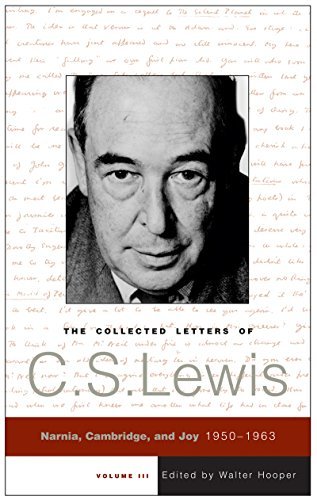
5. Finishing a long book. Books are a favorite every day! I’ve been reading the third volume of the Collected Letters of C. S. Lewis for months now, and finally finished it this week. I enjoyed it a lot, but I am read to move on.

How was your week?

The Collected Letters of C. S. Lewis, Volume 3

Walter Hooper was an American who became something of a secretary to C. S. Lewis, or Jack, as he was known, in the latter’s final years. After Jack’s death, Hooper helped care for Warnie, Jack’s older brother, and tried to preserve some of Jack’s memorabilia. Many of Jack’s letters had been quoted by Warnie in an earlier book titled Letters of C. S. Lewis, but none is quoted in its entirety. Hooper scoured the various libraries where Jack’s papers were kept to present a comprehensive volume of his letters.

That volume ultimately became three. Volume 1 is titled Family Letters and covers 1905-1931. Volume 2 is titled Books, Broadcasts, and the War, from 1931-1949. The final volume is titled Narnia, Cambridge, and Joy, covering 1950-1963.

I chose to read the last volume first. I had read of Jack’s earlier life in Surprised by Joy and other books, but knew the least about his last several years. This book was a whopping 6,328 pages, so it has taken me a while to read it.

Lewis was a prolific letter-writer, corresponding by hand. Warnie helped him when he was home, then Hooper later. It’s obvious Jack enjoyed a great many of the letters he wrote, but answering correspondence also put pressure on him. He even asked some of his friends not to write in December, because he received so much extra mail then.

One question I had was where these letters came from. Lewis says in this volume that he did not keep copies of the letters he answered once he was done with them. He didn’t appear to use carbon copies. It’s understandable the letters to family members were kept by the recipients. But Hooper doesn’t explain how he obtained the letters written to so many people. I don’t know if he, or Warnie, or someone else put out a request to Jack’s correspondents asking for any of his letters, which were then included in various collections.

Some of the letters are lengthy and thoughtful. Some are short notes. I think some of the short notes about where to meet someone for dinner or when they were coming to visit could have been left out. But even some of these have funny or interesting spots. He writes to lifelong friend Arthur Greeves of their travel plans that since Arthur was a light sleeper and Jack “an unreasonably early riser,” they should ask at the places where they were staying to “be put in rooms not adjacent. (This is not meant as a joke!)”

Some letters were news between friends. Others were answers to questions about his writings or philosophical or spiritual queries. Some gave requested writing advice like that “wh. old Macan gave me long ago ‘Don’t put off writing until you know everything or you’ll be too old to write decently.'”

Some of his letters provided critiques requested by his correspondent of their writing. He didn’t pull any punches! But he was not unkind.

By this time, he refused most of the requests for forewords or prefaces to other people’s books. He just didn’t have time. We forget that, with all his writing, he had a full-time job teaching. He writes to one friend, “I am so busy marking examination papers that I can hardly breath! The very good ones and the very bad ones are no trouble, but the in-between ones takes ages.” Plus, he said to most of these authors that his reputation was such that he didn’t think his name in their books would be a help to them.

I thought it a little odd that no letters to Joy were here. Of course, their main correspondence would have occurred before she moved to England. Perhaps she didn’t bring those letters over, or maybe she or Jack destroyed them. They may have been too personal, concerning her own soul-searching plus problems with her first husband.

It was funny to read how he described her when she visited, though. Evidently she liked to talk a lot. He wrote one friend: “I am completely circumvented by a guest, asked for one week but staying three, who talks from morning till night.” To another he said, “Perpetual conversation is a most exhausting thing.” (I agree!)

Jack said he never appreciated parents before–her two boys were good kids, he said, but whirlwinds that left the “two old bachelors” exhausted by the end of the day.

But he tells through various letters of his developing relationship with Joy, their marriage of convenience so she could remain in England, her illness, a “real” marriage ceremony (the first was legal, but when they began to care for each other, they found a minister who would marry them in her hospital room), her miraculous recovery, and a few good years they had until she began to decline again. He writes near the end of her life, “May it please the Lord that, whatever is His will for the body, the minds of both of us may remain unharmed; that faith unimpaired may strengthen us, contrition soften us and peace make us joyful.”

Jack’s letters are filled with literary references. Hooper painstakingly annotated these, sharing the source, the location within the source, and the full quote Lewis cited.

It’s fun to see humor laced through many of the notes. He asked one friend, “What is a ‘rumpus room’? Rumpus with us means a loud noise, or row, or ‘shindy’. Do you have a special room for shouting in? (I’ve known houses where it wd. be convenient!) To another: “There’s no news at all about Cambridge cats. I never see one. No news and no mews.”

One of the great sorrows of his life was his brother Warnie’s alcoholism. Warnie would go off on benders and then go to a place to dry out, then come home, only to repeat the process later. Jack would let close friends know what was going on, but would tell others that Warnie was sick or in the hospital.

It was sad to read of Jack’s final days, knowing when he was going to die. He was to have one last trip with his friend, Arthur. But they had to cancel due to illness on both their parts. Lewis writes that he is comfortable, “But, oh, Arthur, never to see you again! . . .”

As you can imagine, I have multitudes of quotes highlighted. Here are some that stood out to me:

Of course we differ in temperament. Some (like you–and me) find it more natural to approach God in solitude: but we must go to church as well. Others find it easier to approach Him thro’ the services: but they must practice private prayer & reading as well. For the Church is not a human society of people united by their natural affinities but the Body of Christ in which all members however different (and He rejoices in their differences & by no means wishes to iron them out) must share the common life, complementing and helping and receiving one another precisely by their differences.

God loves us: not because we are lovable but because He is love, not because He needs to receive but because He delights to give.

I am going to be (if I live long enough) one of those men who was a famous writer in his forties and dies unknown–

I don’t wonder that you got fogged in Pilgrim’s Regress. It was my first religious book and I didn’t then know how to make things easy.

[On Queen Elisabeth’s coronation] Over here people did not get that fairy-tale feeling about the coronation. What impressed most who saw it was the fact that the Queen herself appeared to be quite overwhelmed by the sacramental side of it. Hence, in the spectators, a feeling of (one hardly knows how to describe it)–awe–pity–pathos–mystery. The pressing of that huge, heavy crown on that small, young head becomes a sort of symbol of the situation of humanity itself: humanity called by God to be His vice-regent and high priest on earth, yet feeling so inadequate. As if He said ‘In my inexorable love I shall lay upon the dust that you are glories and dangers and responsibilities beyond your understanding.’

How little they know of Christianity who think that the story ends with conversion: novelties we never dreamed of may await us at every turn of the road.

As long as we have the itch of self-regard we shall want the pleasure of self-approval: but the happiest moments are those when we forget our precious selves and have neither, but have everything else (God, our fellow-humans, animals, the garden & the sky) instead.

If only people (including myself: I also have fears) were still brought up with the idea that life is a battle where death and wounds await us at every moment, so that courage is the first and most necessary of virtues, things wd. be easier. As it is, fears are all the harder to combat because they disappoint expectations bred on modern poppycock in which unbroken security is regarded as somehow ‘normal’ and the touch of reality as anomalous.

We should mind humiliation less if [we] were humbler.

I’m so pleased about the Abolition of Man, for it is almost my favourite among my books but in general has been almost totally ignored by the public.

At the end of this volume, Hooper included a series of letters between Lewis and his friend, Owen Barfield, called “the Great War” in which Lewis tries to “dissuade Barfield from his belief in anthroposophy,” a “system of theosophy . . . based on the premise that the human soul can, of its own power, contact the spiritual world.” The timing of these belonged to one of the earlier volumes, but Hooper didn’t receive them until he was working on this one. I didn’t read these, because they were quite long and I couldn’t follow the reasoning. I scanned some of them.

Hooper also includes extensive biographies in the back of Jack’s regular correspondents as well as interesting details about them or their interactions with Jack (which, along with the index, makes up some of the lengthy page count). I did not read all of these, either.

I very much enjoyed reading these letters and getting to know Lewis a little better. Someday I’ll get back to the other two volumes.

(Sharing with Bookish Bliss)

How to Find Good Christian Fiction

How to find good Christian fiction

Someone asked me recently how to find good Christian fiction. I thought I’d expand on that conversation here.

I wince when people say there is no good Christian fiction. I’ve been reading Christian fiction for around 45 years. Yes, there’s good and bad, just as there is in any genre. But for the most part, my life has been enriched and edified by my Christian fiction reading.

I wrote a very long post here about reasons to read Christian fiction. On top of all the other reasons to read generally–to learn, grow, expand our horizons, gain empathy by seeing other people’s situations and viewpoints, and so much more–Christian fiction contains the missing element: learning to look to God for help, to conform our lives to His will.

The best way to find good Christian fiction is to ask recommendations from someone you trust. I think my early forays into Christian fiction were from books loaned to me by friends. I remember one older lady in the church we attended when we were first married who was a big fan of Christian fiction and loaned out her books.

Another helpful source is Christian book bloggers. This isn’t foolproof: I’ve been burned a few times by such recommendations. But by trial and error, you can find some whose tastes are similar to yours.

Book reviews on Amazon, GoodReads, or Christian blogs are helpful. Reviews can be somewhat confusing, because I’ve seen rave reviews for books I hated and scathing reviews of books I’ve loved. But if you look at what people praise and criticize about the book, that can give you clues.

If I am looking into a new author, I look at the one- and two-star reviews of their books. If there’s some kind of problem, it’s usually mentioned there.

Another good source is the library. Our library happens to have a good section of Christian fiction. They don’t always have the latest releases, but they have more than enough to keep me busy. You can take a few books to a table and leaf through them, or check them out to try at home. Then you haven’t invested money that you’ll regret if the books aren’t to your liking.

Kindle sales are also a good way to try a new author. I don’t mind taking a chance for a dollar or two. I haven’t returned enough Kindle books to know what Amazon’s policy for returning books is for sure, but I think they have a window of time where you can return an ebook if you don’t like it.

If by “good Christian fiction” you mean something totally in line with all your beliefs and preferences, that’s going to be a little harder. You’re going to run into different preferences among Christians, among your friends, in your church, anywhere where you interact with other people. The key is to know what you believe and why and then exercise discernment.

For instance, say you don’t believe in Christians drinking alcohol, but the characters in your book do. There are probably people in your church who do as well. You would likely still interact with them and be friends with them, unless they really pushed the issue and tried to get you to drink.

I’ve handled different preferences in Christian books the same way. I can overlook the difference–unless the author seems to be making a point of emphasizing whatever the difference is.

One of the highlights of my college experience was a lecture by Dr. Ron Horton in Literary Criticism class on Objectionable Elements in Literature. One point he brought out was to look at how the element was handled.

For instance, most would agree that adultery is wrong. Some would not read a book in which a character committed adultery. But we see people who committed adultery in the Bible.

What’s essential is how the author handles adultery. Is it presented as acceptable or written in a way that promotes lust? Or, like the story of David and Bathsheba, are we spared sordid details and shown clear consequences.

Or take the whole issue of violence. War stories, murder mysteries, police dramas, and such are all going to contain violence. The Bible has a lot of violent, even gory scenes, too. But the Bible never presents violence as gratuitous. It’s not written to promote or feed into someone’s lust for violence.

Some of us are going to be sensitive to various areas, and we shouldn’t violate our conscience. For instance, I don’t want anything to do with horror or the occult, even if the “good guys” win in the end. I read a Christian fiction book once that contained extensive detail of an occult ritual. The author was not promoting the occult: he was warning against it. But that scene bothered me immensely. I didn’t need to know the details involved in those rituals. When the Bible mentions these things, it doesn’t go into enough detail to pique curiosity.

Likewise, I pretty much don’t want to know anything about a character’s sexual life. Yes, God created sex and it’s a wonderful part of life. But it’s not a spectator sport. I don’t want to know the details of a character’s intimate life any more than my friends’ or neighbors’. Most Christian fiction authors are not going to be explicit in this area, but there are a few I don’t read because I felt they crossed the line.

I hope this has been of some help. You can search in the box at the upper right hand corner above for particular books and authors I might have reviewed. Or you can email me if you have a question about one, and I’ll be glad to help if I can.

Do you have any other tips for finding good Christian fiction?
_____
Other posts here about Christian fiction:

(I often link up with some of these bloggers.)

Does God Know You?

Does God know you?

Some of the scariest Bible verses to me are Matthew 7:21-23:

Not everyone who says to me, ‘Lord, Lord,’ will enter the kingdom of heaven, but the one who does the will of my Father who is in heaven. On that day many will say to me, ‘Lord, Lord, did we not prophesy in your name, and cast out demons in your name, and do many mighty works in your name?’ And then will I declare to them, ‘I never knew you; depart from me, you workers of lawlessness.

The people here were doing and saying “religious” things, even calling Jesus Lord. But He professed not to know them.

Of course, He is omniscient. He knows everything about everyone. But He doesn’t know these people in the sense of having a relationship with them.

How can this be? 

Many passages talk about doing, not just hearing, the Word of God. But the reverse is true as well. It’s possible to do religious things without knowing God at all. The Pharisees were famous for knowing the Old Testament law but missing the point of it.

It’s possible to grow up in or become part of Christian culture without really knowing the Lord.

How can we know that we know Him and He knows us?

Psalm 1:6 says, “The Lord knows the way of the righteous, but the way of the wicked will perish.” That righteousness isn’t our own–we could never measure up to the perfect righteousness required. “We have all become like one who is unclean, and all our righteous deeds are like a polluted garment. We all fade like a leaf, and our iniquities, like the wind, take us away.” (Isaiah 64:6).

Philippians 1:11 speaks of the “righteousness that comes through Jesus Christ.” Only He is righteous enough. And He graciously gives His righteousness to us when we repent of our sins and believe in Him. 

He himself bore our sins in his body on the tree, that we might die to sin and live to righteousness. By his wounds you have been healed (1 Peter 2:24).

For our sake he made him to be sin who knew no sin, so that in him we might become the righteousness of God (2 Corinthian 5:21).

He saved us, not because of works done by us in righteousness, but according to his own mercy, by the washing of regeneration and renewal of the Holy Spirit, whom he poured out on us richly through Jesus Christ our Savior, so that being justified by his grace we might become heirs according to the hope of eternal life (Titus 3:5-7).

“The Lord knows those who are his” (2 Timothy 2:19). He’s the good shepherd who knows His sheep (John 10:14). He “knows those who take refuge in him” (Nahum 1:7).

Do you know God? Does He know you?

Please read here for more information.

John 17:3

(I often link up with some of these bloggers.)

Laudable Linkage

Laudable Linkage

Here are some good reads found this week:

Sometimes, Worship Should Be Hard. “We plan our worship services several months in advance. We choose themes for each service and discuss how to introduce them. Last Sunday, our chosen theme was ‘Our Good God.’ In the canon of worship themes we use, the goodness of God is not as difficult to explain as something like transcendence or immanence. But on Sunday, July 6, 2025, it was hard. As we filed into the church and greeted one another, nearly 100 people were still missing due to flash floods in Texas.”

Trying to Make Sense of Bad Things that Happen, HT to Challies. “Most people find it pretty easy to accept that the good things which happen are from the hand of God. But we find it hard to accept any bad, tragic, or painful experiences that come our way. Can they really be from God? Are they really under his governance? Can they really be for a good purpose? The Bible says, ‘Yes, they are. Yes, they can.'”

Boaz: A Pillar of Leadership. Boaz is one of my favorite OT people. “Boaz wasn’t a king, prophet, or warrior. He was a businessman and landowner, yet he exemplified godly leadership. His leadership wasn’t flashy, but it was faithful. It wasn’t about personal gain but about a godly impact. So, what made Boaz a leader worth emulating?”

Leviticus and the Right Hand of Fellowship, HT to Challies. “What we fail to realise is the catechetical nature of the book of Leviticus. As the centre point (and, I would argue, climax) of the Torah or Teaching, its goal is not to simply lay down a law to live by, or to provide fodder for debates over what verses we use. The goal of Leviticus is teaching. And it is hands on teaching much like that of a missionary landing in foreign culture.”

Staying Afloat in Summer. A mom of a newly-graduated high school student looks back at ways she wished she had handled summers.

When You’re Dreading Monday Mornings, HT to Redeeming Productivity. “Maybe you’re currently in a job you once longed for—even prayed for—and couldn’t wait to start, but now you have the Sunday scaries, dragging yourself out of bed on Monday morning only to count down the days until Friday. Or maybe you’re in a job you never really wanted but took out of necessity, expecting to move on to something different after a short time—but you haven’t. So what do you do when you’re no longer excited to go to work?”

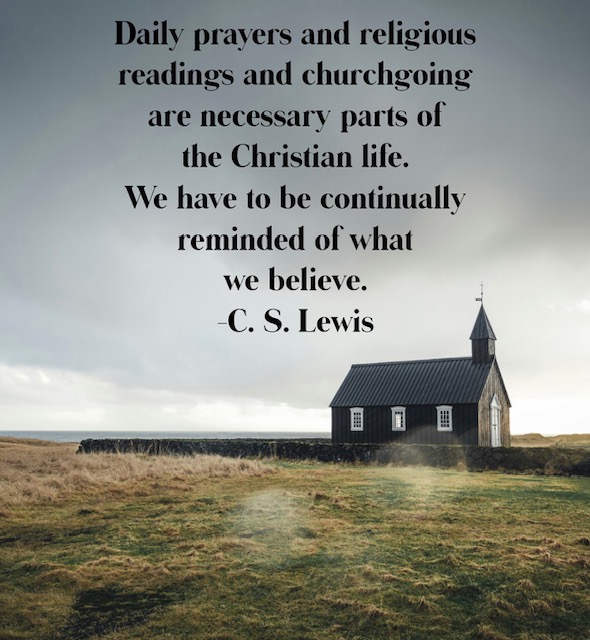
C. S. Lewis quote

Daily prayers and religious readings and churchgoing are
necessary parts of the Christian life.
We have to be continually reminded of what we believe.
C. S. Lewis

Friday’s Fave Five

Friday's Fave Five

I’ve had better weeks. 🙂 I’ve had an elevated heart rate since Monday, 105 to 119 beats per minute. I saw the cardiologist’s PA on Wednesday, where they did an EKG and diagnosed me with atrial flutter. He said it wasn’t uncommon after an ablation for atrial fibrillation, which I had eight years ago.

The first step for treatment is to increase a medicine I am already on for a few days. If that doesn’t work, they’ll try a new one–but I’ll have to be off the old one for three days first. because they can’t both be in my system at the same time. So it might get worse before it gets better. If the new medicine doesn’t work, the next step is to go into the hospital to have my heart “shocked.” And if that doesn’t work, I’ll probably have to have another ablation.

My hope is the first option will work, though it doesn’t seem to be having an effect so far. Prayers are appreciated! (Update: Just heard from my doctor. They want to go ahead and do the cardioversion, shocking my heart back into the right rhythm, rather than trying the new medication. Someone is supposed to call me next week to schedule it.)

In the meantime, even with this new complication, there have been bright spots along the way. I’m sharing them with Susanne and friends at Living to Tell the Story.

1. The cardiologist’s physician’s assistant. I had never seen him before, and he’s very young, but he was great at explaining what was going on and what the options are. Jim took me to the doctor since we felt I probably shouldn’t drive, and he was able to ask some questions to help understand some of what happened with my heart in the past.

2. No cooking except heating up leftovers. Mittu sent dinner over a couple of nights. Timothy made cookies. We’ve gotten take-out a couple of nights and Jim made dinner last night. I always appreciate a night off in the kitchen. 🙂

3. Understanding family. We were supposed to watch Timothy while Jason and Mittu went to a meeting Monday night. I think we probably could have, but Jason and Mittu felt it would be better not to in case things escalated. Then the guys had planned to go camping the latter half of this week, but canceled it. I felt bad, but they were good sports.

4. Going through more old boxes from the shed and finding more old treasures. One was a sock monkey I’d had since childhood and lost track of. I thought it had been lost or tossed ages ago. He’s got patches and holes and has kind of an icky feel to him. I’m going to try soaking and washing him out to see what happens. I may end up having to throw him out anyway, but I figure I’ll give him a chance. Another was an invitation to a Valentine banquet from Jim when we were dating. It was done in the style of a knight to a lady, lettered on parchment paper and stained. Fun!

5. Goldfinches. I rarely see them at the bird feeder, but they like the wildflowers. They usually come as a couple.

Goldfinches

How was your week?

Review: Blue Moon Bay

Blue Moon Bay

Blue Moon Bay is the second novel is Lisa Wingate’s Shores of Moses Lake series, contemporary fiction set in a small town in Texas. The first was Larkspur Cove (linked to my review).

In Blue Moon Bay, Heather Hampton is an architect working in Seattle. Her father was from Moses Lake, but the family only lived there a short time when Heather was in her teens. She felt like an outcast at school and protested the family’s presence in Moses Lake by dressing somewhat Goth-style. Her mother wasn’t very popular in Moses Lake, either, since she stole away a hometown guy.

When Heather’s father died, Heather, her mother, and brother moved away as soon as they could. Heather never wanted to look back.

Now her firm is about to negotiate a big deal for an industrial plant in Moses Lake, with the sale of the family’s land as part of the deal. Heather’s two older great uncles (called the “Uncs”), have plans to move to live with one of their sons. Heather thinks this is the ideal solution to provide for the family, settle the land, and close the door to Moses Lake forever–as well as look good to her boss.

Everything is set, only awaiting her mother’s signature on the documents.

But her mother doesn’t show up for the appointment.

When Heather calls her mother, she gets vague references about considering another offer, which is total news to Heather. And what’s weirder is that her mom is actually in Moses Lake with Heather’s brother, Clay.

Since Heather can’t get any clear details on the phone, she decides to fly to Moses Lake. After a series of mishaps, she finally gets there. But she still can’t get any answers from anyone. And, mysteriously, Blaine Underwood, the handsome football hero of her high school days, is somehow involved.

I know a story needs conflict to have any kind of plot. But the kind of conflict here frustrated me. It’s supposed to, though–the main character is frustrated as well. Heather is more like her father, and her mother and brother are like each other. Her free-spirited mother gives ambiguous answers, getting Heather nowhere in figuring out what’s going on. The Uncs and Clay and Blaine are not much help, either.

Nevertheless, the story wraps up nicely in the end, including some edge-of-your-seat action. Then the reason for the lack of details becomes clear.

A subplot involves the Uncs’ former housekeeper, Ruth, the one person whom Heather had loved when she lived in Moses Lake. Ruth now has cancer, and Heather visits her several times, learning more of her Mennonite history and how she came to the US from Germany as a child. I had thought this was just an interesting side trail, but it ties into the main plot.

Like the first book in the series, this one opens each chapter with “Wall of Wisdom” quotes left by visitors at the Waterbird Bait and Grocery. Some characters from the first book show up there as well as in the story.

Even though I didn’t enjoy this book quite as much as the first, I did like how it came together in the end.

(Sharing with Bookish Bliss)

When “Should” Irritates

When "Should" Irritates

I am in a writing critique group where we take turns presenting a piece to the others for their feedback. Few things have impacted my writing more than having others read it and make suggestions to improve it.

With my last submission, I asked the group about what tone came across. I wanted to sound like an encouraging friend sitting across the table, not a lecturer.

Some of the ladies pointed out that I used “should” a number of times and suggested that I reword those sentences.

They were absolutely correct. Writing what people “should” do can sound like wagging my finger in their faces while frowning over my eyeglasses at them, even when that’s not how I’m thinking as I write.

For instance, instead of writing “You should read your Bible every day,” it’s more encouraging to say “Reading the Bible regularly helps us know God, His character, and His will for us.” The first sentence seems guilt-inducing (not only the “should,” but also saying “You” instead of “we”).

Those thoughts led to a rabbit trail concerning “should.” The word often grates. Buy why?

For instance, recently I bristled in response to an article which said I should read a certain author’s books. I didn’t know the author. None of his book titles interested me. Nothing I read about the author inspired me to read him. I left the site feeling irritated rather than inspired. .

“Shoulds” can seem to imply judgment. I don’t think they are always judgmental; but they feel that way. If we don’t want to do what the other person says we should, we feel guilty–even when we disagree with what they think we should do.

Also, when someone says we should do a thing, it makes them sound superior. Their way, their foods, their health practices, their books, their preferences–whatever they are recommending, they think it’s better than what we’re doing. And that makes us (or at least me) think, “Who do you think you are?” They may be sharing excellent advice, but it hits wrong.

Even if others don’t sound superior, they can seem like busybodies. An older lady at one of our churches told a young married lady she and her husband needed to get busy and have kids, and an older woman with six kids that she needed to slow down her baby production. That advice definitely crossed lines and caused hurt. But even lesser “shoulds” can do that.

Sometimes “should” affects us negatively because we just don’t like being told what to do.

Often, though, I think “should” deflates us because we’re heaped up with so many “shoulds” already that we can’t keep up with. We’re pressured by a whole list of unmet “shoulds” for family, our spiritual lives, health, friends, church, neighbors, our homes . . . we never get it all done, leaving us in an endless guilt cycle.

However, “should” is not always negative.

If I’m teaching my child to brush his teeth, I might say, “You should brush your teeth twice every day.” My dentist told me I should floss daily. “Should,” in those cases, is helpful.

Sometimes “should” is instructional. A math teacher will tell students why they should do long division or multiply fractions a certain way. A science teacher will tell students what they should and shouldn’t do in the lab, for everyone’s safety as well as their learning.

“Should” can even be a promise, or at least a hope. A financial advisor might recommend certain investments which should yield a profit.

“Should” is somewhat easier to take from an authority. We expect a parent, teacher, coach, or boss to tell us what we should do. In fact, we often welcome it. I would feel lost and frustrated in class or at a job where I had no idea what was expected of me.

“Should” also comes across better when there is a relationship behind it. I could probably handle “should” better from my husband or a good friend than from a casual acquaintance or an Internet stranger.

The Bible is full of shoulds and should nots, even when that exact word isn’t used. God is our ultimate authority. But His instructions and requirements are also based on His relationship with His own, His love for them, and His desire for their best interests.

Some of my favorite “shoulds” in the Bible:

I will instruct you and teach you in the way you should go; I will counsel you with my eye upon you (Psalm 32:8).

There is nothing better for a person than that he should eat and drink and find enjoyment in his toil. This also, I saw, is from the hand of God (Ecclesiastes 2:24).

The Lord is good to those who wait for him, to the soul who seeks him. It is good that one should wait quietly for the salvation of the Lord (Lamentations 3:25-26).

Thus it is written, that the Christ should suffer and on the third day rise from the dead, and that repentance for the forgiveness of sins should be proclaimed in his name to all nations, beginning from Jerusalem (Luke 24:46-47).

For I have given you an example, that you also should do just as I have done to you (John 15:16).

They should repent and turn to God, performing deeds in keeping with their repentance (Acts 26:20b).

One person esteems one day as better than another, while another esteems all days alike. Each one should be fully convinced in his own mind (Romans 14:5).

But all things should be done decently and in order (1 Corinthians 14:40).

Brothers, if anyone is caught in any transgression, you who are spiritual should restore him in a spirit of gentleness. Keep watch on yourself, lest you too be tempted (Galatians 6:1). 

And this is love, that we walk according to his commandments; this is the commandment, just as you have heard from the beginning, so that you should walk in it (2 John 1:6).

“Should” has its place.

In my writing, I need to be careful with “should.” It’s usually best to avoid it and reframe my sentences to sound more encouraging.

But when I read or hear “should,” I need to consider it prayerfully and take into account who is saying it and what they are saying I should do. If they are heaping more on me than I can take, imposing their own opinions, or trying to induce shame or guilt, it may be best to ignore their “shoulds.”

But if the admonition is coming from someone who knows me and cares for me, who is responsible for me, who has my best interests in mind, they might be trying to help or guide me. I should probably heed what they say.

Psalm 32:8

(I often link up with some of these bloggers.)