Unknown's avatar

About Barbara Harper

https://barbarah.wordpress.com

Book Review: Little House on the Prairie

When Pa feels that too many people are living in the Big Woods, he decides to take the family West into Indian country, ushering in quite an adventurous year for the Ingalls family.

They pack things up in a covered wagon, leaving major furniture behind “because Pa could always make more” (and I am sure because it would have taken another wagon just to load bigger things like beds and tables), say a poignant good-bye to grandparents and cousins without knowing when they would be able to communicate again, much less see them again, cross the frozen Mississippi River only the day before the ice starts to break, then endure traveling unnumbered days (with no DVDs, radios, iPods, or McDonald’s!) and make camp in a new place almost every night.

Finally they reach Kansas, where they see wide open space with “nothing but the rippling grass and the enormous sky” which seemed to curve over them in a perfect circle, quite a contrast to the Big Woods. But they traveled on still to Oklahoma, passing through a dangerous high creek in the process. I felt almost as sick as Laura said she felt til they were safely on the other side.

When they finally choose a spot to settle, then the long process of making a home begins: making a tent of the wagon covering, hauling logs, making the cut-outs at each end so they can stack together, making doors (without nails!!) Once again I was impressed with the industriousness and knowledge of both Ma and Pa as well as everyone’s bucking up under what we would consider hardship. I can’t quite imagine having a dirt floor or making beds on it: wouldn’t everything constantly get dusty? Yet everyone seems patient with the time it takes to get everything done step by step. When Pa is finally able to build a bed frame and they fill a straw tick with dry grass from the prairie (which almost makes me itchy just to think about), Ma says she is “so comfortable it’s almost sinful.”

The Ingalls had word that the Indians would soon be leaving, but there were still plenty of them around, giving Ma a fright when they would show up at her door and apparently want something to eat. Wolf packs, fire in the chimney and then on the prairie, “fever ‘n’ ague” (which Laura said later was probably malaria) which would likely have taken the whole family if someone had not come upon them when there were sick are just a few of the trials the family experienced. I could empathize with Ma’s long nights alone when Pa had to make the four-day trip back and forth to the nearest town.

And in this book we meet dear Mr. Edwards, one of my favorite characters, and have one of my favorite parts of the series during the Christmas he makes a trip at great hardship to himself so the girls can have Christmas — and they are so thrilled with the little gifts they receive.

There are a few remarks about Indians that we would consider racist today, but I think they were primarily motivated by fear. Pa tried to keep the peace and calm other neighbors’ excited feelings against the Indians. Other books I have been reading debate the controversy of settlers encroaching on Indian territory, but I don’t think most of the settlers had the big picture we do today in retrospect: most of them weren’t personally trying to run the Indians out: they just knew the government said there was land to be homesteaded.

Little House on the Prairie is a fascinating account of what I imagine many pioneer families dealt with in traveling in covered wagons and settling new territory. But even more than the historical interest, the warmth of the family and their character makes this book one of the most special children’s books written.

The Laura Ingalls Wilder Reading Challenge

(This review will also be linked to Semicolon‘s Saturday Review of Books.)

Submission in Christian Marriage

Since e-Mom announced last Friday that the topic for her Marriage Monday this week was “Submission in Christian Marriage,” it’s been in the back of my mind, but I haven’t had the kind of time needed to write that kind of post til this morning.

The concept (command, really) that Christian wives are supposed to be submissive to their husbands comes primarily from a couple of passages, both sections involving instruction to the family. Ephesians 5:22 says, “Wives, submit yourselves unto your own husbands, as unto the Lord” and Colossians 3:18 says, “Wives, submit yourselves unto your own husbands, as it is fit in the Lord.”

This command has been challenged in recent years by the thought that the Bible teaches a mutual submission in the preceding verse in the Ephesians passage, “Submitting yourselves one to another in the fear of God.” But the following verses 22-24 go on to say, “Wives, submit yourselves unto your own husbands, as unto the Lord.  For the husband is the head of the wife, even as Christ is the head of the church: and he is the saviour of the body.  Therefore as the church is subject unto Christ, so let the wives be to their own husbands in every thing,” so wives submitting to their husbands is a step beyond the mutual submission in verse 21. That mutual submission is part of the outflow of being filled with the Spirit in verse 18 (more on that in a moment) and applies to the whole church, but that principle of mutual submission certainly applies in marriage as well. Yet it doesn’t nullify the particular submission a wife is to show to her husband in verses 22-24. The next part of the passage instructs a husband to love his wife as himself as Christ loved the church (v. 25) and as himself (v. 33). I think a couple of ways that mutual submission applies in marriage is that neither partner is an independent agent, and neither is to be tyrannical or selfish. All of the Biblical instruction about how Christians are to love and treat each other in general applies to each partner within marriage as well.

The Greek word for “submit” in all the passages mentioned here is from a Greek word transliterated as “hupotasso” and is defined by this site as:

to arrange under, to subordinate
to subject, put in subjection
to subject one’s self, obey
to submit to one’s control
to yield to one’s admonition or advice
to obey, be subject

A Greek military term meaning “to arrange [troop divisions] in a military fashion under the command of a leader”. In non-military use,it was “a voluntary attitude of giving in, cooperating, assuming responsibility, and carrying a burden”.

So this goes far beyond the idea that submission just means that when push comes to shove, the husband has the final say (there shouldn’t be any pushing or shoving physically or verbally). We’re to “arrange ourselves under” our husband’s leadership just as the church should arrange itself under Christ’s leadership.

This doesn’t mean that the husband is a tyrant — his leadership should be as loving as Christ’s. Nor does it mean that the wife is a doormat, because the church certainly isn’t portrayed that way under Christ.

It also doesn’t mean the wife never shares her opinion, though of course she should do so in a kindly way. The Bible says that the two different people in a marriage become one. Neither eclipses the other: they somehow meld into a new unit.

But it does mean that the husband is the leader, the head. That can rankle modern, independent women. But Chrysalis portrayed the beauty of ice skating couples, the man leading, the woman following, both submitting to each other. The same is true in dance as well as business and even Star Trek. 🙂 I remember noticing during episode one episode the many times a captain had to ask or tell someone to do something. If each of those people challenged his authority, they’d have been defeated by the enemy within the first few episodes. When authority and submission work together like they are supposed to, it’s a beautiful thing.

I think many women have a few particular fears about submission.

One is that they might lose their own voice. But even Christ values the prayers of His bride. That’s a little different — we don’t (or shouldn’t) give Him suggestions about how to run the universe. 🙂 But He does welcome our requests and communication.

But the second fear is that, since our husbands aren’t Christ, they might fail, they might lead the wrong way. And indeed they might. They’re only human, and we need to be as loving and forgiving as we want them to be when we fail. It takes great faith to be truly submissive. When we are concerned about the direction our husband’s leadership is taking the family, we can express our concerns (though we shouldn’t nag or demean or berate), but ultimately we should ask the Lord to guide our husbands in the way they should go. I’ve relied heavily on Psalm 37:23a (“The steps of a good man are ordered by the LORD”) and Jeremiah 10:23 (“O LORD, I know that the way of man is not in himself: it is not in man that walketh to direct his steps”) through many of the major decisions we have faced through the years and prayed for the Lord to guide and direct my husband in the way He wanted him to go.

The third fear is that it is somehow demeaning to be in submission to someone else. But Jesus was not demeaned by being under the headship of His Father. They are co-equal. That word hupotasso is even used when Jesus went home from the temple with Mary and Joseph and “was subject unto them” (Luke 2:51). He was the Son of the Highest, yet He subjected Himself while on earth to his earthly parents.

Sometimes wives feel that if they don’t think their husbands are loving them as Christ loved the church, as the husbands are commanded to do, then the wife isn’t under obligation to submit to her husband. Some years ago when I was a new Christian chafing under the things going on in my unsaved home as I was growing up, I came across the instruction later in Ephesians 5 and Colossians 3 to children to obey their parents. It struck me then that there were no qualifications on that instruction. The Bible didn’t say I was to obey my parents only if they were Christians or if they were doing everything right. It just said “obey.” The example of Jesus as a boy obeying His earthly parents, even though I am sure they didn’t always do everything right, was a help. So it is in the marriage relationship. Ideally these things are to work together: when a husband lovingly leads and loves his wife, it’s easier for her to submit to him; when she is lovingly submitting rather than fighting against him, it’s easier for him to lovingly lead. But we’re each responsible before God to do our part whether the other does or not. I Peter 3: 1-2 says, “Likewise, ye wives, be in subjection [hupotasso again]to your own husbands; that, if any obey not the word, they also may without the word be won by the conversation of the wives;  While they behold your chaste conversation coupled with fear.”

Such a command seems beyond us. I mentioned earlier that the Ephesians 5-6 instruction flows out of the command to be filled with the Holy Spirit in Ephesians 5:18; similarly, the verses about family relationships in Colossians 3 come after instruction to “seek those things which are above (verse 1), to put on certain characteristics (verses 12-15), to “Let the word of Christ dwell in you richly in all wisdom” (verse 16), and to “whatsoever ye do in word or deed, do all in the name of the Lord Jesus, giving thanks to God and the Father by him” (verse 17). It’s only as we’re rightly related to God, spending time in His Word, being filled with His Spirit, doing everything as unto Him and by His grace that we can be what we need to be in our marriages and homes.

This post will be also linked to “Works For Me Wednesday,” where you can find an abundance of helpful hints each week at We Are THAT family on Wednesdays, as well as  Women Living Well.

Book Review: Little House in the Big Woods

Little House in the Big Woods is the first book in the Laura Ingalls Wilder Little House series. My set has the same Garth Williams illustration shown on the left, only my books have a blue background. I think his illustrations are wonderful and add a lot to the stories.

In this opening book, Laura is portrayed as five years old, but according to Wikipedia she was actually three: the publishers changed her age in the stories “because it seemed unrealistic for a three-year-old to have specific memories such as she wrote about.” And I had thought these pretty remarkable memories even for a five year old!

Of course, much of what she wrote about were probably activities that were repeated throughout her life, such as butchering and smoking a hog, making maple syrup and sugar, laying up food for the winter, planting and harvest, etc., so I suppose the details were imprinted on her mind almost without effort. Sprinkled throughout are family stories handed down, songs that Pa played on his fiddle on winter evenings, customs and proverbs of the day.

But even though this is all fascinating historically, it doesn’t read like a history lesson: it reads like a warm family story with old-fashioned but always ever needed “family values”: love of family, respect for parents, obedience, industriousness, thrift, and so on.

There were several things that were amazing to me: that Laura and Mary had not seen a town or a store or even two houses together yet in their young lives (their first trip to town is a major event later in the book); that they used every bit of their resources, even to roasting a pig’s tail and using its bladder for a ball; the sheer amount of knowledge, skill, and energy it took to live in those times; contentment with what we would think of today as very little. Laura plays with an old corn cob as a doll named Susan, and even when she got a new doll, she didn’t want to make “Susan” jealous.

Even the children were expected to work hard and not to complain. Yet they didn’t seem to resent it: they just took it as a matter of course.

And Paul’s twinkling eyes and good humor and Ma’s gentleness, Christmas celebrations and get-togethers with extended family all smoothed some of the rough edges of life.

I so enjoyed revisiting with the Ingalls family a bit for the Laura Ingalls Wilder Reading Challenge. It’s easy to see why these books are beloved children’s classics, and I hope they will be for a many years to come. Yet even though they are written for children, they are beloved and read by adults as well.

The Laura Ingalls Wilder Reading Challenge

(This review will also be linked to Semicolon‘s Saturday Review of Books.)

Happy Birthday to Mittu! A Day Late!

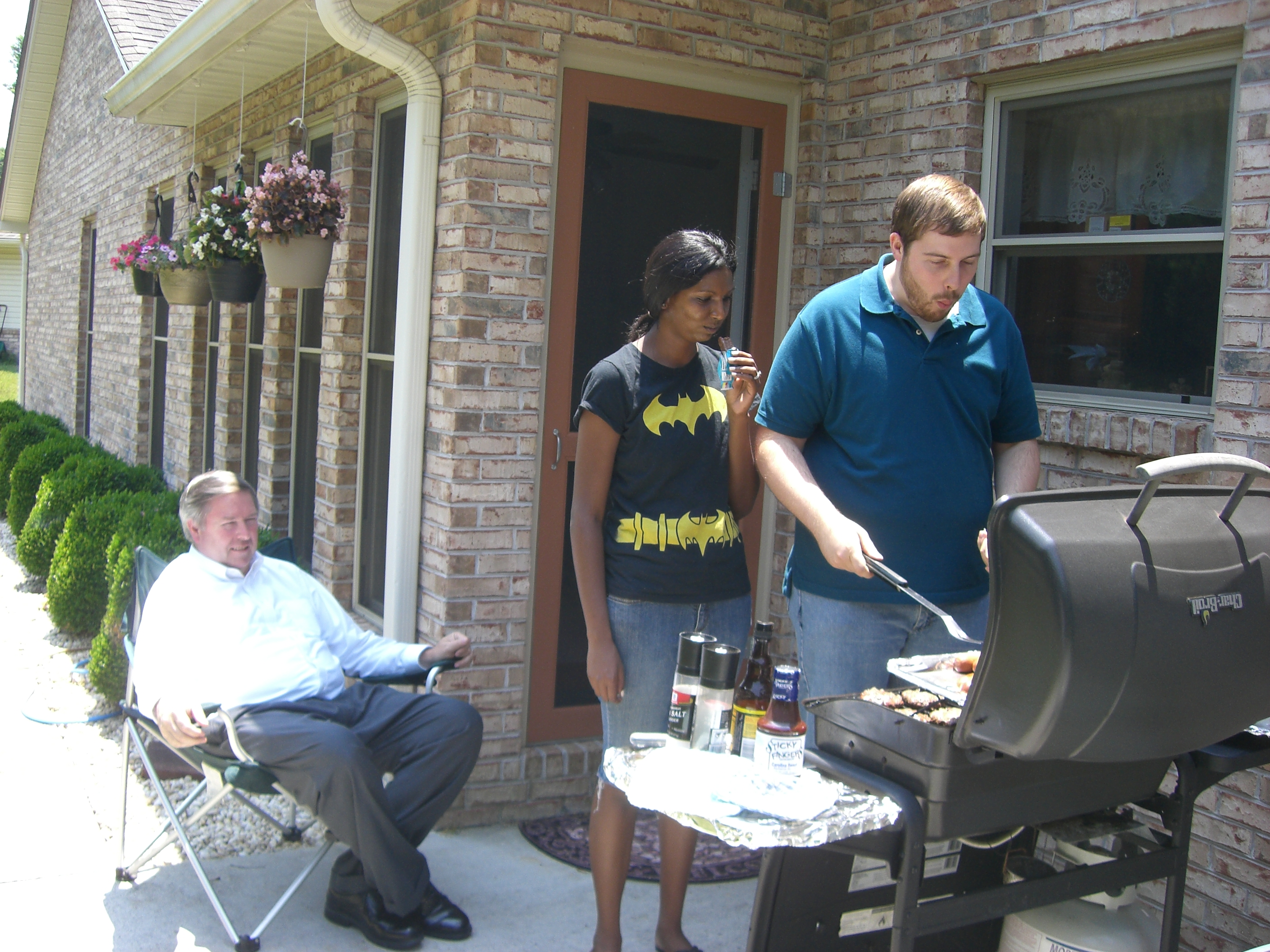
Mittu, my daughter-in-law, had a birthday yesterday but I didn’t have a chance to mention it on the blog then. She and Jason celebrated with the family last night. Unfortunately most of my photos didn’t turn out very well — I might need to wear my reading glasses while taking pictures these days! But we had a fun time — got pizza, “Face-timed” with Jeremy, got into discussions of some of the boys’ childhood exploits, had presents, cake, and ice cream. All in all a good day. 🙂

Thankfully this didn’t happen after I decorated the cake:

That’s the top of the cake dish…to which cake and frosting stuck when I took the top off. 😳  It was a two-layer cake and evidently was higher than usual due to my excess use of frosting to try to level up the layers. I ran out of frosting and had to run out to get more. (I don’t make my own. Not if I want it to turn out right. I’m not so good with cakes.) When I came back and took the top off — voila — the cake had been scalped. Once I decorated it I had to leave the top off so that wouldn’t happen again, but it was still plenty moist when we ate it a few hours later.

I am thankful for a daughter-in-law who loves the Lord, loves my son, and loves his family. I’m so glad God brought her into our lives.

The Week in Words

”"

Welcome to The Week In Words, where we share quotes from the last week’s reading. If something you read this past week  inspired you, caused you to laugh, cry, think, dream, or just resonated with you in some way, please share it with us, attributing it to its source, which can be a book, newspaper, blog, Facebook — anything that you read. More information is here.

Does anyone else remember when we used to celebrate Lincoln’s and Washington’s birthday in February? In some ways I liked that better than the generic President’s Day, but then again, even when we disagree with those in power we can respect and appreciate that they’ve taken on one of the most difficult jobs in the world.

I know I have quotes from various presidents on file but I don’t have them filed that way, so for this edition of the WiW, I looked up a few quotes here.

Experience teaches us that it is much easier to prevent an enemy from posting themselves than it is to dislodge them after they have got possession. ~ George Washington

To be prepared for war is one of the most effective means of preserving peace. ~ George Washington

America will never be destroyed from the outside. If we falter and lose our freedoms, it will be because we destroyed ourselves. ~ Abraham Lincoln

Don’t interfere with anything in the Constitution. That must be maintained, for it is the only safeguard of our liberties. ~ Abraham Lincoln

You can share your family-friendly quotes in the comments below or write a post on your blog and then put the link to that post (not your general blog link) in Mr. Linky below.

I hope you’ll visit the other participants as well and glean some great thoughts to ponder. And I hope you’ll leave a comment here, even if you don’t have any quotes to share.

Laudable Linkage

Here are some notable reads from the last couple of weeks:

Pathway to Freedom — overcoming any addiction.

Introverted. Quote: “My challenge…is to keep introversion from enabling or excusing sin… I can excuse selfishness, self-centeredness, escapism, lack of hospitality, rudeness. I can stay away from people and excuse it as being just the way I am, as being who I am. I can be shy and quiet when the Lord calls me to be strong and bold.”

Some Thoughts on Guns and YouTube Scoldings as Parenting Tools.

10 Churchy Words We All Need to Know.

Why I Read Jane Austen — written by a young man. Austen is not just for girls!

10 Common Misconceptions of the Wannabe Novelist.

Five Publishing Hurdles and How to Clear Them.

Password Check. An amusing piece for anyone who has ever been frustrated with password verifications (and they do seem to be getting even more frustrating!)

A couple of things seen on Pinterest:

Scott Hamilton’s testimony:

Sweet version of Twinkle, Twinkle Little Star with time-lapsed views of overhead stars.

Friday’s Fave Five

Welcome to Friday’s Fave Five, hosted by Susanne at Living to Tell the Story, in which we can share five of our favorite things from the last week, a wonderful exercise in looking for and appreciating the good things God blesses us with. Click on the button to learn more, then go to Susanne’s to read others’ faves and link up your own.

Here are a few favorites from this past week:

1. Puff’s Plus tissues with lotion. These feel so soothing and help keep my nose from getting all red and chapped when I’ve got a cold (I’m thankfully feeling better now).

2. Fellowship. After not having much going on socially for quite a while, we had our “dinner for six” with our new group and a Sunday School party both this past weekend.

3. Valentine’s Day. One of my favorite holidays though it was a bit more low-key this year.

4. Lindt milk chocolate truffles from both my husband and son and daughter-in-law.

5. Encouraging e-mails from readers of my latest newspaper column, saying they had been or are currently taking care of elderly parents and could identify with and appreciate what I had to say. Once I send the column to the editor, then my mind thinks of several ways people could take something I’ve said the wrong way, so it is very encouraging to hear that someone has gotten something beneficial out of what I wrote.

Hope you have a great weekend!

Book Review: Little House in the Ozarks

Little House in the Ozarks: the Rediscovered Writings of Laura Ingalls Wilder, edited by Stephen Hines, is a collection of newspaper columns and magazine articles Laura wrote between 1911 and 1925 before she wrote the Little House books. I have looked at bits and pieces of this but I’ve never read it all the way through, and I wanted to do so for the Laura Ingalls Wilder Reading Challenge this month.

There are over 140 articles or columns arranged by topic, and the topics range from WWI, women’s progress, and “the greatness and goodness of God,” but most are just observations drawn from everyday life.

Laura was very opinionated, especially in preferring farm or country life over town life. But in other ways she was very broad-minded. She was remarkably well read for having only two terms of high school: she quotes from several authors. She had a natural innate curiosity about the world around her and never wanted to stop learning about it. And for being a farmer’s wife tucked away in Mansfield, Missouri, she kept up on politics and current events quite well. There is even a section on fairies. But she valued a woman’s role in her home above all else.

She also reflected on her upbringing a lot and mentions several incidents that showed up in her later books.

One of my favorite columns is from January 1920, titled “The Man of the Place,” which was what Laura called Almanzo in these columns. She records their grumbling over the amount of work on their shoulders and the lack of time to get it all done, then they both recalled that their parents worked long into the night spinning, sewing, sorting their produce, while they themselves had club work and magazines to read in the evenings. They reminisced that their parents did enjoy their lives, though they were so busy. “If we expect to enjoy life, we will have to learn to be joyful in all of it, not just at stated intervals…or when we have nothing else to do” (p. 66). Then they concluded they weren’t really having such a hard time after all.

Another is titled “The Old Dash Churn.” Her husband had bought her a new butter churn that was supposed to make butter in three minutes. But it was supposed to connect to a motor, and they had none, so she had to hold it steady in a certain position with one hand and turn the handle with the other. Plus the blades were sharp and frequently cut her hands. She gave it a good try because her husband had bought it to please her and make her work easier, but it was making it more troublesome instead. She told him the problems she was having and asked him several times to bring back the old dash church, but he just said, “Oh, this one is so much better: you can churn in three minutes…” One day when the churn was being “particularly annoying” she picked up the whole thing and threw it as far as she could. When she told her husband, he said, “I wish I had known that you did not want to use it. I would like to have the wheels and shaft, but they’re ruined now.” I’m not telling it as she did, but it just struck me so funny because she HAD told him repeatedly. But she didn’t generally make a habit of throwing things when she was aggravated. 🙂

A few favorite quotes:

“Let’s be cheerful! We have no more right to steal the brightness out of the day for our own family than we have to steal the purse of a stranger. Let us be as careful that our homes are furnished with pleasant and happy thoughts as we are that the rugs are the right color and texture and the furniture comfortable and beautiful” (p. 37).

“I am beginning to learn that it is the sweet, simple things of life which are the real ones after all” (p. 52).

Quoting a friend who was “home schooling” and had a daughter who was not as academic as her brothers, preferring sewing to studying: “I know what her talent is, but she has to have her books, too: and she will sew all the better for having ‘book learning'” (p. 54).

“So much depends upon the homemakers. I sometimes wonder if they are so busy now with other things that they are forgetting the importance of this special work….Because of their importance, we must not neglect our homes in the rapid changes of the present day. For when tests of character come in later years, strength to the good will not come from the modern improvements or amusements few may have enjoyed but from the quiet moments and the ‘still small voices’ of the old home. Nothing ever can take the place of this early home influence; and as it does not depend upon externals, it may be the possession of the poor as well as of the rich” (p. 64).

“Now it isn’t enough in any garden to cut down the weeds….cultivating the garden plants is just as necessary. If we want vegetables, we must make them grow, not leave the ground barren where we have destroyed the weeds. Just so, we must give much of our attention to the improvements we want, not all to the abuses we would like to correct” (p. 94).

“We are coming, I think, to depend too much on being shown and told and taught instead of using our own eyes and brains and inventive faculties” (p. 122).

“It is a good idea sometimes to think of the importance and dignity of our everyday duties. It keeps them from being so tiresome; besides, others are apt to take us at our own valuation” (p. 130).

“Just as a little thread of gold, running through a fabric, brightens the whole garment, so women’s work at home, while only the doing of little things, is like the golden gleam of sunlight that runs through and brightens all the fabric of civilization” (p. 207).

“Here and there one sees a criticism of Christianity because of the things that have happened [during WWI]….’Christianity has not prevented these things, therefore it is a failure’ some say. But this is a calling of things by the wrong names. It is rather the lack of Christianity that has brought us where we are. Not a lack of churches or religious forms but of the real thing in our hearts” (p. 265).

In a column about how pies were invented, “Its originator was truly an artist, as though she had written a poem or painted a picture, for she had used her creative instinct and imagination with a fine technique” (p. 282).

I enjoyed so much getting to know Laura better through these columns.

The Laura Ingalls Wilder Reading Challenge

(This review will also be linked to Semicolon‘s Saturday Review of Books.)

Book Review: The Help

After I got my iPhone and got ready to find some audiobooks, I opened a trial account at Audible.com. Looking around for my first book to try, I happened upon The Help by Kathryn Stockett. I’d seen it mentioned and highly recommended, so I bought it.

For some reason it didn’t even occur to me that with this being modern secular fiction, there would likely be some bad language. I hadn’t recalled any of the bloggers I’d read mentioning it (for the record I do very much appreciate when reviewers mention these things so readers can take this into account.) By this reviewer’s count (which I hadn’t seen before listening to the book) there are about two dozen expletives, several of them taking the Lord’s name in vain.

Now, I am not naive. I grew up in an unsaved home and public schools, so I know people use such language. I really don’t hear it by and large in everyday life now, but my oldest son, who works with the general public (when they’re having computer problems and therefore upset) says he hears it all the time. But I don’t like to read or listen to it and fill my mind with it so that the next time I am frustrated, one of those words come flying into my thoughts. And I especially don’t like hearing the dearest name in the world brought down to such a level. Yet if I set out to purge every source of such words from my life I’d have to avoid some members of my extended family forever (as it is I have to delete about every other Facebook post from some of them). We live in a fallen world, so we’re going to encounter those things. Yet there is a difference between being unable to avoid it in some cases and voluntarily bringing it in for entertainment in others. I don’t think there is ever a case where it is really needed to make the story realistic. I don’t know if anyone ever gets to the end of a book and thinks, “You know, that was really good except it needed a few bad words.”

So…I wrestle with that. I really do. That’s one reason why I usually read Christian fiction and avoid modern secular work. In some cases the work itself supersedes these kinds of flaws, yet the flaws of such language may be enough to avoid it. I’m still working on that, but I wanted to put this at the forefront.

As for the rest of the book: it is excellent. The story is told from the viewpoint of three different women in Jackson, Mississippi in the 1960s:

Aibileen is a maid for Elizabeth Leefolt and looks after her daughter, Mae Mobley, who is the seventeenth white child Aibileen has helped raise. Mrs. Leefolt is considerably lacking in the maternal affection department, and Aibileen tries to make up for it by often telling Mae Mobley, “You is kind. You is smart. You is important.” Aibileen is the voice of calmness, common sense, and what spirituality is in the book, being noted for her prayer list.

Miss Skeeter is a friend of Elizabeth’s who often comes over to play bridge. Her family’s maid, whom she was closer to than her own mother, disappeared some time earlier, and Skeeter is hurt and mystified over where she went, why she left, and why no one will tell her anything. Skeeter, more than the other white ladies, seems to see and treat “the help” as real people. She’s finished college at Ole Miss and wants to be a writer.

Minnie is feisty, keeps losing jobs because of her tendency to mouth off, but is known for her exceptional cooking. There are only two people Minnie can’t face down: her drunken, abusive husband, and Hilly Holbrook.

Hilly is the self-appointed leader of her circle of friends and the president of the League. She decides to promote a bathroom initiative requiring every white household to build a separate bathroom for the colored help so that they don’t catch diseases from each other. Hilly is the ultimate control freak. Anyone dissenting from her viewpoint is not merely disagreeable. They must be crushed and ruined.

One other major character is Celia Foote, “white trash” who married up, pathetically trying to break into the community of white ladies and not understanding why none of them returns her calls.

Skeeter lands a job at the newspaper, writing a Miss Myrna column of housecleaning tips. She’s thrilled to have a writing job but has never cleaned anything in her life, so she asks Elizabeth if she can talk to Aibileen from time to time to ask her questions for her column. In the friendship that develops, Skeeter gets an idea: writing a book from the point of view of the help. I don’t recall if it was stated whether she just thinks this is a good angle for a book or if she is motivated in the beginning by any altruistic desire (one disadvantage of an audiobook is not being able to flip back through pages to try to find out), but it is not long before her eyes are opened and she sees this as more than just a project. She contacts an editor in New York who tells her to give it a try “before this civil rights thing blows over.”

It’s dangerous, both for Skeeter and Aibileen. Skeeter could be ruined socially and Aibileen could be harmed physically, as well as lose her job (and any job in the town). They meet secretly to work on the book. Then Skeeter’s editor tells her she needs to interview a dozen maids. No one else is willing to talk to her…until a tragedy in their midst convinces them they need to tell their stories. But another tragedy, the murder of Medgar Evers in the maids’ neighborhood, heightens the danger.

As the project continues, warmth and understanding unfolds on both sides — for there is prejudice on both sides (a colored doctor refusing to operate on a white boy’s hand when he loses his fingers is one example). There is even more to poor Celia than initially meets the eye.

The story was wonderfully told with both humor and pathos. The voices, the vernacular were right on.

The production values of the audiobook version were fantastic. Four actresses read the different sections, but at no point did I have the feeling someone was reading a book to me. At one point when I was recalling a particular scene, it was so vivid in my mind I had to remind myself I didn’t actually see it. It was enjoyable to hear the accents as well: one of my pet peeves is fake Southern accents, but for the most part these were genuine.

Overall, except for the instances of bad language and a couple of cases of vulgarity, I loved the book. I mentioned another review above: both it and the comments are very insightful.

(This review will also be linked to Semicolon‘s Saturday Review of Books.)

Book Review: Vicious Cycle

I got the audiobook version of Vicious Cycle by Terri Blackstock when someone posted on Facebook that it was free at GoBible.com for a limited time (it is no longer free at this time). I’ve enjoyed many of Terri’s books and hadn’t read anything by her in a while, so I snapped it up.

This is the second book in her Intervention series . The first book, also titled Intervention, was written several year’s after Terri’s own daughter was trapped in and then delivered from drug addiction. I had not read that one, but there were enough references in this book that I felt I had a basic enough understanding of the points of reference connecting the books.

In this book, Emily Covington is about to finish a year of treatment in a drug rehab facility. One of her friends there, Jordan, leaves the facility, goes home, unexpectedly goes into labor and gets high on meth to handle the pain. She doesn’t go to the hospital partially because she waited too late but partially because her own drug-crazed mother won’t take her. When Jordan wakes up and comes to her senses, she discovers her mother has plans to sell the baby. When Emily’s brother, Lance, comes to Jordan’s house to try to talk her into going back into treatment, Jordan desperately hides the baby in his car to get her away from her mother. Lance doesn’t realize she has done this until he leaves, then, he decides to take the baby home, thinking Jordan will come for her soon. But it is obvious something is wrong with the baby. Just as he decides to take the baby to the hospital, his car is surrounded by police and Lance is arrested for kidnapping.

Lance’s mother, Barbara, calls the detective who helped in her daughter’s case, Kent, and together they try to clear Lance, decide what’s best for the baby, and help Jordan to understand that though she has so many strikes available, a new life is possible with God’s help. When they discover evidence of a baby-trafficking ring, they realize that Jordan’s baby as well as others are in more serious danger than they had thought.

People who accuse Christian fiction of being too pristine to be realistic have not read Terri Blackstock. Somehow she portrays the gritty realism of drug addiction without making us feel we’ve been dragged through the gutter. There is enough there to be convincing without overdoing it.

My husband and I have had family members on both sides who have gotten involved with drugs, sadly, and we recognized the pattern of their behavior in Jordan and her mother. Emily, in the first book, had come from a good family. Jordan’s family is part of her problem rather than a solution or a support. Yet both girls had to realize where true help comes from and be willing to lay hold on it.

I very much enjoyed this book and am looking forward to the next one, Downfall, which, incidentally, can be pre-ordered in a e-book version for $4.99 before the end of February. I have my order in!

(This review will also be linked to Semicolon‘s Saturday Review of Books.)