Here we are at the second Friday of March already. I enjoy pausing the merry-go-round of life to share the blessings of the week with Susanne and friends atLiving to Tell the Story.
1. My husband’s birthday.
2. Fun birthday accessories. This was a “milestone” birthday, and the cake topper says, “I’m not old, I’m classic.” 🙂
I was also excited to find these paper birthday plates:
3. Lunch with Jason, Mittu, and Timothy. Jim was out of town last Friday, and my son and his family invited me to lunch at a Mexican food restaurant. Good food and company. 🙂
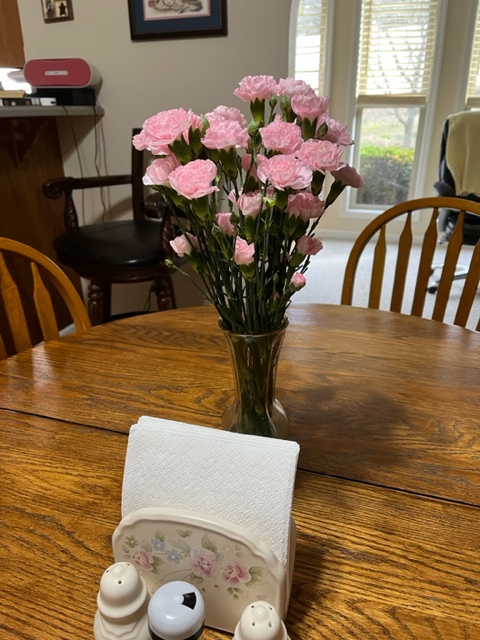
4. Flowers from my middle son’s family. This was actually from last week, but I forgot to mention them. They are still looking good!
5. Girl Scout cookies. My husband brought some home one day. I like the Tagalongs–chocolate and peanut butter combination. They had a new one this year that had a chocolate base with a caramel and sea-salt topping. It would have been better if the chocolate cookie part was soft rather than so hard it scattered crumbs whenever you bit into it. They also had one gluten-free variety, Toffee-tastic, that he got for Mittu.
When Greg Lucas and his wife adopted a baby that had been abandoned to the hospital where his wife worked, they had no idea what was ahead of them. Their son, Jake, seemed normal, healthy, and happy at first. But after his first birthday, he began having seizures where he’d suddenly stop breathing. Various doctors and medications were tried. The seizures eventually stopped, but Jake was left with a series of issues: Sensory Integration Disorder, Obsessive-Compulsive Disorder, Pervasive Developmental Disorder, and autism—just to name a few.
Greg tells of what he’s learned through helping Jake over eighteen years. Jake operated at the level of a two-year-old. Every bath time became a wresting match due to Jake’s severe sensory issues. As Jake got older and stronger, taking care of him became harder.
How do you care for someone who resists your love with violence, who opposes your very presence even when that presence is necessary for his good? How do you keep on loving when the person you are devoted to seems incapable of affection? The only way to make any sense of this kind of relationship is to experience it through the truly unconditional love of the Father (p. 23, Kindle version).
Over and over, Greg and his wife were brought to the total end of themselves in caring for Jake. But they found that a good place to be, because there they could only lean on God’s grace.
Greg writes with raw honesty but also with great sensitivity and beauty. He writes of the grace of an occasional easy day, a glimpse of his son as normal; how humiliation leads to humility, how they found ways to communicate when Jake had only five words in his vocabulary, how dangerous it is when someone can’t express himself, concerns over whether and how much Jake can understand about Jesus and salvation, Jake’s tendency towards injury, concerns about how to take care of Jake as he got older, agonizing over whether to send him to a specialized residential school away from home.
I think this would be an excellent book for someone with a mentally or developmentally disabled child or relative or friend. But I found it beneficial as well, even though I don’t know anyone with problems as severe as Jake’s. The lessons of faith and grace shine through as we realize the spiritual disabilities we all have and our Father’s abundant love in caring for us.
Lauraine Snelling’s Dakota Plans series is made up of five novellas about Norwegian immigrants to North Dakota in the early 1900s. The first three, Dakota Dawn, Dakota Dream, and Dakota Dusk, were packaged together in an audiobook I reviewed here.
The last two, Dakota December and Dakota Destiny, were packaged together in a separate audiobook.
In Dakota December, Sheriff Caleb Stenesrude’s dog needed to go out during a Christmas Eve blizzard, but then stayed out yipping instead of coming back in. Caleb went out to see what was wrong and found a woman collapsed on a horse. He caught her as she fell and discovered a young child clinging to her. When he brought them into the house, he saw that the woman was with child. Her cries let him know she was in labor. He was in for a unique Christmas Eve.
Later, the woman, Johanna Carlson, is ensconced with her children in a widow’s home until she can recover and the weather settles down. She’s reluctant to tell these good people her troubles. But she needs to get away as soon as possible, before her angry and violent husband finds them.
In Dakota Destiny, Pastor Moen’s daughter, Mary, is grown up and in a teacher’s school, thanks to a wealthy benefactress. Mary is in love with Will, the blacksmith’s apprentice we met in the second book, who is also now grown up. But when World War I begins, Will feels he must enlist. Mary spends the summer taking care of a sick woman’s children while Will goes to training camp and then out to sea. When Mary goes back to school, she receives the devastating news that Will is missing and presumed dead.
She carries on with her school and finds her first job as a teacher. A year later, another man seeks her hand. But she can’t shake the feeling that Will is still alive.
The last book was much shorter and seemed a little underdeveloped. It was odd that characters in books 3 and 4 had the same last name, but didn’t seem to be related to each other. The narrator of all the books was really good, but used a different voice for the pastor in book 4 than in the rest of the books. And I disagreed with a statement in the last book that we are all God’s children (we’re not).
But otherwise, I enjoyed both these books. A few characters from the previous books were rarely mentioned again, but others played prominent parts. I’m going to miss this little community. I especially appreciated an older lady, Mrs. Norgard, and the ways she found to help and encourage people.
Do you ever chafe at the routine things you have to do?
Some days I am irked at having to take a shower. I know, I know, people didn’t always bathe every day, and I don’t have to. But if I don’t, I won’t be able to stand myself before the day is over.
Then we unload and reload the same dishes in the dishwasher, wash the same clothes, buy the same groceries only to have them disappear.
Sometimes that sense of sameness can creep into my time with the Lord as well. I’ve mentioned before that I like to start with what we call “the Lord’s prayer” and expand my prayer time from there. But when I see those same words every day, it’s easy to run through them without even thinking.
We know reading God’s Word and talking with Him in prayer are precious privileges. What can we do when they seem just part of the day’s routine?
Here are some ideas:
Pray. Ask God to help you treasure time with Him and give you wisdom to keep it fresh.
Change the order of what you do. If you normally pray and then read, reverse the order. Or pray as you read, letting the Scripture prompt your prayers.
Change your time or location. If you normally have your quiet time in a comfy living room chair, try the kitchen table or the patio or the park.
Listen to the passage instead of reading or while reading. Some Bible apps have the ability to hear the passage read.
Go back to basics. Journals, markers, commentaries, etc., can all aid in Bible study. But sometimes we get more caught up in the aids than the Word itself. Just pick up the Bible sometimes and ask God to speak to you through it rather than looking at your time with God as a homework assignment to get through.
Use a study Bible or commentary. I don’t mean to contradict what I just said. But if you are used to just reading through a passage, then a study Bible can shed new light or bring in insights with background information or connection to other passages.
Use a different aid. If you use the same aids all the time, ask a trusted friend for recommendations of others.
Start with a hymn or psalm. Some people like to sing during their devotional time. But even just reading through the words of a hymn can spur our hearts to worship. And the psalms remind us God is interested in our hearts.
Read from a different translation. I see things I didn’t notice before when I read from a translation I am not used to. Or a familiar verse won’t sound familiar and I’ll question, “Is that what it really says,” prompting further study.
Have a Bible reading project. Some years ago, I heard someone say that Jesus never claimed to be God. I knew that wasn’t true, but I also knew He didn’t stand on a mountaintop and proclaim His identity to the world in a public way. So as I read through the gospels, I put a “C” by every verse where Jesus claimed something about Himself. That was such a rich study. It woke me up in my reading since I was looking for particular things. You could also go through the gospels and put a “P” by every verse which fulfills a prophecy from the Old Testament. Someday I’d like to note every verse which speaks about creation and what we learn from it.
Take a break from the book you are in. I like to read through a book of the Bible rather than hopping around at random. You get the context of the overall message that way and see how the individual points fit together. But some books, like Leviticus and Chronicles, can be a little dry. Take a break one day and read a few psalms or a short epistle like Philippians.
Build in a free day. The church we attended the last few years had a Bible reading plan that spanned five days of the week. We discussed the week’s reading on Sunday. Saturday was a catch-up day. Since I didn’t usually need to catch up, and I didn’t want to get ahead of where we were reading as a group, I used Saturdays to work through a different Bible study book or Christian nonfiction book. I benefit more from those kinds of books when I set aside time to dig in; I can’t just pick them up at random and read a few paragraphs like I can other books (at least I can’t get as much out of them that way). I’ve come to treasure my different routine on Saturdays. I read from Daily Light on the Daily Path every day, so I am getting something directly from God’s Word even if I don’t read a whole chapter.
Remind yourself of the benefits. It helps to get through routine tasks when I remind myself of their benefits. On occasional days I don’t make my bed, I am reminded that the room does look more neat when the largest item in it is neat. When the room is neat, I feel less cluttered mentally. I remind myself to be thankful that I can take a shower easily: in some eras and cultures, that wasn’t always possible. Though going to the grocery store is tiring, we’re blessed to have food readily available.
Read and pray anyway, even if you don’t particularly feel like doing so. The worst thing we can do on those days is avoid the Bible and prayer or just give them short shrift. God’s Word revives us, so if we avoid it, we’re avoiding the very means God can use to enliven our hearts and renew our love for His Word. “Unless thy law had been my delights, I should then have perished in mine affliction. I will never forget thy precepts: for with them thou hast quickened me” (Psalm 119:92-93, KJV). One of our former pastors said that one of his best times of prayer happened when he had to start out confessing that he didn’t feel like praying.
Every meal is not a Thanksgiving feast, but every meal nourishes us. In the same way, some times with the Lord in His Word will be special and deeply meaningful. Other times may not feel that way, but they still nourish our souls and help us grow spiritually.
What have you found to help when your devotional time is in a rut?
Do You Want to Be Well? “Jesus specialized in asking simple, straightforward questions. They weren’t designed to trick people and went straight to the heart of the matter. They invited people to pause and look deep inside at their aching spiritual poverty. John 5:6 says, ‘would you like to get well?’ or ‘wilt thou be made whole?’ Well, of course we want to be well. Why would He even ask?” Plus, Linda links to this printable of verses that share Who Am I in Christ?
How Can We Avoid Putting a Band-Aid on Others’ Grief and Pain? “A reader recently asked me a searching question about this scene from Mark’s Gospel: ‘Mark describes Jesus as greatly distressed and troubled, sorrowful to death. If Jesus felt this way, why do we, as Christians, often just try to put a band-aid on others’ grief and pain?'”
Learning a Lesson from Scandals Close to Home. “Though we would never wish for a scandal to take place and make its way into the headlines, and while we should always regret the circumstances that bring one about, a scandal does offer the opportunity for personal introspection. A wise man will heed its lessons, for it inevitably provides the context to consider whether sin is sneaking up on us as it has on someone else, to practice the biblical admonition ‘let anyone who thinks that he stands take heed lest he fall’ (1 Corinthians 10:12).”
More Than Music: How the Congregation Plays a Part in Every Element of Worship, HT to Challies. “We equate worship with music because we have been trained to think that singing is the only way in which congregations actually participate in worship. But Scripture is clear: corporate worship encompasses much more than music. In fact, every element of Christian worship involves the active participation of the entire congregation.”
Weaknesses: Our Unlikely Ally, HT to Challies. “If you want to turn the world’s wisdom on its head completely, this is it. The Apostle Paul says he will boast about his weaknesses (2 Cor. 12:9). We do not boast of weaknesses; we hide them because they hold us back from being who we should be. They threaten our competence. They are faults and defects. Instead, we boast of accomplishments, skills, talents, and abilities, but biblical wisdom says this is backward.”
I couldn’t help but use the spring icon this week, though spring is officially a few weeks away. It looks like we’ll still have some cold nights over the next week, but pleasant days.
It’s been a quiet, fairly low-key week. Today it’s time to pause with Susanne and friends atLiving to Tell the Story to look back at the highlights of the week.
1. Time with Timothy. My son and daughter-in-law asked me to watch Timothy for a few hours one afternoon.
2. A light cooking week. If you’ve been reading here long, you know that’s a favorite for me. 🙂 Jason and Mittu brought dinner in a crock pot when they brought Timothy and ate with us after they got back. Then we got take-out a couple of nights. Jim was away last night, so I just had frozen pizza.
3. Lunch with Melanie. We talked about the world’s problems and didn’t come up with any solutions except that people need Jesus and we look forward to His coming.
4. A Crumbl cookie. I tried the Maple Bacon one this time. Soooo good. But so sweet and rich I couldn’t eat much at one time. I don’t think I’ll get any of their frosted cookies any more—normally with cakes I scrape off the excess frosting. For just a cookie, it seems silly to pay premium price for a special treat just to scrape off 1/3 of it.
5. Blooms and new growth. I mentioned daffodils last week. Flowering tress are blooming all over town. I just noticed yesterday my roses are leafing out. After the barren landscape of winter, I always look forward to the new growth and color as spring approaches.
Lauraine Snelling wrote a series of five novellas about Norwegian immigrants to North Dakota in the 1900s. The first three, Dakota Dawn, Dakota Dream, and Dakota Dusk, were packaged together in a free-with-my-subscription audiobook. I don’t know what’s up with the picture on the cover—no one dressed that way in the 1900s!
In Dakota Dawn, Norah Johanson’s fiance had gone to America three years ago, promising to send for her. Now she’s on her way. But when she arrives, she finds that Hans has just recently died. Reverend and Mrs. Moen take her in for as long as she needs to decide what to do. She doesn’t have the money to go back home, so she must find work.
Carl Detchman is a quiet but stubborn German immigrant whose wife has just died in childbirth. The Moens have taken care of his young daughter and infant son, but he can’t expect them to do so forever. The Moen’s house guest who has been helping with the children seems capable. But he can’t invite a beauitful young single woman to his home without tongues wagging. So he proposes a marriage of convenience. If she’ll come and keep house and take care of the children until he can make other arrangements, then they can annul the marriage and he’ll pay for her ticket back home.
Norah is shocked at first, but agrees. And, of course, the two fall in love. This is a frequently seen story line with an inevitable conclusion, but it was enjoyable to see the two work through their issues and come first to appreciate, and then to love each other.
In Dakota Dream, Clara Johanson, Norah’s sister, received a ticket to her sister’s town and a picture from a handsome stranger offering to pay her way to Dakota if she’ll be his wife. Clara agrees. But when she arrives at her sister’s house, no one knows who this man is.
What she doesn’t know is that Jude Weinlander brought Clara over to play a trick on his brother, Dag. He signed Dag’s name to the letter but sent his own picture. Dag is tasked with meeting Clara at the train station and taking her to the Detchman’s. He does not make a good first impression, with matted hair and beard and filth from the livery where he works.
Clara stays with her sister until the pastor asks if she can come and stay with an elderly woman who is not doing well and needs full time care. Clara has no idea the change this will make in her life—and in her relationship with Dag.
In Dakota Dusk, Jude Weinlander is disgusted. His trick on Dag backfired. He’s run out of money due to drinking and gambling and has to move with his wife back to his mother’s house.
When a fire destroys his home, after he heals, he becomes a drifter, traveling from place to place looking for work. He doesn’t drink or gamble any more, but he can’t go home. He comes upon a town rebuilding their school after a prairie fire. He stays to help, and then is asked to stay on to help rebuild other homes.
He can’t help but notice the pretty school teacher, Rebekka Stenesrude. But he can never pursue a relationship. He’s not worthy. No one could love him if they learned what he had done.
These stories were set some years after Laura Ingalls Wilder’s Little House series, so there are many similar incidents—grasshopper infestations, prairies fires, etc .But these stories are told primarily from the viewpoint of immigrants adjusting to a new land. I felt the same way I did after reading Laura’s books—glad I was born in my time and not hers!
There were so many hardships in those times. The services for help that we take for granted didn’t exist then, so people had to help each other, and accept help, or die.
But great faith and character emerged as well. I enjoyed these stories as well as the characters and the obstacles they overcame.
In The Space Between Wordsby Michele Phoenix, Jessica and two friends in Denver take a vacation to Paris. Though they’ll do some sight-seeing, they are mainly there to scout out treasures at antique stores and flea markets.
But then Jessica is shot during the Paris attacks in 2015. She’s traumatized by all she saw in the attacks. When she heals enough to be moved, she wants to get out of Paris as quickly as possible.
But one of her friends talks her into staying, at least for a little while. In one flea market, Jessica find an antique sewing box that seems to draw her. Back at her room, she discovers a secret compartment in the box which contains several sheets of handwritten paper and a few pages from an antique French Bible.
A new friend helps Jessica translate the ancient French. The sheets held the writing of a young woman named Adeline Baillard in 1695. She and her family were Huguenots when the Catholic King outlawed their faith and sanctioned torture and persecution against them. Adeline’s family gets her sister and brother and his family out, but Adeline stays with her parents. She’s a teacher and wants to help her students as much as she can while there is time.
As Jessica reads Adeline’s words, she feels compelled to find what happened to her and her family, especially her sister. Her own healing and mental and spiritual health are wrapped up in Adeline’s fate. She can’t understand how Adeline could believe so strongly in a God who would allow such atrocities to happen.
I’m sorry to say that I had completely forgotten about the Paris attacks of 2015. The year isn’t given in the novel, but the details seemed more reality than fiction, so I looked up and read more about them in Wikipedia.
This is the first book of Michele’s I have read, and I was captivated. So much of the story is touching, but subtle humor is sprinkled throughout as well. One surprise twist was heart-wrenching.
Just a few quotes that stood out to me:
I knew he worried, as I did, that that part of my life had been amputated by fear.
Father held what remained of our Bible in both hands and declared, “This is the Truth that binds us to each other and to God. These are the words exhorting us to faithfulness and strength. These are the pages that emancipated our faith from the dictates of a King. We will carry them with us as a testament to our resistance, as a reminder of all the Huguenot community has endured” (p. 115).
My grandmother believed in the power of words, in the capacity of story to transcend both time and place. This scroll is evidence of the temerity of her escape, a tribute to the ancestors who lost their world to save their faith (p. 288).
There were a couple of odd places where a child seemed to see someone who wasn’t there. But other than that, I loved everything about this book.
February has been an up and down month in many ways besides temperatures.
Early in the month we got word that Jim’s sister was not doing well. Then she passed away just a few days before her 67th birthday. She didn’t want any kind of service, so we didn’t travel up to OR. We kind of missed that closure and opportunity to see family, but we were able to touch base with some online. Jim and his oldest brother are the only ones left of his immediate family.
We had a nice Valentine’s Day with all the family. For the first time in I-don’t-know-when, Jim and I went for a pre-Valentine date. I enjoyed that quite a bit. Maybe we’ll start a new tradition!
The very next week was our dear daughter-in-law’s birthday. And, as I mentioned in the last Friday’s Fave Five, the kids saw that this week was the tenth anniversary of my husband’s surgery to remove a cancerous kidney. So they surprised him with “Kidney day,” including dinner and a kidney-shaped cake.
In-between those events, we had an excursion with Timothy and Jason to the American Museum of Science and Energy in Oak Ridge, TN. It focused much on OR’s part in the development of the nuclear bomb and the more productive ways they’ve used the science and equipment since then.
We’re still visiting churches and racking up some . . . interesting experiences. I don’t know if I will post about them. I am still processing them. As we pray for God’s leading and keep finding places with issues too big for us to want to join, I am asking God what He wants me to learn from this.
Creating
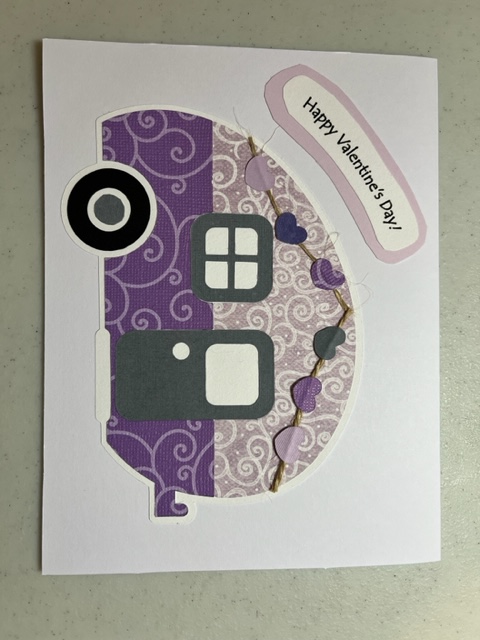
February and December are my biggest card-making months, since I make a card for all the immediate family for Christmas and Valentine’s Day.
This one was for Jim.
The words in the middle were from a sticker collection he had given me.
This was Jeremy’s.
He likes foxes. This fox is a multi-layered sticker. The mushrooms, leaves, and words were stickers as well. I love that this paper isn’t the traditional pink or red hearts (though I love traditional Valentine’s colors, too!)
This is Jason’s.
I wanted to use the candy hearts idea, and these were the only designs I found on the Cricut that would be appropriate for a mother to a son. 🙂
This was Mittu’s.
This was done on the Cricut (except the words). There’s a reason I chose this design . . . if it comes to fruition, I’ll let you in on it. 🙂 Also, I just noticed that a swirl in the bottom and top paper met on the left. I wasn’t trying to do that, so that was a nice surprise. 🙂
This was Timothy’s.
These hearts are from Minecraft, a game he likes to play. This was all done with the Cricut.
And this was Jesse’s.
I adapted it from an idea I saw on Pinterest. The hearts were made with a heart punch.
Then this one was for Mittu’s birthday.
She likes purple and sunflowers, which I’ve used a lot in the past. But she also likes daisies, and I had these adorable multi-level daisy stickers.
Watching and Listening
I didn’t listen to any podcasts this month, but I read the transcripts of a couple from Author Media.
We did see some interesting movies. One was a Polish film called Run, Boy, Run based on a true story. A young Jewish boy ends up alone in Poland, trying to hide his identity and look for work from farm to farm. It’s amazing the cruelty of some people, but the great risk others are willing to undergo to help.I enjoyed the bit at the end with the man whose childhood was depicted here.
I was looking forward to The Most Reluctant Convert about C. S. Lewis’ conversion. It was interesting to hear his story as he might tell it. I knew much of it from reading various biographies, but there were a few details I didn’t know. There were a few acted-put parts (with Nicholas Ralph from All Creatures Great and Small playing Lewis as a young man). But I think it might have been better with a few more acted parts and less narrator-talking-while-walking sections. Still, I enjoyed it overall.
Fanny’s Journey was another WWII film based on a true story about a child. In this case, a girl and her sisters are sent to a group home in the French countryside, but have to flee with their guardians. They miss a contact and end up roaming around by themselves.
With as star-studded a cast as the 2017 Murder on the Orient Express had, I am surprised I hadn’t heard about it, at least not that I remembered. I had never read the book or seen another version, so the conclusion was a surprise to me. There’s a bit of language and innuendo that I have to think was probably not in Agatha Christie’s original version.
Be Rich (Ephesians): Gaining the Things That Money Can’t Buyby Warren W. Wiersbe. This was a reread. I linked to my review of it from a few years ago. This time I slowed down and only read about half a chapter of Ephesians a day to go along with Wierbe’s chapters. Ephesians is so packed, it helped to take it in smaller chunks.
Unveiling the Past, by Kim Vogel Sawye, audiobook. A cold case detective’s current case about a missing father unearths feelings about her own absentee dad. Excellent.
Dakota Dawn, Dakota Dream, and Dakota Dusk by Lauraine Snelling, a novella series about Norwegian immigrants who settle in North Dakota in the early 1900s. They are packaged together in one audiobook. Just finished, not reviewed yet. Very good.
The Fence My Father Built by Linda S. Clare, audiobook, not reviewed or recommended.
I’m currently reading:
Be Patient (Job): Waiting on God In Difficult Times by Warren W. Wiersbe
Murder Your Darlings: And Other Gentle Writing Advice from Aristotle to Zinsser by Roy Peter Clark
Becoming Free Indeed: My Story of Disentangling Faith from Fear by Jinger Duggar Vuolo
All That’s Good: Recovering the Lost Art of Discernment by Hannah Anderson
Love Does Not Eliminate Hard Things. I noticed for the first time that Jesus waited to come when Lazarus was sick because He loved Mary, Martha, and Lazarus. Sometimes in love He allows hard things.
I recently saw a meme which said that our relationship with God is not about Him pointing out our sin, but about exchanging our hearts with Jesus.
I had to think about that a while.
I’m not sure what the writer meant by exchanging hearts with Jesus. Maybe she was alluding to Ezekiel 36:26, where God says He will remove our heart of stone and give us a heart of flesh.
But what particularly struck me was the downplaying, even the rejection, of the need for God to point out our sin. The thought reminded me of a song that was popular when I was a kid. The singer prays at night during a lonely time. She doesn’t want God to correct, challenge, or chasten her. She just wants Him to listen.
Our relationship with God is more than dealing with sin, of course. But dealing with sin is certainly part of it. Even the allusion to needing a new heart is an indication that all is not right with ours.
No one enjoys having their wrongdoings pointed out. Yet God pointing out our sin is not a negative aspect of our relationship with Him. It’s a blessing. It’s sin that comes between us, hinders our prayers, and clouds our fellowship. When God convicts us of sin, it’s a sign of His love and an opportunity to confess to Him and be forgiven. Proverbs 28:13 says, “Whoever conceals his transgressions will not prosper, but he who confesses and forsakes them will obtain mercy.”
We might think of it a little like this. Suppose a young boy who is old enough to know better kicks a ball around in the house and breaks a window, hits his little sister, skips school, and is found smoking with his friends—and then asks his parents for the latest video game. Most parents would say, “We have some other things to talk about first.”
The parents correct the child not just because he’s not living up to their standards or embarrassing them in front of the neighbors, but for his own good. A child who is never corrected by his parents will never learn to say no to himself or rein himself in. He’ll most likely have trouble in school, in his job, and in relationships because he’s never been taught to do anything but have his own way.
We don’t like to be shown that we’re doing something wrong. Everyone having their own “truth” these days makes it even harder to pin down an authoritative right and wrong.
But what about when we are wrong?
If you’re going the wrong direction, wouldn’t you want someone to tell you before you go too far out of your way?
If you are training to be an accountant, wouldn’t you want to work out the mistakes in your calculations so you don’t cost yourself or your client great sums of money?
If you’re a brain surgeon, wouldn’t you want the best training and practice so you’re not a hazard to your patients?
Correction is a fact of everyday life. We’re in a constant state of growth. Learning better ways to do things and treat people involves examining our thoughts, motives, speech, and actions, ferreting out what’s bad, and learning improved ways to think, feel, speak, and act.
The need for correction is even more vital spiritually.
Sin is what originally separates us from God. Isaiah 59:2: “Your iniquities have made a separation between you and your God, and your sins have hidden his face from you so that he does not hear.”
Jesus died on the cross to take care of our sin. 1 John 3:5: “You know that he appeared in order to take away sins, and in him there is no sin.” Galatians 2:21b: “If righteousness were through the law, then Christ died for no purpose.”
Well, you might say, I am a believer. The Bible says “There is therefore now no condemnation for those who are in Christ Jesus (Romans 8:1). So I don’t have to worry about sin any more.
No, that’s not true. I John 1:6-10 says—to Christians—
If we say we have fellowship with him while we walk in darkness, we lie and do not practice the truth.But if we walk in the light, as he is in the light, we have fellowship with one another, and the blood of Jesus his Son cleanses us from all sin.If we say we have no sin, we deceive ourselves, and the truth is not in us.If we confess our sins, he is faithful and just to forgive us our sins and to cleanse us from all unrighteousness.If we say we have not sinned, we make him a liar, and his word is not in us.
Our sins are forgiven and we’re not under condemnation. But we still have an old nature. After we’re saved, we fight against sin because we have a new nature that wants to please our Father. As we grow in Him, He convicts us of things that are wrong so we might confess them and put them aside. Sin doesn’t sever our relationship, but it does affect it.
Usually after several years of being a Christian, we’ll be convicted about things we never thought of when we were first saved. That’s a blessing: if God dealt with everything in our lives at once, we’d be overwhelmed. As parents, the things we deal with our children at age fifteen will be different, and likely more advanced, than what we dealt with at age five.
Being convicted of our sin does more than prompt us to confess and forsake the sin. It also humbles us and reminds us how much we need to be in God’s Word and to rely on Him for our daily walk.
A. W. Tozer said, “We must allow the Word of God to correct us the same way we allow it to encourage us.” “All Scripture is breathed out by God and profitable for teaching, for reproof, for correction, and for training in righteousness, that the man of God may be complete, equipped for every good work’ (2 Timothy 3:16-17). Multitudes of verses in proverbs tell us that wise people receive corrections, but fools don’t listen.
Like the psalmist, we need to regularly invite God to “Search me, O God, and know my heart! Try me and know my thoughts! And see if there be any grievous way in me, and lead me in the way everlasting” (Psalm 139:23-24). “Examine me, O LORD, and prove me; Try my mind and my heart” (Psalm 26:2). Paul tells us to examine ourselves before taking communion.
God “disciplines us for our good, that we may share his holiness. For the moment all discipline seems painful rather than pleasant, but later it yields the peaceful fruit of righteousness to those who have been trained by it” (Hebrews 12:10b-11).
We don’t approach a stern judge who is ready to bang his gavel. We come to one who sympathizes with us in grace. “Since then we have a great high priest who has passed through the heavens, Jesus, the Son of God, let us hold fast our confession. For we do not have a high priest who is unable to sympathize with our weaknesses, but one who in every respect has been tempted as we are, yet without sin. Let us then with confidence draw near to the throne of grace, that we may receive mercy and find grace to help in time of need” (Hebrews 4:14-16).
So don’t search the Bible or pray only for assurance and affirmation. Let God’s Word and Spirit do their sanctifying work of searching you and correcting you. The process may not be pleasant, but His cleansing ultimately brings great peace and joy.



















 Stray Thoughts