Adventures in Elder Care: Decisions

Eldercare

A few years ago I happened upon a couple of blogs dealing with being a caregiver for elderly parents, and they were a help to me even before we got to that point. Those blogs are no longer active, and for some time now I have been thinking of writing some of the experiences and things we learned along the way with my mother-in-law in the hopes that they may be a help to someone else.  I had hoped to contain everything I wanted to say in one post, but it got to be way too long even before I finished, so I thought I’d better divide it up into sections.

Scripturally and morally we’re obligated to care for our parents when they can no longer care for themselves. In Matthew 15:3-6, Jesus says to the Pharisees, “Why do you yourselves transgress the commandment of God for the sake of your tradition?  For God said, ‘Honor your father and mother,’ and, ‘He who speaks evil of father or mother is to be put to death.’ But you say, ‘Whoever says to his father or mother, ‘Whatever I have that would help you has been given to God,’ he is not to honor his father or his mother.’ And by this you invalidated the word of God for the sake of your tradition.” (This is from the NASB, which I think gives the clearest meaning to this passage.) God did not honor their gifts supposedly to Him at the expense of neglect of their parents. In instructing the church concerning the care of elderly widows, Paul writes in I Timothy 5:4: “But if any widow has children or grandchildren, they must first learn to practice piety in regard to their own family and to make some return to their parents; for this is acceptable in the sight of God,” again from the NASB. Both it and the ESV say “children or grandchildren”; the KJV says “children or nephews.” But the idea is that our first responsibility and ministry is to our family. The “sandwich generation” is not a new phenomenon: people have always needed to care for their parents and grandparents in some way. Besides the “obligation” of such care, we should be glad to “return the favor” of caring for those who cared for us for so many years.

Most people really don’t think seriously about what to do with a parent who can no longer live alone until they get to that place. Admittedly you can’t really make a decision until the time comes, because it will depend on the family’s life circumstances and just what condition your loved one is in. But it is good to do some research and have some discussions before you have to make a decision in a crisis.

I would say to anyone nearing retirement age that, as much as we don’t want to think about losing our independence, we have to face the fact that that day will come to all of us. It’s good to look ahead, prepare advance directives, talk to your children about your wishes and financial state, etc. We could even start reducing the amount of “stuff” we have squirreled away in attics or sheds before we get to the place where we don’t have the energy to deal with it so our kids won’t be faced with that chore.

It often seems as if other people see that an older person is having trouble living alone before that person realizes it, but I would make every provision for them to remain in their own home as long as possible. Most people wouldn’t relish the change from private home to a dorm or hospital type setting where anyone can come into your room at any time unless they are extremely gregarious, and many would feel burdensome moving in with their adult children. Some folks I’ve known have hired some household help to come in a couple of times a week; I’ve known some who rented out a room to a college student whose responsibilities around the house offset their rent (some degree of housecleaning, taking care of the lawn, perhaps some cooking, etc.)

The main reason for moving a parent out of their own home would be safety issues: the danger of falling, of forgetting to take medicine or taking too much because they’ve forgotten they already took it, etc. Even still, necessary changes need to be discussed and urged upon the parent without running roughshod over their wishes and feelings. It’s usually better to plant the seed that we need to start thinking about the future long before the need actually arises.

In my mother-in-law’s case, she wasn’t taking any medicine that we needed to be concerned about. We were all concerned about her living alone after her husband passed away. She lived 2,000 miles away from us but had a daughter and grandkids nearby. When my husband visited a couple of times, he noticed the housekeeping was declining and the dog had the run of the place (probably for companionship. They’d always had dogs, but they had never been allowed on furniture or to have free reign in the house, but now every piece of furniture was covered in thick dog hair.) He flew up to ID to accompany her to our home in SC and back for a visit to our house since we didn’t think she could travel alone, and while there he took her on a tour of an assisted living facility “just to see what it’s like.” She said it was nice, but she wasn’t ready for anything like that yet. Just about the time we felt like we needed to gently insist that she needed to consider moving, her daughter became available to move in with her. That gave everyone a reprieve from having to make any changes for a time. I don’t believe her daughter was ready, mentally and emotionally, for her to move to a facility yet, either. They did well together for a time, but then my mother-in-law began having some falls, and one time could not get herself up until her daughter got home from work. Additionally, her daughter began having some back trouble and could no longer help her with things like getting out of the bathtub. They both finally came to the conclusion that the time had come for a major change.

The next step, of course, is trying to figure out what that change should be. My husband and I discussed the possibilities many times as did my husband and his oldest brother long before this day actually arrived.

There are several things to consider when deciding whether to move a parent into your home or an assisted living facility:

1. Housing situation. Not everyone has the space to include a new adult addition, or the house might not be conducive to someone with physical problems.

2. Availability of other family members. It’s easier to bring a parent into your home if you have some kind of support system than it is to do so alone.

3. Finances.

4. Mental ability. If the elderly parent has Alzheimer’s or mental confusion, someone would need to stay with them all the time, and even a family with a stay-at-home member might not be able to manage that between errands, school obligations if there are school-aged children in the house, etc. I know some handle this by hiring someone to stay with the elderly parent a certain amount of time each week.

5. Level of care needed. There might be some situations in which the older person needs physical or medical care that can’t be given at home.

6. Relationships. Some older people will always see their adult child as a child, and won’t follow instructions about medical care (e.g., medicines), food, etc., but they would take such instruction from medical personnel in an assisted living situation.

7. Personalities. We might be loathe to admit this and we might think that every family relationship should amicable, but in real life that is just not the case. Some relationships prosper with a little bit of space for each party.

8. Safety. Particularly Alzheimer’s or some forms of dementia in advanced stages may cause some patients to physically strike their caregivers when frustrated or angry even if the patient would never have done that in earlier years.

9. Socialization. Assisted living could provide the mental stimulation of interacting with others and participating in the activities there, and it might encourage folks to know there are others who are going through the same things she is.

10. Independence. If a person is not capable of being alone, mentally or physically, for short periods of time, it would be hard to bring them into the family home unless someone else in the family can be home all the time, or the elderly person is able physically to go with the family to their activities. It might seem odd to list this as a factor when a person going into assisted living seems to be giving up their independence. But in such a facility they actually do get to make some of their own decisions and schedules to a degree and have their own living space. Some would feel that if they lived with their children they would be an imposition (even if the family is glad to have them), and they are more comfortable being on their own as much as they can be.

In our case, the biggest factor was that our home was not conducive to my mother-in-law’s needs. We had a split level at the time, and she could not handle the stairs safely. The other major factor was that we still had kids at home, one of whom was not driving yet, so our lifestyle involved a lot of taking kids to school, practice, and activities as well as errand-running where we couldn’t leave Mom at home alone. A friend who takes care of her mother-in-law with Alzheimer’s takes her with along with her to her granddaughter’s outings and school activities, etc, and she does fine, but my husband’s mother wasn’t physically capable of that and probably would not have been interested in that, either. She was very much a homebody, and even when her own kids were home, she didn’t go to many of their activities. Socialization was a smaller factor: I almost hate to even use that word because I know it is leveled as an unfair charge against home-schoolers has been a lack of socialization, and most of them get plenty of social interaction and don’t really need to be put into a classroom of people the same age to get it. But we  knew if my mother-in-law lived with us, we would be her whole world — she wouldn’t feel the need to or have the desire to interact with others besides surface greetings at church. Too, some of my own physical issues made me unsure I could help with hers: in fact, when she visited, I inadvertently hurt her shoulder trying to help her out of the tub.

My husband had been researching the nearby assisted living facilities and found one with more of a homey rather than an institutional feel just a few minutes away from us. In the next post in this series (probably next week) I’ll discuss some of our experiences with assisted living and nursing homes.

Disclaimer: This series is not meant as professional or medical advice. It is merely based on personal experiences and offered as information and encouragement. 

Family updates

I shared some family issues a few weeks ago and thought I’d give you an update.

I mentioned Jim’s surgery on the last Friday’s Fave Five, but in case you missed it, we got the pathology report back on his kidney, and the mass definitely was cancerous. The good news was that there is no sign of it in the lymph nodes or lymphatic system, so that is excellent, and he won’t have to have chemotherapy or radiation as they are not effective for this type of cancer anyway. We’re told that kidney cancer, if it spreads, usually goes to the liver, lungs, brain, or bone. His liver looked fine on the original CAT scan, and his chest x-ray was clear. He has an appointment with an oncologist this week to determine if he should have scans to see if everything is ok with bones and brain just to be sure. He has a follow-up appointment with the urologist who did the surgery at the end of the month, and if everything is ok on all those fronts, I think we’ll be able to close this chapter. He is still a little tender in the surgical area and can still get tired after a while. They say it usually takes about 6 weeks to completely recover from surgery.

I had written in the last “family news” that my mother-in-law was in the hospital and would have to be moved to a nursing home when she was released. She was in the hospital about a week. The building of the nursing home is a little depressing, but the people there are just excellent. We had had some problems with her care at her last assisted living place, and it is such a balm to know those taking care of her now have the same concerns we do and to see that they treat her gently and kindly. They have been doing physical and occupational therapy with her to see if they can help her regain some strength and muscle tone — we weren’t sure how much of what she lost had to do with the aging process and how much had to do with having been sick. However, it looks like she is not really regaining anything, so the different therapies will probably come to a stop soon.

Sadly, we have seen an even further decline in her condition. She had not been wanting to eat as much as usual over the last several weeks even before getting sick, except when she really, really liked something, like a couple of Mexican dishes we would have here at home. But since she was sick she doesn’t have much interest in food at all and is having trouble swallowing and speaking. They began pureeing her food so she could swallow it better, but of course that makes it even less appetizing. One day while I was chauffeuring Jim back and forth to see her after his surgery, he was helping her eat, and there were three blobs of brown food that all looked like various shades of refried beans. We looked on the menu for the day, and baked beans were listed, but the entree was hot dogs. Can you imagine pureed hot dogs? But they do have some “real” soft foods, too, like applesauce, mashed potatoes, pudding, and ice cream. She doesn’t usually want more than 5 bites or so of food, and they supplement with Ensure.

The problems with eating and lack of appetite have led to discussion of feeding tubes. We’re not there yet, but we’ve been gathering information in order to make an informed decision. At that age and stage of life, it’s more merciful to avoid some life-saving measures that would be employed under other circumstances: CPR compressions, for instance, could result in broken bones and massive complications in the elderly. And many people do not want to be put on a ventilator at that age and stage. She did sign DNR papers for those kinds of things years ago. But we hadn’t considered a feeding tube as a part of that situation: we had seen it in the same light as the IV fluids and antibiotics she received in the hospital. Letting someone die a natural death is one thing: making it happen is another, and withholding food would certainly make it happen. If someone were in a coma with no hope of recovery, it would make sense to us not to disturb them with medical procedures and just let them go. But when someone is still “there” as a person, can interact and communicate to some degree and make their needs known to a degree, can even laugh and tease, then to us it seems inhumane to say that once you can’t swallow any more, sorry, that’s it, no more food for you. One friend said that a feeding tube is “unnatural.” I don’t know — where do you cross the line over “unnatural” medical intervention? Food through a tube? Fluids and antibiotics through an IV? Insulin for a diabetic?

As my husband told a family member who was very upset over the whole issue, it’s important not to judge anyone else’s decision. It’s a complicated situation, and good people are on either side of it at various stages. I’d just encourage people to study it out so you can make an informed decision for yourself and your loved ones. We’re reading up and discussing it with our medical professionals and a couple of friends in the medical field.

The other issue we’re wrestling with is whether or not to bring her home to our house. There are pros and cons either way. As my husband said, we have this romantic notion about bringing someone home to die, but would she even realize where she was, and would she consider this home, or does “home” for her mean Idaho, where she came from? And we have this vision of being with her when she passes, holding her hand and hearing her ask if we can see the angels — but who knows if it will happen like that. We would be able to be with her more, so that would be a big plus. We wouldn’t have medical help at the push of a button any more, and that would be scary. The social worker there at the nursing home is going to give us some information about hospice, home health care agencies, etc., so we have some reading and fact-finding and thinking to do.

And finally, I had requested prayer for a niece’s fiance with multiple tumors. He’s going into the hospital today for the next to the last round. He’s gotten extremely sick with some rounds and his white blood cell count has gone way low, so this time they decided to just admit him to the hospital to keep an eye on him while he undergoes this treatment. The last scan a few weeks ago showed that some of the tumors were gone and others had shrunk, so everything is working, thank the Lord. I’d appreciate prayer for them, as you feel led, for not only the physical but also the spiritual needs. And while you’re at it, you might pray for another nephew struggling with drug addiction.

Thank you so much for your concern and prayers. I never dreamed when I started a blog several years ago that I would find such dear blog friends along the way.

Family news….

I apologize or not writing much besides book-related posts and Friday’s Fave Fives. I have had other “stray thoughts,” but either not enough time to develop them, or if I’ve had time, I’ve kind of gone blank, even though I try to keep a running list of things to blog about as they occur to me. There have been a number of things going on behind the scenes…

Most recently, Jim’s mom has been in the hospital since Friday. The staff of her assisted living place said she was not eating, not talking, and unresponsive except to painful stimuli, plus her blood pressure was low, so they sent her to the ER. There they found her white blood cell count was pretty high plus she was dehydrated. She was being treated for a UTI with antibiotics, but for some reason it wasn’t taking care of it, so they put her on IV fluids and antibiotics. She is doing much better though her white blood cell count is still not back to normal. She is still pretty tired and weak but will probably be released today or tomorrow.

In the meantime, her assisted living place said they could not take her back because her level of care was more than they could provide for. This in spite of the fact that when Jim specifically asked them, when we first interviewed there, if he would need to move her again at some point if she got worse, and they said no, they could take care of her til the end.

So Jim has been having to call and visit a number of nursing homes or “skilled nursing facilities” to try to make a decision before she is released from the hospital. In all honesty, we’re are kind of glad to move her from the old place because we had some issues there…that may be another post for another time. But having to deal with it all in a short time frame has added pressure. He has found an acceptable place not far from where she was, which is close to church and not too far from where he works, so we will be moving her when she’s released from the hospital. Initially she’ll be in a rehab/physical therapy short term section and will then be moved to long-term care. We’re also exploring the possibility of home health care. I’d appreciate prayer for a smooth transition and adjustment for her.

Then I had mentioned in an FFF in the last week or two that my niece’s fiance was found to have multiple tumors throughout his body a few weeks ago, one the size of a softball around his aorta. He has been on a heavy chemotherapy regimen and was having pretty severe trouble at first, not able to keep even water down. But he seems to be adjusting better now. He’ll be having chemo off and on for three months, and the doctor thinks he has an 80% chance of being cured. We sure hope so. They are a few hours away, so we’re not able to see them, but they’ve been heavily on our hearts. I am not sure where they are spiritually but they have been asking for prayer.

And finally, the day before we found out about my niece’s fiance, we learned my husband had a mass on his kidney. It was a surprise — the doctor ran a CAT scan due to another issue and unexpectedly came across this. He said that is how they usually find tumors of this kind. He also said that 95% of the time they are cancerous, and it doesn’t work so well to remove just a part of a kidney, so he recommended removing his entire kidney. So that is scheduled in a couple of weeks. The good news is that he won’t have to have chemotherapy or radiation as that is usually not effective with this type of cancer, so surgery should take care of it, and people can survive and thrive with just one kidney. He said it’s not likely that cancer will spread to the other kidney, and from everything else they saw on the CAT scan plus his lack of symptoms, it doesn’t look like it has spread anywhere else, though he did recommend a chest x-ray.

I think at first we were just so glad that he was not in pain and wouldn’t have to have chemo that it hardly seemed as dire as a cancer diagnosis would normally be. But surgery is surgery and cancer is cancer, and occasionally I feel a little more rattled. I think he just wants to get it over with. And of course the issues with his mom have added concerns: we’re hoping and praying that she is stable throughout his surgery and recovery.

He had asked me originally not to mention it on my blog or Facebook, but just recently said he didn’t mind if I mentioned it on my blog. So we would definitely appreciate your prayers for us.

“Am I doing any good?”

Old Woman Dozing by Nicolaes Maes (1656). Royal Museums of Fine Arts, Brussels

My mother-in-law sleeps a lot these days. Usually when I go to see her, she’s dozing in her wheelchair and I have to wake her up to visit. She used to encourage me to wake her up because she could sleep any time, but she didn’t get many visitors and didn’t want to miss a visit because she was sleeping. Nowadays she is more inclined to sleep. Once when I woke her up to visit, she actually told me, “Next time, don’t wake me up.” Usually, though, she does her best to be pleasant, but even then, after just a few minutes, she starts yawning and rubbing her eyes, her head starts drooping, and if she has a pillow propping her up in her wheelchair, she’s nuzzling against it to get comfy again.

Sometimes I am tempted to wonder if it is worth a 40 minute drive round trip to wake her up for 5-10 minutes of groggy conversation that she likely won’t even remember.

Sometimes I can do something that makes me feel more useful: get her a pillow, change her hearing aid battery, wipe her hands and face after lunch if the staff hasn’t had a chance yet, advocate with the staff for her concerning some need or oversight, bring her mail.

But really, visiting her shouldn’t be about making me “feel useful.” It’s about letting her know she’s loved and not forgotten and ministering to her in whatever way she needs.

I think of moms going over the same issue for what seems like the hundredth time with their kids, missionaries toiling away in a foreign country with few visible results, men working faithfully the same jobs to pay the same bills, teachers trying to impart knowledge and wisdom to those who don’t seem to want it. Sure, there are times to evaluate methods, ministries, job situations, etc. to see if there is a better way to accomplish the goal and to evaluate whether some change is needed. But sometimes the only answer is to keep going even though we don’t seem to be accomplishing anything. If we’re where God wants us to be doing what He wants us to do, we can rest in the fact that we’re being faithful no matter what the results seem to be. If we do everything we do as unto Him and for His glory, we are indeed accomplishing something good.

The Winter of Life

I used to say I want to live until I’m 100. I’ve amended that. I want to live until I’m 100 in my right mind with all my physical functions working like they’re supposed to and the ability to live independently. But that’s probably not very likely, is it?

Since my mother-in-law moved to be near us three and a half years ago, I’ve had a front row seat observing her weather the indignities of aging. Loss of physical stability led to falling, leading to the inability to live alone for safety concerns. Forgetfulness gave way to confusion, loss of reasoning and logical thinking. Further physical deterioration led to use of a walker, then a wheelchair, loss of privacy as someone was needed to help with baths and then with bathrooms functions, til now even sitting up straight or finishing a meal is beyond her ability. A friend who is a doctor whose mother passed away last year said that once they start declining, it seems to go faster and faster, and we’ve found that to be true so far.

Yesterday as I left the assisted living place where my mother-in-law stays, I was overwhelmingly sad, both from her deterioration, and the lady who cries all the time and the one who is constantly trying to escape and the one who wanders from room to room. Jason made the observation that at her old place, everyone was at Grandma’s level or better, but at this place everyone is at her level or worse.

I can’t help wondering why God leaves some of His dear children here in such a state. I believe God is the author of life.  I believe He has a purpose for every life at every level and ability. One thing the elderly can teach us is compassion and caring. Another is to remind us of our own mortality. One pastor said that one reason God allows our bodies to decline with age is to loosen our grasp of them. My friend Esther Talbert says in A Psalm For Old Age about caring for her mother-in-law with Alzheimer’s:

There is a reason God leaves the elderly and infirm among us, and it is often not for their benefit but for ours. If we are not too busy and self-absorbed, we may learn the qualities of Christ that we lack and that He desires to mold in us, the transformation of character He intends to accomplish in us, by confronting us with their presence and needs. By the time something like Alzheimer’s strikes, God is about done with His earthly work in someone like Mom. “Why, then, does He leave someone to linger like that?” we wonder. His earthly work in Mom is done, but much of His earthly work in us and others, through Mom, is just beginning. He strengthens us daily to love and care for her. In the gentle rebuke of His mercy, He is molding and changing us—revealing our selfishness, unfolding His fifth commandment in new ways. Only as I myself am moldable will God’s power, in my turn, shine through me to “this generation and . . . to every one that is to come.”

In the mean time we trust in Psalm 71:18 and other promises for her: “Now also when I am old and greyheaded, O God, forsake me not; until I have shewed thy strength unto this generation, and thy power to every one that is to come.” And we seek His grace to “comfort the feebleminded, support the weak, be patient toward all men” (I Thessalonians 5:14b).

I recently heard of one’s last years being called the winter of life. I’ve never liked winter. I don’t like the cold, the loss of color, the lack of growing things, the lack of sunshine.

There are some things to like about winter. Cozy blankets, hearty soups, occasional snow, coming in from the cold. But the one thing that makes winter tolerable is knowing that spring is coming.

Someday Mom’s eternal spring will come, when she’ll be without pain, more fully in her right mind than she’s ever been, rejoicing with those loved ones who have gone before and with the Savior she has loved for decades.

Gone they tell me is youth,
Gone is the strength of my life,
Nothing remains but decline,
Nothing but age and decay.

Not so, I’m God’s little child,
Only beginning to live;
Coming the years of my prime,
Coming the strength of my life;
Coming the vision of God,
Coming my bloom and my power.

~ William Newton Clarke

Grandma

I mentioned on Friday a difficult situation that had just arisen. Thankfully it seems to be resolved for now, but it involved my mother-in-law’s living situation.

Most of you know she is in an assisted living facility. She is in overall good health, no problems with blood pressure, blood sugar, cholesterol, heart issues, or any number of things that accompany aging. But she has been steadily declining in her ability to move: getting up from a chair, getting dressed, etc. She had been having trouble walking to dinner with her walker and had in fact not been going to the dining room for meals. The staff will bring her meal to her occasionally, but they don’t have enough staff to do that all the time, plus they want to encourage residents to get out and interact with others. At her last check-up, my husband asked her doctor if he’d prescribe a physical therapist to see if some work along those lines might help her. Some of the problem is due to aging (she’s 83), but we suspected some was due to disuse — the more she stayed in her chair without moving, the less she was able to move.

I came into her room last Thursday when the physical therapist happened to be there. He had already done his physical evaluation and was trying to fill out the paperwork: his Polish accent and Mom’s hearing problems were making it difficult, so I was thankful I arrived when I did and was able to answer some of his questions or help explain some of them to her.

My husband and I were both stunned when the assisted living owner/director called that Thursday evening after 5 p.m. to tell us that, based on the physical therapist’s report, Mom would either have to move to a nursing home that weekend or we would need to hire someone to stay with her at night. The major problem in his report was that he recommended that two people transfer her to her bed. her chair, etc., and the facility did not have enough staff for that, plus regulations decreed that in case of fire each resident needed to be able to vacate the building with one aide in under 13 minutes.

Well, one can’t make a decision about nursing homes in that short a time, plus we felt the PT’s further recommendations that Jim’s mom not attempt to walk with her walker, get into bed, get up from her chair, or use the restroom without calling an aide were going too far and would only further decrease her ability to move. We couldn’t do anything until the next day, so Thursday evening we felt definitely unsettled.

Jim was able to reach the PT the next day and to explain our concerns and the repercussions of his report. He agreed to meet with Jim over at his mom’s, and Jim was able to demonstrate to him and to the CNAs there that his mom could get up from her chair if given enough time (the CNAs, at least the ones there, agreed and said it is a problem sometimes that some want to rush her) and could walk once she got stable.

We think perhaps the problems in communication coupled with the fact that Jim’s mom gets very nervous and agitated when something new and unroutine happens may have contributed to her not “performing” very well during the PT’s first evaluation. He had recommended a two-person transfer because, when they were trying to transfer her from place to place, she wasn’t helping much at all in moving herself and, though she’s a small lady, as just a dead weight she was too heavy for one person. But she may not have understood what he wanted or that she was supposed to be putting forth effort as they moved her. The PT agreed to meet with Jim at his mom’s for another few sessions, and he agreed that she could walk on her own, though he recommended someone walk with her (he left a canvas belt there to put around her, and an aide can walk with her just holding the belt to keep her steady and have something to hold onto and help her up with if she starts to fall rather than just grasping slippery clothes). He still wants her to call for help in using the restroom, but overall he could see she could do more than he thought at first, and he’s working with her on trying to strengthen and limber up her muscles. Jim has attended these first few sessions both to help with the communication and to have a calming influence on his mom, but hopefully after this week they’ll be able to handle things on their own. The assisted living director is fine with all of this reevaluation: she just said that once she has a final report, if it indicates their facility can’t handle Mom’s needs then she would have to act.

So we’ve gotten a reprieve, at least. We’re thankful that the PT was willing to listen and work with the situation rather than being austere and authoritarian.

But even though we’re hoping for some improvement with PT, since she is 83, at some point she probably will need more care. We had already discussed the need to visit and evaluate some nursing homes even before this came up, and now we feel we need to go ahead and do that very soon. Since nursing homes are much more expensive and Jim is afraid they’re more clinical and less homey, we’ve also discussed the possibility of bringing her here and hiring home health care to help with things like showers (the assisted living place has people who do that). We have a spare room Jim and the boys made in the garage: that’s where Jason and Mittu stayed when they moved here and it was just barely put together. Jim has painted and done a little more finishing to it since then, but we need to carpet it, and, if she were going to stay there, put a toilet in it. We also need to find out what Medicare/Medicaid will do in either situation. She has some money from the sale of her home, but we want to parcel that out carefully so that it won’t run out before she passes away and to have some in case of hospitalization or illness in her last days.

In all honesty, I have to admit I am struggling with selfishness over what it would mean to “my” time and routine and the probable need to put aside other pursuits to have her live with us even with the help of an aide. But we just want what the Lord wants and will trust Him for grace for whatever the needs are. It may be that her care would be our primary ministry for a while. We just really need the Lord’s wisdom and direction as to what’s best for her.

I know some of you have walked this road before us. I appreciate your prayers.

How Older Women Can Serve

I wrote a post a few weeks ago about Why Older Women Don’t Serve at church in an in-front-of-people way or a “take charge of big things like VBS” way. But even though older women may have physical issues and may not have the energy to serve in certain ways doesn’t mean they should not serve at all. Psalm 92:14a says, “They shall still bring forth fruit in old age.” God has given to every member of His body gifts to exercise. Older women are given a specific assignment in Titus 2:3-5.

If you’re “older” and can still coordinate the ladies’ group or cook for 200 members for a banquet or teach active five-year-olds in Sunday School, go for it! A friend of mine had an aunt who still delivered Meals on Wheels at 92. But if you’re not quite up to that, here are a few other ideas of ways you can serve:

1. Prayer. You may not have the energy to “go” and “do” a lot, but you might have more time than others to pray. There is a lot to pray for: your pastor, church, missionaries, young people seeking God’s will for their lives, adjustments for newlyweds, harried moms with young children, older moms in the “taxi years” taking their kids hither and yon, moms facing the empty nest, single ladies at any stage…there is enough to keep any of us busy praying for much longer than we do. This doesn’t mean we necessarily need to spend hours on our knees: we can pray while cleaning the kitchen, driving, resting, etc.

I can’t tell you what it meant to me when, while recovering from a serious illness, an older lady from a previous church in the town we had moved from called me to see how I was doing and to tell me she was praying for me. Some of my favorite missionary anecdotes involve people being prompted to pray for a certain missionary at a certain time, and in the days before texts and e-mails it may have been months before they knew what the specific need was, but as they and the missionary compared dates, the missionary had a specific need just when the individual was prompted to pray.

2. Show interest. As you cross paths with other ladies, ask how they’re doing. “How’s that new baby? Sleeping through the night yet?” “How did that job interview go?” “How’s Johnny liking school this year?” Just having someone take a moment to show personal interest can lift someone’s day. Watch out for new people and making them feel welcome. One lady with multiple health problems whom no one would have blamed if she stayed in bed all day instead came with her husband to every sports event, home and away, of our Christian school even though they had neither kids nor grandkids in the school. That meant a lot to those involved. Even in nursing homes and assisted living facilities, there are those who withdraw and keep to themselves and those who try to smile and brighten others’ days.

3. Word of encouragement. When you do show interest in others, you can offer words of shared joy when things are going well and words of encouragement when they’re not. One of my favorite posts of Shannon‘s was It Gets Easier for younger moms (though Shannon’s not in the category I’d generally think of as “Older Women,” we are all older than someone and can offer encouragement to those in the paths we’ve come through).

4. Offers of help. One older lady I knew would sometimes go and help a new mom after the birth of a baby when that lady’s own mother could not come, or when a pregnant lady was on bedrest. Practical help like doing dishes, laundry, tidying, making a meal can lift one’s spirits tremendously when one can’t keep up. Be alert even to little ways one can offer help: when a mom holding a baby is trying to help a toddler go potty in the ladies’ restroom at church, offer to hold the baby; when a mom is trying to coordinate a baby carrier, diaper bag, Bibles, and two preschoolers from the car to the church, ask how you can help (don’t just swoop in — the baby may cry if anyone other than mom holds her, the children may panic if you just take their hands and offer to take them in: ask, “Can I help you somehow? I’d be happy to take the baby or carry the diaper bag” or something similar.)

5. Sharing what you know. Once a lady told me she’d love to have a ladies’ meeting where someone demonstrated how to bake bread, because she couldn’t get a handle on it, and she could learn it more easily by seeing someone do it and being able to ask questions. But we couldn’t think of anyone who made their own bread. If you know how to make bread, can vegetables, knit, etc., you may or may not want to do so in a ladies’ meeting, but maybe you could invite one or two others over, or go to their houses to show them. I know one lady who went to help another younger mom harvest and put up her produce from her garden, and I know another mom who asked a retired school teacher to teach her daughters to sew, so that they could be influenced by her sweet godliness as well as being taught the basics of sewing.

6. Having one or two women over. I mentioned in the previous post a retired lady I looked up to who found various unique ways to serve. One thing she did was to have a couple of ladies at a time over to lunch at her house. She didn’t do so specifically to Try To Be a Good Influence, but people who walk with God do carry a sometimes unconscious godly influence into the lives of others.

Indwelt

Not merely in the words you say,
Not only in your deeds confessed,
But in the most unconscious way
Is Christ expressed.

Is it a beatific smile,
A holy light upon your brow;
Oh no, I felt His Presence while
You laughed just now.

For me ‘twas not the truth you taught
To you so clear, to me still dim
But when you came to me you brought
A sense of Him.

And from your eyes He beckons me,
And from your heart His love is shed,
Til I lose sight of you and see
The Christ instead.

—by A. S. Wilson

6. Visiting shut-ins. We tend to think of this with shut-ins who are alone, but when they have family nearby we assume the family is meeting all their needs and they’re well taken care of. The lady I mentioned above also brought another lady with her to visit my mother-in-law in an assisted living facility. One of us saw her every day, but it brightened her week as well as ours when these ladies came to visit her.

7. Sending notes. Or cookies. Or both. How many people send hand-written notes any more? Yet we all still love receiving them. You can brighten the day of a college student, military personnel, your pastor, or just about anyone with a little note (or even an e-mail or a Facebook post). And you may not have the stamina for a marathon cookie baking session, but maybe you could bake just a few and send a package to one person at a time.

8. Volunteer. When my dad was in the hospital, the “pink ladies” were older volunteers who kept the coffee pot going in the waiting room, stocked donuts, helped people find which way to go, and just generally made themselves available and useful. Having a sweet, friendly face in that place helped a lot. Similarly, Christian schools are having a tough time of it with decreasing enrollment, and volunteers can help provide services that the school couldn’t otherwise offer. At the Christian school my boys attended for twelve years, one older lady oversaw the library part-time while moms or sometimes grandmothers would handle each class’s library time, checking out books and reading a story to the class. Some helped with class parties, some helped sorting papers for students’ weekly folders, some helped in the lunchroom. And the students seemed to love their grandmotherly influence in the school. When I was coordinating our ladies group, sometimes when we would work on a project like cards and bookmarks for missionaries or favors for a ladies’ luncheon and wouldn’t quite get finished, ladies who took some of those things home to finish helped me tremendously.

9. Blogging. Sharing what God has taught you along the way can be a blessing to others who read.

A younger woman may be thinking, “Wow, I’d love to find an older lady to help me in some of these ways!” Pray about it and maybe take the initiative: they may be suffering from a crisis of confidence either in the loss of some of their abilities or the thought that perhaps they’re not wanted. I think many of these kinds of ministries work together: maybe as you invite someone over for coffee or ask them to show you how to do something, that can spark a relationship where some of these other things can flow.

Not everyone will be able to do all of these things, of course. Time and energy will vary from person to person. But if you’re older (in any way) and wanting to be used of the Lord but don’t know how best to serve, pray, seek His will, and start where you are with a word of kindness here, an expression of interest there, prayer here, an offer of help there. He does have work He wants you to do, and He will guide you to it and enable you to do it.

(Graphics are courtesy of Microsoft Office clip art.)

This post will be also linked to “Works For Me Wednesday,” where you can find a plethora of helpful hints each week at We Are THAT family on Wednesdays, as well as  Women Living Well.

Why Don’t Older Women Serve?

IMG_0211

A lady asked that question some years ago on a Christian message forum online. She was asking why older women didn’t serve within the organized church programs. I don’t remember what I answered in response then, but it is a question that has stayed with me, and I wanted to share a few thoughts.

First, I think we need to be careful of blanket statements. Maybe there truly were no older women serving at her particular church, depending on what she meant by “older,” but that’s not to say no older woman serves anywhere. I’ve known some wonderful older women serving in various capacities, even through daunting physical problems.

Secondly, not all ministry tales place within organized church programs. More on that in a moment. Christians are to live a life of ministry, but that may look different at different phases and among different personalities. There are many ways to mentor.

It is true that sometimes older people can have the mindset that, “I’ve served my time, let the younger people do it.” “Serving my time” sounds like a prison sentence, which is not the joyful service a Christian should exemplify. As “older” ladies (however you qualify that), we do need to remember that we are called to minister to others, to exercise the gifts God gave us, to live out the Biblical “one anothers,” and we’re specifically called to teach younger women certain things. God has a function for everyone in the body of Christ. There is no retirement from serving the Lord, though that service may change as life changes.

But it is true that some of those life changes may indeed affect how we serve. It may not involve standing in front of a class, leading a seminar, or any number of “public” ministries. Here are a few reasons why older women may not serve as they did in younger years:

Physical issues.

There is a wide range of what’s “normal” at various stages of aging. Many of us probably know globe-trotting octogenarians who seem as sharp mentally and almost as able physically as people half their age. But we also know people who are nearly disabled by age-related problems in their sixties.

But even beyond known physical problems, like diabetes, high blood pressure, arthritis, etc., there may be physical problems an older woman may not want to talk about, like bladder issues or a gradual loss of control of some bodily functions. Forgive me if this is too much information for some of you, but it’s a reality for many women. One dear lady in one of our former churches came to Sunday School and church, but if we tried to persuade her to come to any other kind of ladies’ meeting, she would say, “Oh, I would love to, but I have such problems with gas, I don’t dare.” We went away chuckling to ourselves, but years later when experiencing some of the same problems, it wasn’t so funny. It’s hard to stand in front of a group when you’re afraid you might have to make a mad dash to the restroom, Kegel exercises notwithstanding. I’ve wanted to tell pastors when they make comments about people sitting near the back of the church that some of us have good reasons for being there!

Menopause.

This might be considered a subset of physical issues, but it carries emotional overtones as well. Some women seem to have smooth sailing through menopausal waters while others experience severe storms, either physically or emotionally or both. For some, the years leading up to menopause can be worse than menopause itself. I could give you details…but I’ll spare you.

Diminished capacity.

As people age they generally lose a certain amount of “oomph,” physically and even emotionally. There is pressure in ministry, and some might get to a point where they can’t handle it as well as they once did. Stress can affect the physical and emotional problem mentioned earlier. A woman may feel she is too wobbly and unsteady to take care of babies in a nursery. I’ve also known women who drive less as they get older, first at night and then generally.

Family obligations.

Middle-aged women are often in that “sandwich generation” where they have a parent in declining years who needs increasing care while their children are going through their teens or college years or navigating life on their own or getting married and having babies. I know one older couple who retired partly because all of their adult married children as well as their aging parents lived in other cities, and they wanted to be able to go help their kids when new babies came and they needed to be available to go at a moment’s notice to help their parents.

One wife I knew had a husband who traveled frequently for meetings, and after the kids moved out, he wanted her to travel with him.

Serving in other ways.

One lady used to apologize to me frequently because she couldn’t come to monthly ladies’ meetings. She had an adult son who was disabled physically and mentally, a widowed mother who depended on her for almost everything that needed to be done around the house, and she seemed to be the “go-to” person for anyone in her extended family needing a baby-sitter. Her whole life was a ministry despite the fact that she couldn’t come to “official” ladies’ meetings.

Another older lady whom I’ve looked up to as an example retired from teaching in a Christian school and led a ladies’ Bible study. She did a wonderful job, but she stepped back after a year or two (I didn’t ask her reasons). But I noticed and admired many “behind the scenes” ways in which she served. She noticed a new lady sitting by herself in one church service, greeted her, and invited her to sit with her and her husband. This sparked a friendship which eventually led to both the woman and her husband becoming vital members of the church. She had ladies over to her house for lunch and fellowship, one or two at a time. She and another lady from church visited my mother-in-law and another woman in an assisted living facility almost every Friday for years. For whatever reason she did not participate in public or organized ministry programs other than teaching a children’s Sunday School class, but she had a vibrant ministry.

New opportunities.

As women face the “empty nest,” sometimes they have a new freedom (depending on their family situations, as mentioned above) since they no longer have the everyday care of their children. For some that means taking classes or traveling or doing things they haven’t been able to do for years.

The woman I mentioned in the first paragraph went on to say that she had seen some of the same women who had “dropped out” of serving go on to take craft classes and such, and it seemed to her that if they could take classes they could serve at church. If those women are in “retirement” mentality, letting the younger women serve because the older women have already, she’s right. But it may be they don’t feel they can handle some of the stress and pressure of organized ministry, yet they can be a testimony in a more relaxed setting like a craft class.

“Burnout.”

That’s not really a term that I like, but people do feel “burned out” in the Lord’s service sometimes. And this is another area where we can’t make blanket statements, but for me, anyway, and at least for some other people, we’re more apt to feel that way when: 1) We’ve taken on way more than we should, or 2) We don’t have adequate help, or 3) We’re serving in our own strength rather than the Lord’s. I would encourage pastors and ministry leaders to watch out for the first two. Sometimes we seem to heap more responsibilities on someone who is already serving because we see that they’re doing a good job until they have more than they can handle, and sometimes people do things on their own feeling heavily burdened but not seeking help because they don’t know who to ask or feel everyone else is either too busy or doesn’t have time or isn’t interested. I love our current church’s method of having ministry teams for most areas of service in the church rather than just one person in charge of different areas. The third area, serving in our own strength, is so easy to do: sometimes we start off leaning on the Lord but then get frantic and run out on our own. We need to acknowledge our weakness and appropriate His grace and strength daily, sometimes even moment by moment.

They may not feel wanted.

Some years ago a younger woman confided to me that she and others her age didn’t come to our monthly ladies’ meetings because it was all “older” women (though most of us there didn’t think we were that much older). That was the only church I have been a part of where that happened – in most, the ladies’ group was a joyful mix of ages and life situations and one of the best formats, in my opinion, for us to learn from each other. And, happily, even in that church things began to change: one or two new younger married women started coming (unaware of the prevailing sentiment, I guess), and eventually a handful of younger women started coming. I pray the trend continues. But I have to admit that hurt, and it has created in me a hesitancy sometimes to even interact with younger women because I feel they don’t want me to. Thankfully that’s not the case, and I feel I have some wonderful friendships with younger women, but I have to battle against a fear of rejection.

It may be time to minister to them.

My in-laws were very generous in helping their extended family when they could, but as they got older, my father-in-law retired and was on permanent disability due to injuries sustained at work, and their income diminished. As we noticed some family members still coming to them for help, my husband and I remarked that the family needed to come to realize that things were changing, that we needed to have the mindset of seeing how we could help them rather than expecting they were always going to be able to help us.

That’s true in the church family as well. Long before a “senior saint” goes to live in a nursing home or with family members, they might benefit from church ministrations. One year our church ladies’ group collected items for gift bags for some of the “shut-ins” and older women in church, then we divided up the gift bags and visited the ladies and delivered the bags. The visits meant more to them than the gifts, though they appreciated the gifts very much, and we were blessed in trying to bless them.

We had an older middle-aged lady in our neighborhood whose church came over and painted the outside of her home. It was something she couldn’t do herself and couldn’t afford to pay someone to do, and this was a tremendous help to her.

Even just visiting older neighbors and church members with some regularity might open up areas of ministry: they might need little things done like light bulbs changed that they can’t reach or overgrown bushes in the yard that need a trim. They might be hesitant to ask, they often don’t want to “be a bother,” but if you just happen to be there and notice, an offer to take care of such a problem would mean a lot.

If you’re a younger woman who would love to benefit from an older woman’s wisdom, first of all spend time with older ladies. Go where they are. Ask them questions. Invite them over, talk to them at church, etc. You can ask them if they’re willing to serve in some formal way – some are able and willing. But if they decline, and especially if they’re flustered, don’t press the matter. Pray about it and ask the Lord to change their mind if it is His will or to lay someone else on your heart to ask.

And as “older” ladies, we do have to be careful that we don’t let years of experience turn us into opinionated old biddies who are critical of new ideas and who consistently say, “Well, the way we always did it was…” Holding on to sound doctrine is something we’re called to do, but we can learn to adapt to new methods and styles.

We may or may not be able to do the same kinds of ministries we’ve always done, but we can seek God as to what exactly He would like for us to do. As long as the Lord has left us here on earth, He has something for us to do, some way for us to bless others. Sometimes we can be dismayed by our limitations, but as Elisabeth Elliot once said, limitations just define our ministry: “For it is with the equipment that I have been given that I am to glorify God. It is this job, not that one, that He gave me.”

Two glad services are ours,
Both the Master loves to bless.
First we serve with all our powers –
Then with all our feebleness.

Nothing else the soul uplifts
Save to serve Him night and day,
Serve Him when He gives His gifts –
Serve Him when He takes away.

C. A. Fox

This post will be linked to  Women Living Well.

Update: I followed this us with another post on Ways Older Women Can Serve.

Save

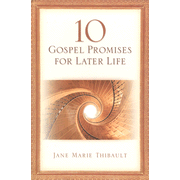
Book Review: 10 Gospel Promises For Later Life

I don’t usually begin book reviews this way, but I feel I must say at the outset that I cannot recommend 10 Gospel Promises For Later Life by Jane Marie Thibault.

The premise is a good one. Mrs. Thibault has been a clinical gerontologist and has worked with the elderly for nearly thirty years. After a consultation with a pastor whose housebound church members said they had trouble relating to the gospel any more for various reasons, Mrs. Thibault began discussing this with her patients and heard similar comments. So she compiled a list of ten major concerns elderly people face — among them, depending on others for help, fear of illness, pain, fragility, disability, loneliness, losing everything and ending up in a nursing home, life after death — and sought to apply gospel truth to them.

While there are some helpful parts to the book, unfortunately there are several major difficulties.

In a section speaking of Jesus’ suffering on the cross, the author says:

Jesus realized that his suffering was necessary. The only way he could convince humanity of God’s love for us was to die for his cause and his teaching. He put his money where his mouth was, dying for his message out of total and complete God-love for the entire world’s well-being until the end of time (p. 85).

Jesus’ death was much more than dying for his cause to convince us of his teaching! He died so that those who believe could be”justified freely by his grace through the redemption that is in Christ Jesus:Whom God hath set forth to be a propitiation through faith in his blood, to declare his righteousness for the remission of sins that are past, through the forbearance of God; To declare, I say, at this time his righteousness: that he might be just, and the justifier of him which believeth in Jesus (Romans 3:24-26.) If a judge told a convicted murderer that he could go free, everyone would cry that that was unjust. In the same way, God cannot just forgive sins without satisfying His justice. When Jesus took our sin on Himself and suffered our punishment, that act satisfied God’s holiness and justice, so He could justify us and still be just Himself, and those who receive Christ as Savior receive as well “the righteousness of God which is by faith of Jesus Christ unto all and upon all them that believe” (Romans 3:22).

Another major problem I have with the book is Mrs. Thibault’s belief that living people can ask the dead for help. Speaking of “institutionally acknowledged saints,” she writes:

“If they continue to live in God’s love and to participate in God’s love of us, the saints might also help us in our daily lives, especially if we ask them to enable us to grow in our love of God and one another” p. 121-122).

“I also believe that every single Christian in the church visible (that’s us) can ask for help from anyone in the church triumphant (those who have been promoted into heaven before us”) (p. 123).

She relates that in struggling with forgiving her mother because of feeling that her mother had been apathetic to her and emotionally abandoned her before her death when the author was a teenager, the author wrote a prayer to her mother asking that the two of them work on healing their relationship.

There is nothing in the Bible that encourages interaction with the dead: in fact, there are warnings against it. Deuteronomy 18:11 says, “There shall not be found among you any one that maketh his son or his daughter to pass through the fire, or that useth divination, or an observer of times, or an enchanter, or a witch.Or a charmer, or a consulter with familiar spirits, or a wizard, or a necromancer.  For all that do these things are an abomination unto the LORD: and because of these abominations the LORD thy God doth drive them out from before thee.” The only time I can remember in the Bible that anyone tried to communicate with the dead was in I Samuel 28 when King Saul was desperate because the Philistines were about to attack him and God wasn’t answering his prayers any more because of his disobedience. He tried to contact the prophet Samuel through a medium, and Samuel did not say, “Hi there, what can I do for you?” He said, “Why hast thou disquieted me, to bring me up?” He not only did not help him, but he prophesied that Saul and his sons would be die. There is nothing I am aware of in the New Testament that would negate these warnings. Mrs. Thibault is not advocating using mediums or having seances, but still, there is nothing in the Bible instructing us to seek help from the dead or to pray to anyone other than God. Why would we want to, anyway, when He has promised to meet every need exceeding abundantly above all that we ask or think?

A third major problem is the idea that “By interpreting our suffering as energy that can be useful to the human community and by offering this energy to God, we unite our sufferings with those of Christ…In effect, we turn the energy of our suffering into a gift for others to use for their well-being” (p. 86). She posits “According to the string theory of quantum physics, we are all inter-connected by subatomic ‘strings’ along which energy flows from one created thing to another. We can use our will, our intention, to direct this energy wherever we want it to go” (p. 88-89).  According to my husband, who is a physicist, this is a faulty application, and the string theory is just a theory: according to Wikipedia, “The theory has yet to make testable experimental predictions, which a theory must do in order to be considered a part of science.” Mrs. Thibault says “This sounds like the scientific equivalent of Jesus’ image of the vine and the branches” (p. 89), but Jesus is speaking of the spiritual life and energy He gives to those who abide in Him (John 15), not of our directing energy wherever we want it. She writes, “Jesus has promised us that we can use our suffering energy for the welfare of all” (p.91). Not in any version of the Bible I have ever read. There are many Scriptural reasons for suffering, but nothing like this is mentioned: even the section of suffering for others’ sake does not indicate this kind of thing. The author tells of “dedicated suffering” as a group for agreed upon persons and  says that those who participated in this kind of thing decreased their doctor visits and personal complaints. I don’t doubt that they felt better, but I think it was more likely due to the thought that their pain could help others and the practice of each participant expressing his or her pain. It is helpful to discuss your pain with others who also experience pain who would uniquely understand you. The author says this practice of offering the energy created by our pain to others or to God for Him to use for others “has its theological foundation” in Colossians 1:24: “Who now rejoice in my sufferings for you, and fill up that which is behind of the afflictions of Christ in my flesh for his body’s sake, which is the church.” But I do not believe this type of practice is what Paul is talking about (my views on what this verse is teaching align more with what is taught here.)

Even though there were parts of the book I found helpful and useful, I cannot endorse it overall for these reasons.

(This review will also be linked to Semicolon‘s Saturday Review of Books.)

How not to be a grumpy old lady

I had a couple of post ideas floating around, but this has been an different kind of day with much to do and I never did sit down and develop either of them. Then this afternoon I was listening to a radio program about growing older and knew I wanted to share some of what was said.

The premise was that you don’t become a sweet little old lady when you get to whatever age you deem “old” — when you get older you’ll be an extended version of whatever you are now. So if we want to be sweet rather than grumpy old ladies, we need to be working on that now. Several ladies then shared things they’d learned about growing older and ways they’d learned to cope with the differences in their bodies and ministries.

The main thing I wanted to share was something they read that I had heard before, but it brought both a smile and conviction to my heart today as well. I found several variations of it online; this is one:

‘Lord, you know better than anybody that I’m getting older and will someday be old. Keep me from being talkative; from the fatal habit of thinking I’ve got to say something on every subject and on every occasion. Release me from the need to straighten out everybody’s affairs. Keep my mind free from the recital of endless details; give me wings to get to the point. I ask for grace to listen to the tales of others’ pains and to endure them with patience. But seal my lips when it comes to my own aches and pains, for they’re increasing, and my love of rehearsing them is becoming sweeter as the years go by. I ask for improved memory, but even more for a growing humility and a lessening cock-sureness when my memory seems to clash with the memory of others. Teach me that occasionally I may be mistaken. Keep me reasonably sweet. I don’t want to be a ‘saint’ because some of them are so hard to live with – and a sour old person is one of the crowning works of the devil. Make me thoughtful, but not moody; helpful, but not bossy. With my vast store of wisdom, it seems a pity not to use it; but you know, Lord, I still want to have a few friends at the end. Give me the ability to see good things in unexpected places and talents in unexpected people, then give me the grace to tell them so. Amen.’

Maybe this was so poignant to me because I can see traces of some of those tendencies in myself even now!

I did a little searching and didn’t find the session itself available online, but a CD of it is here called “Grumpy Old Ladies or Glad Golden Givers – Which Will You Be?” If you have access to a BBN station, the second half of the program will be aired on their “Building Blocks For the Family” segment at 2:30-3:00 p.m. EDT tomorrow, March 18. You can listen to the station online but I don’t know if they have all the programs online that they do on the radio. But if you can arrange to listen to it, I can recommend at least what I have heard so far as very helpful.