Book Review: The Wonderful Wizard of Oz

OzI hadn’t planned on reading The Wonderful Wizard of Oz any time soon. It was one of those “Maybe someday…” books to me. But when a great sale on an Audible version read by Anne Hathaway came through some time ago, I went ahead and bought it. And last month when I had several days between the end of my last audiobook and the availability of my next Audible credit at the beginning of the month and looked for a short book to fill the time, this seemed like a perfect choice.

The story is so well-known, I don’t think I need to go over the plot at all, but just in case someone is unfamiliar with it, the main character is Dorothy Gale, a little girl who lives with her Aunt Em and Uncle Henry in Kansas. Everything is pretty grey and cheerless, except Dorothy’s little dog, Toto. When a cyclone heads toward their house, Dorothy doesn’t quite make it to the storm cellar before the house is whisked away and ends up in the land of the Munchkins, right on top of the wicked witch of the East, for which the Munchkins are very grateful. Dorothy wants to get home to Kansas, but they don’t know how to help her: they can only advise that she go to see the great wizard, Oz, in the Emerald City. So she follows the yellow brick road that direction and along the way meets a Scarecrow who wishes he had brains, a Tin Woodman who wishes he had a heart, and a Cowardly Lion who wishes he had courage. They all decide to join her to see if Oz can help them. But Oz doesn’t quite respond the way they want, sending them on a mission to kill the Wicked Witch of the West. And eventually they find the wizard isn’t who they thought he was at all.

Of course, the book has its differences from the well-known movie. We only see 3 Munchkins rather than a townful, there is no “Lions and tigers and bears, oh my!” line, the shoes Dorothy is given from the dead witch are silver rather than ruby (probably due to the effect of which would look best in Technicolor). I enjoyed getting more back story of the characters, especially the Tin Woodman and how he came to be tin when he was originally human. The winged monkeys aren’t inherently evil – they’re mischievous, but they prove helpful in the end. There is an elephant-sized spider, a little town made of china people and buildings, and a race of people called Hammerheads who can shoot their necks out and butt people off the hill they’re guarding. Those are all interesting in themselves, but since they come between Dorothy’s leaving Oz (which is the end of the movie version) and her finally getting back home, they seem a little anticlimactic.

The book was written in 1899 and is considered the first American fairy tale. In the introduction, Baum says he wrote it just for the pleasure of children. He felt that “Modern education includes morality; therefore the modern child seeks only entertainment in its wonder-tales and gladly dispenses with all disagreeable incident.” I would say there is still plenty of “disagreeable incident” in the story, with some of the trials the troop has to undergo, but they are not of the “horrible and blood-curdling” variety he feels are “devised by their authors to point to a fearsome moral to each tale.” I don’t think morals and stories are antithetical, but I agree it’s fine to  have a story just for fun. And though Baum wasn’t necessarily trying to dispense morality, I think an observant reader would glean good traits from the good characters (their kindness, thoughtfulness, bravery, hard work, persistence, etc.).

I found it interesting that in the book, the idea that “There’s no place like home” came from Dorothy herself: it wasn’t something she had to be told by Glinda.

The Scarecrow listened carefully, and said, “I cannot understand why you should wish to leave this beautiful country and go back to the dry, gray place you call Kansas.”

“That is because you have no brains” answered the girl. “No matter how dreary and gray our homes are, we people of flesh and blood would rather live there than in any other country, be it ever so beautiful. There is no place like home.”

When my children were very little, I had trouble with the idea of a “good witch” in the story, so I didn’t let them see the film for a long while. But I eventually came to terms with the idea that fairy tale witches are a completely different thing from real-life ones.

Apparently Baum did not want to write sequels, but the interest and demand was so great that he wrote thirteen of them.

I’m so glad I gave it a go. Anne Hathaway did a marvelous job narrating. I agree with C. S. Lewis’s quote to the effect that a good children’s book should be enjoyable by adults as well. It would be hard to say whether I like the book or the film better. I like them both. They each have their charms.

(This will also be linked to Semicolon‘s Saturday Review of Books.)

What’s On Your Nightstand: November 2014

 What's On Your NightstandThe folks at 5 Minutes For Books host What’s On Your Nightstand? the fourth Tuesday of each month in which we can share about the books we have been reading and/or plan to read.

I don’t know where in the world November has gone. It doesn’t seem like I have gotten much reading in, but sometimes I surprise myself when I actually start listing it.

Since last time I have completed:

The Return of Sherlock Holmes by Arthur Conan Doyle, audiobook, reviewed here.

The Last Bride by Beverly Lewis, 5th in her Home to Hickory Hollow series, reviewed here.

Walking in the Spirit: A Study Through Galatians 5 by Steve Pettit, reviewed here.

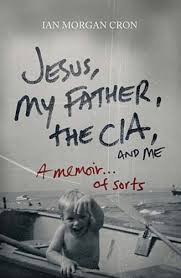
Jesus, My Father, the CIA, and Me: A Memoir of Sorts by Ian Morgan Cron, audiobook, reviewed here.

Nope, no surprises this time – only two actual (paper) books!

I’m currently reading:

Weight of Glory by C. S. Lewis

The Pound a Day Diet by Rocco DiSpirito

Number the Stars by Lois Lowrey for for Carrie’s  Reading to Know Classics Book Club for November

The Gift of the Magi and Other Christmas Stories by O. Henry, Fyodor Dostoevsky, Henry van Dyke, and Leo Tolstoy

Next up:

To Kill a Mockingbird for Carrie’s  Reading to Know Classics Book Club for December

Other than that I am not sure. I got out my Christmas books (some fictional, some devotional) and was surprised to discover a couple I didn’t even know I had and one that I thought I had read but hadn’t. I like to do a little Christmas reading during December but haven’t decided which of these to attempt yet.

Speaking of Christmas books…I am giving some away here.

Some of you might be interested in a post I wrote this month about reasons to read fiction and Christian fiction. It’s one I have been wanting to write for ages, and I was glad to finally do so.

Happy reading!

Book Review: Jesus, My Father, the CIA, and Me

CronI have been wanting to read Jesus, My Father, the CIA, and Me: A Memoir of Sorts by Ian Morgan Cron ever since Lisa’s review of it.

Despite the mention of the CIA in the title, it’s not the primary focus of the book. Ian didn’t know his dad was involved with the CIA until his mid-teens. There had been odd “business trips” when he had thought his father was out of work, his mention of having met people (like President Ford) whom he would not likely have crossed paths with, etc., but the pieces didn’t come together until Cron’s teens.

Cron grew up in England until his father’s work took the family back to the States, where the family set down roots. Cron describes his Irish Catholic upbringing mostly humorously but with a few poignant moments as well. In fact, there is a humorous slant to much of Cron’s writing, but not in connection with his father’s alcoholism. The book focuses primarily on the effect Cron’s father’s alcoholism had on his life: the embarrassment, the anger, the missed concerts, the lack of good example and teaching, the bad example, the lack of relationship.

“’Home is a place you grow up wanting to leave, and grow old wanting to get back to.’ That’s what John Edward Pearce said. But what if your childhood was a train wreck? What if your memories of home are more akin to The Shining than The Waltons? It doesn’t matter. Home is not just a place; it’s a knowing in the soul, a vague premonition of a far-off country that we know exists but haven’t seen yet. Home is where we start, and whether we like it or not, our life is a race against time to come to terms with what was or wasn’t” (p.3).

Ian went from trying to be a “good boy” to win his father’s approval, to trying to be a “bad boy” to get his attention. As happens all too often, he began following in his father’s footsteps with drinking, and then went further with drug experimentation.

But the story is also one of redemption. Though tenderhearted towards spiritual things as a child, Ian felt God had let him down by not answering his prayers concerning his father, and he was highly resistant to any kind of Christian influence. But God brought him to the end of himself. Coming to believe was one step, but overcoming his own alcoholism took much longer, and facing and dealing with the buried emotions and the psychological effects of his relationship with his father took longer still.

As the daughter of an alcoholic, I could identify with much that Ian wrote. Somehow I never had the thought that so many kids have that it must be all my fault. (I knew my dad’s problems were his own. I did learn to lay low and stay under the radar either when he was drinking or when he was angry, and to this day I have problems interacting when I think someone is angry. My first instinct is to retreat.)

Some of the quotes that stood out to me:

“Boys with fathers who, for whatever reason, keep their love undisclosed begin life without a center of gravity. They float like astronauts in space, hoping to find ballast and a patch of earth where they can plant their feet and make a life. Many of us who live without these gifts that only a father can bestow go through life banging from guardrail to guardrail, trying to determine why our fathers kept their love nameless, as if ashamed.”

“My father’s psychological and emotional problems so consumed his visual field that he had trouble seeing anyone but himself , much less a lost, father-hungry kid.”

The author definitely has a way with words, and the book is filled with many descriptive phrases. One disadvantage to listening to the audiobook rather than reading a paper or electronic version is that one can’t flip back through the pages, and I didn’t mark as many quotes as I should have (one can “bookmark” with an audiobook – but not while driving or cooking 🙂 ). The writing seemed a little disjointed in some places, being more thematic than linear. But there is light humor as well as deep sadness, poignancy, beauty and grace. I think those of us who are more conservative need to be reminded that God sometimes uses seemingly unconventional ways and means to reach a person, and that we’re not all cookie cutter Christians.

At one point the author says that many of the Christians he knew, I think in his college years, were fans of John McDowell and C. S. Lewis, but he could never get into them, because he didn’t want to parse God, he wanted to experience Him ecstatically. While I do agree that our Christianity needs to be experiential and not just academic (and I think that’s what he was trying to convey), I have a couple of problems with this line of thinking. For one, voices in our heads aren’t always trustworthy. For another, those men are hardly “just” academic, and many are ministered to by their writings and by thinking through the issues they address. The Bible has a lot to say about knowledge and doctrine. I’ve referenced this here many times before, but Peter had one of the most wonderful experiences possible when he saw Jesus transfigured before his eyes, yet he calls the Scripture (a more sure word of prophecy” – more sure than even that experience (II Peter 1:16-21).

Although I think the book is a worthwhile read, I could not recommend it unreservedly. To me the humor slips into irreverence sometimes, there are a few instances of crudeness (jokes about men’s private parts), the theology was a little wonky in some places. I think this book would be especially good if you or someone within your sphere of influence has had an alcoholic parent or a strained relationship with one.

(This will also be linked to Semicolon‘s Saturday Review of Books.)

Christmas Book Giveaway

I have accumulated a pile of Christmas books, and some of them I am not likely to read again. So I thought I’d offer them to you. 🙂

I will list what I have with a link back to my review, if I have one for it. If you are interested in any, let me know in the comments on this post (not the posts of the book reviews). If you have one in particular you’d like, mention that title, and if you are the only one who wants it, you will get it. If two or more people want a book, I will use random.org to draw a winner. If you want to list a first, second, and third choice, that’s fine: if you don’t care which one you get, that’s fine, too.

I will draw names the Friday after Thanksgiving and will send them at the cheapest rate, but they should still get there in time for some Christmas reading. I’m sorry, but I will have to restrict these to US addresses due to shipping prices.

So here are your choices:

Wreath of Snow

A Wreath of Snow by Liz Curtis Higgs

Christmas at Harrington‘s by Melody Carlson

Treasure of Christmas, a collection of three stories by Melody Carlson (The Christmas Bus, Gift of Christmas Present, and Angels in the Snow).

Snow Day by Billy Coffey. One reservation with this one, but otherwise it is good.

25 days

25 Ways, 26 Days to Make This Your Best Christmas Ever by Ace Collins.

If I have linked everything correctly, clicking on the title should take you to my review (some of them are grouped together in shorter reviews), and clicking on the book image will take you to Amazon if you’d like to learn a little more about the books.

The giveaway and comments are now closed. And the winners are……

A Wreath of Snow: Brenda

 Christmas at Harrington’s: Kaycee

Treasure of Christmas: Abi

Snow Day: rcblibrary

26 Days: Michele

I am sending an email to notify each winner. If I do not hear back from them with their address by the end of the week, I will draw a new winner.

Thanks so much for entering!

Book Review: The Last Bride

Last BrideThe Last Bride by Beverly Lewis is the fifth in her Home to Hickory Hollow series but can easily be read as a stand-alone novel. Tessie Ann Miller is the last of five daughters in her family and the only one still unmarried. She loves Marcus King, but her father disapproves of him. He wants to encourage Levi Smucker’s attentions to his daughter. Marcus and Tessie decide their best course of action is to marry secretly, have Tessie remain home with her parents, and then tell them the news when they feel the time is right.

As you can imagine, they set themselves up for a number of problems. I did guess one outcome of their situation, but another totally took me off guard. It happens fairly early in the story, so I can’t say too much about it without spoiling the suspense.

Woven in is a subplot involving Tessie’s sister, who was in a similar situation except that she did end up marrying the man her father preferred. But that situation did not go smoothly either, and she struggles to learn to live with and submit to someone she doesn’t truly love.

There is an undercurrent, if not a theme, on the problems caused by keeping secrets: at least four characters keep secrets from others, for varying lengths of time, but with negative consequences in each case. One of them is Tessie’s own father, who doesn’t reveal the reasons why he wanted his daughters not to marry certain men until the hardships caused by what appears to be his unreasonableness bruise his relationships.

Another undercurrent in the story is the fact that, since many people in the community are related in some degree to each other, there is a plethora of genetic diseases among their children.

One factor common to all the books in this series, besides the fact that they are set in Hickory Hollow, which I believe is the setting for Beverly’s first books, is the presence of Ella May Zook, an older lady whom they call the Wise Woman who gives kind and gentle but helpful advice to the main characters.

I always enjoy Beverly’s books. Hers is pretty much the only “Amish fiction” I read, and I started back before that became a popular genre. I enjoyed following along with what the characters were learning about their walk with God and each other.

(This will also be linked to Semicolon‘s Saturday Review of Books.)

Book Review: Walking in the Spirit

Walking in the SpiritI’ve enjoyed listening to the music of the Steve Pettit Evangelistic Team for years, and have had the privilege of hearing Steve preach in my church a number of times. So when I saw he had written a book titled Walking in the Spirit: A Study Through Galatians 5, I wanted to read it not only because I felt I could trust it (as much as one can trust a human author), but also because this is a subject and a passage I have thought about and wrestled with for years.

Most Christians are familiar with the last few verses in Galatians 5 that talk about the works of the flesh and the fruit of the Spirit. But the context of the chapter, indeed of the whole book of Galatians, has to do with Christian liberty. Some were telling the Galatian believers that they had to keep the OT laws to be a Christian, which is legalism. But some who had gotten hold of the truth that they were no longer under that law went too far the other way: “For, brethren, ye have been called unto liberty; only use not liberty for an occasion to the flesh, but by love serve one another. For all the law is fulfilled in one word, even in this; Thou shalt love thy neighbour as thyself” (verses 13-14). Pettit says true Christian liberty is walking in the Spirit, as opposed to license on one hand (being a slave to one’s flesh) and legalism on the other (being a slave to the law).

Pettit takes us step by step through Galatians 5 and discusses what legalism and Christian liberty are, what it means to walk in the Spirit, the battle between our flesh and the Holy Spirit, the difference between what the Bible calls our “old man” which was crucified when we believed on Christ and the “flesh” that we still battle, and the evidences of the flesh and fruit of the Spirit. He discusses what our relationship to the law is and what use it is (conviction of sin, for one: “I would not have come to know sin except through the Law; for I would not have known about coveting if the Law had not said, “You shall not covet” [Romans 7:7 NASB]. But the law can only tell us it is sin. It can’t fix us or change us. It’s the diagnosis, not the cure).

It’s hard to summarize a book like this beyond that, so I’ll just share a few quotes that stood out to me:

“Seeking to add to the work of Jesus actually takes away from it” (p. 6).

“The flesh seeks to twist a true understanding of freedom into an opportunity to gratify the flesh’s desires. But Christian liberty is freedom from sin, not freedom to sin. When Christians begin to focus on their own personal rights and freedom from restraints, liberty is abused” (p. 14).

“Walking in the Spirit demands a constant pursuit of and response to God’s Spirit. To be complacent and indifferent about one’s walk is to put oneself in a place of spiritual peril. No one is impervious to the allurements of the flesh” (p. 26).

“We are not so strong that we do not need to be warned, and we are not so weak that we cannot be free. We experience this struggle until the day we die” (p. 15).

The Christian life is not about trying harder to obey the law; it is realizing that we are enabled to obey God by the power of the indwelling Spirit” (p. 47).

“The fruits of the Spirit are of such a nature that, when they are present, the law is no longer necessary” (p. 48).

“Sanctification is the process of submitting to the Holy Spirit as He works to produce this fruit in your life, so that your daily life matches up with who you really are now in Christ” (p. 81).

The book is written as a Bible study, with discussion questions and blanks to fill in answers. It would work well in a group study: in fact, some of the questions would have been more profitable with a group contributing their insights.

The book did clear up some things for me or reminded me of things that I know but need to go over again from time to time. There were a couple of places I wish he had gone into a little more detail. But overall I found this book to be not only thoroughly Biblical but also intensely practical.

(This will also be linked to Semicolon‘s Saturday Review of Books.)


No Mere Mortals

Some years ago I read a book someone loaned to me about a Christian man in a Communist country. In his culture, respect for elders was taken to extremes. His and his wife’s lives were severely impacted by the mercurial demands of his mother, but they never felt they should deal with it in any way except to try to please her. It was particularly hard when they all had to live together for a time. In the end he said the Lord used it to smooth some of his rough edges, like a pebble that has been worn round and smooth by being tossed and bumped around in a stream. I wish I could remember the book title or author’s name, because I would love to revisit this book. (By the way, I am not suggesting that mothers-in-law should act that way or that adult children shouldn’t sometimes have some frank discussions with their parents, but this was how this man felt led in his time and culture.)

Around that same time, there was a lady at the church I was attending who, I am sad to say, really rubbed me the wrong way. Unfortunately, that says more about me than it does about her. She was not mean or unkind. I won’t go into the details about what I found so irritating, but I had just about decided that the best way to keep positive thoughts about her and to keep peace in my heart towards her was just to avoid her as much as possible. Then one January, our ladies’ group at church drew names for “secret pals” from others in the group: our primary duty to our secret pal was to pray for her, but we were also encouraged to send notes and small gifts through the year. Guess whose name I drew. Yes, that particular lady. I was tempted to put her name back and draw another, but I decided that was petty, and this woman was one whom I was supposed to especially pray for that year. And praying for her did help. I began to understand a little of why she acted the way she did (for instance, she sometimes seemed to come across as a know-it-all. You almost couldn’t bring up any subject without getting her input and suggested actions. But she was a very intelligent woman, and in her mind she was helping, not “showing off.”)

I don’t remember exactly when those two incidents happened in relation to each other, but in my mind I connected them, and began to think of my “secret pal” as a sandpaper Christian, one designed to smooth off some of my jagged edges.

Though I have moved away and lost touch with that particular lady, it seems like I almost always have one or two sandpaper acquaintances in my life. Again, that is a sad commentary on me more than a reflection on them. I admit sometimes I wonder who is sandpaper to them, but God reminds me that’s His business, and He is working with each of His children to help them grow more Christlike.

I am often discouraged by my lack of love and my abundance of irritation towards people, and it is a frequent matter of prayer. In a quote I saved but can’t find now from a sermon by David Martyn Lloyd-Jones from I John, he makes a distinction between liking and loving and says we are to love people we might not necessarily like, and that helped some. Biblical love, after all, is not just a warm fuzzy feeling. Verses about “forbearing one another in love” help, as does the reminder that God loves them in their imperfections as much as He loves me in mine. Sometimes I have felt that tolerating or forbearing was the best I could do, but God calls me to more. They are His dear children for whom He died, and He wants me to love them as much as I love myself, and even more – as He loves me. A tall order that can only be accomplished by meditating on His great love.

I just started reading C. S. Lewis’s Weight of Glory recently, and one section in the first essay of the same title really helped along these lines. After discussing what our future glorification in heaven means, he writes:

“It may be possible for each to think too much of his own potential glory hereafter; it is hardly possible for him to think too often or too deeply about that of his neighbour. The load, or weight, or burden of my neighbour’s glory should be laid daily on my back, a load so heavy that only humility can carry it, and the backs of the proud will be broken. It is a serious thing to …remember that the dullest and most  uninteresting person you talk to may one day be a creature which, if you saw it now, you would be strongly tempted to worship, or else a horror and a corruption such as you now meet, if at all, only in a nightmare. All day long we are, in some degree, helping each other to one or other of these destinations. It is in the light of these overwhelming possibilities, it is with the awe and the circumspection proper to them, that we should conduct all our dealings with one another, all friendships, all loves, all play, all politics. There are no ordinary people. You have never talked to a mere mortal. Nations, cultures, arts, civilization—these are mortal, and their life is to ours as the life of a gnat. But it is immortals whom we joke with, work with, marry, snub, and exploit—immortal horrors or everlasting splendours. This does not mean that we are to be perpetually solemn. We must play. But our merriment must be of that kind (and it is, in fact, the merriest kind) which exists between people who have, from the outset, taken each other seriously—no flippancy, no superiority, no presumption. And our charity must be a real and costly love, with deep feeling for the sins in spite of which we love the sinner—no mere tolerance or indulgence which parodies love as flippancy parodies merriment. Next to the Blessed Sacrament itself, your neighbour is the holiest object presented to your senses. If he is your Christian neighbour he is holy in almost the same way, for in him also Christ vere latitat—the glorifier and the glorified, Glory Himself, is truly hidden.”

I would disagree with what I think he is saying about the sacrament – I believe it is symbolic and representative and doesn’t contain any glory in itself. It is a wafer, not Christ’s actual body, meant to put us in mind of His body torn for us. But Christ does indwell a fellow child of God.

No mere mortals. No ordinary people. Future glorified saints. Fellow citizens of the household of God. Sons and daughters of the King. These are the ones with whom we have to do. May we treat them accordingly. And may we treat those who are not yet in the family of God as if we are eager for them to be.

Beneath the cross of Jesus
His family is my own—
Once strangers chasing selfish dreams,
Now one through grace alone.
How could I now dishonor
The ones that You have loved?
Beneath the cross of Jesus
See the children called by God.

~ Keith and Kristen Getty

And the King shall answer and say unto them, Verily I say unto you, Inasmuch as ye have done it unto one of the least of these my brethren, ye have done it unto me. Matthew 25:40

Love each other

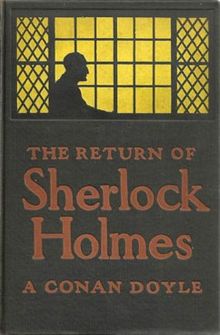
Book Review: The Return of Sherlock Holmes

TheReturnOfSherlockHolmesThis book by Arthur Conan Doyle is titled The Return of Sherlock Holmes  because Holmes was thought to have died at the end of The Memoirs of Sherlock Holmes. Doyle had wanted to end the Holmes series to concentrate on historical novels, but he published The Hound of the Baskervilles (set before Holmes’ supposed death though published after) a few years later, and it was such a success that he was pressured to revive the series. Holmes returns to a stunned Watson three years after his disappearance, explaining that though Moriarty died (at the same time Holmes was thought to), his men were still alive and knew that Holmes was as well – one of them sought to kill him in the moments after Moriarty’s death. But Holmes is on their trail and has returned in disguise back to London.

This book is a series of short stories that appeared first in a magazine called The Strand over 1903-1904. Holmes’s clients vary from a governess to the prime minister, and the cases include a missing heir, a stalker, a blackmailer, and crust ship’s captain, busted busts of Napoleon, a student cheating on an exam, a missing rugby player, a false testimony, and a stolen document which could lead to war if not found. Quite a variety! Watson says “As I have preserved very full notes of all these cases, and was myself personally engaged in many of them, it may be imagined that it is no easy task to know which I should select to lay before the public. I shall, however, preserve my former rule, and give the preference to those cases which derive their interest not so much from the brutality of the crime as from the ingenuity and dramatic quality of the solution.” Holmes accuses Watson once of sensationalism: “Your fatal habit of looking at everything from the point of view of a story instead of as a scientific exercise has ruined what might have been an instructive and even classical series of demonstrations. You slur over work of the utmost finesse and delicacy, in order to dwell upon sensational details which may excite, but cannot possibly instruct, the reader.”  When asked why Holmes doesn’t write them himself, he replies that one day he will in textbook form.

Holmes’s personality continues to unfold in these stories. Here are a few of Watson’s comments:

“My friend, who loved above all things precision and concentration of thought, resented anything which distracted his attention from the matter in hand. And yet, without a harshness which was foreign to his nature, it was impossible to refuse to listen to the story of the young and beautiful woman, tall, graceful, and queenly, who presented herself at Baker Street late in the evening, and implored his assistance and advice.”

“Holmes, however, like all great artists, lived for his art’s sake, and, save in the case of the Duke of Holdernesse, I have seldom known him claim any large reward for his inestimable services. So unworldly was he—or so capricious—that he frequently refused his help to the powerful and wealthy where the problem made no appeal to his sympathies, while he would devote weeks of most intense application to the affairs of some humble client whose case presented those strange and dramatic qualities which appealed to his imagination and challenged his ingenuity.”

“Lestrade and I sat silent for a moment, and then, with a spontaneous impulse, we both broke at clapping, as at the well-wrought crisis of a play. A flush of colour sprang to Holmes’s pale cheeks, and he bowed to us like the master dramatist who receives the homage of his audience. It was at such moments that for an instant he ceased to be a reasoning machine, and betrayed his human love for admiration and applause. The same singularly proud and reserved nature which turned away with disdain from popular notoriety was capable of being moved to its depths by spontaneous wonder and praise from a friend.”

“My friend’s temper had not improved since he had been deprived of the congenial surroundings of Baker Street. Without his scrapbooks, his chemicals, and his homely untidiness, he was an uncomfortable man.”

“I may have remarked before that Holmes had, when he liked, a peculiarly ingratiating way with women, and that he very readily established terms of confidence with them. In half the time which he had named, he had captured the housekeeper’s goodwill and was chatting with her as if he had known her for years.”

“Sherlock Holmes was a past-master in the art of putting a humble witness at his ease.”

Some of what I have read concerning modern depictions of Holmes seem to cast him as socially awkward, even rude, and perhaps having Asberger’s. I think these samples show that he was not socially awkward at all – he was described as being quite genial when he wanted to be, and he could carry on a conversation with anyone. But he preferred working alone or with Watson and one or two others – a classic introvert, in my opinion.

There were a few cases before now and a couple of cases here where Holmes decided justice was served, and he did not see a reason to report his findings to the police even when he was working with them. In one case he said, “No, I couldn’t do it, Watson…Once that warrant was made out, nothing on earth would save him. Once or twice in my career I feel that I have done more real harm by my discovery of the criminal than ever he had done by his crime. I have learned caution now, and I had rather play tricks with the law of England than with my own conscience. Let us know a little more before we act.” I wouldn’t advocate that in real life, but it did make sense in the context of the story.

At the end of this book Holmes was said to have retired, and only allowed Watson to tell a few of the stories long after they occurred. Since there are three more books about him, however, either he didn’t retire, or those stories are more past cases.

Once again I listened to the audiobook version superbly narrated by Derek Jacobi. In my journey through the Holmes books, I look for versions read by Jacobi now. I also looked at some portions in closer detail in the online version of the book provided by Project Gutenberg.

(This will also be linked to Semicolon‘s Saturday Review of Books.)

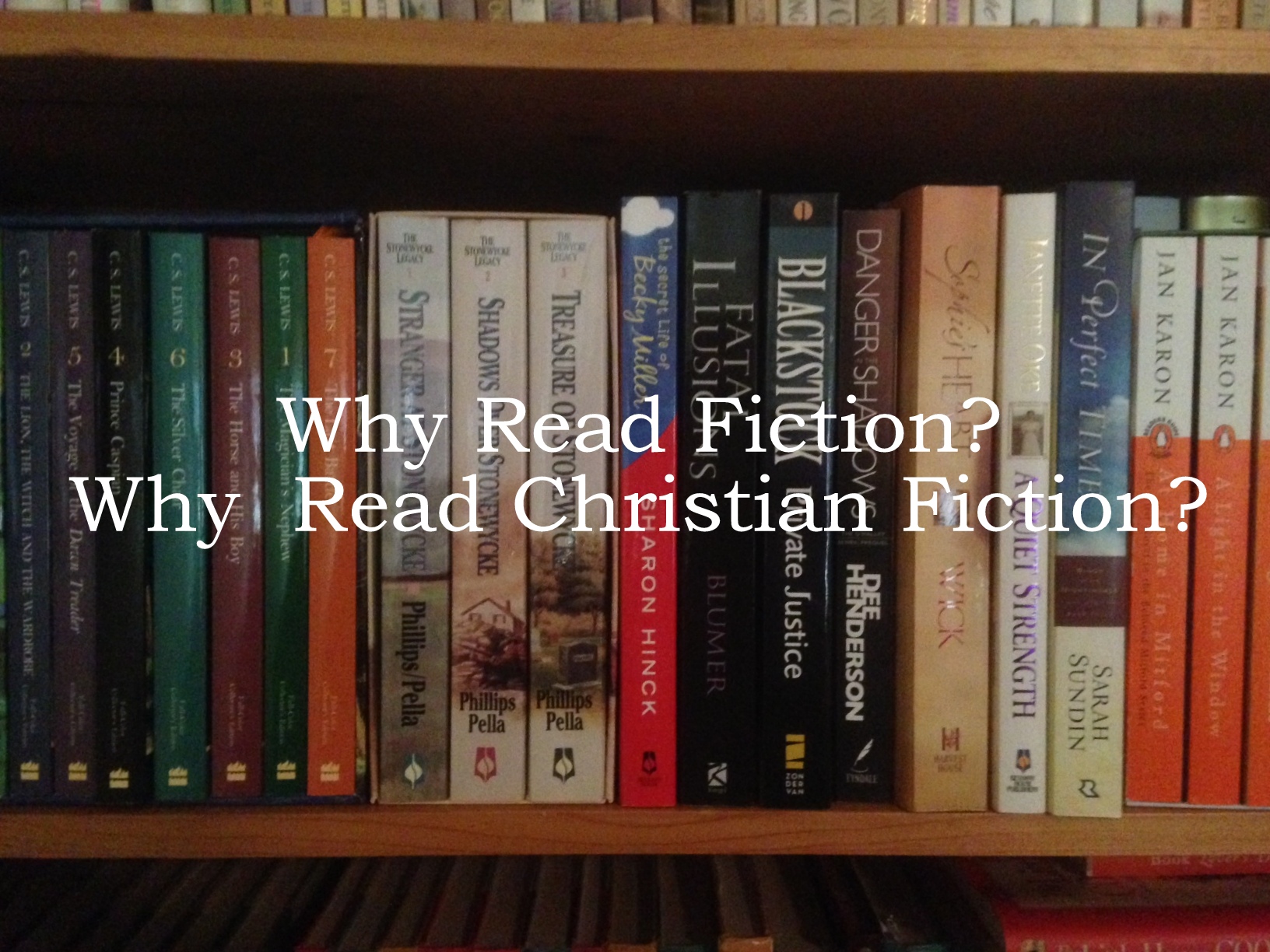
Why Read? Why Read Fiction? Why Read Christian Fiction?

photo 1(1)

I have been reading Christian fiction for some 35 years or so, and for the most part have loved it. It has ministered to me in many ways. I always wince a bit when I hear someone “slam” it. Especially when they say “All Christian fiction is…” whatever it is they don’t like about it. My snarky(and probably fleshly) inward response is “You haven’t read all of it.” 🙂

I’m probably not going to convince anyone who is dead set against it, and that’s fine. We can still be friends. 🙂 But I wanted to share why I find it valuable, and to do that, it seems to me I need to start with reasons to read anything in the first place, and then reasons to read fiction, and then Christian fiction.

Why Read?

God chose to communicate to us through words. He created the world by speaking. His Son is called “the Word.” The Bible contains a number of different genres (poetry, history, letters, narrative, forensics).

To gain information

To learn – about other people’s experiences, other points of view, any of the many things we don’t know yet or know as much as there is to know

To understand how things work

To understand how others feel and develop empathy.

To gain perspective

To gain wisdom

To broaden horizons. There are places you’ll likely never go, experiences you’ll likely never have, except by reading about them. On the other hand, something you read may spark an interest in a new venture.

To understand your own culture better

To understand other cultures

To strengthen your views

To know you are not alone in your views.

To test your own beliefs against others

To understand others’ views

To improve reasoning skills

To find others who express thoughts you’ve had but couldn’t quite put into words

To improve concentration and focus

To improve vocabulary and communication skills

To relax

To be amused

To be challenged

To profitably pass time

To be surprised

To stave off boredom

To be inspired

To become a more well-rounded person

To become more creative

To immerse oneself in a subject. Randy Alcorn wrote at the end of Courageous that they wanted to write a full book after the movie partly so that people could spend 10 hours in a book thinking over the topics involved rather than just 2 hours of a film.

For enjoyment and pleasure

To understand cultural references so that when someone quotes Dickens or Frost or Shakespeare you have some idea who they’re talking about. If someone mentions “Two roads diverged….,” knowing the poem and its subject enriches your understanding of what the person is referring to.

To have a point of contact with one’s fellow man or woman. A friend’s son was planning to go into a vocational job working with his hands and struggled with literature classes. She felt that her son’s time and mental powers would be better employed just reading and studying the Bible. But even the apostle Paul quoted poets and took time to understand other people’s culture as a way of understanding them as a people and having a point of reference from which to share the gospel (Titus 1:11-13, Acts 17:21-23).

To inspire “noble action.”

“All literature, all philosophy, all history, all abounds with incentives to noble action which would be buried in black darkness were the light of the written word not flashed upon them.” – Cicero, Pro Archia

“I believe stories can broaden our empathy, helping us to love. They tell us we’re not alone. But they can also give us something to live up to, whetting our appetite for virtues we don’t yet have.” James D. Witmer, Stories That Lead By Example

To think. I found it interesting that a daughter of a friend teaching English and American culture in a Communist country said that parents there did not read books to their children for pleasure.

“Books are weapons in the war of ideas.” – U.S. Government Printing Office, Office of War Information, S. Broder (artist) 1942 World War II Poster. In totalitarian societies, books that disagree with national policy are banned.

“The books that help you most are those which make you think the most. The hardest way of learning is that of easy reading; but a great book that comes from a great thinker is a ship of thought, deep freighted with truth and beauty.” Theodore Parker (1810 – 1860) (seen at Carrie’s)

To glean from the minds of great thinkers.

“The reading of all good books is indeed like a conversation with the noblest men of past centuries who were the authors of them, nay a carefully studied conversation, in which they reveal to us none but the best of their thoughts.” Rene Descartes (1596 – 1650) (seen at Carrie’s).

To comprehend right and wrong

“The great fairy tales and fantasy stories capture the meaning of morality through vivid depictions of the struggle between good and evil, where characters must make difficult choices between right and wrong, or heroes and villains contest the very fate of imaginary worlds.” Vigen Guroian, Tending the Heart of Virtue

To gain power. Thanks to Janet for this one. She shared that

“In his autobiography, Frederick Douglass writes that his owner forbade his wife to teach a slave to read on the grounds that it would ‘forever unfit him to be a slave.’ ‘I now understood what had been to me a most perplexing difficulty — to wit, the white man’s power to enslave the black man,’ writes Douglass. ‘It was a grand achievement, and I prized it highly. From that moment I understood the pathway from slavery to freedom… I set out with high hope, and a fixed purpose, at whatever cost of trouble, to learn how to read.’”

Why Read Fiction?

You may agree with all the reasons listed so far for reading, but you want to read what’s “real” and have no room for fiction in your life. Here are some things to think about regarding reading fiction. I believe all of the above reasons apply to fiction as well as non-fiction, but here are some that apply primarily to fiction:

God employed fiction in the Bible (Nathan to David, parables in the NT, story of the bramble in the OT, plus many others). We have to be careful not to fictionalize or label as myth what the Bible indicates as fact – as someone once said of Bible interpretation, “Where common sense makes good sense don’t seek any other sense.” Some people want to categorize much of the Old Testament as myth, and that is going way too far for too many reasons to go into here. But God does make use of stories.

God created imagination and stories employ it.

A story might provide conviction and instruction when we see ourselves in the story (Nathan to David in the story about a lamb, Aesop’s fables). A lecture or direct confrontation is not always the best approach. In It Takes a Pirate to Raise a Child by Daniel B. Coupland, he tells of a time when he was trying to get across to his young son why the way he was acting towards his sisters was wrong. The son did not comprehend or agree with what his father was saying until he said, “You’re acting like Edmund” in The Lion, the Witch, and the Wardrobe by C. S. Lewis. Then he “got it” and not only realized where he was wrong, but “The reference to Edmund hit my son in a very deep place in his heart, which only stories can reach.”

Fiction fleshes out truth. Sometimes during a sermon I am following along and understanding but find myself wondering what that truth looks like in real life. A story or illustration helps us know how to apply truth or helps us understand the truth better.

Fiction appeals to our minds. Somehow most of us are wired to tune in to a story. I read one preacher who lamented that his listeners got drowsy while he exposited Scripture but perked up when he told a story. That doesn’t necessarily mean they are unspiritual and shallow. I have often fought sleepiness during a message I really wanted to hear but then found myself wide awake when the preacher began to tell a story. That’s not to say preachers should tell more stories than preach the Bible – we do need to discipline ourselves to hear sound doctrine. But it is not always due to laziness that are minds are attracted to stories.

Here are what greater minds than mine have said about fiction:

“The appeal of stories is universal, and all of us are incessant storytellers during the course of a typical day.” Justin Taylor, How Stories Work

“Good literature erects bridges between different peoples, and by having us enjoy, suffer, or feel surprise, unites us beneath the languages, beliefs, habits, customs, and prejudices that separate us. When the great white whale buries Captain Ahab in the sea, the hearts of readers take fright in exactly the same way in Tokyo, Lima, or Timbuctu.” ~Mario Vargas Llosa, Seen at Semicolon

“Reading is to the mind what exercise is to the body. As by the one, health is preserved, strengthened and invigorated; by the other, virtue (which is the health of the mind) is kept alive, cherished and confirmed. But as exercise becomes tedious and painful when we make use of it only as the means of health, so reading is apt to grow uneasy and burdensome, when we apply ourselves to it only for our improvement in virtue. For this reason, the virtue which we gather from a fable, or an allegory, is like the health we get by hunting; as we are engaged in an agreeable pursuit that draws us on with pleasure, and makes us insensible of the fatigues that accompany it.” -Joseph Addison and Richard Steele, The Tatler No. 147

“Stories give children the opportunity to think about morals, lessons, and conflict resolution. With practice, children begin to search for the moral at the end of the story, and some will even structure their own stories around a specific message. Children who listen and tell many stories begin to recognize trends in human behavior. Their perspectives expand, and they become more critical, observant thinkers. They begin to consider in broader terms what it means to be helpful, mean, practical, hopeful, spiteful or considerate. Creating characters – which teaches that multiple perspectives exist at every moment – gives children invaluable tool for understanding others and for finding their way in the world.” (page 13)  Show Me a Story: 40 Craft Projects and Activities to Spark Children’s Storytelling, HT to Carrie.

“Some Christians view fiction as the opposite of truth.  But sometimes it opens eyes to the truth more effectively than nonfiction.” – Randy Alcorn.

“It is only a novel… or, in short, only some work in which the greatest powers of the mind are displayed, in which the most thorough knowledge of human nature, the happiest delineation of its varieties, the liveliest effusions of wit and humour, are conveyed to the world in the best-chosen language” ― Jane Austen, Northanger Abbey

“Fairy Tales are more than true; not because they tell us that dragons exist, but because they tell us that dragons can be beaten.” – G.K. Chesterton

“It might be expected that such a book would unfit us for the harshness of reality and send us back into our daily lives unsettled and discontent. I do not find that it does so….Story, paradoxically enough, strengthens our relish for real life. This excursion into the preposterous [speaking here of The Wind in the Willows] sends us back with renewed pleasure to the actual” –C. S. Lewis, On Stories and Other Essays on Literature, p. 14

Since it is so likely [children] will meet cruel enemies, let them at least have heard of brave knights and heroic courage.C. S. Lewis, On Stories and Other Essays on Literature, p. 39

“The value of myth is that it takes all the things we know and restores to them the rich significance which has been hidden by the ‘veil of familiarity.’ The child enjoys his cold meat (otherwise dull to him) by pretending it is buffalo, just killed with his own bow and arrow. And the child is wise. The real meat comes back to him more savory for having been dipped in a story…If you are tired of the real landscape, look at it in a mirror. By putting bread, gold, horse, apple, or the very roads into a myth, we do not retreat from reality: we rediscover it. As long as the story lingers in our mind, the real things are more themselves. This book [LOTR] applies the treatment not only to bread and apple but to good and evil, to our endless perils, our anguish, and our joys. By dipping them in myth we see them more clearly.” – C. S. Lewis, On Stories and Other Essays on Literature, p. 90
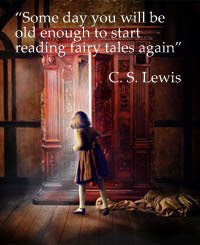
Fairy Tales

Why Read Christian Fiction?

In addition to all of the above reasons for reading, which I believe can be applied to Christian fiction as well, here are some reasons particular to Christian fiction:

The missing element. Even the best of secular stories tends to leave God out of the picture and have the characters acting on their own initiative. Christian fiction shows how a Christian might act in dependence on God in some of these scenarios.

To see how Christians act in everyday life. I’ve mentioned here before that my mother was not, as far as I know, a Christian as I was growing up. In her later years she had some questions and concerns about it, but she did not want to discuss it. It was too sensitive, too personal for her to open up about it. I began sending her some of the Christian fiction I was reading. Not only did she enjoy the stories (Terri Blackstock and Dee Henderson were a couple of her favorites), but it helped her to see what Christianity in action looked like (we lived 1,000 miles away, so though we talked and wrote, we didn’t have that everyday life contact back when there was no texting or Facebook to keep in touch every day).

To display the gospel. I don’t think every Christian story has to include the plan of salvation or show a conversion, but if the gospel affects every aspect of our lives, that would be displayed in the stories in some way. I went into this further in an earlier post titled The Gospel and Christian Fiction. To repeat one thought from that post, while not every Christian story needs to explain the whole gospel, what it does share needs to be accurate. Because some have accused Christian fiction of being too “preachy” (more on that later), the pendulum has swung the other way lately, and some authors have tried to make their message a little more subtle. That can be fine: some stories would call for the book’s message to be a little more explicit, some call for more subtlety. But in some cases subtlety has generated obscurity or even misleading statements. I would not have sent those kinds to my mom so as not to confuse her, though a mature Christian might benefit from them.

To learn spiritual truth.

To be helped in your own life by another’s example. Just one instance of this in my life: for several years of our married life, my husband had to travel quite a bit, and I was often discouraged about it. During one of those periods I was reading Janette Oke’s A Quiet Strength, and the young wife in the story was experiencing something similar with her husband having to be away much of the time to work. Even though our ages, life situations, time in history, and number of years married was different, I was still encouraged by what she found that encouraged herself.

It’s clean – or should be. There is a growing trend to use bad language or sexual scenes to be more “realistic,” but I think explicitness in either vein is detrimental. I wrote about these elements in The Language of Christians and Sexuality in Christian Fiction, so I won’t reproduce those thoughts here.

Charges against Christian fiction:

Here are some complaints about Christian fiction that I have heard or read:

“It is predictable.” The person who is not a Christian becomes one or the problem a Christian has is solved or the lesson learned. But isn’t there a measure of predictability in every genre? Usually the guy and the girl get together in a romance, the detective figures out the mystery and “whodunnit,” the good guys win in the Western, the doctor helps save the patient, etc. (unless it is a series, and then a few lost cases are thrown in for realism). We expect a certain ending with most of the books we read, and the fun is in seeing how it is done and what unexpected twists and turns arise on the journey.

“It’s too preachy” or it is more of a sermon in the guise of a story. I’ve only found that occasionally. Of course authors, Christian or secular, usually do have some kind of truth they are trying to convey, but usually they try not to be blatant about it. Sometimes they are accused of being blatant when they are not: in C. S. Lewis’s book On Stories, he quotes Dorothy L. Sayers as saying, about the assumption that she wrote to “do good”: “My object was to tell that story to the best of my ability, within the medium at my disposal — in short, to make as good a work of art as I could. For a work of art that is not good and true in art is not good and true in any other respect” (p. 93). An author’s worldview is going to seep out into his story in some way. Lewis said that the Narnia stories were not intended as an allegory. They started with a couple of pictures in his mind, one of a faun, and some “supposings,” and developed from there.

I mentioned earlier that Christian fiction will show the everyday activity of Christians, so obviously there will possibly be prayer, reading and discussing Biblical truths, going to church, etc., in the story. But those elements should be woven in as naturally as possible and not just tossed in to label a character as Christian. One of the best at this is Jan Karon in her Mitford books, which are not even marketed as Christian fiction but convey a definite element of faith.

“The characters are too perfect.” I have rarely found this to be the case in the Christian fiction I have read. Most writers strive to make their characters realistically flawed.

“It’s poorly written.” I have only a handful of times found a Christian fiction book that I thought was truly terrible. There are some Christian novels that are mediocre, but, again, that could be said of any genre. I have found plenty of Christian fiction that has kept me glued to the page, instructed or inspired me, and some that had me looking up at the ceiling thinking, “I wish I could write like that.”

“As soon as someone becomes a Christian in the book, all of their problems are solved and they live happily ever after.” Again, I have rarely found that to be the case in the Christian fiction I have read, especially in recent years.

I think some of these charges might have been more true of some of the earliest Christian fiction, but most authors I have read over the last 25+ years have striven to make their characters and plots and realistic as possible.

If someone truly feels convicted that they should not read Christian fiction, of course one shouldn’t violate conscience. I have mentioned missionary Isobel Kuhn many times. For a time she came to a place of laying aside fiction because one time, after finishing a very exciting novel, she tried to read her Bible and couldn’t engage with what she was reading. She felt the Lord was telling her that trying to read the Bible after a novel was like trying to eat dinner after ice cream. She felt the fiction was stunting her taste for the Bible (I don’t know what kind of fiction it was). To that I would say, as parents the world over have, don’t eat your dessert before your main course. 🙂 Make sure to put Bible reading before any other reading. Probably that same kind of thing would happen if trying to read the Bible just after an exciting ball game or social gathering or play: it takes a bit of time to “change gears.” But I wouldn’t argue with someone who felt this way: sometimes God does call us to put aside things that aren’t harmful in themselves in order to give first place to the best things. Later on when Isobel’s husband became a superintendent for their mission and had to travel frequently, and she was left alone in lonely mountain villages for long periods of time, she did come back to the classics for moments of respite and company. She felt like she was visiting with old friends, and because she was familiar with them, she didn’t have the temptation to neglect duties to stay glued to the book to see what happened.

I am not saying Christians should only read Christian books – not at all. One good post I’ve seen on that subject is Three Reasons to Diversify Your Reading.

I am also not endorsing all Christian fiction. Just as I wince when someone says they think it is all bad, I would also wince to hear someone say it is all good. We need to use discernment in everything we read. I have found some Christian fiction that I did feel was either poorly written or was off-base in something it said, but those have been the minority.

Conventional blogging wisdom would suggest that I divide this up into several posts – but personally I like having it all in one place even though it makes for too long a post. I hope you don’t mind. I also have a few more quotes I was going to share about books and reading, but I think I will save those for another time.

I’d love to hear your thoughts about reading fiction and Christian fiction.

“Every great story tells in some part The Great Story. Each truth revealed helps us make sense of our world. And through each tragedy, comedy, and fairy tale, the Truth is woven through the fabric of our being.” – Julie Silander, Threads

(Sharing with Booknificent Thursday)

Why Read Biographies?

You would think a post like this would come at the beginning of a series titled 31 Days of Inspirational Biography rather than the end. That would have been more logical – but I didn’t think of it then beyond the few remarks in my introductory post. However, having been steeped in biographies all this month, I have been reminded of several good reasons to pursue them.

I’ve always been interested in people’s stories, in what makes them tick. The very first book I remember checking out at my school library in first or second grade was a biography of Martin Luther (that may not have been the first book I ever actually checked out, but it is the first I remember). I’m sure I read more through my school years, but it was at college that an older woman spoke to a group of us involved in praying for missionaries about her years of reading missionary biographies and the benefit they were to her. That got me started reading Christian and missionary biographies, and that practice was reinforced at the first church we attended after we were married, where a part of the monthly ladies’ meetings included a book report by one of the officers from one of the books in the group’s lending library. So I have been purposefully reading biographies for some 35+ years.

The first benefits that come to mind from reading biographies are the same first benefits gained from reading anything: learning about other places, times, cultures, people, gaining empathy for the people in the story, and understanding how other people think and react.

While you can derive these benefits even from fiction (I have another post in the works about the benefit of reading fiction), biographies and “true life” stories have the advantage of being real. Though spiritual truth can be conveyed even in fiction, in a biography there is no arguing with how the story should have ended or what directions the plot should have taken. If you believe in God, as I do, part of reading a biography is tracing His hand in people’s lives, even, perhaps especially, when the circumstances are different from what we would have thought they would or should be. Though I primarily read Christian biographies, I enjoy some secular ones, and it is interesting to see not only what has influenced them, but they also often have some brush with spiritual truth (Robert Burns‘ story, for example).

We learn history for a number of reasons, among them: to better understand our current times, to appreciate our heritage, to avoid repeating mistakes. There are heroes in our national history who inspire us to a love of country and duty and courage. There are heroes of our spiritual heritage who inspire us in love and dedication to God and to greater faith in remembering that the God they served and loved and Who provided for and used them is the very same God we love and serve today and Who will provide for and use us. Though times and culture change, human nature at its core doesn’t change much, and God never changes.

For me the primary  reason for reading Christian biographies is to follow others as they follow Christ, as Paul said. No, they won’t be perfect, but we can learn from their mistakes just as we learn from David’s or Peter’s in the Bible. Missionaries would never want to be thought of as super-Christians or a step above anyone spiritually, but by and large there usually is a seriousness and maturity in their walk with the Lord, some wrestlings and overcomings, if they have gone through everything they need to in order to get to a mission field. Even though I am not called to “the” mission field (it’s my belief that every Christian is called to “a” mission field, whether on foreign soil or in their own homes and neighborhoods), I can still learn much from what Christians who have gone before me have learned and experienced.

Some people, including a former pastor of mine, don’t like to read older biographies because they made the subjects seem almost too good to be true. Even Isobel Kuhn, whose writing I love, put Amy Carmichael’s books, which I also love, back on the shelf because she thought she was too high and unattainable (I think Amy would either be highly dismayed or would laugh that anyone thought such about her). Admittedly some older Christian biographies can seem unrealistically perfect. I think there are several reasons for this: I think a “warts and all” type of biography was not the fashion in older times like it is today, even in secular biographies, and since Christians are generally instructed to give each other the benefit of the doubt, love each other, overlook each other’s faults, and not gossip or “backbite,” I think that would come into play in writing a biography as well. Yet the Bible shares people’s faults and sins in a realistic and not malicious way. I think we relate to people better when we can see that they are as human as we are, but they acknowledge their faults and are growing in sanctification. I think many of them would probably blush to read the glowing reports people wrote after their deaths.

Let me share, as well, some points to keep in mind when reading Christian biographies.

When reading any book, of course we filter everything through our own frame of reference. But an author can’t possibly know what every reader’s frame of reference will be even in her own time, much less hundreds of years later. So it is the reader’s responsibility to try to figure out the author’s frame of reference or at least to give the benefit of the doubt.

Different times and cultures will yield different practices. It’s fairly common in older missionary biographies for them to speak of servants. That doesn’t mean they were living upper class Western lifestyles while ministering to more primitive people. In more primitive cultures especially, sometimes they would hire help in the kitchen or for certain household tasks so the couple, particularly the wife, could teach or minister in other ways. (Even in modern times I had a missionary friend who mourned over having to spend so much time in the kitchen instead of  in ministerial pursuits: if that is so today, imagine what it would have been like 100+ years ago). Too, in some cultures where becoming a Christian could cost someone their job or family standing, sometimes missionaries would hire them in order to help them out.  Today they might say they hired help or employed someone; likely no one would use the word “servant” today. Another example would be schooling situations. In a lot of older biographies, missionaries sent their kids off to a mission school at a fairly young age because there was no appropriate school available and home schooling as it is known today was unheard of.  Often it was agonizing for both parents and children, and some stories share how God gave grace for the parents to cope. We can’t really hold it against parents then for sending their kids off if that’s all they knew to do at the time. I think the hardships involved as well as the realization that educating and raising their kids was a part of their ministry and testimony led to the changes we see today, where most missionaries home school and some send their kids to public schools in town. But we can understand that God could give grace to people who sent their kids away to school even while that is not a choice most of us would make today.

Even in the more glowing missionary books, you won’t agree with everything. You likely wouldn’t agree with everything even in a biography of your best friend or closest loved one. No two of us is going to agree on every little point of faith and practice. One of the things that stood out to me in 50 People Every Christian Should Know by Warren Wiersbe is that a lot of those people would be on opposite sides of certain fences from each other, yet God used them all. That doesn’t mean the fences and sides don’t matter: each of us is responsible to search out issues and take the stands we feel most faithfully represent Scripture. There are fundamental or foundational issues on which we cannot budge, but there are some beliefs and practices where we can give each other room to differ.

On the other hand, there are those foundational issues to consider. If someone is preaching a false gospel which is going to lead his followers to hell, we need to be aware of that and even warn people about it even though some of what they might say sounds compatible with Scripture, which tells us to “rebuke them sharply,” “mark them and avoid them,” “receive him not. ” Even the devil uses Scripture and appears as an “angel of light.”

I think to sum up what I have been verbosely trying to say in the last few paragraphs, we need to be discerning but not critical.

On the other hand, you might find practices you want to emulate, but don’t feel you necessarily need to change everything with every biography you read. In my early years of reading them, I might be inspired by how one had their time in the Bible, and in the next book I’d see a different way and wonder if I should try that. Feel free to try some of those things and glean what works best for you, but don’t feel tossed about or feel you have to do something just like they did.

Instruction. Encouragement. Inspiration. Illustration of the Christian life in action – overcoming difficulties, growing, seeking God’s wisdom, help and grace. Comfort from that which has comforted others. Warning from their mistakes. These are among the many reasons I enjoy reading Christian biographies.

I’ve often said that reading Christian biographies has been the most influential impact in my Christian life, next to the Word of God itself. I’ve posted this poem before, discovered by an unknown author in the first pages of Rosalind Goforth’s Climbing, but I post it here again as it embodies what Christian biographies have been to me:

Call Back!

If you have gone a little way ahead of me, call back-
It will cheer my heart and help my feet along the stony track;
And if, perchance, Faith’s light is dim, because the oil is low,
Your call will guide my lagging course as wearily I go.

Call back, and tell me that He went with you into the storm;
Call back, and say He kept you when forest’s roots were torn;
That when the heavens thunder and the earthquake shook the hill.
He bore you up and held where the very air was still.

O friend, call back, and tell me for I cannot see your face;
They say it glows with triumph, and your feet bound in the race;
But there are mists between us and my spirit eyes are dim,
And I cannot see the glory, though I long for word of Him.

But if you’ll say He heard you when your prayer was but a cry,
And if you’ll say He saw you through the night’s sin-darkened sky-
If you have gone a little way ahead, O friend, call back-
It will cheer my heart and help my feet along the stony track.

Robert Murray McCheyne said of Jonathan Edwards, “How feeble does my spark of Christianity appear beside such a sun! But even his was a borrowed light, and the same source is still open to enlighten me.” May we learn from these “borrowed lights” to seek the same Light they did.

photo 3(2)

For the 31 Days writing challenge, I have been sharing 31 Days of Inspirational Biography. You can find others in this series here.

(Sharing with Literary Musing Monday)