Book Review: Somewhere Safe With Somebody Good

SomewhereSafeJan Karon had thought that she had finished up the Mitford books, but her fans desire for more encouraged her to write another book about Father Tim in Mitford (according to this article, which also includes an excerpt from the first chapter.) Thankfully she indulged her fans, and her newest book is Somewhere Safe With Somebody Good, just released last month.

The last two novels are called Father Tim novels rather than Mitford books because in one he took an interim pulpit for a time somewhere else, and in the other he and his wife were in Ireland. A few of the Mitford folks were here and there, and the books were good – just not the same as the Mitford-based ones. This book is set squarely in  Mitford, however. And though visiting in Mitford is cozy, that doesn’t mean everything goes smoothly and perfectly. Different characters have serious situations to wrestle with.

Father Tim and Cynthia are just back from Ireland, and he feels a restlessness. He’s not sure what to do with himself in retirement. He has little odds and ends things to keep busy, even things that useful to others, but it is just not the same as having an overall purpose and focus that comes with a regular job, or in his case, church. Then, due to tragic circumstances, he is offered what at one time would have seemed like the ideal job. But should he take it? He had to retire due to health reasons. Could he manage the full time load again for a time as an interim, or would it be wiser to step aside?

As he contemplates this dilemma, he is also waylaid by another. Sammie, Dooley’s younger brother, was found in an earlier book and moved into Mitford, and though he could pass for Dooley in looks, his attitude and demeanor are quite different. He is out of control, out of temper, destructive, and about to be kicked out by his landlady. Nothing anyone does seems to get through to him. Of all of Dooley’s dysfunctional birth family, Sammie in some ways had the worst situation in living with his alcoholic father. Father Tim knows he can’t deal with him like he did  Dooley, but it’s hard to know just how to deal with him.

Meanwhile Hope Murphy, manager of the Happy Endings bookstore, is in danger of losing her unborn baby and even her business due to the need to be on bedrest. Father Tim and a couple of others offer to keep her shop open for a couple of days a week.

There are other subplots – aging Esther Cunningham, former mayor, thinks about throwing her hat in the ring again, a new eatery opens in town, an Internet romance blooms, someone discovers and unknown relative, and Coot Hendricks, who has always been a background character before, has a particularly sad and sweet storyline.

I think one challenge an author like Karon might have would be how to keep the Mitford books similar enough so they have that same familiarity to them, yet different enough so that they’re not just remixes of the same thing. I think she does that skilfully. This book was like a visit back home with a stop to see all the loved ones and neighbors, but there were enough differences to add more interest. For instance, Fancy Skinner, the motormouth hairdresser in hot pink, (never one of my favorite characters) in several of the books subjected Father Tim to an inevitable long harangue while she cut his hair and he couldn’t get a word in edgewise. In later books Karon has managed to include her and show her personality without having the same scene repeated every time.  Similarly, Mule Skinner never knows what he wants to order at restaurants, and the scenes with him are familiar enough to think, “Yep, that’s ol’ Mule,” but different enough that they don’t get boring.

Then, too, there are signs that everything is not quite the same, just like in real life. Different characters feel the effects of aging, one passes on, some have serious changes to deal with. I loved how Karon showed, without stating it, that Esther is really not up to running for mayor again and demonstrates how that “take charge” personality can manifest itself when one gets older.

As always in Karon’s books, there is an underpinning of faith naturally and seamlessly woven in.

Some of my favorite moments from this book:

When a young, bookish boy in the book store asks Father Tim about a book by Wordsworth (Father Tim’s favorite author), “He turned away for a moment, smacked by the beauty of complete surprise” (p. 197).

“Since retiring, he hadn’t been able to find the groove worn by all those years of priesting. Getting up at five had remained routine, as had Morning Prayer, but from there, routine staggered off the cliff around 7:30 a.m. and perished on the rocks below. He had missed being in a groove” (p. 217).

“Books! Man’s best friend. Next to the dog, of course” (p. 217).

“‘You love him. I can see it’
‘More than anything.’
That alone should be enough, he thought, but of course it never is. Courage has to come in there somewhere, and perseverance and forbearance and patience and all the rest. A job of work, as Uncle Billy would say, but worth it and then some” (p. 337).

And a quote from Samuel Taylor Coleridge: “The happiness of life is made up of minute fractions – the little soon forgotten charities of a kiss or smile, a kind look, a heartfelt compliment, and the countless infinitesimals of pleasurable and genial feelings” (p. 440).

I loved catching up with the folks back in Mitford. I don’t know if Jan Karon is planning any more books. There was a distinct “wrapped up” (except for one storyline that I felt was left hanging, but I guess enough was said to give us an indication that everything would be all right) and refocused feeling at the end. But who knows? Maybe if her fans keep clamoring for more, she’ll keep indulging us.

(This will also be linked to Semicolon‘s Saturday Review of Books.)

31 Days of Inspirational Biography: Louis Zamperini, Olympian, POW, Christian

The preface of Unbroken by Laura Hillenbrand tells of three men in a raft in the Pacific Ocean. Their plane had crashed, the rest of the crew was dead, they’d been on the raft for 27 days. Finally they rejoiced to hear a plane. They shot flares into the sky and put dye in the water to make their raft more visible. But then the plane started shooting at them: it was Japanese, not American. One of the men jumped into the water, but the sharks came toward him…

And then the author cuts away to the childhood of Louis Zamperini, one of the men in the boat. He had been on the fast track to becoming a juvenile delinquent until his brother intervened for him with the high school principal who had banned Louis from participating in sports as a punishment. The principal relented and allowed Louis to run track, where Louis found focus and purpose.

Louis did so well, in fact, that he ran in the 1936 Olympics in Berlin and was expected to be the first man to break the four-minute mile. His dream of the 1940 Olympics was shattered when they were cancelled due to WWII.

Louis joined the Army Air Force and became a second lieutenant and a bombardier. On one harrowing mission, his plane was ravaged by over 500 bullet holes, yet made it safely back to base.

But on one May day in 1943, their plane crashed into the Pacific, killing the other eight crewman. Louis and the other two survivors stayed afloat for 27 days until the event described in the preface occurred.

I had thought that would be the climax of the story, but it was just the beginning of Louis’s troubles. The crew was eventually captured by the Japanese and taken to a place off the grid from the other POW camps. It was not registered with the Red Cross, no one knew about it, the men were given up for dead, and ultimately the Japanese could do what they wanted with the prisoners with no fear of consequences.

When we think of WWII we often think of the atrocities of the Nazis, but the Japanese were uncommonly cruel. Hillenbrand explains that their concept of “saving face” makes surrender the ultimate humiliation, and the soldiers’ surrender to them gave them license, they felt, to degrade them in any way that came to mind.

At several points in Louis’s story, I thought, “How much more can one man endure?” He must have wondered the same thing at times.

Even after he returned home, his troubles did not end as he was afflicted with post-traumatic stress syndrome, severe nightmares, and succumbed to alcoholism.

But the subtitle to Unbroken is “A World War II Story of Survival, Resilience, and Redemption.” Louis’s survival, resilience, and redemption make for an exceptionally touching and inspiring book.

The story is told primarily through narrative, with very little dialogue, but it is captivating. I listened to it via audiobook, and Edward Herrman did an excellent job narrating.

There are those who would want to be forewarned that there is a smattering of bad language in it, understandable in the context, including one particularity vulgar word that could have been left out. But other than that, this is an excellent book.

A movie is being made of Louis’s life, and I hope they won’t leave out the faith element. After Louis got back to the USA, his troubles weren’t over, but God used them to lead him to Himself.

(Reposted from the archives)

photo 3(2)

For the 31 Days writing challenge, I am sharing 31 Days of Inspirational Biography. You can find others in the series here.


31 Days of Inspirational Biography: Darlene Deibler Rose learns “faith stripped of feelings, faith without trappings”

Evidence Not SeenLast year I wrote about Darlene Deibler Rose’s testimony in the book Evidence Not Seen of being a missionary in the Philippines and then imprisoned as a POW during WWII. This is one of my all-time favorite biographies. This year I wanted to share just this one excerpt. The following takes place after Darlene has been incarcerated by the Japanese for some time:

 I knew that without God, without that consciousness of His Presence in every troubled hour, I could never have made it…Quite suddenly and unexpectedly, I felt enveloped in a spiritual vacuum. “Lord, where have You gone? What have I said or done to grieve You? Why have You withdrawn Your Presence from me? Oh Father—” In a panic I jumped to my feet, my heart frantically searching for a hidden sin, for a careless thought, for any reason why my Lord should have withdrawn His Presence from me. My prayers, my expressions of worship, seemed to go no higher than the ceiling; there seemed to be no sounding board. I prayed for forgiveness, for the Holy Spirit to search my heart. To none of my petitions was there any apparent response.

 I sank to the floor and quietly and purposefully began to search the Scriptures hidden in my heart…

 “Lord, I believe all that the Bible says. I do walk by faith and not by sight. I do not need to feel You near, because Your Word says You will never leave me nor forsake me. Lord, I confirm my faith; I believe.” The words of Hebrews 11:1 welled up, unbeckoned, to fill my mind: “Now faith is the substance of things hoped for, the evidence of things not seen.” The evidence of things not seen. Evidence not seen — that was what I put my trust in — not in feelings or moments of ecstasy, but in the unchanging Person of Jesus Christ. Suddenly I realized that I was singing:

When darkness veils His lovely face,
I rest on His unchanging grace.
In every high and stormy gale,
My anchor holds within the veil.

On Christ the solid Rock I stand;
All other ground is sinking sand.

 I was assured that my faith rested not on feelings, not on moments of ecstasy, but on the Person of my matchless, changeless Savior, in Whom is no shadow caused by turning. In a measure I felt I understood what Job meant when he declared, “Though He slay me, yet will I trust in Him” (13:35). Job knew that he could trust God, because Job knew the character of the One in Whom he had put his trust. It was faith stripped of feelings, faith without trappings. More than ever before, I knew that I could ever and always put my trust, my faith, in my glorious Lord. I encouraged myself in the Lord and His Word.


photo 3(2)

For the 31 Days writing challenge, I am sharing 31 Days of Inspirational Biography. You can find others in the series here.

31 Days of Inspirational Biography: Rosaria Butterfield

I don’t know when 148 pages of someone’s life story has impacted me more. There are sections where I have sticky tabs and markings on several pages in a row.

Unlikely ConvertThe Secret Thoughts of an Unlikely Convert: An English Professor’s Journey Into Christian Faith is Rosaria Champagne Butterfield’s story of how she, as an atheist, leftist, feminist, lesbian professor specializing Critical Theory, or postmodernism, and whose specialty was Queer Theory, who hated Christians, encountered and embraced the truths of Christianity in what she calls a “train wreck” of a conversion.

After a few pages detailing how she came to her professorship and worldview, she describes a kind and inquiring letter from a pastor in response to an article she had written.

The Bible makes it clear that reason is not the front door of faith. It takes spiritual eyes to discern spiritual matters. But how do we develop spiritual eyes unless Christians engage the culture with those questions and paradigms of mindfulness out of which spiritual logic flows? That’s exactly what Ken’s letter did for me – invited me to think in ways I hadn’t before (pp. 8-9).

The letter had invited her to call him, and after a week, she did. He invited her to have dinner with him and his wife at their home, and she accepted. She was also at this time doing research for a book on the Religious Right and figured he could answer some of her questions. “Even though obviously these Christians and I were very different, they seemed to know that I wasn’t just a blank slate, that I had values and opinions too, and they talked with me in a way that didn’t make me feel erased” (p. 10). Thus began two years of regular meetings and studying Scripture before she ever set foot in a church, which Ken and his wife knew would probably be “too threatening, too weird, too much” (p. 11) for her. “Good teachers make it possible for people to change their positions without shame. Even as Ken prayed for my soul, he did it in a way that welcomed me into the church rather than made me a scapegoat of Christian fear or an example of what not to become,” (p. 14.)

Gradually she came to believe, but she knew it would cost her. “I clung to Matthew 16:24, remembering that every believer had to at some point in life take the step I was taking: giving up the right to myself, taking up his Cross (i.e., the historicity of the resurrection, not masochism endured to please others), and following Jesus.” “I learned that we must obey in faith before we feel better or different. At this time, though, obeying in faith, to me, felt like throwing myself off a cliff” (p. 22). “One doesn’t repent for a sin of identity in one session. Sins of identity have multiple dimensions, and throughout this journey, I have come to my pastor and his wife, friends in the Lord, and always the Lord himself with different facets of my sin” (p. 23).

She tells of a woman she knew and counseled who was in a Bible-believing church but was in a secret lesbian relationship. Her secret denied her the help and prayers of other believers and only resulted in shame and pretense. When Rosaria asked why she didn’t share her struggle with anyone in her church, she replied, “If people in my church really believed that gay people could be transformed by Christ, they wouldn’t talk about us or pray about us in the hateful way they do” (p. 25). Rosaria then asks readers, “Do your prayers rise no higher than your prejudice? I think that churches would be places of greater intimacy and growth in Christ if people stopped lying about what we need, what we fear, where we fail, and how we sin” (p. 25).

Rosaria was a tenured professor in subjects that would now radically change because of her conversion. When she let it be known that she was now a Christian, both she and her gay friends felt she had betrayed them and turned traitor. “I…was alert to the reality that God had ministry waiting for me. I prayed that I would be strong for the task at hand. Yes, I was still a laughing stock in the gay community. Yes, I was still a traitor and an example of what not to be. But so too was Paul the Apostle shamed among Pharisees, and I trusted that God would take my life and make a place for me” (p. 50).

The rest of the book tells how God did just that, both in her career and ministry to others, leading her to marry a pastor, to eventually adopt four biracial children, and to become a homeschooling mom.

Along the way, she shares an eye-opening perspective of what Christianity looks like to others. For instance, when she moved to a community where there were Bible verses on bumper stickers and placards, instead of it looking like people were sharing a bit of light, it looked to her like the community was for “insiders” only. Christians seemed like “bad thinkers” or even anti-intellectual to her before this journey, using Scripture to shut down conversations rather than to shed light. Unfortunately, that is too often true: instead of truly discussing what the Bible has to say and being “ready always to give an answer to every man that asketh you a reason of the hope that is in you with meekness and fear” (I Peter 3:15b), some Christians take offense at being asked and use Scripture to bludgeon. I’ve known some who have been turned off, not so much to all Christian truth, but to Christian community because of this experience.

One theme that comes out throughout the book is the willingness to engage people who are different from us in any way. Thank God the pastor and wife who first shared Christ with her looked past her butch haircut and gay and pro-choice bumper stickers to the need of her heart. But even after she became a Christian, she ran into this phenomenon in various churches. When her husband was the guest speaker at a church and she was getting out of the car holding one of her adopted children while the other was asleep in the car seat, a man said to her, “So, is it chic for white women to adopt black kids these days?” After asking him if he was a Christian, she said, “So, did God save you because it was chic?” When her husband started pastoring a small church plant made up mostly of college students, families would come for a month or so and then leave because of a “lack of fellowship” with people just like themselves. I could step on a small soapbox here: I get so discouraged when people within the same church only want to fellowship with people just like themselves — same age bracket, same marital or parental status, same way of educating or disciplining children, etc., etc.

If I shared everything else I marked, I’d be nearly rewriting the book here, so I can’t do that. But here are just a few more things that grabbed me:

“Since all major U. S. universities had Christian roots, too many Christians thought that they could rest in Christian tradition, not Christian relevance” (p. 7).

“When we read in the book of Romans, “And we know that God causes all things to work together for good to those who love God, to those who are the called according to His purpose” (8:28), we are not to be Pollyanna about this. Many of the ‘things’ we will face come with the razor edges of a fallen and broken world. You can’t play poker with God’s mercy – if you want the sweet mercy then you must also swallow the bitter mercy. And what is the difference between sweet and bitter? Only this: your critical perspective, your worldview. One of God’s greatest gifts is the ability to see and appreciate the world from points of view foreign to your own, points of view that exceed your personal experience”  (p. 125).

“Many people in our community protect themselves from inconvenience as though inconvenience is deadly. We have decided that we are not inconvenienced by inconvenience. The needs of children come up unexpectedly. We are sure that the Good Samaritan had other plans that fateful day. Our plans are not sacred” (p. 126).

When a teenage girl in foster care with mental illness heard a pastor speaking about God’s call, afterward she “approached Pastor Steve and said, ‘Steve, I hear voices all the time. How do I know the difference between hearing the voice of God and hearing the voices of my own sick mind?’ Pastor Steve said, ‘Dear one, we all have the check the voices of our own sick mind with the Bible. Daily. You are no different’” (p. 128).

One thought that came to mind while reading the book was, “Why don’t we see this happening more often?” If the gospel is the power of God unto salvation, and it is, then why don’t we see such transformative conversions more often, and why are those raised in Christian culture often so anemic? Sometimes I long with the Psalmist “To see thy power and thy glory, so as I have seen thee in the sanctuary” (Psalm 63:2). Is it because we don’t share the gospel in a kind and loving way enough? Or is it because not many people are truly willing to examine the claims of the Bible and bring themselves under its authority? Maybe both. I’ve seen online encounters where non-Christians have as much of a “smackdown” way of encountering Christians as Christians do encountering them. I know I would have been scared to death to engage someone like Rosaria before she was saved: I’d have been afraid that I wouldn’t be able to answer her questions and she’d be able to run rings around me with her reasoning ability. But I have to remind myself that those whom God brought across her path with just the right thing to say at the right time were operating under the leadership of the Holy Spirit, not their own wisdom and insight. Sometimes we look for a formula: we see articles or pamphlets about “How to witness to atheists” or whomever else, and those can have some helpful points, but we can’t memorize a script and then present it to people. We need to share a Person and show His love to others and trust Him for the right words to say and pray for His working in hearts.

Rosaria writes now from a Reformed Presbyterian perspective, and since I am not from that perspective, I’d disagree with a few minor points here and there, but I am not going to nitpick about them. I do believe Christians can agree on the big issues and agree to disagree about smaller ones.

There is a condensed version of her testimony here, but I do encourage you to read the book as well. I was one of my top ten books read in 2013, and it is one of my top ten of all time.

And if you think of it, you might pray for her ministry now. I’ve caught a few news items since reading this book where she has gone to speak at a university and faced student protests from those who are close-minded about her message. She understands where they are coming from because she used to think the same way. May the light of God’s truth open many more hearts.

(Reposted from the archives. I was just going to post a quick summary – but I couldn’t. 🙂 )

photo 3(2)

For the 31 Days writing challenge, I am sharing 31 Days of Inspirational Biography. You can find others in the series here.

Book Review: Why We Are Not Emergent: By Two Guys Who Should Be

EmergentThose of you who read here regularly and have seen Why We Are Not Emergent: By Two Guys Who Should Be by Kevin DeYoung and Ted Kluck on about five different Nightstand posts are probably thinking, “Yes! She finally finished it!” When I was trying to read a bit here and there in 10-15 minutes offhand segments, it wasn’t working, but then I committed to trying to read a chapter, or at least a section, as many mornings as I could right after my devotional time. Once I really got into it, I loved it.

I would say this is a highly valuable book to read even if you don’t know (or aren’t interested in) what the emergent movement is all about, because there are tendrils of it popping up all over the place, and it is good to have Biblical thinking about these issues.

This book caught my eye because some years ago, when I first heard anything about the Emergent or Emerging church, I was active on a Christian message forum online and asked if someone could tell me in 2 or 3 sentences what it was all about. No one could, or at least, no one did. All I got were book recommendations. I wasn’t interested enough to read a whole book about it at the time. Fairly recently I saw this mentioned somewhere with the comment that it was a fair treatment, so when it came through on a Kindle sale, I got it. But then it sat there until the TBR challenge motivated me to add it to my books to be read this year, and then until just recently.

I don’t know much about either author except that DeYoung is a name in the “young, restless, Reformed” crowd. None of those adjectives fits me, but I do enjoy reading some of those folks and can work around those areas where I disagree with a Reformed view of things.

The Emergent movement or church is kind of hard to pin down, because it is not a denomination and there is no national spokesperson. But DeYoung and Gluck have done extensive research into the books and messages of those who identify themselves as  emergent and addressed some common themes (there is a distinction between those who would call themselves “emergent” and “emerging,” but for the purposes of this book the terms are used interchangeably). They discuss, from emergent writings, the good points, the valid concerns the emerging church has, and the problems they see with some of the emergent viewpoints and practices and why.

I have so many areas highlighted that it is going to be hard to share just a few things.

The authors begin by acknowledging that defining the emergent church or movement is like trying to “nail Jello to a wall,” but after reading some 5,000 pages of writing on the topic, they’ve identified some basic trends. They’re quick to acknowledge that not everyone who calls themselves  emergent will agree on every point and that they even share many of the same concerns as those in the movement, but while they “affirm a number of the emergent diagnoses, it’s their prescribed remedies that trouble us the most.” The emergent church is basically what postmodernism looks like applied to church, valuing questions more than answers, mystery more than authority, Christian living more than doctrine.

Here are some quotes that stood out to me:

For emerging Christians, the journey of the Christian life is less about our pilgrimage through this fallen world that is not our home, and more about the wild, uncensored adventure of mystery and paradox. We are not tour guides who know where we are going and stick to the course. We are more like travelers…the destination is a secondary matter, as is any concern about being on the right path…The journey is more wandering than directional, more action than belief, more ambiguous than defined. To explain and define the journey of faith would be to cheapen it.

[To the emergent] Christian life requires less doctrinal reflection and more personal introspection.

The emergent view of journey…undermines the knowability of God…emergent leaders are allowing the immensity of God to swallow up His knowability.

 Mystery as an expression of our finitude is one thing. Mystery as a way of jettisoning responsibility for our beliefs is another thing. Mystery as a radical unknowing of God and His revealed truth is not Christian, and it will not sustain the church.

One emergent leader writes, “Drop any affair you may have with certainty, proof, argument – and replace it with dialogue, conversation, intrigue, and search.”

There is a place for questions. There is a time for conversations. But there is also the possibility of certainty, not because we have dissected God…but because God has spoken to us clearly and intelligibly and has given us ears to hear His voice.

It is not a mark of humility when we refuse to speak about God and His will except in the most ambiguous terms. It is an assault on the Holy Spirit and disbelief in God’s ability to communicate rational, clear statements about Himself in human language.

The mantra “God is too big to understand and the truth too mysterious to know with certainty” is not just a confused humility. It has dangerous pastoral implications…Uncertainty in the light of our human limitations is a virtue. Uncertainty in light of God’s Word is not.

[Emergent leaders] confess to having “mixed feelings” about the Bible…They don’t want to use the traditional terms – authority, infallibility, inerrancy, revelation, objective, absolute, literal…They would rather use phrases like “deep love of” and “respect for.”…[To them] the Bible is not the voice of God from heaven and certainly not the foundation (foundationalism being a whipping boy among emerging Christians of a philosophical bent). Rather, the Bible “spurs us on to new ways of imagining and learning.”

[Emergents] pit information versus transformation, believing versus belonging, and propositions about Christ versus the person of Christ. The emerging church will be a helpful corrective against real, and sometimes perceived, abuses in evangelicalism when they discover the genius of the “and” and stop forcing us to accept half-truths….Our fullness of joy is dependent on believing, embracing, and treasuring the sentences that Jesus spoke. The sentences do not save us. The life, death, and resurrection of Jesus save us. But without truth-corresponding propositions like “this is eternal life, that they may know you the only true God, and Jesus Christ whom you have sent” (John 17:3) and “I have manifested your name to the people” (v. 6) and “I am praying for them” (v. 9) and “all mine are yours, and yours are mine, and I am glorified in them” (v. 10) – without these precious theological statements communicated and understood by verbal utterances, the joy of Jesus will not be fulfilled in us.

It simply isn’t true that orthodoxy as a right belief is nothing but a perverted Greek idea. John wrote his gospel..that people…might believe that Jesus was the Christ and by believing have life in His name (John 20:31)…There are certain truths that must be affirmed in order to be a Christian…There is no question that Paul believed in orthodoxy. “Follow the pattern of the sound words that you have heard from me, in the faith and love that are in Christ Jesus,” he told Timothy (II Timothy 1:13).

If the good news is an invitation to a Jesus way of life and not information about somebody who accomplished something on my behalf, I’m sunk. This is law and no gospel.

Yes, we do see through a glass darkly; we do not fully understand God…God is greater than we can conceive – but what about the 1,189 chapters in the Bible? Don’t they tell us lots of things about God that we are supposed to do more with than doubt and not understand? Aren’t the Scriptures written so that we might believe and be sure of what we hope for and certain of what we do not see and even proclaim this faith to others?

To the Emergent, Christianity is a story from which ethics are gleaned, rather than a life-saving proposition.

Christ was wounded for our transgressions and crushed for our iniquities. That is the heartbeat of the gospel. It is not the heartbeat of the emergent gospel.  Rather, the cross is a moral example.

Forgive me for not putting notations of where those quotes were: on the Kindle app is just says “Location 250” or whatever, and I started out putting that, but it was just too clunky.

One of the best parts of the book is the epilogue, where the writer sums up by discussing some of the seven churches in Revelation 2-3 and their application to us. The church at Ephesus was praised for being doctrinally correct and intolerant of those who brought false doctrine, but they were unloving. The churches at Pergamum and Thyatira were loving but tolerated false teaching.  “Their love was blindly affirming. The big problem at Thyatira was tolerance. They tolerated false teaching and immoral behavior, two things He who has eyes as piercing as fire and feet as pure as burnished bronze is fiercely intolerant of (Rev. 2:20). Jesus says, ‘You’re loving, which is great, but your tolerance is not love. It’s faithlessness.'” Each church was praised for its virtues but rebuked for its weaknesses. The need is not be be doctrinally correct or loving, but doctrinally correct and loving. We have to be careful in addressing the faults of one side or the other that we don’t magnify those and minimize the virtues and swing the pendulum too far the other way.

There is so much more I wish I could share. I’ll close with one last quote:

As a Christian man, specifically as a husband and father, I need truth. I need to worship a God who makes demands on my character, with consequences. I need to know that Christianity is about more than me just “reaching my untapped potential” or “finding the God inside me.” I need to know I worship a Christ who died, bodily, and rose from the dead. Literally. I need to know that decisions can (and should) be made on the basis of Scripture and not just experience. These are things that give me peace in a world of maybe.

An excellent review of this book is here.

(This will also be linked to Semicolon‘s Saturday Review of Books.)

31 Days of Inspirational Biography: Sarah Edwards As a Mother

Yesterday I wrote about the marriage of Jonathan and Sarah Edwards from the book Marriage to a Difficult Man by Elisabeth M. Dodds. As I mentioned then, the writer doesn’t mean that Mr. Edwards was “difficult” in the sense of being hard to get along with: she classifies him as a genius (which she feels made him misunderstood by some) but also lacking somewhat in social skills and willing to strongly preach unvarnished truth, which some would have trouble accepting. It is written from a historical viewpoint, so there are all sorts of neat little tidbits about life in that time. In fact, I am fairly sure that the writer is not saved and is writing from a historical interest rather than a Christian one, yet she still conveys the truth of Edward’s beliefs.

Today I want to just focus on a few passages about Sarah as a mother. She had 11 children, which was not unusual for the 1700’s: but what was unusual for the times was that they all lived past childhood. “Every account of the Edwards house has the same ring. All visitors seem to have been impressed that eleven children managed to be lively and individual as personalities, yet could act courteously with one another and function as a coordinated unit…[Sarah’s] way was not at all permissive. The requirements were completely clear. But she at the same time allowed the children areas of flexibility that were unusual for that day.” “A curious feature about the Edwards children is that this firmness did not squash individuality.”

The following four paragraphs are observations of Samuel Hopkins, one of many houseguests of the Edwards’, who lived with them for several months:

She had an excellent way of governing her children; she knew how to make them regard and obey her cheerfully, without loud angry words, much less heavy blows. She seldom punished them; and in speaking to them, used gentle and pleasant words. If any correction was necessary, she did not administer it in a passion; and when she had occasion to reprove and rebuke she would do it in a few words, without warmth and noise…In her directions in matters of importance, she would address herself to the reason of her children, that they might not only know her…will, but at the same time be convinced of the reasonableness of it. She had need to speak but once; she was cheerfully obeyed; murmuring and answering again was not know among them.

In their manners they were uncommonly respectful to their parents. When their parents came into the room they all rose instinctively from their seats and never resumed them until their parents were seated; and when either parent was speaking…they were all immediately silent and attentive. The kind and gentle treatment they received from their mother, while she strictly and punctiliously maintained her parental authority, seemed naturally to…promote a filial respect and affection, and to lead them to a mild tender treatment of each other. Quarreling and contention…were in her family unknown.

She carefully observed the first appearance of resentment and ill will in her young children, towards any person whatever, and did not connive at it…but was careful to show her displeasure and suppress it to the utmost; yet not by angry, wrathful words, which often provoke children to wrath…Her system of discipline was begun at a very early age and it was her rule to resist the first, as a well as every subsequent exhibition of temper or disobedience in the child…wisely reflecting that until a child will obey his parents he can never be brought to obey God.

For [her children] she constantly and earnestly prayed and bore them on her heart before God…and that even before they were born.

“The management of a large busy household took leadership and efficiency. Mothers then had to be administrators, because the food and clothing depended on the mother’s ability to produce it. Sarah had to learn to assign chores…Children then had the advantage of knowing that their chores were indispensable.”

“The Edwardses saw that the children learned to be orderly about money…[Sarah] herself took care to save anything of trifling value, or directed her children…to do so, or when she saw them waste any thing, she would repeat the words of our Savior — ‘THAT NOTHING BE LOST.'” (emphasis the author’s.) Edwards himself wrote sermons on the backs of shopping lists. Paper was precious in those days.

“The Edwardses made it a point to single out individual children from the humming family hive, to get to know each one in turn by himself.”

“Sarah’s way with their children did more than shield [him] from the hullabaloo while he studied…[He] poured his feelings about this in sermons which eventually appeared as a book, Christian Love as Manifested in the Heart and Life,which I have not yet read.

I am sure the Edwards weren’t perfect and wouldn’t claim to be. Modern biographies tend to show “warts and all” to provide a more real picture of the subject, whereas older biographies did not want to appear unkind or gossipy. In addition, most of the author’s material came through others, as Sarah was not much of a letter-writer and was too busy to keep a journal, and those sources probably did not know or were too kind to spread their faults. Mrs. Dodds does not present them as perfect: she claims they were both very complex individuals. So I think we can assume that all was not idyllic and there was an occasional misunderstanding or cross word, but we can still take inspiration from their walk with God knowing that though they were sinners just like we are, God gave them grace and wisdom in their marriage and the raising of their family.

I mentioned yesterday that the book was out of print, but used copies were available online. I did just find what appears to be a free audio version of the book here. The audio quality is not great – but it’s free. 🙂

photo 3(2)

For the 31 Days writing challenge, I am sharing 31 Days of Inspirational Biography. You can find others in the series here.


31 Days of Inspirational Biography: The “Uncommon Union” of Jonathan and Sarah Edwards

Marriage to a Difficult Man by Elisabeth D. Dodds is a story of what Jonathan Edwards called on his deathbed his “uncommon union” with his wife, Sarah. The author does not mean Edwards was “difficult” in a negative sense, but rather that his lack of social skills combined with what she calls his “genius” made him perhaps a little hard to adapt to.

In fact, when Edwards “first showed an interest in Sarah, he scared her.” “Already it was clear that this glowering young man was touched by the fatal ingredient of greatness.” He had “entered college at the age of thirteen,” had been the “valedictory orator, and was “collecting a reputation as a formidable intellect.” “Often people who turn out to be the most interesting adults are the ones least acceptable to their adolescent peers.” “But it is remarkable that these two survived their courtship. Moody, socially bumbling, barricaded behind the stateliness of the very shy, Edwards was totally unlike the girl who fatefully caught his eye. She was a vibrant brunette, with erect posture and burnished manners. She was skillful at small talk — he had no talent for it at all. She was blithe — he was given to black patches of introspection.” Over four years, as Edwards had opportunity to participate in various ministries, he learned and grew. He and Sarah discovered mutual interests in books and nature (she was educated beyond the norm for the times). They married when she was seventeen and he was twenty-four (it was customary in those days for girls to be married before they were sixteen).

This book is full of details of everyday life in this period of history. This was the age of the Puritans, and modern-day conceptions of them are often wrong. What would have been involved for Sarah in housekeeping and the hospitality she was known for exercising are detailed as are also the customs of church life.

Jonathan and Sarah had eleven children, and their lineage is outlined (for example, a study made in 1900 revealed 13 college presidents, 66 physicians, 100 lawyers, 65 professors, 30 judges, and 80 holders of public office from the Edwards line). With just a handful of exceptions, their descendents were productive citizens.

Some of the most enjoyable passages in the book provide glimpses into Jonathan and Sarah’s relationship. The author writes, “The town saw Edwards’ composed dignity. Only his wife and closest friends knew what storms slammed about in the controlled exterior of him. What was driving him? [His sermons] were models of reason and rhetorical power, but they were more. Though the people in Northampton did not realize it, they were witnessing a great mind pushing out the frontiers of thought almost as drastically as other men in that day were pushing back forests.” A longtime houseguest and family friend, Samuel Hopkins, writes,

It was a happy circumstance that he could trust everything…to the care of Mrs. Edwards with entire safety and with undoubting confidence. She was a most judicious and faithful mistress of a family, habitually industrious, a sound economist, managing her household affairs with diligence and discretion. While she uniformly paid a becoming deference to her husband and treated him with entire respect, she spared no pains in conforming to his inclination and rendering everything in the family agreeable and pleasant; accounting it her greatest glory and there wherein she could best serve God and her generation, to be the means in this way of promoting his usefulness and happiness.

Jonathan “treated her as a fully mature being — as a person whose conversation entertained him, whose spirit nourished his own religious life, whose presence gave him repose.” Many days at about 4:00 in the afternoon, Jonathan would come out of his study and Sarah would “join him for a horseback ride… She often visited him in his study, and at night they had prayers together after everyone else…had gone to bed. As their days began with thanks to God for the return of the miracle of morning, so they ended with the consecration of their sleeping selves to the Lord of both their lives.”

After they began having children, Jonathan saved an hour of each day to focus just on his family, “entering freely into the concerns of his children and relaxing into cheerful and animate conversation accompanied frequently with sprightly remarks and sallies of wit and humor…then he went back to his study for more work before dinner.” Edwards also believed in educating his girls, which was unusual for the times, so he tutored them at home while the boys went to school in town. He took turns taking one child at a time with him on his travels.

Edwards pastored in Northampton, Massachusetts for about 24 years until an increasing difference of many opinions caused him to sadly resign. (Interestingly, his famous sermon, “Sinners in the Hands of an Angry God” did not yield much response in his own church: it was when he preached it elsewhere that it caused such a stir.) He then ministered in Stockbridge for about six years to a small English congregation and a great number of Indian families. This at first may have seemed a strange assignment, but it offered a time of recuperation for the family from the stresses of Northampton and afforded Edwards opportunity to write some of his greatest works.

Edwards had just accepted the presidency of Princeton when he received a smallpox inoculation, which was new and controversial and proved deadly for him. Sarah died a few months later at he age of 49.

I’m not sure of the author’s spiritual state due to some of her comments and conclusions, but still the truth of what Edwards preached and what he and Sarah lived comes though clearly and reveals two hearts dependent on God and cherishing one another.

Unfortunately the book is out of print, but used copies are available from $1.78 and up through Amazon and other booksellers online.

For more about Sarah Edwards as a mother, see this post.


photo 3(2)

For the 31 Days writing challenge, I am sharing 31 Days of Inspirational Biography. You can find others in the series here.

(This will also be linked to Semicolon‘s Saturday Review of Books.)

31 Days of Inspirational Biography: Georgi and Natasha Vins, Christianity Behind the Iron Curtain

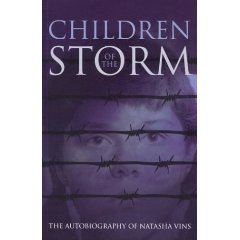
Some of you may remember the name of Georgi Vins. He was a Ukrainian pastor in prison for his “religious activities” in the Soviet Union several years ago. I was a student praying for him in the campus Slavic Mission Prayer Band in the late 70s, and it was with great joy I heard years later that he had been exiled to the USA in exchange for Soviet spies.  Children of the Storm, written by his daughter, Natasha, tells of her perspective during those years of persecution.

Natasha was about nine years old when persecution began in her school (though ridicule of Christianity had begun years before), and it seemed to increase as the years went by. Teachers would hold her up for ridicule in front of her classmates and blame her for her class’s not making it into certain competitions. She was assigned to write a report on a boy held up as a Soviet hero who turned his father in to the KGB for keeping back a little of his grain for his starving family. The other children began to taunt and threaten her or just avoid her. She was threatened with being removed from her home and “re-educated.” These things struck a chord with me when I first read this book because my youngest was at the age Natasha was when some of this was happening, and I just could not imagine him going through these things. Yet as it all struck me as so sad, the Lord reminded me that He marvelously kept her through that time. And she was not even saved yet!

In later years she had a teacher who had similar interests, befriended her, was kind to her, and then began to undermine her Christian beliefs. This time Natasha listened, thought some of what her teacher said made sense, and began to question. When her father came home from a prison camp and she had an opportunity, she talked with him. Imagine coming home from being in prison for your faith to have your own daughter question your faith. Yet he did not express anger or disappointment: he just answered her questions as best he could. Not long afterward Natasha was saved.

At this time and place one truly had to count the cost of following Christ. Natasha was denied finishing her studies in her field of choice because of her Christianity. Her father had had to go “underground” by this time and sent word that he would like her to join him in the printing ministry. She helped for many years in vital ways, and even got to see her father here and there. Once they were to meet with someone who at the last minute had to postpone meeting with them for a couple of hours. Natasha and her father used the time to walk around the city and talk. He thought it highly likely that he would be arrested again, and his talks with her that day helped her to make it through the time when he was indeed arrested. Imagine having to prepare your child not for the remote possibility but for the very real likelihood of your imprisonment…and to do so in a way that does not leave her bitter or feeling sorry for you or herself, but leaves her strengthened and resting in the Lord.

Natasha’s grandmother was also arrested when she was in her sixties and thought she would die in prison, yet the Lord delivered her.

The book tells also of Natasha’s mother and siblings, of visits to her father and grandmother in prison, of the persecuted church, of struggling to maintain a Christian attitude toward persecutors, of their reaction when her father was suddenly and unexpectedly exiled, of the family’s preparing to join him, of their impressions of America: one of the younger siblings was astounded that everyone carried Bibles to church. Natasha wept upon seeing a Christian bookstore. They left Russia with sorrow because it was their homeland, but before long they began to see how the Lord could use them in the USA.

The epilogue of the book tells of the Lord’s help through their adjustments to the US, and then opportunities for ministry by publishing newsletters and several books and establishing a mission. After 11 years of exile, in 1990, Pastor Vins was able to make several return trips to the former Soviet Union, visiting and preaching openly, discussing with church leaders how the mission in America could best help them. He passed away Jan. 11, 1998, leaving not only a continuing ministry, but a legacy of godly man and his family.

Reposted from the archives.

photo 3(2)

For the 31 Days writing challenge, I am sharing 31 Days of Inspirational Biography. You can find others in the series here.

31 Days of Inspirational Biography: Walter Wilson

Walter WilsonWalter Wilson had the ability to turn nearly any conversation into a witnessing opportunity, yet with graciousness and kindness rather than belligerent buttonholing. A friend commented about him that he certainly had the gift of evangelism. True. But he also had an obedient and willing heart. He would have been the last person to have wanted people to think he was unique or that no one could do what he did. We can learn much from his spirit as well as the particular ways he had of turning conversations to the things of the Lord.

Harry Ironside urged him to write some of his experiences, which led to five books of anecdotes about various opportunities he had to lead people to the Lord. Some of the stories have been compiled into a fascinating book titled Just What the Doctor Ordered.

He was able to lead a German shop owner to the Lord when he told him the blank book he was buying was to be used for recording his prayer requests and answers. The man asked, “Can you get to Gott?” explaining that he had wanted to “find Gott” for many years.

One of my favorite chapters, “The Wrong Address But the Right Persons,” tells of a visit he tried to make while out of town to the son of a friend. After looking up the name and address, he arrived to find the man’s wife and two friends. As they began to talk, he realized that this young man, though he had the same name, was not the son of his friend. As he apologized and began to get ready to leave, he noticed a well-worn Bible on a table. He asked if they read it and loved it, which they said they did. He asked if they had learned from its pages how to be saved. Stirred, the three looked at each other, and then explained that when he had rung the doorbell, they had been on their knees praying that God would send someone who would show them how to be saved.

Another chapter tells about an atheist doctor known for his antagonism. Dr. Wilson visited him and discovered the one issue that kept the doctor from believing. He invited the doctor to church, and the Lord gave him just the right illustration that removed the obstacle in this doctor’s thinking. Another chapter tells how, as he was holding special meetings in a certain city, the pastor invited him to visit a church member who had been seriously ill in the hospital. They did so and had a good visit. Dr. Wilson took notice of a nurse in the room and went over to her to ask her if any of this man’s visitors had brought any message of comfort to her as well. She said no, she was not a Christian as these folks were. As he told her about the Lord, she began to weep. “All unknown to those who had visited the sick man, this nurse had been listening, the hunger had been increasing, and the desire to have what they were talking about became more and more acute in her soul…Although the visiting Christians had overlooked this splendid prospect, nevertheless God used their words to prepare her heart…The hungry heart may be quite close to us but may be all unobserved because we are not looking for the troubled soul.”

Other chapters are “The Case of the Japanese Barber,” “The Ticket Did Not Arrive on Time,” “God visited the Circus,” “Mrs. Fox Did Not Like It,” “A Hopeless Cripple Could Sing,” “Lost on Mount Wilson,” “The Candlestick Was Not in the Ark,” “”Lillian Was Miserable on the Stage,” “’Will I See My Little Girl Again?’” “The Intern Was Surprised,” “The Cursing Barber,” as well as others. At the end is a chapter entitled, “Hints and Helps For Personal Soulwinners.”

Dr. Wilson was not a trained or ordained preacher. He was a “medical doctor, natural scientist, salesman, businessman, author, preacher, school administrator, and more.” But he viewed sharing the gospel as his “principal business in life.” David Woehr, in his biographical sketch at the beginning of the book, says:

He translated that concern into action by taking advantage of every available opportunity to present the gospel. On the other hand, he placed great emphasis on the leading of the Holy Spirit. Each morning he would earnestly pray for the Holy Spirit to guide him to the particular person whom He had prepared to receive the gospel. During the day, expecting God to answer his prayer, he would take advantage of each favorable occasion to speak a word for Christ. He was not one to wait for some strange, inner urging of the Spirit to move him, for the opening up of an opportunity was leading enough for him.

Always a gentleman and never intrusive or abrasive, it was evident that the love of God motivated him. He was not a salesman with a product to huckster onto some unsuspecting potential client…Each one with whom he came in contact was a person who perhaps needed the water of life. He was a man under orders, ready at every moment to follow the Spirit’s leading and be the instrument by which God would bring a new-born babe into His kingdom.

photo 3(2)

For the 31 Days writing challenge, I am sharing 31 Days of Inspirational Biography. You can find others in the series here.

(This will also be linked to Semicolon‘s Saturday Review of Books.)

31 Days of Inspirational Biography: Margaret Paton, Missionary to Cannibals in the South Sea Islands

Margaret PatonI wrote last year about John Paton, a missionary to the New Hebrides in the 1800s and a great man of God, who is the source of one of my all time favorite missionary quotes. Before he went to the field, some regarded him as foolish for going to minister where there were cannibals. To one man’s warning about his potential fate, he replied, “Mr. Dixon, you are advanced in years and your own prospect is soon to be laid in the grave, there to be eaten by worms. I confess to you that if I can but live and die serving and honoring the Lord Jesus, it will make no difference to me whether my body is eaten by cannibals or by worms.”

Some time ago I happened upon a book titled Margaret Paton: Letters From the South Seas, which, as its name implies, is a collection of letters that John Paton’s wife sent out over the years. The letters were written primarily to family back home, though there are a few to other individuals. They are quite long, but that is because they did not have the opportunity to send and receive mail very often. Since they were written to family, they contain more personal glimpses and anecdotes than a prayer letter to supporters would, and Margaret (or Maggie, as she signs herself) often had an amusing way of telling them. But there were also times of tragedy and perplexity that they experienced, and Maggie’s letters convey the situations and the wrestlings of heart they had in trying to discern the Lord’s will and His grace through every trial.
Rather than trying to summarize the whole book, I just want to give you a few excerpts here and there.

Maggie was John’s second wife: his first wife and son had died of malaria on the island of Tanna. When Maggie first came to the island with John, he pointed out “that Sacred Spot [the grave of his wife and child], so indelibly photographed on his memory. Oh, how I longed to spend a quiet hour by the grave of her whose footsteps I feel so unfit to follow, and who met her trials so unshrinkingly and alone — alone, so far as regards female companionship and sympathy!”

They were going to another island to labor and dropping off fellow missionaries at their respective islands on the way. On one island, “Great crowds of people came to look at us, as I believe we are the first white women who eve landed on Fotuna. The ladies were, in consequence, very curious to have us examined properly; and they went about it in a business-like way, as I can testify from the pokes and thumps received. They always felt themselves at the same time, to see how far we were alike. Poor things, they had yet to learn that we were sisters, resting under the same penalty and equally in need of and entitled to the same Saviour.” Then she mentioned having to “escape” when “their examinations” became “rather too minute.”

One thing that some missionaries struggle with, especially in primitive areas, is whether their living arrangements should be just like the natives or closer to what they are used to. There is no one right answer: it depends on the place, the people, health issues, and the leading of the Lord in each circumstance. The Paton’s home would have been nothing really like European homes, but Maggie writes, “I am trying my best to make it the prettiest and most inviting home I know — as refined, as civilized, and as nearly what we have been accustomed to, as our limited resources will permit. We must not let ourselves ‘down’ because we are among Savages, but try rather to lift them up to our Christian level in all things. One’s home has so much influence on one’s work, and on life and character; and it is due to our two wee boys to make it a bright one…it is no part of my creed to believe that…everything pleasant in sinful.” She then writes that, before she left for the field, one lady told her, “that missionaries’ wives were expected to live and dress in the most primitive way, and to set an example of great gravity and solemnity, else they would get to be talked about.” After wrestling with the “old Adam” in her, Maggie “controlled myself to retort, that in my Bible there was no separate code of rules for missionaries’ wives, any more than for other Christian gentlewomen.” She then wonders “that any one can be blind to the fact that our kind Creator has given us such wealth of beauty in Nature.” He could have made everything just useful, yet He chose to scatter beauty and charm throughout creation. This could probably be a separate post, but it all comes back to balance: I’ve read other stories of missionaries trying to find the right balance. I’m thinking of Isobel Kuhn in particular, who had some nice things from her wedding in her new home in a primitive area of China only to have them ruined by such practices the people then had of blowing their nose in their hands and then wiping them on the (new!) furniture, or letting babies use the bathroom on the beloved rug. She had to learn that though it isn’t wrong to “nest” or have nice things, it’s wrong to let them have priority over people’s souls or the work they were called to. I don’t think Maggie went too far the other way, but I’m just offering the other side of the balance for perspective.

In struggling to learn the language, she writes, “How the Apostles must have appreciated the gift of tongues on the Day of Pentecost! I wonder if it was accorded to their wives as well!” She writes how “provoking” it s to think you’ve mastered enough to converse a little, only to see them “looking at each other wonderingly.” “I got Mr. Paton’s help in any great difficulty — though he did not at all times enjoy the interruption, especially if the point in question turned out to be only about a needle and a thread, while he had been called away” from his work.

To some children who had given toward the Dayspring, the mission ship that transported people and supplies to the islands, she wrote, ”Now, if I tell you how really grateful all the missionaries are to the children who give their money so willingly to keep the Dayspring in nice order, and how the little vessel actually helps to keep the missionaries alive, as well as those so dear to them, by bringing them food and medicine and all they require, I am sure you will not grudge having denied yourselves many little gratifications to help in so important a work.”

There is a section I wish I had space to include answering some who criticize a missionary having a family. “The life of the Christian home is the best treatise on Christianity — a daily object lesson, which all can…’read, mark, learn, and inwardly digest.’” She also has a good section answering the comments some make that “ seem to grudge a man of burning enthusiasm and magnetic eloquence going to the foreign field, as if it were so much power and genius being wasted.” She argues convincingly for sending our best to the field.

I’ll forewarn you that there is a bit of perspective that’s not what we would think of as politically correct by today’s standards but I think is probably common for the times.

All of this comes just from the first third of the book! There’s so much more I wish I could include. I hope I’ve inspired you to read it for yourself.

photo 3(2)

For the 31 Days writing challenge, I am sharing 31 Days of Inspirational Biography. You can find others in the series here.

(This will also be linked to Semicolon‘s Saturday Review of Books.)