31 Days of Inspirational Biography: Dr. Sa’eed of Iran

Some years back I wrote about Dr. John Dreisbach, a modern-day missionary who had recently gone Home to heaven. I was listening to his memorial service online when I heard the following poem read:

Christ is my Life, and Christ is my light;
Christ is my guide in the darkness of night;
Priest and strong Advocate Christ is for me;
Christ is my Master, to truth he’s the key.

Christ is my Leader, he peace to me brought;
Christ is my Savior, Christ righteousness wrought;
Christ is my Prophet, my Priest, and my King;
My Way, and the Truth to which I firmly cling.

Christ is my Glory, and Christ is my Crown;
Christ shares my troubles when woe strikes me down;
Christ is my treasure in heaven above:
In every deep sorrow he soothes me with love.

Christ is my Savior, my Portion, my Lord;
All honor and homage to Him I accord.
Christ is my Peace, and Christ my Repast;
Christ is my Rapture forever to last.

In joy and in sorrow Christ satisfies me;
‘Tis Christ who from bondage of sin set me free.
In all times of sickness Christ is my Health;
In want and in poverty Christ is my Wealth.

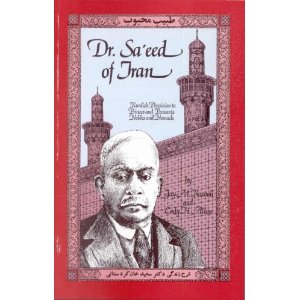
Afterward I searched online to find out who wrote this poem and discovered it was titled “Dr. Sa’eed’s Hymn” and was contained in the book  Dr. Sa’eed of Iran: Kurdish Physician to Princes and Peasants Nobles and Nomads by Jay M. Rasooli and Cady Hews Allen. It is no longer in print, but Amazon.com has inexpensive used copies, so I ordered one. (If you don’t mind reading books on the computer, the text is online through Google books.)

Dr. Sa’eed’s is a fascinating story. He was born into a Kurdish mullah’s (an Islamic teacher) family in June of 1863 in what was then Persia, now known as Iran. He was uncommonly bright and well-taught, so much so that he was given the title of mullah at the age of thirteen when his father died.

As a child he once saw a foreigner wearing a hat with a brim, uncommon because Persians then wore brimless hats. When he asked his mother why the man wore that “funny hat.”

“He is an unbeliever,” she replied, “and they do not wish him to see the sky, which is the abode of God.” By such an answer was aversion to non-Moslems instilled in the receptive mind (p. 23).

Sometimes he might be in a Christian home and “accidentally” knock something fragile off a shelf so that it broke or sit on a rug and cut holes in it with his knife. “Such misdeeds, while inspired by bigotry, were done especially to earn merit with God by causing damage to an unbeliever or even to one of a rival Moslem sect” (p 24).

But he also had a thirst for holiness that led him to fervent study and extreme rituals. After years he was still “dissatisfied and restive” (p. 29.) His first encounters with professing Christians were with Catholics who disgusted him, as they drank alcohol (forbidden in the Koran).

When he was seventeen, some Protestant missionaries came to town and engaged Sa’eed as a tutor in the Persian language. He had heard even worse things about Protestants, but he acquiesced.

He was surprised by many things: they knew something of the Koran, they prayed for their enemies, they did not drink, lie, or gossip. Their behavior matched their teaching. They used the Bible for language study, and Sa’eed heard many discussions about Christian teachings. Over time he began to speak with Kasha Yohanan about religion and read the Bible for himself. He began to see his own failings and to doubt what he had always been taught. This was agony to him, causing him to burn himself with hot coals as a vow never to speak with Christians about religion again and to tell the missionary that he was no longer available. But the words he had heard continued to burn in his heart until he finally prayed to be led in the true way. He decided to study both the Bible and the Koran. “In Mohammed’s teachings and personal life I found nothing which would satisfy the longing soul — not a drop of water to quench the thirsty spirit” (p. 38). Finally he yielded to faith in God.

His heart was now at peace, but his persecutions began in earnest. Even his own brother planned to kill him. The rest of the book details his growth, his training as a physician, and his life as a testimony to the One who saved him. Though often in danger, he never failed to treat anyone who called on him, even his enemies. His faith and godly character were a witness and a reflection of the One in Whom he believed.

(Reposted from the archives)

photo 3(2)

For the 31 Days writing challenge, I am sharing 31 Days of Inspirational Biography. You can find others in the series here.

31 Days of Inspirational Biography: Mimosa

783046_the_sensitive_flower

Sometimes people who work in children’s ministries can get discouraged due to the seeming lack of fruit or the fact that they have some children just a few times and then never see them again. Mimosa by Amy Carmichael tells the story of a little girl who was marvelously changed by just a short encounter with the gospel.

When Amy Carmichael was a missionary in India she learned that some little girls were sold to the temples for immoral purposes. Whenever she could, she tried to rescue these girls, to talk their parents into letting them stay with her instead. One such little girl was named Star. She had been with Amy for a while when her father came, bringing her sister, Mimosa, with him, to try to take Star back. He met and talked with Amy and Mr. Walker, the director, and at one point even stretched out his arm to take Star — yet he felt he could not move, that some strange power was preventing him.

Mimosa saw this. Some of the workers had a short time to talk with her, not even time enough to present the gospel completely. Mimosa asked her father to let her stay: he would not hear of it.

Those who had met with Mimosa longed for her: she seemed intelligent and interested. They lamented that they had not had time to tell her more. “How could she possibly remember what we had told her? It was impossible to expect her to remember……Impossible? Is there such a word where the things of the Lord are concerned?”

Something of what she heard about a God who loved her stayed with her. She knew instinctively she could no longer rub the ashes of her family’s god on her forehead, as was their custom. The women in the house thought her naughty or “bewitched” and beat her with a stick. She was bewildered, but she knew God loved her, in spite of all she could not understand of her circumstances.

After she was married at age seventeen, she found she had been deceived by her husband’s family: He was “landless [and] neck-deep in debt.” It was no shame to be in debt: in that culture: “”If you have no debt, does it not follow that no one trusts you enough to lend you anything, and from that is it not obvious that you are a person of small consequence?” But Mimosa’s character could not endure it, though she had never been taught against it. She encouraged him to sell the land in her name, the only piece of land he had that he had given as a dowry, to pay off the debt, and then suggested they would work. He was amazed at such a thing, but agreed. His unscrupulous elder brother suggested they start a salt market and that Mimosa sell her jewels to get them set up: he would take care of it. He instead somehow misused the money. She gave some money to her mother to keep for her, but then her mother would not give it to her when she asked for it: her mother was angry with her over the loss of the jewels that had been passed to her. “Let thy God help thee!” she told her daughter.

Mimosa went out to pray: “O God, my husband has deceived me, his brother has deceived me, even my mother has deceived me, but You will not deceive me…Yes, they have all deceived me, but I am not offended with you. Whatever You do is good. What should I do without you? You are the Giver of health and strength and will to work. Are not these things better than riches or people’s help?….I am an emptiness for You to fill.”

Thus her life went. She was a derision because she would not worship the false gods or engage in idolatrous practices. She worked hard because her husband would not. There were times when she was weak and could not work that God worked in unusual ways to provide for her. She had three sons; then a snake bite left her husband blind and crazy. In a couple of instances she received a bit more information about the God she loved, and she clung to it and to Him.

Meanwhile, Star was concerned for her sister. She felt led to write to her and prayed someone would read the letter to Mimosa. A cousin did read it to her, as often as Mimosa asked him, but neither of them thought to write back to Star, so she and the ladies of Dohnavur were left to wonder and pray.

A mysterious illness which took the life of one of her sons caused the neighbors to torment her further with their words. They felt it was all her fault since she would do nothing to appease the gods. Mimosa replied, “ My child God gave; my child has God taken. It is well.” Though weak, ill, grieving, and alone, she still told God, “I am not offended with you.”

The years followed in much the same way. She had two more sons. The oldest one was taken by the father (who had regained something of his right mind) to another town to work but, to Mimosa’s grief, required him to rub the god’s ashes on his forehead.

She began to long that her children should have “what she had never had, the chance to learn fully of the true and living and holy God and themselves choose His worship.” It would take too much space here to tell how God wondrously worked out the all the details to go to Dohnavur, even, miraculously, her husband’s approval. Her sister, Star, was strongly burdened to pray for Mimosa and discovered later that was just the time when all of this was coming to pass. Twenty-two years after she first visited Dohnavur, she returned. It can only be imagined what she felt as she soaked up Christian fellowship, learned to read, studied the Bible, was baptized. After a time she went back to her husband, determined to win him. He was in a less tolerant caste, yet amazingly he did not put her away. Her life was not easy. “But then, she has not asked for ease; she has asked for the shield of patience that she may overcome.”

“Is not the courage of the love of God amazing?” Amy Carmichael wrote. “Could human love have asked it of a soul? Fortitude based on knowledge so slender; deathless, dauntless faith — who could have dared to ask it but the Lord God Himself? And what could have held her but Love Omnipotent?”

photo 3(2)

For the 31 Days writing challenge, I am sharing 31 Days of Inspirational Biography. You can find others in the series here.

31 Days of Inspirational Biography: Bill Maher, “Missionary to the Handicapped”

photo 3(2)

Beyond My DreamsWhen Bill Maher was born in 1928, the midwife assisting his mother thought he was dead. He was laid in the crib while the midwife and doctor turned their attentions to his mother, who was having severe complications. Bill was not dead, however, he was diagnosed with severe cerebral palsy. His parents were advised to put him away in an institution and forget they had him. The shocked mother refused. His parents sought any help and advice they could find to help their son while trying to treat him as normally as possible. His neck muscles were too weak to hold up his head, his arm and leg and tongue muscles were contracted and had to be stretched out daily. The therapy had both mother and son in tears, but it worked.

When Bill was two, he developed mumps and measles at the same time and lost his hearing. Yet he somehow learned to lip read. By the age of five he still could not talk.

Other children and even adults would taunt and tease Bill if his family was not around. Sadly, some of those people were even Christians — who would then ask Bill if he wanted to become a Christian! Neither he nor his parents did. Bill writes later in his autobiography, Beyond My Dreams, “Apparently these people had never read Leviticus 19:14: ‘Thou shalt not curse the deaf, not put a stumblingblock before the blind, but shalt fear thy God: I am the Lord.’ In other words, Christians should realize that God made the afflicted the way they are for a purpose and no one should take advantage of them because of their afflictions.”

One Christian lady knocked him down into the mud to get him out of her way and then told his mother he should not be allowed to walk where other civilized people did; he should instead be taken into the woods where the other animals were. Bill did not want to walk outside any more after that, but his mother told him, “Giving up is not in our vocabulary.”

Bill’s parents made him do chores and work hard. One time when he got out of a job his grandfather paid him to do by paying another child a lesser amount to do it, his mother was angry, but his grandfather realized he had to use his brains to figure that out. Bill had a wonderful sense of humor, manifested throughout his book.

Bill attended a regular school until fifth grade, when he failed because he could not keep up. The school felt they had taken him as far as they could, but the principal recommended a school for the deaf 30 miles away. His family made the daily commute, and Bill began to learn more.

When Bill was about 12, one family that was kind to him invited him to their church. There he saw many of the kids who picked on him, as well as the lady who had pushed him down. Yet he enjoyed the service and came back that evening. He misunderstood something the pastor said, and asked to speak to him afterward. Bill was ignorant of what the Bible said, and the pastor patiently explained Bill’s need for a Savior. Thankfully he did not let the failures of some of God’s people keep him from the one and only Savior who could meet his deepest needs. He accepted Christ and experienced immediate changes. He writes, “When I had walked into church that night, I had seen people I hated. When I left, I couldn’t hate them any more.”

When Bill completed the tenth grade at the school for the deaf, he was told he needed to face the “real world” and go to the public high school. He did passing work, got involved in extracurricular activities, held down part time jobs, got his driver’s license. But on graduation night, as he walked across the stage to receive his diploma, the man handing them out said, “It is amazing that you’ve graduated. You work hard, but you will still not amount to anything. If you can get a job, all you’ll ever be is maybe a janitor.” Bill was stunned, his mother was in tears, his dad was angry. Yet Bill was more determined that ever to prove this kind of thinking wrong.

Bill got a good job, but began getting into some of the activities of the unsaved coworkers and backslid. One day at work he had a heart attack, at the age of 22, and was told he only had a month to live. He asked his parents if he could stay with the pastor who had led him to the Lord at the camp where the pastor now ministered. They agreed, and over time Bill confessed his sins to the Lord and surrendered to do anything the Lord wanted him to do. The pastor felt Bill was called to preach. Bill didn’t think so because of his impediments. As he studied his Bible, he came across II Cor. 1:3-4 about comforting others with the comfort wherewith God comforted us, II Cor. 12 about God’s grace being sufficient, Phil. 4:13, and God’s answers to Moses’ objections. He surrendered to preach. His parents were upset and his dad told him not to come home.

Eventually his father did overcome his objections, Bill became a preacher, married, had two children, traveled all over the United States and then the world, preaching, ministering to the handicapped and afflicted, helped to start Christian schools for them, became a police chaplain, and received a honorary doctorate. He went home to be with the Lord in 2002.

In Dr. John Vaughn’s forward to Dr. Bill Maher’s book, he writes, “God is to be praised for the wonderful way he has worked in and through this man’s life. Bill Maher is to be commended for the wonderful way he has served the Lord under circumstances that would have discouraged most others from the start. As you read, you will probably ask yourself the question that comes to me so often when I am with this man who is like a father to me, ‘If he has done this with the Lord’s help, what could I do if I would really trust Him myself?’”

Luke 14: 13-14: But when thou makest a feast, call the poor, the maimed, the lame, the blind: And thou shalt be blessed; for they cannot recompense thee: for thou shalt be recompensed at the resurrection of the just.

For the 31 Days writing challenge, I am sharing 31 Days of Inspirational Biography. You can find others in the series here.

(This will also be linked to Semicolon‘s Saturday Review of Books.)

31 Days of Inspirational Biography: One Woman Against the Reich

photo 3(2)

Sometimes, when we hear of the possibility of future hard times or even persecution, our greatest concerns are for our loved ones. We know from Scripture that God is in control, that He won’t allow anything that He won’t give us the grace to handle, that the “trial of our faith” works patience and endurance in us and glorifies the Lord. From time to time we also hear testimonies of God’s keeping grace during trial.

One WomanOne such book I discovered some years ago is titled One Woman Against the Reich: The True Story of a Mother’s Struggle to Keep Her Family Faithful to God in a World Gone Mad by Helmut Ziefle. Mr. Ziefle’s parents lived in Germany during WW II; in fact, he was born in April 1939. In the previous years, the Nazi regime had grown, and trials and persecutions had grown for anyone not in agreement with them. There were two older brothers and a sister already in the family before Helmut made his appearance. His brother Kurt, 11, rushed home excited one day to tell his parents he had joined the Hitler Youth Organization. His mother reminded him that he belonged first to Jesus. But he was carried away with excitement. Of course, the youth organization happened to meet at the same time the rest of the family went to church. Hitler is quoted as saying, “In my Teutonic order, a youth will grow up which will frighten the world. I want a fierce, masterful, fearless and ferocious youth. It can’t show any weakness or tenderness. The free and magnificent beast of prey must finally glow again from their eyes.” Can you imagine such a man after the young people of our homes and churches?

Maria, Helmut’s mother, had many concerns to deal with in those days: her children being carried away with Nazism; the possibility of persecution from neighbors when she did not return their “Heil Hitler;” threats against her husband; safety for herself and her family during air raids and bombings; severe scarcity of food; having a baby during all of this; the safety of her two older sons when they became old enough to go into military service, one fighting for Nazism, one against it but having to go nonetheless (the latter son ended up in a Russian POW camp for 5 years, sadly, ironically, for a cause he did not believe in); being turned out of their home so that soldiers could use it; her own poor health with phlebitis; the uncertainty of being separated from the rest of her family for a time. Yet in each situation her heart instinctively turned to her Lord. And in each situation she found Him faithful.

For the 31 Days writing challenge, I am sharing 31 Days of Inspirational Biography. You can find others in the series here.

(This will also be linked to Semicolon‘s Saturday Review of Books.)

31 Days of Inspirational Biography: Lady Huntingdon

photo 3(2)

For the 31 Days writing challenge, I am sharing 31 Days of Inspirational Biography. You can find others in the series here.

Lady Huntingdon used to say she was “saved by an M,” pointing out that I Corinthians 1:26 did not say “not any noble,” but rather that “not many noble” after the flesh are called. She rejoiced to be counted among those called.

Lady Selina Shirley Huntingdon lived in England in the time of John Wesley and George Whitfield in the 1700s. Though a member of the Church of England as the Wesleys were, she came to trust completely in Christ alone for salvation around age 32 through the influence of a sister-in-law. Her husband died a few years after her conversion, and she lived her remaining years helping to establish 64 “meeting-houses,” supporting George Whitefield and other clergy, opening chapels attached to her residences, opening a college to train men for the ministry, and supporting the Bethesda orphanage in Savannah which George Whitfield willed to her. It was her desire that the orphanage become a launching ground for missionary work in Georgia.

Lady Huntingdon also tried to reach her own friends for the Lord, who did not always appreciate her efforts. The Duchess of Buckingham wrote, “I   thank your Ladyship for information on the Methodist preaching. Their doctrines are strongly tinctured with impertinence toward their superiors… It is monstrous to be told you have a heart as sinful as the common wretches who crawl the earth.” The Duchess of Marlborough replied: “Your concern for my improvement and religious knowledge is very obliging and I hope I shall be the better for your excellent advice…women of wit, beauty and quality cannot bear too many home truths… I am forced to the society of those I detest and abhor. There is Lady Sanderson’s great rout tomorrow night-I do hate the woman as much as I hate a physician, but I must go if only to mortify and spite her…I confess my little peccadilloes to you; your goodness will lead you to…forgiving. “

A Sunday School teacher once commented that God needs and uses people at all economic levels, all classes, all types, to reach those within their influence. Lady Huntingdon certainly used her influence for the Lord and followed after Joanna, Susanna, and others in the Bible who “ministered unto Him of their substance.” (Luke 8:2-3) A good book about her life and ministry is Lady Huntingdon and Her Friends by Helen Knight.

(This will also be linked to Semicolon‘s Saturday Review of Books.)

31 Days of Inspirational Biography: If I Perish

photo 3(2)

For the 31 Days writing challenge, I am sharing 31 Days of Inspirational Biography. You can find others in the series here.

If I PerishAhn Ei Sook is not a household name among most Christians today (nor is her married name, Esther Ahn Kim), but her testimony in her autobiography, If I Perish, is soul-stirring. She was a young Korean Christian schoolteacher in the 1930s when Korea was under Japanese rule. The Japanese had set up shrines throughout the country, even in Christian churches and schools, and ordered people to bow down and worship at them. In Ahn’s school, she successfully avoided having to go to the shrine for many days, but finally the day came when the principal of the school sought her out and insisted she come to the shrine, lest the Japanese close their school because of her refusal. Miss Ahn went to the shrine, but did not bow down when everyone else did. She was taken to the office of the chief of the district and interrogated, but when he received a phone call and stepped out of the room, she fled.

She and her mother ended up hiding out in a quiet village while her sister brought them food. They tried to be inconspicuous, yet other Christians found them out and came to visit under the cover of darkness. Some of these were living in caves or mountains. Miss Ahn and her mother shared their food with them and enjoyed their fellowship.

One day a man called Elder Park came and told Miss Ahn God had told him to come and find her and go with her to warn the Japanese officials of God’s judgment to come if they did not repent. She initially shrank from this, but finally agreed to go. They had many disagreements about exactly how to accomplish this, and, indeed, some of what they did seems strange to us, even remembering that the times, culture, and circumstances were different. For instance, she felt she should get the proper paperwork; he felt he did not need such “man-made things,” for God was his refuge. He felt that God would blind the eyes of the officials….and that is exactly what happened. When the officials came on the train to see everyone’s paperwork, they walked right by him as if they did not see him.

God gave them a good audience with a few sympathetic Japanese officials. Yet in another disagreement, Elder Park felt they should go to the Japanese Diet and drop a warning from the balcony. This would be illegal: he felt then there would be an arrest and a hearing. Miss Ahn felt that deliberately breaking the law was the wrong way to go about it, but felt she must go with him. They were, of course, arrested and imprisoned. After some days she was released to go home, yet under guard. Some weeks later she was arrested along with several other pastors and Christian leaders and imprisoned for six years.

The majority of the rest of the book is about her prison experiences, how the Lord sustained her and used her. I want to share just one incident that shows real agape love.

A woman had been brought to the prison who was thought to be insane. She had killed her husband and cut him up into pieces. This woman would moan and curse in her cell, was known for biting, and, because she kept pounding the door, she was handcuffed 24 hours a day. Miss Ahn felt that the Lord would have her reach out to this woman. She requested that she be brought to her cell. The woman was disheveled and filthy. When she fell asleep, Miss Ahn, concerned about her being cold, took the woman’s bare feet, which were covered with excrement, into her own bosom and held them against her chest to keep them warm. Bit by bit, every day, with acts of kindness and words of love, the Lord enabled her to break through to this woman, who became a believer. The jailers were astounded at the change in her. Miss Ahn was able to disciple her, and she faced her execution in peace.

Many people who knew Miss Ahn commented on her weakness; she herself referred to being weak many times. Yet God uses “the weak things of the world” to show His power (I Corinthians 1:27, II Corinthians 12:9-10). One thing that encouraged me was that she struggled often with her feelings: she would be full of faith at one time, even feeling adventurous about what she was facing. But another time she would feel fearful. This encouraged me because it showed just how human she was. Even feeling fearful, though, she knew she must obey, and relied on the Lord for strength.

When the Japanese surrendered at the end of World War II, the Christians in the prison were released. Of the thirty-four who had entered that prison, only fourteen survived.

The Russian Communists took over then, and they were not much better than the Japanese: in some ways they were a great deal worse. The Lord opened a way for her to go to South Korea and eventually to America. She married Kim Dong Myung and took the name Esther, so her book was written under the name Esther Ahn Kim.

I hope you’ll read more of her story.


(This will also be linked to Semicolon‘s Saturday Review of Books.)

RTK Classics Book Club Selection for October: How I Know God Answers Prayer


Reading to Know - Book Club

Those of you who follow along with Carrie’s  Reading to Know Classics Book Club. know that we were originally going to do To the Golden Shore by Adoniram Judson this month. But shortly before the end of September, I began to be concerned that most participants might not read it, for several reasons: the book club was running a bit behind due to some lengthier classics earlier in the year and to busy life circumstances, there is no Kindle version of this book, and it probably isn’t in most public libraries. I was thinking about How I Know God Answers Prayer for next year, then suggested to Carrie that under the circumstances we might want to switch and do it this year: it’s shorter, there is a free Kindle version, and the text is online at Project Gutenberg. Though I am a little sad about not going forward with To the Golden Shore, I’d much rather choose a book that people will actually read. It seems from the comments Carrie and I both have received that this was a good decision. I do recommend To the Golden Shore to you: I apologize if you did go ahead and buy the book for this month’s discussion, but I feel sure you’ll find it worth the money and effort to read it.

Jonathan and Rosalind Goforth were pioneer missionaries to China at a time when foreign suspicion and distrust there reigned.

In the foreword of her little book How I Know God Answers Prayer, Rosalind shares how this book came to be:

When in Canada on our first furloughs I was frequently amazed at the incredulity expressed when definite testimony was given to an answer to prayer. Sometimes this was shown by an expressive shrug of the shoulders, sometimes by a sudden silence or turning of the topic of conversation, and sometimes more openly by the query: “How do you know that it might not have happened so, anyway?”

Gradually the impression deepened: “If they will not believe one, two, or a dozen testimonies, will they believe the combined testimonies of one whole life?”

The more I thought of what it would mean to record the sacred incidents connected with answers to prayer the more I shrank from the publicity, and from undertaking the task. There were dozens of answers far too sacred for the public eye, which were known only to a few, others known only to God. But if the record were to carry weight with those who did not believe in the supernatural element in prayer, many personal and scarcely less sacred incidents must of necessity be made public.

…It will be seen that these incidents of answered prayer are not given as being more wonderful, or more worthy of record, than multitudes the world over could testify to; but they are written and sent out simply and only because I had to write them or disobey God.

She goes on to do just that. Some of the answers to prayer are miraculous and monumental; some involve everyday concerns. Some are deeply personal, involving the depths of her own heart.

This was Rosalind’s first book, originally published in 1921. She went on to publish her husband’s biography, Goforth of China, in 1937, and then she was asked to share some of her own perspectives of life as a missionary wife in Climbing, one of my all-time favorite books, in 1940 (links are to my reviews). You’ll probably find her writing just a touch old-fashioned, but it is not hard to comprehend. She’s very transparent, and I’ve written before how it encouraging it is to find a woman “of like passions as we are” who found God’s grace to live for Him.

If you’ve never read of the Goforths, this will be a good introduction, and I hope you’ll go on to read her other books: if you have, it will be a good refresher.

If you’d like to read this book with us this month, you might let Carrie know here, and around the end of the month she’ll have a post where we can comment, share thoughts, or link up our review posts.

Book Review: The Princess and the Goblin

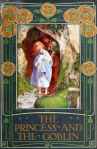
Princess_and_the_GoblinMy interest in George MacDonald was first piqued when I read of his influence on the life and writings of C. S. Lewis, whose imagination, he said, was “baptised” by reading MacDonald’s Phantastes. I’ve seen him quoted by various others, but somehow I don’t think I have ever read one of his books. I was especially interested in The Princess and the Goblin after listening to the funeral service of a young wife and mom who passed away last year (Julie Herbster, for those who knew her). Her pastor spoke of her love for literature and mentioned her hanging on to the truth she knew in the face of such devastating circumstances, just like the princess followed her great-great-grandmother’s thread through the goblin cave even though no one else could see it or believed it was there (more on that later). So I was delighted to see this title listed for this month for Carrie’s  Reading to Know Classics Book Club. That’s one of the values of these kinds of challenges and book clubs: they spur me to read books I might not otherwise have ever gotten around to.

The story begins with a bored 8 year old Princess Irene, inside on a rainy day, restless and dissatisfied with all her many wonderful toys. Her “King Papa” has sent her out into the country to be raised at first because her mother was not very strong, later because her mother died and her father was often away on kingdom business. On this rainy day her nurse, Lootie, leaves the room for a moment, and Irene notices another door left ajar, one that goes upstairs. She decides to investigate but gets thoroughly lost amidst seemingly myriad doors. She can’t find her way back down and gets quite upset until she finds a very old lady at a spinning wheel in one room. Though she was obviously very old and wise, with white hair, her skin was smooth. She told Irene she was her great-great-grandmother and that she was also named Irene. After her great-great-grandmother  wipes the tears from Irene’s dusty face and shows her her pigeons, she shows her the way back downstairs so that Lootie won’t be worried about her.

Irene tells Lootie all about her great-great-grandmother, but Lootie thinks she is just making up stories. Irene is quite offended, but after a while she wonders if perhaps her visit to her great-great-grandmother was all just a dream.

One thing the princess doesn’t know, but everyone else does, is that the mountains’ underground passages are full of goblins who used to be people but chose to live underground after some disagreements with the King. Eons of living “away from the sun, in cold and wet and dark places” had transformed them into hideous and grotesque creatures. Lootie is supposed to be keeping Irene safe especially from goblins, but one day as they are out exploring, Lootie realizes they’ve gone too far and won’t make it back home before dark. Frightened, she grabs Irene and starts running without having the time to explain why. They take a wrong turn and begin to see odd shapes in the rocks and hear laughter, when suddenly a young miner’s son named Curdie comes across their path singing a rhyme. He tells them the goblins can’t stand rhymes and songs, but they are out and about, and they need to get home as quickly as possible, so he helps them find the way and escorts them back.

Later, when Curdie works late in the mines one night to try to earn money to buy his mother a red petticoat, he overhears some goblins talking and hears reference to a plan that would endanger Irene, and another “Plan B” that isn’t exactly clear. In trying to find out more about it, he eventually is captured. Irene had found her great-great-grandmother once again, who had given her a ring filled with fine thread she had woven for her. She told her that when she needed to, she could put the ring under her pillow and follow the thread to guide her. One day she follows the thread to where Curdie is being kept, and helps him escape. Curdie can’t see the thread and can’t see Irene’s great-great-grandmother, either, when she tries to introduce him. He thinks Irene is trying to make a fool of him; Irene is hurt.

But Curdie determines that he will still try to find out the goblins’ plan and protect the princess. I’ll leave the story there for you to find out the rest if you choose to read the book, but you can be sure a confrontation with the goblins will occur.

One one level, this is a fairy tale with a classic good vs. evil battle and with young people learning and growing in the course of it. Unfortunately I couldn’t find any Spark Notes or Cliff Notes that discussed the plot, theme, and symbolism. Just Googling “symbolism in The Princess and the Goblin” and perusing a few of the posts that came up led to a wide variety of interpretations. Some see Irene’s sreat-great-grandmother as a fairy godmother, a goddess, or the Virgin Mary. Some sympathize with the goblins as victims of a classist society. Some took umbrage to MacDonald’s view that a princess (or anyone of royal blood) should have certain inherent qualities.

Since MacDonald was a Christian (though I’d disagree with some of his views as described in Wikipedia), I think we have to interpret the story in the light of basic Christian teachings. I don’t think the story is meant to be an overt allegory, but it does portray a beneficent being who cares for, heals, protects (and sometimes rebukes) its charges, who can’t be seen unless allowed and with some degree of faith. Light is associated with it, light that guides and protects, and a bird showing up at certain moments seems to invoke Biblical instances of the Holy Spirit in the form of a bird (though in the story the bird is a pigeon rather than a dove). I think the thread does represent truth, and Irene has to discern between what appears to be true and what her great-great-grandmother told her and choose which to trust, even (especially) when others don’t believe. I don’t think that royal blood really influences one’s behavior (except in fairy tales) – both history and modern times have given us royals with less than commendable character. But we can agree that a royal should have certain characteristics, and if Irene and Curdie are supposed to represent children of God, then, yes, they should have certain characteristics and should also be growing in them.

Besides the overall story and symbolism, there is a lot of humor in the book, especially in regard to the goblins. In one of my favorite passages, a goblin father is telling his son that humans have toes, which goblins apparently don’t have:

‘Why do they wear shoes up there?’

‘Ah, now that’s a sensible question, and I will answer it. But in order to do so, I must first tell you a secret. I once saw the queen’s feet.’

‘Without her shoes?’

‘Yes—without her shoes.’

‘No! Did you? How was it?’

‘Never you mind how it was. She didn’t know I saw them. And what do you think!—they had toes!’

‘Toes! What’s that?’

‘You may well ask! I should never have known if I had not seen the queen’s feet. Just imagine! the ends of her feet were split up into five or six thin pieces!’

‘Oh, horrid! How could the king have fallen in love with her?’

‘You forget that she wore shoes. That is just why she wore them. That is why all the men, and women too, upstairs wear shoes. They can’t bear the sight of their own feet without them.’

A few of my other favorite passages:

When Irene in fear unwisely runs right into the path of danger, “Not daring to look behind her, she rushed straight out of the gate and up the mountain. It was foolish indeed—thus to run farther and farther from all who could help her, as if she had been seeking a fit spot for the goblin creature to eat her in his leisure; but that is the way fear serves us: it always sides with the thing we are afraid of. “

“Lootie had very foolish notions concerning the dignity of a princess, not understanding that the truest princess is just the one who loves all her brothers and sisters best, and who is most able to do them good by being humble towards them.”

“…it is so silly of people to fancy that old age means crookedness and witheredness and feebleness and sticks and spectacles and rheumatism and forgetfulness! It is so silly! Old age has nothing whatever to do with all that. The right old age means strength and beauty and mirth and courage and clear eyes and strong painless limbs.”

“Here I should like to remark, for the sake of princes and princesses in general, that it is a low and contemptible thing to refuse to confess a fault, or even an error. If a true princess has done wrong, she is always uneasy until she has had an opportunity of throwing the wrongness away from her by saying: ‘I did it; and I wish I had not; and I am sorry for having done it.”

A comment I saw on Goodreads said that in one person’s edition, the story starts this way:

“THERE was once a little princess who—
“But Mr. Author, why do you always write about princesses?”
“Because every little girl is a princess.”
“You will make them vain if you tell them that.”
“Not if they understand what I mean.”
“Then what do you mean?”
“What do you mean by a princess?”
“The daughter of a king.”
“Very well, then every little girl is a princess, and there would be no need to say anything about it, except that she is always in danger of forgetting her rank, and behaving as if she had grown out of the mud. I have seen little princesses behave like children of thieves and lying beggars, and that is why they need to be told they are princesses. And that is why when I tell a story of this kind, I like to tell it about a princess. Then I can say better what I mean, because I can then give her every beautiful thing I want her to have.”
“Please go on.”

I love that – I don’t know why it is taken out in some editions.

Overall I loved this book and am so glad Bekah chose it for this months Reading to Know Classics Book Club selection.

(This will also be linked to Semicolon‘s Saturday Review of Books.)



What’s On Your Nightstand: September 2014

 What's On Your NightstandThe folks at 5 Minutes For Books host What’s On Your Nightstand? the fourth Tuesday of each month in which we can share about the books we have been reading and/or plan to read.

This is one of those months when the fourth Tuesday comes a week before the actual end of the month. Thankfully I remembered in good time this time. 🙂

Since last time I have completed:

Seeking Allah, Finding Jesus: A Devout Muslim Encounters Christianity by Nabeel Qureshi, reviewed here. Excellent – likely will be one of my top ten of the year.

Undetected by Dee Henderson, reviewed here. Excellent.

The Girl in the Gatehouse by Julie Klassen, reviewed here. Not excellent, in my opinion. Very disappointing.

The Hound of the Baskervilles by Sir Arthur Conan Doyle, audiobook, reviewed here. One of the best of the Holmes books.

Persuasion by Jane Austen, audiobook. I read it for the first time 7 years ago (reviewed here), and very much enjoyed listening to it.

I’m currently reading:

Why We Are Not Emergent: By Two Guys Who Should Be by Kevin DeYoung, Ted Kluck, and David F. Wells. I started it, anyway – need to get going with it.

The Princess and the Goblin by George MacDonald for Carrie’s  Reading to Know Classics Book Club. (Just finished this one shortly after posting, reviewed here.)

Somewhere Safe With Somebody Good, NEWEST Mitford book by Jan Karon! Loving it!

The Pound a Day Diet by Rocco DiSpirito – I’m not convinced that that’s a healthy plan, but I’ve seen him on the “Extreme Weight Loss” show this summer and liked what he had to say, so I thought I’d read the book and possibly gain some tips and recipes.

Gospel Meditations for Missions.

Next up:

The Last Bride by Beverly Lewis

In Perfect Time by Sarah Sundin

The Return of Sherlock Holmes by Arthur Conan Doyle

How I Know God Answers Prayer by Rosalind Goforth for Carrie’s  Reading to Know Classics Book Club. We were originally going to do To the Golden Shore by Adoniram Judson, but the book club is running a bit behind just now due to some lengthier classics earlier in the year and to busy life circumstances. I’m leading the discussion this month, and I was concerned that with the length of the book, the fact that there is no Kindle version, and it probably won’t be in most public libraries, that therefore few people would read it. I was thinking about How I Know God Answers Prayer for next year, then suggested to Carrie that under the circumstances we might want to switch and do it this year: it’s shorter, there is a free Kindle version, and the text is online at Project Gutenberg. If you’ve never read of the Goforths, this will be a good introduction: if you have, it will be a good refresher.

Also starting Oct. 1 I’ll be sharing 31 Days of Inspirational Biographies as part of The Nester’s 31 Days. I invite you join me!

31 Days of Inspirational Biography

For the past few years Myquillyn Smith (The Nester) has hosted 31 Days on her blog, a writing challenge wherein bloggers can choose a topic to write on every day in October in 9 different categories. It has gotten so big that this year it has its own site: 31 Days. You can find more information at What is 31 Days?

I really enjoyed participating for the first time last year with 31 Days of Missionary Stories. I decided this year to write about 31 Days of Inspirational Biography. I was originally going to call it Christian Biography, but rather than just give you an overview of someone’s life that you can find on Wikipedia, I want to share what inspired me about that person’s life. It may be an overview in some cases, or it may be one incident.

photo 3(2)

Reading Christian biographies has been one of the most influential activities of my life: I’ve learned so much by seeing faith in action, growth, example, victories as well as defeats, all of which has aided me in my own walk with the Lord.  I hope to share some of that with you.

I got several comments last year about how much time it must take to write these posts: most of them will come from newsletter articles I’ve already written. For nine years in a previous church I compiled a newsletter for our ladies’ group with a biographical section, for the same reasons listed above, and the Lord has opened the door for me to do something similar in our current church. I’ll be editing and tweaking them, but for the most part I won’t be writing these “from scratch,” so it is not taking as much time as it might appear to be.

I hope you’ll join me! As I post each day, I’ll put the links on this post so that they’ll all be in one place.

And in the meantime you might check out the 31 Days site and see if you’d like to participate. Let me know if you do!

Day 1: Frances Ridley Havergal’s Response to a Rude Waitress.
Day 2: If I Perish. Refusing to bow down to falsehood.
Day 3: A Sense of Him: One of Isobel Kuhn’s “Second Mile People
Day 4: Facing the Darkness.
Day 5: Lady Huntingdon. Saved by an “M”
Day 6: One Woman Against the Reich: The True Story of a Mother’s Struggle to Keep Her Family Faithful to God in a World Gone Mad.
Day 7: Bill Maher, “Missionary to the Handicapped
Day 8: Mimosa: Great Faith From Small Seeds.
Day 9: Dr. Sa’eed of Iran.
Day 10: Margaret Paton, Missionary to Cannibals in the South Sea Islands
Day 11: Walter Wilson, Caring Ambassador For Christ.
Day 12: Georgi and Natasha Vins, Christianity Behind the Iron Curtain
Day 13: William Tyndale, Bringing the Scripture to the People at Risk to Himself
Day 14: Anne Bradstreet, Puritan Poetess
Day 15: The “Uncommon Union” of Jonathan and Sarah Edwards
Day 16: Sarah Edwards As a Mother
Day 17: Rosaria Butterfield: How a Leftist, Feminist, Lesbian Professor Who Hated Christians…Became One.
Day 18: Darlene Deibler Rose learns “faith stripped of feelings, faith without trappings
Day 19: Corrie Ten Boom Repurposes a Concentration Camp
Day 20: Louis Zamperini: Olympian, POW, Christian
Day 21: Ann Judson, Brave and Faithful First American Woman Missionary
Day 22: Margaret Baxter, Overcoming Natural Fear to Face Persecution and Hardship
Day 23: Mrs. C. H. Spurgeon
Day 24: Rosalind Goforth: How I Know God Answers Prayer
Day 25: Rosalind Goforth Learns Submission
Day 26: Rosalind Goforth As a Young Mother Tries to Find Time For Bible Reading
Day 27: The Last CIM Missionaries in Communist China
Day 28: Charlie Wedemeyer, Living With ALS and Giving Hope to Others
Day 29: Nabeel Qureshi: A Devout Muslim Encounters Christianity
Day 30: A list of several other good biographies
Day 31: Why Read Biographies?