Book Review: The Hound of the Baskervilles

HoundThe Hound of the Baskervilles by Sir Arthur Conan Doyle was written 8 years after The Memoirs of Sherlock Holmes, in which Holmes supposedly died, but is set before that time. According to Wikipedia, its success prompted Doyle to write more Holmes novels, and it’s rated as one of his best Holmes stories.

It opens in typical fashion with Holmes wowing Watson with various deductions before they’re visited by a client. Dr James Mortimer has traveled to London to ask Holmes’ advice. It seems that the most recent baronet of Baskerville Hall in Devonshire (and Mortimer’s neighbor) , Sir Charles Baskerville, died of extreme fright apparently after being pursued by a large hound. A mysterious, monstrous hound killed one of his ancestors, and this and the ancestor’s evil deeds grew into a legend that the Baskervilles were cursed. Though the hound didn’t attack Sir Charles directly, its nearby footprints seem to give credence to the legend. Dr. Mortimer’s problem is that the new heir is supposed to arrive from Canada, and Mortimer doesn’t know whether it is safe to conduct him to Baskerville Hall. Holmes asks Mortimer to bring the new heir, Sir Henry, to him when he arrives. By the time they meet, though, Sir Henry has received an anonymous warning to avoid the moors at Devonshire, and one of his boots has been stolen. When they leave Holmes’s apartment, he discovers that Sir Henry is being followed. Henry wants to go to his estate despite the weird occurrences and warnings. Holmes is busy with another case but sends Watson to the Hall with Henry and Mortimer to observe, meet the staff and neighbors, and report back to Holmes.

Holmes says early on that there are several strands to the case, and he has to try various ones to find out which will lead him to the truth. His investigation and Watson’s reports put some strands to rest easily, but others cause more excitement and concern. An escaped convict hiding out in the moor complicates the case. When Holmes does arrive in Devonshire he discerns who was responsible for Sir Charles’s death and realizes Sir Henry is in imminent danger himself, but he does not yet have enough concrete evidence to make a case. While he waits to close the net on the perpetrator, will he be too late to prevent yet another crime?

In my venture through the Holmes novels in publication order, I’ve been piecing together his character as a whole and comparing it to some of the modern characterizations and adaptations of him. Most modern portrayals present him as somewhat rude, but I haven’t found him to be so in the novels, as least not yet. He is pretty egotistical, though. In one amusing exchange, he and Watson are disagreeing about their deductions from a certain piece of evidence. Watson eventually concedes by saying, “You may be right.” Holmes responds, “The probability lies in that direction.” Another conversation is perhaps a little more snide:

“Really, Watson, you excel yourself,” said Holmes, pushing back his chair and lighting a cigarette. “I am bound to say that in all the accounts which you have been so good as to give of my own small achievements you have habitually underrated your own abilities. It may be that you are not yourself luminous, but you are a conductor of light. Some people without possessing genius have a remarkable power of stimulating it. I confess, my dear fellow, that I am very much in your debt.”

He had never said as much before, and I must admit that his words gave me keen pleasure, for I had often been piqued by his indifference to my admiration and to the attempts which I had made to give publicity to his methods. I was proud, too, to think that I had so far mastered his system as to apply it in a way which earned his approval….

[After differing over the evidence in question] “I am afraid, my dear Watson, that most of your conclusions were erroneous. When I said that you stimulated me I meant, to be frank, that in noting your fallacies I was occasionally guided towards the truth.”

Watson’s character continues to emerge as well. Some older film versions portray him as a dumpy old man whose only purpose is a foil for Holmes and a chronicler of his cases: thankfully more modern adaptations show more of his strengths. In this story he is described as “fleet of foot” in a chase scene, and though some of his conclusions are wrong, his observations are helpful. When Holmes sends him with Sir Henry, he says of Watson, “There is no man who is better worth having at your side when you are in a tight place. No one can say so more confidently than I.” Watson himself confesses, “The promise of adventure had always a fascination for me.”

I listened to the audiobook read very nicely by Derek Jacobi. He not only portrayed the different characters very well, but he incorporated the action into his voice, sounding like he was running when his characters were, etc. I also looked at some passages a little more closely at the Project Gutenberg online version of the text.

I do agree that this is the best Holmes novel I have read/heard so far. Doyle did an admirable job setting the scene for a Gothic-type mystery with the  depressing old house, the mysterious legend, and the dangerous moors, and the plot was adequately suspenseful.

(This will also be linked to Semicolon‘s Saturday Review of Books.)

Reading Challenge Update

2014tbrbuttonI keep forgetting that Roof Beam Reader, who hosts the 2014 TBR Pile Challenge, has check-in points around the 15th of each month so we can summarize how we’re doing. I haven’t done one since June, and since that time I have completed (all links are to my reviews):

How to Read Slowly by James W. Sire

The Book of Three by Alexander Lloyd

The Girl in the Gatehouse by Julie Klassen

Just Jane, A Novel of Jane Austen’s Life by Nancy Moser

The last two were my alternates, and this completes twelve books from my list, so technically I am done. I have started Why We Are Not Emergent: By Two Guys Who Should Be, one of the books on my original list. I’d like to get to How to Be a Writer but I am not sure I will. I like to read a book about writing now and then to keep those fires stirred up, but the lack of time to write is a bit of a sore spot right now, so I am undecided.

classics2014I’ve completed everything for the Back to the Classics Challenge except To Kill a Mockingbird, both the book and the movie. We’ll be reading that title in December for Carrie’s  Reading to Know Classics Book Club, so I’ll pick that one up then, or maybe a little early.


bible-verse-christian-hebrews-12-1-2For the The Cloud of Witnesses Challenge, in addition to Mere Christianity and Crowded to Christ, which I had read earlier this year, I finished The Knowledge of the Holy by A. W. Tozer. I had planned to read four books in this category of nonfiction books written by a Christian who has passed on, so with these three and the devotional I am reading by Mrs. Charles E. Cowman, I’ll have no problem finishing my goals for this challenge as well, though I may read one or two more before the year is out.

As much as I have enjoyed the challenges, especially the impetus to work some titles into my reading that I might not have gotten to otherwise, I’m happy to be pretty much done with them and back to some of the fiction books that have been waiting for me.

Book Review: Undetected

UndetectedDee Henderson is one of my favorite authors, so I am always alert to her new releases. I’ve had Undetected on the shelf while I tried to be a good girl and keep to some of my reading commitments before delving into it, but I finally gave myself permission.

Most people acquainted with Mark Bishop only know he is a Navy submarine commander. In truth he is one of a small number of people “entrusted with half the U. S. deployed nuclear arsenal” (p. 12). He commands one of a few a ballistic submarines that is on patrol every 90 days, switching off with other submarines for the next 90. Though ready to launch a nuclear missile if ordered to by the president, their mission is to try to keep peace and to observe trouble spots. He is a widower with no children and is just starting to think about dating again.

Gina Gray is nearly 30 and unmarried, though she wants to be. Her relationships seem to end with the guy giving the “It’s not you, it’s me” speech. With above average intelligence (to put it mildly), she sailed through school and college at early ages. Though she has a vast number of interests, her brother’s being a submariner led her to map the ocean floors to help subs avoid accidents and find optimal places to hide. Further discoveries lead to improvements in sonar readings, each one further into classified territory, hugely helpful to the US but dangerous if its enemies should make the same discoveries. Thus she finds herself with a security detail posted around the clock for her safety.

Since Gina’s brother is one of Mark’s close friends, they’ve met before, but never considered each other as potential for a relationship for various reasons, chiefly their age difference. But as Gina’s work brings them into closer contact, Mark begins to see qualities he admires. He may be too late, though, as she begins dating another submariner.

Though Dee’s books are usually action-packed and suspenseful, that aspect of the story only came in the last part of the book. But I’m fine with that. The details of submarine life and Gina’s work were fascinating. In a previous book where a couple of characters dealt with rare coins, I felt there was too much detail for the average reader and it bogged down the story a bit. I didn’t feel that way in this story: there was enough detail to make it understandable, to make you feel like you were watching over someone’s shoulder, but not so much that an average reader would feel it is too technical. I’m wondering if Dee has spent time on a sub or was in the Navy: her portrayal seemed pretty realistic to me. I wondered, too, how much of Gina’s sonar work was real and in use or just from Dee’s imagination.

I’m not much for “romance for romance’s sake” books, but Dee’s books are rich in story and are mature: I don’t mean just that the characters are a bit older, but after recently finishing a different book that would be classified as a romance that I can only describe as silly, I am glad that Dee’s books aren’t that. I also like that the characters seek the Lord’s will in a genuine way.

I like the multiple shades of the book’s title, dealing with the sub’s need to stay undetected, the value of being able to see other vessels previously undetectable, and Mark and Gina’s finding value in each other previously undetected.

Bryce and Charlotte Bishop from Unspoken make an appearance in this book: Bryce is Mark’s brother. But you don’t have to have read that story first in order to understand this one. The only problem if you read them in reverse would be knowing Charlotte’s true identity, which is part of the mystery in that book.

There were just a couple of places I felt could have used a bit more editing: a couple of places that seemed repetitive, and awkward sentence or two. I thought the “competition” between two men for Gina’s interest was handled more maturely than it probably would have happened in real life. But those are all minor criticisms.

Overall I loved this book and feel Dee has another winner on her hands.

(This will also be linked to Semicolon‘s Saturday Review of Books.)

Book Review: The Girl in the Gatehouse

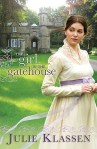
GatehouseI picked up The Girl in the Gatehouse by Julie Klassen when it was on sale for the Kindle because I had  enjoyed a previous book by the author, The Maid of Fairbourne Hall. Unfortunately I did not enjoy this book as much.

Set in the Regency era, this is a story of Miss Mariah Aubrey, who, due to some kind of disgraceful indiscretion we’re not made privy to at first, is sent away from her family to stay on a widowed aunt’s estate. She has fallen so far that she is not even welcomed into her aunt’s home: she is sent to live in the estate’s gatehouse. Only her former nanny and companion, Dixon, is with her, and they set up housekeeping. To supplement their meager stores, Mariah secretly and anonymously writes romance novels.

When her aunt dies, her cousin rents the manor house out to a Captain Matthew Bryant, successfully returned from the Napoleanic wars. Byant’s main purpose in living is such a place is to try to win back a high-society maiden who had previously rejected him, even though she in engaged to another. He meets Mariah in the meantime and they strike up a friendship, he is aware that there is some kind of cloud over her reputation.

There are several Jane Austen nods and epigraphs throughout the book, which I enjoyed. The author’s afterword says Bryant was inspired by Captain Wentworth of Persuasion and Horatio Hornblower, but I don’t think he lived up to either, personally.

The theme of the story is a good one, that though there are consequences for sin, there is grace a forgiveness from God and should be from others as well. Mariah is well-advised late in the story that “God is far more forgiving than people are, or than we are to ourselves. Society may never forgive and certainly never lets anyone forget. But God will forgive you if you ask Him” and “None of us gets through life without a tangle or two. Accept His mercy and move forward.”

But the story is disjointed in places, has some odd and unlikely plot twists, and has too many coincidences (three people on the same estate who have secretly published novels under a pseudonym unbeknownst to each other?)

Worse than that to me are unneeded references to things like Mariah being distracted by how Bryant looks in a wet shirt when she comes upon him as he’s just fallen into a pond. Do women notice and get distracted by such? Sure. But elaborating on it is just not needed. I wouldn’t want to read of the male character’s thoughts and distractions if the situation had been reversed, so why would I want to read of hers, either? Mariah also writes of what caused her own disgrace in her novel, and while it would serve (as she meant it to) as a cautionary tale to readers, it went too far. Dixon’s editing of one offending phrase in Mariah’s novel seems like an acknowledgement of that by the author, so I don’t know why she felt she needed to include it in the first place. References like this are sprinkled throughout the book:

“…aware of the modest display of decollete her simple gown allowed” (an oxymoron. NO “decollete” is modest.)

When Bryant helped guide her foot into a stirrup: “Warm pleasure threaded up her leg at his touch, innocent and pragmatic though it was.”

“She grasped the chain and fished the key from [her bodice]…Matthew forced himself to avert his gaze.”

“Miss Aubrey put her hands on her hips, causing her billowy dress to cling to her curves.”

Not only are these kinds of things unneeded, but their inclusion makes the story cheap and tawdry. I don’t remember any of this kind of thing in the previous book I read by this author and I hope they are not characteristic of her. If you’ve read any of her other books, I’d love to know, because some of them look interesting but I am just not going to read any more if they follow his pattern.

So, all in all I am very disappointed in what could have been a great story. Reviews are mixed on Goodreads. Amazon reviews are mostly positive, at least the ones that I perused. Some loved it, some did not. I did not.

(This will also be linked to Semicolon‘s Saturday Review of Books.)

Austen in August Challenge Wrap-up

Austen in August

Lost Generation Reader sponsored an Austen in August reading challenge for those who wanted to read something by, about, or related to Jane Austen during the month of August. I read:

Just Jane, A Novel of Her Life by Nancy Moser (links are to my reviews)

Dear Mr Knightly by Katherine Reay

Northhanger Abbey via audiobook, a reread and re-listen: linked to my original review from a few years ago.

I’m also currently listening to Persuasion.

I really enjoyed the challenge, although I neglected to check back with Lost Generation Reader throughout the month and missed some giveaways! She also had a variety in interesting posts about Austen and her work. I’ll know better next year!

Book Review: Seeking Allah, Finding Jesus

SeekingIn Seeking Allah, Finding Jesus: A Devout Muslim Encounters Christianity Nabeel Qureshi first gives a window into a loving and devout Muslim home, with all its practices, disciplines, and teachings, as well as a peek into the perspective of growing up Muslim in a non-Muslim culture.  Wanting to be a faithful representative of Islam, having been taught critical thinking in school and having a mind geared for it, he often turned the arguments of some of his Christian classmates on their heads, bringing up aspects they had not thought about before and were not ready to defend.

In college God brought to him “an intelligent, uncompromising, Non-Muslim friend who would be willing to challenge” him, someone who was “bold and stubborn enough” to deal with him but also someone he could trust “enough to dialogue…about the things that mattered to [him] the most.” Nabeel and his friend, David, were both on the forensics team and knew how to get to the heart of an argument and draw out and refute key points. For the most part they did this with each other’s worldviews good-naturedly, but when a given topic became too heated, they’d table it for a while. Muslims particularly have trouble with the reliability of the Bible, the deity of Christ, the Trinity, and the connection between Christ’s death on the cross and how it atoned for others’ sins. For three years Nabeel studied the Bible and its claims and others’ claims about it, fully confident that he’d be able to disprove those claims, and then to study the history of Mohamed and the claims of the Quran, fully confident that Islam would be justified. Though he was obviously biased toward the Quran, he really wanted to know the truth. He discovered the Bible’s claims were justified and Islam’s to be on shaky ground.

For some time he resisted acting on this knowledge. Being a Muslim was a matter of identity as well as religion: his whole life, everything he had always believed, his relationship with his family and community, everything would be turned upside down if he became a Christian. Yet he could not continue on, knowing what he now knew. In one of the most beautiful and touching passages in the book, he was seeking time to mourn before making the decision he knew he had to, and he opened the Bible for guidance this time, not simply to look for information to refute. He came to Matthew 5:4, 6:

Blessed are they that mourn: for they shall be comforted.

 Blessed are they which do hunger and thirst after righteousness: for they shall be filled.

Nabeel writes further:

There are costs Muslims must calculate when considering the gospel: losing the relationships they have built in this life, potentially losing this life, and if they are wrong, losing their afterlife. It is no understatement to say that Muslims often risk everything to embrace the cross.

But then again, it is the cross. There is a reason Jesus said, “Whoever wants to be my disciple must deny themselves and take up their cross and follow me. For whoever wants to save their life will lose it, but whoever loses their life for me and for the gospel will save it” (Mark 8:34-35).

Would it be worth it to pick up my cross and be crucified next to Jesus? If He is not God, then, no. Lose everything I love to worship a false God? A million times over, no!

But if He is God, then yes. Being forever bonded to my Lord by suffering alongside Him? A million times over, yes!

All suffering is worth it to follow Jesus. He is that amazing.

I feel I must comment on one aspect of the story that I questioned at first and I am sure other readers might as well: When Nabeel mentioned early on being “called to Jesus through visions and dreams,” I admit I inwardly winced and wondered what kind of story I’d be reading. For reasons too long to go into here, I am of those who believe that once God gave us His completed Word in writing, then dreams, visions, tongues, and the like fell away as unneeded.  The few modern instances I have ever heard or read of that seemed most in line with Bible truth were in cultures which didn’t have the Bible, often didn’t have a written language at all. Another problem with relying on dreams Nabeel discovered himself: one questions what it really means (his Muslim mother and Christian friend had completely opposite interpretations for what Nabeel’s dreams meant), wonders how much was due to wishful thinking, asks “Could I really hinge my life and eternal destiny on a dream?” etc. If that’s all he had to go on to become a believer, I would question what he was really trusting, but these dreams came after years of intense searching and study. In an appendix by Josh McDowell on this topic, he states, “Dreams and visions do not convert people; the gospel does,” but he explains, “In many Muslim cultures, dreams and visions play a strong role in people’s lives. Muslims rarely have access to the scriptures or interactions with Christian missionaries.” As in Nabeel’s case, “the dreams lead them to the scriptures and to believers who can share Jesus with them. It is the gospel through the Holy Spirit that converts people.”

One of many passages that stood out to me was in the chapter “Muslims in the West,” which described how Muslims view the West and Christians and, because they think both have corrupting influences and Westerners they are against Islam, they tend to keep to themselves. “On the rare occasion that someone does invite a Muslim to his or her home, differences in culture and hospitality may make the Muslim feel uncomfortable, and the host must be willing to ask, learn, and adapt to overcome this. There are simply too many  barriers for Muslim immigrants to understand Christians and the West by sheer circumstance. Only the exceptional blend of love, humility, hospitality, and persistence can overcome these barriers, and not enough people make the effort.”

I didn’t agree with everything Nabeel’s Christian friend said in the section about the Bible, in regard to believing some sections in the Bible were added later and not part of the original canon, but I do acknowledge that some do believe that.

There are multiple good aspects of this book: the window into another culture and mindset and the understanding of the difficulties a Muslim would have in coming to Christianity; the example of David and other friends who shared truth kindly and politely rather than belligerently or condescendingly, who genuinely cared about Nabeel as a friend rather than a “project”; the  wealth of information Nabeel found and shared from his studies which give a valuable apologetic (supplemented by several appendices>); and the touching yet agonizing conversion of a soul truly hungering and thirsting after the one true God.

This will also be linked to Semicolon‘s Saturday Review of Books.)

What’s On Your Nightstand: August 2014

 What's On Your NightstandThe folks at 5 Minutes For Books host What’s On Your Nightstand? the fourth Tuesday of each month in which we can share about the books we have been reading and/or plan to read.

Hard to believe we’re 2/3 through the year already and summer will be over before the next Nightstand. I’m glad to spend some of the passing time with good books.

Since last time I have completed:

Just Jane: A Novel of Jane Austen’s Life by Nancy Moser, reviewed here. Didn’t like this as much as I thought I would, but it is an interesting peek into her life.

Dear Mr. Knightley by Katherine Reay, reviewed here. Loved this!

On Stories and Other Essays on Literature by C. S. Lewis, reviewed here. Some excellent observations.

Gospel Meditations for the Hurting by Chris Anderson and Joe Tyrpak. Didn’t review this as it is just a 31-day devotional. The tone is not what I’d call warm and fuzzy, but the Biblical truths are right on target and helpful.

The Adventures of Sherlock Holmes by Sir Arthur Conan Doyle, audiobook, reviewed here.

The Memoirs of Sherlock Holmes, audiobook, reviewed here.

Northanger Abbey by Jane Austen, audiobook. This was a re-listen as I read it in 2008 and listened to the audiobook in 2013. My previous review is here.

I’m currently reading:

Undetected by Dee Henderson. Loving it.

Seeking Allah, Finding Jesus: A Devout Muslim Encounters Christianity by Nabeel Qureshi. Excellent.

The Girl in the Gatehouse by Julie Klassen. Enjoyed the first part – not enjoying the middle so much. We’ll see how it ends up.

Next up:

Why We Are Not Emergent: By Two Guys Who Should Be by Kevin DeYoung, Ted Kluck, and David F. Wells. This will finish my TBR Challenge list. I need to get it read and off my every Nightstand TBR section, but I wanted to take a break from my reading challenges with some fiction.

The Princess and the Goblin by George MacDonald for Carrie’s  Reading to Know Classics Book Club. I have been wanting to try MacDonald for some time and this book in particular.

Somewhere Safe With Somebody Good, NEWEST book by Jan Karon! Can’t wait! It’s supposed to come out in early September and I have pre-ordered it.

The Hound of the Baskervilles by Sir Arthur Conan Doyle.

The Last Bride by Beverly Lewis

In Perfect Time by Sarah Sundin

I’ve got some good reading to look forward to! How about you?

Book Review: The Memoirs of Sherlock Holmes

HolmesI’ve been going through the Sherlock Holmes books by publication date, but I was tempted to skip The Memoirs of Sherlock Holmes, which is another collection of short stories, and go on ahead to The Hounds of the Baskervilles, which I really wanted to get to. Then I remembered that Memoirs was the book where Holmes’ nemesis, Professor Moriarty, was introduced and where (slight spoiler here though it is well known and the title suggests it) the author seems to have killed off Holmes. According to Wikipedia he did so in order to spend more time on historical novels, but public pressure was evidently enough for him to bring Holmes back in a later book, saying that he had faked his death.

So I embarked on this collection of stories and was delighted to find that in addition to the above, this set introduced Holmes’ brother Mycroft (portrayed as smarter than Holmes but less energetic), shows Holmes as completely depleted physically due to one case, and shared one case where he totally missed the mark. Of the last, he told Watson, “If it should ever strike you that I am getting a little overconfident in my powers, or giving less pains to a case than it deserves, kindly whisper ‘Norbury’ in my ear, and I shall be infinitely obliged to you.” Holmes also shared with Watson the case that got him started investigating crime (I had wondered, with Watson, how a mind such as Holmes’ had gotten started on this particular career path.)

Holmes’ statement about having only one friend in college seems to conform his introversion: “I was never a very sociable fellow, Watson, always rather fond of moping in my rooms and working out my own little methods of thought, so that I never mixed much with the men of my year. Bar fencing and boxing I had few athletic tastes, and then my line of study was quite distinct from that of the other fellows, so that we had no points of contact at all.”

There is a story titled “The Adventure of the Cardboard Box” which was originally published in the American version of this book but later removed because two characters in it were adulterous. It was not in the version I listened to.

Overall I enjoyed this collection of stories. Doyle continued to avoid a formulaic approach, with each story and case showcasing Holmes’ skills without becoming repetitive. One of the best of any of his stories that I have read so far is “The Final Problem,” the last story in the book which introduces Moriarty and deals with Holmes’ apparent death. There is an intensity about it that is different from the others. I thought at first perhaps that was just my impression because I knew what the end would be, but then I read this is one of Doyle’s favorite stories as well.

I listened to the audiobook read by Simon Prebble. I had avoided his narrations up until now because I am used to his voice in the Jeeves books by P. D. Wodehouse, which are a completely different tone and feel than Holmes’ stories. But he adapted to the tone very well and soon I had completely forgotten that this was also the voice in my head for Jeeves and Wooster.

(This will also be linked to Semicolon‘s Saturday Review of Books.)


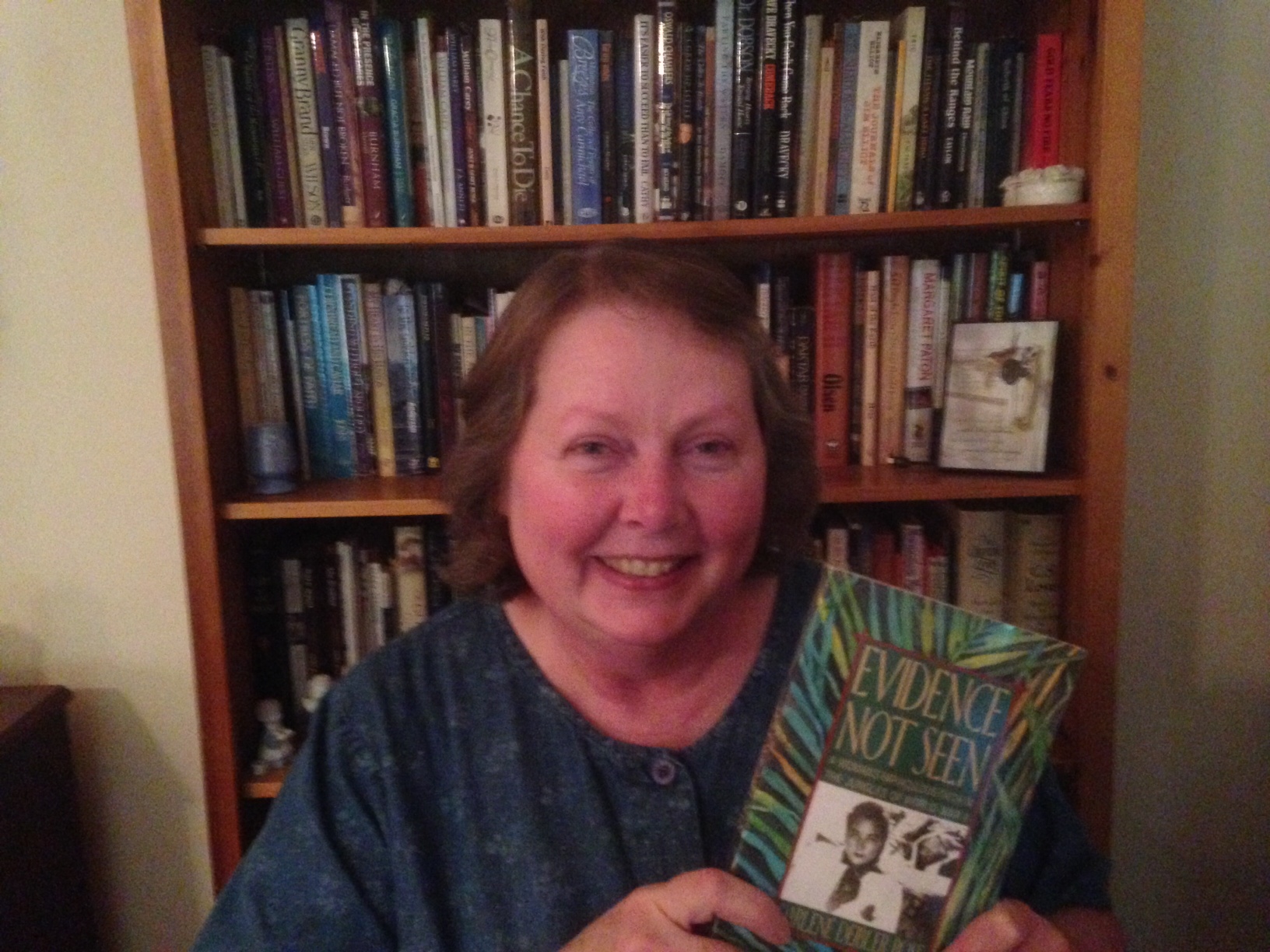
Carrie at Reading to Know is celebrating her 8th blogging anniversary with a giveaway of a $50 Amazon card, but to qualify she asks readers to post a photo of themselves with a favorite book.

The hardest part for me was choosing just one book. Of course the Bible would be the all time #1 favorite, and I don’t want to just take that for granted. In a recent book meme I had a hard time choosing just one book in any category. But Evidence Not Seen (linked to my review), about a missionary wife who was taken captive and confined to a Japanese prison camp during WWII, would definitely be up there in the very top echelons of my favorites.

photo 4

Book Review: Dear Mr. Knightley

Dear Mr KnightleyThe cover and title of Dear Mr. Knightley almost makes you think it will be a cute modern takeoff of Jane Austen’s Emma. But it’s far from that, and, oh my, so rich on so many levels.

Samantha Moore (known as Sam) has spent most of her life in the foster care system. Because of her past and being so often moved about, she finds it hard to relate to people: to protect herself from being hurt she hides her true self. She confesses, “I let go of people and relationships to protect myself, and then I detached so completely that I lost the ability to relate.” At one foster care home she discovered classic books. She became fast friends with Jane Eyre and loved the “safe, ordered, and confined” world of Jane Austen. Classic books became her refuge, and in many cases she responds to people by quoting them, thus hiding her real self.

When presented with the opportunity to receive a grant to go to graduate school, she decides to take it. One unusual stipulation is that the grantor wants to receive “personal progress letters” from her on a regular basis. To preserve his anonymity and give her more freedom to express herself, he goes by the pseudonym George Knightley. Sam accepts the conditions and finds school much harder than she thought and trying to open up and relate to people even harder. He letters to Mr. Knightley become “one-sided soul purgings,” made possible because of the anonymity and because she is sure they will never actually meet.

Much of the book unfolds her growth as a person and in her relationships, including one with a young hostile 14 year old who comes to the group home where she lives and with a couple of new friends at school. When she (literally) runs into her favorite contemporary author, who is speaking at a class in her school, she introduces herself and is invited to coffee, and so starts a tentative friendship with him. But just when she is learning to trust, will a betrayal set her back?

I don’t want to say much more about the plot than that, but I loved watching Sam’s growth. A quick glance at some reviews at Amazon and Goodreads showed that some readers thought she was “a jerk” and didn’t like her. But that’s the whole point: she comes across that way (not in her letters, but to her potential friends) in the “I’m going to drive you away before you drive me away” stance that many people who have been deeply wounded take to protect themselves. Watching the ups and downs of her beginning to realize how she’s been coming across, open up, take risks, learn to trust was full of pathos. Similarly, her naivete, which some criticized, was, I thought, quite understandable since she hadn’t been in any kind of a setting where people tried to teach her about life, the world, and relationships until she came to Grace House, a group home, as a teenager. She eventually learns that “self-protection keeps you from love.”

I also loved the multitude of classic book references and quotes, not only from Austen and Bronte, but also Dickens, Dantes (The Count of Monte Cristo), L. M. Montgomery, and C. S. Lewis. I especially liked a passage where Sam reads about Eustace becoming a dragon in The Voyage of the Dawn Treader and realizes her own dragonish tendencies and her need to be delivered from them. Sam (and Reay) loves many of the same books I do. We became friends when she wrote that “George Knightly is a good and honorable man – even better than Fitzwilliam Darcy, and few women put anyone above Mr. Darcy. Yes, Darcy’s got the tempestuous masculinity and brooding looks, but Knightley is a kinder, softer man with no pretense or dissimulation. Yes, he’s a gentleman. And I can write with candor to a silent gentleman, and I can believe that he will not violate this trust.” Yes! I’ve always liked Knightley better than Darcy.

I appreciated the way the faith element was brought in very naturally. Sam isn’t open to it at first because she thinks “He doesn’t pay attention to me. But…I want to badly to believe that God cares, that all of this matters to Him, that all this pain has a purpose and that none of it tarnishes me forever.” After her encounter with a couple who show her Christ’s love, who “drop hints and hope like bread crumbs for me to follow,” she writes, “How can I not believe that there is a God who exists and loves, when the people before me are infused with that love and pour it out daily? I still can’t grasp that it’s for me, but what if it is?”

I’m normally not a fan of epistolary novels, because not many people really write letters at all these days, much less letters full of plot points and dialogue, but I could easily set that aside and just get into the story and its telling in this way. Even though I think such letters are still probably unrealistic, the style fit this story well. This is the first novel I have been this wrapped up in in a long time, eagerly looking for ways to get in more reading throughout the day (the Kindle app on the phone is nice for that: it’s a little harder to read on a small screen but handy if you find yourself with a few minutes to spare here and there).

I had gotten this book when it was either free or very inexpensive for the Kindle app, and then had forgotten about it. I’m thankful the Austen in August reading challenge reminded me it was there. Katherine Reay is a favorite new author. This is her first novel, and I eagerly await more.

Austen in August

(This will also be linked to Semicolon‘s Saturday Review of Books.)