Book Review: The Incorrigible Children of Ashton Place, Book 1: The Mysterious Howling

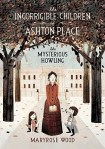
IncorrigibleI hadn’t planned on reading The Incorrigible Children of Ashton Place, Book 1: The Mysterious Howling by Maryrose Wood, but I had seen the title on different people’s book lists, and when I saw the audiobook was free (through today, June 12) via Sync, I decided to give it a try. I’m so glad I did.

The story involves a star graduate from Swanburne Academy for Poor Bright Females, Penelope Lumley, age fifteen, who is taking up her first assignment as a governess. Her charges are unusual: two boys and a girl with somewhat…canine tendencies, having been raised by wolves. Lord Ashton found them, but Lady Ashton is less than pleased.

Penelope is up for the challenge, which has its various ups and downs, along with several mysteries: How did the children come to be living alone in the woods? What happened to Penelope’s own parents? Why does Old Timothy, trusted servant and coachman, seem to be lurking about when Penelope is outside with the children?

The writing is a delight, with the quirky flavor of the Lemony Snicket and Mysterious Benedict Society books and an abundance of colorful similes, odd sayings of Swanburne’s founder (“If it were easy to resist, it would not be called chocolate cake”), amusing asides, and references to Dickens and Sherlock Holmes.

Katherine Kellgren’s reading brought the book wonderfully to life, with a variety of accents and tones for the different characters.

I’m hooked, even though it is technically a children’s book (but then, some of the best books adults love are children’s books, e.g, Narnia, Anne of Green Gables. etc). I already checked out the second book from the library.

(This will also be linked to Semicolon‘s Saturday Review of Books.)

And Carol‘s Books You Loved.

Books you loved 4

The Hidden Art of Homemaking: Chapter 8: Food

Chapter 8 of The Hidden Art of Homemaking by Edith Schaeffer, which we’re discussing a chapter at a time at  The Hidden Art of Homemaking Book Club hosted by Cindy at Ordo Amoris, is about food.

Once again Edith emphasizes that in this area as in all others, we have to balance time, money, energy, and priorities, and there will be times when food has to take a back seat to other things going on. But God has created a variety of foods that are both nutritious and beautiful to look at and has given us the taste buds, sense of smell, and eyes to enjoy them. She has some interesting observations on the manna that God provided the Israelites with during their travels in the wilderness, and notes that God could have made all food like that – nutritious compact packets – but that was just temporary “traveling food,” and for all the rest of time He’s allowed a great variety to enjoy.

Food is a major aspect of hospitality, and she emphasizes that the people Jesus said to include are not just old friends or people we’re trying to impress, but also “the least of these.”

I have to admit that I am relieved that this chapter is not what I thought it was going to be. I remember learning how to make radish roses in a high school Home Ec. class and thinking it was such a waste. She is not talking about providing extravagant meals or elaborate garnishes, but enjoying simple food prepared and offered with the simple artistry of a variety of colors, shapes, and textures. Although my husband appreciates the effort behind a nice meal, I think he would much rather have something simple and peaceful than something that takes hours and wears and stresses me out.

On the other hand, Edith describes a tramp coming to her door to ask for food, and instead of reluctantly thrusting whatever was at hand out the door at him, she made him a tasty and nice-looking sandwich and soup on a tray complete with flowers. Those little touches and efforts can convey, “You matter, and I care.”

Food cannot take care of spiritual, psychological and emotional problems, but the feeling of being loved and cared for, the actual comfort of the beauty and flavour of food, the increase of blood sugar and physical well-being, help one to go on during the next hours better equipped to meet the problems (p. 124).

One of the most well-known quotes about Edith herself, though I don’t know the source, is “As many people were brought to the Lord through Mrs. Schaeffer’s cinnamon buns as through Dr. Schaeffer’s sermons!”

I confessed some years ago that I don’t really like to cook a lot of the time, but I like to eat, and they sort of go together. 🙂 I recognize that it is a ministry to my family and part of my job description, and once I get going I’m ok with it. I just usually dislike having to stop whatever else I am involved in to go make dinner, but we all have to do things like that. I’m sure my husband doesn’t feel like going to work every day, either, but thankfully he does.

In discussing the last chapters, I’ve showed pictures of things I am pleased with: this time I am going to show you some of my epic fails, because I have had more of those in cooking than anything else. Enjoy. 🙂

Failure

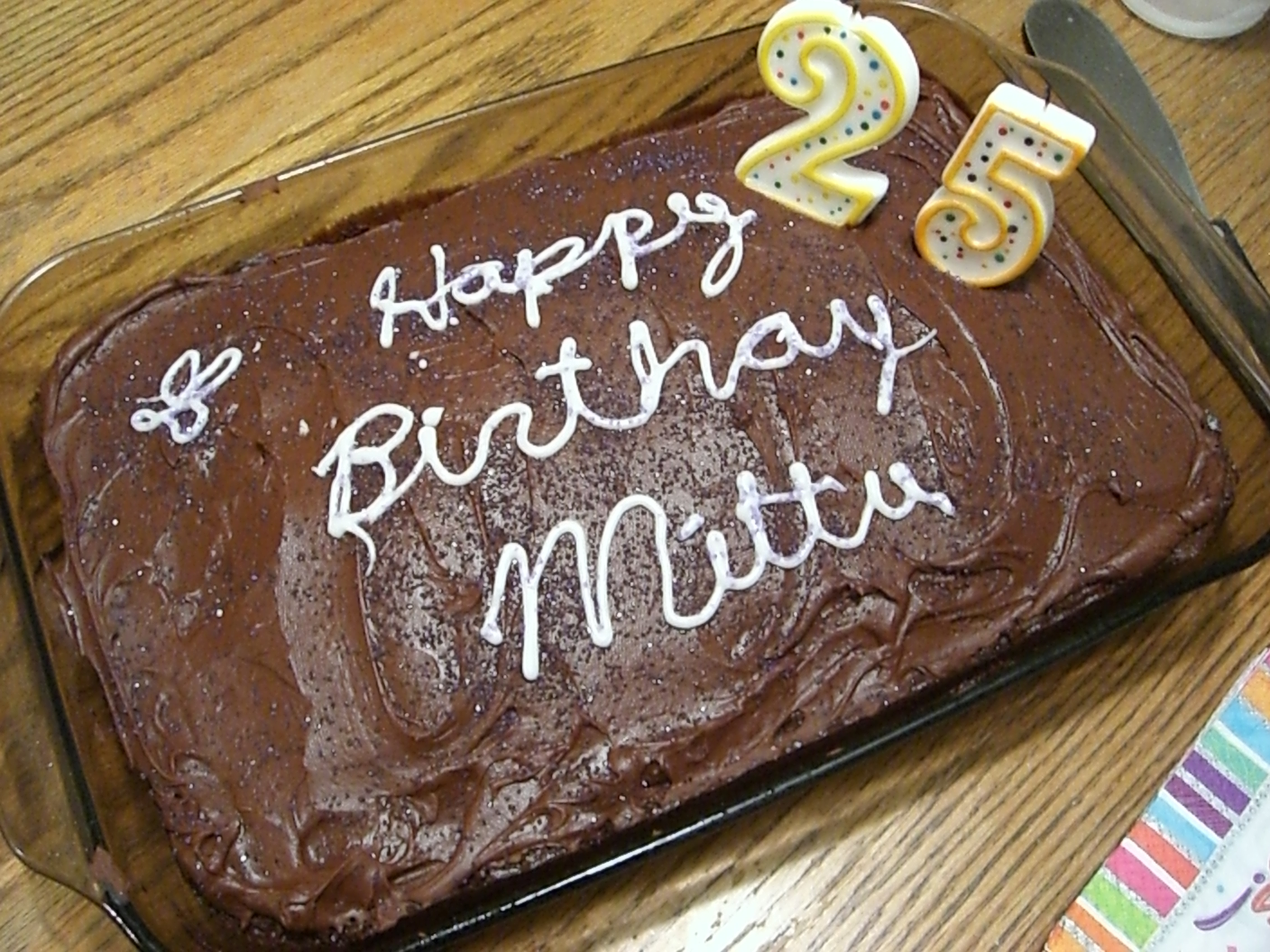
One day I posted just this picture with the title “This is how my day has been going.” That was supposed to be for a ladies’ function at church the same night, so I had to come up with a plan B. I did dig the rest of the cake out of the pan, put it on the platter, covered it with glaze, and we enjoyed it as a family. It did taste good even if it didn’t look so good!

image01.jpg

These were supposed to be little Muppet-looking cupcakes, but the runny green icing made them look like baby swamp monsters.

Cake decorating has never been my forte, but I used to be able to spell.

And then there was the green gravy. One day years ago I was trying to make gravy that wasn’t turning as brown as I wanted it to. I had heard somewhere that mixing red and green make brown, so I added a few drops of red and green food coloring into the gravy. It turned green, and no amount of added red food coloring drops would change it to any other color. That time, instead of crying into my gravy, I started laughing hysterically until my husband came to see what was going on. But I couldn’t eat it. The strange greenish color was revolting. (I rarely make gravy, but these days I eat it whatever color it ends up being.)

And then there was the time I reached for the cinnamon instead of the chili powder for chili mac. That turned out….interestingly. And the time I accidentally grabbed baking soda instead of corn starch for teriyaki – that made it foam like a science fair volcano. I scooped out the foam and tried to rectify it, but it was still so salty that we were drinking fluids all evening to counterbalance the extra sodium in our systems, and my husband can’t eat my teriyaki to this day.

Thankfully I’ve had more successes than failures, and though I’m not the best cook in the world, my family likes it enough to keep coming back for more, and we appear to be relatively healthy. 🙂

Some other cooking-related posts here that you might enjoy:
Cakes Are My Culinary Waterloo.
Cooking style.
Cooking experiences.
Food flashbacks.
Encouragement for Homemakers.

Book Review: The Merchant’s Daughter

Merchants daughterI picked up The Merchant’s Daughter by Melanie Dickerson on Lisa’s recommendation.

It’s the story of Annabel Chapman in the England of 1352, whose merchant father has died and whose proud family refuses the duty of every villager to work in the lord’s fields. As punishment, someone from her family is required to be his servant for three years, and Annabel offers herself for that position.

Lord Ranulf le Wyse is said to have a very short temper and to have some sort of deformity, making him repulsive to look upon and frightening to Annabel, but she soon discovers a different side to him.

Meanwhile, the bailiff, old enough to be her father and disgusting, has set his sights on her. Unfortunately, her duties at the lord’s house bring her into more contact with him, and even worse, her brother has given the man permission to pursue her.

Annabel feels the only way to both escape the bailiff and have access to the Bible she longs to read for herself is to escape to a nunnery as soon as her servitude is over, but when the opportunity arises, she questions that desire.

This story is based loosely on Beauty and the Beast, so of course I knew where it was ultimately going, but that was actually fun, to see how it corresponded to the fairy tale. It is a realistic retelling, though – no magic wands or spells – but I enjoyed that.

Probably my favorite parts involved Annabel being asked to read the Bible to Lord le Wyse since she is one of the few people in his household who can read Latin. Reading the Bible for herself (not everyone had one: even the local priest did not) has been one of her lifelong desires, and it’s a joy to watch her pore over it and discover its treasures for herself, stopping in her reading to ponder what it says.

This book was a pleasant companion on a recent “sick day,” and I thoroughly enjoyed it. I’m looking forward to checking out Melanie’s other books.

Here’s the book trailer for The Merchant’s Daughter:

Updated: I just discovered that the Kindle edition of this book is on sale for a limited time at $2.99. You don’t have to have a Kindle to get deals on Kindle books: they have apps for computer, tablets, and phones.

(This will also be linked to Semicolon‘s Saturday Review of Books.)

And Carol‘s Books You Loved.

Books you loved 4

The Hidden Art of Homemaking, Chapter 7: Flower Arrangements

It’s Week 7 of  The Hidden Art of Homemaking Book Club hosted by Cindy at Ordo Amoris where we’re discussing Edith Schaeffer’s book, The Hidden Art of Homemaking a chapter at a time.

Chapter 7 focuses on flower arrangements, and Edith reiterates that one need not become an “expert” or go to great expense or study to incorporate the principals she discusses. She mainly discusses centerpieces, arguing that at the table there “should be something to bring realization, a warmth of knowing that someone has taken thought and put some originality into preparing the place where food and conversation are going to be shared” (p. 100).

She argues that this should be done even when it is just the family at table or when one is alone, that it shouldn’t wait for “company.” “There is a ‘togetherness’ in sharing a prepared table that even very small children feel, although they cannot express it verbally. Instead of saying, ‘Oh, it doesn’t matter, it’s only the children,’ when you are alone with children for a meal, it is important to say the opposite to yourself. ‘I wonder what the children would enjoy most.'” (p. 104).

And centerpieces don’t even have to be flowers: she lists several suggestions using shells, mirror, candles, etc.

I have to admit that although I agree with what she says, we have never used centerpieces at the dining table. There just isn’t room. When passing food around at dinner, I think everyone here would rather be able to do so easily without having to work around something decorative in the middle. Our usual “centerpiece” is a cute napkin holder and the salt and pepper shakers. I do like to use nice tablecloths on holidays, but most of the time we use the table all through the day for other purposes, and I don’t want to have to keep moving a centerpiece in and out of the way.

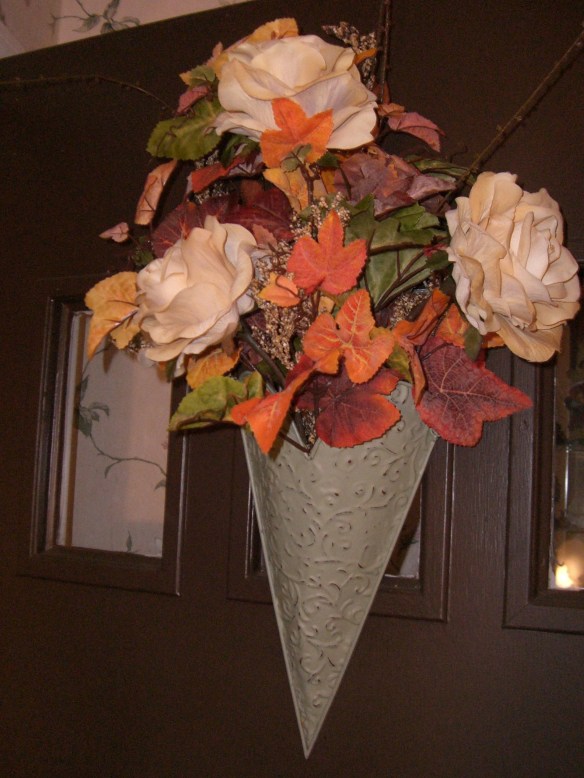
But I do have artificial flower arrangements in several rooms and think they are a great way to add color and brightness. I have a couple of “wall pockets” for the front door where I can toss in a few seasonal flowers.

CIMG3233

Roses and Hydrangea door ornament

And I like to get fresh flowers every now and then, especially in winter when there is nothing much growing and I long for some color and beauty. But even a few flowers from something outside in a vase on the windowsill is a nice touch.

Photo Sharing and Video Hosting at Photobucket

One good point she makes is that people tend to send an overabundance of flowers when a person is in the hospital, but then nothing during a long recuperation, so she suggests sending one simple flower or arrangement (not big expensive florist’s concoctions) each week or so to cheer the convalescent.

One of my favorite quotes so far in the book which could be a theme for the whole book is this:

“If you have been afraid that your love of beautiful flowers and the flickering flame of the candle is somehow less spiritual than living in starkness and ugliness, remember that He who created you to be creative gave you the things with which to make beauty and the sensitivity to appreciate and respond to His creation” (p. 109).

Although I don’t do centerpieces at home, I’ve enjoyed trying to come up with something unusual for our annual Ladies’ Luncheons for several years in our former church, and I thought you might enjoy seeing some of those. I looked for something unusual for two reasons: for one, I am not that skilled at flower arranging. Years ago a friend who had a florist shop in her home taught me how to do bud vases and corsages and hired me when she was super-busy, but I could never manage bigger arrangements. She could toss something together in 15 minutes that look gorgeous, and I could get the major flowers in ok, but agonized over filling it in. It took me forever and never looked right. The second reason was just that I liked to do something different each year rather than a water bowl with floating candles or flowers in it every single year. So, here are a few things we came up with:

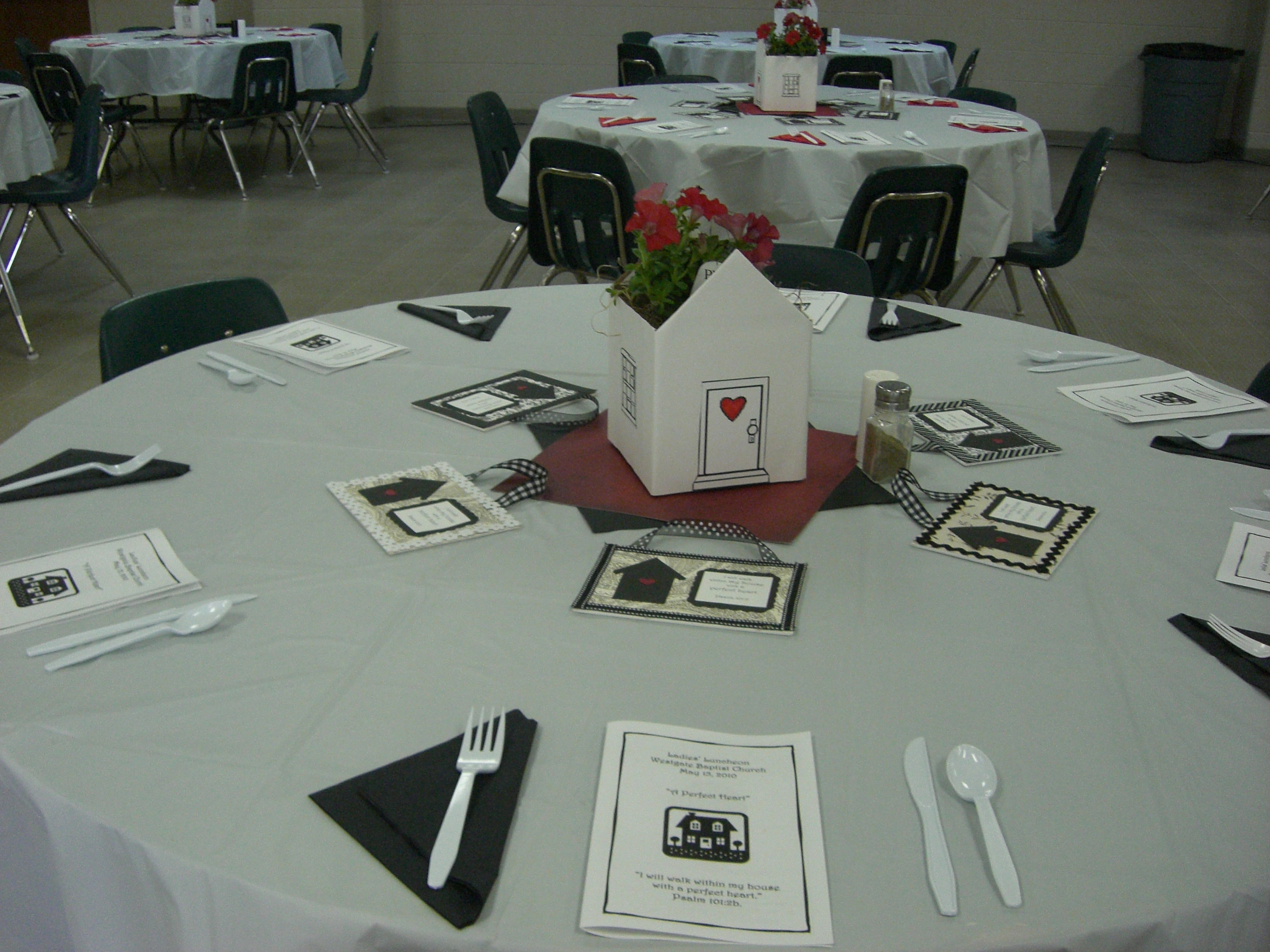
The theme of this one was “A Perfect Heart” from Psalm 101:2b: “I will walk within my house with a perfect heart.” The favors around the centerpiece had that verse as well as a little house with a heart on the front door, and the centerpiece was a covered cardboard box made to look like a house with a potted petunia in the center.

Ladies' Luncheon 09

I don’t remember the exact name for the theme for this one, but the program centered around a one-woman interpretation of one of my all-time favorite books, Evidence Not Seen by Darlene Deibler Rose. We chose the rose, of course, because the author’s last name is Rose, and gold because of the overarching theme of faith in her life (I Peter 1:7: “That the trial of your faith, being much more precious than of gold that perisheth, though it be tried with fire, might be found unto praise and honour and glory at the appearing of Jesus Christ.”) One of my favorite things about this one was the gold curlicues – they had been red and we spray painted them gold.

CIMG0751

cimg0748.jpg

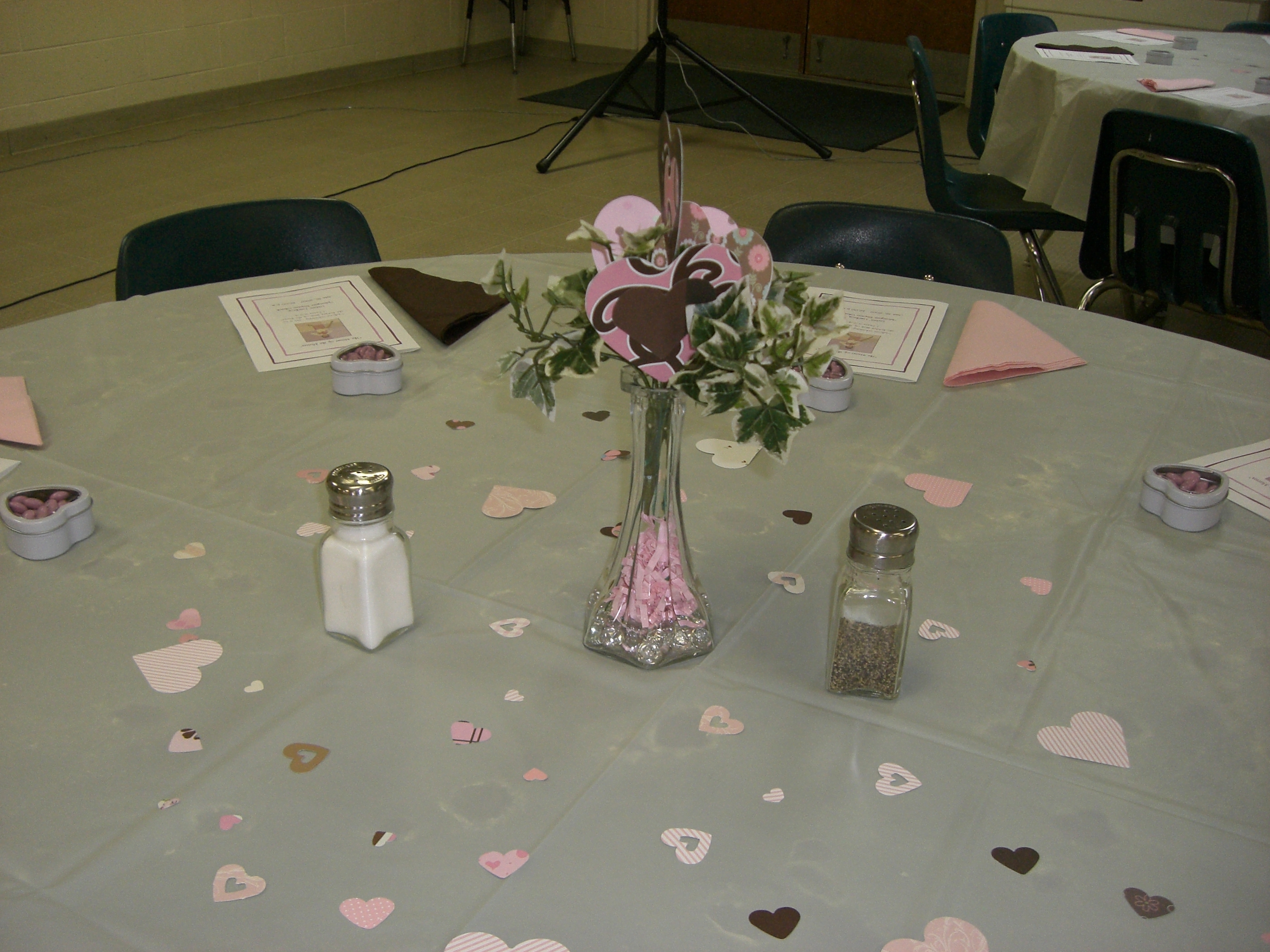
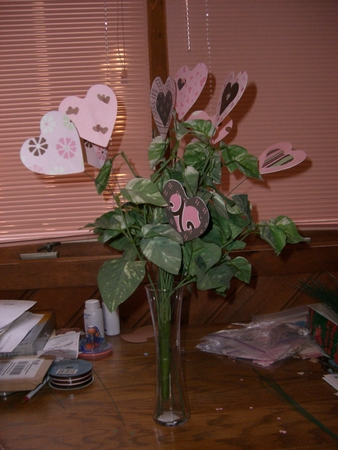
The theme of this one was ““The Heart of the Matter” from I Peter 3:3-4: “Whose adorning…let it be the hidden man of the heart.” The hearts were cut from scrapbooking paper: thankfully I had little punches for those shapes, so we didn’t have to cut them by hand.

Dresses

These were the centerpieces in progress for the theme “The Well-Dressed Woman from Ephesians 4:21-24: “If so be that ye have heard him, and have been taught by him, as the truth is in Jesus:  That ye put off concerning the former conversation the old man, which is corrupt according to the deceitful lusts; And be renewed in the spirit of your mind; And that ye put on the new man, which after God is created in righteousness and true holiness.” I did go back later and cover the Styrofoam with Spanish moss and little paper flowers.

Those are all the ones I have pictures of in the computer: the other photos are in shoeboxes I need to do something with some time. But one of my favorites was on the theme of patterns from Titus 2:7, “In all things shewing thyself a pattern of good works,” and on each table we had a different craft and patterns: a bowl of yarn balls and knitting needles with crochet and knitting patterns in one, a few dress patterns and piece of fabric on another, etc. For another, the theme was “A Woman’s Adornment,” from I Peter 3:3-4, and we borrowed vanity trays from the ladies at church and set them with sets of gloves (also borrowed), little buttons that looked like brooches (from Michael’s), and little bottles that were meant to look like perfume bottles (I had originally wanted perfume atomizers, but they were hard to find and expensive) and a single rose.

I almost didn’t include these since they are churchy and not homey, but thought they might be useful in sharing some ideas that aren’t always “traditional” centerpieces. One of my Pinterest boards is Table settings – I like the simplest ones best. I might add some of them in to the Hidden Art of Homemaking Board.

More discussions on this chapter can be found here.

Join Us Reading Through Gates of Splendor in June

Reading to Know - Book Club

Carrie’s Reading to Know Book Club has been featuring classics this year, trading off between adult and children’s classics. Carrie asked several blog friends to choose a book for each month. I was honored to be asked, but had a hard time deciding on which of multitudes of favorite books to choose. Finally I decided I wanted to include a missionary classic, which is one of my favorite genres, and Through Gates of Splendor by Elisabeth Elliot seemed recent enough and its story well-known enough that I felt it would be accessible to anyone who wanted to read it.

Through Gates of Splendor was, I believe, the first missionary book I ever read, sparking a lifetime of exploring other missionary books and Elisabeth Elliot’s writing. I’ve read it multiple times since. I listed it among the 98 Books That Have Enriched My Life and Books to Read Before You Die. It’s the story of how five men and their families came to minister together together among Indians in Ecuador, how they became interested in what was then known as the Auca tribe, fierce warriors who killed any outsiders (as well as their own tribesmen), how they determined to try to reach them, how they went about it, how they were killed, and how a wife of one man and sister of another were eventually given the opportunity to live with this tribe.

It’s not just fascinating for the sake of the story: it’s fascinating to read how each of these very different men and their wives came to know the Lord and then felt called to their particular field. These men didn’t know, when they went to the mission field, that they would be martyrs, though once they began to consider reaching the Aucas, they knew it was a possibility. But they each gave their lives to God to use in any way that He saw fit, and their faith and walk with Him is inspiring.

Some like to watch the films of books along with or after reading, so you might be interested to know there is a DVD called Through Gates of Splendor here (it seems to be also on YouTube here), narrated by Elisabeth Elliot, using footage that she, Nate Saint, and Life Magazine had taken. Also several years ago the film “End of the Spear” (linked to my thoughts) came out. The book is much deeper and fuller, and some have various problems with the film, as I discussed, but it’s okay if you want to see a general visualization. I would highly recommend Beyond the Gates of Splendor: it is a documentary made fifty years after the events of the book. Here is an excerpt:

At the wrap-up post at the end, I’ll have some other resources for those who might want to read more about those involved in this story which has been used by the Lord in remarkable ways.

If you’d like to join in the Carrie’s Book Club to read it, just leave a note at her place saying so, and at the end of the month she’ll have a post where all those who read it can post comments or links to their own blog post about it. That’s one of the most fun parts of this book club: discussing the book we’re reading with others.

Book Review: Island of the Blue Dolphins

Blue DolphinsIsland of the Blue Dolphins, by Scott O’Dell, was selected by Amy at Hope is the Word for Carrie’s Reading to Know Book Club for May. I’m running a little behind with it – first I forgot about this, then the local library didn’t have it on its shelves (though its web site said it did), and I had to put it on hold and wait for it. But it is a fairly quick read, so it didn’t take long to get through it. The cover to the left is the cover on the one that I read, a 50th anniversary edition.

I wanted to read it partly because I’d heard the name for years and wanted to see what it was about, and partly because Scott O’Dell authored one of my favorite books for young people that I read years ago, The Hawk That Dare Not Hunt by Day about William Tyndale.

The book is based on the true story of a woman known as Juana Maria, or the Lone Woman of San Nicolas Island, who was found alone on San Nicolas Island off the coast of California in the 1850s. No one could understand her language, but she was thought to be the last member of the Nicolenos who had lived on the island but were massacred by Aleuts who had come there to hunt otter. A mission on the California coast sent a ship to rescue the remnant of the tribe, but somehow a young girl was left behind (there are various versions of how and why she was left). The ship made it back to California, but bad weather and then the sinking of the ship and the shortage of other available ships meant no one could go back to pick up this one girl. She was discovered about twenty years later.

Scott O’Dell took the bones of the story and imagined what a young girl alone on an island would have had to deal with. He named her Karana. As you can imagine, finding food and shelter would have been the first order of business, and she would have faced various dangers, such as wild animals, storms, other visitors to the island, etc. The great majority of her time would have been spent in providing for herself and making what she needed as well as exploring the rest of the island.

O’Dell did a great job imagining what kinds of things she might have done and thought. I’m not sure whether he researched what similar tribes did or just used his imagination to describe how she used various plants and animal parts for weapons, tools, and shelter.

At the beginning she had no problem killing animals for either food or skins or feathers or tools, but as she gradually befriended some, in the absence of anyone else available for friendship, she decided she couldn’t kill any more.

I wasn’t just totally blown away by the book, but it was definitely interesting, and I am glad to have read it.

(This will also be linked to Semicolon‘s Saturday Review of Books.)

Book Review: Introverts in the Church

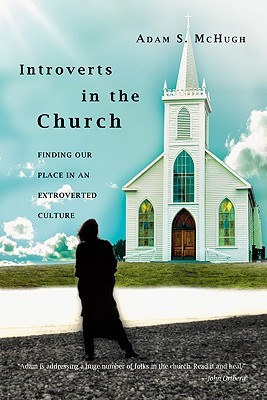
IntrovertsI came across Introverts in the Church: Finding Our Place in an Extroverted Culture by Adam S. McHugh around the same time that I came across Quiet: The Power of Introverts in a World That Can’t Stop Talking by Susan Cain (linked to my review). Susan’s book was somewhat clinical and historical, and I thought Adam’s would be a nice complement to hers, with spiritual applications.

It was and wasn’t. Some parts of the book were extremely helpful, but some of it totally turned me off.

One of the main characteristics of introverts is that they’re energized by solitude. They’re not hermits, not all are shy, they do like socializing to a degree, but it drains them, whereas extroverts are energized by socializing. They also process things differently. Extroverts process by talking with others: they can speak and think at the same time, though sometimes they are more prone than introverts to speak before thinking (e.g., Peter). Introverts process things internally and take longer to do so, so sometimes they miss speaking up because they’re still trying to figure out what to say. Extroverts can handle a lot of stimulation: introverts, only so much. Introverts also “prefer depth over breadth” (p. 41). That doesn’t mean that extroverts have no depth: it just means that introverts may have only a few very close friends rather than a great number of casual friends, generally hate small talk, prefer to fully explore a few interests rather than experiencing a smattering of interests.

McHugh starts off by making the case that church life seems to be set up more for extroverts than introverts (see the post on his blog, The Top Five Things Introverts Dread About Church, one of my all-time favorite posts ever). He cites a survey indicating more people than not thought Jesus was an extrovert (though McHugh lists several qualities of both the introvert and extrovert from what we see of Jesus’s life and suggests that Jesus was the perfect balance between the two), examples of equating spirituality with sociability, of a church atmosphere resembling a “nonalcoholic cocktail party” where “there is a chatty, mingling informality…where words flow like wine” (p. 21) rather than quietness and reverence.

Introverts tend to process things slowly, so they might lag behind in conversation and therefore be uncomfortable. They prefer having more involved, meaningful conversation with one or two people rather than glad-handing everyone they see. They “can faithfully sit in the back pew of worship services, rarely talking to anyone and still feel a genuine connection to the community (p. 93). They probably prefer quieter forms of church worship and wouldn’t mind some intervals of silence in order to think and process.

McHugh emphasizes that neither approach is right or wrong, and most of us have some mixture of introvert and extrovert in us, though most of us are usually stronger one way than the other. He asserts that, just like there are a variety of spiritual gifts withing the church that are supposed to interact to make up the body, so the church needs different personality types, partly so that we can minister to different personality types. There are valuable ways introverts can minister that may not look just like the way extroverts do, and that’s ok. An introvert doesn’t have to change his personality to “fit in” God’s kingdom, though McHugh acknowledges that we all need to be stretched out of our comfort zones sometimes.

He cites various ways introverts can be misunderstood or can feel they don’t fit in. He tells of a few people whose pastors thought that fostering community meant having a lot of church activities and groups, and one was thought less than spiritual if one did not attend all or most of these, yet the introverts found them exhausting.  Introverts may be thought standoffish. I admit I have seen some of this. Recently a pastor who is usually very gracious equated being “quiet and bashful” with being “self-absorbed,” and the solution seemed to be to stop being quiet and bashful rather than to find ways a quiet and bashful person can minister (although, as I said above, we do need to extend ourselves past our comfort zones sometimes, but anyone can be self-absorbed, introvert or extrovert). Those kinds of things hurt, yet I can’t say I carry the sense of woundedness McHugh seems to, but he does have a chapter on “Finding Healing” for those who do.

He does have some admonitions for introverts that I found helpful:

“It is natural for introverts to distance themselves from others to do the necessary work of internal processing, but too often we use that as an excuse for avoiding others, even when we have the social energy to engage” (p. 52).

We are “susceptible to an unhealthy degree of self-preoccupation” and “become mired in our inner worlds, to the exclusion of relationships and actions that would bring …healing and joy” (p. 59).

“Our inner reflections can become excessive to the point of inaction. Introversion should never be an excuse for laziness or sin. Understanding our introversion is not the end of our self-discovery and growth; it is a beginning point for learning to love God and others” (p. 59).

“The love that is the ultimate goal of the Christian life cannot be restricted to inner stirrings, but it must be expressed in self-sacrificial action. Healing will come en route. We stretch as we take risks and move beyond our comfort zones” (p. 59)

“We bless the body of Christ when we express our gifts within community and when we love at personal costs to ourselves” (p. 60).

“When we use our introversion as an excuse for not loving people sacrificially, we are not acting as introverts formed in the image of God. We who follow a crucified Messiah know that love will sometimes compel us to willingly choose things that make us uncomfortable, to surrender our rights for the blessing of others. We worship a God ‘who by the power at work within us is able to accomplish abundantly far more than all we can ask or imagine’ [Ephesians 3:20]. We must be always be open to the sovereign God who can shake us to our cores, who gives us the strength to transcend our humanness and to do things we never thought possible” (p. 63).

“Even when our resources are at their lowest point, even when we have nothing to offer, we work out of a power that can take our scant reserves and overwhelm people with a mercy that heals both body and soul” (p. 65)

“Sometimes we play the ‘introvert card’ in order to avoid taking a risk or doing something uncomfortable” (p. 136).

“Introverts may need to keep struggling through greeting times at church, because we need the constant reminder that the Christian life is never lived in isolation” (p. 193).

“God may call some people into a work for which they are not perfectly suited, for His greater glory” (p. 138).

“When Moses objected to God at the burning bush, saying that he was a clumsy speaker, God did not disagree with him…The power of the Holy Spirit gives us the ability to do things we couldn’t do otherwise” (p. 138).

But while we need to extend ourselves, there are things churches can do to minister to introverts and enable them to connect and minister. He doesn’t suggest that churches should “coddle” introverts or “create yet another target audience” (p. 193), but one of the main things churches can do is to recognize that there are different ways to energize, lead, worship, experience community. He spends much of the book discussing these factors.They can stop “communicating to introverts that their ways of living and relating and worshiping are inferior or unfaithful” (p. 193) and realize that though we hold to the same “paramount, indispensable values” (p. 23), we may have different ways of expressing them. “The truly healthy church is a combination of introverted and extroverted qualities that fluidly move together. Only in that partnership can we capture both the depth and breadth of God’s mission” (p. 30).

Someone I read thought he focused too much on leadership rather than lay people, but I didn’t think so personally: there are two chapters specifically on leadership, and many of his examples involve pastors, but I found much I could glean and apply to myself even within those chapters.

I found the majority of the book very helpful, but I had major problems with the chapter on “Introverted Spirituality” and some of the chapter on “Introverts in Church”. He recommends several Eastern practices that “move beyond the senses” (p. 70) and mystical and Catholic practices that I would be uncomfortable with. I do agree that “words and tangible images are signs pointing to God, but they are not God Himself” (p. 71), and that God said, “as the heavens are higher than the earth, so are my ways higher than your ways, and my thoughts than your thoughts” (Isaiah 55:9), but I very strongly disagree that “words have a way of trying to control Him” (p. 71) or that we need to seek Him beyond words, especially the very words that He breathed out for us to have until we see Him again. A former pastor used to call the Bible “divinely brief” – of all the infinite number of things God could have said and conveyed to us, this is what He wanted us to know and think about and learn from. In the chapter on “Introverts in the Church,” he opens the chapter with a quote from Neil Postman that “If an audience is not immersed in an aura of mystery and symbolic otherworldliness, then it is unlikely that it can still call forth the state of mind required for a nontrivial religious experience” (p. 187). Though there are times when we can be humbled and amazed by God’s “otherworldliness” and transcendence, and though there are mysteries in the Bible and about God Himself that we can never fully fathom, I don’t think worship is “mystical.” A speaker I used to hear in college called worship “worth-ship” – ascribing to God and acknowledging His worth, His majesty, glory, holiness, and His abundant other qualities – which we learn of through His Word, not “beyond our senses.” Peter, James, and John had one of the most amazing spiritual experiences ever when they saw Christ transfigured before their very eyes, yet when Peter referred to it, he went on to say we have a “more sure word of prophecy” in the Scripture than even that experience. I am also wary of a prayer form that involves “silence to quiet the mind and focus on a sacred word or phrase. Apophatic prayer tries to rid the mind of all images and forms so as to be open to encounter directly the Mysterious One. It is the desire of the meditator to listen to God rather than talk to God” (p. 71). I have read suggestions that the focusing on a single word or phrase while meditating may be an occultish practice. I don’t know about that, but I do know that Biblical meditation is not an emptying of the mind but rather a using the mind, mulling or thinking over. Right when I was in the midst of this book, I was at home from church sick one day and listened to a sermon by Jim Berg on “Let the Word of Christ Dwell in You Richly” from Colossians 3:16. He defined meditation as “peering intently with purpose” involving concentration, purpose, and focus on a particular passage. I’m not saying that every single practice McHugh mentions is wrong (though there are some I am more uncomfortable with than others) or that Christians might not be able to use some of them in beneficial ways, but I am very wary of extra-Biblical practices, and strongly disagree that introverts need to seek this kind of spirituality. Besides all of that, I am just more practically minded. When he was writing of a specific form he likes to use in prayer, my thought was, “Well, ok, if that helps you. But some of us just like to talk to God in prayer.” Admittedly sometimes my thoughts get scattered in prayer, and when they do I go back to what we call the Lord’s prayer (not to say it in a rote way, but to use it phrase by phrase as a jumping-off point) or the Psalms or one of the New Testament prayers like Colossians 1:9-14 or Philippians 1:9-11.

So…as I said at the beginning, much of the book was extremely helpful, but some of it raised some red flags for me.

(This will also be linked to Semicolon‘s Saturday Review of Books.)

The Hidden Art of Homemaking: Gardens and Gardening

It’s Week 6 of  The Hidden Art of Homemaking Book Club hosted by Cindy at Ordo Amoris where we’re discussing Edith Schaeffer’s book, The Hidden Art of Homemaking a chapter at a time.

Chapter 6 discusses “Gardens and Gardening,” and Edith applies some of the same principles as in other chapters, that people don’t necessarily need to become experts, get a degree, start a farm, etc., to participate and benefit by doing a little gardening, but they can start small, as she did with what we would call now container gardening, or with a small space of land. She lists many of the benefits of gardening (exercise, contributing to rather than taking from the environment, the pleasure and anticipation of planting something and watching it grow, etc.) and a few of the many Biblical allusions to planting.

And while I understand and agree with all of that, I have to confess, I am no gardener. My husband had a garden for a few years, but it was a battle royal to keep bugs from destroying it, and at certain times of the year it was more pressure that relaxation to keep up with it. I have not been able to spend more than a very few minutes on my knees since TM, even with a pad, so I am not keen to go start a garden myself. I have thought of starting some squash growing in a container or two, since often what I find in the store is so sad-looking, and have also thought of growing some herbs. I’d have to figure out better ways of battling the bugs – I cringe at spraying pesticides over something I am going to eat.

I do a little better with ornamental plants. Somehow both at our former house and this one, rose bushes have flourished despite me, not because of me. I think some of my first plants were hanging baskets, just the basic petunias, impatiens, and begonias. Last year I tried verbena for the first time, and this year some blue lobelia and pink Gerber daisies. At our last home there was a purple hydrangea bush that I just loved and wanted one here: the one I planted last year is putting forth buds (I can’t remember what color I bought, though. 🙂 Either pink or blue, as they didn’t have purple, but I think the color of the bloom primarily depends on the soil, anyway. I’m excited to see how they turn out). I do want to plant some bulbs some time for early spring blooms.

With this chapter, as well, as the others, if we have little or no experience at all in the given topic, we can start out small, learn as we go, and expand. I do enjoy walking around the plant sections at stores and seeing what kinds of things are there and wondering how I can incorporate them.

I do love how flowers can brighten up the area. We had none right next to this house, and I’ve enjoyed planting some since we’ve been here (oddly, the previous owner planted daffodils and a few other things behind the shed and in an area of the back yard that can’t be seen from the windows. Haven’t figured that out yet.)

Barbara's Cell phone pics 191

Patio flowers

This one came with this variety of plants all together: all I had to do was transplant it into this container. It has filled out nicely.

Planter

One of the spiritual parallels I’ve learned most with the small experiences I’ve had with plants is that of John 15:2b: “every branch that beareth fruit, he purgeth it, that it may bring forth more fruit.” The few that I have worked with need to be cut back sometimes. If they’re just let go, they may continue to grow to an extent but will look scraggly and sick or may even stop growing altogether. Cutting back – pruning or “deadheading” the spent flowers and even sometimes cutting back what looks like perfectly good growth – makes the plant, full, lush, bushy, healthy, ad produces many more flowers. This is one of the most comforting truths concerning suffering and loss: we may not know why God took a certain person or thing or closed a certain door, and there are many Biblical reasons for suffering, but one is this: we will grow spiritually in ways we would not have without that “pruning.”

More discussion on this chapter can be found here.

What’s On Your Nightstand: May 2013

What's On Your NightstandThe folks at 5 Minutes For Books host What’s On Your Nightstand? the fourth Tuesday of each month in which we can share about the books we have been reading and/or plan to read.

May has seemed like an awfully long month! Here’s what has been passing over my nightstand since last time:

Completed:

The New American Standard Bible. No, not the whole Bible in a month. I like reading the Bible through, for various reasons, but on my own timetable as I feel led rather than in a year. I don’t remember when I started this time around, but I just finished reading through the NASB.

With the Word by Warren Wiersbe, again, not just since last month. I used it as my companion through the Bible this last time: it contains a few paragraphs of commentary on every chapter in the Bible. I have not reviewed it, but I quoted from it extensively when I was hosting The Week in Words.

Betrayal by Robin Lee Hatcher, second in the Where the Heart Lives series, reviewed here.

His Ways, Your Walk, focusing on Bible passages written specifically to women, newly published by my friend Lou Ann Keiser, reviewed here.

Comforts From Romans: Celebrating the Gospel One Day at a Time by Elyse Fitzpatrick, reviewed here. Mixed emotions on this one.

The Freedom of Self-Forgetfulness by Tim Keller, more of a booklet, really, at 46 pages. Very good.

My Heart Christ’s Home by Robert Boyd Munger, another small booklet, also good.

Introverts in the Church: Finding Our Place in an Extroverted Culture by Adam S. McHugh. Just finished it Sunday, hope to have a review up in the next day or two. Review is up here. Mixed emotions with this one, too.

Pride and Prejudice by Jane Austen, audiobook. I enjoyed it much more than I did my first time reading the book a few years ago.

Shepherds Abiding, Jan Karon, audiobook.

Currently Reading:

Island of the Blue Dolphins, by Scott O’Dell, selected by Amy at Hope is the Word for Carrie’s Reading to Know Book Club for May. First I forgot about this, then the library didn’t have it, so I’ll be pushing to get this one done.

Bonhoeffer: Pastor, Martyr, Prophet, Spy by Eric Metaxas.

The Hidden Art of Homemaking by Edith Schaeffer along with Cindy at Ordo Amoris who is hosting a read-along book club.

The Greatest Thing in the World by Henry Drummond, a closer look at I Corinthians 13.

Those who know me well know that’s an awful lot of non-fiction for me! I’m aching to get back to stories!

Coming up next:

The English Standard Version of the Bible. I probably won’t mention this month to month.

Through Gates of Splendor, by Elizabeth Elliot, a missionary classic, for Carrie’s Reading to Know Book Club for June, selected by myself.

The Merchant’s Daughter by Melanie Dickerson.

The Duet by Robert Elmer.

Light From Heaven by Jan Karon, last of the Mitford series, via audiobook.

What are you reading?

Book Review: His Ways, Your Walk

HWYWHis Ways, Your Walk by my friend Lou Ann Keiser focuses on Bible passages written specifically to women. It grew out of Lou Ann’s long experience as a missionary wife, counseling many women and seeing the types of problems and struggles that regularly arise, and out of her years of Bible reading and study.

It covers a lot of ground for 244 pages: how to become born again, how to know God’s will for one’s life, singleness, romance, marriage, motherhood, women in the church, spiritual gifts, dress, entertainment, dealing with emotions, abuse – and that’s not even half the topics discussed. There are “application” questions after major sections, to process and apply what one has read. It is very practical, straightforward, balanced, chock full of Biblical wisdom, and laced with humor.

One of my favorite aspects of the book is that most of the time, when Lou Ann is discussing a passage, she includes the whole passage right there in the book rather than just a reference (though sometimes references are listed for further study).

One of my favorite quotes is in the chapter on dress: “We shouldn’t call attention to ourselves by looking tacky any more than we should call attention to ourselves by wearing too much bling. We need to find balance” (p. 152). Another, in a section on the husband’s headship over his wife, quotes I Corinthians 11:3 (“But I would have you know, that the head of every man is Christ; and the head of the woman is the man; and the head of Christ is God”), and then observes, “Is it negative to have a head? Obviously not, since Christ has one! Here, we have a glimpse of God’s order of authority. God the Father is in a position over Christ. Is God the father more important or better than Christ? No. They are equal; both are God! But Christ was obedient to His heavenly Father” (p. 72).

This book is good not only for personal study, but it would be good to share with daughters, a Sunday School class, or in a mentoring situation.

This book also represents a few firsts for me: this is the first (and only, so far) book I was asked to read and critique before publication, the first book in which I was listed in the acknowledgments, and the first book in which I am actually quoted. Thanks, Lou Ann!

You can read more of Lou Ann’s writings at her blog, In the Way.

(This will also be linked to Semicolon‘s Saturday Review of Books.)