Review: Nathan Coulter

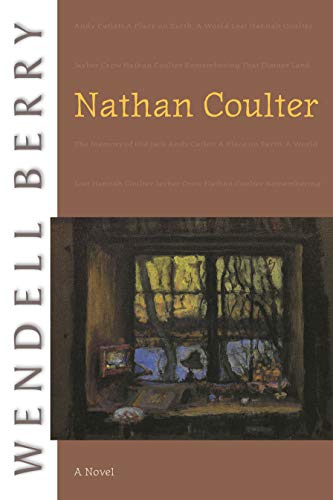
Nathan Coulter was Wendell Berry’s first book, published when he was 27. This is the beginning of his eight novels set in Port William, a fictitious town based on his own Port Royal.

Nathan grows up on a family farm in Port William with his brother Tom, who he usually just calls Brother, and his parents. His father’s parents live next door on the farm that had been passed down through the generations.

Nathan’s mother is sick, so he and his brother are told to stay out of the house in the afternoons so she can rest. They wander all over, getting into various kinds of mischief.

When Nathan’s mother dies, he and Brother go to live with their grandparents. One source said this was so because the father blamed the boys for their mother’s death, but I don’t recall that being the case. One problem with an audiobook is that it’s hard to go back and look up details like this. Another source cited the father’s depression.

Whatever the father’s issues, he was a taciturn man, generally quiet, tending to motivate the boys by taunting them rather than encouraging them. His reason for living was work. He handled everything by working. He was determined to outwork everyone else.

We see events unfold from Nathan’s point of view, though he doesn’t say much. The book mainly describes life on a farm in a small Kentucky community. But the theme seems to be Nathan’s journey to becoming a man. One scene where all the men are working hard to get a tobacco harvest in on time reads with the tension of Ben-Hur’s chariot race as the father challenges Tom, who has never beat him before but is coming closer all the time. The men seem to be in the various stages of manhood: the grandfather lamenting his decline and inability to do what he used to, the father in his prime, the oldest son growing in strength almost to the point of the father.

Unfortunately, Nathan doesn’t have many good examples. His grandfather and father are harsh and distant. His uncle Burley is kind, but has a wild streak.

The version of the book I read ends with the death of Nathan’s grandfather, when Nathan was sixteen, almost like the baton is passing to the next generation. I’ve read that the book originally was longer, telling of Nathan’s growing into adulthood.

I got this audiobook (wonderfully read by Paul Michael) because it’s currently in Audible’s Plus Catalog of free titles for members and because I wanted to read more of Berry. I’ve only read his Jayber Crow until now, which I had mixed emotions about.

I had mixed emotions about this book, too. Berry’s writing is lyrical in places, his characters well-drawn, and with a strong sense of place. None of my relatives were farmers, but many did live in rural settings which Berry’s story reminded me of.

There’s a smattering of bad language. But the most offensive thing in the book is when Tom and Nathan go to a carnival, part of which has a strip-tease act–which, for some reason, boys were allowed into. Berry describes the act in too much detail, and I almost stopped the book there. The only reason I continued was because the act was presented as somewhat sad rather than titillating. If this is a story about becoming a man, unfortunately, men at some point come across this type of thing. Thankfully Nathan felt sorry for the woman and wasn’t attracted by the display. But I think the author could have gotten across his point with much less visual detail.

Also, most of the characters who are religious to any degree are odd.

I got Hannah Coulter at the same time as this book, for the same reason. I was going to review the books together, but I ended up saying more about this book than I planned to. So I’ll wait til next week to talk about Hannah, though I’ll say that I liked her story much, much more. Some of the themes Berry is know for are represented in seed form in Nathan Coulter but come to fruition in Hannah Coulter. Hannah is Berry’s seventh novel. It was written 44 years after Nathan, but its story begins just a few years later.

I started reading Berry because I know so many people who love him. His poem “The Blue Robe” is one of my favorites, along with “They Sit Together on the Porch” and “To Tanya on My Sixtieth Birthday.” I love the way he writes, lyrical and tender in places, with a strong sense of place and relationships. But I disagree with him in some areas. I’m still trying to figure him out.

Are you a Wendell Berry fan? What do you like about him?

Review Elderberry Croft

Elderberry Croft

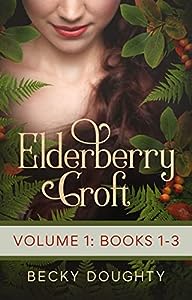
Elderberry Croft by Becky Doughty is a series of stories that take place in the Coach House Trailer Park in southern California after Willow Goodhope moves into Space 12.

Willow is an enigma to her neighbors at first. She festoons her run-down spot with plants, wind chimes, fairy lights, and sun-catchers. She’s gorgeous enough to turn heads, but not at all flirtatious. She takes the initiative to introduce herself to her neighbors, even the standoffish ones, and seems to know just what everyone needs. She has a loud, outrageous laugh. But every now and then, someone will catch just a glimpse of hidden sorrow.

These stories are published in four books, with a sequel called Elderberry Days. I’ve wondered if they were originally published this way, or if they were blog posts or some other venue.

But here’s a little taste of the stories:

Elderberry Croft: Volume 1: January Breeze, February Embers, March Whispers

January Breeze: Kathy Kekoa watches from her window with binoculars as her strange new neighbor move in. Kathy is convinced that everyone in their trailer park has come there to die. Or, at the very least, they’re stuck. But Willow seems vibrant. Until Kathy hears her weeping one night. Willow’s gift of home-mixed tea leaves and other treats when Kathy is sick opens a door of friendship for them.

In her heart of hearts, Kathy yearns for her son, Makani, who hung up on her the last time she tried to call him.

February Embers: Richard Davis suffers from scarring resulting from extensive burns. His wife, Patti, has taken care of him for years. But she feels unappreciated, especially after she notices Richard eyeing the new neighbor. However, an unexpected gesture stirs the embers of the love they almost let die out.

March Whispers: Everyone thinks Joe Sanderson is single. He loves to cook and garden. He’s been content with his secrets. But Willow’s influence persuades him it’s time to step out of his comfort zone.

Elderberry Croft: Volume 2: April Shadows, May Enchantment, June Melody

April Shadows: Shelly keeps to herself, has several cats, follows a rigid routine, and only leaves her house once a week. But a seeming stalker in the neighborhood draws her out of her self-imposed isolation.

May Enchantment: Eddie is the manager of the trailer park. His new tenant, Willow, is sure shaking things up around the place. He feels protective of her, especially when his lazy lecherous brother notices her. When Eddie meets the reported stalker one night, nicknamed Shadowman by the park, his assumptions are upended and he doesn’t know what to think.

June Melody: Myra may be a hypochondriac, but she has a sharp eye to notice and welcome misfits and oddballs. She loves to be needed. But an accident lands her flat on her back, and Willow is the first to help her.

Elderberry Croft: Volume 3: July Madness, August Memories, September Longing

July Madness: Donny Banks, Eddie’s brother, is single again and moves in with his mother—again. She’s always been soft with him and let him get away with most anything. But he’s going too far, and she has to stop coddling him.

August Memories: No one knows Al Tanner’s deepest secret. The day of reckoning he always knew would come has finally arrived. He’s ready to take the consequences. But Willow presents him with another option. Dare he hope life could turn out differently?

September Longing: Prudence Merriweather loves hot pink and animal prints, both in her clothing and decor. She’s been dating Carney, a huge trucker, for ages. But his distance in their last phone call makes her wonder where his heart really is.

Elderberry Croft: Volume 4: October Mourning, November Awakening, December Dawning

October Mourning: Andrea and George met at the post office where they both work and love their lives. Andrea’s pregnancy was a surprise, but they’re both looking forward to their baby’s arrival. But Andrea’s past threatens everything. Willow offers to help, but doing so will mean sharing a painful part of her own past.

November Awakening: Doc is a pleasant man who drinks a little too much. But no one knows he suffers from post-traumatic stress which drove him from his wife and daughters. When he finds Willow burning letters in her yard late one night, he recognizes the pain in her eyes and tells his story, hoping to relieve her.

December Dawning: Willow is finally able to face what she was running from. She knows it’s time to start on the long road to healing. But how can she leave this community who has become family to her?

Elderberry Days: Season of Joy is the sequel to the series. Willow finds that reconciliation and facing the tragedy she ran from is just the first step in healing. The road back to wholeness is a long and slow journey. But her friends help her along the way. In-between chapters of this book are recipes for the elderberry treats and remedies that have been mentioned in the books.

Three things stood out to me in these stories. First, ministry to others doesn’t have to be demonstrated in grand gestures or “official” ministry channels. Thoughtfulness and kindness go a long way. Secondly, it can be therapeutic to help other people with their needs, but it’s no substitute for dealing with your own. Thirdly, everyone has a story. Someone who seems eccentric or oddballish may have hidden hurts.

I got the first set of three stories several years ago when it was free for the Kindle. I just recently rediscovered it when looking to catch up with some of my older Kindle volumes. Of course, when I read the first one, I had to continue with the rest of the series. Thankfully, each book was not expensive.

Willow might seem too good to be true from the description, or the stories a little fairy-taleish. But they are not. The characters and story lines are realistically drawn.

One thing I didn’t like, though, is the description that the author’s books include “a bit of magic now and then.” Magical realism was one of the categories for the book. The only way that really came out was in each character perceiving Willow’s scent in a different way, a way that reminds them of something from their past. Also, Willow often seems to know just what to do or what is needed, but she attributes that to God’s guidance as she prayed. If you’ve got the Lord’s guidance and provision, what do you need with magic? But, as I said, the “magic” wasn’t a major part of the story.

The only other negative was that all the books with the same name or similar names were confusing. Then, after I read all four, I discovered the first four books had been put together in one volume under Elderberry Croft: Seasons of the Heart. (which looks like a separate book until you read the description). It would have saved a little money (at least according to the current prices) to have gotten the one volume rather than four different Kindle books.

But other than that, I loved the stories. I had never read Becky Doughty before, but I’d be willing to read some of her other books now. I enjoyed all the characters (though I lost track of who a couple of them were) and story lines and how everything wrapped up.

Review: The Second Half

The Second Half novel

In The Second Half, a novel by Lauraine Snelling, Ken Sorenson is just about to retire from his university Dean of Students position. He’s looking forward to unstructured days, fishing, and traveling. But office politics threaten the department he spent his career building up and the students he wants it to serve. He struggles leaving all he’s worked for to the office vultures.

Ken’s wife, Mona, has started an event-planning business, which she hopes Ken will help her with when he retires. When a major client considers her services, Mona feels she’s about to get her big break that will establish her company. But Ken is worried that the stress will send her back into the depression that she took so long to recover from. And he keeps talking about traveling. How is she going to work a trip into everything else she has to do?

Then both Ken and Mona get the wind knocked out of them with a phone call from their son. He’s with the Army Special Forces, hoping he’ll get transferred near his parents. Instead, he’s being deployed to Pakistan. His wife left the family, and his parents are the only ones he can ask to take care of his ten-year-old daughter and five-year-old son.

Ken and Mona love their grandchildren, so of course they agree. But not only are their lives and plans are thrown into an upheaval, but they’re not as young as they used to be. Then as the weeks go by, they find that the children have been traumatized by their mother before she left.

On top of everything else, their son doesn’t contact them via Skype from Pakistan at the appointed time. Is he safe?

Lauraine dedicated this novel to all grandparents who have left plans and dreams to take care of grandchildren. “While there are joys as well as hardships and sacrifices, they are gallant people who step up because they love their children and grandchildren, no matter what.”

This story also demonstrates Proverbs 16:9, though I don’t think it’s stated there: “The heart of man plans his way, but the LORD establishes his steps.”

The plot seems chaotic at first, understandable with all that’s going on. But eventually the family works through the trials and issues and finds the aid they need.

Mona struggles with worry throughout the novel, which is also understandable. But one odd place puzzled me: “She’d never been so shocked as when Pastor Oliver preached on worry and used the word anathema. God didn’t just dislike his children worrying, it was anathema to Him” (p. 28, Kindle version). Though the Bible repeatedly directs us to trust rather than worry, I’m not aware of any passage that uses anathema in connection with worry. Plus, it would have been good to explain the term for readers who might not be aware of it.

But overall, this is a great novel. The characters and struggles are realistic, and the ending wraps up beautifully.

Review: Ladies of the Lake

In Cathy Gohlke’s novel, Ladies of the Lake, Addie MacNeill is orphaned at age twelve. Her older half-brother sells the family home in Prince Edward Island and ships Addie off to a Lakeside Ladies’ Academy in Connecticut.

Some of the older girls pick on Addie for her newness and different ways. But she surprises herself by finding three dear friends: Dot, Susannah, and Ruth. Eventually they dub themselves the “ladies of the lake” and plan to meet together regularly once they’ve graduated.

When Lucy Laude Montgomery publishes Anne of Green Gables, set in Addie’s beloved PEI, Addie writes to her. The two begin a regular correspondence, and Montgomery encourages Addie in her own writing endeavors.

But trouble stirs when Addie and Dot fall in love with the same young man, Stephen. Over time as he favors one over the other, jealousy and deceit escalate between the girls and ruins their friendship.

WWI is brewing, and Ruth lost her brother in the Lusitania bombing, so she’s prejudiced against Germans. Stephen Meyer and his brother, Jonas, are as American as they come. But their parents still have a heavy German accent. Soon the rest of the community joins in persecuting and ostracizing the Meyers.

Addie is called to Halifax to help her sister-in-law through the end of her pregnancy and delivery. While there, the colliding of two ships sparks the Halifax Explosion, which killed and injured thousands and destroyed homes and buildings. Addie lost her brother and his family and was deeply burned and scarred. Believing that Steven had chosen Dot, Addie decides to change her name to Rosaline Murray and make a new start.

Seventeen years later, Rosaline’s daughter, Bernadette, is about to graduate from Lakeside Ladies’ Academy and dearly wants her mother to come. Rosaline is sensitive about traveling outside of Halifax with her scars. But worse than that, she doesn’t want to face Dot, who is now the headmistress of the Academy.

Dot herself has struggled with secrets for seventeen years now. Believing Addie died in the explosion, Dot has no way to make things right. But when Bernadette starts reminding her of Addie, Dot wonders if Addie could possibly be alive. Could she ever face her again?

Rosaline and Dot resist the things they need to do the most: face each other and confess their wrongdoings and apologize. Their inner torment threatens to hurt themselves and those they love.

I enjoyed this story so much. I loved the characters and how the plot unfolded. The correspondence with Montgomery was a fun element. I had never heard of the devastating Halifax explosion. I loved how the author told it from the standpoint of those affected.

I listened to the audiobook which, sadly, did not contain the author’s end notes. I would have loved to learn more about what inspired the author.

Cathy Gohlke has written another winner that I can highly recommend.

Review: Yesterday’s Tides

Yesterday's Tides novel by Roseanna M. White

Roseanna M. White’s novel, Yesterday’s Tides, has two related story lines taking place in 1914 and 1942 on Ocracoke Island in North Carolina’s Outer Banks.

In 1914, Louisa Adair helps her mother and “Grann” run an inn. She’d like to go to teacher’s college, but there isn’t enough money. Plus, she’s needed at home.

Though Louisa has blue eyes, her skin coloring is darker than most people’s. Her mother will not tell her anything about her deceased father except that he was a good man. A few people are prejudiced against her, thinking she must be of mixed race.

When two college-age cousins, one from Maryland and one from England, come to the inn for the summer, Louisa has no idea how her life will change as a result. Louisa has no plans to fall in love: she keeps a polite reserve with the inn’s male guests. But she and Remington Culbreth, from England, find themselves in each other’s company often. Just after they do fall in love, WWI breaks out and Remington is called to service at home. Will their relationship survive not only the war, but the differences in their families and lifestyles?

In 1942, Evie Farrow now runs the inn with her grandmother. One day while taking some baked goods to the neighbors, a loud explosion is heard in the distant waters. While Evie’s Coast Guard friends prepare to investigate and help, Evie heads home to pray. When a badly burned Englishman washes up near the inn, somehow Evie knows not to report him. He says he is military, but he’s not in uniform. What mutterings she hears as he goes in and out of consciousness alert her to the fact that he is an intelligence officer. But what would an English spy be doing in Ocracoke?

When he wakes up, she learns his name is Sterling Bertrand and he is tracking a German operative. But it will take weeks for his wounds to heal. Meanwhile, he wonders just how far he can trust Evie, who seems to have secrets of her own.

I’ve read many dual timeline novels, and usually there are enough differences between the two timelines to keep from getting confused. I had a little harder time with this one, since both stories took place at an inn in Ocracoke and involved a visiting Englishman. I think I would have had an easier time with reading rather than listening. I didn’t catch some of the names that were the same in both timelines, so I kept getting surprised at the connections. I don’t think that would have happened if I were reading instead of listening.

As it happened, partway through the audiobook I discovered that I did have a Kindle copy! So I went back and forth between reading and listening.

One delight with this book was running into some characters from Roseanna’s previous books. I won’t say which ones, as that might give away parts of the plot. You don’t have to have read those books to understand this one, but it was a fun surprise to see those characters again. Evidently Remington was in an earlier book as well, but, though I remember the story and situation, I don’t remember him.

I’m sorry to say I was not thrilled with the audiobook narrator. Some of her accents seemed a little off to me. Plus she had an odd cadence, her inflection going up when it didn’t need to.

There are so many layers to this novel, and so much more to it than there appears to be at first. I loved the stories, and after finishing the book, I just wanted to sit with the characters a bit more before saying goodbye to them and starting another story.

Review: Be Worshipful

Be Worshipful by Wiersbe on Psalms

Psalms is the longest book of the Bible at 150 chapters, so Warren Wiersbe divided his commentaries on the Psalms into two books. The first is Be Worshipful (Psalms 1-89): Glorifying God for Who He Is.

“The book of Psalms has been and still is the irreplaceable devotional guide, prayer book, and hymnal of the people of God,” (p. 15). About one-third of the psalms don’t list an author, but King David wrote the majority of the others. The sons of Korah, Asaph, Solomon, Ethan, and Moses wrote others. All, however, wrote under the inspiration of the Holy Spirit.

Except for Moses’ psalm, the rest span the time of King David through the divided kingdom and Israel’s exile into Babylon.

“Some of the psalms are laments to the Lord, written by people in dire circumstances. There are also messianic psalms that point forward to the Lord Jesus Christ. There are also psalms of praise and thanksgiving, royal psalms, wisdom psalms, psalms of affirmation and trust, penitential psalms, and even imprecatory psalms calling down God’s wrath on the enemy” (p. 16).

The psalms’ poetry is not rhyming and rhythmic like English poetry. Hebrew poetry expresses itself in parallel lines. The second line of a pair might say the same as the first differently, or contrast with the first, or expand on the first. But the psalms uses similar literary devices as our poetry: simile, metaphor, imagery, symbolism, synecdoche (referring to one part to represent the whole, like keeping hands clean representing keeping one’s life clean), hyperbole, apostrophe (addressing a thing as if it were a person, like Wisdom), anthropomorphism, and others.

“There are over four hundred quotations or allusions to the psalms in the New Testament” (p. 16).

The psalms cover a lot of different subjects. “But primarily, the Psalms are about God and His relationship to His creation, the nations of the world, Israel, and His believing people” (p. 16).

“The psalms teach us to seek God with a whole heart, to tell Him the truth and tell Him everything, and to worship Him because of who He is, not just because of what He gives. They show us how to accept trials and turn them into triumphs, and when we’ve failed, they show us how to repent and receive God’s gracious forgiveness. The God described in the book of Psalms is both transcendent and immanent, far above us and yet personally with us in our pilgrim journey. He is ‘God Most High’ and ‘Immanuel—God with us'” (p. 18).

Wiersbe writes a few pages of comments on each psalm, explaining, drawing out truth, sharing insights. He includes discussion questions at the end of the book.

Many of the comments I have highlighted refer to specific contexts of psalms that would be impossible to explain without sharing all of Wiersbe’s comments on that particular section. But here are a few general comments I found helpful:

Those who have problems with the military aspects of some of David’s psalms should remember that David went to war only when the enemy attacked Israel. He did not invade other nations just to gain territory, and he was fighting the Lord’s battles (1 Sam. 17:47; 25: 28; 2 Chron. 20:15). The covenant God made with David (2 Sam. 7:11) assured him of victory over his enemies (p. 85).

Though David occasionally fell, as we all do, the habitual bent of his life was toward the Lord and His Word (p. 106).

The secret of David’s public confidence was his private obedience: He took time to fellowship with the Lord and get directions from Him. David knew that the most important part of his life was the part that only God could see, and this was one priority he would not negotiate” (p. 108).

David tried to “cover” his sins, but his schemes didn’t work. They never do (Prov. 28: 13), but when God covers the sins we confess to Him, they are hidden from sight and never seen again. (See Isa. 38:17; 43:25; 44:22; Jer. 31:34; 1 John 1:7–9.) (p. 121).

Chastening isn’t a judge punishing a criminal; it’s a loving Father dealing with His disobedient children to bring them willingly to the place of surrender. According to Hebrews 12:1–13, God’s chastening is proof that He loves us and that we are genuinely His children (p. 122).

[Re David praying against enemies} This was not a personal vendetta on David’s part, but a concern for the future of the nation of Israel and the dynasty of David. As ruler of the land, David wielded the sword of justice (Rom. 13:1–4), and nations today punish treason with death (p. 152).

The greatest danger a nation faces is not the invading enemy on the outside but the eroding enemy on the inside—a people gradually turning away from the faith of their fathers. Each generation must pass along to the next generation who the Lord is, what He has done, and what they must do in response to His goodness and faithfulness (71:18; 78:4, 6; 79:13; 109:13; 145:4; 2 Tim. 2:2) (p. 178).

It is our regular worship that prepares us for the crisis experiences of life (p. 207).

The psalms are not just emotional: they are full of truth and doctrine. Yet I love that the psalms show the writers’ hearts as they wrestle with problems, unanswered prayer, confusion, God’s seeming distance. Most of the psalms of lament end with the psalmist reminding himself the truth he knows about God and restoring his hope and confidence. And who can beat the praise psalms for lifting one’s heart in thanksgiving and worship.

The Bible tells us to study God’s Word, not just read it casually. Yet it’s possible to go too far the other way and examine a passage’s pieces, losing the main message or emphasis. I had to wrestle with this since I was using both the ESV Study Bible notes as well as Wiersbe’s commentary. Both were beneficial, but sometimes I left a passage with my head swimming. It helped to go back and read the passage again as a unit and as poetry after reading the comments and notes.

I appreciated the help Wiersbe’s commentary was to understanding and gaining more from the psalms.

Review: The Words We Lost

The Word We Lost novel

In The Words We Lost by Nicole Deese, Ingrid Erikson moved to western Washington state with her father and became friends with cousins Cece and Joel Campbell when they were all teenagers.

Cece grew up to write a novel, which Ingrid, as an intern at a publishing house, sneaked to her editor. The editor loved the manuscript, bought it, and Cece’s series became runaway best-sellers.

But then Cece tragically died on the operating table during surgery to remove a brain tumor.

Besides losing Cece, Ingrid’s father died several years before. Ingrid blamed Joel and broke contact with him. So she lost all the people and the place she loved most and moved hundreds of miles away.

Ingrid is now a senior acquisitions editor, but she has a hard time functioning due to her grief. She relies heavily on her own intern, Chip. But her new boss can see she’s faltering.

Then Joel suddenly shows up unannounced. The family lawyer discovered a sealed letter addressed to him and Ingrid from Cece. She wanted them to come back home together to retrieve a package.

Ingrid’s boss gives her an ultimatum: find the rumored missing fourth manuscript to Cece’s series, or lose her job.

Ingrid isn’t sure she can go back to the area that she loves, but that brought her so much pain—and do so with Joel. But she doesn’t have a choice if she wants to keep her job.

I bought this book because I loved two of Nicole’s other books I had read. I got the audiobook at first, but the narrator just hit me wrong somehow. So I returned the book and got the Kindle version.

Then the first few pages held one of my pet peeves in writing. 🙂

But once we got past all that and I settled into the story, I loved it just as much as the others.

Some of the quotes I liked:

Success is a slow, long process of repetition (p. 90, Kindle version).

No heartache has ever gone unseen, and no darkness is ever too solid for light to overcome (p. 156).

God is often made visible by the hands and feet of the people He places in our lives (p. 177).

We can’t change the time we’ve spent, just how we choose to spend the time we have left (p. 228).

Even though there are still things to talk and sing and laugh about in this life, there are also things to miss and lament and grieve, too. Both are welcome and both are necessary (p. 367).

I enjoyed the depth of the characters and was pulled into their heartaches. The last few chapters unravel a bit of mystery. After the first few pages, I loved how the story developed and then concluded. I also loved the double meaning in the title. I’m happy to recommend this book to you.


Review: Dreams of Savannah

In Dreams of Savannah by Roseanna M. White, Cordelia Owens is a pampered Southern belle who loves to dream and write stories. She also loves Phineas Dunn, a lifelong friend newly recruited to the Confederate Navy, and promises to wait for him forever.

When she learns Phineas has been lost at sea, she weaves heroic tales for his mother and sister to help them keep up hope.

When Phineas was shot and fell overboard, he thought he was done for. But somehow he washes up on an island near Cuba. He’s rescued by a person he never imagined existed: an educated free black man from England. He has no way to let his family or his commanding officer know what has happened to him. All he can do is try to get well as fast as possible and get home. But his injuries are severe.

As the weeks drag by, a distant cousin of Cordelia’s comes to Savannah, assigned to the Confederate regiment there. Her parents are impressed by his manners, standing, and wealth. They like Phineas well enough, but his family’s credentials just don’t compare. They put pressure on Cordelia to turn her attention to her cousin. But even if she had not promised Phin she would wait forever, she would not have her cousin. There’s a predatory gleam in his eyes when her parents aren’t around.

When Phineas finally returns, he is still suffering from his injury. Worse, he has fallen in his own estimation. He wanted to be the hero of Cordelia’s stories. He doesn’t feel worthy of her, but he still vies for her hand. Her parents keep pushing her toward her cousin.

Both Cordelia and Phineas are from good families who are known to be kind to their slaves. Phineas’ father was, in fact, planning to free his slaves until doing so became illegal in Georgia.

But different experiences and people begin to change their perspectives. The question now is what to do. Is it enough just to be good to one’s slaves? Could they be mocked, scorned, or even arrested if their views on slavery changed? And how could their views change without changing their actions as well?

At the beginning of this book, Cordelia came across to me as young and somewhat silly (one of her fears for Phineas was that he might be attacked by a giant squid. . . ). I’m not sure how old she was, something hard to go back and find in an audiobook. Also, the Southern belle vibe came across a little too thick, replete with “fiddale-faddle” and “fiddel-dee-dee” (making me wonder for the first time why “fiddle’ was in so many expressions then).

But after I settled into the story, I began to enjoy it more. Cordelia is immature at the beginning. But the circumstances of the story cause her to grow. Even her story-telling matures over time.

It would be hard to write a book of changing viewpoints towards slavery and black people set in the 1861 South without attributing to the characters twenty-first century sensibilities. But Roseanna avoided that and had beliefs change and grow in the context of what was going on at the time.

A couple of my favorite quotes:

She certainly shouldn’t be refused happiness because of your convoluted ideas about your precious blood making her better than her mother . . . Because let me just tell you . . . your blood doesn’t have that power. There’s only one Man’s blood in all of history that can make us better than we are—and your are not Him.

She didn’t need to be a heroine in some fantastic tale of derring-do. That wasn’t what the Lord had given her. No, He’d given her words. Words to live by. Words to create with. Words that maybe, just maybe, could change the world beyond her house as surely as they had changed the one within.

I listened to the audiobook nicely narrated by Sarah Zimmerman.

So far, I have loved every book of Roseanna’s that I have read, including this one.

Blogging for God’s Glory in a Clickbait World

Blogging for God's Glory

In Blogging for God’s Glory in a Clickbait World, Benjamin Vrbicek and John Beeson propose this definition of blogging for God’s glory: “Blogging for God’s glory means . . . first, to have our motivations aligned with God’s, and second, to pursue excellence in the craft, including theological precision, beautiful prose, visual appeal, and the edification of readers, all drawing from the best industry practices” (p. 14).

First they deal with aligning our motivation with God’s. That’s often the most difficult part to maintain. Usually a Christian blogger begins by wanting to share posts that glorify God and help others. But “our own motives . . . are always layered and mixed” (p. 3). And though Christian writing instructors tell us not to worry about the numbers of those following, liking, and sharing our posts, those who want to move from blogging to publishing a book are told agents and publishers will look at those numbers and won’t consider taking a writer on unless those numbers are high. It’s a continual but necessary struggle to keep our focus on writing for God’s glory and purposes and trusting Him with the results, even when it doesn’t seem like many people are reading.

The authors apply the goal of writing for God’s glory into the everyday nuts and bolts of writing. Write with the reader in mind rather than anticipating accolades. Know your why, what difference you want to make. Serve others, not yourself. But that doesn’t mean never talking about yourself: Paul wanted to proclaim “not ourselves, but Jesus Christ as Lord” (2 Corinthians 4:5), yet 2 Corinthians is “Paul’s most autobiographical letter. He shares much of his own story not because he is narcissistic, but because he knows the church is struggling to trust him and he needs to build rapport” (p. 22).

“If we have any hope of offering others wisdom, listening to God must become a primary and ongoing habit.” We can’t share what we haven’t first taken it. That doesn’t mean every blog post needs to exposit Scripture or be a devotional, but it should still be “subject to God’s truth and ought to reflect His light” (p. 31).

Then, “Christian writers must labor not only to write what is true but also write in a manner that adorns the truth” (p. 38). We need to focus on building up, not tearing down. That doesn’t mean we never share what’s wrong, but we do so with discernment and with the purpose of helping.

The authors give helpful advice with the mechanics of blogging: discerning how much time to give to it, in connection with your other obligations; setting a schedule that works for you; dealing with writer’s block; engaging social media; blogging costs, platforms, layouts; using photos without plagiarizing; networking; monetizing; and more.

They include several appendices. One is a compilation of several bloggers’ answers to the question of whether blogging is dead. One is a glossary of blogging terms. One is a collection of sidebar quotes in the paper version that wouldn’t work in the e-book formatting.

A few other quotes that stood out to me:

Where can you offer yourself to your audience for the sake of proclaiming Jesus Christ as Lord? How can your life become a bridge for the gospel to travel? What work has God done (or is doing) in you that will encourage others? (p. 22).

Don’t feel compelled to chase whatever is hot. Be true to who God has made you to be (p. 23).

Blogging ought to grow us in holiness. When we blog for God’s glory, the discipline of writing becomes integrated into the web of our spiritual disciplines (p. 29).

It is not the size of our platform that assures us how far our words will reach, but rather it is our trust in a God whose word never returns void (Isa 55: 11) (p. 32).

Writing comes down to making and remaking slight improvements to achieve better clarity and aesthetic; writing is the pursuit of marginal gains, insignificant by themselves but significant in the aggregate (p. 37). (I loved the illustration they used here of an eye doctor trying different lenses, asking each time which is better.)

So why should we worry about getting the tone and the content right when we know fewer people will read an article if we write with discernment? We bother because God is God, and on the day of judgment we will give an account for every careless word we have ever blogged (Matt 12: 36) (p. 42).

I think this book is an excellent resource, especially when we need to adjust our motives away from the manipulative and self-focused approach of the world and remind ourselves of our real purpose: glorifying God. 

Review: In This Moment

In This Moment is the sequel to When the Day Comes by Gabrielle Meyer. Maggie is the youngest daughter of Libby from the first book. Like Libby, Maggie is a time crosser. But because both Maggie’s parents were time crossers, she has three paths instead of two.

One of her timelines is in Washington D.C. in 1861, where she goes by Margaret and is the daughter of a senator. The Civil War has begin, and after hearing of Confederate spies in the area, she keeps alert. She helps Clara Barton nurse wounded soldiers, but incognito, because such work would be frowned upon in society. Maggie wouldn’t care what people thought, but she has to think of her father’s reputation.

When Maggie goes to sleep in 1861, she wakes up in 1941. Her time crossing parents reside in Williamsburg, VA. Maggie is a nurse who joins the Navy along with her sister, Anna. But when they are asked to join a team on a hospital ship in Pearl Harbor, Maggie wrestles with what she knows will happen.

When Maggie goes to sleep in 1941, she wakes up in 2001 in D. C., where she is in medical school training to become a surgeon.

Though it takes Maggie 30 years to get through 10 normal years, no time is lost between her timelines. When she wakes up in one timeline, it’s the next day after the last time she was there.

Like her mother, Maggie will have to choose which timeline she wants to stay in by her twenty-first birthday. Then her body will die in the other two time periods.

Her mother knew all her life which timeline she wanted, though she had to wrestle with the fact that her preference might not be what God wanted. However, Maggie has no clear preference. She loves all of her timelines and her families. She has important work to do in each one. She’s frustrated that God seems silent on the matter.

Maggie has determined not to become romantically involved in any timeline before her twenty-first birthday because she doesn’t want the complication for her decision-making. But an attractive man becomes part of each of her lives.

Since Maggie is involved in medicine in all three lives, it’s hard not to let her twenty-first century medical knowledge impact her work in 1861 and 1941. If she knowingly tries to change history in any timeline, she’ll forfeit her life in that timeline early. She also struggles with the knowledge of what will happen in 1861 and 1941 and the desire to warn people. But no one in any of her timelines knows that disaster is looming in September 2001.

i loved this book just as much as the first one. I wondered how Gabrielle could write another book about time crossers without repeating some of the same scenarios in the first book. But though Maggie and her parents wrestled with some of the same things, their circumstances and challenges were very different.

I liked the fact that the 1861 and 2001 timelines both occurred in Washington, D. C., but with vast differences.

Happily, the audiobook this time included the author’s notes about what circumstances and people were real and which were made up. I always enjoy that information after finishing a historical fiction book.

There were just a couple of small things I disagreed with here—one character saying he had to learn to love himself before others could love him, and another who determines to “follow her heart.”

But overall, I loved this book. I kept looking for ways to sneak in a few minutes listening more than my usual times. There is at least one more book coming in this series, and I am looking forward to it.