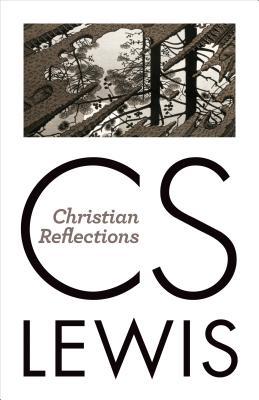
C. S. Lewis: Christian Reflections

Reading C. S. Lewis’ nonfiction is always a stretch for the brain muscles. Even Elisabeth Elliot, a deep thinker herself, said that she could follow his line of reasoning but couldn’t always reproduce or explain it.

Lewis’ writings for the general population, like Mere Christianity, are accessible–I would not want to scare anyone away from them.

However, I checked out Lewis’ Christian Reflections several month ago–and laid them aside several times. I was about to give up on them completely when I decided to try once more, praying for understanding and discernment. And then I was able to follow the gist of what he was saying.

This book is a collection of Lewis’ essays on various topics pertaining to Christianity or from a Christian point of view. They were assembled and published by Walter Hooper, Lewis’ longtime secretary, after Lewis’ death. In Hooper’s preface, he shares which of the essays had been previously published or never before published. Many were written for Lewis’ peers, which explains the elevated level of philosophic thought (and the plethora of unfamiliar Latin phrases. I wished I had read this in my Kindle app, where at a touch I could get the translations).

There are fourteen essays in all, touching on topics like Christianity and Literature, Christianity and Culture, ethics, church music, and the psalms. Others delve into things like subjectivism and historicism and de futilitate. I’ll try to give a sentence or two about each:

“Christianity and Literature.” These first two were the ones I was most looking forward to, but they were also the most difficult. I can’t really sum them up in a short sentence or two. I think I need to come back and read them again some time in the future to get more out of them. This blogger has created a helpful outline of the essay.

“Christianity and Culture.”

“Religion: Reality or Substitute?” This essay discusses faith vs. reason and whether religion is a substitute for reality.

“On Ethics.” Lewis discusses whether “the world must return to Christian ethics in order to preserve civilization, or even in order to save the human species from destruction” p. 44).

De Futilitate.” Lewis debunks the idea that we can’t really know anything so therefore everything is futile. Doesn’t that sound depressing?

“The Poison of Subjectivism.” This sounds a lot like the postmodernism of our era: maybe the seeds of it began here. “There are modern scientists, I am told, who have dropped the words truth and reality out of their vocabulary and who hold that the end of their work is not to know what is there but simply to get practical results” (p. 72). Indignation against another person’s or country’s morality . . .

is perfectly groundless if we ourselves regard morality as a subjective sentiment to be altered at will. Unless there is some objective standard of good, over-arching Germans, Japanese and ourselves alike whether any of us obey it or no, then of course the Germans are as competent to create their ideology as we are to create ours. If ‘good’ and ‘better’ are terms deriving their sole meaning from the ideology of each people, then of course ideologies themselves cannot be better or worse than one another. Unless the measuring rod is independent of the things measured, we can do no measuring (p. 73).

“The Funeral of a Great Myth” takes a look at evolution not in the scientific sense but in the sense of society. Lewis says the thought of humanity continually getting better has been around longer than Darwin but at no point has been witnessed or proven true. Rather, just the opposite seems to be the case. Nor does the complex arise from the simple, but the complex often offers the seed of the simple.

“On Church Music.” In Lewis’ day, church music “glorifies God by being excellent in its own kind; almost as the birds and flowers and the heavens themselves glorify Him. In the composition and highly-trained execution of sacred music we offer our natural gifts at their highest to God, as we do also in ecclesiastical architecture, in vestments, in glass and gold and silver, in well-kept parish accounts, or the careful organization of a Social” (p. 95). “But in most discussions about Church Music the alternative to learned music is popular music” (p. 95) which he says can be shouted and “bellowed” as well as sung. Either one can be done to the glory of God—or simply because it’s what people like. Each one could be done with pride and condescension. Or, the musician “of trained and delicate taste” can “humbly and charitably sacrifice his own . . . desires and give people the humbler and coarser fare than he would wish” (p. 96), and the the less musically learned could “humbly and patiently, and above all silently, listen to music which he . . . cannot fully appreciate, in the belief that it somehow glorifies God (p. 96). To both, “Church Music will have been a means of grace; not the music they have liked, but the music they have disliked. They have both offered, sacrificed, their taste in the fullest sense” (p. 97) for love of others, the glory of God, and the good of the church.

“Historicism.” ““What I mean by a Historicist is a man who asks me to accept his account of the inner meaning of history on the grounds of his learning and genius” (p. 101). He doesn’t have a problem with those who find “causal connections between historical events” (p. 100), a work belongs to historians. “The mark of the Historicist, on the other hand, is that he tries to get from historical premises conclusions which are more than historical; conclusions metaphysical or theological or (to coin a word) atheo-logical” (pp. 100-101).

“The Psalms.” I’ve always appreciated the psalms for their humanness, their depth of emotion. So I was a little surprised Lewis called them “shockingly alien,” until he described his religious experience of “Anglican choirs, well laundered surplices, soapy boys’ faces, hassocks, and organ, prayer books” (p. 114). He has an interesting discussion on the call for justice in the psalms, “not something that the conscience-stricken believer fears but something the downtrodden believer hopes for” (p. 123), “the continual hope of the Hebrews for ‘judgement’, the hope that some day, somehow, wrongs will be righted” (p. 124). I would disagree with his view of imprecatory psalms, but I admit I don’t always know how to interpret them.

“The Language of Religion.” Lewis begins by discussing different kinds of language: ordinary (his example: “It was very cold.”), scientific (“There were 13 degrees of frost.”), and poetic, with several lines from Keats. He discusses how each type conveys some level of accuracy and elicits some degree of emotion, yet each has its failings. Then he applies this to apologetics, which he compares to trying to convey a certain shade of color to a blind man who has never seen color.

“Petitionary Prayer: A Problem Without an Answer.” Lewis struggles here with the difference between biblical promises that we receive whatever we ask for in faith vs. Jesus’ prayer in Gethsemane that the cup be removed, yet “not my will but Yours be done.” He doesn’t have a problem with a loving providence saying no. But he seems to have a problem with so many promises of answers to prayers of faith for what one asks, even of mountains being moved (acknowledging the metaphorical aspect), that it would seem that Jesus did not pray with that kind of faith. But I think Jesus did pray with that kind of faith–faith that the Father’s will would ultimately be done. To me, the mystery is that Jesus prayed that the cup would be removed when that cup was the very reason He came, as He said earlier. I’ve only been able to conclude that this shows the human side of our Lord. And it shows that deep dread of a coming crisis in the will of God is not necessarily sin. Jesus had planed and prepared for this before creation–it was His own will (I lay down my life, no on can take it from me) as well as the Father’s. Yet His human side shrank from it. That gives me great comfort.

“Modern Theology and Biblical Criticism.” This essay was not only fairly easy to follow, it was delightful. Lewis takes on the problem of modern theologians who “ask me to believe they can read between the lines of the old texts; the evidence is their obvious inability to read (in any sense worth discussing) the lines themselves” (p. 157). These Biblical critics “seem to me to lack literary judgement, to be imperceptive about the very quality of the texts they are reading” (p. 154). “I have been reading poems, romances, vision-literature, legends, myths all my life. I know what they are like. I know that not one of them is like this [the Biblical text]” (p. 155).

Lewis speaks not as a theologian, but as a “sheep telling shepherds what only a sheep can tell them” (p. 152). He claims some authority on the basis of how people have wrongly evaluated his writings and that of his friends, assuming things about the background and meaning which weren’t true. A longer quote:

A theology which denies the historicity of nearly everything in the Gospels to which Christian life and affections and thought have been fastened for nearly two millennia—which either denies the miraculous altogether or, more strangely, after swallowing the camel of the Resurrection strains at such gnats as the feeding of the multitudes–if offered to the uneducated man can produce only one or other of two effects (p. 153).

Those effects, Lewis goes on to say, would be to look elsewhere for spiritual truth or to become an atheist.

“The Seeing Eye.” Lewis here refers to the Russian astronauts who said they had not found God in space. He replies, ‘It is not in the least disquieting that no astronauts have discovered a god of that sort. The really disquieting thing would be if they had” (p. 167).

Space-travel really has nothing to do with the matter. To some, God is discoverable everywhere; to others, nowhere. Those who do not find Him on earth are unlikely to find Him in space. (Hang it all, we’re in space already; every year we go a huge circular tour in space.) (p. 171).

He then discusses various scenarios of what kinds of other creatures we might find on other worlds and how we’d likely respond to them. He explored this to a degree in his science fiction series.

In the end, I was glad I persevered. I did enjoy and benefit from several of the essays, though it would take multiple readings to really grasp everything Lewis was saying in some of them. But it’s good to give one’s brain a workout.

I’m counting this book for the essay category for the Nonfiction Reading Challenge.

Book Review: A Quilt for Christmas

Sandra Dallas’ novel, A Quilt for Christmas, takes place in Kansas in 1864. Eliza Spooner is trying to keep the farm together with her two children while her husband is away fighting for the Union. An expert quilter, Eliza decides to make a quilt for her husband’s Christmas present to keep him warm and remind him of her love.

When Eliza’s friend, Missouri Ann, learns that her own husband has died, Eliza invites Missouri Ann and her daughter to stay with her in order to rescue them from Missouri’s abusive in-laws.

Then the unthinkable happens. Eliza receives news that Will has also died. She hopes he was buried in her quilt. Her children and her quilting group help bear her through her grief.

Eliza’s beliefs are put to the test when she is asked to shelter an escaped slave. She has already given a husband to the war: isn’t that enough? And what about the danger to her children? Though Kansas is a Union state, slave catchers in pursuit of a reward could be dangerous to anyone in their way.

As the war ends, soldiers in various states of need show up at her door occasionally, asking for a meal or permission to sleep in the barn overnight. Then one day a soldier shows up with Will’s quilt with the surprising, and at first disconcerting, story of what happened to it after Will died.

I picked this up on my friend Susanne’s recommendation and listened to the audiobook version, nicely read by Pilar Witherspoon.

I thought this was a very well-written book. The story shows the hardships women went through alone on a farm in that time. Not only did they have to deal with their husbands’ absence while fighting or his death, they had all the responsibility of the farm on their shoulders. Even though the North won the war, and the widows and wives received some compensation, many lived in poverty. Yet they were generous, helping others in need as much as they could.

I really liked Eliza’s character and could empathize with her struggles..

I appreciated the emphasis in the last few chapters on forgiveness. Eliza’s son is full of hatred against “Johnnies” because they killed his father. But Eliza tries to teach him that the war is over and they are one nation now.

I also appreciated the talk that, even though only men could fight, there was much women could do to help after all.

Though there is talk of God in the book, I wouldn’t call this Christian fiction. One reason is that Eliza credits her dead husband with watching over her. Another is that, in the talk of forgiveness, nothing is brought up about God’s forgiveness or expectation that we forgive others.

All in all, it was a very good book.

Book Review: Chapel Springs Revival

In the Chapel Springs Revival novel by Ane Mulligan, best friends Claire Bennett and Patsy Kowalski meet with other friends weekly at Dees ‘n’ Doughs’ bakery in their small Georgia town. Most of the ladies are also entrepreneurs. As they discuss the diminishing tourist trade, the newest resident points out the shabby fronts of most of the main street businesses.

Claire, “with all the subtlety of a charging water buffalo,” makes it her mission to revitalize the town—or at least encourage all the business owners to spiff up their places and the town council to spring for repainting and flower baskets.

Patsy, for all the time she has known Claire, has helped helped rein her in and bail her out of trouble.

Both ladies are experiencing trouble in their marriages, which need revitalization more than the town does. They had married men who were also best friends, but now one is grouchy and the other is absent more often than not.

A series of “mishaps and miscommunication,” according to the Amazon description, gives the ladies sometimes comedic trouble. But the book isn’t all comedy. The characters learn and grow and have some touching moments.

This book wasn’t quite my cup of tea, so I don’t plan to read any more of the series. Claire never quite resonated with me. And one or more characters had a penchant for saying “Van Gogh’s ear!” when they were exasperated, which made no sense to me. But if you like I Love Lucy-type comedy with a Southern accent, you’d probably like this book.

Literary Christmas 2021

I enjoy reading Christmas books after Thanksgiving through the end of the year. Tarissa at In the Bookcase hosts a Literary Christmas challenge for that purpose. You can find the details here, but the basic idea is to read Christmas books and write posts about them.

I have several unread Christmas books in my Kindle app. Here are a few I’d like to get to:

A Quilt for Christmas by Sandra Dallas, set during the Civil War. I am listening to it currently.

A Christmas by the Sea by Melody Carlson. This appealed to me because I grew up on the Texas coastline, so my early Christmases were more seaside than wintery. I had this on last year’s list and regretted not getting to it.

Expecting Christmas by multiple authors, a daily devotional. Free for the Kindle as of this writing.

The Ornament Keeper by Eva Marie Everson, contemporary fiction about a couple separated after 20 years of marriage (99 cents as of this writing).

The Yuletide Angel by Sandra Ardoin, an author new to me. A woman in the 1890s who helps people behind the scenes may be in need if help herself.

I have eight more, but we’ll see how I do with these first.

Do you like to read Christmas books in December? What’s in your stack?

Book Review: The Nature of a Lady

In The Nature of a Lady by Roseanna M. White, Lady Elizabeth Sinclair prefers microscopes to ballrooms. She never feels she fits in with her peers. Her best friend is her maid, Mabena. Libby’s brother wants to marry her off to Lord Sheridan so she’s “taken care of.” Sheridan would at least tolerate her eccentricities. But is that she can expect out of life—toleration?

Libby decides to take Mabena on a summer holiday to the Isles of Scilly, where Mabena is from. While she’s away, Libby hopes Sheridan will see that they can’t possibly get married. She rents a cottage and discovers the previous occupant had also been named Elisabeth and had left suddenly with no explanation.

Then Libby begins receiving packages and notes that must be for the other Elizabeth. But one contains a cannonball, of all things.

Then a young man shows up at her doorstep demanding to know where his sister is. And this young man somehow knows Mabena.

Oliver Tremayne is a vicar and a gentleman, but most of the family’s wealth was spent on his brother’s illness. He’s exasperated with his sister, Beth. She was supposed to write him twice a week, but he hasn’t heard from her in two weeks. He’s afraid Beth’s absence is aggravating his grandmother’s dementia. He’d told Beth he’d stay away and giver her her freedom while on Holiday, but he has to make sure she is all right. Imagination his surprise, then, when someone other than his sister opens her door at his knock—someone he has met before, someone with Mabena.

Besides the mysteries of what happened to Beth and how everyone knows Mabena, other unexplained happenings include strange noises on one of the islands, a white figure, odd notations in an old book, pirate treasure, and past princes.

Meanwhile, Libby feels more at home in the isles than she has ever felt in her life. But can she ever convince her brother to let her stay?

One mystery to me: why the cover portrays Libby as dark-haired, when she’s repeatedly described as blonde and fair in the book.

I had never heard of the Isles of Scilly before listening to this book, and I enjoyed learning about them. The puzzles and mysteries in the book were intriguing, though I think I lost a couple of the threads before it was all over–probably a result of listening to the audiobook rather than reading the book, which made it harder to go back and trace some things. I liked the threads about being who God created you to be and the fact that science and faith aren’t enemies (though Libby seemed to accept evolution as fact, which I would disagree with).

I can’t say I enjoyed this story quite as much as Roseanna’s other books I’ve read, but I still enjoyed it quite a bit. And I am looking forward to the next book in the series.

Be Right (Romans): How to Be Right with God, Yourself, and Others

Warren W. Wiersbe sheds some light on the book of Romans in Be Right (Romans): How to Be Right with God, Yourself, and Others. The title comes from the fact that some form of the word “righteousness” is used over sixty times in Romans. Also, the most important pursuits in the world are being right with God and our fellow humans.

Romans has some of the most familiar verses in the Bible, but also many difficult passages.

We typically use verses from Romans when sharing the gospel with others.

“For all have sinned and fall short of the glory of God” (Romans 3:23).

For the wages of sin is death, but the free gift of God is eternal life in Christ Jesus our Lord” (Romans 6:23).

God shows his love for us in that while we were still sinners, Christ died for us” (Romans 5:8)

“If you confess with your mouth that Jesus is Lord and believe in your heart that God raised him from the dead, you will be saved. 10 For with the heart one believes and is justified, and with the mouth one confesses and is saved” (Romans 10:9-10).

But these are not isolated verses. They come from a context of Paul’s detailed explanation of man’s sin, Christ’s sacrifice, and more.

Chapters 6-8 detail the struggle between the flesh and Spirit.

Romans also discusses God’s plan for Jews and Gentiles. He has not forsaken the Jews, but he has “grafted in” the Gentiles (chapters 9-11). Paul shows that this was God’s plan all along. The section about election and free will from Romans 9 was very helpful to me.

Then chapters 12-14 are full of practical instructions. Paul often deals with the doctrinal first, then shows how doctrine manifests itself in everyday lives. Romans 14:1-15:7 particularly deal with disagreements among Christians over what we call “debatable” matters.

Romans ends with Paul’s warm greetings to several individuals.

As always, I have several passages marked. Here are a couple that stood out to me:

In the Christian life, doctrine and duty always go together. What we believe helps to determine how we behave. It is not enough for us to understand Paul’s doctrinal explanations. We must translate our learning into living and show by our daily lives that we trust God’s Word.

Christian living depends on Christian learning; duty is always founded on doctrine. If Satan can keep a Christian ignorant, he can keep him impotent.

The law was a signpost, pointing the way. But it could never take them to their destination. The law cannot give righteousness; it only leads the sinner to the Savior who can give righteousness.

Does a strong Christian think he is making a great sacrifice by giving up some food or drink [for the sake of a weaker believer]? Then let him measure his sacrifice by the sacrifice of Christ. No sacrifice we could ever make could match Calvary.

A person’s spiritual maturity is revealed by his discernment. He is willing to give up his rights that others might be helped. He does this, not as a burden, but as a blessing. Just as loving parents make sacrifices for their children, so the mature believer sacrifices to help younger Christians grow in the faith.

Spiritual gifts are tools to build with, not toys to play with or weapons to fight with. In the church at Corinth, the believers were tearing down the ministry because they were abusing spiritual gifts. They were using their gifts as ends in themselves and not as a means toward the end of building up the church. They so emphasized their spiritual gifts that they lost their spiritual graces! They had the gifts of the Spirit but were lacking in the fruit of the Spirit—love, joy, peace, etc. (Gal. 5: 22–23)

This is a fairly short commentary, so Wiersbe didn’t go into as much detail as he could have in some sections. But I think this is a good book for those who want more insight from Romans without slogging through a massive volume.

Book Review: Hidden Among the Stars

In Austria in 1938, Annika Knopf is the daughter of the caretaker of the Dornbach family’s castle in Hallstatt. She and the Dornbach’s only son, Max, have been friends since childhood. But now they are grown, and she has quietly loved him for a long time.

When Annika discovers Max is hiding treasures of their Jewish friends on the estate grounds, she wants to help. Max wants to protect her as much as possible, but the time comes when he must accept her offer.

Max has never seen Annika as anything but a good friend. He’s in love with Luzia Weiss, a beautiful and brilliant violinist with the local orchestra. The Dornbach and Weiss families have been friends for years. But as Hitler’s forces advance, it’s not healthy to associate with Jews like the Weiss family. Max loves Luzia still and looks for ways to avoid fighting for the Reich and to get Luzia and her family out of Austria before it’s too late. In the meantime, he brings Luzia to the family’s lake castle to hide and asks Annika to watch over Luzia.

In modern times, Callie Randall runs a book store with her sister. Her tumultuous early life, with rejection from both parents and and betrayal by her fiance, has turned her naturally introverted character into someone who enjoys hiding out and is afraid of . . . almost everything except her job and shop.

Callie’s sister gifts her an early edition copy of Bambi, and Callie finds within its pages a list of items in the same script as the book’s font. The name written in the front is Annika Knopf. Callie begins an Internet search, hoping to reunite the book with Annika or someone in her family. But Callie discovers Annika’s story may intersect with Charlotte, the woman who took Callie and her sister in and whom she loves like a mother. Callie yearns to find Annika and restore to Charlotte something of her lost history. But first she must find the courage to step outside her safe haven.

I had read several WWII-era books this year, and was determined to read something from a different time. I love stories from that era, but I was starting to get a little tired of it. However, when I read the description of Hidden Among the Stars by Melanie Dobson, I had to read it next. A main character with a personalty similar to mine, a bookstore owner, mention of several classic children’s books, a castle on a lake—all these drew me in. And I am glad. I think this might be my favorite of Melanie’s books so far—and that’s saying something, because I’ve enjoyed all I’ve read from her.

I listened to the audiobook, wonderfully read by Nancy Peterson. Unfortunately, the audio version didn’t include any back matter that books sometimes have about the author’s inspiration for writing, historical research, etc. However, I did find that information on Melanie’s site here. There really is an abandoned castle in Hallstatt! I enjoyed hearing about Melanie’s trip there.

I’m pretty sure this will be one of my top ten books of the year. Highly recommended.

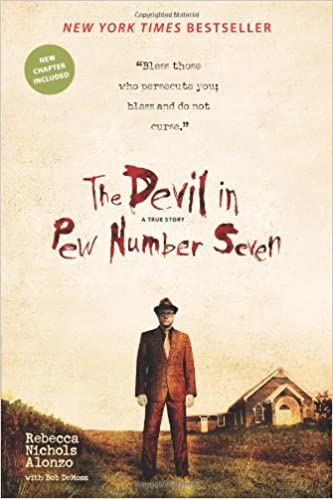
The Devil in Pew Number Seven

“The story you are about to read actually happened, every last detail of it. As the plot unfolds, my hunch is that you’ll need to remind yourself of this reality more than once.” So Rebecca Nichols Alonzo opens her book The Devil in Pew Number Seven.

Her hunch was right.

Rebecca tells the story of a man who harassed—no, terrorized her family for several years as she was growing up.

Rebecca’s father was the new pastor of a small church in Sellerstown, NC, in 1969. He found that one man, a Mr. Watts, held key positions in the church even though he was not a member. Recognizing Mr. Watts’ “stranglehold” on the church, Pastor Nichols “made changes to end his dominance” (p. 48).

Mr. Watts did not take his loss of position well, nor the pastor’s difference of opinion over issues like the style of the new church roof. Mr. Watts started acting up in church from pew number seven, making faces at the pastor while he preached, tapping on his watch, walking out and slamming the door loudly before the sermon was finished.

The Nichols family started receiving threatening anonymous phone calls in the middle of the night and unsigned letters. One letter promised the pastor’s family would leave “crawling or walking, running or riding, dead or alive” (p. 54).

Then followed several incidents of escalating attacks: home invasions while the family was away, which one time included water in the fuel tank and oil in the water pump; shots fired at the outside walls; dynamite set off near the house.

The Nichols family, the neighbors, the church, and even the police knew who was behind these attacks, but no one could prove it. Some of the incidents occurred while Mrs. Nichols was pregnant and then while the family had a newborn.

Finally events came to a tragic head. (It’s no spoiler to say this since it’s mentioned in the first chapter).

The rest of the book tells of the long-term effects these years had on the family and the necessity of learning to forgive those involved.

Rebecca was a child when much of this happened, but she read her parents’ journals, newspaper reports, court documents, and interviewed several people from the town.

It’s hard to fathom how far this man went to drive out the pastor. Rebecca’s father felt he couldn’t leave, because that would mean Mr. Watts would again assert his dominance over the church if Pastor Nichols left. The pastor and his wife also believed and modeled for their children “Love your enemies and pray for those who persecute you” (Matthew 5:44).

I first heard of this book from my friend Lou Ann. But I kept passing it by on my TBR list because I thought it might be too hard to read. I finally listened to the audiobook nicely read by Pam Ward. Then I checked the book out of the library to see the pictures and read the afterword.

The book was not hard to read or listen to. Rebecca doesn’t sensationalize the violence. She begins with the climactic incident, but then backtracks to tell how her parents met, were called to the ministry, how they came to Sellerstown, and other “normal” occurrences.

Some of my favorite quotes:

With a few rare exceptions, everyone in Sellerstown was related to one another in some way. Which is why at times, shotguns in hand, they watched out for one another. The Sellers kin are true salt-of-the-earth people . . . although some were saltier than others (p. 31).

I knew [God] said in the Bible that He’s a father to the fatherless and to the brokenhearted. I was both, so we had a perfect fit. There was one more insight I came to embrace. I needed God more than I needed to blame God (p. 235).

I didn’t ask for this abrasion on my soul to be a part of my life; it just is. Now, day by day, I have the choice to forgive the two men who took so much from me, or I can choose to wallow in a toxic brew of bitterness. True, I forgave . . . a long time ago. But that doesn’t mean I still don’t have to forgive him again and again . . . (p. 250).

I’m the one who remains in jail if I withhold God’s grace by failing to forgive when wronged (p. 251).

My one critique is that the author seems to belabor some points overmuch. For instance, with the first threatening phone call, a little more than a page is spent on describing what happens inside the phone when it rings, explaining how phones in those days didn’t have optional ring tones and couldn’t be left off the hook without setting off a warning tone, how her father couldn’t take the phone off the hook anyway because a country pastor was “on call” 24/7 just like a country doctor was. Maybe this was supposed to build suspense with three rings leading up to the first threat, but it just seemed extraneous and a touch irritating. But, this is a minor criticism and for the most part doesn’t hinder the story.

Sometimes the circumstances were hard to read about and illustrated how “truth is stranger than fiction,” But I highly recommend this book. Ultimately it’s about God’s grace and strength through the most difficult of times.

Be Strong: Study of Joshua

Our church has been reading through the book of Joshua the last few weeks. I read Be Strong (Joshua): Putting God’s Power to Work in Your Life by Warren W. Wiersbe along with our daily Bible reading.

Joshua marks two major transitions in Israel’s history. First, Moses, their leader of over forty years, had just passed away. Then the Israelites had just finished forty years of wandering and were about to enter the land God had promised their ancestors long ago.

Either situation would be daunting to a new leader. So God encourages Joshua right off the bat:

No man shall be able to stand before you all the days of your life. Just as I was with Moses, so I will be with you. I will not leave you or forsake you. Be strong and courageous, for you shall cause this people to inherit the land that I swore to their fathers to give them (Joshua 1:5-6).

God also gives Joshua vital instruction:

Only be strong and very courageous, being careful to do according to all the law that Moses my servant commanded you. Do not turn from it to the right hand or to the left, that you may have good success wherever you go. This Book of the Law shall not depart from your mouth, but you shall meditate on it day and night, so that you may be careful to do according to all that is written in it. For then you will make your way prosperous, and then you will have good success. Have I not commanded you? Be strong and courageous. Do not be frightened, and do not be dismayed, for the Lord your God is with you wherever you go (Joshua 1:7-9).

Joshua seems to have followed God’s instruction faithfully throughout the rest of his life. He made a couple of costly mistakes: going up to Ai and making a pact with the Gibeonites without seeking counsel of the Lord. But Wiersbe spends a lot of time pointing out that when we err, we don’t give up: we confess our sins, pick up again, and get back on the right path.

Wiersbe discusses the difficulty of God having His people slaughter the nations in Canaan. He points out that the Canaanites weren’t innocent: they were known for cruel acts like sacrificing their children to their gods and vile sexual acts in the name of worship. And he reminds that God gave them plenty of space to repent. Rahab was one who heard of the God of Israel and turned to Him in faith (eventually becoming an ancestor of the Messiah).

Some hymns have portrayed the promised land as symbolic of heaven. But Wiersbe repeatably points out that the symbolism doesn’t fit: we don’t battle our way either into heaven or after we get there. He says that entering the promised land symbolizes our maturity in Christ. God often said that He was the one driving out the nations before Israel, yet they had to pick up their swords and fight (most of the time. Jericho and some of the other cities had different battle plans). So with us: we’re saved by grace through faith plus nothing. And we’re sanctified by grace as well. Yet we only become mature Christians as we pick up our “sword of the Spirit,” God’s Word, and believe it and apply it. We can and should pray for God’s grace and help in taking temptation away and helping us overcome, but He expects us to read and apply the Word He gave us. “What Paul’s letter to the Ephesians explains doctrinally, the book of Joshua illustrates practically. It shows us how to claim our riches in Christ. But it also shows us how to claim our rest in Christ (p. 22, Kindle version). Wiersbe discusses briefly the different kinds of rest Hebrews 4 and 5 tell about, then says, “This ‘Canaan rest’ is a picture of the rest that Christian believers experience when they yield their all to Christ and claim their inheritance by faith” (p. 22).

The victorious Christian life isn’t a once-for-all triumph that ends all our problems. As pictured by Israel in the book of Joshua, the victorious Christian life is a series of conflicts and victories as we defeat one enemy after another and claim more of our inheritance to the glory of God (p. 23).

The main point of Joshua is that God kept His promises to His people. Not only did He give them the land He originally promised Abraham, but He provided for each of the tribes. At the end of the book, Joshua tells the people, “You know in your hearts and souls, all of you, that not one word has failed of all the good things that the Lord your God promised concerning you. All have come to pass for you; not one of them has failed” (Joshua 23:14). He encourages them to “cling to the Lord your God just as you have done to this day” (23:8) and warns that just as God kept His promises to give them the land, He’ll keep His promise to punish them if they go after other gods.

Wiersbe has a closing chapter of the example of Joshua himself in his following the Lord and leading the people.

As always, I appreciate Dr. Wiersbe’s insights into this book of the Bible.


Memories of Glass

Memories of Glass by Melanie Dobson is a time-slip novel. One time line is modern day, and one begins in 1933 but quickly progresses to WWII.

In the older timeline, three childhood friends in Amsterdam are joined by a fourth when Anneliese Linden moves into their neighborhood. Just a few years later, the war has begun. Eliese’s father’s bank was closed because he was Jewish. Samuel works in another bank and sends his sister, Josie, on missions to deliver hidden correspondence in baskets of flowers and jam when she’s not taking classes at the teacher’s college. Klaas—well, no one knows quite where he stands, so they don’t trust him.

Eliese had moved to London for a time. Her friends don’t know that she’s back in Amsterdam with a young son. Her father has a position helping the Nazis, which he thinks will protect him and Eliese. Eliese feels conflicted registering the families that the Nazis round up, but she doesn’t know what she, as one young woman, can do. When she finds that Josie is working at a creche nearby, they form a plan to rescue some of the children.

In the modern timeline, Ava Drake helps her grandmother, Marcella Kingston, with her charitable foundation though the rest of the family disapproves. Ava’s mom had left the family years ago, but when she and Ava’s brother died in a fire, a case worker found Ava’s connections to the Kingstons. The Kingstons all view Ava as an outsider except Marcella, and since Marcella is the matriarch and holds the purse strings, they all go along—at least in public.

Part of Ava’s job is to vet the charities that apply to the Kingston Foundation for grants. In that capacity, she travels to Uganda to visit a man, Paul, who runs a coffee plantation as a means to help Ugandans. Later, Ava travels to the coffee company’s headquarters in Portland and meets Paul’s sister and grandmother, where she finds a surprising connection.

Ava determines that her family won’t heal until its past is brought to light. As she digs into her family history, she finds connections with the young friends from Amsterdam—connections that some of the Kingstons don’t want known.

The part about rescuing children away by deleting their names on the registration forms was a true one, and Melanie tells that story in her afterword. It’s a reminder that even thought it looks like someone is collaborating with the enemy, he or she might have another purpose in mind.

I felt for Eliese here—there were probably many who were in similar positions, stuck “helping” the Reich. If she resisted, she and possibly her father would have been killed. I was glad she found a way to help after all.

I found myself reading parts of this while also reading Women Heroes of World War II, mentioned yesterday. It was interesting seeing some of the activities there fleshed out in the novel.

There were a lot of details to keep up with, and I am not sure I caught all the threads in the end. But I enjoyed the stories of hope and redemption.