Review and Giveaway: Journaling for the Soul

I kept journals in high school, but I became embarrassed by their content and threw them out. I wish I had kept them, embarrassing as they may have been, for a window into my teenage mind. I made notes from my devotional time for years, but stopped for two main reasons. My writing took up much more time than my reading, and I felt I needed to be listening to God in His Word more than writing my thoughts about His Word. Plus I had stacks of small spiral notebooks that I wasn’t sure what to do with. I rarely went back through them, so I figured they had served their purpose, and I threw them out, too. The closest thing I’ve had to a journal in recent years has been my blog.

But lately I’ve been reminded of the value of writing in connection with our time in God’s Word. Writing helps us process thoughts, and writing helps reinforce and make those thoughts permanent.
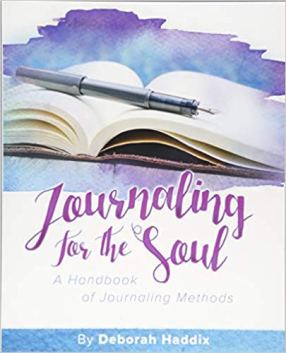
JournalingAbout this time, Michele’s review of Journaling for the Soul: A Handbook of Journaling Methods by Deborah Haddix caught my eye, so I asked for a copy for Christmas.

Deborah shares that journaling in the only way she knew it seemed like too much pressure and took up too much time. But as friends shared with her a variety of journaling methods, she hit on one that resonated with her and enhanced her time with the Lord.

Deborah shares several benefits to journaling. In addition to the ones I mentioned above, journaling can help us engage with a text of Scripture more than a cursory reading would provide, “moving you from reading for information to reading for transformation” (p. 13). Journaling enables us to slow down and focus, “documents what God is currently teaching us” (p. 16), “provides a record of our spiritual growth, one that we can look back on as a reminder of God’s persistent work in our lives” (p. 16). And journaling can be a tool to speak to our loved ones and others. The Journals of Jim Elliot profoundly affected me when I discovered it as a young adult.

Deborah has amassed a multitude of journaling methods. Some are written; some are more artsy. Some focus on prayer, some of self-reflection, some on meditating on one particular text, some on on working through a particular passage, some on gratitude lists or prompts.

Deborah recommends that we “start small and keep it simple” (p. 21). First we need to decide the purpose for which we want to journal and then assess which method fits within our interests and talents. She also advises that we evaluate what we’re doing periodically and decide whether it’s working or whether we need to change. She emphasizes that journaling should not be a source of pressure or driven by perfectionism. One of the best pieces of advice, and new to me, was the recommendation of leaving space for an “insight line” at the bottom of the journaling page – when we read back through our journal entries, we can add a line or two about how we’re doing with whatever we wrote about, whether we’ve grown or are still struggling, ways the Lord answered prayer, etc.

I found, as Deborah predicted, that not all of the methods appealed to me. One that did was Inductive Study Journaling – reading through a passage and jotting down our observations (what it says), interpretations (what it means) and application (“How does God want me to live in light of the truth of His Word” [p. 52]). Another was the Spiritual Markers Journaling, taken from the memorial stones Joshua was instructed to gather and set up as a reminder to Israel of His working among them in Joshua 4:2-7, something like the Ebenezers I listed a while back.  She has a couple of pages on Truth Journaling developed by Barb Raveling. I’m more inclined towards journaling through a passage of Scripture than responding to seemingly random prompts, though the latter has its value as well. I’m considering a variation on the bullet method. I often read from more than one source, and it’s amazing how often they intersect. I’ve thought of just writing a sentence or two from each source each day.

Of course, some people’s minds work differently. A man in our former church was speaking on a particular topic, and in his presentation he shared some “doodles” he had made during a recent sermon. They weren’t art in the sense of being enhanced by frills and flourishes, but he had just arranged the words of a verse or quote from the sermon in a way that illustrated its meaning just by how it was arranged. I wish I had a sample to explain it. I could not have done it in a week’s worth of thought and effort, much less in a quick few strokes while listening to a sermon. His mind worked in such a way that his note-taking took that form. Some like to study a passage not by outlining and highlighting but by verse mapping (some examples here, here, and here). Some take it a step further with art journaling, like Robin Lee Hatcher’s examples here or Karla Dornacher‘s. I’ve seen some examples of art journaling where the illustration covers over the Scripture itself, which, in my opinion, seems to be exalting it over the words of the Bible. To me, some of these types of methods would work best with one verse, whether meditating on it and/or trying to memorize it.

I’d add a word of caution with some of the more artsy methods. There’s a difference between coloring a verse as a hobby, a method of relaxation, etc., and engaging mentally with the text while drawing and illustrating it. I wouldn’t use coloring a verse as my whole time with the Bible. It does take thought and effort to engage with a text to determine the meaning and the best way to apply it. If drawing and illustrating it does that for a person, that’s fine.

So there are any number of methods for engaging with the Bible text in a way that helps us understand and apply its meaning. Deborah has done a great job detailing the reasons for and benefits of journaling and finding examples for just about every personality and mindset.

When I asked for a copy of this book for Christmas, somehow I ended up with two. So I’d like to share one with one of you. If you’d like to be entered for a drawing to win this book, just leave a comment on this post. A week from today, Feb. 27, I’ll collect all the comments here and use random.org to draw a name. (I’ll take all the comments on this post as entries for the drawing unless you let me know that you don’t want your name entered.) In addition, I must have a way to contact you: if you would, leave your email not in the comments but in the form underneath where you place your name. If you are commenting from a WordPress account, your email fills in automatically with the email associated with your account. And, due to shipping costs, I am only able to ship to the US.

Do you journal? Do you use a particular method?

Update: The giveaway is now closed. The winner is Kathie!

(Sharing with Literary Musing Monday, Carole’s Books You Loved)


Book Review: A Little Princess

PrincessIn A Little Princess by Frances Hodgson Burnett, seven-year-old Sara Crewe has grown up in India with her beloved father. Her mother had died years before. Now the time has come for Sara to go to a boarding school in England.

Her father takes her to Miss Minchen’s Select Seminary for Young Ladies. Because he is rich, he provides for Sara to have her own room, maid, and carriage. Because Sara’s father is rich, Miss Minchen fawns over Sara and sets her as her “star pupil.” Privately she dislikes Sara. Because Sara is so elevated, the older popular girls immediately dislike her.

Sara herself is largely unaware of what being rich means. She seems much older than she is, quiet, thoughtful, and serious. But she has a sweet disposition and befriends other outcasts, like the overweight and not very smart Ermengarde, a motherless younger child named Lottie, and the scullery maid Becky.

Sara likes to pretend, and her most frequent pretend is that she is a princess – not because she is haughty or thinks herself entitled to be a princess, but to remind herself to act as a princess would act. Acting as a princess helps her not to lash or or slap people, even when they deserve it.

Suddenly Sara’s world is turned upside down when her father dies amidst a massive business failure. With no time to mourn or even adjust to the news, Sara is relegated to the attic and now has to work at whatever Miss Minchen assign to her. Sara has no other relatives and apparently there is nothing like children’s protective services in that day and time: Miss Minchen is now responsible for Sara and her upkeep, so she’s determined that Sara will earn her keep.

Sara still pretends to be a princess to help her act right, and she pretends that she is a prisoner in the Bastille to make her situation a little more palatable. But she is sad and miserable. Demands are made on her all day, she’s scolded and denied food for the least infraction. She visits with Becky, who has the attic room next to hers, but Lottie and Ermengarde can only come up when they can sneak in unawares.

At Sara’s lowest point, she wakes up to find “a dream come true” in her attic room – a fire in the grate, good food, warm bed coverings, a stack of books. Where could they have come from?

Though A Little Princess isn’t written exactly in the style of a fairy tale, it has many fairy tale elements: a “princess” in disguise or down on her luck, facing various trials, hidden away in a dark place, only to have things change and put to rights at the end with the villains getting their due comeuppance.

I searched a bit to try to discover Burnett’s purpose in writing the book. I couldn’t discover anything except that Wikipedia said “The novella appears to have been inspired in part by Charlotte Bronte’s unfinished novel, Emma, the first two chapters of which were published in Cornhill Magazine in 1860, featuring a rich heiress with a mysterious past who is apparently abandoned at a boarding school.” Perhaps she just wanted to write a fairy tale set in her time. But Sara certainly seems to be an exemplary heroine: not perfect (she admits to having pride and a temper), but constant in her character, kindness, and interest in others no matter what her circumstances. Maybe Burnett set up a character children could look up to and emulate.

But one factor that stood out to me was the way people treat others based on their economic status. Sara was the same person in good times or bad. Neither she nor her father asked or expected that she be out on a pedestal when they were rich, and certainly no one deserves to be treated as Sara and Becky were just because they were poor. The difference came in how others perceived them. Sure, there are some rich people in every age who feel entitled and deserving of pedestals and accolades. But we need to treat people with kindness and consideration no matter what their circumstances.

There’s some mention of “magic” in this book, but it’s not as pervasive as in The Secret Garden. The view of English imperialism and Indian servants might be offensive to modern sensibilities.

I had never read this book, that I can remember, but some years ago I saw a film version which I’d like to see again now.

I didn’t like the cover (pictured above) of the audiobook I listened to, but I enjoyed the wonderful narration by Virginia Leishman.

C. S. Lewis said the best children’s books are good reading for adults, too, and I agree. I very much enjoyed getting acquainted with this classic.

(Sharing with Literary Musing Monday, Carole’s Books You Loved)


Book Review: Read the Bible for Life

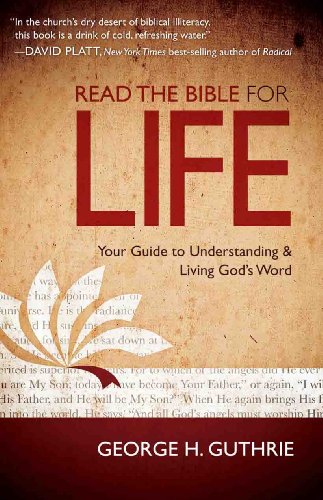
I first discovered George Guthrie through links to his blog from others. The posts I read there were so helpful that I got his book, Read the Bible for Life: Your Guide to Understanding and Living God’s Word.

After an introduction detailing reasons for reading the Bible, lamenting a lack of Biblical literacy among Christians, and posting several reasons why Christians don’t read, Guthrie launches into the four parts of his book.

The first part covers “Foundational Issues,” like how to read it, reading it in context and for transformation. etc.

Part 2 discusses reading the various genres in the Old Testament: stories, laws, psalms and proverbs, and prophets.

Part 3 covers the different types of literature in the New Testament: stories, Jesus’ teachings, epistles (letters), and Revelation.

Part 4 contains four chapters concerning “Reading the Bible in Modern Contexts,” like personal and family devotions, as a church, and in times of sorrow.

At the end, Guthrie includes a couple of reading plans, including a chronological one.

Most of the chapters are the result of interviews Guthrie conducted with experts in various fields of Bible study. I appreciated that the interview format kept the book informal and accessible rather than academic. But because of the interview setting, sometimes extraneous details were included, like scenes from where the interview took place, the interviewee’s posture, etc. But I think the benefits of this process probably outweighed the extra unnecessary details.

I have multitudes of places marked in this book, but I’ll try to share just a few. If the source was someone other than Guthrie, I put that person’s name in parentheses.

God’s Word, wielded by the Holy Spirit, has the power to sort us out spiritually, to surprise and confront us, growing us in relationship with our Lord Christ. Thus, reading the Bible ought to at once be as encouraging as a mother’s gentle touch and, at moments, as unsettling and disturbing as a violent storm.

I would suggest that true literacy—the kind that matters—brings about clearer thinking and informed action. Thus, true biblical literacy involves an interaction with the Bible that changes the way one thinks and acts, and that kind of interaction takes time.

As we read on a daily basis, growing in our skill in Bible reading, the rhythm of a life lived deeply in God’s Word will become as nurturing as our daily meals, as spiritually strengthening as daily exercise, and as emotionally satisfying as a good-morning kiss from a spouse. It takes discipline, but Bible reading can come to be a discipline of delight if we open our hearts and lives to it.

The key is to have a posture toward God’s Word by which His Word is changing us in our context rather than our molding the Word to our cultural tastes and values. That is hard to do. We have to read with humility. And I think the beginning of humility is the fear of God. We have to believe in the authority of God’s Word and be ready to adjust our lives to it. (Andreas Kostenberger)

Jesus meant for people to put His words into action in specific, tangible ways. Our problem is that we think it is enough just to grasp general concepts as if taking in the Word of God is a mental exercise. Jesus, rather, meant our interaction with the Word to be a life exercise.

When we begin to see the beauty and power of the Bible’s story as a whole, we then begin to read each part of the Bible better. (Bruce Waltke)

When slogging through the myriad of laws about priestly worship practices, the tabernacle, uncleanness, and primitive issues of justice, you may feel like the wheels are coming off your momentum. Yet this part of Scripture is also God’s gift to His people. Gems here are waiting to be unearthed from under the seemingly crusty surface, and those gems form a vital part of the foundation of the Bible’s grand story.

I would hope, that when we come to Scripture, we would approach it not as a chore or a duty or a textbook but as a source of delight. At times we should say, ‘Wow! I’ve actually got the next half hour to read the Bible and talk to God!’ (David Howard)

So we need to remember that the Lord wants us to understand this book. We should pray, asking the Holy Spirit for insight and discernment as we read, even as we are putting forth effort to study and understand it. (J. Scott Duvall)

Lament teaches us that we have to go through the process of dealing with our suffering before God. You don’t just stuff your feelings down and put a good face on it, like a lot of us tend to do. You need to go through the process of pouring your heart out to God. And if you don’t have the language for it, the Bible will give you the language. (Michael Card)

Because we are ‘self-help’ oriented, too often we as Christians have become more content to go to the Christian bookstore and get good books there, neglecting our reading of the Bible. We think those books apply to us better than the Bible does, but the reality is, no book in the Christian bookstore can do what the Bible is divinely inspired to do: to transform us at the deepest levels in the way we think and live, to mold us into the image of Christ and show us our place in the grand story of Scripture. (Buddy Gray)

All I know about Guthrie is from some of his blog posts and this book, and I didn’t know any of the people he interviewed except that I had heard of a few of them. But don’t remember seeing any theological problems or concerning issues or statements.

This is a book I wish I had kept running notes or outlines of. But Guthrie does include a summary of the principles discussed at the end of each chapter, which helps for a quick review.

The general helps to reading and understanding as well as the specific advice and tips for the different genres were greatly helpful. I thought this book was an excellent resource for anyone who would like to understand and apply more of the Bible.

(Sharing with Literary Musing Monday, Carole’s Books You Loved)

Book Review: Katie’s Dream

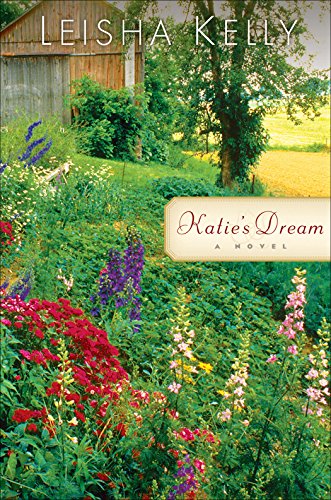
Katie Katie’s Dream is the third installment in Leisha Kelly’s book about the Wortham family. In the first book, Julia’s Hope, Sam and Julia Wortham had come to the end of their resources when they discovered an empty house needing work and asked if they could live in it and let repairing it be their rent. The owner, Emma, agreed, and the Worthams even made it possible for Emma to move back home. They forged a new kind of family and learned from and helped each other. In the next book, Emma’s Gift, both Emma and a neighbor passed away. The neighbor was the mother of ten children. The Worthams had to help the neighbor’s grieving husband plus deal with their own grief and the consequences of Emma’s passing.

In  Katie’s Dream, the Worthams and their neighbors, the Hammonds, have settled into a routine. Half the Hammond children are at the Wortham’s house at any given time. Sam Wortham and George Hammond help each other with the farming. Life is still hard and resources are few, yet everyone is doing well.

But suddenly life is turned upside-down when Sam’s brother, Edward, shows up on their doorstep after being released from prison. He claims that Katie, the little girl he has with him, is Sam’s daughter.

Sam is dumbfounded. He has never been unfaithful, has never even met the girl’s mother. Why would Edward do such a thing? What will the townspeople think? What will Julia think? And what should be done with poor Katie, who just wants a home?

Samuel has never talked about his family much in the years Julia has known him, but now she learns about his mother’s alcoholism, his father’s violence, and his brother’s antics. It wasn’t that Samuel was ashamed of them, but he just wanted to forget the life he came from and start a new one. But now the old one won’t leave him alone. But perhaps he and Julia can find the grace to listen, to forgive, and to share God’s love with those who seem to have no interest in it.

The plot is a somewhat unusual premise: I don’t think I have ever read a story quite like this. But I liked the truths that were subtly conveyed. For one, you don’t have to come from a pristine family to go on and serve the Lord and change the course of your own life. Too, troublesome people (even family members) are not just a plague to be avoided: it’s a challenge to show them love and grace, but sometimes that’s exactly why God brings them to us. As Julia says, “Thank God for the opportunity to know Hazel and George and Edward and all the other difficult people we’d ever had to love. God knows what he’s doing wrapping up the crazy mix he put on this earth.”

There’s also a subplot with the Hammond family. One son, Frankie, is smart but can’t learn to read. He’s somewhat dreamy, but can say the most insightful things at times. His father, George, just doesn’t understand him and sometimes unwittingly hurts him by his reactions. This comes to a head when Frankie is injured.

I think each of these books could be read as a stand-alone novel, but the story is enhanced greatly by reading them all.

I loved visiting with the Worthams once again and am looking forward to the next book.

(Sharing with Carole’s Books You Loved)

Why Laura Ingalls Wilder Is Still Worth Reading

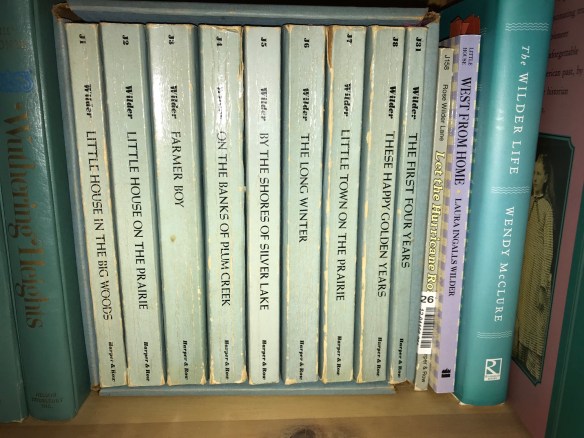
IMG_1338

I have hosted the Laura Ingalls Wilder Reading Challenge during the month of February for the past eight years. In recent years Laura Ingalls Wilder’s books and legacy have come under closer cultural scrutiny. There’s evidence that Pa knowingly homesteaded on land that belonged to Indians and skipped town to avoid debts. Last year Laura’s name was even removed from the Association for Library Service to Children’s award due to perceived “inconsistency between Wilder’s legacy and the association’s core values of inclusiveness, integrity and respect, and responsiveness” and “anti-Native [American] and anti-black sentiments in her work.”

Some who charge Wilder with racism fail to read the concerning passages in context. For instance, one oft-quoted passage states that “the only good Indian is a dead Indian.” But, in context, this statement was made by the Ingalls’ neighbor in Little House on the Prairie, and “Pa said he didn’t know about that. He figured that Indians would be as peaceable as anybody else if they were left alone.” In The Long Winter, Pa advocates believing and following the advice of an Indian predicting a severe winter ahead. Another troubling sentence in Little House on the Prairie reads, ” … there were no people. Only Indians lived there.” When an editor pointed out to Laura that the sentence made it sound as if Indians weren’t considered people, Laura had the sentence changed to “‘… there were no settlers.’ She wrote to the editor, ‘It was a stupid blunder of mine. Of course Indians are people and I did not intend to imply they were not.'”

Pa participates in a minstrel show in blackface. But the family enjoyed and respected a black doctor whom they credited with saving them from scarlet fever. Pamela Hill Smith has a section in Pioneer Girl explaining how blackface was viewed at the time, saying that “Before the American Civil War, many abolitionists embraced minstrelsy as a way to reach a broader American audience, and some minstrel troupes performed songs with distinctly abolitionist themes” (p. 254, note 62). It was not considered offensive then, though it is now.

Even the ALSC said that “Changing the name of the award should not be viewed as an attempt to censor, limit, or deter access to Wilder’s books and materials…This change is not a call for readers to change their personal relationship with or feelings about Wilder’s books, nor does it suggest that anyone stop reading Wilder’s books, talking about them, or making them available to children. The change, however, may prompt further critical thinking about Wilder’s books and the discussions that can take place around them.”

Here on Laura’s 152nd birthday, I want to share why I believe Laura is still worth reading:

1. Her books depict accurate, if not right, views of the times. Parents and teachers who use Laura’s book should discuss the larger picture. Probably most of the settlers’ negative feelings about Native Americans sprang from fear. A major massacre by Native Americans occurred during this time in history, so naturally settlers were afraid and wary. But study can be made about why the Native Americans reacted as they did and the ways they were mistreated. Our country’s treatment of Native Americans is one of the worst marks on its record. But it would be anachronistic to have the characters of the late 1800s depicting enlightened thinking of the early 2000s.  The books can also act as a springboard to discussion of how times and attitudes have changed over the years. No time or culture has every aspect right. It takes long years to change cultural thinking. We don’t learn from history by excising the parts we disagree with today. Wrong attitudes can be viewed in light of the times, not to excuse them but to understand them and to trace how those attitudes have changed since that time. Society still has a long way to go, but we can look back and see that progress has been made.

2. Laura is not responsible for her father’s wrongdoing. She was a child when he made his decisions.

3. Laura’s books are historically based fiction. Some have faulted Laura for not including some aspects of her family’s history in the books and for changing some details. But the books were not meant to be completely autobiographical. Laura originally wrote her life story in Pioneer Girl, but then changed her focus to stories for children.

4. Laura’s books represent a significant swatch of American history. Through story Laura shares with us what is was like to travel in a covered wagon, build a homestead, establish a town, and so many other aspects of pioneer life.

5. Laura’s book depict strong family values like industriousness, independence, frugality, hospitality, community, resilience through hardships, thoughtfulness towards others.

6. Laura’s books can spark discussions, such as:

  • Every culture has its blind spots. What were some of theirs? What are some of ours?
  • Every person and culture has good and bad points. What were some good and bad attitudes in the Little House books? (Good: industriousness, frugality, hospitality. Bad: wrong views of other races, Laura’s wanting to “get back” at others, particularly Nellie Olsen).
  • What led to the hostility between settlers and Native Americans? How could things have been handled differently?
  • Look at how far society has come in its thinking about other races over the years. But our racial attitudes on an individual and national level are still not what they should be. How can we grow in this area?
  • Were there any signs in the books that attitudes were changing? (For instance, Laura’s family was treated by a black doctor at one time. Pa interacted with the Indians sometimes, assured Ma it was fine to do so, and in The Long Winter believed an Indian who came to warn the white men that a bad winter was coming).

7. Laura’s writing is realistic, not idyllic. Some have charged Laura with painting the pioneering family and life as idyllic. But…locusts? Blindness? Bilzzards? Wolves? Fire? Drought? Lack of food and resources? No, nearly every book deals with some kind of calamity. And Laura even realistically depicts sibling squabbling and parental tension.

8. Laura’s writing is excellent. Her stories would not have been read and loved all these years if they were not readable and enjoyable.

9. If we stopped reading people with flaws, we wouldn’t have anyone to read.

I agree with Katrina Trinko’s conclusion here:

Wilder — an amazing writer who poignantly and vividly depicted a crucial part of American history — deserves to remain honored as an icon of American children’s literature. By all means, let’s pair reading her with conversations about America’s past and what was right and what was not and what remains debated.

But let’s encourage critical thinking, not purging.

See also:

The Real Story Behind “The Little House on the Prairie” Controversy
Learning From Laura Ingalls Wilder
Historical Perspective or Racism in Little House on the Prairie?

(Sharing with Literary Musing Monday)

Book Review: Murder in an English Village

EnglishIn Murder in an English Village by Jessica Ellicott, Beryl Helliwell seeks adventure all over the world in the 1920s. Brash, impulsive, and outspoken, she’s become famous as newspapers cover her exploits. “Beryl had a great deal of experience with people in the throes of shock. It tended to happen to others at an alarming rate when she was in the vicinity.”

But she has become bored and restless. After a while “one camel caravan is very much like another.” Finding an ad for a room to rent in the small English village of Walmsley Parva, Beryl decides to take a break and rest a while.

Edwina Davenport has been a quiet pillar in Walmsley Parva for decades, but the economy after WWI has greatly reduced her resources. When she decides to rent a room, she’s delighted when her old school chum, Beryl, asks to rent it. As the two get reacquainted, Edwina admits that she’s embarrassed to go into the village and face scrutiny and gossip because of her financial constraints. Beryl takes it upon herself to help out: she tells the chief rumormonger in town that she and Edwina are secret agents, and “Ed’s” seemingly reduced circumstances are just a front.

Edwina’s dismay at Beryl’s storytelling morphs into deep concern after someone makes an attempt on Edwina’s life in her own back yard. Who in sleepy little Walmsley Parva would have a secret that they don’t want investigated?

I had not heard of this book or author until I was sorting through a 2-for-1 sale at Audible. I had found one book I wanted, but couldn’t find another among the sale items. Then I saw this title. Normally I am wary of modern fiction, because usually it contains bad language or sexual scenes. But I perused a few reviews that said this was a clean story, so I took a chance on it.

As a “cozy mystery,” it’s a lot of fun. Well, except for a murder investigation and several sad tales connected with it. But Beryl and Edwina play well off each other. The story has a cast of distinctive characters. It dragged just a bit for me in the middle as the two women interviewed several people, but as the clues unfolded, the mystery came together satisfactorily. The ending left the possibility open for more Beryl and Edwina stories, and I found that a sequel has been written. The two have good potential for a running series.

I don’t recall that there was any bad language except Beryl uses one word as an idiom which I didn’t understand. Edwina didn’t, either, but her sensibilities were “shocked.” (I wasn’t about to look it up…). Besides that one incident, and the mention of a man having “octopus hands,” the book is clean. Someone is found to have had an adulterous relationship, but nothing explicit is discussed or shown. Beryl does have a penchant for alcohol and divorce.

I saw some reviews criticizing the narrator of the audiobook, Barbara Rosenblat, for some odd hesitations. But I did not find them distracting and thought she did a great job.

Overall I thought it an enjoyable story.

(Sharing with Carole’s Books You Loved)

Book Review: Marilla of Green Gables

MarillaWhen I first saw mention of Marilla of Green Gables by Sarah McCoy, I was intrigued but wary. So many dearly love the Anne of Green Gables series by Lucy Maud Montgomery: how could anyone in our day add to the story? Would it just be fan fiction? Would the author make Marilla’s story too modern and politically correct? Somewhere, in a link I forgot to note, I read that the Montgomery family was also wary of McCoy’s book, but liked it in the end. So that gave me impetus to read it for myself.

In this interview, McCoy tells how she searched and marked the Anne books for clues about Marilla herself. This interview shares some other background information as well.

The book opens with a scene right before Marilla and Matthew decide that he needs help with the farm, and they discuss sending for an orphan boy. The next chapter takes the story back to Marilla as a thirteen-year-old girl. Her brother, Matthew, is in his twenties, still living at home and helping on the farm. Her mother is expecting her third child. Green Gables is being built but is not finished or named yet.

Marilla and Matthew work hard on the farm, and we see each of their personalities as they might have been. Matthew is quiet and shy. Marilla is sensible and practical, but she is a teenage girl and not an older spinster at this point. So she has hopes and dreams and enjoys idle time reading a magazine.

She makes friends with the chatty and opinionated Rachel White (later Lynde) and meets a young, strong John Blythe. Marilla’s first unusual opportunity to travel with Rachel’s family to another town to deliver shawls knitted by the ladies of Avonlea for orphans broadens her horizons and opens her eyes to people and needs outside their small community.

Tragedy strikes at home, which colors Marilla’s decisions for the rest of her life. Suddenly she has to work harder than ever. But she finds outlets for other causes when she’s tapped to lead the newly formed Ladies’ Aid Society.

Political issues in their region pit neighbor against neighbor and cause ripples of unrest. And Marilla finds that helping others sometimes involves risk and sacrifice.

I felt that the author did a good job with the setting and characters. The story did have a familiar Avonlea feel. Most of the main characters seemed reasonable representations (Rachel seemed the least like her LMM counterpart to me). It was bittersweet watching Marilla and John’s romance unfold, knowing it was not going to work out. But I liked that the author presented the break-up as sad but not unrecoverable. Marilla did fine as an independent single woman. I wasn’t thrilled with the political aspects of the story: I don’t remember there being much of anything political in the Anne books. On the other hand, the author researched issues that would have been important in PEI at the time, and it’s reasonable to think those issues would have impacted Avonlea. I liked the fact that each section of the contents echoed the titles of the Anne books (Marilla of Green Gables, Marilla of Avonlea, Marilla’s House of Dreams).

My one main objection centers around Marilla and John’s kiss scene. I felt that a sweet, chaste kiss would have been more in keeping with the setting and style of the books. Instead, the author has John falling in a brook, taking his wet shirt off, and Marilla’s sensation of her hands on his “naked body” (even though we was only shirtless, not naked.) The whole scene was written much more sensually than it needed to be. Sure, Marilla would have been a normal teenage girl with normal sensations and urges, and I suppose that’s what the author was trying to convey. Even still, I would venture to guess that most people’s first kiss even in our day would not border on erotic.

There was also a scene early on where someone thinks a bee is in the house, and the reaction from the other ladies was tremendously overblown, in my opinion, with ladies fleeing the house in panic, and the owner giving the house a thorough cleaning, even calling for the county inspector.

But for the most part, I enjoyed the story and the visit back to Avonlea.

(Sharing with Carole’s Books You Loved, Literary Musing Monday)

Laura Ingalls Wilder Reading Challenge 2019 Sign-up

It’s time for the Laura Ingalls Wilder reading Challenge for 2018! The basic idea is to read anything by, about, or relating to Laura Ingalls Wilder during February, the month of her birth and death. I have an extensive book list here if you’d like some ideas beyond the Little House series, but if course the Little House series is delightful to read or reread.

In the comments below let us know what you’re planning to read. On Feb. 28 I’ll have a wrap-up post where you can tell us how you did and what you thought, either in the comments or with a link back to your posts. You don’t have to have a blog to participate, but if you do I’d appreciate your linking back here.

Sometimes participants have done projects or made recipes from the series as well. If you do so, please do share with us! Annette at Little House Companion has some activities and other resources.

At the end I’ll draw a name from those who participate to win their choice of a prize:

The Little House Cookbook compiled by Barbara M. Walker

OR

Laura’s Album: A Remembrance Scrapbook of Laura Ingalls Wilder by William Anderson

OR

Little House Coloring Book, which contains art and quotes from the books. It’s not designed as an “adult” coloring book, but adults could certainly use it. 🙂

If none of those suits you, I can substitute a similarly-priced Laura book of your choice. To be eligible, leave a comment on the wrap-up post at the end of the month telling us what you read for this challenge. I’ll choose a name through random.org. a week from then to give everyone time to get their last books and posts finished.

This year I am planning to read On the Way Home, written by Laura as she, Almanzo, and Rose traveled from South Dakota to Mansfield, Missouri, and The Road Back, in which Laura and Almanzo traveled back to De Smet for a visit.

How about you? Will you be joining us this year? What will you be reading?

(Sharing with Literary Musing Monday)

Laura Ingalls Wilder Reading Challenge 2019

With all that we’ve had going on lately, Feb. 1 is sneaking up on me. With the month of February comes the annual Laura Ingalls Wilder Reading Challenge, which will take place February 1-18.

The idea is to read anything by or about Laura Ingalls Wilder during the month of February since her birth and death both occurred in February. I posted a Laura-related book list here, if you’re looking for something other than the Little House books.

Some have also incorporated some LIW activities during that month! It’s not required, but I love to see and hear about it.

I’ll have a sign-up post here on February 1st. You can join in any time during the month. You don’t have to have a blog to participate, but if you do, I welcome you to post about the books you read or any activities you might do, and/or post a wrap-up of your LIW reading at the end of the month and link to our wrap-up post here on Feb. 28. If you don’t have a blog, you can let us know in the comments on that post what you read.

No need to share now what you are going to read: you can save that for our sign-up post Friday. I just wanted to give you a heads-up that the Laura Ingalls Wilder Reading Challenge is coming!

Update: this year’s sign-up is here!

Book Review: Baby, It’s Cold Outside

Cold Outside

Dottie Morgan just wants to be left alone. Even at Christmas. Especially at Christmas. A part of her died when her son, Nelson, died in WWII. She’s not been well-favored in the town of Frost, Minnesota, since she ran off and married a “Dapper Dan” stranger, only to return pregnant and alone when her husband went to jail and later died. She and the town had held each at arm’s distance ever since. She felt that even God was keeping His distance from her because of her mistakes.

And then a blizzard trapped four other people in her house.

First Violet Hart came to tentatively ask Dottie about using the star she and Nelson had once made for the Christmas dance. But Violet got into an accident right in front of Dottie’s house and had to be tended to. Violet had been in the WAACs during WWII, a crack mechanic, but people didn’t respect her service. Now, even when she changed a light bulb or fuse, people wondered why she did a man’s job. But Violet had always felt more comfortable with mechanical issues than typical women’s pursuits. She had met one young man, Alex, overseas and corresponded for years. She had hoped he’d come to visit, but when her last letter came back stamped “Return to Sender,” she could only conclude he wasn’t interested, and she’d end up an old spinster like Dottie.

Jake Ramsey was the inadvertent cause of Violet’s accident when he tried to catch her. He had been Alex’s best friend all his life. When Alex died, all his belongings came to Jake, including Violet’s letters. Jake sort of took over Alex’s place, writing in his stead. In the process he began to get to know Dottie and then to love her. But how would she react when she learned that Alex had died and Jake had pretended to be him?

Gordy Lindholm had been Dottie’s neighbor across the street for as long as they could remember. He had loved her once. Still did, in fact. But she had married someone else. He had loved Nelson like his own, but Dottie resented that Gordy had taught Nelson to shoot and then inspired him to be a soldier. Dottie and Gordy had maintained a distant truce over the years, but he watched out for her, filled her wood bin and such. Now he heard the accident and went over to see what was wrong when the blizzard suddenly blew in. He could probably make it home, but it looked like he could be of help at Dottie’s house – if she’d let him.

Arnie Shiller had to stay after school as punishment for daydreaming. Darkness and cold descended on him as he made his way home, and then a sudden snow storm. He tried to make it home, but when that seemed impossible, he strove to make it to his designated Storm House, Mrs. Morgan’s.

Susan May Warren deftly weaves all these lives together in  Baby, It’s Cold Outside. I had started this before Christmas, but then set it aside to finish a library book that I could not renew due to holds on it. After Christmas I planned to put this book away for next Christmas. But I picked it up and read a few pages where I had left off – and got hooked into the story.

Susan has managed to write a tale of five wounded souls with all their flaws, unrecognized virtues, and issues without it becoming sappy or trite Christmas fare.

I loved this book. I loved each person’s story, their interactions, misunderstandings, and journey to make peace with God and each other.

And there were some brilliant moments throughout. As one example (in a slight spoiler), Arnie has been out in the cold too long when he is finally discovered. As they try to warm him, Jake explains that as feeling comes back into Arnie’s limbs, they’re going to be painful at first before they get better. In an aha moment, I realized that the exact same thing was happening to Dottie inwardly. All the emotions she had numbed since her son died were being rubbed back to life by all the circumstances and conversations, and at first they caused nothing but pain. I love that Susan made that parallel without being blatant about it, setting it up to dawn on the reader. She explains in her afterward another parallel or symbolism in the storm house itself.

A few quotes:

God doesn’t expect us to be strong without Him…we’re supposed to need Him, and there’s no disgrace in that. In fact, weakness just might be the mark of a man of God. Don’t call yourself weak because of the things you can’t do. Call yourself weak when you don’t let God take over, do His work in your life…That’s the point of Christmas, isn’t it? Our weakness, His strength? Him coming to our rescue? (pp. 225-226).

Hope, however fragile, is the one thing that keeps us from getting lost…We can’t stop the pain. We can only apply the comfort of God to it (p. 281).

Excellent book, even after Christmas.

(Sharing with Literary Musing Monday, Carole’s Books You Loved)