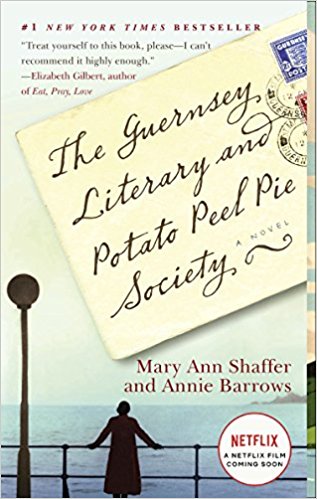
Book Review: The Guernsey Literary and Potato Peel Pie Society

GuernseyIn the novel The Guernsey Literary and Potato Peel Pie Society By Mary Ann Shaffer and Annie Barrows, Juliet Ashton had begun writing a lighthearted newspaper column during WWII under the name Izzy Bickertstaff. Her editors thought the country needed a bit of humor and uplift. After the war, the columns were collected and published as a book, making Juliet and her publishers a lot of money.

But now the war is over, and Juliet wants to write something more meaningful under her own name. She’s not sure what, though, until she receives a note from someone on Guernsey named Dawsey who had somehow ended up with a book she had given away about Charles Lamb. During WWII, Guernsey and surrounding Channel islands were occupied by the Germans. Most of the children were evacuated off the island, and for five years the island didn’t have contact with the outside world. As the island had been isolated during the war and no booksellers had come back yet, Dawsey can’t find other books by or about Lamb, and he  wonders if she might have access to some. In their correspondence, he mentions the Guernsey Literary and Potato Peel Pie Society.

Understandably curious, Juliet asks to know more about the society. It was invented one night when a few neighbors out after curfew were stopped and questioned by a guard (why they were out was another interesting story). One of them made up on the spot the literary society that they had supposedly just come from and even mentioned a German book. Thankfully the guard was a literary type and let them go. But now they had to implement such a society to avoid suspicion, so they began to meet regularly to discuss books they were reading. Some of the members were not avid readers, but they found at least one book to read and talk about.

The more Juliet hears, the more she feels maybe this is what she needs to write about. The book is made of of correspondence mostly between Juliet and her publisher, a few friends, and the various members of the society.

Some of their stories are comical, some are poignant, others are quite sad. Some were helped by the books they read; others were helped more by the camaraderie and community. And a fair bit of drama occurs in Juliet’s life as well, and her life changes in several ways she could not have predicted.

It seemed like everyone was talking about this book a few years ago, and I had always intended to read it “someday.” When I saw a film was being made of the book, I decided now was the time. I have not seen the film yet, but I knew I wanted to read the book first.

Epistolary novels are not my favorite form of story, but it works for this novel. You would have thought that it would be hard to “show rather than tell” through letters, which are a way of telling. But Mary Ann Shaffer and her niece, Annie Barrows, do this masterfully.

Unfortunately there is a smattering of bad words, including the Lord’s name taken in vain. There are no sexual scenes, but one woman has a baby out of wedlock, a couple of men are characterized as homosexual, and mention is made of women who fraternize with the Germans sexually.

But the characters are charming, and I love the way the story unfolds. I hated to see the story come to an end.

I’ve read much WWII fiction, but nothing that I can recall from this period of recovery just after the war. Amid the joy and relief of the war ending and the Germans retreating, there were still shortages, missing people who had been sent off to camps, buildings defaced or marred by Germans who had taken them over, not to mention the emotional trauma many carried with them for a long while afterward.

I listened to the audiobook wonderfully read by a number of people. At first it was a little hard to distinguish between some of the characters, but after a while I got them straight. I ordered the book as well, and it contains a wonderful afterword by Annie Barrows. Most of the book was written by Mary Ann Shaffer, but her health began to fail during the rewrites, and she asked Annie to step in. Evidently Mary Ann had always been a wonderful storyteller, and the family was so pleased that her work was received so well.

I’ll close with a few of my favorite quotes:

That’s what I love about reading: one tiny thing will interest you in a book, and that tiny thing will lead you to another book, and another bit there will lead you onto a third book. It’s geometrically progressive – all with no end in sight, and for no other reason than sheer enjoyment.

Perhaps there is some secret sort of homing instinct in books that brings them to their perfect readers. How delightful if that were true.

All my life I thought that the story was over when the hero and heroine were safely engaged — after all, what’s good enough for Jane Austen ought to be good enough for anyone. But it’s a lie. The story is about to begin, and every day will be a new piece of the plot.

Because there is nothing I would rather do than rummage through bookshops, I went at once to Hastings & Sons Bookshop upon receiving your letter. I have gone to them for years, always finding the one book I wanted – and then three more I hadn’t known I wanted.

Your questions regarding that gentleman are very delicate, very subtle, very much like being smacked in the head with a mallet…it’s a tuba among the flutes.

Reading good books ruins you for enjoying bad books.

(Sharing with Semicolon‘s Saturday Review of Books, Carole’s Books You Loved)
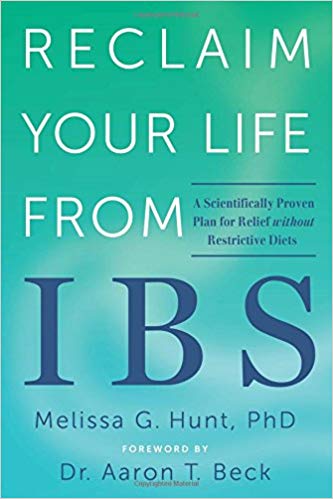
Book Review: Reclaim Your Life From IBS

I hadn’t planned to review this book at first, but then I thought it might be helpful to others.

IBS stands for irritable bowel syndrome. I’ll let you look up the symptoms elsewhere if you don’t know them. But the bathroom-related issues of IBS can cause anxiety (about being able to find a bathroom when you need one, having issues at an inopportune time, etc.) That anxiety can in turn exacerbate IBS symptoms. It’s not that IBS is a disease of the mind, but our thoughts and anxieties can make it worse, creating more anxiety which creates worse symptoms, creating a vicious cycle.

IBSReclaim Your Life from IBS: A Scientifically Proven Plan for Relief without Restrictive Diets by Melissa G. Hunt deals primarily with the cognitive aspect of IBS, the way we think about it.
Dr. Hunt begins with other diseases of what she calls the “gut” which have to be ruled out before an IBS diagnosis can be made. Someone who thinks they might have IBS might actually have something else which has a specific treatment, so it’s important to be checked out. Then she describes the processes involved in digestive issues, from the nervous system to gut bacteria.

Dr. Hunt shares some relaxation techniques to help us dial back from panic mode. Then she explains the “cognitive model of stress management.” Basically, what and how we believe and think influences us one way or another. She gives the example of seeing a friend across the street and waving at her, but receiving no response. Our minds can take off imagining scenarios – that our friend is mad at us for something, that she’s snubbing us., etc., when probably she just didn’t see us. Applying that to IBS, when we experience gut twinges or gurgles when we’re out or preparing to go out, we can panic, thinking we need to get to a bathroom fast. But every twinge and gurgle doesn’t mean an attack is coming on. Or we can panic about the possibility of needing to step out to go to the bathroom during a work meeting, thinking everyone will think less of us and we might even be jeopardizing future promotions, when in reality no one will think anything of it (plus everyone probably has to do that at some time).

Dr Hunt also shares ways to eliminate avoidance: people with IBS can become experts in avoiding situations where they think they might have problems. Some of what Dr. Hunt shares here is the same process as overcoming phobias: exposing ourselves to whatever we’re fearful of a little bit at a time as we become more comfortable. One example she gives is that of someone who avoids commuter trains because they don’t have bathrooms.  First she suggests just visiting the train station for a while until that nervousness we get just from being there subsides (which might take multiple attempts). Then, we might get on the train just until the next stop. Once we can do that without nervousness, then we might go two stops, etc.

Finally she discusses some of the dietary and medicinal approaches to IBS. She stresses that there is no one IBS diet that works for everyone or particular foods that everyone must avoid. She discusses some of the most common foods that might give IBS patients trouble.

I hope I never have to see a therapist, but I hope that if I do, I can find one as practical and down to earth as Dr. Hunt rather the ethereal and New Age-y kinds I have read elsewhere. Much of what she has to say, especially about our thoughts, can be applied to many situations beyond IBS:

Cognitive interventions are not about “pretending” that things are going well if they’re not. In fact, this wouldn’t help even if you tried it, because you wouldn’t believe it. Rather, cognitive interventions are about helping you see the world as accurately and objectively as possible. The problem is that many, many people do have negative biases or filters that they use to interpret situations in their lives. If you do this routinely and without realizing it, you will be a lot more stressed than you need to be. If you have been entertaining lots of negatively biased automatic thoughts, then seeing the world more accurately should bring about a great deal of relief. In other words: Don’t believe everything you think (p. 66).

Dr. Hunt’s style is easy to read and understand. I am happy to recommend this book.

(Sharing with Semicolon‘s Saturday Review of Books, Literary Musing Monday, Carole’s Books You Loved)


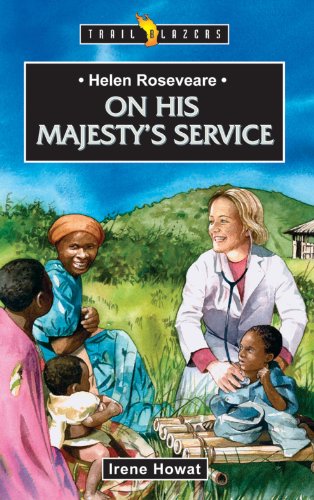
Book Review: Helen Roseveare: On His Majesty’s Service

Roseveare Helen Roseveare was a missionary to the Belgian Congo in Africa, later named Zaire, from 1953-1973. I first became aware of her through Faithful Women and Their Extraordinary God by Noel Piper several years ago. I wanted to read more about her, so when I saw Helen Roseveare: On His Majesty’s Service by Irene Howat on sale for the Kindle app, I decided to try it, even though it was part of the Trailblazer series of biographies for children.

The first few chapters deal with Helen’s childhood in England: terrorizing nannies with her brother, moving several times due to her father’s job, going to boarding school in Wales. She had a strong desire to be first and best at as much as she could, and she didn’t make friends very easily. In a Sunday School class, she decided she wanted to be a missionary even before she became a Christian. Confirmation classes in her church caused her to take a more serious look at herself, but it was in a camp some years later that she became a believer. She became quite conscientious.

As a teenager during WWII, Helen wrestled with the devastation and unfairness of it all, especially the unfitness of young people losing their lives. Once when a German plane was shot down, Helen was horrified to learn that her mother was among the people trying to save the young man, though he later died. Her mother explained that he was just a boy fighting for his country, like their boys, and had a home and family.

Helen became involved in helping at camps and the GCU (Girl Crusader’s Union) while in college. She never lost her desire to be a missionary doctor, and soon after college she went through missionary training and then went to the Congo. She was plunged into medical service right away. From her earliest days she felt the need to train the national workers and open a nursing school. She had to set up a hospital from the ground up, with students and church members and even patients helping.

But civil unrest was rumbling in the distance and drawing ever closer. Helen had opportunity to leave many times, but she felt she should remain. Finally rebel soldiers did take over Helen’s area. Probably because this is a children’s book, the author did not go into much detail or mention the multiple rapes Helen endured. She sums it up this way:

Things too terrible to tell happened to her at the hands of Congolese rebel soldiers, things so horrible and shocking that she wished she were dead. In a way that we cannot understand they were part of God’s plan for her and she knew that, even at the time. With her body battered and broken and her back teeth kicked out, Helen survived when others did not. But she survived to endure further months of terror.

After several months of captivity and cruelty, Helen and a few others were released and sent back to England for a long recovery.

After fifteen months, went back to Africa, to Zaire, building more hospitals and training more medical workers.

When Helen went back to England years later, she stayed active speaking at schools, GCU gatherings, and churches. When someone wanted to make a film of her life, she traveled back to a warm welcome in Zaire and was thrilled to see how the work was progressing.

One of the most well-known stories of her life was one I had heard but didn’t realize happened to Helen until I read it in Faithful Women and Their Extraordinary God. It’s told in detail here. A woman had come to the hospital in labor with a premature baby. They could not save the woman, but the baby was safely delivered. Yet they had no way to keep the baby warm: they usually used hot water bottles, but were out. The baby also had a two-year-old sister. When Helen had prayer with the orphan children the next day, she told them of the little girl and baby and the need for hot water bottles. One ten-year-old girl named Ruth began to spontaneously pray:

God, please send a hot water bottle so that this little baby doesn’t die. And, God, it will be no use sending it tomorrow because we need it today. And, God, while you’re at it, will you send a dolly for the baby’s sister who is crying because her mummy has died.

Helen “didn’t think the Lord could do that.” But that very afternoon a truck delivered a parcel containing soap, bandages, babe sweaters…and a hot water bottle and a doll! Helen tells this story here:

Since this book was published in 2008, it doesn’t contain information about Helen’s death in 2016 at the age of 91. Zaire is now known as the Democratic Republic of the Congo.

The writing in this book is not the best: it’s a little choppy, with several odd scenes involving unnamed people that I think were made up in an effort to illustrate something in Helen’s life. But It’s still a good book overall, with a good overview of Helen’s life.

(Sharing with Semicolon‘s Saturday Review of Books,  Literary Musing Monday, Carole’s Books You Loved)


What’s On Your Nightstand: August 2018

Nightstand82The folks at 5 Minutes For Books host What’s On Your Nightstand the last Tuesday of each month in which we can share about the books we have been reading and/or plan to read.

As we near the end of another month, it’s time to recap what we’ve read.

Since last time I have completed:

The Hunchback of Notre Dame by Victor Hugo, reviewed here. Not my favorite classic or Hugo book, but I am glad to have read it. It kept me thinking for days afterward.

30 Days of Hope When Caring for Aging Parents  by Kathy Howard, reviewed here. Very good.

Full Assurance by Harry A. Ironside, reviewed here. Excellent study on what the Bible has to say about assurance of salvation.

The Pattern Artist by Nancy Moser, reviewed here. A maid from England accompanies her employers on a visit to America in 1911, then strikes out on her own. She lands a job in the sewing department of Macy’s and captures the attention of the Butterick Patterns salesman. Very good!

Back Home Again: Tales from the Grace Chapel Inn by Melody Carlson, reviewed here. Three sisters turn the old family home into a bed-and-breakfast, working through their own differences and town opposition. The first in a long series. Good.

Before We Were Yours by Lisa Wingate, reviewed here. Riveting historical fiction based on real circumstances concerning a woman who stole poor children and then placed them for adoption.

The Incorrigible Children of Ashton Place: Book VI: The Long-Lost Home by Maryrose Wood, reviewed here. A fun and satisfying wrap-up to this series.

Reshaping It All: Motivation for Physical and Spiritual Fitness by Candace Cameron Bure, reviewed here. Cameron’s journey from bulimia and excess weight to fitness, inside and out. Very good.

I’m currently reading:

The Guernsey Literary and Potato Peel Pie Society By Mary Ann Shaffer and Annie Barrows. Finally!

Helen Roseveare: On His Majesty’s Service by Irene Howat

Reclaim Your Life from IBS: A Scientifically Proven Plan for Relief without Restrictive Diets by Melissa G. Hunt

Up Next:

Christian Publishing 101 by Ann Byle

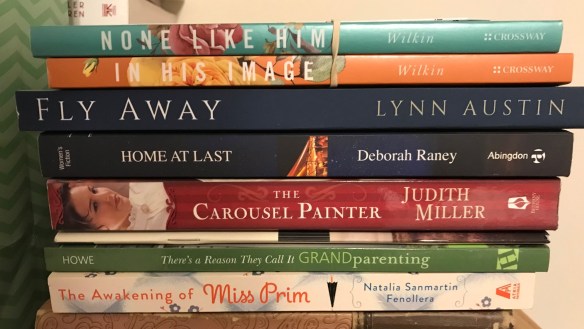
I’d like to reread, or at least look through again, Women of the Word by Jen Wilkin

Something from this stack and my ever-increasing Kindle collection:

IMG_1115

Are you reading anything good now?

Book Review: The Incorrigible Children of Ashton Place: Book VI: The Long-Lost Home

Incorrigible The Incorrigible Children of Ashton Place: Book VI: the Long-Lost Home is the long-awaited finale to the Incorrigible Children series by Maryrose Wood.

If you’re not familiar with the series, it’s about three children raised by wolves whom Lord Frederick Ashton brings home after he discovered them on a hunting trip. Needing someone to teach and “tame” the children, Lord Ashton advertised for a governess. He was sent the plucky Miss Penelope Lumley, graduate of Agatha Swanburne’s Academy for Poor Bright Females.

A number of intriguing mysteries and connections have been traced through the first five books: the fact that Penelope’s hair is the exact same color as the Incorrigibles, that Frederick Ashton gets “wolfy” during full moons, that Frederick’s presumed-dead father is not really dead but has not revealed himself. Book V ended with Penelope separated from the Incorrigibles,  having been tricked into switching places with a tutor to the  Horrible Babushkinovs in Plinkst, Russia.

In this final book, the looming due date of Lady Constance Ashton’s baby means the family curse will come to a head, and one side or the other will be destroyed.  How can Penelope help them while so far away? How can she possibly get home with no resources?

All of the various threads are satisfactorily resolved in this final book. I’ve mentioned before that I don’t normally go for books about “curses” or ones that have soothsayers as recurring characters. Those weren’t elements in the first book that got me hooked on the series. The most objectionable element to me was a seance, I think in Book III. If you read this with your children, you’ll have to discuss these issues in concert with your beliefs.

I also don’t read all that many children’s books, and I am not sure what age level this book is intended for.

But what I love most about the series is the clever writing and the humor. Every book is sprinkled with Agatha Swanburne’s pithy sayings and includes explanations and references to a couple of classics (Hamlet and The Count of Monte Cristo, in this case). Values such as hard work, resourcefulness, basic decency, and loving family are emphasized in each book.

I loved the distinction between “Optoomuchism” – an overly optimistic and ultimately untenable outlook – and “pessimax” – pessimism to the extreme.

I happened to listen to the first book due to a free audio version, and I fell in love with Katherine Kellgren’s fantastic narration, character voices, and inflections. I chose to listen to all of the books via audio because she added so much to them. Sadly, she passed away before the final book was published. There is a very touching afterword in this book honoring Katherine and telling of the friendship that had arisen between the author and narrator. Audiobooks don’t always include forwards and afterwards, so I am glad this one did. This audiobook was ably narrated by Fiona Hardingham.

These are my reviews of the previous books:

The Incorrigible Children of Ashton Place, Book 1: The Mysterious Howling 

The Incorrigible Children of Ashton Place, Book II: The Hidden Gallery

The Incorrigible Children of Ashton Place, Book III: The Unseen Guest (for some reason did not review this one)

The Incorrigible Children of Ashton Place: Book IV: The Interrupted Tale

The Incorrigible Children of Ashton Place, Book V: The Unmapped Sea

(Sharing with Carole’s Books You Loved)

Book Review: Before We Were Yours

Truth is stranger than fiction, the saying goes. It is also more heartbreaking. One of the saddest and strangest situations in history is the story of Georgia Tann and the Tennessee Children’s Home Society she operated. Georgia would abduct poor children by various illegal means: outright kidnapping, taking children born to unwed mothers for “medical care” and then telling the mothers their babies died; tricking parents into signing their children over to the home, and others. Policemen, family court judges, a crime boss, and others were a part of Tann’s network. The children they obtained would be adopted out to unsuspecting couples or sometimes sold to high-profile, wealthy families. Records were often destroyed or falsified. Even though Tann thought the children would be better off in their new situations, ultimately her enterprise was a money-making scheme. Tann died while she and the home were investigated, but before she could be brought to justice.

Before we were yoursLisa Wingate sets her novel Before We Were Yours in these circumstances.

Avery Stafford is a senator’s daughter being groomed to take his place. On a trip with her father to a nursing home, a resident pauses before Avery, seems to recognize her, and calls her “Fern.” An aide hustles the woman away, chalking the incident up to dementia. But the woman made off with Avery’s heirloom bracelet, and when Avery goes back to the woman’s room to retrieve it, she sees a framed photograph of a woman who looks remarkably like Avery’s grandmother. Conversations with the resident, May, lead Avery to look into her grandmother’s journals. Every scrap of information uncovered produces more questions. Avery isn’t sure what she will ultimately find or what the consequences will be, but she feels compelled to know the truth. And the process causes Avery to question whether she is living a “role” in life set out for her by others.

May’s story is told in flashbacks. She was born Rill Foss, the oldest of five children who lived with their parents on a houseboat. When Rill’s mother goes into hard labor, the midwife insists that she be taken to the hospital. While Rill’s parents are gone, a policeman comes to pick up the children, saying he will take them to see their parents. Instead, he takes them to a woman waiting in a nearby car, who whisks them away to a children’s home.

Children in the home are neglected, not well fed, and abused. But when potential adoptive parents come, the children are dressed up and threatened to be on their best behavior. One by one Rill’s siblings disappear, but when she protests or tries to thwart their removal, she is punished and her remaining siblings threatened.

Even though May’s history is heart-rending, ultimately the book ends redemptively and hopefully.

Lisa’s scenes on the river are so real, I could almost see and smell and feel the surroundings. I ached with May through her story and the ultimate hard choice she had to make, and rejoiced at how things wrapped up for her. And I enjoyed Avery’s story as well.

A very well-written, excellent book.

(Sharing with Semicolon‘s Saturday Review of Books, Literary Musing Monday, Carole’s Books You Loved)

Book Review: Reshaping It All

ReshapingSome of you may remember Candace Cameron Bure as oldest daughter D. J. Tanner in the TV series Full House several years ago. I have not really kept up with her career since then, but somehow I was aware that she’d had some eating issues, had lost weight, and was an outspoken Christian like her brother Kirk Cameron. So when her book, Reshaping It All: Motivation for Physical and Spiritual Fitness came up on a Kindle sale, I got it.

Although the book is not a full-fledged memoir, Candace gives glimpses of her growing-up years, family, time on Full House, marriage, and motherhood.

Her family seems remarkably grounded: even though Cameron and her brother were making all kinds of money, their father still made them work (at other jobs: he didn’t consider acting “work”) when they wanted something.

He could see that hard work was not only a prerequisite for success but that it was also a prerequisite for strong character. Struggling for the things we get teaches us the all-important lesson of self-disciple while it strengthens our body and spirit. It wasn’t enough for us to achieve a certain level of success in this world: our parents wanted us to reach our full potential as people who are strong in spirit and mind.

But Candace received mixed signals about food. He father provided “cardboard-tasting ‘health’ food” while her mother brought in doughnuts and such. Various other factors came into play, resulting in Cameron’s being about 25 pounds overweight and suffering from bulimia in her early twenties.

What I didn’t realize at the time is that my heart was longing for the things of this world. I ran to comfort food instead of running to God. I discovered my sin, but I hadn’t discovered that my heart was in the wrong place. I sought moral reformation instead of spiritual transformation. I had known who He was, but I still hadn’t grasped who I was in His sight.

She tells how she changed her approach to food and fitness. She didn’t follow a specific diet plan, and she believed everything was allowable in moderation, but she had a few principles she went by.

Transforming our bodies must begin by the renewing of our minds. Our bodies aren’t making these detrimental choices for us; they are simply animated by a mind that needs a mental makeover.

One such principle was HALT. “When you feel like reaching for food, ask yourself first if you are hungry, angry, lonely, or tired. If you’re hungry, then proceed, but it you are reaching for food in response to emotion, then halt your behavior immediately.”

And even though the book is primarily about her journey towards fitness, she applies some of the same principle to style, clutter, marriage, and other facets of life.

Candace became a Christian at age 12, and the life principles she espouses are based squarely on Scripture. She writes in a conversational, level-headed, encouraging, easy to read style.

Standing face-to-face with a mountain can be overwhelming, especially when your perspective is that of looking up from the bottom. But if we decide to take one step and then another, looking only at the ground set before us, we realize the potential we have.

The only negative for me was the fan letters. At the end of every chapter, Cameron includes a fan letter asking her a question related to the chapter before. That was fine, but each letter also contains a certain amount of fannish praise that I felt awkward reading.

This book was written back in 2011, before her co-hosting stint on The View and other pursuits. She has written a few more books since that time, too.

I enjoyed the book very much and took away a few nuggets to help me in my own journey.

(Sharing with Semicolon‘s Saturday Review of Books, Literary Musing Monday, Carole’s Books You Loved)

Book Review: Full Assurance

For several years I struggled with whether or not I was really a Christian. During that time we visited my mother-in-law’s home, and I discovered on her book shelves Full Assurance by H. A. Ironside. I borrowed it, and it helped me with one key point in particular.

Recently while looking for something else on my bookshelf, I came across this volume again (I guess that means I never gave it back – sorry, Mom!) I couldn’t remember much about it except for the one point that had helped me so much some 30 or so years before, so I decided to read through it again.

Ironside says in his introduction that he wrestled with assurance for a while himself, and he wanted to “make as plain as I possibly can just how any troubled soul may find settled peace with God” (p. 7). He said that “so many people who profess to want help along these lines are too indifferent to investigate,” but he wanted to appeal to “earnest seekers after truth” (p. 7). He assures that God cares about us and wants us to rest in His salvation.

In subsequent chapters he unpacks several verses that speak specifically of assurance, like Isaiah 32:17 (“And the work of righteousness shall be peace; and the effect of righteousness quietness and assurance for ever”) and Colossians 2:1-3 (especially verse 2: “That their hearts might be comforted, being knit together in love, and unto all riches of the full assurance of understanding“).

Then his longest chapter deals with “Difficulties Which Hinder Full Assurance” in the form of questions and answers, like “How can I be sure I have repented enough?” and “I do not feel fit to come to God” and “I don’t know if I can hold out.”

Ironside had been a preacher for almost 50 years at the time of this writing, and he deftly handles every issue from the Scriptures and shares several anecdotes to illustrate his points.

The point I mentioned having trouble with was whether I had repented “right” or “enough.” Forgive the long quote, but I wanted to share his whole answer here:

Very often the real difficulty arises from a misapprehension of the meaning of repentance. There is no salvation without repentance, but it is important to see exactly what is meant by this term. It should not be confused with penitence, which is sorrow for sin; nor with penance, which is an effort to make some satisfaction for sin; nor yet with reformation, which is turning from sin. Repentance is a change of attitude toward sin, toward self, and toward God. The original word (in the Greek Testament) literally means “a change of mind.” This is not a mere intellectual change of viewpoint, however. but a complete reversal of attitude.

Now test yourself in this way. You once lived in sin and loved it. Do you now desire deliverance from it? You were once self-confident and trusting in your own fancied goodness. Do you now judge yourself as a sinner before God? You once sought to hide from God and rebelled against His authority. Do you now look up to Him, desiring to know Him, and to yield yourself to Him? If you can honestly answer yes to these questions, you have repented. Your attitude is altogether different to what it once was.

You confess you are a sinner, unable to cleanse your own soul, and you are willing to be saved in God’s way. This is repentance. And remember, it is not the amount of repentance that counts: it is the fact that you turn from self to God that puts you in the place where His grace avails through Jesus Christ.

Strictly speaking, not one of us has ever repented enough. None of us has realized the enormity of our guilt as God sees it. But when we judge ourselves and trust the Saviour whom He has provided, we are saved through His merits. As recipients of His lovingkindness, repentance will be deepened and will continue day by day, as we learn more of His infinite worth and our own unworthiness (pp. 89-90).

One other point that I remember being struck with, though I can’t find now the specific place he discusses it, is from Hebrews 6:11-12: “And we desire that every one of you do shew the same diligence to the full assurance of hope unto the end: That ye be not slothful, but followers of them who through faith and patience inherit the promises.” Showing “diligence to full assurance” helped me understand that when we’re having problems along this line, we need to “be not slothful” but diligently seek God’s Word for the answers rather letting doubts and questions fester in the background for years.

I have many places marked in the book. Here are a few of the helpful, standout quotes:

It is well to remember that some vivid emotional experience is not a safe ground of assurance. It is the blood of Christ that makes us safe and the Word of God that makes us sure” (p. 29).

Faith is not the savior. Faith is the hand that lays hold of Him who does save. Therefore the folly of talking of weak faith as opposed to strong faith. The feeblest faith in Christ is saving faith. The strongest faith in self, or something other than Christ, is but a delusion and a snare, and will leave the soul at last unsaved and forever forlorn (p. 39).

Assurance is not based upon any emotional change, but whatever emotional experience there may be, it will be the result of accepting the testimony of the Lord given in the Scriptures. Faith rests on the naked Word of God. That Word believed gives full assurance (p. 45).

So long as a man considers himself worthy there is no salvation for him; but when, in repentance, he owns his unworthiness, there is immediate deliverance for him through faith in the Lord Jesus Christ. Without repentance the sinner is unable to believe unto salvation (pp. 91-92).

Many times Ironside counsels readers to study the Bible:

As soon as one knows he is saved, he should begin, in dependence upon the Holy Spirit, a careful regular, systematic study of the Word of God. The Bible is our Father’s letter to us, His redeemed children. We should value it as that which reveals His mind and indicates the way in which He would have us walk. ‘All Scripture is given by inspiration of God, and is profitable for doctrine, for reproof, for correction, for instruction in righteousness: that the man of God may be perfect, throughly furnished unto all good works” (II Tim. 3:16-17). The study of the Word will instruct me in the truth, it will show me what needs to be rectified in my life and walk, it will make clear how I may get right with God, and it will guide me in paths of uprightness. No Christian can afford to neglect his Bible. If he does, he will be stunted and dwarfed in his spiritual life, and he will be a prey to doubts and fears, and may be carried away by every wind of doctrine (p. 48).

Nothing will make up for lack of this diligent study of the Bible for yourself. You cannot get the full assurance of understanding without it. But as you search the Scriptures, you will find truth after truth unfolding in a wonderful way, so that doubts and questions will be banished and divinely given certainty will take their place (p. 50).

How necessary then for His redeemed ones to study His Word in dependence upon His Holy Spirit, that they may be delivered both from the fears that are a result of ignorance of His truth and pride that is a result of self-confidence. The liberating Word alone will give to the honest, yielded soul who searches it prayerfully, in order that it shall have sway over his life, the full assurance of understanding, for it is written: ‘The entrance of thy words giveth light; it giveth understanding unto the simple'” (p. 54).

There’s a very helpful section for those fearing they might not be “elect” or “predestined,” but it’s about three pages long, too long to share here. But one excerpt: “But what does the Word say? ‘Christ died for the ungodly.’ Are you ungodly? Then He died for you. Put in your claim and enter into peace” (p. 92).

I have seen this book listed by various titles just Full Assurance, or Full Assurance: How to Know You’re Saved; Full Assurance, or A Series of Messages for the Anxious Soul, and the author’s name sometimes listed as Harry A., most times as H. A. Ironside. I assume they are all basically the same book, but I don’t know whether there might have been some revisions between reprintings. The copy I have is from 1968, but it says it is a revised edition. If you look at Kindle versions, check the reviews first: one I came across said that several chapters were left out.

This book is an excellent resource especially for those who have wrestled with assurance of salvation or those who counsel such people, but it is also a good resource for those who want to learn more about what salvation is or for those who are already saved to understand and appreciate more what their salvation involves.

(Sharing with Semicolon‘s Saturday Review of Books, Literary Musing Monday, Inspire Me Monday ,Let’s Have Coffee, Carole’s Books You Loved)

Book Review: The Hunchback of Notre Dame

The Hunchback of Notre Dame by Victor Hugo was published in 1831 but set in the Paris of 1482.

Quasimodo was a deformed child left at a place where foundlings were deposited for anyone who might want to take them in. He had so many physical issues that one of the gossipy women observing him declared it “must be a sin to look at such a thing.” A priest came by, saw the child, and adopted him.

The priest, Claude Frollo, had been a promising scholar when his own parents died. In compassion he took in his younger brother, Jehan, and raised him, and thoughts of what would have happened to Jehan if Claude had not been available compelled Claude to take in Quasimodo.

But several years later, Jehan became dissolute, preferring drinking and carousing to studying. Quasimodo, “From his very first steps among men…had felt himself, later on he had seen himself, spewed out, blasted, rejected. Human words were, for him, always a raillery or a malediction. As he grew up, he had found nothing but hatred around him. He had caught the general malevolence. He had picked up the weapon with which he had been wounded.” Quasimodo became the bell ringer for Notre Dame and loved the bells as he did no one else except Claude, but the bells made Quasimodo deaf. He was unable to benefit from the study Claude longed to impart. Thus, “Claude, saddened and discouraged in his human affections, by all this, had flung himself eagerly into the arms of learning, that sister which, at least does not laugh in your face, and which always pays you, though in money that is sometimes a little hollow, for the attention which you have paid to her. Hence, he became more and more learned, and, at the same time, as a natural consequence, more and more rigid as a priest, more and more sad as a man.” His insatiable thirst for knowledge led him to delve “further, lower, beneath all that finished, material, limited knowledge; he had, perhaps, risked his soul, and had seated himself in the cavern at that mysterious table of the alchemists, of the astrologers, of the hermetics.”

Further drawing Claude away from anything good and right was his lust for a gypsy girl named Esmeralda, who used to dance in the streets with her tambourine and have her goat perform tricks to earn money. Claude deemed that his unhealthy obsession for Esmeralda must be due to some sorcery on her part.

When Quasimodo was publicly punished for a crime that Claude put him up to, Esmeralda was the only person who took pity on him and offered him water. That act of kindness caused Quasimodo to love her, though he knew his love would never be returned.

Claude’s jealousy led to an assault for which Esmeralda was blamed. Quasimodo rescued her and hid her in the cathedral. But massive misunderstandings all around led to multiple tragedies.

My thoughts:

I have not seen any of the film versions of this book, but from what I understand, many of them twist the ending to be more upbeat. There is no happy ending in this book, except maybe for the playwright and the goat. In fact, it’s so dark and seemingly hopeless, I pondered for a long while what it was all for.

Some have said, due to the fact that the Hugo’s original title was Notre-Dame de Paris, and most of the action in the novel takes place in and around the cathedral, that it is the main character. One reason Hugo wrote this book was to call attention to the value of the Gothic architecture in the city and to rouse support for preserving it. Many of Paris’s buildings had been damaged over the centuries and new construction or repairs were not always in keeping with the Gothic style. One chapter in the book talks about how literature will “kill” architecture as a means of expression.

But on another level, this novel depicts a very human story. I can’t believe that it is all about the cathedral.

It could be about the destructive power of lust. Most of the tragedies that came raining down on almost everyone stem from Claude’s obsession with Esmeralda. Some of the others came or were exacerbated by a lust for power. Early in the novel, a playwright wanders into the wrong part of town and is put on “trial” by the riffraff of the city. Later, two different trials by the proper magistrates show themselves to be no more just than the underground kangaroo court. Even one scene involving the king shows his misplaced priorities.

It could be about the mistake of judging by appearances. Quasimodo, of course, was obviously misjudged from day one, which had an effect on his character. A captain, Phoebus is misjudged, but on the other end of the scale: because he is so handsome, people think he is good, when in reality he is a cad. Esmeralda is misjudged for her beauty but also for her ethnicity: gypsies were not respected, and she is constantly accused of sorcery or other crimes just because she is a gypsy. One of my favorite parts is a song Quasimodo sings outside Esmeralda’s window, translated by Project Gutenberg as follows:

Look not at the face, young girl, look at the heart. The heart of a handsome young man is often deformed. There are hearts in which love does not keep. Young girl, the pine is not beautiful; it is not beautiful like the poplar, but it keeps its foliage in winter. Alas! What is the use of saying that? That which is not beautiful has no right to exist; beauty loves only beauty; April turns her back on January. Beauty is perfect, beauty can do all things, beauty is the only thing which does not exist by halves. The raven flies only by day, the owl flies only by night, the swan flies by day and by night.

It could be about the nature of real love. Claude thinks he loves Esmeralda but his affection is dark, destructive, and self-centered. Esmeralda thinks she loves the captain, but her warm feelings are based on his looks and an act of kindness he rendered toward her. She’s totally blind to his real nature. Quasimodo, though not a good character, shines in his love for the bells and the cathedral – some say he is the soul of the cathedral, and without him, the building “seems deserted, inanimate, dead…like a skull which still has holes for the eyes, but no longer sight.” He loved Claude, but it was a love based on “gratitude carried to its extreme limit.” But his love for Esmeralda causes him to extend himself and sacrifice for her benefit. When he rescues her from the gallows, for the first time the mob sees him as “really beautiful,” at least for a time. Personally I like this view the best.

It could be about fate. In Hugo’s introduction, he describes “rummaging about” Notre Dame coming across the word “ANNAKE” inscribed on one of the walls. Later someone in the book defines the inscription to mean “Fate.” That did not make much sense to me, as the troubles in the book came often from wrong choices rather than outside forces. But Wikipedia defines the word as “a personification of inevitability, compulsion and necessity.” That makes more sense considering who inscribed it and why. The Wikipedia article also quotes Hugo in a collection of his poems, Toute la Lyre:

Religion, society, nature; these are the three struggles of man. These three conflicts are, at the same time, his three needs: it is necessary for him to believe, hence the temple; it is necessary for him to create, hence the city; it is necessary for him to live, hence the plow and the ship. But these three solutions contain three conflicts. The mysterious difficulty of life springs from all three. Man has to deal with obstacles under the form of superstition, under the form of prejudice, and under the form of the elements. A triple “ananke” (necessity) weighs upon us, the “ananke” of dogmas, the “ananke” of laws, and the “ananke” of things. In Notre Dame de Paris the author has denounced the first; in Les Misérables he has pointed out the second; in this book (Toilers of the Sea) he indicates the third. With these three fatalities which envelop man is mingled the interior fatality, that supreme ananke, the human heart.

I’m still sifting through what that means.

I chose The Hunchback of Notre Dame for the “classic that intimidates you” category of the Back to the Classics Challenge. It intimidated me due to its length, due to the fact that the subject matter didn’t naturally draw me, and due to Hugo’s penchant for rabbit trails. I have come close to reading it many times and then backed away, but Tarissa’s review encouraged me toward trying it.

There were fewer side discussions here than there were in Les Miserables, one of my top three favorite novels, and this book is not as long as Les Mis. But Les Mis ends triumphantly and beautifully even though it ends sadly. And even though darkness pervades Les Mis, light shines through. There’s little light in Hunchback. I was stunned to find much more sensuality in Hunchback, even though a major character in Les Mis is a prostitute. I thought Les Mis was fairly discreet, but Hunchback goes into much more detail in Frollo’s thoughts and in the captain’s nearly successful seduction scene. On the other hand, sometimes it sounds worse than it is: Esmeralda is described as “half naked” when she is taken to the gallows, but she is in a shift (something like a slip) with her legs uncovered: that hardly constitutes being “half naked” in our day, but it would have been indecent then.

So, I have mixed emotions about the book. I am glad to have read it, but it will never go down as a favorite. But I did enjoy the way Hugo developed the characters and their psychology. And, as most classics do, this book had me pondering different aspects of it for days after finishing it.

Forgive the lack of page numbers for the quotes: I listened to the audio version marvelously narrated by Bill Homewood. I got a paperback copy from the library to go over some parts, but it was a modernized translation. So I ended up using the Gutenberg version online to look up certain sections.

(Sharing with Semicolon‘s Saturday Review of Books, Carole’s Books You Loved)

Book Review: Back Home Again

Back HomeIn Back Home Again: Tales from the Grace Chapel Inn by Melody Carlson, Alice Howard is a middle-aged single woman who has lived with her father in the old family home for years. Now her father has passed away, and her sisters have come home for the funeral. The house has been left to the three of them equally, and as they discuss what to do with it, they hit upon the idea of converting it to a bed-and-breakfast.

Their first obstacle is a meddling aunt and small-town resistance to anything new. Then, the three sisters are so different, and two of them in particular disagree over every little aspect. Alice tries to be a peacemaker between her two sisters and her family and the town.

The sisters, their aunt, and the town learn to come together, forgive, and give each other the benefit of the doubt.

This is the first book in a series of over thirty, authored by various writers. A light, pleasant read.

(Sharing with Semicolon‘s Saturday Review of Books, Literary Musing Monday, Carole’s Books You Loved)