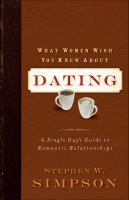
 Some months ago I saw What Women Wish You Knew About Dating: A Single Guy’s Guide to Romantic Relationships by Stephen W. Simpson mentioned on a couple of blogs with, if I remember correctly, the first chapter included on one. Having two sons of dating age and one approaching it in a few years, I thought this might be a good resource, so I wanted to check it out first.
I’m more conflicted about this book than any other in recent memory.
There is a lot I like about it. I agree with a lot of the actual dating advice: getting to know the other person in group situations before asking them out, tips for actually asking them plus suggestions for the first couple of dates, being a man rather than “a guy,” being assertive without being overbearing, taking the lead without being controlling, differences between being authentic (not putting on a false front to impress people) yet not being blunt, working on your life before asking anyone out, signals that she is not interested, understanding that no other person can take God’s place in your life and no one else is responsible for your self-esteem.
But I do have several problems with the book as well.
1. In a discussion of places to meet women and the advantages and disadvantages of each, bars are listed as a possibility. I don’t know why a Christian writer writing to Christians would even list bars and nightclubs: the author does discuss the potential problems of such a setting, and with all the caveats mentioned, any thinking young person would deduce that bars are not really options. To give the author the benefit of the doubt, perhaps that is exactly what he was trying to do: help the reader see the problems without outright saying, “DON’T go to these places,” knowing that that in itself would cause some to seek them out; or perhaps he was thinking of a wider audience who might already have some experience in such places, and he was trying to help them see they were the least attractive options. But I can just picture some people thinking that, because it is listed, and he didn’t say not to consider them, then they’re plausible options: He does say, “This is not to say that bars and nightclubs are evil (though some are close). You can have fun as long as you pay attention to the fun you’re having” (p. 87). As the daughter of an alcoholic and therefore, I am sad to admit, having spent some time in those places growing up, they are really no place for Christians.
2. Drinking alcohol is mentioned here and there as a natural thing that Christians might be doing. If you have a young person old enough to consider dating, you’ve probably already had discussions about your standards on this issue — if not, you should. But with this consideration and the first one, you’d really need to take into account how your young person might respond. (I’m thinking about another post with my own thoughts on this subject, but let me just say for now that though personally I don’t believe in social drinking, I don’t toss a book out just because it might be mentioned, but a book made up of advice for primarily young adults is one where I would be wary of the subject.)
3. I’ve lamented before that reverence seems to be a lost commodity in a lot of Christian literature. Jesus is a “friend who sticks closer than a brother” and was called “a friend of sinners,” but he’s not a buddy. There is a difference. But there is that overly-familiar, irreverent tone towards the Lord in the book, such as “God will never leave you. And He’s a great guy to have around” and our being “lucky to have Him around” (pp. 200-204). I don’t think we have to address Him as “Thou” and speak in King James English to and about him, but to hear the Creator, the Lord of glory being spoken of casually as “a great guy to have around” does just rub me the wrong way.
4. Simpson advocates waiting until the third date to kiss, and that’s with the understanding that the young man has gotten to know the young woman well before he even asked her out: he even advocates it because otherwise “she’ll think you don’t like her” (p. 158). He does advocate waiting until there is some level of commitment and avoiding physical contact on a casual date. Personally I would advocate waiting much longer for that kind of physical contact until there is much more of an understanding and commitment. He also “oks” brief hugs on the first date, but with the increased amount of body contact involved in hugging, I’d hold off on that, too. He also lists “cuddling while sitting up” as an “appropriate physical behavior” for those in “committed relationships” (p. 188). I would be very cautious about that, because, honestly, that’s where a lot of problems start. Parents need to have discussions on this topic with their young people, and seriously dating young people need to discuss it with each other, but one of the things we have told our boys is not to linger with a kiss or hug. Cuddling on the couch while watching a movie is inherently lingering and is especially dangerous if the couple is alone.
Then I have some other areas of disagreement though I wouldn’t call these major problems:
1. The overall tone of the book is more like an older friend or brother coming alongside and giving friendly advice rather than an authority figure giving lists of dos and don’ts, which I think would go over much better with the intended audience. Either the tone or the author’s personal style leans towards a casualness which overall is fine and fitting, (except in reference to God as mentioned above), but here and there it makes me wince, as when, in discussing several Biblical character’s accomplishments, he describes Paul’s trials as going “through a bunch of crap” (p. 37). (I’ve written before how I feel about that word.)
2. He lists as a “myth” the idea that God has one person picked out to be your spouse and that He will guide you to that person. I disagree that that’s a myth — I think God does guide us to the right person — but I do agree probably too many Christians take that to mean there will be some “sign” or that it won’t take personal effort on their part. I think it is like anything else in the Christian life — we don’t always know exactly what is “our part” and “His part,” but they work together: as we walk with Him each day, seeking His direction, He leads and guides, but it doesn’t mean we sit idly by. Dr. Bob Jones, Jr. used to say something like “God will help you with your responsibilities if you ask Him, but He’s not going to do your math homework for you.” He does guide and direct and help, but we have our responsibilities as well, and often He directs through what He guides and helps us to do.
3. For those who believe in courtship over dating, Simpson does not, so if you have strong views you’d want to preview his book before passing it on . I am not one who believes “courtship” is the only option for Christians, nevertheless I do share the concerns some of these folks have. For those who have no idea what I am talking about, there is a growing segment who believes that dating as we know it in this era is wrong for several reasons and that we need to go back to the practice of courtship, where young people don’t date widely and generally, but that a young man comes “calling” on a young lady when he is ready to pursue that relationship through to marriage (unless they discover along the way some reason not to marry), and the girl’s father has to give his permission for this step. There are various levels of belief in regard to courtship, some very rigid and extreme. Perhaps that would be a subject for another post, but the major point I disagreed with Simpson on was a quote from Henry Cloud and John Townsend in Boundaries In Dating that “fear of rejection has spawned the anti-dating movement in the church.” I don’t believe that was the primary factor, if it was a factor at all: rather, I believe it was concern that, 1) the date, form an exclusive relationship with, then break up cycle occurring over and over wasn’t good training for marriage; 2) that these young people who were going together were emotionally married even without being physically and financially married and this wasn’t healthy but rather too intense for this stage of their relationship; 3) that this kind of dating put more temptation and pressure on the young people to get involved physically.
Favorite quotes from the book:
“That’s why this poor girl whom I hardly knew was carrying the weight of my self-worth. It was never hers to bear in the first place” (p. 12, emphasis mine.) (That would solve so many problems if we would realize our self-worth isn’t any one else’s weight to bear.)
“When he’s competing, his goal is to challenge himself instead of humiliating others” (p. 29).
“Confidence is not being cocky and loud. It’s not a personality style. Confidence means trusting that you are God’s unique and important creation” (p. 28).
“You need a reason for getting out of bed in the morning other than finding Miss Right. You need to focus on Mr. Right Now” (p. 36).
“”Being yourself’ isn’t the same as hurling forth every thought without hitting the censor button. It means that you can express yourself while caring enough about someone not to offend them if you can avoid it” (p. 65).
In conclusion, if you have a young adult in your home or under your influence, and you’d like to give them a book about dating, or you are a young person interested in the subject, you would have to evaluate this book (and any other) in light of your beliefs and convictions. I am still undecided about whether to pass it on to my sons or not.
Related posts:
What women want…in a Christian man





 Stray Thoughts